REVIEW 4 major objections 4 minor 48 references
Adapting Lightweight Vision Language Models for Radiological Visual Question Answering
T0 review · 4 major / 4 minor · reviewed 2026-08-07 · deepseek-v4-flash
Pith's one-line read The paper claims that a compact 3B vision-language model, fine-tuned with curated synthetic data, can be competitive with much larger models on radiological visual question answering.
desk verdict The claimed 'competitive performance' is contradicted by the paper's own Table 1, and the appendix numbers don't line up—useful recipe and data, but not ready for peer review. read the letter →
The pith
A machine-rendered reading of the paper's core claim, the machinery that carries it, and where it could break.
The reading
What carries the argument
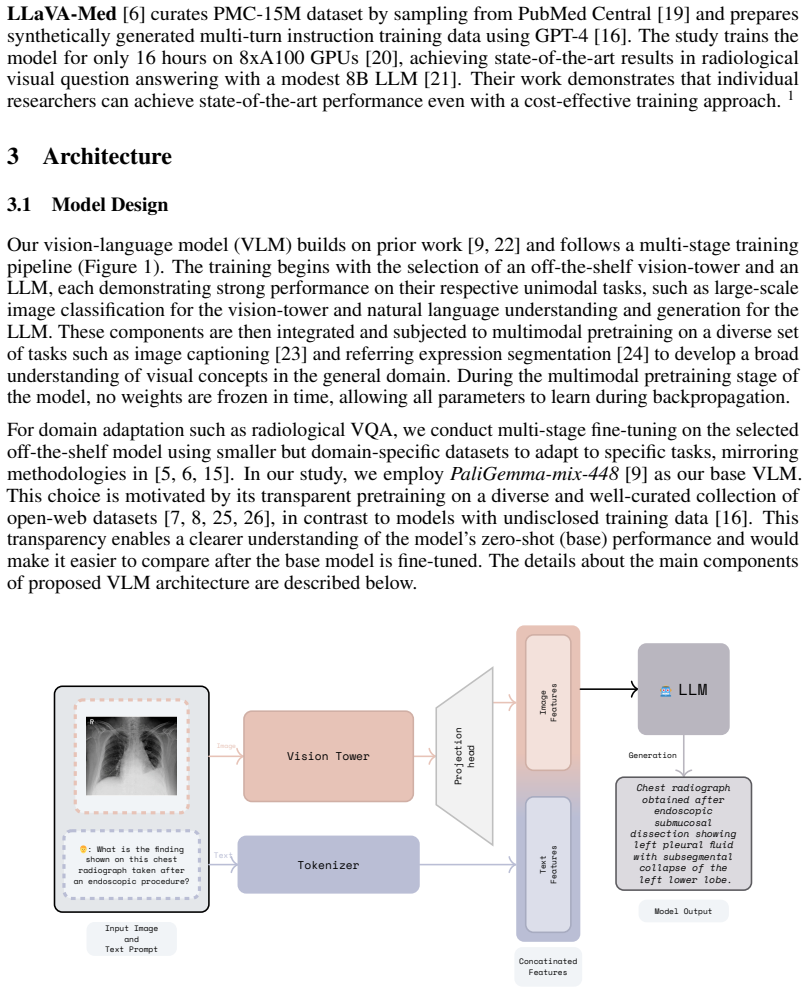
The load-bearing object is PaliGemma-mix-448, a 3B VLM that pairs a 400M-parameter SigLIP vision tower with a 2B Gemma language model through a single linear projection. The paper's training machinery has four parts: synthetic QA generation with LLaMA-8B from ROCO and MedPix captions; annealing, which repeatedly mixes in the smaller, higher-quality MedPix set to enrich the larger corpus; a first fine-tuning stage that trains only the projection head on SLAKE to align visual features with anatomical vocabulary; and a second stage that applies LoRA low-rank adapters to the vision and language attention heads. For evaluation, the machinery is a GPT-4 judge for open-ended answers plus raw and rollout attention maps used as a saliency diagnostic. The two-stage schedule and annealing together are what carry the claim that small models can be specialized cheaply.
What would settle it
Check the released ROCO-QA-Train and ROCO-QA test splits for overlapping images or captions; if a meaningful fraction of test items also appeared in the generated training set, re-score the model on a non-overlapping split and compare it again with LLaVA-Med under identical conditions. A large accuracy drop after removing overlap would show the reported gains came from memorization rather than radiological reasoning.
Extended reading notes
Core claim
The paper's central claim is that model scale is not the only route to radiological reasoning: a 3B PaliGemma-mix-448 VLM, adapted through a two-stage pipeline of projection-head alignment on SLAKE followed by LoRA fine-tuning on ROCO, MedPix, and PMC-VQA, achieves competitive accuracy on both open- and closed-ended radiology questions. The authors present this as a reassessment of scaling trends in medical VQA, arguing that small models with curated synthetic data can approach the behavior of much larger systems. They support the claim with accuracy comparisons against LLaVA-Med across four datasets, with the compact model reaching 79% on SLAKE closed-ended QA and 33-41% on the other benchmarks while LLaVA-Med scores 56-58% there. The paper also claims that its attention-rollout saliency tool can reveal whether the model is keying on clinically relevant image regions, framing interpretability as part of the evaluation, not an afterthought.
Load-bearing premise
The evaluation data are assumed to be independent of the data used to create the training question-answer pairs, but the paper does not describe train/test splits and the QA pairs were generated from the same caption corpora that later appear in evaluation.
Editorial extensions
If this is right
- If the central claim is right, a single NVIDIA H100 can produce a radiology VQA model in roughly three days, which makes model development feasible for teams without large GPU clusters.
- Synthetic question-answer pairs generated from captions, rather than expert-written questions, can provide enough supervision for domain adaptation, easing the data bottleneck.
- Two-stage fine-tuning with a frozen projection-head stage followed by LoRA gives faster convergence than single-stage tuning, so small models can be trained with fewer epochs.
- Attention-rollout saliency can be used to spot answers that are generated from irrelevant image regions, supplying a lightweight auditing step before a model is trusted on new cases.
Reading between the lines
- As an editorial check: because the QA pairs used for training were generated from the same ROCO and MedPix caption corpora used in evaluation, and the paper does not describe train/test splits, the reported accuracies could be inflated if any generated training pair overlaps a test sample; a held-out evaluation would settle this.
- The open-ended scores also depend on GPT-4 as the judge, so a judge that rewards fluent or verbose wording could raise accuracy beyond what strict factual matching would give; scoring the same generations on a factual entailment rubric would be a useful comparison.
- The recipe is largely model-agnostic, so the same data-generation, annealing, and two-stage fine-tuning pattern could be tested on other small VLMs or other imaging domains such as pathology, dermatology, or retinal imaging.
Editorial analysis
A structured set of objections, weighed in public.
Referee Report
Summary. The paper proposes a pipeline for adapting a 3B-parameter PaliGemma vision-language model to radiological visual question answering (VQA). The pipeline comprises synthetic QA generation from radiological captions (using LLaMA-8B), dataset annealing with MedPix, and two-stage fine-tuning (projection-head training on SLAKE followed by LoRA fine-tuning on ROCO, MedPix, and PMC-VQA). The authors report accuracy numbers on SLAKE, PMC-VQA, ROCO, and an annealed ROCO+MedPix set, and claim that this compact model achieves competitive performance approaching LLaVA-Med. They also introduce a saliency-based diagnostic tool for cross-modal interpretability and perform manual verification on organ-level pathologies.
Significance. If the reported results were reliable, the paper would make a modest but useful contribution: it demonstrates a compute-efficient recipe for specializing a small VLM to a medical domain and releases code and synthetic QA data. The proposed saliency tool is a practical addition, even if it is not deeply validated. However, the significance is substantially undercut by severe internal inconsistencies between the main tables and the appendix, an incompletely specified evaluation protocol, and an unvalidated GPT-4 judge. The headline claim of 'competitive performance' is not supported by the paper's own numbers, which show 15–25 percentage-point gaps against LLaVA-Med on the primary benchmarks.
major comments (4)
- [Table 1 vs. Appendix Tables 4 and 5] The accuracy numbers are inconsistent between the main text and the appendix for the same configurations. For example, ROCO+MedPix with Stage 1 fine-tuning is reported as 41.48±3.90 in Table 1 but only 74/200 = 37.0% in Table 5; SLAKE with Stage 1 is 79.00±2.75 in Table 1 but 0.26 (26%) in Table 5; and ROCO without Stage 1 is 32.25±3.60 in Table 1 but 63/200 = 31.5% in Table 4. These discrepancies are not minor rounding differences—they change the conclusions and make the reported results unreliable.
- [§5.3 and §4.2] The evaluation protocol does not specify how the test samples (reported as 'a sample of 200' in Table 1) are drawn, nor whether the evaluated instances are disjoint from the fine-tuning data. In §4.2, synthetic QA pairs are generated from ROCO and MedPix captions, the same corpora that are later used for fine-tuning (§5.1). Without explicit train/test splits, any overlap between the training data and the 200-item evaluation samples would inflate the reported accuracies. This issue must be clarified and resolved for the results to be interpretable.
- [§5.3 and Appendix Figure 10] The GPT-4 judge used for open-ended QA evaluation is not validated. The paper provides no evidence that GPT-4's binary factuality judgments agree with human expert assessments, and the supplied prompt in Figure 10 calls 'ollama.chat(model='gpt-4', ...)', which is not a valid OpenAI API interface and suggests the judge may not actually be GPT-4. The open-ended accuracy numbers (e.g., on ROCO and ROCO+MedPix) therefore cannot be trusted as measurements of factual correctness.
- [§1 and Table 1] The central claim that the 3B model 'can achieve competitive performance' and 'approaching the performance of much larger models like LLaVA-Med' is contradicted by the paper's own results. Table 1 shows gaps of 7.5 points on SLAKE, 25.3 points on PMC-VQA, 22.6 points on ROCO, and 15.2 points on ROCO+MedPix. These differences are several standard errors from the reported means, so the claim as stated is not supported by the data. The wording should be revised to reflect that the model is 'promising given its small size' rather than 'competitive' with LLaVA-Med.
minor comments (4)
- [§5.2, Eq. (1)] The scaling-law analysis around Equation (1) is presented without any fitted parameter values, goodness-of-fit measures, or statistical tests. The qualitative discussion of differing scaling exponents would be more convincing if the fitting procedure and uncertainties were reported.
- [Abstract and §1] The abstract contains a duplicated phrase 'evaluation evaluation efforts' and the introduction uses inconsistent spacing in 'LLaV A-Med'; these should be corrected.
- [§5.4] The manual verification in Table 2 is based on a single inference run per case, and the paper acknowledges that it was conducted without expert involvement. For a tool intended for expert use, some measure of inter-annotator reliability or a structured sampling procedure would strengthen the claim.
- [§3.1] The vision tower is described as having 'approximately 400M parameters' and later as 'pretrained with a sigmoid contrastive loss and comprising 400M parameters'; the repetition and inconsistent phrasing should be cleaned up.
Circularity Check
No circularity found: the paper is an empirical fine-tuning study whose only formal model, Eq. 1, is quoted from prior literature and is not used to predict any reported result.
full rationale
The paper does not contain a derivation chain whose outputs reduce to its inputs. Table 1 reports measured fine-tuning accuracies against LLaVA-Med, and the only formal expression, Eq. (1), is presented as an empirical loss model from prior scaling-law work; the authors state that scaling exponents differ by template type, but they do not fit Eq. (1) and use it to produce any accuracy reported in the paper. The QA pairs are generated from ROCO and MedPix captions and evaluation is conducted on the resulting ROCO and ROCO+MedPix sets, which creates a legitimate train/test contamination concern, and the 15–25 point gaps in Table 1 contradict the paper's 'competitive' claim; however, these are evaluation validity and correctness issues rather than circular reasoning by construction. There are no load-bearing self-citations, no imported uniqueness theorems, and no fitted parameters renamed as predictions, so the circularity score is 0.
Assumptions & free parameters
free parameters (5)
- grade penalty for non-robust predictions =
1 point
- evaluation sample size =
200
- number of stochastic generations =
5
- learning rate =
1e-5
- stage-1 epochs =
5
assumptions (4)
- domain assumption GPT-4 provides a valid 0/1 factual-correctness judgment for open-ended radiology answers.
- ad hoc to paper Synthetic QA pairs generated by LLaMA-8B from image captions are clinically relevant and correctly formatted after manual filtering.
- domain assumption PaliGemma-mix-448 is a representative off-the-shelf 3B VLM whose base capabilities are well understood.
- domain assumption ROCO v2.0 and MedPix v2.0 are suitable proxies for radiological VQA and their captions accurately describe images.
Cite this review
Pith. "Pith review of Adapting Lightweight Vision Language Models for Radiological Visual Question Answering." pith.science (2026). https://pith.science/paper/HXTWSBGK
@misc{pith2026250614451,
  author       = {Pith},
  title        = {Pith review of: Adapting Lightweight Vision Language Models for Radiological Visual Question Answering},
  year         = {2026},
  howpublished = {\url{https://pith.science/paper/HXTWSBGK}},
  note         = {Machine review of arXiv:2506.14451}
}
read the original abstract
Recent advancements in vision-language systems have improved the accuracy of Radiological Visual Question Answering (VQA) Models. However, some challenges remain across each stage of model development: limited expert-labeled images hinders data procurement at scale; the intricate and nuanced patterns of radiological images make modeling inherently difficult; and the lack of evaluation evaluation efforts makes it difficult to identify cases where the model might be ill-conditioned. In this study, we fine-tune a lightweight 3B parameter vision-language model for Radiological VQA, demonstrating that small models, when appropriately tuned with curated data, can achieve robust performance across both open- and closed-ended questions. We propose a cost-effective training pipeline from synthetic question-answer pair generation to multi-stage fine-tuning on specialised radiological domain-targeted datasets (e.g., ROCO v2.0, MedPix v2.0). Our results show that despite operating at a fraction of the scale of state-of-the-art models such as LLaVA-Med, our model achieves promising performance given its small parameter size and the limited scale of training data. We introduce a lightweight saliency-based diagnostic tool that enables domain experts to inspect VQA model performance and identify ill-conditioned failure modes through saliency analysis.
Figures


Figures from the paper (10 more)


Reference graph
Works this paper leans on
-
[1]
Ai agriculture: Boost yields with yolo11
Haziqa Sajid. Ai agriculture: Boost yields with yolo11. https://www.ultralytics.com/ blog/the-changing-landscape-of-ai-in-agriculture , 2024. Accessed: 2025-04-30
work page 2024
-
[2]
Video alarms for 24/7 security & monitoring
Verkada Inc. Video alarms for 24/7 security & monitoring. https://www.verkada.com/ alarms/video-alarms/. Accessed: 2025-04-30
work page 2025
-
[3]
Vir Chau Markus Zhang. Babydoctor. https://github.com/photomz/BabyDoctor, 2023. GitHub
work page 2023
-
[4]
Tom van Sonsbeek, Mohammad Mahdi Derakhshani, Ivona Najdenkoska, Cees G. M. Snoek, and Marcel Worring. Open-ended medical visual question answering through prefix tuning of language models, 2023. URL https://arxiv.org/abs/2303.05977
arXiv 2023
-
[5]
Large language models encode clinical knowledge
Karan Singhal, Shekoofeh Azizi, Tomas Tu, et al. Large language models encode clinical knowledge. Nature, 620:172–180, 2023. doi: 10.1038/s41586-023-06291-2. URL https: //doi.org/10.1038/s41586-023-06291-2
-
[6]
Llava-med: Training a large language-and-vision assistant for biomedicine in one day, 2023
Chunyuan Li, Cliff Wong, Sheng Zhang, Naoto Usuyama, Haotian Liu, Jianwei Yang, Tristan Naumann, Hoifung Poon, and Jianfeng Gao. Llava-med: Training a large language-and-vision assistant for biomedicine in one day, 2023. URL https://arxiv.org/abs/2306.00890
arXiv 2023
-
[7]
All you may need for VQA are image captions
Soravit Changpinyo, Doron Kukliansy, Idan Szpektor, Xi Chen, Nan Ding, and Radu Soricut. All you may need for VQA are image captions. In Marine Carpuat, Marie- Catherine de Marneffe, and Ivan Vladimir Meza Ruiz, editors, Proceedings of the 2022 Conference of the North American Chapter of the Association for Computational Linguistics: Human Language Techno...
-
[8]
Pre-training image-language transform- ers for open-vocabulary tasks, 2022
AJ Piergiovanni, Weicheng Kuo, and Anelia Angelova. Pre-training image-language transform- ers for open-vocabulary tasks, 2022. URL https://arxiv.org/abs/2209.04372
arXiv 2022
Show all 48 references
-
[9]
PaliGemma: A versatile 3B VLM for transfer
Lucas Beyer*, Andreas Steiner*, André Susano Pinto*, Alexander Kolesnikov*, Xiao Wang*, Daniel Salz, Maxim Neumann, Ibrahim Alabdulmohsin, Michael Tschannen, Emanuele Bugliarello, Thomas Unterthiner, Daniel Keysers, Skanda Koppula, Fangyu Liu, Adam Grycner, Alexey Gritsenko, N...
2024 arXiv
-
[10]
Hu, Yelong Shen, Phillip Wallis, Zeyuan Allen-Zhu, Yuanzhi Li, Shean Wang, Lu Wang, and Weizhu Chen
Edward J. Hu, Yelong Shen, Phillip Wallis, Zeyuan Allen-Zhu, Yuanzhi Li, Shean Wang, Lu Wang, and Weizhu Chen. Lora: Low-rank adaptation of large language models, 2021. URL https://arxiv.org/abs/2106.09685
2021 arXiv
-
[11]
Slake: A semantically- labeled knowledge-enhanced dataset for medical visual question answering, 2021
Bo Liu, Li-Ming Zhan, Li Xu, Lin Ma, Yan Yang, and Xiao-Ming Wu. Slake: A semantically- labeled knowledge-enhanced dataset for medical visual question answering, 2021. URL https: //arxiv.org/abs/2102.09542
2021 arXiv
-
[12]
Pmc-vqa dataset, 2023
Xiaoman Zhang et al. Pmc-vqa dataset, 2023. URL https://huggingface.co/datasets/ xmcmic/PMC-VQA. Accessed: 2025-02-08
2023
-
[13]
Friedrich
Obioma Pelka, Sven Koitka, Johannes Rückert, Felix Nensa, and Christoph M. Friedrich. Ra- diology objects in context (roco): A multimodal image dataset. Technical report, University of Applied Sciences and Arts Dortmund, TU Dortmund University, University of Duisburg- Essen, 2...
2018
-
[14]
Medpix 2.0: A comprehensive multimodal biomedical dataset for advanced ai applications,
Irene Siragusa, Salvatore Contino, Massimo La Ciura, Rosario Alicata, and Roberto Pirrone. Medpix 2.0: A comprehensive multimodal biomedical dataset for advanced ai applications,
-
[15]
Pmc-vqa: Visual instruction tuning for medical visual question answering, 2024
Xiaoman Zhang, Chaoyi Wu, Ziheng Zhao, Weixiong Lin, Ya Zhang, Yanfeng Wang, and Weidi Xie. Pmc-vqa: Visual instruction tuning for medical visual question answering, 2024. URL https://arxiv.org/abs/2305.10415
2024 arXiv
-
[16]
ChatGPT: A Large Language Model
OpenAI. ChatGPT: A Large Language Model. Online, 2024. Available at: https://openai. com/chatgpt [Accessed YEAR MONTH DAY]
2024
-
[17]
Healthsearchqa
katielink. Healthsearchqa. https://huggingface.co/datasets/katielink/ healthsearchqa, 2023. Accessed: 2025-05-01
2023
-
[18]
Chi, Jeff Dean, Jacob Devlin, Adam Roberts, Denny Zhou, Quoc V
Hyung Won Chung, Le Hou, Shayne Longpre, Barret Zoph, Yi Tay, William Fedus, Eric Li, Xuezhi Wang, Mostafa Dehghani, Siddhartha Brahma, Albert Webson, Shixiang Shane Gu, Zhuyun Dai, Mirac Suzgun, Xinyun Chen, Aakanksha Chowdhery, Sharan Narang, Gaurav Mishra, Adams Yu, Vincent...
2022 arXiv
-
[19]
PubMed Central (PMC), 2024
National Library of Medicine. PubMed Central (PMC), 2024. URL https://www.ncbi.nlm. nih.gov/pmc/. Accessed: 2024-02-08
2024
-
[20]
Nvidia a100 tensor core gpu, 2020
NVIDIA Corporation. Nvidia a100 tensor core gpu, 2020. URL https://www.nvidia.com/ en-us/data-center/a100/. Accessed: 2025-03-30
2020
-
[21]
Llama: Open and efficient foundation language models, 2023
Hugo Touvron, Thibaut Lavril, Gautier Izacard, Xavier Martinet, Marie-Anne Lachaux, Timo- thée Lacroix, Baptiste Rozière, Naman Goyal, Eric Hambro, Faisal Azhar, Aurelien Rodriguez, Armand Joulin, Edouard Grave, and Guillaume Lample. Llama: Open and efficient foundation langua...
2023 arXiv
-
[22]
Hewett, Jamie Huynh, Mojan Javaheripi, Xin Jin, Piero Kauffmann, Nikos Karampatziakis, Dongwoo Kim, Mahmoud Khademi, Lev Kurilenko, James R
Marah I Abdin, Sam Ade Jacobs, Ammar Ahmad Awan, Jyoti Aneja, Ahmed Awadallah, Hany Hassan Awadalla, Nguyen Bach, Amit Bahree, Arash Bakhtiari, Harkirat Behl, Alon Benhaim, Misha Bilenko, Johan Bjorck, Sébastien Bubeck, Martin Cai, Caio César Teodoro Mendes, Weizhu Chen, Vishr...
2024
-
[23]
Show and tell: A neural image caption generator
Oriol Vinyals, Alexander Toshev, Samy Bengio, and Dumitru Erhan. Show and tell: A neural image caption generator. InProceedings of the IEEE conference on computer vision and pattern recognition (CVPR), 2015
2015
-
[24]
Referitgame: Referring to objects in photographs of natural scenes
Sahar Kazemzadeh, Vicente Ordonez, Mark Matten, and Tamara L Berg. Referitgame: Referring to objects in photographs of natural scenes. In EMNLP, 2014
2014
-
[25]
Conceptual captions: A cleaned, hypernymed, image alt-text dataset for automatic image captioning
Piyush Sharma, Nan Ding, Sebastian Goodman, and Radu Soricut. Conceptual captions: A cleaned, hypernymed, image alt-text dataset for automatic image captioning. In Iryna Gurevych and Yusuke Miyao, editors, Proceedings of the 56th Annual Meeting of the Association for Computati...
2018 doi
-
[26]
Wit: Wikipedia-based image text dataset for multimodal multilingual machine learning
Krishna Srinivasan, Karthik Raman, Jiecao Chen, Michael Bendersky, and Marc Najork. Wit: Wikipedia-based image text dataset for multimodal multilingual machine learning. In Proceedings of the 44th International ACM SIGIR Conference on Research and Development in Information Re...
2021
-
[27]
Sigmoid loss for language image pre-training, 2023
Xiaohua Zhai, Basil Mustafa, Alexander Kolesnikov, and Lucas Beyer. Sigmoid loss for language image pre-training, 2023. URL https://arxiv.org/abs/2303.15343
2023 arXiv
-
[28]
Sentencepiece: A simple and language independent subword tokenizer and detokenizer for neural text processing, 2018
Taku Kudo and John Richardson. Sentencepiece: A simple and language independent subword tokenizer and detokenizer for neural text processing, 2018. URL https://arxiv.org/abs/ 1808.06226
2018 arXiv
-
[29]
Gemma Team, Morgane Riviere, Shreya Pathak, Pier Giuseppe Sessa, Cassidy Hardin, Surya Bhupatiraju, Léonard Hussenot, Thomas Mesnard, Bobak Shahriari, Alexandre Ramé, Johan Ferret, Peter Liu, Pouya Tafti, Abe Friesen, Michelle Casbon, Sabela Ramos, Ravin Kumar, Charline Le Lan...
2024 arXiv
-
[30]
Arnab Kumar Mondal, Arnab Bhattacharjee, Parag Singla, and A. P. Prathosh. xvitcos: Ex- plainable vision transformer based covid-19 screening using radiography. IEEE Journal of Translational Engineering in Health and Medicine, 10:1–10, 2022. ISSN 2168-2372. doi: 10.1109/JTEHM....
2022
-
[31]
Lvlm-interpret: An interpretability tool for large vision-language models, 2024
Gabriela Ben Melech Stan, Estelle Aflalo, Raanan Yehezkel Rohekar, Anahita Bhiwandiwalla, Shao-Yen Tseng, Matthew Lyle Olson, Yaniv Gurwicz, Chenfei Wu, Nan Duan, and Vasudev Lal. Lvlm-interpret: An interpretability tool for large vision-language models, 2024. URL https://arxi...
2024 arXiv
-
[32]
Searching for unintended biases with saliency
Astrid Bertrand, Adam Pearce, and Nithum Thain. Searching for unintended biases with saliency. PAIR Explorables, 2022. https://pair.withgoogle.com/explorables/saliency/. 13
2022
-
[33]
Gomez, Lukasz Kaiser, and Illia Polosukhin
Ashish Vaswani, Noam Shazeer, Niki Parmar, Jakob Uszkoreit, Llion Jones, Aidan N. Gomez, Lukasz Kaiser, and Illia Polosukhin. Attention is all you need, 2023. URL https://arxiv. org/abs/1706.03762
2023 arXiv
-
[34]
Transformer interpretability beyond attention visualization
Hila Chefer, Shir Gur, and Lior Wolf. Transformer interpretability beyond attention visualization. In 2021 IEEE/CVF Conference on Computer Vision and Pattern Recognition (CVPR), pages 782–791, June 2021. doi: 10.1109/CVPR46437.2021.00084
2021
-
[35]
Explainability for vision transformers
Jacob Gildenblat. Explainability for vision transformers. https://github.com/jacobgil/ vit-explain, 2021. Accessed: 2025-02-03
2021
-
[36]
MedPix: Free Online Medical Image Database
National Library of Medicine. MedPix: Free Online Medical Image Database. Online, 2024. Available at: https://medpix.nlm.nih.gov/home [Accessed YEAR MONTH DAY]
2024
-
[37]
Lin et al
W. Lin et al. Pmc-clip: Contrastive language-image pre-training using biomedical documents. In H. Greenspan, editor,Medical Image Computing and Computer Assisted Intervention, pages 525–536. Springer, 2023
2023
-
[38]
Chatgpt asks, blip-2 answers: Automatic questioning towards enriched visual descriptions, 2023
Deyao Zhu, Jun Chen, Kilichbek Haydarov, Xiaoqian Shen, Wenxuan Zhang, and Mohamed Elhoseiny. Chatgpt asks, blip-2 answers: Automatic questioning towards enriched visual descriptions, 2023. URL https://arxiv.org/abs/2303.06594
2023 arXiv
-
[39]
Language models are few-shot learners
Tom B Brown, Ben Mann, Nick Ryder, Melvin Subbiah, Jared Kaplan, Prafulla Dhariwal, Arvind Neelakantan, Nicholas Shinn, Donald Ziegler, Jeffrey Wu, et al. Language models are few-shot learners. arXiv preprint arXiv:2005.14165, 2020
2005 arXiv
-
[40]
Training verifiers to solve math word problems
Karl Cobbe, Vineet Kosaraju, Mohammad Bavarian, Mark Chen, Heewoo Jun, Lukasz Kaiser, Matthias Plappert, Jerry Tworek, Jacob Hilton, Reiichiro Nakano, Christopher Hesse, and John Schulman. Training verifiers to solve math word problems. arXiv preprint arXiv:2110.14168, 2021
-
[41]
Measuring mathematical problem solving with the math dataset
Dan Hendrycks, Collin Burns, Saurav Kadavath, Akul Arora, Steven Basart, Eric Tang, Dawn Song, and Jacob Steinhardt. Measuring mathematical problem solving with the math dataset. NeurIPS, 2021
2021
-
[42]
Curriculum learning for data-efficient vision-language alignment, 2022
Tejas Srinivasan, Xiang Ren, and Jesse Thomason. Curriculum learning for data-efficient vision-language alignment, 2022. URL https://arxiv.org/abs/2207.14525
2022 arXiv
-
[43]
PMC Open Access Subset
National Library of Medicine. PMC Open Access Subset. Online, 2003. Bethesda (MD): National Library of Medicine. [cited YEAR MONTH DAY]. Available from:https://pmc. ncbi.nlm.nih.gov/tools/openftlist/
2003
-
[44]
When scaling meets llm finetuning: The effect of data, model and finetuning method
Biao Zhang, Zhongtao Liu, Colin Cherry, and Orhan Firat. When scaling meets llm finetuning: The effect of data, model and finetuning method. InProceedings of the International Conference on Learning Representations (ICLR), 2024. URL https://openreview.net/forum?id= 5HCnKDeTws
2024
-
[45]
Alistair E. W. Johnson, Tom J. Pollard, Nathaniel R. Greenbaum, Matthew P. Lungren, Chih ying Deng, Yifan Peng, Zhiyong Lu, Roger G. Mark, Seth J. Berkowitz, and Steven Horng. Mimic-cxr-jpg, a large publicly available database of labeled chest radiographs, 2019. URL https://ar...
2019 arXiv
-
[46]
Bleu: A method for auto- matic evaluation of machine translation
Kishore Papineni, Salim Roukos, Todd Ward, and Wei-Jing Zhu. Bleu: A method for auto- matic evaluation of machine translation. In Proceedings of the 40th Annual Meeting of the Association for Computational Linguistics, pages 311–318. Association for Computational Linguistics, ...
2002
-
[47]
"" Figure 9: Generate Literature Based Questions Prompt B Evaluation and Saliency Diagnostics def evaluate_generation(generation,ground): prompt = f
Chin-Yew Lin. ROUGE: A package for automatic evaluation of summaries. In Text Summarization Branches Out, pages 74–81, Barcelona, Spain, July 2004. Association for Computational Linguistics. URL https://www.aclweb.org/anthology/W04-1013. 14 Appendix A Generating Question Answe...
2004
-
[2024]
URL https://arxiv.org/abs/2407.02994. 11
Reviewed August 7, 2026 · model on record in the stance chip above.
Discussion (0). Sign in to comment.