REVIEW 3 major objections 8 minor 50 references
Foundation Model Insights and a Multi-Model Approach for Superior Fine-Grained One-shot Subset Selection
T0 review · 3 major / 8 minor · reviewed 2026-08-07 · deepseek-v4-flash
Pith's one-line read Foundation models can replace dataset-trained extractors in one-shot subset selection, and a CLIP+DINOv2 score beats all twelve baselines on fine-grained benchmarks.
desk verdict A practical FM-based subset selection method with honest observations, but the FM-vs-traditional comparison and the Pet headline numbers both rest on choices that need one more experiment. read the letter →
The pith
A machine-rendered reading of the paper's core claim, the machinery that carries it, and where it could break.
The reading
What carries the argument
The mechanism is the score rule $\mathrm{Score} = W_1 R + W_2(1-\varphi)$, built from two per-sample metrics computed separately in each foundation model's feature space. RAM ('ranking mean') computes the Euclidean distance of each sample to its class-mean feature, ranks samples within the class, and averages the normalized ranks across all foundation models, so a low value means the sample is close to the class prototype in every model's view. APL ('accuracy of pseudo-class labels') assigns each sample the class label of its nearest class-mean feature in each model's space, then averages the indicator that this pseudo-label equals the true label; $1-\varphi$ is high for samples that different models keep confusing with other classes. The weights follow a logistic schedule in the sampling rate $p$: $W_1 = \alpha + (1-\alpha)/(1+e^{\beta(p-0.5)})$ and $W_2 = 1-W_1$, with $\alpha=0.2$ and $\beta=1$, so $W_1$ stays above $W_2$ for all tested sampling rates while the inter-class term gains influence as $p$ grows. The method selects the smallest-score samples up to the budget.
What would settle it
Rerun the Single-Model Study with a traditional extractor trained to convergence (for example, the same ResNet backbone trained on the target set for 90 epochs instead of 10) and compare MIN, KCG, GC, and MDS selections at 10%, 30%, and 50% sampling rates on Pet and CUB; if the fully trained extractor matches or beats CLIP and DINOv2 in the accuracy of models trained on the selected subsets, Observation 2 is falsified.
Extended reading notes
Core claim
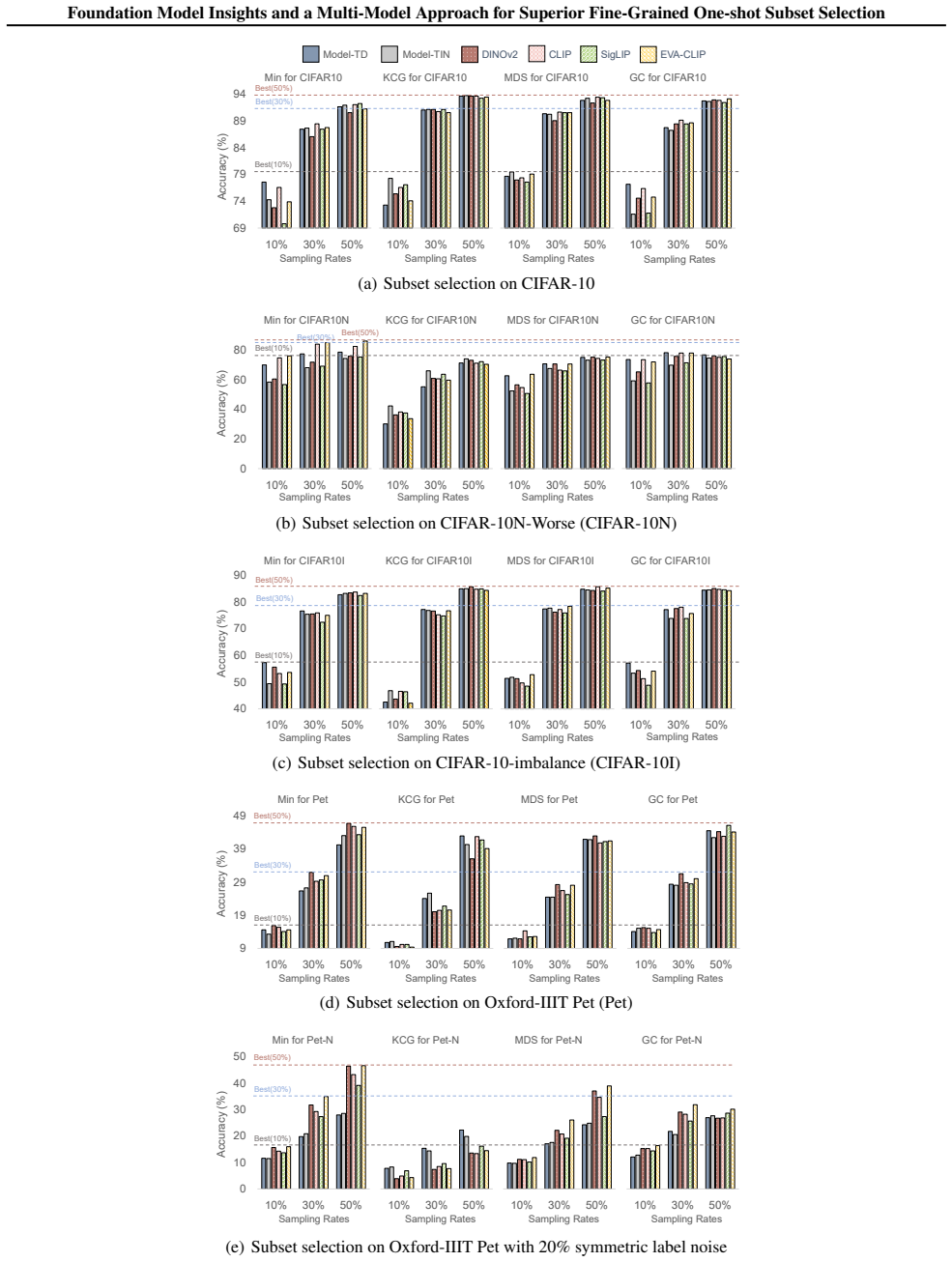
The central claim is that a foundation model used as a frozen feature extractor is a better information extractor for one-shot subset selection on fine-grained image datasets than a small model pre-trained on the target training set for ten epochs, and that this advantage is task-dependent: it holds on fine-grained datasets with clean or noisy labels but mostly vanishes on coarse-grained datasets with noisy labels. A second claim is that no single foundation model is always the best extractor; the best FM varies with the dataset, the sampling rate, and the selection algorithm, so the paper's method avoids choosing one. RAM-APL therefore uses two foundation models, CLIP and DINOv2, and converts their unaligned features into two comparable signals per sample: the average rank of the sample's distance to its class-mean feature across models, and the fraction of models whose nearest-class-center pseudo-label matches the ground truth. The final score is $W_1 R + W_2(1-\varphi)$ with weights that keep the intra-class ranking dominant at all sampling rates while letting the inter-class term grow as the budget increases. On Pet, Food-101, and CUB the paper reports that this score selects subsets whose trained models reach state-of-the-art accuracy at every tested sampling rate.
Load-bearing premise
The load-bearing premise is that a model pre-trained on the target training set for just ten epochs adequately represents what traditional information extractors achieve, because several published extractors are trained far longer (the paper itself notes one baseline needing 90 epochs on ImageNet-1K); if a fully converged traditional extractor closed the gap with foundation models, the claimed FM advantage on fine-grained datasets would weaken.
Editorial extensions
If this is right
- If the finding holds, one-shot subset selection can drop the target-dataset pre-training step entirely, since frozen CLIP and DINOv2 features replace the traditional extractor.
- Because RAM-APL beats every single foundation model in its own experiments, practitioners no longer need to search for the best extractor; the multi-model consensus score is the default.
- The reported average gains over Random, 3.74 points on Pet, 4.44 on Food-101, and 6.40 on CUB, imply the largest benefits on fine-grained recognition tasks with many visually similar classes.
- Cross-architecture results on Pet show subsets chosen with CLIP+DINOv2 improve a MobileNet-V3 target model as well as a ResNet target, so the selected data are not tied to one architecture.
- The method is not a universal fix: on coarse-grained datasets with noisy labels the FM advantage diminishes, so the engineering recommendation is to apply it where inter-class differences are subtle.
Reading between the lines
- Because RAM and APL need only class-mean features and nearest-center pseudo-labels, the same score could in principle be computed without any ground-truth labels by using pseudo-labels as the target; the paper does not test this, but it suggests a path to subset selection in unlabeled or weakly labeled pools.
- The two signals decompose data difficulty in a testable way: RAM measures within-class representativeness and APL measures cross-class confusability, so one could predict that RAM-APL's advantage grows as class boundaries become visually subtler and shrinks as classes become easy to separate.
- Given the near-zero cosine similarity between features of different foundation models reported in the paper, adding a third model should help only if it supplies a genuinely new visual bias; otherwise multi-model gains should saturate.
- The paper's noisy fine-grained results, including Pet with 20% and 40% label noise, suggest ranking-based selection is robust to label noise when classes are fine-grained, which could be tested directly on other noisy fine-grained benchmarks.
Editorial analysis
A structured set of objections, weighed in public.
Referee Report
Summary. The paper studies one-shot subset selection for image classification, asking whether foundation models (FMs) can replace traditional information extractors (IEs) and whether all FMs perform equally. It reports that FMs consistently outperform traditional IEs on fine-grained datasets, while their advantage is limited on coarse-grained noisy datasets. Motivated by these observations, the authors propose RAM-APL, which fuses multiple FMs by combining a within-class distance ranking mean (RAM) and a pseudo-class label accuracy score (APL) into a weighted selection score. The method is evaluated on Oxford-IIIT Pet, Food-101, and CUB-200-2011, where it is reported to outperform 12 baselines at all tested sampling rates, with average gains over Random of 3.74%, 4.44%, and 6.40% respectively.
Significance. If the results hold, the paper offers a practical, dataset-agnostic alternative to traditional IEs for fine-grained subset selection and provides a useful empirical mapping of when FMs help. The paper ships its code, uses multiple datasets and seeds, and includes cross-architecture and ablation experiments. The main claims, however, rest on a comparison protocol whose fairness and statistical reliability need to be established before the SOTA and FM-dominance conclusions can be accepted.
major comments (3)
- [Section 6.1 and Appendix A.1] The comparison with traditional information extractors uses IEs trained for only 10 epochs on the target dataset. This is explicitly stated for baselines (2)-(12) in Section 6.1 and for model-TD in Appendix A.1. For training-dynamics methods such as Forgetting and GraNd, 10 epochs is too short to obtain reliable dynamics, and the paper itself notes in Section 2 that TDDS uses 90 epochs on ImageNet-1K. The independent variable (IE type) is therefore confounded with training budget, and the claim that 'FMs consistently outperform traditional IEs' (Observation 2) and the SOTA claims in Tables 8-10 are not yet supported against properly converged traditional IEs. I request additional experiments with traditional IEs trained to convergence (or at least to a comparable budget) to confirm that the FM advantage persists.
- [Section 6.2 and Section 6.4] The hyperparameters α=0.2, β=1 and the FM pair {CLIP, DINOv2} are selected using the Pet dataset (Figure 4, Table 2) and then applied to Food-101 and CUB. This makes the reported gains on the other two datasets a form of tuning-on-one-dataset evaluation rather than independent predictions. I acknowledge that the hyperparameters are few and the method is conceptually generic, but the selection of the FM pair is a dataset-dependent design choice that should be treated as a validation process. The authors should either report results with per-dataset validation, show robustness to a small grid of hyperparameters on all datasets, or clearly state that the reported cross-dataset numbers are the result of transferring configuration chosen on Pet and therefore carry a selection bias.
- [Tables 8-10, Section 6.2] The claim that RAM-APL 'outperforms all baselines at each sampling rate' is not supported by the reported variance at several points. For example, in Table 10 at the 30% sampling rate, RAM-APL reports 42.6±3.1, while GC reports 36.1±10.4 and Cal reports 32.7±4.5; these confidence intervals overlap substantially. The averaged improvement over Random of 6.40% on CUB is heavily influenced by this high-variance point. The paper should report significance tests or at least a discussion of which differences are reliable, given the small number of seeds (three for Food-101 and CUB). Without this, the 'superior' in the title and contributions is stronger than the evidence supports.
minor comments (8)
- [Section 4 (Experimental Setting)] The main text states that the single-model study is conducted on five datasets, while Appendix A describes results on nine datasets; please reconcile this discrepancy.
- [Section 5.2, Equation (1)] The symbol S is used both for the subset selected by the algorithm and for the index set of a class, which is confusing; please rename one of them.
- [Section 5.2, Equations (3) and (7)] Equation (3) defines Rc for a class, but Equation (7) uses R without a class index; please clarify that R denotes the vector obtained by concatenating ranking means over all classes.
- [Section 6.2] There is a missing space in 'β = 1for our method'; please correct the typo.
- [Section 6.4 and Table 2] The caption of Table 2 defines D, C, S, E but the table uses bullet symbols; please make the legend self-contained or move it into the caption text.
- [Appendix A.1] The model name 'SigLIP-base-patch16-22' appears to be a typo for 'patch16-224'; please verify.
- [Section 5 (overall)] The claim of being 'the first to investigate selection with multiple foundation models' is strong; please soften it or cite related ensemble-based selection work to avoid overclaiming.
- [Section 4, Figure 1(c)] The 'frequency of being the best IE' metric is a coarse categorical count; it would be informative to also report the average accuracy gap between the best FM and the best traditional IE to quantify the magnitude of the claimed advantage.
Circularity Check
No significant circularity: the RAM-APL selection score is built from training-set features and labels, while the reported accuracies come from independently trained target models.
full rationale
The paper's central selection rule, Score = W1*R + W2*(1-phi), is computed entirely from training-set features, class centers, and pseudo-class agreement; it is not fitted to, or algebraically equivalent to, the target model's test accuracy. The claimed improvements are obtained by training a ResNet on the selected subset and measuring its test accuracy, which is an independent evaluation step. The only mild concerns are hyperparameter and FM-pair selection on Pet before reporting Pet results, and the 10-epoch training of traditional information-extractor baselines. These are benchmark-tuning and experimental-validity issues, not circular derivations: neither the Score equation nor Observation 2 reduces to its own inputs by construction. Self-citations appear only as background and do not supply a load-bearing uniqueness theorem or ansatz. Therefore no circular step meets the evidentiary bar of Eq. X = Eq. Y by construction or a fitted parameter renamed as a prediction.
Assumptions & free parameters
free parameters (2)
- Fusion weight parameters alpha and beta =
alpha=0.2, beta=1
- Foundation model pair for the extractor =
CLIP-VITl14 + DINOv2-VITs14
assumptions (5)
- ad hoc to paper A 10-epoch pre-trained model is an adequate representative of traditional information extractors.
- domain assumption Training labels are correct and available for class centers and pseudo-label scoring.
- domain assumption Euclidean distance to the class-mean feature is a valid measure of sample representativeness.
- ad hoc to paper Normalized per-model distance rankings can be averaged across foundation models.
- domain assumption Class-balanced sampling is used and is appropriate for the evaluation.
Cite this review
Pith. "Pith review of Foundation Model Insights and a Multi-Model Approach for Superior Fine-Grained One-shot Subset Selection." pith.science (2026). https://pith.science/paper/JIY7TCC4
@misc{pith2026250614473,
  author       = {Pith},
  title        = {Pith review of: Foundation Model Insights and a Multi-Model Approach for Superior Fine-Grained One-shot Subset Selection},
  year         = {2026},
  howpublished = {\url{https://pith.science/paper/JIY7TCC4}},
  note         = {Machine review of arXiv:2506.14473}
}
read the original abstract
One-shot subset selection serves as an effective tool to reduce deep learning training costs by identifying an informative data subset based on the information extracted by an information extractor (IE). Traditional IEs, typically pre-trained on the target dataset, are inherently dataset-dependent. Foundation models (FMs) offer a promising alternative, potentially mitigating this limitation. This work investigates two key questions: (1) Can FM-based subset selection outperform traditional IE-based methods across diverse datasets? (2) Do all FMs perform equally well as IEs for subset selection? Extensive experiments uncovered surprising insights: FMs consistently outperform traditional IEs on fine-grained datasets, whereas their advantage diminishes on coarse-grained datasets with noisy labels. Motivated by these finding, we propose RAM-APL (RAnking Mean-Accuracy of Pseudo-class Labels), a method tailored for fine-grained image datasets. RAM-APL leverages multiple FMs to enhance subset selection by exploiting their complementary strengths. Our approach achieves state-of-the-art performance on fine-grained datasets, including Oxford-IIIT Pet, Food-101, and Caltech-UCSD Birds-200-2011.
Figures


Figures from the paper (7 more)




Reference graph
Works this paper leans on
-
[1]
Contextual diversity for active learning
Agarwal, S., Arora, H., Anand, S., and Arora, C. Contextual diversity for active learning. In Computer Vision--ECCV 2020: 16th European Conference, Glasgow, UK, August 23--28, 2020, Proceedings, Part XVI 16, pp.\ 137--153. Springer, 2020
work page 2020
-
[2]
Food-101--mining discriminative components with random forests
Bossard, L., Guillaumin, M., and Van Gool, L. Food-101--mining discriminative components with random forests. In Computer vision--ECCV 2014: 13th European conference, zurich, Switzerland, September 6-12, 2014, proceedings, part VI 13, pp.\ 446--461. Springer, 2014
work page 2014
-
[3]
Emerging properties in self-supervised vision transformers
Caron, M., Touvron, H., Misra, I., J \'e gou, H., Mairal, J., Bojanowski, P., and Joulin, A. Emerging properties in self-supervised vision transformers. In Proceedings of the IEEE/CVF international conference on computer vision, pp.\ 9650--9660, 2021
2021
-
[4]
Selection via proxy: Efficient data selection for deep learning
Coleman, C., Yeh, C., Mussmann, S., Mirzasoleiman, B., Bailis, P., Liang, P., Leskovec, J., and Zaharia, M. Selection via proxy: Efficient data selection for deep learning. arXiv preprint arXiv:1906.11829, 2019
arXiv 1906
-
[5]
Class-balanced loss based on effective number of samples
Cui, Y., Jia, M., Lin, T.-Y., Song, Y., and Belongie, S. Class-balanced loss based on effective number of samples. In Proceedings of the IEEE/CVF Conference on Computer Vision and Pattern Recognition, pp.\ 9268--9277, 2019
2019
-
[6]
Imagenet: A large-scale hierarchical image database
Deng, J., Dong, W., Socher, R., Li, L.-J., Li, K., and Fei-Fei, L. Imagenet: A large-scale hierarchical image database. In 2009 IEEE conference on computer vision and pattern recognition, pp.\ 248--255. IEEE, 2009
work page 2009
-
[7]
Parameter-efficient fine-tuning of large-scale pre-trained language models
Ding, N., Qin, Y., Yang, G., Wei, F., Yang, Z., Su, Y., Hu, S., Chen, Y., Chan, C.-M., Chen, W., et al. Parameter-efficient fine-tuning of large-scale pre-trained language models. Nature Machine Intelligence, 5 0 (3): 0 220--235, 2023
2023
-
[8]
Ducoffe, M. and Precioso, F. Adversarial active learning for deep networks: a margin based approach. arXiv preprint arXiv:1802.09841, 2018
arXiv 2018
Show all 50 references
-
[9]
Clipcleaner: Cleaning noisy labels with clip
Feng, C., Tzimiropoulos, G., and Patras, I. Clipcleaner: Cleaning noisy labels with clip. In Proceedings of the 32nd ACM International Conference on Multimedia, pp.\ 876--885, 2024
2024
-
[10]
Deepcore: A comprehensive library for coreset selection in deep learning
Guo, C., Zhao, B., and Bai, Y. Deepcore: A comprehensive library for coreset selection in deep learning. arXiv preprint arXiv:2204.08499, 2022
2022 arXiv
-
[11]
Deep residual learning for image recognition
He, K., Zhang, X., Ren, S., and Sun, J. Deep residual learning for image recognition. In Proceedings of the IEEE/CVF Conference on Computer Vision and Pattern Recognition, pp.\ 770--778, 2016
2016
-
[12]
Large-scale dataset pruning with dynamic uncertainty
He, M., Yang, S., Huang, T., and Zhao, B. Large-scale dataset pruning with dynamic uncertainty. In Proceedings of the IEEE/CVF Conference on Computer Vision and Pattern Recognition, pp.\ 7713--7722, 2024
2024
-
[13]
Submodular combinatorial information measures with applications in machine learning
Iyer, R., Khargoankar, N., Bilmes, J., and Asanani, H. Submodular combinatorial information measures with applications in machine learning. In Algorithmic Learning Theory, pp.\ 722--754. PMLR, 2021
2021
-
[14]
Balancing privacy and performance: A many-in-one approach for image anonymization
Jia, X., Du, J., Wei, H., Xue, R., Wang, Z., Zhu, H., and Chen, J. Balancing privacy and performance: A many-in-one approach for image anonymization. In Proceedings of the AAAI Conference on Artificial Intelligence, volume 39, pp.\ 17608--17616, 2025
2025
-
[15]
Orient: Submodular mutual information measures for data subset selection under distribution shift
Karanam, A., Killamsetty, K., Kokel, H., and Iyer, R. Orient: Submodular mutual information measures for data subset selection under distribution shift. Advances in Neural Information Processing Systems, 35: 0 31796--31808, 2022
2022
-
[16]
Grad-match: Gradient matching based data subset selection for efficient deep model training
Killamsetty, K., Durga, S., Ramakrishnan, G., De, A., and Iyer, R. Grad-match: Gradient matching based data subset selection for efficient deep model training. In International Conference on Machine Learning, pp.\ 5464--5474. PMLR, 2021 a
2021
-
[17]
Glister: Generalization based data subset selection for efficient and robust learning
Killamsetty, K., Sivasubramanian, D., Ramakrishnan, G., and Iyer, R. Glister: Generalization based data subset selection for efficient and robust learning. In Proceedings of the AAAI Conference on Artificial Intelligence, volume 35, pp.\ 8110--8118, 2021 b
2021
-
[18]
S., Lnu, A., Ramakrishnan, G., Evfimievski, A., Popa, L., and Iyer, R
Killamsetty, K., Abhishek, G. S., Lnu, A., Ramakrishnan, G., Evfimievski, A., Popa, L., and Iyer, R. Automata: Gradient based data subset selection for compute-efficient hyper-parameter tuning. Advances in Neural Information Processing Systems, 35: 0 28721--28733, 2022
2022
-
[19]
V., Pedapati, T., Kate, K., Popa, L., and Iyer, R
Killamsetty, K., Evfimievski, A. V., Pedapati, T., Kate, K., Popa, L., and Iyer, R. Milo: Model-agnostic subset selection framework for efficient model training and tuning. arXiv preprint arXiv:2301.13287, 2023
2023 arXiv
-
[20]
Prism: A rich class of parameterized submodular information measures for guided data subset selection
Kothawade, S., Kaushal, V., Ramakrishnan, G., Bilmes, J., and Iyer, R. Prism: A rich class of parameterized submodular information measures for guided data subset selection. In Proceedings of the AAAI Conference on Artificial Intelligence, volume 36, pp.\ 10238--10246, 2022
2022
-
[21]
Learning multiple layers of features from tiny images
Krizhevsky, A., Hinton, G., et al. Learning multiple layers of features from tiny images. 2009
2009
-
[22]
Krizhevsky, A., Sutskever, I., and Hinton, G. E. Imagenet classification with deep convolutional neural networks. Advances in Neural Information Processing Systems, 25, 2012
2012
-
[23]
Active learning by acquiring contrastive examples
Margatina, K., Vernikos, G., Barrault, L., and Aletras, N. Active learning by acquiring contrastive examples. arXiv preprint arXiv:2109.03764, 2021
2021 arXiv
-
[24]
Coresets for data-efficient training of machine learning models
Mirzasoleiman, B., Bilmes, J., and Leskovec, J. Coresets for data-efficient training of machine learning models. In International Conference on Machine Learning, pp.\ 6950--6960. PMLR, 2020
2020
-
[25]
Dinov2: Learning robust visual features without supervision
Oquab, M., Darcet, T., Moutakanni, T., Vo, H., Szafraniec, M., Khalidov, V., Fernandez, P., Haziza, D., Massa, F., El-Nouby, A., et al. Dinov2: Learning robust visual features without supervision. arXiv preprint arXiv:2304.07193, 2023
2023 arXiv
-
[26]
M., Vedaldi, A., Zisserman, A., and Jawahar, C
Parkhi, O. M., Vedaldi, A., Zisserman, A., and Jawahar, C. V. Cats and dogs. In Proceedings of the IEEE/CVF Conference on Computer Vision and Pattern Recognition, 2012
2012
-
[27]
Paul, M., Ganguli, S., and Dziugaite, G. K. Deep learning on a data diet: Finding important examples early in training. Advances in Neural Information Processing Systems, 34: 0 20596--20607, 2021
2021
-
[28]
Pearson, K. Liii. on lines and planes of closest fit to systems of points in space. The London, Edinburgh, and Dublin philosophical magazine and journal of science, 2 0 (11): 0 559--572, 1901
1901
-
[29]
W., Hallacy, C., Ramesh, A., Goh, G., Agarwal, S., Sastry, G., Askell, A., Mishkin, P., Clark, J., et al
Radford, A., Kim, J. W., Hallacy, C., Ramesh, A., Goh, G., Agarwal, S., Sastry, G., Askell, A., Mishkin, P., Clark, J., et al. Learning transferable visual models from natural language supervision. In International Conference on Machine Learning, pp.\ 8748--8763. PMLR, 2021
2021
-
[30]
and Savarese, S
Sener, O. and Savarese, S. Active learning for convolutional neural networks: A core-set approach. arXiv preprint arXiv:1708.00489, 2017
2017 arXiv
-
[31]
Eva-clip: Improved training techniques for clip at scale
Sun, Q., Fang, Y., Wu, L., Wang, X., and Cao, Y. Eva-clip: Improved training techniques for clip at scale. arXiv preprint arXiv:2303.15389, 2023
2023 arXiv
-
[32]
A., and Choi, Y
Swayamdipta, S., Schwartz, R., Lourie, N., Wang, Y., Hajishirzi, H., Smith, N. A., and Choi, Y. Dataset cartography: Mapping and diagnosing datasets with training dynamics. arXiv preprint arXiv:2009.10795, 2020
2009 arXiv
-
[33]
Toneva, M., Sordoni, A., Combes, R. T. d., Trischler, A., Bengio, Y., and Gordon, G. J. An empirical study of example forgetting during deep neural network learning. In International Conference on Learning Representations, 2018
2018
-
[34]
The caltech-ucsd birds-200-2011 dataset
Wah, C., Branson, S., Welinder, P., Perona, P., and Belongie, S. The caltech-ucsd birds-200-2011 dataset. Technical Report CNS-TR-2011-001, California Institute of Technology, 2011
2011
-
[35]
A survey of dataset refinement for problems in computer vision datasets
Wan, Z., Wang, Z., Chung, C., and Wang, Z. A survey of dataset refinement for problems in computer vision datasets. ACM computing surveys, 56 0 (7): 0 1--34, 2024 a
2024
-
[36]
Contributing dimension structure of deep feature for coreset selection
Wan, Z., Wang, Z., Wang, Y., Wang, Z., Zhu, H., and Satoh, S. Contributing dimension structure of deep feature for coreset selection. In Proceedings of the AAAI Conference on Artificial Intelligence, volume 38, pp.\ 9080--9088, 2024 b
2024
-
[37]
The parables of the mustard seed and the yeast: Extremely low-budget, high-performance nighttime semantic segmentation
Wang, S., Xu, X., Chen, H., Jiang, K., and Wang, Z. The parables of the mustard seed and the yeast: Extremely low-budget, high-performance nighttime semantic segmentation. In Proceedings of the AAAI Conference on Artificial Intelligence, volume 39, pp.\ 7853--7861, 2025
2025
-
[38]
Learning with noisy labels revisited: A study using real-world human annotations
Wei, J., Zhu, Z., Cheng, H., Liu, T., Niu, G., and Liu, Y. Learning with noisy labels revisited: A study using real-world human annotations. In International Conference on Learning Representations, 2022. URL https://openreview.net/forum?id=TBWA6PLJZQm
2022
-
[39]
Herding dynamical weights to learn
Welling, M. Herding dynamical weights to learn. In International Conference on Machine Learning, pp.\ 1121--1128, 2009
2009
-
[40]
Huggingface's transformers: State-of-the-art natural language processing
Wolf, T., Debut, L., Sanh, V., Chaumond, J., Delangue, C., Moi, A., Cistac, P., Rault, T., Louf, R., Funtowicz, M., et al. Huggingface's transformers: State-of-the-art natural language processing. arXiv preprint arXiv:1910.03771, 2019
1910 arXiv
-
[41]
Assess and guide: Multi-modal fake news detection via decision uncertainty
Wu, J., Xu, D., Liu, W., Zhou, J., Ong, Y., Hu, S., Zhu, H., and Wang, Z. Assess and guide: Multi-modal fake news detection via decision uncertainty. In Proceedings of the 1st ACM Multimedia Workshop on Multi-modal Misinformation Governance in the Era of Foundation Models, pp....
2024
-
[42]
LESS : Selecting influential data for targeted instruction tuning
Xia, M., Malladi, S., Gururangan, S., Arora, S., and Chen, D. LESS : Selecting influential data for targeted instruction tuning. In Proceedings of the 41st International Conference on Machine Learning, volume 235 of Proceedings of Machine Learning Research, pp.\ 54104--54132. ...
2024
-
[43]
Moderate coreset: A universal method of data selection for real-world data-efficient deep learning
Xia, X., Liu, J., Yu, J., Shen, X., Han, B., and Liu, T. Moderate coreset: A universal method of data selection for real-world data-efficient deep learning. In International Conference on Learning Representations, pp.\ 1--20, 2023
2023
-
[44]
Towards free data selection with general-purpose models
Xie, Y., Ding, M., Tomizuka, M., and Zhan, W. Towards free data selection with general-purpose models. Advances in Neural Information Processing Systems, 36: 0 1309--1325, 2023
2023
-
[45]
Mind the boundary: Coreset selection via reconstructing the decision boundary
Yang, S., Cao, Z., Guo, S., Zhang, R., Luo, P., Zhang, S., and Nie, L. Mind the boundary: Coreset selection via reconstructing the decision boundary. In Proceedings of the 41st International Conference on Machine Learning, volume 235 of Proceedings of Machine Learning Research...
2024
-
[46]
Sigmoid loss for language image pre-training, 2023
Zhai, X., Mustafa, B., Kolesnikov, A., and Beyer, L. Sigmoid loss for language image pre-training, 2023
2023
-
[47]
Zhang, X., Du, J., Li, Y., Xie, W., and Zhou, J. T. Spanning training progress: Temporal dual-depth scoring (tdds) for enhanced dataset pruning. In Proceedings of the IEEE/CVF Conference on Computer Vision and Pattern Recognition, pp.\ 26223--26232, 2024
2024
-
[48]
Coverage-centric coreset selection for high pruning rates
Zheng, H., Liu, R., Lai, F., and Prakash, A. Coverage-centric coreset selection for high pruning rates. arXiv preprint arXiv:2210.15809, 2022
2022 arXiv
-
[49]
Coverage-centric coreset selection for high pruning rates
Zheng, H., Liu, R., Lai, F., and Prakash, A. Coverage-centric coreset selection for high pruning rates. In International Conference on Learning Representations, 2023. URL https://openreview.net/forum?id=QwKvL6wC8Yi
2023
-
[50]
Curriculum learning by dynamic instance hardness
Zhou, T., Wang, S., and Bilmes, J. Curriculum learning by dynamic instance hardness. Advances in Neural Information Processing Systems, 33: 0 8602--8613, 2020
2020
Reviewed August 7, 2026 · model on record in the stance chip above.
Discussion (0). Sign in to comment.