REVIEW 3 major objections 4 minor 59 references
Omnidirectional Video Super-Resolution using Deep Learning
T0 review · 3 major / 4 minor · reviewed 2026-08-07 · deepseek-v4-flash
Pith's one-line read A distortion-aware recurrent network, S3PO, is claimed to outperform conventional video super-resolution models on 360-degree footage by accounting for equirectangular distortion and horizontal cyclicity.
desk verdict The dataset and 360-specific components are worth attention, but the SOTA claim rests on an uneven comparison: S3PO is fine-tuned on the target domain while baselines use off-the-shelf weights, and the margins are small. read the letter →
The pith
A machine-rendered reading of the paper's core claim, the machinery that carries it, and where it could break.
The reading
What carries the argument
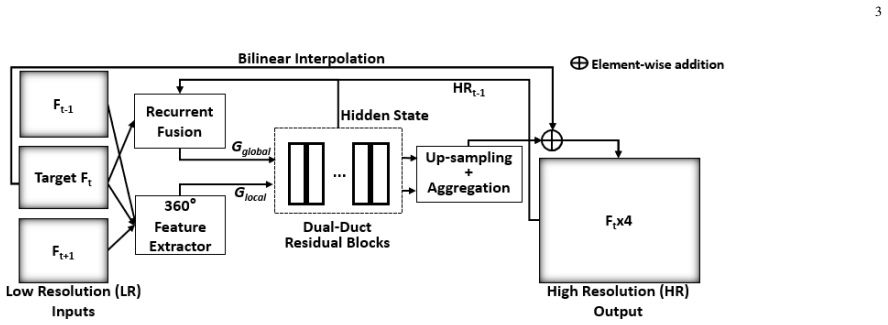
The load-bearing mechanism is the Weighted Spherically Smooth-L1 (WSS-L1) loss, whose per-pixel weight is $\psi_{i,j} = \cos\left(\frac{(i + 0.5 - \mathrm{height}/2)\pi}{\mathrm{height}}\right)$, so training emphasis falls on the equatorial band where ERP distortion is smallest and viewer attention is highest. Around it sits the 360-degree Feature Extractor, which takes three consecutive unaligned ERP frames, builds a joint feature map with shared convolutions, correlates each neighbour with the target frame, and applies spatial and channel attention; these local features are then fused with a recurrent hidden state and the previous super-resolved output, refined in ten dual-duct residual blocks with mutual information exchange, and upsampled by pixel shuffle. Replacing explicit optical-flow alignment with this correlated-feature extraction is what lets the model handle large motion and cyclic motion across the ERP seam.
What would settle it
Retrain or fine-tune the top two conventional baselines, such as BasicVSR and RSDN, on the 360VDS training set under the same bicubic and blur degradations used for S3PO, then evaluate on the 45-clip test set with repeated runs and confidence intervals; if their PSNR or WS-PSNR reaches or exceeds S3PO's values of 27.26 dB BI and 27.51 dB BD, or if the reported margins over frozen baselines disappear under matched training, the paper's superiority claim would be falsified.
Extended reading notes
Core claim
On the paper's own terms, the central discovery is that a VSR model built around ERP geometry can outperform both conventional video super-resolution models and existing 360-degree image and video super-resolution approaches on 360-degree content. Table I reports S3PO at 27.26 dB PSNR under bicubic degradation and 27.51 dB under blur degradation on 360VDS, ahead of the best conventional baselines, RBPN at 27.14 dB and RSDN at 27.32 dB, with the same ordering on SSIM, WS-PSNR, and WS-SSIM. Table II reports the same claim on the four-clip MiG Panorama test set, where S3PO reaches 30.42 dB WS-PSNR versus 30.22 dB for BasicVSR. The paper also finds that conventional recurrent models are surprisingly usable on ERP frames, but that their performance is capped because they ignore spherical distortion and the continuous left-right boundary. S3PO's edge is attributed to the combination of an attention-based 360-degree feature extractor, recurrent global fusion that avoids explicit alignment, dual-duct residual refinement with mutual information exchange, and the WSS-L1 loss that weights equatorial pixels more heavily than polar pixels.
Load-bearing premise
The central comparison assumes that evaluating baselines only with their published pretrained weights and original degradation is a fair representation of their performance ceiling on 360-degree video, while S3PO is fine-tuned on the 360VDS training domain; no control retraining or significance testing is provided.
Editorial extensions
If this is right
- A single model can super-resolve ERP 360-degree video by a factor of four without optical-flow alignment, using only three input frames, so it is applicable to both online and offline processing settings.
- The new 360VDS benchmark provides 590 clips with varied spatial and temporal complexity, plus an eight-clip 360UHD high-resolution subset ranging from HD to 4K, giving the community a more diverse test bed than the four-clip MiG Panorama set.
- The latitude-weighted WSS-L1 loss is proposed as a standard training objective for ERP-based 360-degree video enhancement, not just as an evaluation metric.
- Conventional VSR models remain usable on 360-degree video but are improved upon by 360-degree-specific modelling, and this gap also appears on high-resolution 360UHD clips where S3PO beats BasicVSR on every clip and metric.
- A cyclic-treatment variant that stitches the frame edges before feature extraction yields a small PSNR gain, confirming horizontal cyclicity as a distinct and separable source of error in ERP super-resolution.
Reading between the lines
- A matched-domain comparison, in which top conventional baselines are retrained or fine-tuned on the 360VDS training set under the same BI and BD degradations, could narrow the reported margins, which are often below 0.2 dB PSNR; the paper compares against baselines used only with their published pretrained weights.
- The cosine latitude weight addresses vertical distortion but not the left-right seam at training time; the small gain from the S3PO-cyc variant suggests that seam-aware padding, spherical convolutions, or rotation-invariant training could push further.
- Because S3PO avoids alignment and uses only three frames, its runtime and parameter profile could translate into bandwidth savings for tile-based adaptive 360-degree streaming, although the paper does not test streaming or quality-of-experience outcomes.
- The benchmark's 480x360 training resolution is far below 4K deployment resolutions; the 360UHD results suggest generalization, but fine-tuning at higher resolution on a larger high-resolution 360-degree corpus is a natural next test.
Editorial analysis
A structured set of objections, weighed in public.
Referee Report
Summary. The paper introduces 360VDS, a new dataset of 590 equirectangular video clips for 360° video super-resolution, and proposes a model called S3PO built on recurrent propagation with a sliding-window feature extractor, spatial/channel attention, dual-duct residual refinement, and a weighted spherically smooth L1 (WSS-L1) loss. S3PO is first trained on Vimeo90K and then fine-tuned on 360VDS, and it is evaluated on the 360VDS test set, the MiG Panorama test set, and a new 360UHD high-resolution subset, under both bicubic (BI) and blur (BD) degradations. The paper reports that S3PO outperforms existing conventional and 360°-specific VSR models on most metrics, and it includes ablations of the feature extractor, attention, loss function, recurrent residue, mutual exchange, and domain adaptation.
Significance. The dataset contribution is potentially valuable: 360VDS is larger and more diverse than the existing MiG Panorama benchmark, and the paper's analysis of spatial and temporal complexity supports this. The architectural study is also useful, particularly the ablation evidence that the recurrent design without explicit alignment can work on ERP frames, and the claim that the WSS-L1 loss helps is tested against a Smooth-L1 baseline. The paper states that code and weights will be released, which would aid reproducibility. However, the headline claim of state-of-the-art performance rests on an evaluation protocol that gives S3PO a domain-adaptation advantage over baselines that are not retrained on the target 360VDS domain; the reported margins are small, and no significance testing is provided. As a result, the empirical superiority claim is not presently established, although the underlying architecture and dataset are credible contributions that could be supported by a fairer comparison.
major comments (3)
- [Section V-B, Tables I–III] The central comparison is confounded: S3PO is initialized on Vimeo90K and then fine-tuned on the 360VDS training split (Section V-A1), while the conventional VSR baselines are evaluated with their original published settings, as indicated by the Table I caption stating that these models 'use the original degradation, as presented by the corresponding authors.' This means the evaluation conflates architectural merit with domain adaptation. The reported advantages are small—BI PSNR 27.26 dB vs 27.14 dB for RBPN, BD PSNR 27.51 dB vs 27.32 dB for RSDN, and an exact SSIM tie with BasicVSR under BI (0.8227)—and no confidence intervals, per-clip paired tests, or repeated-seed evaluations are provided. To support the claim of state-of-the-art performance, the authors should retrain or fine-tune the baselines on the 360VDS training split and report per-clip paired significance tests (e.g., Wilcoxon signed-rank or paired t-test with confidence intervals). Without such a control, the headline conclusion is not established.
- [Section IV-B] The dataset construction creates a potential train/test contamination risk. The 590 clips are derived from 301 source videos, and the paper states that the 590 clips are 'split randomly' into 45 test and 545 training clips. If clips from the same source video appear on both sides of the split, then a model fine-tuned on the training side may have seen near-duplicate content at test time, which would inflate its measured performance. The authors should either split at the source-video level (ensuring no source video contributes clips to both train and test) or provide a provenance mapping showing that all test clips come from source videos not represented in the training set. This is load-bearing for every quantitative claim made on 360VDS.
- [Section V-B, Table III] The high-resolution evaluation in Table III compares S3PO only against BasicVSR, rather than against the full set of baselines used in Tables I and II. Since the abstract claims superiority over 'most state-of-the-art' conventional and 360°-specific models, restricting the 360UHD comparison to a single baseline is insufficient to support that claim at high resolutions. Additionally, the 360UHD clips are randomly selected from the same 45-clip 360VDS test set, so the comparison is on a subset of the already small test set and inherits the split-contamination concern raised above. The authors should either compare against additional baselines on 360UHD or temper the claim to be specific to the 360VDS and MiG test sets.
minor comments (4)
- [General] The text contains several typos: '360VSD' instead of '360VDS' in Section V-A2, 'aixs' instead of 'axis' in the Conclusion, and 'BLOOD' instead of 'BOLD' in the Table III caption.
- [Eqn. (2)] The definition 'CA Feat(·) = Conv3×3(ReLU(Conv3×3(·))' is missing a closing parenthesis for the inner Conv3×3. Please correct the notation to 'CA Feat(·) = Conv3×3(ReLU(Conv3×3(·)))'.
- [Section V-D, Table IV] The cyclic treatment variant is referred to as 'S3PO-cyc' in Table IV but as 'S3PO-cyclic' in the text; please use a single consistent name.
- [Section III-C] The paper describes S3PO as applicable in both online and offline settings, but the 360° Feature Extractor uses the future frame Ft+1 (Eqn. 1), which means the model requires a one-frame look-ahead and is not suitable for true online processing in its current form. Please clarify this point in the applicability discussion.
Circularity Check
No derivation-level circularity; the SOTA claim is empirical against external baselines, though the comparison protocol has a target-domain fine-tuning confound that is a validity issue, not a circularity.
full rationale
The central claim is that S3PO outperforms existing VSR models on 360-degree video, and it is supported by evaluations on held-out test frames from 360VDS and the external MiG Panorama test set, using external metrics (PSNR, SSIM, WS-PSNR, WS-SSIM). No equation reduces to itself: the final output is a learned residual added to a bilinearly upsampled LR frame, and the WSS-L1 loss in Eq. (7) is a weighted Smooth-L1 training objective. Optimizing this loss toward a spherical-weighting scheme is standard loss design, not a circular definition of the evaluation. The paper does cite the authors' prior R2D2 work [17], but only as related work; the reported superiority of S3PO is demonstrated through comparisons to independently published baseline weights and an external test set, so the self-citation is not load-bearing. The real weakness is a methodological fairness confound, not circularity: in Sec. V-A1 S3PO is initialized on Vimeo90K and fine-tuned on the 360VDS training split, while the caption of Table I states that conventional baselines use the original degradation as presented by their authors, giving S3PO a domain-adaptation advantage. Also, Sec. IV-B describes only a random clip-level split, without explicitly separating clips from the same source video. These concerns affect the strength of the empirical claim but do not make the derivation circular.
Assumptions & free parameters
free parameters (1)
- β (WSS-L1 loss) =
1
assumptions (3)
- domain assumption ERP frames are a valid representation for 360-degree VSR, and the planar model sees them as conventional frames
- domain assumption Baseline models using their original weights are representative of their performance on 360-degree data
- domain assumption Synthetic degradations (BI and BD) sufficiently model real 360-degree capture degradation
Cite this review
Pith. "Pith review of Omnidirectional Video Super-Resolution using Deep Learning." pith.science (2026). https://pith.science/paper/FRHGWZWX
@misc{pith2026250614803,
  author       = {Pith},
  title        = {Pith review of: Omnidirectional Video Super-Resolution using Deep Learning},
  year         = {2026},
  howpublished = {\url{https://pith.science/paper/FRHGWZWX}},
  note         = {Machine review of arXiv:2506.14803}
}
read the original abstract
Omnidirectional Videos (or 360{\deg} videos) are widely used in Virtual Reality (VR) to facilitate immersive and interactive viewing experiences. However, the limited spatial resolution in 360{\deg} videos does not allow for each degree of view to be represented with adequate pixels, limiting the visual quality offered in the immersive experience. Deep learning Video Super-Resolution (VSR) techniques used for conventional videos could provide a promising software-based solution; however, these techniques do not tackle the distortion present in equirectangular projections of 360{\deg} video signals. An additional obstacle is the limited availability of 360{\deg} video datasets for study. To address these issues, this paper creates a novel 360{\deg} Video Dataset (360VDS) with a study of the extensibility of conventional VSR models to 360{\deg} videos. This paper further proposes a novel deep learning model for 360{\deg} Video Super-Resolution (360{\deg} VSR), called Spherical Signal Super-resolution with a Proportioned Optimisation (S3PO). S3PO adopts recurrent modelling with an attention mechanism, unbound from conventional VSR techniques like alignment. With a purpose-built feature extractor and a novel loss function addressing spherical distortion, S3PO outperforms most state-of-the-art conventional VSR models and 360{\deg}~specific super-resolution models on 360{\deg} video datasets. A step-wise ablation study is presented to understand and demonstrate the impact of the chosen architectural sub-components, targeted training and optimisation.
Figures


Figures from the paper (13 more)


Reference graph
Works this paper leans on
-
[1]
Tile-based joint caching and delivery of 360 videos in heterogeneous networks,
P. Maniotis, E. Bourtsoulatze, and N. Thomos, “Tile-based joint caching and delivery of 360 videos in heterogeneous networks,” IEEE Transac- tions on Multimedia , vol. 22, no. 9, pp. 2382–2395, 2019
work page 2019
-
[2]
A survey on adaptive 360 video streaming: solutions, challenges and opportunities,
A. Yaqoob, T. Bi, and G.-M. Muntean, “A survey on adaptive 360 video streaming: solutions, challenges and opportunities,” IEEE Communica- tions Surveys & Tutorials , vol. 22, no. 4, pp. 2801–2838, 2020
work page 2020
-
[3]
Video coding optimization for virtual reality 360-degree source,
Y . Zhou, L. Tian, C. Zhu, X. Jin, and Y . Sun, “Video coding optimization for virtual reality 360-degree source,” IEEE Journal of Selected Topics in Signal Processing , vol. 14, no. 1, pp. 118–129, 2019
work page 2019
-
[4]
Characterization of 360-degree videos,
S. Afzal, J. Chen, and K. K. Ramakrishnan, “Characterization of 360-degree videos,” in Proceedings of the Workshop on Virtual Reality and Augmented Reality Network , ser. VR/AR Network ’17. New York, NY , USA: Association for Computing Machinery, 2017, p. 1–6. [Online]. Available: https://doi-org.ezproxy-f.deakin.edu.au/10. 1145/3097895.3097896
-
[5]
Streaming 360-degree videos using super-resolution,
M. Dasari, A. Bhattacharya, S. Vargas, P. Sahu, A. Balasubramanian, and S. R. Das, “Streaming 360-degree videos using super-resolution,” in IEEE INFOCOM 2020 - IEEE Conference on Computer Communi- cations, 2020, pp. 1977–1986
work page 2020
-
[6]
Toward low- latency and ultra-reliable virtual reality,
M. S. Elbamby, C. Perfecto, M. Bennis, and K. Doppler, “Toward low- latency and ultra-reliable virtual reality,” IEEE Network, vol. 32, no. 2, pp. 78–84, 2018
2018
-
[7]
Recurrent back-projection network for video super-resolution,
M. Haris, G. Shakhnarovich, and N. Ukita, “Recurrent back-projection network for video super-resolution,” in Proceedings of the IEEE/CVF Conference on Computer Vision and Pattern Recognition , 2019, pp. 3897–3906
work page 2019
-
[8]
Edvr: Video restoration with enhanced deformable convolutional networks,
X. Wang, K. C. Chan, K. Yu, C. Dong, and C. Change Loy, “Edvr: Video restoration with enhanced deformable convolutional networks,” in Proceedings of the IEEE/CVF Conference on Computer Vision and Pattern Recognition Workshops, 2019
work page 2019
Show all 59 references
-
[9]
Video super- resolution with recurrent structure-detail network,
T. Isobe, X. Jia, S. Gu, S. Li, S. Wang, and Q. Tian, “Video super- resolution with recurrent structure-detail network,” in Computer Vision – ECCV 2020 , A. Vedaldi, H. Bischof, T. Brox, and J.-M. Frahm, Eds. Cham: Springer International Publishing, 2020, pp. 645–660
2020
-
[10]
Basicvsr: The search for essential components in video super-resolution and beyond,
K. C. Chan, X. Wang, K. Yu, C. Dong, and C. C. Loy, “Basicvsr: The search for essential components in video super-resolution and beyond,” in Proceedings of the IEEE/CVF Conference on Computer Vision and Pattern Recognition (CVPR), June 2021, pp. 4947–4956
2021
-
[11]
Video super-resolution with temporal group attention,
T. Isobe, S. Li, X. Jia, S. Yuan, G. Slabaugh, C. Xu, Y .-L. Li, S. Wang, and Q. Tian, “Video super-resolution with temporal group attention,” in Proceedings of the IEEE/CVF Conference on Computer Vision and Pattern Recognition (CVPR), June 2020
2020
-
[12]
Deformable convolutional networks,
J. Dai, H. Qi, Y . Xiong, Y . Li, G. Zhang, H. Hu, and Y . Wei, “Deformable convolutional networks,” in Proceedings of the IEEE international conference on computer vision , 2017, pp. 764–773
2017
-
[13]
Deep video super-resolution network using dynamic upsampling filters without explicit motion com- pensation,
Y . Jo, S. W. Oh, J. Kang, and S. J. Kim, “Deep video super-resolution network using dynamic upsampling filters without explicit motion com- pensation,” in Proceedings of the IEEE conference on computer vision and pattern recognition , 2018, pp. 3224–3232
2018
-
[14]
Gen- erative adversarial networks and perceptual losses for video super- resolution,
A. Lucas, S. Lopez-Tapia, R. Molina, and A. K. Katsaggelos, “Gen- erative adversarial networks and perceptual losses for video super- resolution,” IEEE Trans Image Process , vol. 28, no. 7, pp. 3312–3327, 2019
2019
-
[15]
A single frame and multi-frame joint network for 360-degree panorama video super-resolution,
H. Liu, Z. Ruan, C. Fang, P. Zhao, F. Shang, Y . Liu, and L. Wang, “A single frame and multi-frame joint network for 360-degree panorama video super-resolution,” arXiv preprint arXiv:2008.10320 , 2020
2008 arXiv
-
[16]
Revisiting temporal modeling for video super-resolution,
T. Isobe, F. Zhu, X. Jia, and S. Wang, “Revisiting temporal modeling for video super-resolution,” arXiv preprint arXiv:2008.05765 , 2020
2008 arXiv
-
[17]
Online Video Super-Resolution us- ing Unidirectional Recurrent Model,
A. Agrahari Baniya., T. Lee., P. Eklund, S. Aryal, and A. Robles-Kelly, “Online Video Super-Resolution us- ing Unidirectional Recurrent Model,” 11 2022. [Online]. Available: https://www.techrxiv.org/articles/preprint/Online Video Super-Resolution using Unidirectional Recurrent...
2022
-
[18]
Basicvsr++: Improving video super-resolution with enhanced propagation and alignment,
K. C. Chan, S. Zhou, X. Xu, and C. C. Loy, “Basicvsr++: Improving video super-resolution with enhanced propagation and alignment,” in Proceedings of the IEEE/CVF conference on computer vision and pattern recognition, 2022, pp. 5972–5981
2022
-
[19]
Omniscient video super-resolution,
P. Yi, Z. Wang, K. Jiang, J. Jiang, T. Lu, X. Tian, and J. Ma, “Omniscient video super-resolution,” in Proceedings of the IEEE/CVF International Conference on Computer Vision , 2021, pp. 4429–4438
2021
-
[20]
360 panorama super-resolution using deep convolutional networks,
V . Fakour-Sevom, E. Guldogan, and J.-K. K ¨am¨ar¨ainen, “360 panorama super-resolution using deep convolutional networks,” in Int. Conf. on Computer Vision Theory and Applications (VISAPP) , vol. 1, 2018
2018
-
[21]
Super-resolution of omnidirec- tional images using adversarial learning,
C. Ozcinar, A. Rana, and A. Smolic, “Super-resolution of omnidirec- tional images using adversarial learning,” in 2019 IEEE 21st Interna- tional Workshop on Multimedia Signal Processing (MMSP) , 2019, pp. 1–6
2019
-
[22]
360° single image super res- olution via distortion-aware network and distorted perspective images,
A. Nishiyama, S. Ikehata, and K. Aizawa, “360° single image super res- olution via distortion-aware network and distorted perspective images,” in 2021 IEEE International Conference on Image Processing (ICIP) , 2021, pp. 1829–1833. 14
2021
-
[23]
Image super-resolution using deep convolutional networks,
C. Dong, C. C. Loy, K. He, and X. Tang, “Image super-resolution using deep convolutional networks,” IEEE transactions on pattern analysis and machine intelligence , vol. 38, no. 2, pp. 295–307, 2015
2015
-
[24]
Recognizing scene viewpoint using panoramic place representation,
J. Xiao, K. A. Ehinger, A. Oliva, and A. Torralba, “Recognizing scene viewpoint using panoramic place representation,” in 2012 IEEE Conference on Computer Vision and Pattern Recognition . IEEE, 2012, pp. 2695–2702
2012
-
[25]
Streaming 360-degree videos using super-resolution,
M. Dasari, A. Bhattacharya, S. Vargas, P. Sahu, A. Balasubramanian, and S. R. Das, “Streaming 360-degree videos using super-resolution,” in IEEE INFOCOM 2020-IEEE Conference on Computer Communications. IEEE, 2020, pp. 1977–1986
2020
-
[26]
Image quality metrics: Psnr vs. ssim,
A. Hore and D. Ziou, “Image quality metrics: Psnr vs. ssim,” in 2010 20th international conference on pattern recognition . IEEE, 2010, pp. 2366–2369
2010
-
[27]
Weighted-to-spherically- uniform ssim objective quality evaluation for panoramic video,
Y . Zhou, M. Yu, H. Ma, H. Shao, and G. Jiang, “Weighted-to-spherically- uniform ssim objective quality evaluation for panoramic video,” in 2018 14th IEEE International Conference on Signal Processing (ICSP) . IEEE, 2018, pp. 54–57
2018
-
[28]
Optical flow estimation using a spatial pyramid network,
A. Ranjan and M. J. Black, “Optical flow estimation using a spatial pyramid network,” in Proceedings of the IEEE conference on computer vision and pattern recognition , 2017, pp. 4161–4170
2017
-
[29]
Dynamic field of view restriction in 360° video: Aligning optical flow and visual slam to mitigate vims,
P. Bala, I. Oakley, V . Nisi, and N. J. Nunes, “Dynamic field of view restriction in 360° video: Aligning optical flow and visual slam to mitigate vims,” in Proceedings of the 2021 CHI Conference on Human Factors in Computing Systems , ser. CHI ’21. New York, NY , USA: Associa...
2021
-
[30]
Revisiting optical flow estimation in 360 videos,
K. Bhandari, Z. Zong, and Y . Yan, “Revisiting optical flow estimation in 360 videos,” in 2020 25th International Conference on Pattern Recognition (ICPR). IEEE, 2021, pp. 8196–8203
2020
-
[31]
Panoflow: Learning optical flow for panoramic images,
H. Shi, Y . Zhou, K. Yang, Y . Ye, X. Yin, Z. Yin, S. Meng, and K. Wang, “Panoflow: Learning optical flow for panoramic images,” arXiv preprint arXiv:2202.13388, 2022
2022 arXiv
-
[32]
Gen- erative adversarial networks and perceptual losses for video super- resolution,
A. Lucas, S. Lopez-Tapia, R. Molina, and A. K. Katsaggelos, “Gen- erative adversarial networks and perceptual losses for video super- resolution,” IEEE Transactions on Image Processing , vol. 28, no. 7, pp. 3312–3327, 2019
2019
-
[33]
Cbam: Convolutional block attention module,
S. Woo, J. Park, J.-Y . Lee, and I. S. Kweon, “Cbam: Convolutional block attention module,” in Proceedings of the European conference on computer vision (ECCV) , 2018, pp. 3–19
2018
-
[34]
Bridge the gap between vqa and human behavior on omnidirectional video: A large-scale dataset and a deep learning model,
C. Li, M. Xu, X. Du, and Z. Wang, “Bridge the gap between vqa and human behavior on omnidirectional video: A large-scale dataset and a deep learning model,” in Proceedings of the 26th ACM international conference on Multimedia , 2018, pp. 932–940
2018
-
[35]
Learning compressible 360° video isomers,
Y .-C. Su and K. Grauman, “Learning compressible 360° video isomers,” in Proceedings of the IEEE Conference on Computer Vision and Pattern Recognition, 2018, pp. 7824–7833
2018
-
[37]
A survey on 360-degree video: Coding, quality of experi- ence and streaming,
F. Chiariotti, “A survey on 360-degree video: Coding, quality of experi- ence and streaming,” Computer Communications, vol. 177, pp. 133–155, 2021
2021
-
[38]
State-of-the-art in 360 video/image processing: Perception, assessment and compression,
M. Xu, C. Li, S. Zhang, and P. Le Callet, “State-of-the-art in 360 video/image processing: Perception, assessment and compression,” IEEE Journal of Selected Topics in Signal Processing, vol. 14, no. 1, pp. 5–26, 2020
2020
-
[39]
A taxonomy and dataset for 360° videos,
A. T. Nasrabadi, A. Samiei, A. Mahzari, R. P. McMahan, R. Prakash, M. C. Q. Farias, and M. M. Carvalho, “A taxonomy and dataset for 360° videos,” in Proceedings of the 10th ACM Multimedia Systems Conference, ser. MMSys ’19. New York, NY , USA: Association for Computing Machine...
2019
-
[40]
Personal identifiability of user tracking data during observation of 360- degree vr video,
M. R. Miller, F. Herrera, H. Jun, J. A. Landay, and J. N. Bailenson, “Personal identifiability of user tracking data during observation of 360- degree vr video,” Scientific Reports, vol. 10, no. 1, pp. 1–10, 2020
2020
-
[41]
Castellano
B. Castellano. (2022) Pyscenedetect. [Online]. Available: http: //scenedetect.com/en/latest/
2022
-
[42]
Subjective video quality assessment methods for multimedia applications,
T. Installations and L. Line, “Subjective video quality assessment methods for multimedia applications,” Networks, vol. 910, no. 37, p. 5, 1999
1999
-
[43]
Video enhance- ment with task-oriented flow,
T. Xue, B. Chen, J. Wu, D. Wei, and W. T. Freeman, “Video enhance- ment with task-oriented flow,”International Journal of Computer Vision, vol. 127, no. 8, pp. 1106–1125, 2019
2019
-
[44]
Ntire 2019 challenge on video deblurring and super-resolution: Dataset and study,
S. Nah, S. Baik, S. Hong, G. Moon, S. Son, R. Timofte, and K. Mu Lee, “Ntire 2019 challenge on video deblurring and super-resolution: Dataset and study,” in Proceedings of the IEEE/CVF Conference on Computer Vision and Pattern Recognition (CVPR) Workshops , June 2019
2019
-
[45]
Multi-temporal ultra dense memory network for video super-resolution,
P. Yi, Z. Wang, K. Jiang, Z. Shao, and J. Ma, “Multi-temporal ultra dense memory network for video super-resolution,” IEEE Transactions on Circuits and Systems for Video Technology, vol. 30, no. 8, pp. 2503– 2516, 2020
2020
-
[46]
Freezing subnetworks to analyze domain adaptation in neural machine translation,
B. Thompson, H. Khayrallah, A. Anastasopoulos, A. McCarthy, K. Duh, R. Marvin, P. McNamee, J. Gwinnup, T. Anderson, and P. Koehn, “Freezing subnetworks to analyze domain adaptation in neural machine translation,” in Proceedings of the Third Conference on Machine Trans- lation:...
2018
-
[47]
Video super-resolution based on deep learning: a comprehensive survey,
H. Liu, Z. Ruan, P. Zhao, C. Dong, F. Shang, Y . Liu, L. Yang, and R. Timofte, “Video super-resolution based on deep learning: a comprehensive survey,” Artificial Intelligence Review , vol. 55, no. 8, pp. 5981–6035, 2022
2022
-
[48]
Fast r-cnn,
R. Girshick, “Fast r-cnn,” in Proceedings of the IEEE international conference on computer vision , 2015, pp. 1440–1448
2015
-
[49]
Adam: A method for stochastic optimization,
D. P. Kingma and J. Ba, “Adam: A method for stochastic optimization,” arXiv preprint arXiv:1412.6980 , 2014
2014 arXiv
-
[50]
Pytorch: An imperative style, high-performance deep learning library,
A. Paszke, S. Gross, F. Massa, A. Lerer, J. Bradbury, G. Chanan, T. Killeen, Z. Lin, N. Gimelshein, L. Antiga, A. Desmaison, A. Kopf, E. Yang, Z. DeVito, M. Raison, A. Tejani, S. Chilamkurthy, B. Steiner, L. Fang, J. Bai, and S. Chintala, “Pytorch: An imperative style, high-pe...
2019
-
[51]
Ahg8: Ws-psnr for 360 video objective quality evaluation,
Y . Sun, A. Lu, and L. Yu, “Ahg8: Ws-psnr for 360 video objective quality evaluation,” in Joint Video Exploration Team of ITU-T SG16 WP3 and ISO/IEC JTC1/SC29/WG11, JVET-D0040, 4th Meeting , 2016
2016
-
[52]
Tell me where to look: Investigating ways for assisting focus in 360 video,
Y .-C. Lin, Y .-J. Chang, H.-N. Hu, H.-T. Cheng, C.-W. Huang, and M. Sun, “Tell me where to look: Investigating ways for assisting focus in 360 video,” in Proceedings of the 2017 CHI Conference on Human Factors in Computing Systems , 2017, pp. 2535–2545
2017
-
[53]
Lau-net: Latitude adaptive upscaling network for omnidirectional image super- resolution,
X. Deng, H. Wang, M. Xu, Y . Guo, Y . Song, and L. Yang, “Lau-net: Latitude adaptive upscaling network for omnidirectional image super- resolution,” in Proceedings of the IEEE/CVF Conference on Computer Vision and Pattern Recognition , 2021, pp. 9189–9198
2021
-
[54]
Super-resolution of omnidirec- tional images using adversarial learning,
C. Ozcinar, A. Rana, and A. Smolic, “Super-resolution of omnidirec- tional images using adversarial learning,” in 2019 IEEE 21st Interna- tional Workshop on Multimedia Signal Processing (MMSP) . IEEE, 2019, pp. 1–6
2019
-
[55]
Video super- resolution with convolutional neural networks,
A. Kappeler, S. Yoo, Q. Dai, and A. K. Katsaggelos, “Video super- resolution with convolutional neural networks,” IEEE transactions on computational imaging, vol. 2, no. 2, pp. 109–122, 2016
2016
-
[56]
Real-time video super-resolution with spatio-temporal networks and motion compensation,
J. Caballero, C. Ledig, A. Aitken, A. Acosta, J. Totz, Z. Wang, and W. Shi, “Real-time video super-resolution with spatio-temporal networks and motion compensation,” in Proceedings of the IEEE Conference on Computer Vision and Pattern Recognition , 2017, pp. 4778–4787
2017
-
[57]
Frame-recurrent video super-resolution,
M. S. Sajjadi, R. Vemulapalli, and M. Brown, “Frame-recurrent video super-resolution,” in Proceedings of the IEEE Conference on Computer Vision and Pattern Recognition , 2018, pp. 6626–6634
2018
-
[58]
360-aware saliency estimation with conven- tional image saliency predictors,
M. Startsev and M. Dorr, “360-aware saliency estimation with conven- tional image saliency predictors,” Signal Processing: Image Communi- cation, vol. 69, pp. 43–52, 2018
2018
-
[59]
Deep learning for omnidirectional vision: A survey and new perspectives,
H. Ai, Z. Cao, J. Zhu, H. Bai, Y . Chen, and L. Wang, “Deep learning for omnidirectional vision: A survey and new perspectives,” arXiv preprint arXiv:2205.10468, 2022. 15 Arbind Agrahari Baniya is a current PhD candi- date at the Centre for Software, Systems and Society (CSSS)...
2022 arXiv
-
[2017]
Dr Lee was a Postdoctoral Fellow at the Center for Signal Processing at The Hong Kong Polytechnic University in 2017-2018
During her PhD studies, she was awarded Li Po Chun Charitable Trust Fund Scholarship. Dr Lee was a Postdoctoral Fellow at the Center for Signal Processing at The Hong Kong Polytechnic University in 2017-2018. She was also an invited speaker at the IEEE CAS Guangzhou Workshop 2...
1991
Reviewed August 7, 2026 · model on record in the stance chip above.
Discussion (0). Sign in to comment.