REVIEW 4 major objections 6 minor 43 references
SFT-GO: Supervised Fine-Tuning with Group Optimization for Large Language Models
T0 review · 4 major / 6 minor · reviewed 2026-08-07 · deepseek-v4-flash
Pith's one-line read Splitting tokens by importance and adding the worse group's loss to the fine-tuning objective improves supervised fine-tuning of large language models.
desk verdict Token-level Group DRO is a neat idea, but the empirical comparison is confounded by tuning on the test benchmarks and mismatched learning rates, so the central claim needs a matched-configuration rerun. read the letter →
The pith
A machine-rendered reading of the paper's core claim, the machinery that carries it, and where it could break.
The reading
What carries the argument
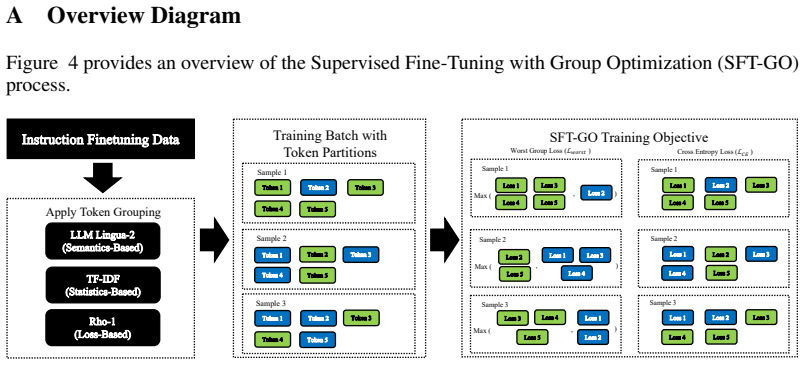
The load-bearing object is the worst-group loss, $L_{\mathrm{worst}}(\theta) = \max(L_{\mathrm{CE}}(G_1;\theta), L_{\mathrm{CE}}(G_0;\theta))$, added to the standard cross-entropy loss with weight $\lambda$. This term makes the gradient depend on whichever token group currently has the higher loss, so training effort is repeatedly redirected to the group the model is learning most slowly. The other half of the machinery is the grouping function $g$, which fixes the partition; the paper tests a statistics-based version (TF-IDF), a semantics-based version (LLMLingua-2), and a loss-based version (Rho-1) to show that the objective works across different definitions of token importance. The annealing schedule for $\lambda$, which starts high and decays, lets the method emphasize the worst group early and then let standard language modeling take over.
What would settle it
Run baseline SFT and SFT-GO on the same dataset with identical learning rate, optimizer, schedule, and epoch count, and choose $\eta$ and $\lambda$ on a validation split that is disjoint from the final evaluation benchmarks; if the average benchmark scores no longer differ, the claim that the worst-group objective drives the improvement is refuted. Alternatively, track $L_{\mathrm{worst}}$ on held-out tokens during training, since Proposition 1 predicts it should stay at or below the standard-SFT level and a sustained violation would contradict the theory.
Extended reading notes
Core claim
The central claim is that replacing the uniform token average in supervised fine-tuning with an objective that explicitly optimizes the worse of two token groups improves the resulting model. Given a grouping function $g$ that labels each token as important or unimportant, SFT-GO minimizes $L_{\mathrm{GO}} = (1-\lambda)L_{\mathrm{CE}} + \lambda L_{\mathrm{worst}}$ with $L_{\mathrm{worst}} = \max(L_{\mathrm{CE}}(G_1;\theta), L_{\mathrm{CE}}(G_0;\theta))$, so gradients are redirected toward whichever group is currently harder. The paper demonstrates the framework with three grouping functions: TF-IDF statistics, LLMLingua-2's semantics-based keep/drop probabilities, and Rho-1's excess-loss selection. It shows that Rho-1 is a special case when $\lambda=1$ and grouping is loss-based. Empirically, all three variants outperform baseline SFT on average across eight reported columns spanning seven benchmarks for Llama-3.2-3B and Llama-3.1-8B on both LIMA and Alpaca, with the largest improvements on general-reasoning benchmarks. The paper additionally claims a bound of the form $L_{\mathrm{worst}}(\hat{\theta}) \le L_{\mathrm{worst}}(\theta_{\mathrm{avg}})$ and an $O(1/\sqrt{T})$ convergence rate, which tell a fair reader that the worst-group term is intended to balance token groups without sacrificing optimization efficiency.
Load-bearing premise
The empirical comparison assumes that the reported gains come from the group-optimization objective rather than from per-method hyperparameter tuning: in the Alpaca setup the learning rates differ by an order of magnitude between baseline and SFT-GO, and $\eta$ and $\lambda$ were selected on the same benchmarks used for the final evaluation; the convergence theory additionally assumes convexity and exact optimality, which do not hold for large language models.
Editorial extensions
If this is right
- Any method that can score token importance, from lexical statistics to a pretrained compressor to a reference-model loss, can be plugged into the same objective, so SFT-GO turns token importance into a general training signal.
- Existing token-selection and token-reweighting fine-tuning methods are subsumed as special cases, giving one unified objective with which to compare and combine them.
- Because the worst-group term tracks the harder group, it should reduce the under-optimization of rare, semantically rich tokens that standard average cross-entropy tends to sacrifice to frequent function words.
- Empirically, the improvement appears on both LIMA and Alpaca and for two model sizes, so the benefit is not tied to a single data scale or model family.
- The $O(1/\sqrt{T})$ bound indicates that, in the convex setting, the group term does not change the optimization rate compared with standard SGD, so the added balancing behavior costs no theoretical convergence speed.
Reading between the lines
- An implication the authors leave implicit is that the same worst-group trick could be applied to groups defined by attributes other than semantic importance, such as token difficulty, domain, or safety-relevance, turning the objective into a general way to optimize the weakest slice of the training distribution.
- Because the ablation shows performance holds over a wide range of important-token ratios, an untested prediction is that the gain should be largest precisely when the easy group dominates the token count, since that is when the uniform average most under-weights hard tokens.
- A sharper test of the mechanism than final benchmark averages would be to monitor $L_{\mathrm{worst}}$ on held-out tokens during training; Proposition 1 predicts it should stay at or below the standard-SFT trajectory, which is a direct, checkable consequence not reported in the paper.
Editorial analysis
A structured set of objections, weighed in public.
Referee Report
Summary. The paper proposes SFT-GO, a supervised fine-tuning objective that combines the standard cross-entropy loss with a worst-group loss over token-importance groups: L_GO = (1-λ)L_CE + λ L_worst, where L_worst = max(L_CE(G1), L_CE(G0)). Three grouping strategies are considered: TF-IDF, LLMLingua-2, and Rho-1, with Rho-1 reformulated as a special case. The authors provide two theoretical results: Proposition 1 claims that the worst-group loss of the group-optimized solution is no worse than that of standard SFT, and Proposition 2 claims an O(1/sqrt(T)) SGD convergence rate. Empirically, the paper reports average improvements over baseline SFT across seven benchmarks using LIMA and Alpaca with Llama-3.2-3B and Llama-3.1-8B, over five seeds.
Significance. If the reported gains survive a controlled comparison, SFT-GO would be a simple and useful addition to the instruction-tuning toolbox: it is flexible in how token importance is defined, it subsumes Rho-1, and it is evaluated on two base models, two datasets, and seven benchmarks with multiple seeds and transparent compute reporting. The paper also usefully separates token groups rather than reweighting every token independently. However, the central empirical claim is not currently established because the evaluation protocol confounds the objective with learning-rate choices and performs hyperparameter selection on the same benchmarks used for the final numbers. The theoretical results are standard and are explicitly limited by the convexity assumption conceded in Appendix C.
major comments (4)
- [Appendix F.2, Table 2] The Alpaca experiments confound method with learning rate. For Llama-3.2-3B, Baseline-SFT uses a learning rate of 6e-6 while TF-IDF, Rho-1, and LLMLingua-2 use 1e-6, 5e-7, and 6e-7, respectively; for Llama-3.1-8B, Baseline-SFT uses 1e-7 while all SFT-GO variants use 6e-7. Since the learning rate differs by an order of magnitude between the baseline and each SFT-GO method, the average gains in Table 2 cannot be attributed to the SFT-GO objective rather than to a better-tuned learning rate. The authors should rerun Baseline-SFT at the learning rates used by the SFT-GO variants, and rerun SFT-GO at the baseline learning rate, to show that the objective itself, not the learning-rate schedule, drives the improvements.
- [Section 4, Section 5, Appendix F] The paper states that the optimal learning rate, eta, and lambda are searched, but it does not describe a held-out validation split; the final numbers are reported on the same seven benchmarks used for that search. For LIMA, the baseline uses the hyperparameters recommended by the original LIMA paper while SFT-GO's eta and lambda are tuned on the evaluation benchmarks. This gives SFT-GO additional degrees of freedom and risks selection on the test set, which can inflate average performance even if the objective is neutral. The authors should either select hyperparameters on a separate validation set (e.g., a subset of the training data or a small held-out benchmark) and then report on the seven benchmarks, or show that the qualitative conclusion is unchanged across a wide grid of eta and lambda values for both baseline and SFT-GO.
- [Table 2, Section 5.1] The claim that SFT-GO models 'consistently outperform' the baseline is not supported at the individual benchmark level on Alpaca. For Llama-3.2-3B, all three SFT-GO methods score below Baseline-SFT on ARC-C (45.05-45.61 vs. 46.60) and on HellaSwag (55.54-56.10 vs. 56.54), with the average gains driven mainly by TruthfulQA and IFEval. The authors should qualify the claim to refer to average performance, or provide per-benchmark significance tests (e.g., paired tests across seeds) to show which individual differences are reliable.
- [Appendix B, Appendix C, Proposition 2] The theoretical convergence result assumes L_GO is convex with Lipschitz subgradients and that the parameter space is convex and bounded, and Proposition 1 assumes the solutions are exact global optima of their respective objectives. Appendix C explicitly acknowledges that the convexity assumption does not hold for LLMs. As a result, the O(1/sqrt(T)) rate and the worst-group-loss guarantee do not directly apply to the actual nonconvex LLM fine-tuning setting, and the theory should not be presented as demonstrating efficiency for LLM training without a clear statement of this gap. The empirical comparison, not the theory, must carry the central claim.
minor comments (6)
- [Section 4] There is a typo in the datasets paragraph: 'STF-GO' should be 'SFT-GO'.
- [Appendix B, Eq. (17)] In the proof of Proposition 2, the first norm term on the right-hand side of Eq. (17) appears to be missing the square: it should read ||θ(t) - θ*||^2 for consistency with the surrounding derivation and with the telescoping sum that follows.
- [Appendix E] The HellaSwag description says it tests 'broad knowledge and reasoning in 57 diverse subjects,' which is the description of MMLU; the HellaSwag entry should be corrected to describe commonsense physical reasoning about everyday situations.
- [Figure 3] The x-axis is labeled 'Percentile' while the text refers to a 'compression rate' and the caption says that at the 90th percentile the bottom 90% of tokens are unimportant; the axis label and caption should be reconciled to avoid confusion about whether larger values mean more or fewer important tokens.
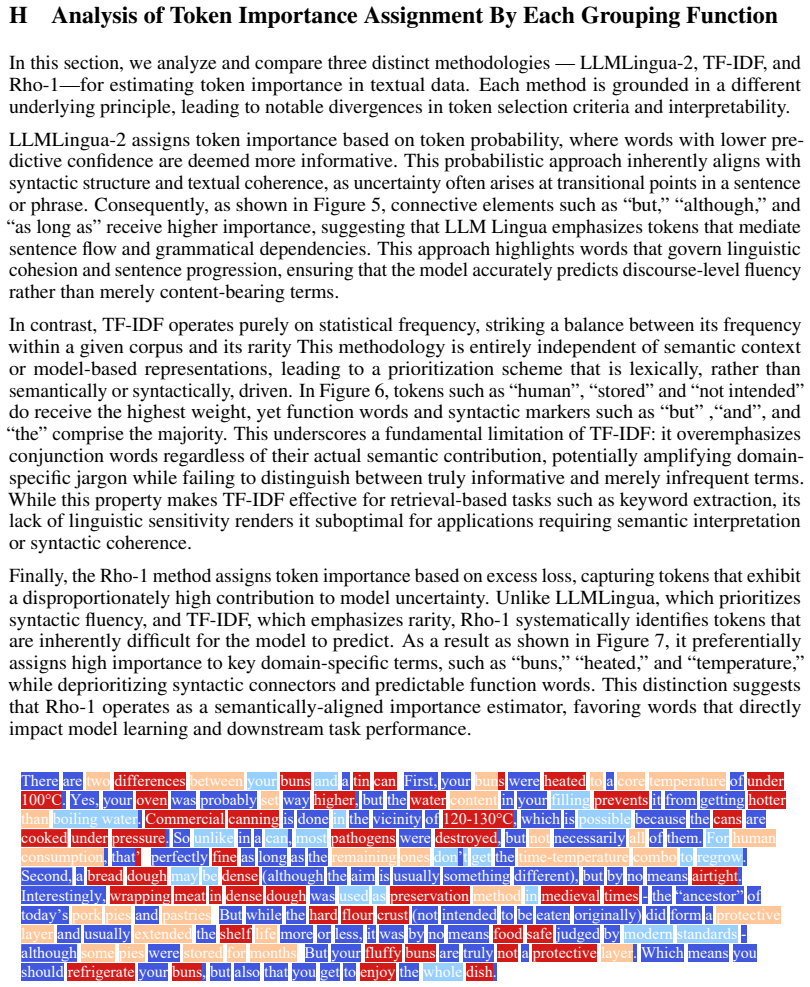
- [Appendix H] The appendix uses 'LLM Lingua' inconsistently and describes LLMLingua-2 as assigning importance based on low predictive confidence, which is not clearly the same as the keep/drop probability described in Section 3.3; the authors should make the description consistent with the method they actually use.
- [References] References [10] and [23] appear to refer to the same Rho-1 work in different venues; the authors should cite the published version once and avoid duplicate entries.
Circularity Check
One self-definitional theoretical result (Proposition 1) is built into the objective, while the empirical benchmark claims remain external measurements.
-
self definitional
[Section 3.2 (Proposition 1) and Appendix B (Proof)]
"Let ˆθ be the solution obtained by minimizing the group objective function (Eq. 3), and let θavg be the solution obtained by minimizing the standard autoregressive objective function. Then, the worst-group loss of the model trained with group optimization is no greater than that of the model trained with the standard objective: Lworst(ˆθ)≤ Lworst(θavg). (6) Proof. For simplicity, prove without the constant λ in Eq. 3. Let θavg = arg min LCE(θ). By definition of ˆθ, we obtain LGO(w; ˆθ) = LCE(ˆθ) + Lworst(ˆθ)≤ LCE(θavg) + Lworst(θavg) = LGO(θavg)."
The proposition is a direct consequence of the definition of L_GO, which already contains L_worst as a summand: L_GO = (1−λ)L_CE + λL_worst (Eq. 3). The proof removes λ and uses only global optimality of θ_hat and θ_avg; it introduces no mechanism beyond the objective's own definition. Minimizing an objective that penalizes L_worst will, by construction, produce a minimizer whose L_worst is no larger than that of a minimizer of L_CE alone, so the stated result is an identity of the optimization problem rather than an independently derived prediction. It also does not imply the paper's abstract claim of improvement 'in all token groups'; the bound concerns only the worst group.
full rationale
The paper's main empirical claims are measured against external benchmarks (MMLU, MathQA, ARC-C, OpenBookQA, HellaSwag, TruthfulQA, IFEval) and are not derived from the theory, so the core claim that SFT-GO improves SFT is not circular. The only step that reduces to its own input by construction is Proposition 1: because the group objective is defined as a weighted combination that includes L_worst, the statement that its minimizer has no larger L_worst than the L_CE minimizer is true by definition and global optimality, as the proof itself shows. This is a self-definitional side-claim and does not by itself produce the empirical gains. Proposition 2 is a standard convex-SGD bound imported from Group DRO analysis; the paper concedes in Appendix C that the convexity assumption does not hold for LLMs, which limits applicability but is not circular. Separately, Appendix F.2 reports searching the learning rate, η, and λ without describing a held-out validation split, so the Alpaca comparison is at risk of selection on the evaluation benchmarks; this is an evaluation-validity concern rather than a derivation-chain circularity. Overall, there is one definitional theoretical result, but the central empirical derivation remains self-contained and externally benchmarked.
Assumptions & free parameters
free parameters (3)
- lambda (λ) =
0.9 static or decaying to 0.07/0.05/0.01 depending on dataset/model
- eta (η) =
55-90th percentile depending on grouping method and model
- learning rate =
1e-7 to 6e-6 depending on method
assumptions (3)
- domain assumption L_GO is convex with Lipschitz continuous subgradients and the parameter space Θ is convex, closed, and bounded.
- ad hoc to paper The grouping function g becomes deterministic after early training steps.
- domain assumption External importance measures (TF-IDF, LLMLingua-2, excess loss) identify task-relevant tokens.
Cite this review
Pith. "Pith review of SFT-GO: Supervised Fine-Tuning with Group Optimization for Large Language Models." pith.science (2026). https://pith.science/paper/LJHUVL4F
@misc{pith2026250615021,
  author       = {Pith},
  title        = {Pith review of: SFT-GO: Supervised Fine-Tuning with Group Optimization for Large Language Models},
  year         = {2026},
  howpublished = {\url{https://pith.science/paper/LJHUVL4F}},
  note         = {Machine review of arXiv:2506.15021}
}
read the original abstract
Supervised fine-tuning (SFT) has become an essential step in tailoring large language models (LLMs) to align with human expectations and specific downstream tasks. However, existing SFT methods typically treat each training instance as a uniform sequence, giving equal importance to all tokens regardless of their relevance. This overlooks the fact that only a subset of tokens often contains critical, task-specific information. To address this limitation, we introduce Supervised Fine-Tuning with Group Optimization (SFT-GO), a novel approach that treats groups of tokens differently based on their importance.SFT-GO groups tokens in each sample based on their importance values and optimizes the LLM using a weighted combination of the worst-group loss and the standard cross-entropy loss. This mechanism adaptively emphasizes the most challenging token groups and guides the model to better handle different group distributions, thereby improving overall learning dynamics. We provide a theoretical analysis of SFT-GO's convergence rate, demonstrating its efficiency. Empirically, we apply SFT-GO with three different token grouping strategies and show that models trained with SFT-GO consistently outperform baseline approaches across popular LLM benchmarks. These improvements hold across various datasets and base models, demonstrating the robustness and the effectiveness of our method.
Figures


Figures from the paper (4 more)


Reference graph
Works this paper leans on
-
[1]
Language models are unsupervised multitask learners, 2019
Alec Radford, Jeff Wu, Rewon Child, David Luan, Dario Amodei, and Ilya Sutskever. Language models are unsupervised multitask learners, 2019
2019
-
[2]
Training language models to follow instructions with human feedback
Long Ouyang, Jeffrey Wu, Xu Jiang, Diogo Almeida, Carroll Wainwright, Pamela Mishkin, Chong Zhang, Sandhini Agarwal, Katarina Slama, Alex Gray, John Schulman, Jacob Hilton, Fraser Kelton, Luke Miller, Maddie Simens, Amanda Askell, Peter Welinder, Paul Christiano, Jan Leike, and Ryan Lowe. Training language models to follow instructions with human feedback...
work page 2022
-
[3]
Llama: Open and efficient foundation language models, 2023
Hugo Touvron, Thibaut Lavril, Gautier Izacard, Xavier Martinet, Marie-Anne Lachaux, Timo- thée Lacroix, Baptiste Rozière, Naman Goyal, Eric Hambro, Faisal Azhar, Aurelien Rodriguez, Armand Joulin, Edouard Grave, and Guillaume Lample. Llama: Open and efficient foundation language models, 2023
2023
-
[4]
Nathan Lambert, Jacob Morrison, Valentina Pyatkin, Shengyi Huang, Hamish Ivison, Faeze Brahman, Lester James V Miranda, Alisa Liu, Nouha Dziri, Shane Lyu, et al. T\" ulu 3: Pushing frontiers in open language model post-training.arXiv preprint arXiv:2411.15124, 2024
arXiv 2024
-
[5]
LIMA: Less is more for alignment
Chunting Zhou, Pengfei Liu, Puxin Xu, Srini Iyer, Jiao Sun, Yuning Mao, Xuezhe Ma, Avia Efrat, Ping Yu, LILI YU, Susan Zhang, Gargi Ghosh, Mike Lewis, Luke Zettlemoyer, and Omer Levy. LIMA: Less is more for alignment. InThirty-seventh Conference on Neural Information Processing Systems, 2023
2023
-
[6]
Zhilin Wang, Yi Dong, Olivier Delalleau, Jiaqi Zeng, Gerald Shen, Daniel Egert, Jimmy J Zhang, Makesh Narsimhan Sreedhar, and Oleksii Kuchaiev. Helpsteer2: Open-source dataset for training top-performing reward models.arXiv preprint arXiv:2406.08673, 2024
arXiv 2024
-
[7]
Ming Li, Yong Zhang, Zhitao Li, Jiuhai Chen, Lichang Chen, Ning Cheng, Jianzong Wang, Tianyi Zhou, and Jing Xiao. From quantity to quality: Boosting LLM performance with self- guided data selection for instruction tuning. In Kevin Duh, Helena Gomez, and Steven Bethard, editors,Proceedings of the 2024 Conference of the North American Chapter of the Associa...
work page 2024
-
[8]
Hashimoto, and Percy Liang
Shiori Sagawa*, Pang Wei Koh*, Tatsunori B. Hashimoto, and Percy Liang. Distributionally robust neural networks. InInternational Conference on Learning Representations, 2020
2020
Show all 43 references
-
[9]
Vicky Zhao, Lili Qiu, and Dongmei Zhang
Zhuoshi Pan, Qianhui Wu, Huiqiang Jiang, Menglin Xia, Xufang Luo, Jue Zhang, Qingwei Lin, Victor Ruhle, Yuqing Yang, Chin-Yew Lin, H. Vicky Zhao, Lili Qiu, and Dongmei Zhang. LLMLingua-2: Data distillation for efficient and faithful task-agnostic prompt compression. In Lun-Wei...
2024
-
[10]
Rho-1: Not all tokens are what you need.CoRR, abs/2404.07965, 2024
Zhenghao Lin, Zhibin Gou, Yeyun Gong, Xiao Liu, Yelong Shen, Ruochen Xu, Chen Lin, Yujiu Yang, Jian Jiao, Nan Duan, and Weizhu Chen. Rho-1: Not all tokens are what you need.CoRR, abs/2404.07965, 2024. 10
2024 arXiv
-
[11]
Hashimoto
Rohan Taori, Ishaan Gulrajani, Tianyi Zhang, Yann Dubois, Xuechen Li, Carlos Guestrin, Percy Liang, and Tatsunori B. Hashimoto. Stanford alpaca: An instruction-following llama model. https://github.com/tatsu-lab/stanford_alpaca, 2023
2023
-
[12]
Attention is all you need.Advances in Neural Information Processing Systems, 2017
A Vaswani. Attention is all you need.Advances in Neural Information Processing Systems, 2017
2017
-
[13]
Attention is not explanation.arXiv preprint arXiv:1902.10186, 2019
Sarthak Jain and Byron C Wallace. Attention is not explanation.arXiv preprint arXiv:1902.10186, 2019
1902 arXiv
-
[14]
Attention is not not explanation.arXiv preprint arXiv:1908.04626, 2019
Sarah Wiegreffe and Yuval Pinter. Attention is not not explanation.arXiv preprint arXiv:1908.04626, 2019
1908 arXiv
-
[15]
LLMLingua: Com- pressing prompts for accelerated inference of large language models
Huiqiang Jiang, Qianhui Wu, Chin-Yew Lin, Yuqing Yang, and Lili Qiu. LLMLingua: Com- pressing prompts for accelerated inference of large language models. InThe 2023 Conference on Empirical Methods in Natural Language Processing, 2023
2023
-
[16]
LongLLMLingua: Accelerating and enhancing LLMs in long context scenarios via prompt compression
Huiqiang Jiang, Qianhui Wu, Xufang Luo, Dongsheng Li, Chin-Yew Lin, Yuqing Yang, and Lili Qiu. LongLLMLingua: Accelerating and enhancing LLMs in long context scenarios via prompt compression. In Lun-Wei Ku, Andre Martins, and Vivek Srikumar, editors,Proceedings of the 62nd Ann...
2024
-
[17]
Learning to compress prompts with gist tokens
Jesse Mu, Xiang Li, and Noah Goodman. Learning to compress prompts with gist tokens. Advances in Neural Information Processing Systems, 36, 2024
2024
-
[18]
annotator rationales
Omar Zaidan, Jason Eisner, and Christine Piatko. Using “annotator rationales” to improve machine learning for text categorization. InHuman language technologies 2007: The conference of the North American chapter of the association for computational linguistics; proceedings of ...
2007
-
[19]
Rationale-augmented convolutional neural networks for text classification
Ye Zhang, Iain Marshall, and Byron C Wallace. Rationale-augmented convolutional neural networks for text classification. InProceedings of the Conference on Empirical Methods in Natural Language Processing. Conference on Empirical Methods in Natural Language Processing, volume ...
2016
-
[20]
Deriving machine attention from human rationales.arXiv preprint arXiv:1808.09367, 2018
Yujia Bao, Shiyu Chang, Mo Yu, and Regina Barzilay. Deriving machine attention from human rationales.arXiv preprint arXiv:1808.09367, 2018
2018 arXiv
-
[21]
Token-level adaptive training for neural machine translation
Shuhao Gu, Jinchao Zhang, Fandong Meng, Yang Feng, Wanying Xie, Jie Zhou, and Dong Yu. Token-level adaptive training for neural machine translation. In Bonnie Webber, Trevor Cohn, Yulan He, and Yang Liu, editors,Proceedings of the 2020 Conference on Empirical Methods in Natura...
2020
-
[22]
Re-weighting tokens: A simple and effective active learning strategy for named entity recognition
Haocheng Luo, Wei Tan, Ngoc Dang Nguyen, and Lan Du. Re-weighting tokens: A simple and effective active learning strategy for named entity recognition. InThe 2023 Conference on Empirical Methods in Natural Language Processing, 2023
2023
-
[23]
Not all tokens are what you need for pretraining
Zhenghao Lin, Zhibin Gou, Yeyun Gong, Xiao Liu, yelong shen, Ruochen Xu, Chen Lin, Yujiu Yang, Jian Jiao, Nan Duan, and Weizhu Chen. Not all tokens are what you need for pretraining. InThe Thirty-eighth Annual Conference on Neural Information Processing Systems, 2024
2024
-
[24]
Does distributionally robust super- vised learning give robust classifiers? InInternational Conference on Machine Learning, pages 2029–2037
Weihua Hu, Gang Niu, Issei Sato, and Masashi Sugiyama. Does distributionally robust super- vised learning give robust classifiers? InInternational Conference on Machine Learning, pages 2029–2037. PMLR, 2018
2018
-
[25]
Weihua Hu, Gang Niu, Issei Sato, and Masashi Sugiyama. Does distributionally robust super- vised learning give robust classifiers? In Jennifer Dy and Andreas Krause, editors,Proceedings of the 35th International Conference on Machine Learning, volume 80 ofProceedings of Machin...
2018
-
[26]
Distributionally robust losses against mixture covariate shifts.Under review, 2(1), 2019
John C Duchi, Tatsunori Hashimoto, and Hongseok Namkoong. Distributionally robust losses against mixture covariate shifts.Under review, 2(1), 2019
2019
-
[27]
Distribu- tionally robust logistic regression.Advances in neural information processing systems, 28, 2015
Soroosh Shafieezadeh Abadeh, Peyman M Mohajerin Esfahani, and Daniel Kuhn. Distribu- tionally robust logistic regression.Advances in neural information processing systems, 28, 2015
2015
-
[28]
Variance-based regularization with convex objectives
John Duchi and Hongseok Namkoong. Variance-based regularization with convex objectives. Journal of Machine Learning Research, 20(68):1–55, 2019
2019
-
[29]
Hashimoto, and Percy Liang
Yonatan Oren, Shiori Sagawa, Tatsunori B. Hashimoto, and Percy Liang. Distributionally robust language modeling. In Kentaro Inui, Jing Jiang, Vincent Ng, and Xiaojun Wan, editors,Proceed- ings of the 2019 Conference on Empirical Methods in Natural Language Processing and the 9...
2019
-
[30]
Compressing context to enhance inference efficiency of large language models
Yucheng Li, Bo Dong, Frank Guerin, and Chenghua Lin. Compressing context to enhance inference efficiency of large language models. In Houda Bouamor, Juan Pino, and Kalika Bali, editors,Proceedings of the 2023 Conference on Empirical Methods in Natural Language Processing, page...
2023
-
[31]
The llama 3 herd of models.arXiv preprint arXiv:2407.21783, 2024
Abhimanyu Dubey, Abhinav Jauhri, Abhinav Pandey, Abhishek Kadian, Ahmad Al-Dahle, Aiesha Letman, Akhil Mathur, Alan Schelten, Amy Yang, Angela Fan, et al. The llama 3 herd of models.arXiv preprint arXiv:2407.21783, 2024
2024 arXiv
-
[32]
Measuring massive multitask language understanding
Dan Hendrycks, Collin Burns, Steven Basart, Andy Zou, Mantas Mazeika, Dawn Song, and Jacob Steinhardt. Measuring massive multitask language understanding. InInternational Conference on Learning Representations, 2021
2021
-
[33]
MathQA: Towards interpretable math word problem solving with operation-based formalisms
Aida Amini, Saadia Gabriel, Shanchuan Lin, Rik Koncel-Kedziorski, Yejin Choi, and Hannaneh Hajishirzi. MathQA: Towards interpretable math word problem solving with operation-based formalisms. In Jill Burstein, Christy Doran, and Thamar Solorio, editors,Proceedings of the 2019 ...
2019
-
[34]
Think you have solved question answering? try arc, the ai2 reasoning challenge, 2018
Peter Clark, Isaac Cowhey, Oren Etzioni, Tushar Khot, Ashish Sabharwal, Carissa Schoenick, and Oyvind Tafjord. Think you have solved question answering? try arc, the ai2 reasoning challenge, 2018
2018
-
[35]
Can a suit of armor conduct electricity? a new dataset for open book question answering
Todor Mihaylov, Peter Clark, Tushar Khot, and Ashish Sabharwal. Can a suit of armor conduct electricity? a new dataset for open book question answering. InEMNLP, 2018
2018
-
[36]
Rowan Zellers, Ari Holtzman, Yonatan Bisk, Ali Farhadi, and Yejin Choi. HellaSwag: Can a machine really finish your sentence? In Anna Korhonen, David Traum, and Lluís Màrquez, edi- tors,Proceedings of the 57th Annual Meeting of the Association for Computational Linguistics, pa...
2019
-
[37]
TruthfulQA: Measuring how models mimic human falsehoods
Stephanie Lin, Jacob Hilton, and Owain Evans. TruthfulQA: Measuring how models mimic human falsehoods. In Smaranda Muresan, Preslav Nakov, and Aline Villavicencio, editors, Proceedings of the 60th Annual Meeting of the Association for Computational Linguistics (Volume 1: Long ...
2022
-
[38]
Instruction-following evaluation for large language models.arXiv preprint arXiv:2311.07911, 2023
Jeffrey Zhou, Tianjian Lu, Swaroop Mishra, Siddhartha Brahma, Sujoy Basu, Yi Luan, Denny Zhou, and Le Hou. Instruction-following evaluation for large language models.arXiv preprint arXiv:2311.07911, 2023
2023 arXiv
-
[39]
Decoupled weight decay regularization
Ilya Loshchilov and Frank Hutter. Decoupled weight decay regularization. InInternational Conference on Learning Representations, 2019
2019
-
[40]
Nemirovski, A
A. Nemirovski, A. Juditsky, G. Lan, and A. Shapiro. Robust stochastic approximation approach to stochastic programming.SIAM Journal on Optimization, 19(4):1574–1609, 2009. 12
2009
-
[41]
Learning to solve routing problems via distributionally robust optimization.Proceedings of the AAAI Conference on Artificial Intelligence, 36(9):9786–9794, Jun
Yuan Jiang, Yaoxin Wu, Zhiguang Cao, and Jie Zhang. Learning to solve routing problems via distributionally robust optimization.Proceedings of the AAAI Conference on Artificial Intelligence, 36(9):9786–9794, Jun. 2022
2022
-
[42]
but,” “although,
Ismail Mustapha, Shafaatunnur Hasan, Hatem SY Nabbus, Mohamed Mostafa Ali Montaser, Sunday Olusanya Olatunji, Siti Maryam Shamsuddin, et al. Investigating group distribution- ally robust optimization for deep imbalanced learning: A case study of binary tabular data classificat...
2023 arXiv
-
[2020]
Association for Computational Linguistics
Reviewed August 7, 2026 · model on record in the stance chip above.
Discussion (0). Sign in to comment.