REVIEW 5 major objections 5 minor 48 references
Minimizing Structural Vibrations via Guided Flow Matching Design Optimization
T0 review · 5 major / 5 minor · reviewed 2026-08-15 · deepseek-v4-flash
Pith's one-line read Guided flow matching, a generative model steered by a vibration surrogate, finds beading patterns with 9 percent lower vibration than the best tested baseline.
desk verdict Useful applied paper with real FEM-validated results, but the headline advantage over baselines is overstated because there is no unguided flow matching control and the GA baseline is weak. read the letter →
The pith
A machine-rendered reading of the paper's core claim, the machinery that carries it, and where it could break.
The reading
What carries the argument
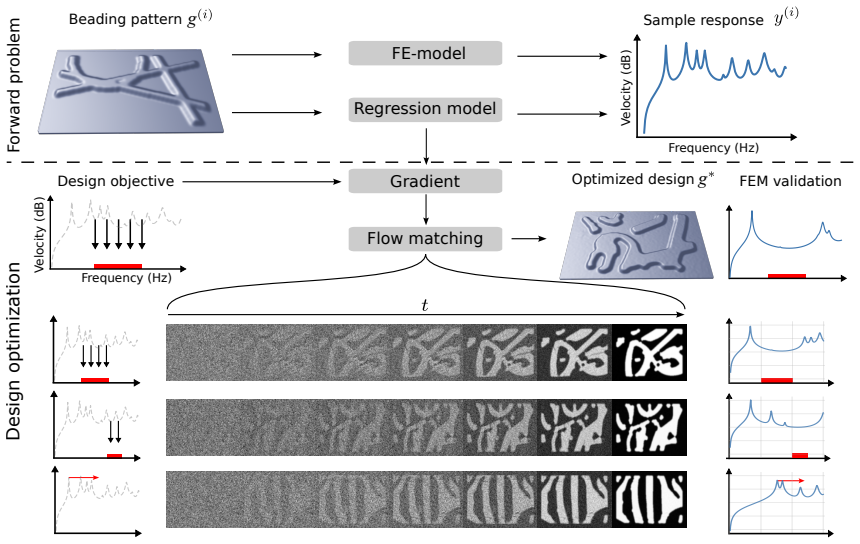
The load-bearing mechanism is guided flow matching: an ODE velocity model $v_{\mathrm{flow}}(x_t,t)$ trained to generate beading patterns from the training distribution is augmented with a guidance term, $v_{\mathrm{aug}}(x,t)=v_{\mathrm{flow}}(x,t)+\alpha\beta(t)\hat{\nabla}J$, where $\hat{\nabla}J$ is the gradient, rescaled to the norm of $v_{\mathrm{flow}}$, of an objective computed on the surrogate prediction $r(g,p,\Omega)\approx L_v(\Omega\mid g,p)$ with respect to the partially generated pattern. The cosine schedule $\beta(t)$ switches guidance off for $t\ge 0.75$ so the final generation steps stay close to the learned data manifold. The training data itself defines the manufacturable design space, and a postprocessing step of morphological opening, closing, and a custom convolution kernel enforces the geometric constraints C1–C4 (edge distance, bead height, flank angle, minimum length scale).
What would settle it
Take the 16 FEM-validated guided-flow-matching designs from the 100–200 Hz experiment and the best genetic-optimization designs; if physical forming trials or high-fidelity simulations show the guided designs crack, thin, or fail springback checks, or if their measured mean squared velocity advantage over the genetic baseline falls below roughly 2 dB, the paper's practical claim is weakened.
Extended reading notes
Core claim
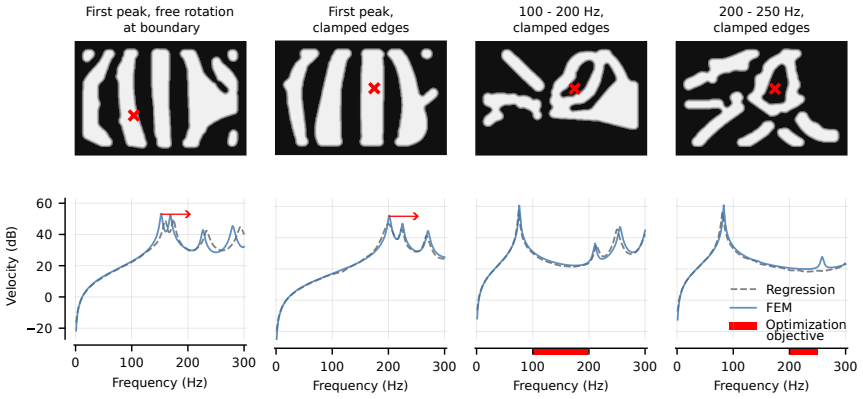
The paper's central claim is that guided flow matching produces manufacturable beading patterns with the lowest mean squared velocity level $L_v$ among all tested methods. For a simply supported plate, guided flow matching yields an additional reduction of 9% (2.4 dB) for the 100–200 Hz optimization range and 9% (2.1 dB) for the 200–250 Hz range compared with the second-best method, with the best generated patterns re-evaluated by FEM. The method is not tied to one objective: it minimizes averaged velocity in chosen bands, works for clamped and simply supported boundaries, and maximizes the first eigenfrequency through a differentiable softmax-mean objective. Generated patterns are diverse and obey the paper's four manufacturability constraints after postprocessing, though they are more complex and less regular than parametric baselines.
Load-bearing premise
The load-bearing premise is that the four simplified geometric constraints used to filter beading patterns capture enough of real manufacturability that patterns passing them can actually be formed from sheet metal without consequential defects.
Editorial extensions
If this is right
- If the central claim holds, beading-pattern optimization can find FEM-validated designs with about 9% lower mean squared velocity than the strongest tested baseline, in both the 100–200 Hz and 200–250 Hz bands.
- The same guided generation pipeline transfers to different boundary conditions, load positions, and objectives, including maximizing the first eigenfrequency, without retraining the generative model for each case.
- Because the design space is defined by training data rather than a 43-parameter representation, the optimizer can produce patterns that parametric baselines cannot express, including variable-width beadings and bulges.
- The method reaches its final result with far fewer neural function evaluations than genetic optimization: about 1312 generated plates within roughly 40,000 evaluations, in around 15 minutes on a single A100 GPU.
- Surrogate inaccuracies still leak into the optimized result: the FEM-validated outcome is on average 1.5 dB worse than the regression model predicted, so gains are bounded by surrogate quality.
Reading between the lines
- If the design-space-as-training-data idea generalizes, the same guided flow matching setup could be applied to other structural design tasks (damping material placement, curved shells, multi-component assemblies) whenever a differentiable surrogate exists; the authors name these as future work, not claimed results.
- The gap between surrogate prediction and FEM (about 1.5 dB) suggests that improving surrogate accuracy or explicitly penalizing out-of-distribution patterns could yield further vibration reductions than those reported.
- Because manufacturability is proxied by four geometric constraints, a direct test would be to physically form the generated patterns with single-point incremental forming and check for thinning, cracks, or springback; the paper's own limitations note that the complex patterns might be harder to manufacture.
- A testable extension is to fold the constraints into the flow itself via differentiable constraint terms instead of postprocessing, which the paper identifies as promising; this could reduce the residual 0.11% average pixel noncompliance.
Signed reviews
Editorial analysis
A structured set of objections, weighed in public.
Referee Report
Summary. The paper presents a design optimization method for placing beadings on plates to reduce structural vibrations. It combines a flow matching generative model trained on manufacturable beading patterns with a regression surrogate that predicts the mean squared velocity response; during generation, the flow matching ODE is augmented with a gradient term from the surrogate to minimize a user-defined objective (e.g., band-averaged Lv or first eigenfrequency). The proposed guided flow matching method is compared against random search, a rotation-criterion heuristic, and a genetic algorithm, with final designs selected via the surrogate and then validated by an external finite-element solver. The paper reports roughly 9% (2.4 dB) lower Lv than the best baseline in two target frequency ranges, plus experiments with different boundary conditions, loading positions, and objective functions, and ablations of guidance strength, ODE step size, gradient rescaling, and postprocessing.
Significance. If the FEM-validated performance ordering is robust, the method is a useful contribution: it demonstrates a generative-model-based design optimization loop that produces diverse beading patterns, supports multiple differentiable objectives, and is backed by external FEM validation rather than surrogate-only evaluation. The public release of code and data and the inclusion of a broad set of experiments and ablations are strengths. The main uncertainties are whether the advantage over baselines survives stronger baselines and an unguided control, and whether the geometric constraints truly support the stated manufacturability claim. These issues are addressable in revision.
major comments (5)
- [Section 4.1, Table 1] The method comparison does not include an unguided flow matching control (alpha = 0). Without this control, the reported advantage of 'Flow matching' cannot separate the benefit of guidance from the benefit of the generative prior defined by the flow matching model and its training data. The ablation in Figure 12a varies alpha but does not report alpha = 0 under the same selection protocol (same n and same k). Please add an unguided flow matching condition to Table 1 or otherwise explicitly report the alpha = 0 result with FEM validation.
- [Appendix B.2, Figure 9] The genetic algorithm baseline uses scipy's differential evolution with default mutation/recombination parameters, population size 10, and 100 iterations. This is a weak configuration, and Figure 9 indeed shows the genetic optimization curve improving very little over the optimization budget. Since the headline 9% (2.4 dB) improvement is measured relative to the second-best method, it is important to know whether the advantage persists against a stronger baseline, for example by tuning the GA or increasing its population and iteration count. Please provide a stronger baseline or justify the current choice as representative of a standard practical setting.
- [Section 4.1, Figure 9] The paper reports only an average 1.5 dB surrogate-to-FEM discrepancy, not the per-method discrepancy. If the surrogate is more accurate for patterns close to the training distribution (e.g., flow-matching-generated patterns) than for patterns produced by random search or GA, then selecting the k best designs via the same surrogate could systematically favor flow matching even if the FEM-validated ordering is different. Please report, for each method, the surrogate-predicted Lv and the FEM-validated Lv of the final selected designs, and discuss whether the selection bias changes the ordering.
- [Section 2.1 and Section 5, Limitations] The abstract and contributions describe the generated designs as 'manufacturable', but manufacturability is assessed only through the simplified geometric constraints C1-C4 and a postprocessing step. Section 5 explicitly concedes that the generated patterns 'might pose more difficulties' to manufacture than simpler patterns. The claim of manufacturability is therefore stronger than what the evidence supports. Please either qualify the manufacturability claim to 'satisfy the geometric constraints used in this work' or provide additional validation (e.g., forming simulations or stress-based checks) to support the stronger claim.
- [Section 4.1, Table 1] The statement 'reduction of 9 % (2.4 dB)' is potentially misleading because Lv is a logarithmic quantity in decibels. A 2.4 dB reduction corresponds to a reduction in mean squared velocity by a factor of 10^(-2.4/10) = 0.575, i.e., roughly 42% in physical units, not 9%. The 9% appears to be the relative reduction of the dB value (from 25.3 dB to 22.9 dB). Please clarify the definition of the percentage reduction and report physical units where appropriate so that readers do not misinterpret the headline number.
minor comments (5)
- [Section 1] There is a typo in the introduction: 'the flow matching model and it's training data' should be 'its training data'.
- [Figure 10] The caption lists 'Flow matching, Random search, Rotation criterion, Genetic optimization' but the legend order in the figure appears different; please align the caption and legend.
- [Table 1 and Appendix E] Table 1 reports 1,312 generated plates for flow matching, while Figures 13-16 in Appendix E state that the '4 best beading patterns' were selected from 1,600 generated patterns. Please clarify whether these are different experimental runs or whether the table and figures use different values of n.
- [Section 3.3, Equation (5)] In Equation (5), the guidance gradient is written as ∇J without an explicit subscript. Since the gradient is taken with respect to x_t, please write ∇_{x_t} J to avoid confusion with the gradient with respect to network weights.
- [Section 3.4] The text says 'the flow matching model and its training data implicitly define the design space', but the generation procedure requires specifying the number of generated plates n and the selection size k. Please state explicitly how n is chosen in the main experiments (e.g., n = 1600 or n = 1312) in one place.
Circularity Check
No significant circularity: the headline FEM-validated results are not produced by the fitted surrogate, and self-citations are not load-bearing.
full rationale
Walking the derivation chain, the fitted regression model r is trained on FEM-computed responses (Section 3.2: "We train a regression model r to predict the velocity field of the vibrations given a frequency Omega, a discretized beading pattern g and plate properties p"), and it is used only to guide sampling and to select k=4 candidates. The paper then states (Section 4): "Among the generated beading patterns, we select the k = 4 patterns with the best objective function value according to the regression model r and numerical simulation is performed to obtain validated optimization results." The reported 9% (2.4 dB / 2.1 dB) advantage is therefore based on independent FEM validation, not on the surrogate's own predictions. The guidance term in Equation 5, vaug = vflow + alpha*beta(t)*grad J, uses gradients of J(r(xt)) as a steering signal, but this is an optimization mechanism rather than a definition of the measured quantity; the paper explicitly acknowledges the surrogate-FEM gap in its Limitations ("the process can still exploit surrogate inaccuracies, leading to observed discrepancies (around 1.5 dB in our results) between predicted and validated performance"), confirming that surrogate and FEM results are not conflated. The fact that the flow matching model and its training data implicitly define the design space is an explicit modeling choice, not a way of baking in the result; baselines are compared on the same physical FEM model, so the central claim is not equivalent to its inputs by construction. Self-citations [2, 25] supply the regression architecture and a preliminary guided-diffusion study, but the models used here are retrained and independently validated in this paper, so those citations are not load-bearing reductions. Concerns about weak genetic-algorithm defaults, the absence of an unguided flow-matching control, and unreported per-method regression-to-FEM gaps are legitimate comparison-robustness questions, but they are not instances of circular reasoning under the stated criteria.
Assumptions & free parameters
free parameters (6)
- alpha (guidance strength) =
1.0
- beta(t) schedule parameters =
floor=0.1, cutoff t=0.75
- ODE step size =
0.05 (40 steps)
- top-k selection (k) and number of generated plates (n) =
k=4, n=1312 (main experiments)
- first eigenfrequency objective beta =
1
- beading geometry and constraint parameters =
h_bead=20 mm, alpha_F=70 deg, r_f=r_h=9.5 mm, edge distance=10 mm, l_min=10 mm
assumptions (5)
- domain assumption The Mindlin plate combined with a disk formulation and complex Young's modulus with constant loss factor accurately represents the vibroacoustic response of bead-stiffened plates.
- domain assumption The four constraints C1-C4 are sufficient proxies for manufacturability.
- domain assumption The surrogate model r predicts the frequency response accurately enough that its gradients are useful descent directions.
- domain assumption The flow matching model trained on 300k procedurally generated patterns samples the intended manufacturable design space.
- domain assumption Differential evolution with default parameters and a population size of 10 is a representative genetic optimization baseline.
Cite this review
Pith. "Pith review of Minimizing Structural Vibrations via Guided Flow Matching Design Optimization." pith.science (2026). https://pith.science/paper/QCJRY2KA
@misc{pith2026250615263,
  author       = {Pith},
  title        = {Pith review of: Minimizing Structural Vibrations via Guided Flow Matching Design Optimization},
  year         = {2026},
  howpublished = {\url{https://pith.science/paper/QCJRY2KA}},
  note         = {Machine review of arXiv:2506.15263}
}
read the original abstract
Structural vibrations are a source of unwanted noise in engineering systems like cars, trains or airplanes. Minimizing these vibrations is crucial for improving passenger comfort. This work presents a novel design optimization approach based on guided flow matching for reducing vibrations by placing beadings (indentations) in plate-like structures. Our method integrates a generative flow matching model and a surrogate model trained to predict structural vibrations. During the generation process, the flow matching model pushes towards manufacturability while the surrogate model pushes to low-vibration solutions. The flow matching model and its training data implicitly define the design space, enabling a broader exploration of potential solutions as no optimization of manually-defined design parameters is required. We apply our method to a range of differentiable optimization objectives, including direct optimization of specific eigenfrequencies through careful construction of the objective function. Results demonstrate that our method generates diverse and manufacturable plate designs with reduced structural vibrations compared to designs from random search, a criterion-based design heuristic and genetic optimization. The code and data are available from https://github.com/ecker-lab/Optimizing_Vibrating_Plates.
Figures


Figures from the paper (15 more)




Reference graph
Works this paper leans on
-
[1]
Auditory and non-auditory effects of noise on health
Mathias Basner, Wolfgang Babisch, Adrian Davis, Mark Brink, Charlotte Clark, Sabine Janssen, and Stephen Stansfeld. “Auditory and non-auditory effects of noise on health”. In: The Lancet 383.9925 (2014), pp. 1325–1332. doi: 10.1121/1.4920192
-
[2]
Learning to Predict Structural Vibrations
Jan van Delden, Julius Schultz, Christopher Blech, Sabine C. Langer, and Timo L¨ uddecke. “Learning to Predict Structural Vibrations”. In: The Thirty-eighth Annual Conference on Neural Information Processing Systems . 2024. url: https://openreview.net/forum?id= i4jZ6fCDdy
work page 2024
-
[3]
Deep un- supervised learning using nonequilibrium thermodynamics
Jascha Sohl-Dickstein, Eric Weiss, Niru Maheswaranathan, and Surya Ganguli. “Deep un- supervised learning using nonequilibrium thermodynamics”. In: International conference on machine learning. PMLR. 2015, pp. 2256–2265. url: https://proceedings.mlr.press/ v37/sohl-dickstein15.html
work page 2015
-
[4]
Denoising diffusion probabilistic models
Jonathan Ho, Ajay Jain, and Pieter Abbeel. “Denoising diffusion probabilistic models”. In: Advances in neural information processing systems 33 (2020), pp. 6840–6851
2020
-
[5]
Diffusion models beat gans on image synthesis
Prafulla Dhariwal and Alexander Nichol. “Diffusion models beat gans on image synthesis”. In: Advances in neural information processing systems 34 (2021), pp. 8780–8794
work page 2021
-
[6]
Score-based generative modeling through stochastic differential equations
Yang Song, Jascha Sohl-Dickstein, Diederik P Kingma, Abhishek Kumar, Stefano Ermon, and Ben Poole. “Score-based generative modeling through stochastic differential equations”. In: (2020). doi: 10.48550/arXiv.2011.13456
-
[7]
Flow matching for generative modeling
Yaron Lipman, Ricky TQ Chen, Heli Ben-Hamu, Maximilian Nickel, and Matt Le. “Flow matching for generative modeling”. In: arXiv preprint (2022). doi: 10.48550/arXiv.2210. 02747. 15
-
[8]
Improving and generalizing flow-based gen- erative models with minibatch optimal transport
Alexander Tong, Kilian Fatras, Nikolay Malkin, Guillaume Huguet, Yanlei Zhang, Jarrid Rector-Brooks, Guy Wolf, and Yoshua Bengio. “Improving and generalizing flow-based gen- erative models with minibatch optimal transport”. In:arXiv preprint (2023). doi: 10.48550/ arXiv.2302.00482
Show all 48 references
- [9]
-
[10]
Sit: Exploring flow and diffusion-based generative models with scalable interpolant transformers
Nanye Ma, Mark Goldstein, Michael S Albergo, Nicholas M Boffi, Eric Vanden-Eijnden, and Saining Xie. “Sit: Exploring flow and diffusion-based generative models with scalable interpolant transformers”. In: European Conference on Computer Vision . Springer. 2024, pp. 23–40. doi:...
2024 doi
- [11]
-
[12]
Glide: Towards photorealistic image generation and editing with text-guided diffusion models
Alex Nichol, Prafulla Dhariwal, Aditya Ramesh, Pranav Shyam, Pamela Mishkin, Bob Mc- Grew, Ilya Sutskever, and Mark Chen. “Glide: Towards photorealistic image generation and editing with text-guided diffusion models”. In: arXiv preprint (2021). doi: 10.48550/arXiv. 2112.10741
- [13]
-
[14]
Loss-guided diffusion models for plug-and-play control- lable generation
Jiaming Song, Qinsheng Zhang, Hongxu Yin, Morteza Mardani, Ming-Yu Liu, Jan Kautz, Yongxin Chen, and Arash Vahdat. “Loss-guided diffusion models for plug-and-play control- lable generation”. In:International Conference on Machine Learning. PMLR. 2023, pp. 32483– 32498. url: ht...
2023
-
[15]
Pseudoinverse-guided diffu- sion models for inverse problems
Jiaming Song, Arash Vahdat, Morteza Mardani, and Jan Kautz. “Pseudoinverse-guided diffu- sion models for inverse problems”. In: International Conference on Learning Representations. 2023
2023
-
[16]
Flowgrad: Controlling the output of generative odes with gradients
Xingchao Liu, Lemeng Wu, Shujian Zhang, Chengyue Gong, Wei Ping, and Qiang Liu. “Flowgrad: Controlling the output of generative odes with gradients”. In: Proceedings of the IEEE/CVF Conference on Computer Vision and Pattern Recognition . 2023, pp. 24335– 24344
2023
- [17]
-
[18]
Diffusion models beat gans on topology optimization
Fran¸ cois Maz´ e and Faez Ahmed. “Diffusion models beat gans on topology optimization”. In: Proceedings of the AAAI Conference on Artificial Intelligence (AAAI), Washington, DC
-
[19]
Aligning optimization trajectories with diffusion models for constrained design generation
Giorgio Giannone, Akash Srivastava, Ole Winther, and Faez Ahmed. “Aligning optimization trajectories with diffusion models for constrained design generation”. In: Advances in Neural Information Processing Systems 36 (2023), pp. 51830–51861. doi: 10.48550/arXiv.2305. 18470
2023 doi
-
[20]
Shipgen: A diffusion model for parametric ship hull generation with multiple objectives and constraints
Noah J Bagazinski and Faez Ahmed. “Shipgen: A diffusion model for parametric ship hull generation with multiple objectives and constraints”. In: Journal of Marine Science and Engineering 11.12 (2023), p. 2215. doi: 10.3390/jmse11122215
2023 doi
-
[21]
Compositional Generative Inverse Design
Tailin Wu, Takashi Maruyama, Long Wei, Tao Zhang, Yilun Du, Gianluca Iaccarino, and Jure Leskovec. “Compositional Generative Inverse Design”. In: The Twelfth International Conference on Learning Representations. 2024. url: https://openreview.net/forum?id= wmX0CqFSd7
2024
-
[22]
Inverse design of two- dimensional airfoils using conditional generative models and surrogate log-likelihoods
Qiuyi Chen, Jun Wang, Phillip Pope, Wei Chen, and Mark Fuge. “Inverse design of two- dimensional airfoils using conditional generative models and surrogate log-likelihoods”. In: Journal of Mechanical Design 144.2 (2022), p. 021712. doi: 10.1115/1.4052846
2022 doi
- [23]
- [24]
-
[25]
Minimizing Structural Vibrations via Guided Diffusion Design Optimization
Jan van Delden, Julius Schultz, Christopher Blech, Sabine C Langer, and Timo L¨ uddecke. “Minimizing Structural Vibrations via Guided Diffusion Design Optimization”. In: ICLR 2024 Workshop on AI4DifferentialEquations In Science . 2024. url: https://openreview. net/forum?id=z4dcQodnoo
2024
-
[26]
Design and placement of passive acoustic measures in early design phases
Sebastian Rothe. Design and placement of passive acoustic measures in early design phases . Vol. 2. Schriften des Instituts f¨ ur Akustik. Dissertation, Technische Universit¨ at Braunschweig,
-
[27]
Shape optimization of a vehicle hat-shelf: im- proving acoustic properties for different load cases by maximizing first eigenfrequency
Steffen Marburg and Hans-J¨ urgen Hardtke. “Shape optimization of a vehicle hat-shelf: im- proving acoustic properties for different load cases by maximizing first eigenfrequency”. In: Computers & Structures 79.20-21 (2001), pp. 1943–1957. doi: 10.1016/S0045- 7949(01) 00107-9
2001 doi
-
[28]
Optimization of structure-borne sound popaga- tion using structural intensity
Sebastian Rothe and Sabine C. Langer. “Optimization of structure-borne sound popaga- tion using structural intensity”. In: PAMM 19.1 (2019), e201900482. doi: 10.1002/pamm. 201900482
2019 doi
-
[29]
Steife Blech-und Kunststoffkonstruktionen
Gerhard Oehler and Anton Weber. Steife Blech-und Kunststoffkonstruktionen . Springer,
-
[30]
Festigkeits-und Steifigkeitsverhal- ten von d¨ unnen Blechen mit Sicken
Tilman Schriever, Frank Herrmann, and J¨ urgen Maiwald. Festigkeits-und Steifigkeitsverhal- ten von d¨ unnen Blechen mit Sicken. FAT, 1994
1994
-
[31]
Handbuch Konstruktion
Frank Rieg and Rolf Steinhilper. Handbuch Konstruktion . M¨ unchen: Carl Hanser Verlag GmbH & Co. KG, June 2018. isbn: 978-3-446-45224-4
2018
-
[32]
Auslegung von Blechen mit Sicken (Sickenatlas)
Dominik Schwarz. Auslegung von Blechen mit Sicken (Sickenatlas) . Vol. 168. FAT-Schrift- enreihe. Frankfurt/M.: FAT, 2002, p. 255. url: https://publications.rwth-aachen.de/ record/96309
2002
-
[33]
Optimal shape design of shell structures
Matthias Firl. “Optimal shape design of shell structures”. PhD thesis. Technische Universit¨ at M¨ unchen, 2010.url: https://mediatum.ub.tum.de/?id=981720
2010
-
[34]
Praxisfahiges Werkzeug zur Konturoptimierung
B Klein and D Freitag. “Praxisfahiges Werkzeug zur Konturoptimierung”. In: Technica- Zurich 44.22 (1995), pp. 27–40
1995
-
[35]
A new approach for optimization of sheet metal components
A Albers, H Weiler, D Emmrich, and B Lauber. “A new approach for optimization of sheet metal components”. In: Advanced Materials Research 6 (2005), pp. 255–262. doi: 10.4028/ www.scientific.net/AMR.6-8.255
2005
-
[36]
Strukturintensit¨ atsanalyse als Werkzeug der Maschinenakustik
Thorsten Hering. “Strukturintensit¨ atsanalyse als Werkzeug der Maschinenakustik”. PhD the- sis. Technische Universit¨ at Darmstadt, 2012.url: http://tuprints.ulb.tu-darmstadt. de/2991/
2012
-
[37]
Manufacture of bead-stiffened panels using the single point incremental sheet forming technique
Bogdan Krasowski, Andrzej Kubit, Tomasz Trzepieci´ nski, and Jan Slota. “Manufacture of bead-stiffened panels using the single point incremental sheet forming technique”. In: Archives of Metallurgy and Materials 67.4 (2022), pp. 1305–1314. doi: 10.24425/amm.2022. 141056
2022 doi
-
[38]
Formability consideration during bead optimisation to stiffen deep drawn parts
Wan-Gi Cha, Sabrina M¨ uller, Albert Albers, and Wolfram Volk. “Formability consideration during bead optimisation to stiffen deep drawn parts”. In: Production Engineering 12 (2018), pp. 691–702. doi: 10.1007/s11740-018-0850-z
2018 doi
-
[39]
Development and statistical evaluation of manufacturing-oriented bead patterns
Neven Majic, Albert Albers, Marcel Kalmbach, and Peter M Clausen. “Development and statistical evaluation of manufacturing-oriented bead patterns”. In: Advances in Engineering Software 57 (2013), pp. 40–47. doi: 10.1016/j.advengsoft.2012.11.018
2013 doi
-
[40]
Morphology-based black and white filters for topology optimization
Ole Sigmund. “Morphology-based black and white filters for topology optimization”. In: Structural and Multidisciplinary Optimization 33.4 (2007), pp. 401–424. doi: 10 . 1007 / s00158-006-0087-x
2007
- [41]
-
[42]
Neural ordi- nary differential equations
Ricky TQ Chen, Yulia Rubanova, Jesse Bettencourt, and David K Duvenaud. “Neural ordi- nary differential equations”. In:Advances in neural information processing systems31 (2018). 17
2018
-
[43]
Sreekumar and Sabine C
Harikrishnan K. Sreekumar and Sabine C. Langer. elPaSo Core - Elementary parallel solver core module for high performance vibroacoustic simulations. 2023. doi: 10.24355/dbbs.084- 202301301305-0. url: https://doi.org/10.24355/dbbs.084-202301301305-0
2023 doi
-
[44]
PyTorch: An Imperative Style, High-Performance Deep Learning Li- brary
Adam Paszke et al. “PyTorch: An Imperative Style, High-Performance Deep Learning Li- brary”. In: Advances in Neural Information Processing Systems . Ed. by H. Wallach, H. Larochelle, A. Beygelzimer, F. d’Alch´ e-Buc, E. Fox, and R. Garnett. Vol. 32. Curran As- sociates, Inc., ...
2019
-
[45]
Differential evolution–a simple and efficient heuristic for global optimization over continuous spaces
Rainer Storn and Kenneth Price. “Differential evolution–a simple and efficient heuristic for global optimization over continuous spaces”. In: Journal of global optimization 11 (1997), pp. 341–359. doi: 10.1023/A:1008202821328. 18 Appendix A Plate model A.1 Properties Table 2: ...
1997 doi
-
[1972]
doi: 10.1007/978-3-642-99997-0
-
[2022]
D¨ uren: Shaker, 2022.doi: 10.24355/dbbs.084-202208100945-0
2022 doi
-
[2023]
doi: 10.1609/aaai.v37i8.26093
Reviewed August 15, 2026 · model on record in the stance chip above.
Discussion (0). Continue with ORCID to comment.