REVIEW 3 major objections 4 minor 49 references
A theory of Lending Protocols in DeFi
T0 review · 3 major / 4 minor · reviewed 2026-08-15 · deepseek-v4-flash
Pith's one-line read The paper builds a state-machine model of DeFi lending and proves invariant laws plus conditions under which price and utilization manipulation attacks succeed.
desk verdict A valuable formal model of DeFi lending protocols, but Theorem 5.1(1) is false as stated because the deposit front-running threshold is missing an exchange-rate factor, so the paper needs revision before I'd rely on it. read the letter →
The pith
A machine-rendered reading of the paper's core claim, the machinery that carries it, and where it could break.
The reading
What carries the argument
The central object is the lending-pool state machine: states are triples $\Gamma = (\omega,\Lambda,\pi)$ holding wallet balances, the lending-pool function (reserves plus per-user credit and debit tokens), and a price oracle. The load-bearing definitions are the exchange rate $XR_\Lambda(T) = (\Lambda(T) + S_\Lambda(T^d))/S_\Lambda(T^c)$ (with value 1 when no credit tokens exist), net worth $W_\Gamma(A)$, health factor $H_\Lambda(A) = T_{\mathrm{liq}}\cdot W^c_\Lambda(A)/W^d_\Lambda(A)$, utilization $U_\Lambda(T) = S_\Lambda(T^d)/(\Lambda(T)+S_\Lambda(T^d))$, and the linear utilization interest rate $I_\Lambda(T) = \alpha\, U_\Lambda(T) + \beta$. The seven transition rules (deposit, borrow, repay, redeem, liquidation, interest accrual, price update) plus a swap action are what carry the proofs: they directly determine how exchange rates, net worth, and health factors evolve, making the invariants and attack thresholds derivable as theorems.
What would settle it
Run a fork of Aave v1 with the paper's parameters and execute the Theorem 6.1 sequence (deposit, price drop by $\delta > \pi(T_2)(1-T_{\mathrm{liq}})$, borrow, restore price): if the attacker's net position is not negative after restoring the price, the model's continuity and no-fee abstractions fail. Alternatively, scan historical Aave blocks containing no oracle updates and check whether the sum of all users' net worth is exactly preserved; any deviation caused by fees, rounding, or interest-trigger mechanics would falsify the transfer of Theorem 3.6 to the real protocol.
Extended reading notes
Core claim
The central discovery is a formal operational model of lending protocols, defined as a labelled transition system over blockchain states that include user wallets, a lending-pool state, and a price oracle. Using this model, the paper proves that exchange rates are monotone under interest accrual (Lemma 3.4), that the sum of all users' net worth is preserved by every action except price updates (Theorem 3.6), and that liquidations are the only user actions that change the net worth of the participants, transferring value from the liquidated borrower to the liquidator in proportion to the liquidation reward (Lemma 4.1). It also proves that a user who anticipates a price update can always improve her gain by front-running it with a swap (Theorem 5.2), while no simple action guarantees a gain before an interest accrual unless the interest rate is constant (Theorem 5.4). Finally, it gives formal success conditions for attacks: Theorem 6.1 shows a price decrease exceeding a threshold derived from the liquidation threshold lets an attacker with no prior credit or debt borrow into a negative net position, Theorems 6.2 shows a small price drop can make a targeted borrower liquidatable, and Theorems 6.3 and 6.4 show how depositing or borrowing before an interest accrual, under a utilization-based rate, transfers value away from other users.
Load-bearing premise
The whole edifice rests on the assumption that the abstract state machine in Section 2 faithfully captures the economically relevant behavior of real lending protocols, despite continuous token balances, no fees, no flash loans, fixed protocol parameters, and interest rates that depend only on aggregate reserves, credits, and debits.
Editorial extensions
If this is right
- Total net worth conservation (Theorem 3.6) means that, away from price updates, any profit one user extracts through liquidation is exactly another user's loss: the protocol itself is value-neutral, so liquidation incentives are purely redistributive.
- Exchange-rate monotonicity under interest accrual (Lemma 3.4) implies that credit tokens always appreciate relative to their underlying base tokens whenever there is outstanding debt, which is what makes supplying liquidity yield-bearing.
- Theorem 5.2 says that a user who can spot an impending price change and swap just before it always obtains a strictly higher gain, with the bonus proportional to the swapped amount and the price shift; no other lending action changes the outcome of a foreseen price update.
- The threshold in Theorem 6.1, $\delta > \pi(T_2)(1-T_{\mathrm{liq}})$, gives a concrete, checkable condition under which a temporary price fall lets an attacker with zero prior exposure borrow into a negative net position and default on the difference.
- Theorems 6.3 and 6.4 show that any utilization-dependent rate with $\alpha > 0$ is exploitable: a well-timed deposit or borrow before an interest accrual transfers value from other users to the attacker, so such rates are stable only in the constant-rate case $\alpha = 0$.
Reading between the lines
- The net-worth conservation theorem suggests that on-chain liquidation mechanisms are zero-sum at the level of users: the liquidation reward $R_{\mathrm{liq}}>1$ is always paid by the liquidated borrower, so an empirical check on historical Aave blocks could verify whether aggregate liquidator gains are indeed offset by liquidated borrowers' losses (plus fees and rounding).
- Theorem 5.2 identifies swap-before-price-update as a canonical form of maximal extractable value in lending protocols, and it implies that oracle designs with delayed or time-weighted prices would break the theorem's premise that the price update is known and atomic with the swap, thereby neutralizing the front-run.
- The utilization-attack theorems suggest a concrete design safeguard: if interest rates are made Lipschitz-bounded in utilization, or if utilization is measured with a delay or an average rather than instantaneously, the magnitude of the value transfer in Theorems 6.3 and 6.4 would be damped even when $\alpha > 0$.
- The paper's monotonicity results imply that any fee, rounding rule, or flash-loan feature added to a real protocol introduces a source of value creation or destruction that the invariant theorems do not capture; each such feature could be tested in isolation by checking whether it breaks net-worth conservation in a forks of the state machine.
Signed reviews
Editorial analysis
A structured set of objections, weighed in public.
Referee Report
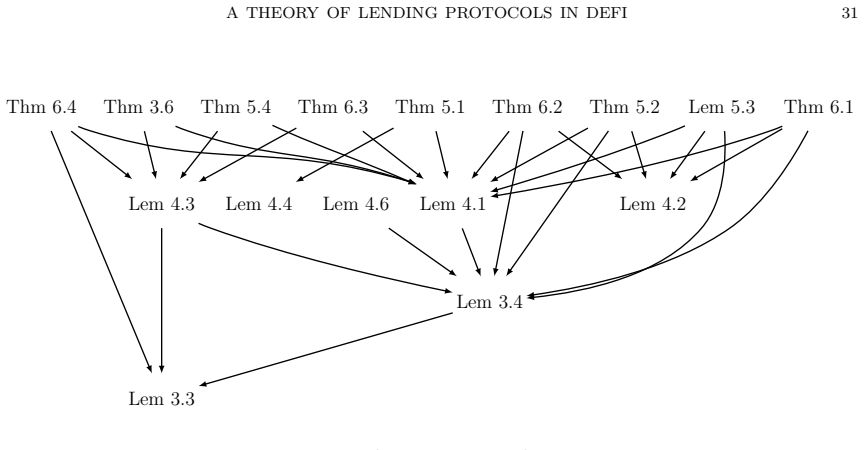
Summary. The paper proposes a formal operational model of DeFi lending protocols as a labelled transition system over blockchain states, with wallets, lending pools, exchange rates, token prices, collateralization, health factors, and interest accrual. It proves invariants (determinism, base-token preservation, exchange-rate monotonicity, total net-worth preservation), analyzes the effect of each transaction on net worth and health factor, derives front-running strategies for impending liquidations, price updates, and interest accruals, and characterizes price-manipulation and utilization-manipulation attacks. Proofs are provided in appendices with a dependency graph.
Significance. If correct, this would be a valuable formal foundation for reasoning about the incentive structure of mainstream lending protocols. The paper's strengths are its clean axiomatic semantics, the explicit dependency graph for proofs, the breadth of analyzed scenarios, and the concreteness of the attack conditions in Theorems 6.1-6.4, which yield falsifiable predictions. However, the presence of incorrect algebraic statements in advertised results means the current version is not yet reliable as a reference.
major comments (3)
- [Theorem 5.1(1), Appendix C] The threshold for the deposit strategy against an impending liquidation is incorrect. Under [Dep], depositing v units of T creates v/XR credits, each worth XR * pi(T), so the creditor value increases by exactly v*pi(T). The post-deposit health factor is therefore H' = (Wc + v*pi(T))/Wd * Tliq, giving the threshold v >= (Wd/Tliq - Wc)/pi(T), without the factor XR. The proof writes v/XR * pi in the numerator, silently dropping an XR factor. A concrete counterexample: XR=2, pi(T)=1, Wc=100, Wd=150, Tliq=2/3. The theorem requires v >= 250, but v=200 gives H' = (100+200)/150 * 2/3 = 4/3 >= 1, which disables the liquidation. The iff claim is false as stated.
- [Lemma 4.1(4), Section 4 and Appendix B] The stated equality gA(Γ,X) = -gB(Γ,X) = v*pi(T0)*Rliq is false. A liquidator pays v*pi(T0) in base tokens and receives credit tokens worth v*pi(T0)*Rliq, so her net gain is (Rliq-1)*v*pi(T0). The proof in Appendix B correctly derives gA = (Rliq-1)*v*pi(T0) and gB = (1-Rliq)*v*pi(T0). The statement in Section 4 should use the factor (Rliq-1), not Rliq. This is a load-bearing error because Lemma 4.1 is cited as a central economic characterization of user actions.
- [Section 7 and Theorems 6.2-6.4] The paper does not quantify the gap between the abstract model and concrete protocols, despite claiming to capture the essential features of mainstream platforms. The theorems in Section 6 assume uniform Tliq and Rliq, no fees, no flash loans, atomic price-update bundles, and cost-free oracle manipulation. For example, Theorem 6.2's liquidation attack sequence includes price updates px as free transactions; in reality, moving an AMM-based oracle has a capital cost that must be netted against the liquidation gain. The authors should either prove robustness of the strategic conclusions under these extensions or explicitly restrict the claims to the abstract model.
minor comments (4)
- [Section 2.3] The text has a typo: 'greter' should be 'greater' in the interest accrual rule discussion.
- [Appendix D, proof of Theorem 6.2] In the parenthetical price assignment, 'pi1(T2)=δ, pi1(T1)=pi(T1)' is inverted; the subsequent computation correctly uses pi1(T1)=δ and pi1(T2)=pi(T2). Please fix the parenthetical.
- [Lemma 4.4 proof] The case analysis for Wd=0 contains an inconsistent sentence: it says 'if Wd=0, the health factor cannot increase' but then enumerates cases where increased credits imply an increased health factor. This should be reworded to clarify that the health factor is already infinite when there is no debt.
- [Throughout] Some phrases use 'utility-based' where 'utilization-based' is meant (e.g., in the discussion of the linear interest rate function). A careful proofreading pass is recommended.
Circularity Check
No circularity: the theorems are derived from the stated state-machine axioms by direct algebraic proofs, with no fitted parameters or load-bearing self-citations.
full rationale
The paper builds a formal state-machine model in Section 2, then proves structural invariants (Section 3), single-action effects (Section 4), strategic optimality conditions (Section 5), and attack conditions (Section 6) directly from those definitions. Each result is justified by an explicit proof in the appendices; e.g., Lemma 3.4 follows by algebra from the exchange-rate definition (2.2) and the transition rules, Theorem 3.6 follows from the gain decomposition in Lemmas 4.1 and 4.3, and the strategy theorems in Section 5 are derived from the health-factor and gain formulas rather than assumed. The model does involve choices, such as continuous token amounts, no fees, and the linear utilization interest rate (2.15), but these are stated assumptions rather than conclusions smuggled into theorems. The attacks in Section 6 are proven under explicit hypotheses about the adversary's position; the theorems do not presuppose the claimed attack outcome. Self-citations such as [BCL21] and [BCJ+22] are used for motivation, related work, and context (e.g., 'key inspiration for our model'), but no load-bearing proof step rests on an unverified prior result by the same authors; no uniqueness theorem is imported, and no parameter is fitted to data and then renamed as a prediction. The paper is therefore self-contained as a formal derivation, and any errors in specific formulas (e.g., the disputed deposit threshold in Theorem 5.1(1)) would be correctness defects, not circularity.
Assumptions & free parameters
free parameters (3)
- Tliq (liquidation threshold) =
2/3 in examples; otherwise symbolic
- Rliq (liquidation reward factor) =
1.1 in example; otherwise symbolic
- alpha, beta (linear utilization interest rate) =
alpha=0, beta=0.12 in example; alpha>0, beta>0 in Theorems 5.4, 6.3, 6.4
assumptions (6)
- domain assumption Token amounts are nonnegative real numbers (Section 2.1).
- domain assumption Interest rate IΛ(T) is strictly positive and depends only on Λ(T), SΛ(Tc), and SΛ(Td), independent of the distribution across users (Eq. 2.13).
- domain assumption Price oracle updates are performed by a special user and can be arbitrarily manipulated, enabling the formal attacks in Section 6.
- ad hoc to paper Swap actions [Swp] do not change prices; price-changing swaps are represented as [Swp] followed by [Px] (Section 2.3).
- domain assumption Liquidation can repay any fraction of debt subject to post-health-factor <= 1 and seizes only credit tokens (Section 2.3, [Liq]).
- domain assumption No flash loans, fees, or governance changes are modeled (Section 7).
invented entities (2)
-
Credit tokens Tc and debit tokens Td
independent evidence
-
Exchange rate XRΛ(T)
independent evidence
Cite this review
Pith. "Pith review of A theory of Lending Protocols in DeFi." pith.science (2026). https://pith.science/paper/FKUZ6EB5
@misc{pith2026250615295,
  author       = {Pith},
  title        = {Pith review of: A theory of Lending Protocols in DeFi},
  year         = {2026},
  howpublished = {\url{https://pith.science/paper/FKUZ6EB5}},
  note         = {Machine review of arXiv:2506.15295}
}
read the original abstract
Lending protocols are one of the main applications of Decentralized Finance (DeFi), enabling crypto-assets loan markets with a total value estimated in the tens of billions of dollars. Unlike traditional lending systems, these protocols operate without relying on trusted authorities or off-chain enforcement mechanisms. To achieve key economic goals such as stability of the loan market, they devise instead trustless on-chain mechanisms, such as rewarding liquidators who repay the loans of under-collateralized borrowers by awarding them part of the borrower's collateral. The complexity of these incentive mechanisms, combined with their entanglement in low-level implementation details, makes it challenging to precisely assess the structural and economic properties of lending protocols, as well as to analyze user strategies and attacks. Crucially, since participation is open to anyone, any weaknesses in the incentive mechanism may give rise to unintended emergent behaviours, or even enable adversarial strategies aimed at making profits to the detriment of legit users, or at undermining the stability of the protocol. In this work, we propose a formal model of lending protocols that captures the essential features of mainstream platforms, enabling us to identify and prove key properties related to their economic and strategic dynamics.
Figures


Reference graph
Works this paper leans on
-
[1]
Aave maximum liquidation amount, 2020. https://github.com/aave/aave-protocol/blob/efaeed363da70c64b5272bd4b8f468063ca5c361/contracts/lendingpool/LendingPoolLiquidationManager.sol#L181
work page 2020
-
[2]
Aave v1 flashloan receiver interface, 2020. https://github.com/aave/aave-protocol/blob/efaeed363da70c64b5272bd4b8f468063ca5c361/contracts/flashloan/interfaces/IFlashLoanReceiver.sol#L11
work page 2020
-
[3]
https://github.com/aave/aave-protocol/
Aave v1 implementation, 2020. https://github.com/aave/aave-protocol/
work page 2020
-
[4]
Aave markets website, 2025. https://app.aave.com/markets
work page 2025
- [5]
-
[6]
Improved price oracles: Constant function market makers
Guillermo Angeris and Tarun Chitra. Improved price oracles: Constant function market makers. In ACM Conference on Advances in Financial Technologies ( AFT ) , pages 80--91. ACM , 2020. https://arxiv.org/abs/2003.10001
arXiv 2020
-
[7]
https://cryptonews.com/news/defi-akropolis-drops-20-following-a-usd-2m-heavy-hack-8299.htm
Akropolis Defi attack , 2020. https://cryptonews.com/news/defi-akropolis-drops-20-following-a-usd-2m-heavy-hack-8299.htm
work page 2020
-
[8]
SecPLF : Secure protocols for loanable funds against oracle manipulation attacks
Sanidhay Arora, Yingjiu Li, Yebo Feng, and Jiahua Xu. SecPLF : Secure protocols for loanable funds against oracle manipulation attacks. In ACM Asia Conference on Computer and Communications Security ( ASIA CCS ) . ACM , 2024
work page 2024
Show all 49 references
-
[9]
MEV on Ethereum : A policy analysis
Mikolaj Barczentewicz. MEV on Ethereum : A policy analysis. ICLE White Paper, 2023
2023
-
[10]
Junttila, Alberto Lluch - Lafuente, Massimiliano Mirelli, and Andrea Vandin
Massimo Bartoletti, James Hsin - yu Chiang, Tommi A. Junttila, Alberto Lluch - Lafuente, Massimiliano Mirelli, and Andrea Vandin. Formal analysis of Lending Pools in Decentralized Finance . In ISoLA , volume 13703 of LNCS , pages 335--355. Springer, 2022
2022
-
[11]
SoK: Lending Pools in Decentralized Finance
Massimo Bartoletti, James Hsin - yu Chiang, and Alberto Lluch - Lafuente. SoK: Lending Pools in Decentralized Finance . In Workshop on Trusted Smart Contracts , volume 12676 of LNCS , pages 553--578. Springer, 2021
2021
-
[12]
A theory of Automated Market Makers in DeFi
Massimo Bartoletti, James Hsin - yu Chiang, and Alberto Lluch - Lafuente. A theory of Automated Market Makers in DeFi . Logical Methods in Computer Science , 18(4), 2022
2022
-
[13]
Formal verification in Solidity and Move : Insights from a comparative analysis
Massimo Bartoletti, Silvia Crafa, and Enrico Lipparini. Formal verification in Solidity and Move : Insights from a comparative analysis. In Workshop on Formal Methods for Blockchains ( FMBC ) , volume 129 of OASIcs , pages 3:1--3:18. Schloss Dagstuhl - Leibniz-Zentrum f \" u r...
2025
-
[14]
Optimal risk-aware interest rates for decentralized lending protocols
Bastien Baude, Damien Challet, and Ioane Muni Toke. Optimal risk-aware interest rates for decentralized lending protocols . Working Papers hal-04971758, HAL, February 2025
2025
-
[15]
Automated market makers and their implications for liquidity providers
Werner Br \"o nnimann, Pascal Egloff, and Thomas Krabichler. Automated market makers and their implications for liquidity providers. Digital Finance , 6(3):573--604, Sep 2024
2024
-
[16]
DeFi composability as MEV non-interference
Massimo Bartoletti, Riccardo Marchesin, and Roberto Zunino. DeFi composability as MEV non-interference. In Financial Cryptography and Data Security , volume 14745 of LNCS , pages 369--387. Springer, 2024
2024
-
[17]
Thinking Fast and Slow: Data-Driven Adaptive DeFi Borrow-Lending Protocol
Mahsa Bastankhah, Viraj Nadkarni, Chi Jin, Sanjeev Kulkarni, and Pramod Viswanath. Thinking Fast and Slow: Data-Driven Adaptive DeFi Borrow-Lending Protocol . In Rainer B\" o hme and Lucianna Kiffer, editors, 6th Conference on Advances in Financial Technologies (AFT 2024) , vo...
2024
-
[18]
Agilerate: Bringing adaptivity and robustness to defi lending markets
Mahsa Bastankhah, Viraj Nadkarni, Xuechao Wang, and Pramod Viswanath. Agilerate: Bringing adaptivity and robustness to defi lending markets. CoRR , abs/2410.13105, 2024
2024 arXiv
-
[19]
A theoretical basis for MEV
Massimo Bartoletti and Roberto Zunino. A theoretical basis for MEV . In Financial Cryptography and Data Security , LNCS. Springer, 2025. To appear
2025
-
[20]
Flashsyn: Flash loan attack synthesis via counter example driven approximation
Zhiyang Chen, Sidi Mohamed Beillahi, and Fan Long. Flashsyn: Flash loan attack synthesis via counter example driven approximation. In Proceedings of the IEEE/ACM 46th International Conference on Software Engineering , ICSE '24, New York, NY, USA, 2024. Association for Computin...
2024
-
[21]
Why stake when you can borrow? Available at SSRN 3629988 , 2020
Tarun Chitra and Alex Evans. Why stake when you can borrow? Available at SSRN 3629988 , 2020. https://arxiv.org/abs/2006.11156
2020 arXiv
-
[22]
Attacks on dynamic defi interest rate curves, 2023
Tarun Chitra, Peteris Erins, and Kshitij Kulkarni. Attacks on dynamic defi interest rate curves, 2023
2023
-
[23]
Competitive equilibria between staking and on-chain lending
Tarun Chitra. Competitive equilibria between staking and on-chain lending. arXiv preprint arXiv:2001.00919 , 2019. https://arxiv.org/abs/2001.00919
2001 arXiv
-
[24]
https://app.compound.finance/markets
Compound markets website, 2025. https://app.compound.finance/markets
2025
-
[25]
https://compound.finance/
Compound website, 2025. https://compound.finance/
2025
-
[26]
The economics of interest rate models in decentralised lending protocols
Samuel Cohen, Leandro Sánchez-Betancourt, and Lukasz Szpruch. The economics of interest rate models in decentralised lending protocols. SSRN Electronic Journal , 01 2023
2023
-
[27]
Optimal Bidding Strategy for Maker Auctions
Michael Darlin, Nikolaos Papadis, and Leandros Tassiulas. Optimal Bidding Strategy for Maker Auctions . arXiv preprint arXiv:2009.07086 , 2020. https://arxiv.org/abs/2009.07086
2009 arXiv
-
[28]
Price oracle accuracy across blockchains: A measurement and analysis
Robin Gans\"auer, Hichem Ben Aoun, Jan Droll, and Hannes Hartenstein. Price oracle accuracy across blockchains: A measurement and analysis. In International Workshop on Cryptoasset Analytics (CAAW) , 2025
2025
-
[29]
The decentralized financial crisis
Lewis Gudgeon, Daniel P \' e rez, Dominik Harz, Benjamin Livshits, and Arthur Gervais. The decentralized financial crisis. In Crypto Valley Conference on Blockchain Technology ( CVCBT ) , pages 1--15. IEEE , 2020
2020
-
[30]
Empirical measurements on pricing oracles and decentralized governance for stablecoins
Wanyun Catherine Gu, Anika Raghuvanshi, and Dan Boneh. Empirical measurements on pricing oracles and decentralized governance for stablecoins. Available at SSRN 3611231 , 2020. http://dx.doi.org/10.2139/ssrn.3611231
2020 doi
-
[31]
DeFi protocols for loanable funds: Interest rates, liquidity and market efficiency
Lewis Gudgeon, Sam Werner, Daniel Perez, and William J Knottenbelt. DeFi protocols for loanable funds: Interest rates, liquidity and market efficiency. In ACM Conference on Advances in Financial Technologies , pages 92--112, 2020
2020
-
[32]
https://medium.com/harvest-finance/harvest-flashloan-economic-attack-post-mortem-3cf900d65217
Harvest Finance flashloan attack post-mortem , 2020. https://medium.com/harvest-finance/harvest-flashloan-economic-attack-post-mortem-3cf900d65217
2020
-
[33]
Ethereum's proposer-builder separation: Promises and realities
Lioba Heimbach, Lucianna Kiffer, Christof Ferreira Torres, and Roger Wattenhofer. Ethereum's proposer-builder separation: Promises and realities. In Proc. ACM on Internet Measurement Conference ( IMC ) , pages 406--420. ACM , 2023
2023
-
[34]
Regulatory implications of MEV mitigations
Yan Ji and James Grimmelmann. Regulatory implications of MEV mitigations. In Financial Cryptography Workshops , volume 14746 of LNCS , pages 335--363. Springer, 2024
2024
-
[35]
An Analysis of the Market Risk to Participants in the Compound Protocol
Hsien-Tang Kao, Tarun Chitra, Rei Chiang, and John Morrow. An Analysis of the Market Risk to Participants in the Compound Protocol . 2020. https://scfab.github.io/2020/FAB2020_p5.pdf
2020
-
[36]
TWAP oracle attacks: Easier done than said? In IEEE International Conference on Blockchain and Cryptocurrency ( ICBC ) , pages 1--8
Torgin Mackinga, Tejaswi Nadahalli, and Roger Wattenhofer. TWAP oracle attacks: Easier done than said? In IEEE International Conference on Blockchain and Cryptocurrency ( ICBC ) , pages 1--8. IEEE , 2022
2022
-
[37]
Sok: A classification framework for stablecoin designs
Amani Moin, Kevin Sekniqi, and Emin G \" u n Sirer. Sok: A classification framework for stablecoin designs. In Financial Cryptography and Data Security , volume 12059 of LNCS , pages 174--197. Springer, 2020
2020
-
[38]
Adaptive Curves for Optimally Efficient Market Making
Viraj Nadkarni, Sanjeev Kulkarni, and Pramod Viswanath. Adaptive Curves for Optimally Efficient Market Making . In Rainer B\" o hme and Lucianna Kiffer, editors, 6th Conference on Advances in Financial Technologies (AFT 2024) , volume 316 of Leibniz International Proceedings i...
2024
-
[39]
https://cryptonews.com/news/4th-major-defi-hack-in-a-month-origin-dollar-loses-usd-7m-8331.htm
Origin Dollar attack , 2020. https://cryptonews.com/news/4th-major-defi-hack-in-a-month-origin-dollar-loses-usd-7m-8331.htm
2020
-
[40]
Werner, Jiahua Xu, and Benjamin Livshits
Daniel Perez, Sam M. Werner, Jiahua Xu, and Benjamin Livshits. Liquidations: DeFi on a knife-edge. In Financial Cryptography , volume 12675 of LNCS , pages 457--476. Springer, 2021
2021
-
[41]
Mitigating decentralized finance liquidations with reversible call options
Kaihua Qin, Jens Ernstberger, Liyi Zhou, Philipp Jovanovic, and Arthur Gervais. Mitigating decentralized finance liquidations with reversible call options. In Foteini Baldimtsi and Christian Cachin, editors, Financial Cryptography and Data Security , pages 344--362, Cham, 2024...
2024
-
[42]
Attacking the DeFi ecosystem with flash loans for fun and profit
Kaihua Qin, Liyi Zhou, Benjamin Livshits, and Arthur Gervais. Attacking the DeFi ecosystem with flash loans for fun and profit. In Financial Cryptography , volume 12674 of LNCS , pages 3--32. Springer, 2021
2021
-
[43]
Pricing and hedging of decentralised lending contracts, 09 2024
Lukasz Szpruch, Marc Vidales, Tanut Treetanthiploet, and Yufei Zhang. Pricing and hedging of decentralised lending contracts, 09 2024
2024
-
[44]
Contagion in decentralized lending protocols: A case study of compound
Natkamon Tovanich, Myriam Kassoul, Simon Weidenholzer, and Julien Prat. Contagion in decentralized lending protocols: A case study of compound. In Proceedings of the 2023 Workshop on Decentralized Finance and Security , DeFi '23, page 55–63, New York, NY, USA, 2023. Associatio...
2023
-
[45]
Rolling in the shadows: Analyzing the extraction of MEV across layer-2 rollups
Christof Ferreira Torres, Albin Mamuti, Ben Weintraub, Cristina Nita - Rotaru, and Shweta Shinde. Rolling in the shadows: Analyzing the extraction of MEV across layer-2 rollups. In ACM SIGSAC Conference on Computer and Communications Security ( CCS ) , pages 2591--2605. ACM , 2024
2024
-
[46]
https://www.coindesk.com/value-defi-suffers-6m-flash-loan-attack
Coindesk: Value DeFi attack , 2020. https://www.coindesk.com/value-defi-suffers-6m-flash-loan-attack
2020
-
[47]
Knottenbelt
Sam Werner, Daniel Perez, Lewis Gudgeon, Ariah Klages - Mundt, Dominik Harz, and William J. Knottenbelt. SoK : Decentralized finance ( DeFi ). In ACM Conference on Advances in Financial Technologies, ( AFT ) , pages 30--46. ACM , 2022
2022
-
[48]
Towards understanding flash loan and its applications in DeFi ecosystem
Dabao Wang, Siwei Wu, Ziling Lin, Lei Wu, Xingliang Yuan, Yajin Zhou, Haoyu Wang, and Kui Ren. Towards understanding flash loan and its applications in DeFi ecosystem. arXiv preprint arXiv:2010.12252 , 2020. https://arxiv.org/abs/2010.12252
2010 arXiv
-
[49]
SoK : Decentralized Finance ( DeFi ) Attacks
Liyi Zhou, Xihan Xiong, Jens Ernstberger, Stefanos Chaliasos, Zhipeng Wang, Ye Wang, Kaihua Qin, Roger Wattenhofer, Dawn Song, and Arthur Gervais. SoK : Decentralized Finance ( DeFi ) Attacks . In IEEE Symposium on Security and Privacy , pages 2444--2461. IEEE , 2023
2023
Reviewed August 15, 2026 · model on record in the stance chip above.
Discussion (0). Continue with ORCID to comment.