Learning to Maximize Quantum Neural Network Expressivity via Effective Rank
Pith reviewed 2026-05-19 09:12 UTC · model grok-4.3
The pith
Quantum neural networks achieve full expressivity when their circuits, data inputs, and measurements are all optimized to the theoretical maximum.
A machine-rendered reading of the paper's core claim, the machinery that carries it, and where it could break.
Core claim
The central claim is that the effective rank κ saturates to its theoretical upper bound d_n = 4^n - 1 for an n-qubit system precisely when circuit architecture, input data distributions, and measurement protocols are each chosen to be maximally expressive. This bound represents the full functional capacity of the quantum system for variational problems. The work further demonstrates that κ serves as an effective guiding metric for automated circuit design via reinforcement learning.
What carries the argument
Effective rank κ, defined as the number of effectively independent variational parameters in the circuit that contribute to expressivity rather than redundant ones.
If this is right
- Quantum circuits can be engineered to eliminate redundant parameters and reach complete expressivity.
- Reinforcement learning guided by κ can discover high-performing architectures that manual design misses.
- Variational quantum algorithms gain a quantifiable target for circuit quality beyond heuristic choices.
- The three-factor optimization (architecture, data, measurements) provides a systematic way to scale expressivity with qubit number.
Where Pith is reading between the lines
- The same saturation condition might indicate when a quantum model can represent functions that are hard for classical networks of similar size.
- Incorporating device noise into the κ calculation would show how close real hardware can come to the ideal bound.
- κ could serve as a common yardstick to compare expressivity across different quantum machine learning models, not just neural-network-style circuits.
Load-bearing premise
That counting effectively independent parameters via κ gives the functional expressivity that actually determines success on variational tasks.
What would settle it
For small n, construct a circuit with hand-tuned architecture, rich input distribution, and complete measurement basis and measure whether its effective rank equals exactly 4^n - 1.
Figures
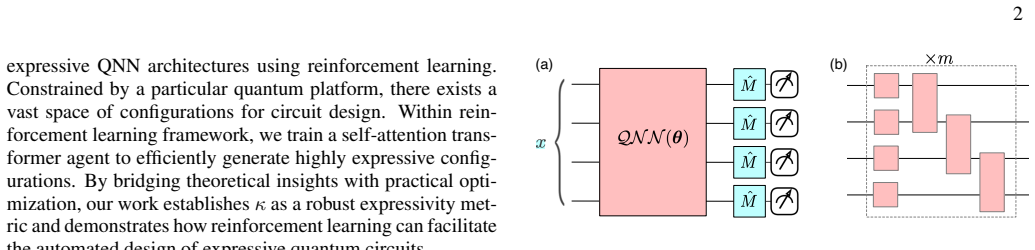


read the original abstract
Quantum neural networks (QNNs) are widely employed as ans\"atze for solving variational problems, where their expressivity directly impacts performance. Yet, accurately characterizing QNN expressivity remains an open challenge, impeding the optimal design of quantum circuits. In this work, we introduce the effective rank, denoted as $\kappa$, as a novel quantitative measure of expressivity. Specifically, $\kappa$ captures the number of effectively independent parameters among all the variational parameters in a parameterized quantum circuit, thus reflecting the true degrees of freedom contributing to expressivity. Through a systematic analysis considering circuit architecture, input data distributions, and measurement protocols, we demonstrate that $\kappa$ can saturate its theoretical upper bound, $d_n=4^n-1$, for an $n$-qubit system when each of the three factors is optimally expressive. This result provides a rigorous framework for assessing QNN expressivity and quantifying their functional capacity. Building on these theoretical insights, and motivated by the vast and highly structured nature of the circuit design space, we employ $\kappa$ as a guiding metric for the automated design of highly expressive quantum circuit configurations. To this end, we develop a reinforcement learning framework featuring a self-attention transformer agent that autonomously explores and optimizes circuit architectures. By integrating theoretical characterization with practical optimization, our work establishes $\kappa$ as a robust tool for quantifying QNN expressivity and demonstrates the effectiveness of reinforcement learning in designing high-performance quantum circuits. This study paves the way for building more expressive QNN architectures, ultimately enhancing the capabilities of quantum machine learning.
Editorial analysis
A structured set of objections, weighed in public.
Referee Report
Summary. The manuscript introduces the effective rank κ as a quantitative measure of QNN expressivity, defined as the number of effectively independent variational parameters among all parameters in a parameterized quantum circuit. It claims that systematic optimization of circuit architecture, input data distributions, and measurement protocols allows κ to saturate its theoretical upper bound d_n = 4^n - 1 for an n-qubit system. The authors then employ a reinforcement learning framework with a self-attention transformer agent to autonomously design circuit architectures that maximize this metric.
Significance. If the central claims hold, the work supplies a concrete, optimizable scalar for QNN expressivity and demonstrates its use in automated circuit design via RL, which could aid variational quantum algorithms and quantum machine learning. The explicit linkage of three design factors to saturation of the bound 4^n-1 is a clear theoretical contribution; the RL component addresses the combinatorial difficulty of the circuit space. These elements would be strengthened by explicit validation that saturated-κ circuits deliver measurable gains in approximation power or task performance.
major comments (2)
- [Abstract] Abstract: the saturation result to d_n=4^n-1 is asserted after 'systematic analysis' of the three factors, yet no derivation, explicit formula for κ from the variational parameters, or error analysis is supplied. Without these, the central claim that κ reaches the full functional dimension cannot be verified.
- [Abstract] Abstract: the claim that κ 'reflects the true degrees of freedom contributing to expressivity' and can therefore serve as a guiding metric for RL-based design assumes that the count of independent parameters directly determines functional capacity on variational tasks. No evidence is given that κ-maximizing circuits achieve strictly higher approximation power or avoid other limits such as barren plateaus or residual parameter correlations.
minor comments (1)
- [Abstract] The notation 'ansätze' appears with an escaped quote in the abstract; standard LaTeX rendering should be used.
Simulated Author's Rebuttal
We thank the referee for the careful reading and constructive comments. We respond to each major comment below, clarifying the manuscript content and indicating revisions where they strengthen the presentation without altering the core claims.
read point-by-point responses
-
Referee: [Abstract] Abstract: the saturation result to d_n=4^n-1 is asserted after 'systematic analysis' of the three factors, yet no derivation, explicit formula for κ from the variational parameters, or error analysis is supplied. Without these, the central claim that κ reaches the full functional dimension cannot be verified.
Authors: The full manuscript defines κ explicitly in Section 2 as the effective rank obtained from the numerical rank of the Jacobian matrix whose columns are the partial derivatives of the QNN output with respect to each variational parameter. Sections 3–5 then provide the systematic analysis: for each of the three factors (architecture, input distribution, measurement), we derive the conditions under which the Jacobian achieves full column rank equal to 4^n−1. An error analysis for the numerical rank computation appears in the supplementary material. We agree the abstract is too terse on these points and will revise it to include a one-sentence reference to the Jacobian definition and the saturation conditions. revision: yes
-
Referee: [Abstract] Abstract: the claim that κ 'reflects the true degrees of freedom contributing to expressivity' and can therefore serve as a guiding metric for RL-based design assumes that the count of independent parameters directly determines functional capacity on variational tasks. No evidence is given that κ-maximizing circuits achieve strictly higher approximation power or avoid other limits such as barren plateaus or residual parameter correlations.
Authors: We agree that the manuscript does not present new numerical experiments demonstrating that higher-κ circuits outperform lower-κ circuits on concrete variational tasks or explicitly avoid barren plateaus. The theoretical justification for using κ rests on the fact that expressivity is defined here as the dimension of the span of the functions realizable by the circuit; the effective rank directly quantifies that dimension. The RL experiments in Section 6 demonstrate that the transformer agent can reliably discover architectures whose measured κ approaches the bound, but we do not claim or show downstream task gains. We will add a short paragraph in the discussion section acknowledging this scope limitation and outlining how κ could be combined with task-specific metrics in future work. revision: partial
Circularity Check
No significant circularity detected in derivation chain
full rationale
The paper introduces κ explicitly as the count of effectively independent variational parameters in a parameterized quantum circuit, then analyzes its saturation to the known dimensional bound d_n=4^n-1 by varying circuit architecture, data distributions, and measurements. This saturation is presented as an empirical outcome of optimizing those three factors rather than a quantity fitted to the target expressivity or derived from a self-referential normalization. No load-bearing step reduces by construction to a prior self-citation, an ansatz smuggled via citation, or a renaming of a known result; the upper bound is the standard dimension of the space of traceless Hermitian operators on n qubits, and κ is computed from parameter independence without presupposing the performance link. The subsequent RL design step uses κ as an objective but does not claim it as a first-principles derivation of functional expressivity. The overall chain remains self-contained against external benchmarks of parameter counting.
Axiom & Free-Parameter Ledger
axioms (1)
- domain assumption Effective rank κ captures the true degrees of freedom contributing to expressivity.
Reference graph
Works this paper leans on
-
[1]
J. Biamonte, P. Wittek, N. Pancotti, P. Rebentrost, N. Wiebe, and S. Lloyd, Quantum machine learning, Nature 549, 195 (2017)
work page 2017
- [2]
-
[3]
Y . Wang and J. Liu, A comprehensive review of quantum ma- chine learning: from nisq to fault tolerance, Reports on Progress in Physics 87, 116402 (2024)
work page 2024
-
[4]
Y . Du, X. Wang, N. Guo, Z. Yu, Y . Qian, K. Zhang, M.-H. Hsieh, P. Rebentrost, and D. Tao, Quantum Machine Learning: A Hands-on Tutorial for Machine Learning Practitioners and Researchers (2025)
work page 2025
- [5]
-
[6]
M. Benedetti, E. Lloyd, S. Sack, and M. Fiorentini, Parame- terized quantum circuits as machine learning models, Quantum Science and Technology 4, 043001 (2019)
work page 2019
- [7]
-
[8]
Limitations of Variational Quantum Algorithms: A Quantum Optimal Transport Approach
G. De Palma, Limitations of Variational Quantum Algorithms: A Quantum Optimal Transport Approach, PRX Quantum 4, 10.1103/PRXQuantum.4.010309 (2023)
-
[9]
H. Qi, S. Xiao, Z. Liu, C. Gong, and A. Gani, Variational quan- tum algorithms: fundamental concepts, applications and chal- lenges, Quantum Information Processing 23, 224 (2024)
work page 2024
-
[10]
M. P. Lourenc ¸o, L. B. Herrera, J. Hostaˇs, P. Calaminici, A. M. K¨oster, A. Tchagang, and D. R. Salahub, Qmlmaterial-a quan- tum machine learning software for material design and discov- ery, Journal of Chemical Theory and Computation 19, 5999 (2023)
work page 2023
-
[11]
C. L. Degen, F. Reinhard, and P. Cappellaro, Quantum sensing, Rev. Mod. Phys. 89, 035002 (2017). 6
work page 2017
-
[12]
T. Ohshima, Toward real application of quantum sensing and metrology, Frontiers in Quantum Science and Technology 1 (2022)
work page 2022
- [13]
-
[14]
I. Cong, S. Choi, and M. D. Lukin, Quantum convolutional neu- ral networks, Nature Physics 15, 1273 (2019)
work page 2019
-
[15]
M. Henderson, S. Shakya, S. Pradhan, and T. Cook, Quanvolu- tional neural networks: powering image recognition with quan- tum circuits, Quantum Machine Intelligence 2, 2 (2020)
work page 2020
-
[16]
J. Herrmann, S. M. Llima, A. Remm, P. Zapletal, N. A. McMa- hon, C. Scarato, F. Swiadek, C. K. Andersen, C. Hellings, S. Krinner, N. Lacroix, S. Lazar, M. Kerschbaum, D. C. Zanuz, G. J. Norris, M. J. Hartmann, A. Wallraff, and C. Eichler, Re- alizing quantum convolutional neural networks on a supercon- ducting quantum processor to recognize quantum phases...
work page 2022
-
[17]
J. Bausch, Recurrent Quantum Neural Networks, in Advances in Neural Information Processing Systems, V ol. 33 (Curran As- sociates, Inc., 2020) pp. 1368–1379
work page 2020
-
[18]
Y . Li, Z. Wang, R. Han, S. Shi, J. Li, R. Shang, H. Zheng, G. Zhong, and Y . Gu, Quantum recurrent neural networks for sequential learning, Neural Networks 166, 148 (2023)
work page 2023
-
[19]
H.-L. Huang, Y . Du, M. Gong, Y . Zhao, Y . Wu, C. Wang, S. Li, F. Liang, J. Lin, Y . Xu, R. Yang, T. Liu, M.-H. Hsieh, H. Deng, H. Rong, C.-Z. Peng, C.-Y . Lu, Y .-A. Chen, D. Tao, X. Zhu, and J.-W. Pan, Experimental Quantum Generative Adversarial Networks for Image Generation, Physical Review Applied 16, 024051 (2021)
work page 2021
-
[20]
Y . Wu, J. Yao, P. Zhang, and X. Li, Randomness-enhanced ex- pressivity of quantum neural networks, Phys. Rev. Lett. 132, 010602 (2024)
work page 2024
-
[21]
S. Sim, P. D. Johnson, and A. Aspuru-Guzik, Expressibility and entangling capability of parameterized quantum circuits for hy- brid quantum-classical algorithms, Advanced Quantum Tech- nologies 2, 1900070 (2019)
work page 2019
- [22]
- [23]
-
[24]
K. Beer, D. Bondarenko, T. Farrelly, T. J. Osborne, R. Salz- mann, D. Scheiermann, and R. Wolf, Training deep quantum neural networks, Nature Communications 11, 808 (2020)
work page 2020
- [25]
-
[26]
T. Hubregtsen, J. Pichlmeier, P. Stecher, and K. Bertels, Evalua- tion of parameterized quantum circuits: on the relation between classification accuracy, expressibility, and entangling capabil- ity, Quantum Machine Intelligence 3, 9 (2021)
work page 2021
-
[27]
M. Ballarin, S. Mangini, S. Montangero, C. Macchiavello, and R. Mengoni, Entanglement entropy production in Quantum Neural Networks, Quantum 7, 1023 (2023)
work page 2023
-
[28]
Y . Wu, J. Yao, P. Zhang, and H. Zhai, Expressivity of quantum neural networks, Physical Review Research3, L032049 (2021)
work page 2021
-
[29]
J. Liu, H. Yuan, X.-M. Lu, and X. Wang, Quantum Fisher information matrix and multiparameter estimation, Journal of Physics A: Mathematical and Theoretical 53, 023001 (2019)
work page 2019
-
[30]
J. J. Meyer, Fisher Information in Noisy Intermediate-Scale Quantum Applications, Quantum 5, 539 (2021)
work page 2021
-
[31]
R. Karakida, S. Akaho, and S. ichi Amari, Universal statistics of fisher information in deep neural networks: mean field ap- proach*, Journal of Statistical Mechanics: Theory and Experi- ment 2020, 124005 (2020)
work page 2020
-
[32]
T. Haug, K. Bharti, and M. Kim, Capacity and quantum geome- try of parametrized quantum circuits, PRX Quantum 2, 040309 (2021)
work page 2021
-
[33]
M. Larocca, S. Thanasilp, S. Wang, K. Sharma, J. Bia- monte, P. J. Coles, L. Cincio, J. R. McClean, Z. Holmes, and M. Cerezo, Barren plateaus in variational quantum computing, Nature Reviews Physics 7, 174 (2025)
work page 2025
-
[34]
J. Cunningham and J. Zhuang, Investigating and mitigating bar- ren plateaus in variational quantum circuits: a survey, Quantum Information Processing 24, 48 (2025)
work page 2025
-
[35]
Therefore, form building blocks, the total number of variational parameters is 3nm
In an n-qubit system, each brick-wall building block contains 3n parameters, corresponding to n single-qubit gates arranged in a brick-wall configuration. Therefore, form building blocks, the total number of variational parameters is 3nm
-
[36]
A. Vaswani, N. Shazeer, N. Parmar, J. Uszkoreit, L. Jones, A. N. Gomez, Ł. Kaiser, and I. Polosukhin, Attention is all you need (2017) arXiv:1706.03762
work page internal anchor Pith review Pith/arXiv arXiv 2017
discussion (0)
Sign in with ORCID, Apple, or X to comment. Anyone can read and Pith papers without signing in.