REVIEW 3 major objections 7 minor 50 references
RE-IMAGINE: Symbolic Benchmark Synthesis for Reasoning Evaluation
T0 review · 3 major / 7 minor · reviewed 2026-08-15 · deepseek-v4-flash
Pith's one-line read By mutating benchmark problems in an executable symbolic form, RE-IMAGINE shows that every tested LLM's accuracy falls as reasoning demands rise, indicating that high benchmark scores partly reflect memorization.
desk verdict Useful, reusable benchmark-synthesis pipeline with a real Level-3 confound: the accuracy drops are solid, but the 'statistical recall' interpretation outruns the evidence. read the letter →
The pith
A machine-rendered reading of the paper's core claim, the machinery that carries it, and where it could break.
The reading
What carries the argument
The machinery is the executable symbolic representation: each natural-language problem is converted into a Python snippet whose computational graph has variables as nodes and dependencies as edges. Six graph mutations are defined — SampleValues and UselessInfo at level 2, AddDependence, InsertConditional, CounterFactual, and Bi-CounterFactual at level 3 — and because the mutated code still runs, the ground-truth answer to every new problem is obtained by executing it, which guarantees correctness without manual annotation. Mutations are admitted only after a back-translation pass in which a second LLM rewrites the mutated question into code that must reproduce the execution answer, and a human review of 50 examples per mutation type found 0–6.7% invalid. For benchmarks that are already programs (CRUXEval and Loop), the mutation is applied directly to the code, with outputs checked by execution and by an automated program verifier respectively; the Loop mutations are restricted to level 2 because changing program values can make loop invariants cease to exist. The computational graph also plays the role of a structural causal model, which lets the Bi-CounterFactual mutation evaluate models with counterfactual metrics (probability of necessity and sufficiency, summarized as N-IR and S-IR).
What would settle it
Re-run the evaluation on mutations whose natural-language translations have been independently certified by multiple human raters as equivalent to the code, and look for any tested model whose accuracy stays flat or rises from level 1 to level 3; the paper's claim predicts a monotone drop across all four benchmarks for every model, so a single family with flat accuracy on certified mutations would undercut the universal reliance-on-recall conclusion. The paper's own reported invalid rates (up to 6.7% of reviewed examples) make this the natural decisive check.
Extended reading notes
Core claim
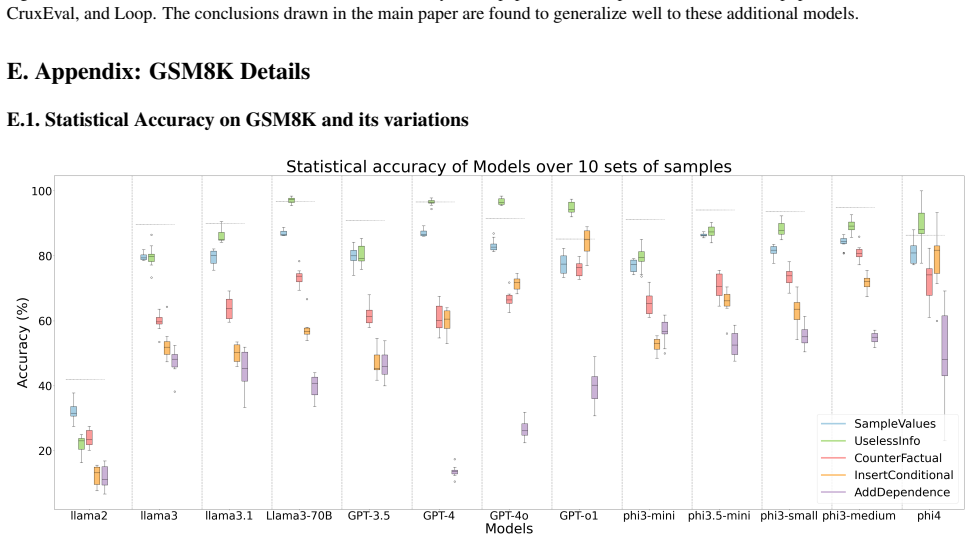
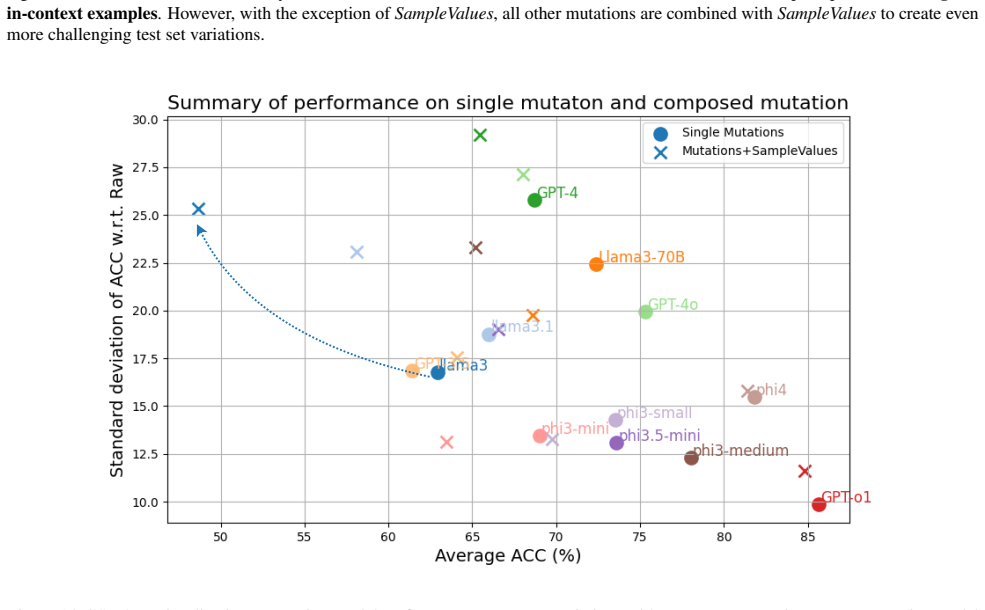
The paper's central claim is that part of LLMs' success on reasoning benchmarks is statistical recall of training data, and that this can be demonstrated and quantified with a three-level hierarchy modeled on Pearl's ladder of causation. Level 1 ('observe') is the original benchmark. Level 2 ('mutate') keeps the problem's logical core intact while changing surface content: new numbers, added irrelevant information, renamed variables, or small code-level edits. Level 3 ('imagine') rewrites the logic: an added dependency, a conditional branch, or a counterfactual assumption appended to the question, so that solving requires revising a previously stated fact. The framework renders each question as an executable Python snippet, applies one of six mutations to the snippet's computational graph, and translates the mutated code back to natural language with a second LLM, so every generated problem has an exact execution-computed answer. Across GSM8K, CLadder, CRUXEval, and Loop, overall performance degrades as ladder level increases, the decline persists when the number of reasoning steps is held constant, and composing mutations widens it — evidence, the paper argues, that the mutations themselves, not added complexity, reveal the reliance on recall.
Load-bearing premise
The whole measurement depends on each mutated natural-language question being a faithful, unambiguous rendering of the mutated code — a correspondence validated only by execution-matching, back-translation, and a 50-example human review per mutation type, so if the translations are systematically awkward or subtly wrong, the accuracy drops would be artifacts rather than evidence about reasoning.
Editorial extensions
If this is right
- Raw benchmark scores should be reported together with scores on level-2 and level-3 variants, since the gap between them estimates how much of the original score came from recall rather than reasoning.
- Any claim that a new model 'reasons' becomes testable at scale: the pipeline can generate an arbitrary number of unseen variants at each level, making memorization an insufficient route to a high score.
- Level-3 questions — new logic, revisions, and counterfactuals — remain largely unsolved even by the strongest tested models, which identifies the next target for training and evaluation.
- Composed mutations (for example, new values plus a counterfactual) enlarge the accuracy gap, so combining mutation types is an immediate way to build harder evaluation sets.
- The pattern is cross-domain: the same hierarchy and pipeline apply to math, causal reasoning, and code, so the observed reliance on statistical recall is not specific to one benchmark format.
Reading between the lines
- My inference: the same pipeline that produces evaluation variants also produces execution-verified training pairs, so level-2 and level-3 mutations could be used to fine-tune models on exactly the skills the hierarchy measures — a use the paper does not pursue.
- My inference: the hierarchy implies a testable prediction — models trained with program-execution or causal supervision should show a smaller level-1-to-level-3 gap, and comparing such models with standard pretraining would separate training-data effects from architectural limits.
- My inference: if the drops are genuine, leaderboard comparisons are partly confounded by test-set leakage, and a normalized 'reasoning gap' (level-1 accuracy minus level-3 accuracy) could become a standard complement to raw accuracy in future evaluations.
Signed reviews
Editorial analysis
A structured set of objections, weighed in public.
Referee Report
Summary. The paper introduces RE-IMAGINE, a framework that classifies LLM reasoning evaluation into three levels (Observe, Mutate, Imagine) inspired by Pearl's ladder of causation, and an automated pipeline that converts benchmark questions into executable symbolic (Python) representations, applies code-level mutations, and translates the mutated code back into natural language. The authors apply the pipeline to GSM8K, CLadder, CRUXEval, and Loop, and report that model accuracy declines monotonically from Level-1 to Level-2 to Level-3 across these benchmarks. They interpret this decline as evidence that current LLM performance on reasoning benchmarks reflects, at least in part, statistical recall of training data rather than robust reasoning. The paper includes multiple validity checks: execution-based ground truth, back-translation verification for GSM8K, Frama-C verification for Loop, human review of 50 examples per GSM8K mutation, matched factual accuracy for CRUXEval, and a reasoning-step control in Section 6.1.
Significance. If the central claim is supported, the paper makes a useful contribution: it provides a scalable, cross-benchmark methodology for generating benchmark variations that are not answerable by memorizing the original training answers, and it quantifies a hierarchy of reasoning difficulty. The paper's strengths include an automated pipeline with executable ground truth, conservative upper-bound adjustments for invalid GSM8K mutations, matched factual baselines for CRUXEval, Frama-C verification for Loop, and statistical accuracy over 10 random test-set samples. The three-level hierarchy is a clean organizing principle that could influence future benchmark design. However, the strength of the central interpretation—that the observed accuracy drops indicate statistical recall—depends on isolating the reasoning level from task-format confounds, which the current experiments do not fully establish.
major comments (3)
- [§6.1 and §4/§5.1] Section 6.1 controls for the number of code operations, but this does not isolate the reasoning level from surface-form difficulty. In GSM8K, Level-3 mutations append a 'Suppose/Assume ... instead' sentence that requires the model to detect a contradiction and override a previously stated fact; in CRUXEval, Level-3 mutations require the model to apply a diff to the original code. Both add parsing and instruction-following load beyond the single code operation controlled in §6.1. To support the claim that the L1→L2→L3 accuracy declines reflect the reasoning hierarchy and statistical recall, the authors should add a control that introduces the same added surface complexity (e.g., a 'Suppose' sentence or a diff-like format) without changing the underlying logic, and show that accuracy does not drop under that control.
- [§5.2, Appendix H, and Conclusion] The Loop benchmark contains only Level-1 and Level-2 mutations; Appendix H states, 'we limit ourselves to a category of Level-2 mutations that add useless information.' The abstract and conclusion, however, claim a consistent decline 'across all evaluated benchmarks' as mutations move from Level-1 to Level-2 to Level-3. This overstates the evidence: no Level-3 loop task is evaluated. The authors should either soften the cross-benchmark claim to reflect the absence of Level-3 Loop data or add Level-3 variants (e.g., counterfactual initializations for which a valid invariant still exists) to make the claim testable on all four benchmarks.
- [§4.1 and Figure 16] The back-translation check (Figure 16) verifies only that GPT-4o can find one code interpretation of the mutated natural language; it does not show that the mutated question is unambiguous or that the evaluated models parse it in the intended way. The human review of 50 examples per mutation type, with reported invalid rates of 0.00%–6.67%, is too small to rule out systematic ambiguity or awkward phrasing that could depress accuracy independently of reasoning ability. The authors should provide larger validity samples with confidence intervals, or filter the test set using stricter checks such as multiple independent back-translations or consistency across paraphrases.
minor comments (7)
- [Table 3] The row for 'Llama 3.3 (70B)' lists '#Parameters' as '8B', which appears to be a typo; it should be '70B'.
- [Figure 2] The hashed blocks above the accuracy bars represent the percentage of invalid mutated examples; the text should explicitly state that this percentage is added to the accuracy to form the upper bound, and clarify whether the percentage is computed over the same test-set size used for accuracy.
- [§4.3] The text says 50 questions are taken 'from the validation set of the benchmark,' while the rest of the paper refers to the GSM8K test set; please clarify which split is used and why.
- [Figure 7 and Appendix E.5] The aggregated accuracy in Figure 7 is averaged over all tested models; the authors should specify whether this is a macro-average or micro-average and report the number of models included.
- [§3.2] The distinction between SampleValues and CounterFactual is described only by how the change is presented in natural language; the authors should state explicitly that both mutations can affect the same nodes in the computational graph and that the difference lies in the presentation as an assumption statement.
- [Appendix F.2.2] The mutation name 'Unrelate-dIrrelevantInfo' contains a hyphen artifact; it should be 'UnrelatedIrrelevantInfo' consistently.
- [§4.1] The paper reports human-validated invalid rates for GSM8K mutations but does not report the coverage rate of the GSM8K transformation (i.e., the fraction of original problems for which all constants align with the code); a coverage statistic analogous to that in Appendix G.3 would help assess selection bias.
Circularity Check
No significant circularity: the measured declines are empirical, anchored to external benchmarks and executed code ground truth; author-overlap citations are used as external metrics/benchmarks, not as load-bearing derivations.
full rationale
The paper's derivation chain is: take existing external benchmarks (GSM8K, CLadder, CRUXEval, Loop); convert questions to Python where needed; apply explicitly defined code mutations; compute ground truth by executing the mutated code; translate mutations back to natural language with back-translation and human checks; then measure LLM accuracy. None of the headline results is a fitted parameter renamed as a prediction. The L1/L2/L3 ordering is a taxonomy that says what the levels mean, but it does not by itself force the observed accuracy decline; the decline is measured and could in principle have been flat or reversed. The 'not solvable by memorization alone' property of value-sampled mutations follows from construction, but the paper's empirical conclusion about model behavior is not equivalent to that construction. The self-citations (Gonzalez & Nori 2024; Huyuk et al. 2024; Kamath et al. 2024) overlap with the present authors, but they supply standard causal metrics (PN, PS, N-IR, S-IR) and an external code benchmark whose verification is checked by Frama-C with Z3/alt-ergo/CVC4; the central 'statistical recall' claim does not rest solely on those citations. The skeptic's points about GPT-4o translation ambiguity, small human review samples, and extra diff-application complexity in Level-3 CRUXEval are validity/confound concerns rather than cases where an output variable is identical to an input by definition. Accordingly, there is no exhibited circular reduction and the score is 0.
Assumptions & free parameters
free parameters (3)
- SampleValues sampling distribution for GSM8K =
discrete uniform for integers; uniform centered on original value for floats
- CRUXEval MutateValue perturbation bound =
±10
- Loop junk-variable count and polynomial identities =
two junk variables; identically zero polynomials
assumptions (5)
- domain assumption Python snippets in OpenMathInstruct faithfully represent the reasoning in GSM8K questions
- domain assumption GPT-4o symbolic-to-NL translations produce unambiguous questions equivalent to the code mutation
- domain assumption Accuracy drops on mutated questions are attributable to statistical recall rather than generic distribution shift or question ambiguity
- standard math Frama-C with SMT solvers reliably verifies loop invariants
- domain assumption Computational graph mutations map onto Pearl's ladder of causation levels
invented entities (2)
-
RE-IMAGINE three-level reasoning hierarchy (Observe, Mutate, Imagine)
-
Bi-Counterfactual binary computational graph abstraction
Cite this review
Pith. "Pith review of RE-IMAGINE: Symbolic Benchmark Synthesis for Reasoning Evaluation." pith.science (2026). https://pith.science/paper/TPYHH5VB
@misc{pith2026250615455,
  author       = {Pith},
  title        = {Pith review of: RE-IMAGINE: Symbolic Benchmark Synthesis for Reasoning Evaluation},
  year         = {2026},
  howpublished = {\url{https://pith.science/paper/TPYHH5VB}},
  note         = {Machine review of arXiv:2506.15455}
}
read the original abstract
Recent Large Language Models (LLMs) have reported high accuracy on reasoning benchmarks. However, it is still unclear whether the observed results arise from true reasoning or from statistical recall of the training set. Inspired by the ladder of causation (Pearl, 2009) and its three levels (associations, interventions and counterfactuals), this paper introduces RE-IMAGINE, a framework to characterize a hierarchy of reasoning ability in LLMs, alongside an automated pipeline to generate problem variations at different levels of the hierarchy. By altering problems in an intermediate symbolic representation, RE-IMAGINE generates arbitrarily many problems that are not solvable using memorization alone. Moreover, the framework is general and can work across reasoning domains, including math, code, and logic. We demonstrate our framework on four widely-used benchmarks to evaluate several families of LLMs, and observe reductions in performance when the models are queried with problem variations. These assessments indicate a degree of reliance on statistical recall for past performance, and open the door to further research targeting skills across the reasoning hierarchy.
Figures


Figures from the paper (20 more)






Reference graph
Works this paper leans on
-
[1]
R., Bury, G., and de Oliveira, S
Ait El Hara, H. R., Bury, G., and de Oliveira, S. Alt-Ergo-Fuzz: A fuzzer for the Alt-Ergo SMT solver . In Keller, C. and Bourke, T. (eds.), Journ \'e es Francophones des Langages Applicatifs , pp.\ 235--244, Saint-M \'e dard-d'Excideuil, France, June 2022. URL https://inria.hal.science/hal-03626861
work page 2022
-
[2]
Barrett, C. W., Conway, C. L., Deters, M., Hadarean, L., Jovanovic, D., King, T., Reynolds, A., and Tinelli, C. CVC4 . In Gopalakrishnan, G. and Qadeer, S. (eds.), Computer Aided Verification - 23rd International Conference, CAV 2011, Snowbird, UT, USA, July 14-20, 2011. Proceedings , volume 6806 of Lecture Notes in Computer Science, pp.\ 171--177. Spring...
-
[3]
Brown, T. B., Mann, B., Ryder, N., Subbiah, M., Kaplan, J., Dhariwal, P., Neelakantan, A., Shyam, P., Sastry, G., Askell, A., et al. Language models are few-shot learners. arXiv preprint arXiv:2005.14165, 2020
arXiv 2005
-
[5]
Arc prize 2024: Technical report, 2025
Chollet, F., Knoop, M., Kamradt, G., and Landers, B. Arc prize 2024: Technical report, 2025. URL https://arxiv.org/abs/2412.04604
arXiv 2024
-
[6]
Training verifiers to solve math word problems
Cobbe, K., Kosaraju, V., Hilton, J., and Schulman, J. Training verifiers to solve math word problems. arXiv preprint arXiv:2110.14168, 2021
arXiv 2021
-
[7]
Correnson, L., Cuoq, P., Kirchner, F., Maroneze, A., Prevosto, V., Puccetti, A., Signoles, J., and Yakobowski, B. Frama-C User Manual. URL http://frama-c.com/download/frama-c-user-manual.pdf
-
[8]
de Moura, L. and Bj rner, N. Z3: An efficient smt solver. In Ramakrishnan, C. R. and Rehof, J. (eds.), Tools and Algorithms for the Construction and Analysis of Systems, pp.\ 337--340, Berlin, Heidelberg, 2008. Springer Berlin Heidelberg. ISBN 978-3-540-78800-3
work page 2008
-
[9]
Pal: Program-aided language models
Gao, L., Madaan, A., Zhou, S., Alon, U., Liu, P., Yang, Y., Callan, J., and Neubig, G. Pal: Program-aided language models. In International Conference on Machine Learning, pp.\ 10764--10799. PMLR, 2023
2023
Show all 50 references
-
[10]
Glazer, E., Erdil, E., Besiroglu, T., Chicharro, D., Chen, E., Gunning, A., Olsson, C. F., Denain, J.-S., Ho, A., de Oliveira Santos, E., Järviniemi, O., Barnett, M., Sandler, R., Vrzala, M., Sevilla, J., Ren, Q., Pratt, E., Levine, L., Barkley, G., Stewart, N., Grechuk, B., G...
2024 arXiv
-
[11]
and Nori, A
González, J. and Nori, A. V. Does reasoning emerge? examining the probabilities of causation in large language models. In Advances in Neural Information Processing Systems (NeurIPS), 2024
2024
-
[12]
Gu, A., Rozi \`e re, B., Leather, H., Solar-Lezama, A., Synnaeve, G., and Wang, S. I. Cruxeval: A benchmark for code reasoning, understanding and execution. arXiv preprint arXiv:2401.03065, 2024
2024 arXiv
-
[13]
Halpern, J. Y. and Pearl, J. Causes and explanations: A structural-model approach. Part I : Causes. The British journal for the Philosophy of Science, 2005
2005
-
[14]
Measuring massive multitask language understanding
Hendrycks, D., Basart, S., Mazeika, M., Zou, A., Song, D., and Steinhardt, J. Measuring massive multitask language understanding. arXiv preprint arXiv:2009.03300, 2020
2009 arXiv
-
[15]
Holyoak, K. J. and Morrison, R. G. (eds.). The Cambridge Handbook of Thinking and Reasoning. Cambridge University Press, Cambridge, England, 2005. ISBN 9780521824170
2005
-
[16]
and Chang, K
Huang, J. and Chang, K. C.-C. Towards reasoning in large language models: A survey. In Rogers, A., Boyd-Graber, J., and Okazaki, N. (eds.), Findings of the Association for Computational Linguistics: ACL 2023, pp.\ 1049--1065, Toronto, Canada, jul 2023. Association for Computat...
2023
-
[17]
V., and González, J
Hüyük, A., Xu, X., Maasch, J., Nori, A. V., and González, J. Reasoning elicitation in language models via counterfactual feedback, 2024. URL https://arxiv.org/abs/2410.03767
2024 arXiv
-
[18]
Openai o1 system card
Jaech, A., Kalai, A., Lerer, A., et al. Openai o1 system card. arXiv preprint arXiv:2412.16720, 2024
2024 arXiv
-
[19]
Q., Sablayrolles, A., Roux, A., Mensch, A., Savary, B., Bamford, C., Chaplot, D
Jiang, A. Q., Sablayrolles, A., Roux, A., Mensch, A., Savary, B., Bamford, C., Chaplot, D. S., Casas, D. d. l., Hanna, E. B., Bressand, F., et al. Mixtral of experts. arXiv preprint arXiv:2401.04088, 2024
2024 arXiv
-
[20]
CL adder: A ssessing causal reasoning in language models
Jin, Z., Chen, Y., Leeb, F., Gresele, L., Kamal, O., Lyu, Z., Blin, K., Gonzalez, F., Kleiman-Weiner, M., Sachan, M., and Sch \" o lkopf, B. CL adder: A ssessing causal reasoning in language models. In NeurIPS, 2023 a . URL https://openreview.net/forum?id=e2wtjx0Yqu
2023
-
[21]
Cladder: Assessing causal reasoning in language models
Jin, Z., Chen, Y., Leeb, F., Gresele, L., Kamal, O., Lyu, Z., Blin, K., Gonzalez Adauto, F., Kleiman-Weiner, M., Sachan, M., et al. Cladder: Assessing causal reasoning in language models. Advances in Neural Information Processing Systems, 36: 0 31038--31065, 2023 b
2023
-
[22]
K., Lal, A., Rastogi, A., Roy, S., and Sharma, R
Kamath, A., Mohammed, N., Senthilnathan, A., Chakraborty, S., Deligiannis, P., Lahiri, S. K., Lal, A., Rastogi, A., Roy, S., and Sharma, R. Leveraging llms for program verification. In FMCAD , 2024. URL http://hdl.handle.net/20.500.12708/200783
2024
-
[23]
S., Iwafuchi, T., and Dasaka, S
Kambhampati, R. S., Iwafuchi, T., and Dasaka, S. Phi-3: A family of small open models. Microsoft AI Research, 2024. Pre-release information
2024
-
[24]
and Mitchell, M
Lewis, M. and Mitchell, M. Evaluating the robustness of analogical reasoning in large language models. arXiv preprint arXiv:2411.14215, 2024
2024 arXiv
-
[25]
Neuro-symbolic data generation for math reasoning, 2024
Li, Z., Zhou, Z., Yao, Y., Li, Y.-F., Cao, C., Yang, F., Zhang, X., and Ma, X. Neuro-symbolic data generation for math reasoning, 2024. URL https://arxiv.org/abs/2412.04857
2024 arXiv
-
[26]
Gsm-symbolic: Understanding the limitations of mathematical reasoning in large language models
Mirzadeh, I., Alizadeh, K., Shahrokhi, H., Tuzel, O., Bengio, S., and Farajtabar, M. Gsm-symbolic: Understanding the limitations of mathematical reasoning in large language models. arXiv preprint arXiv:2410.05229, 2024
2024 arXiv
-
[27]
and Krakauer, D
Mitchell, M. and Krakauer, D. C. The debate over understanding in ai’s large language models. Proceedings of the National Academy of Sciences, 120 0 (13): 0 1--15, 2023. doi:10.1073/pnas.2215907120
2023 doi
-
[28]
Neuberg, L. G. Causality: models, reasoning, and inference, by judea pearl, cambridge university press, 2000. Econometric Theory, 19 0 (4): 0 675--685, 2003
2000
-
[29]
Early access for safety testing, December 2024
OpenAI . Early access for safety testing, December 2024. https://openai.com/index/early-access-for-safety-testing/
2024
-
[30]
Causality: Models, Reasoning, and Inference
Pearl, J. Causality: Models, Reasoning, and Inference. Cambridge University Press, Cambridge, England, 2nd edition, 2009. ISBN 9780521895606
2009
-
[31]
Pearl, J. et al. Models, reasoning and inference. Cambridge, UK: CambridgeUniversityPress, 19 0 (2): 0 3, 2000
2000
-
[32]
H., Sch \"a rli, N., and Zhou, D
Shi, F., Chen, X., Misra, K., Scales, N., Dohan, D., Chi, E. H., Sch \"a rli, N., and Zhou, D. Large language models can be easily distracted by irrelevant context. In International Conference on Machine Learning, pp.\ 31210--31227. PMLR, 2023
2023
-
[33]
Learning loop invariants for program verification
Si, X., Dai, H., Raghothaman, M., Naik, M., and Song, L. Learning loop invariants for program verification. In NeurIPS 2018 , 2018
2018
-
[34]
Beyond the imitation game: Quantifying and extrapolating the capabilities of language models
Srivastava, A., Wei, J., Jun, H., et al. Beyond the imitation game: Quantifying and extrapolating the capabilities of language models. arXiv preprint arXiv:2206.04615, 2022
2022 arXiv
-
[35]
Functional benchmarks for robust evaluation of reasoning performance, and the reasoning gap
Srivastava, S., PV, A., Menon, S., Sukumar, A., Philipose, A., Prince, S., Thomas, S., et al. Functional benchmarks for robust evaluation of reasoning performance, and the reasoning gap. arXiv preprint arXiv:2402.19450, 2024
2024 arXiv
-
[36]
Team, D. A. Deepseek-r1: A comprehensive reasoning model. DeepSeek AI Research, 2025. URL https://github.com/deepseek-ai/DeepSeek-R1. Available on GitHub
2025
-
[37]
Openmathinstruct-1: A 1.8 million math instruction tuning dataset
Toshniwal, S., Moshkov, I., Narenthiran, S., Gitman, D., Jia, F., and Gitman, I. Openmathinstruct-1: A 1.8 million math instruction tuning dataset. arXiv preprint arXiv: Arxiv-2402.10176, 2024
2024 arXiv
-
[38]
Llama: Open and efficient foundation language models
Touvron, H., Lavril, T., Izacard, G., Martinet, X., Lachaux, M.-A., Lacroix, T., Roziere, B., Goyal, N., Hambro, E., Azhar, F., Rodriguez, A., Joulin, A., Grave, E., and Lample, G. Llama: Open and efficient foundation language models. arXiv preprint arXiv:2302.13971, 2023
2023 arXiv
-
[39]
Large language models still can't plan (a benchmark for llms on planning and reasoning about change)
Valmeekam, K., Olmo, A., Sreedharan, S., and Kambhampati, S. Large language models still can't plan (a benchmark for llms on planning and reasoning about change). In NeurIPS 2022 Foundation Models for Decision Making Workshop, 2022
2022
-
[40]
Wang, A., Pruksachatkun, Y., Nangia, N., Singh, A., Michael, J., Hill, F., Levy, O., and Bowman, S. R. Superglue: A stickier benchmark for general-purpose language understanding systems. arXiv preprint arXiv:1905.00537, 2019
1905 arXiv
-
[41]
S., and Momennejad, I
Webb, T., Mondal, S. S., and Momennejad, I. Improving planning with large language models: A modular agentic architecture. arXiv preprint arXiv:2310.00194, 2024
2024
-
[42]
Ethical and social risks of harm from language models
Weidinger, L., Mellor, J., Rauh, M., et al. Ethical and social risks of harm from language models. arXiv preprint arXiv:2112.04359, 2021
2021 arXiv
-
[43]
W., and Narodytska, N
Wu, H., Barrett, C. W., and Narodytska, N. Lemur: Integrating large language models in automated program verification. In ICLR , 2024
2024
-
[44]
Reasoning or reciting? exploring the capabilities and limitations of language models through counterfactual tasks
Wu, Z., Qiu, L., Ross, A., Aky \"u rek, E., Chen, B., Wang, B., Kim, N., Andreas, J., and Kim, Y. Reasoning or reciting? exploring the capabilities and limitations of language models through counterfactual tasks. arXiv preprint arXiv:2307.02477, 2023
2023 arXiv
-
[45]
Towards large reasoning models: A survey on scaling llm reasoning capabilities
Xu, F., Hao, Q., Zong, Z., Wang, J., Zhang, Y., Wang, J., Lan, X., Gong, J., Ouyang, T., Meng, F., et al. Towards large reasoning models: A survey on scaling llm reasoning capabilities. arXiv preprint arXiv:2501.09686, 2025
2025 arXiv
-
[46]
A critical review of causal reasoning benchmarks for large language models
Yang, L., Shirvaikar, V., Clivio, O., and Falck, F. A critical review of causal reasoning benchmarks for large language models. In AAAI 2024 Workshop on''Are Large Language Models Simply Causal Parrots?'', 2024
2024
-
[47]
Physics of Language Models: Part 2.1, Grade-School Math and the Hidden Reasoning Process
Ye, T., Xu, Z., Li, Y., and Allen-Zhu , Z. Physics of Language Models: Part 2.1, Grade-School Math and the Hidden Reasoning Process . In Proceedings of the 13th International Conference on Learning Representations, ICLR '25, April 2025. Full version available at https://ssrn.c...
2025
-
[48]
Darg: Dynamic evaluation of large language models via adaptive reasoning graph, 2024
Zhang, Z., Chen, J., and Yang, D. Darg: Dynamic evaluation of large language models via adaptive reasoning graph, 2024
2024
-
[49]
X., Chen, X., Lin, Y., Wen, J.-R., and Han, J
Zhou, K., Zhu, Y., Chen, Z., Chen, W., Zhao, W. X., Chen, X., Lin, Y., Wen, J.-R., and Han, J. Don't make your llm an evaluation benchmark cheater. arXiv preprint arXiv:2311.01964, 2023
2023 arXiv
-
[50]
Z., Yang, D., and Xie, X
Zhu, K., Chen, J., Wang, J., Gong, N. Z., Yang, D., and Xie, X. Dyval: Dynamic evaluation of large language models for reasoning tasks. In The Twelfth International Conference on Learning Representations, 2023
2023
-
[51]
write newline
" write newline "" before.all 'output.state := FUNCTION n.dashify 't := "" t empty not t #1 #1 substring "-" = t #1 #2 substring "--" = not "--" * t #2 global.max substring 't := t #1 #1 substring "-" = "-" * t #2 global.max substring 't := while if t #1 #1 substring * t #2 gl...
Reviewed August 15, 2026 · model on record in the stance chip above.
Discussion (0). Continue with ORCID to comment.