Real-Time Initialization of Unknown Anchors for UWB-aided Navigation
Pith reviewed 2026-05-19 09:01 UTC · model grok-4.3
The pith
A framework initializes unknown UWB anchors in real time by waiting for sufficient measurement geometry.
A machine-rendered reading of the paper's core claim, the machinery that carries it, and where it could break.
Core claim
The central discovery is a real-time initialization framework for unknown UWB anchors that combines online PDOP estimation, lightweight outlier detection, and an adaptive robust kernel for non-linear optimization. This results in more conservative initialization decisions based on actual geometry rather than initial guesses, yielding lower initialization errors and improved robustness for real-world UWB-aided navigation on mobile robots.
What carries the argument
Online Positional Dilution of Precision (PDOP) estimation used as the metric to trigger the initialization of an unknown anchor's position.
If this is right
- Lower initialization errors result from waiting for better anchor geometry before calibration.
- The approach works without any manual pre-setup of anchors in the environment.
- Robustness to real-world measurement errors is increased through the adaptive robust kernel.
- Successful demonstration on both ground robots like forklifts and aerial quadcopters.
Where Pith is reading between the lines
- This method might allow seamless addition of new UWB anchors in changing environments without stopping operations.
- Similar conservative geometry checks could be applied to other sensor initialization problems in robotics.
- Long-term navigation accuracy could improve as drift is corrected more reliably with accurate anchor positions.
Load-bearing premise
Online PDOP estimation combined with outlier detection will identify good geometry before triggering initialization, and the adaptive robust kernel will handle measurement errors without biasing the anchor estimates.
What would settle it
Running the system in an environment where initial measurements have poor geometry but the PDOP check passes anyway, resulting in higher than expected anchor position errors.
Figures




read the original abstract
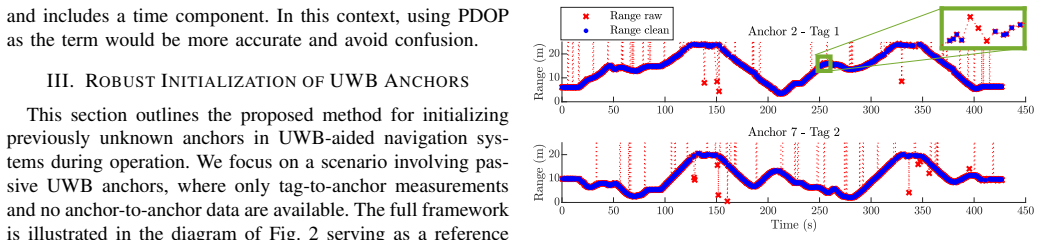
This paper presents a framework for the real-time initialization of unknown Ultra-Wideband (UWB) anchors in UWB-aided navigation systems. The method is designed for localization solutions where UWB modules act as supplementary sensors. Our approach enables the automatic detection and calibration of previously unknown anchors during operation, removing the need for manual setup. By combining an online Positional Dilution of Precision (PDOP) estimation, a lightweight outlier detection method, and an adaptive robust kernel for non-linear optimization, our approach significantly improves robustness and suitability for real-world applications compared to state-of-the-art. In particular, we show that our metric which triggers an initialization decision is more conservative than current ones commonly based on initial linear or non-linear initialization guesses. This allows for better initialization geometry and subsequently lower initialization errors. We demonstrate the proposed approach on two different mobile robots: an autonomous forklift and a quadcopter equipped with a UWB-aided Visual-Inertial Odometry (VIO) framework. The results highlight the effectiveness of the proposed method with robust initialization and low positioning error. We open-source our code in a C++ library including a ROS wrapper.
Editorial analysis
A structured set of objections, weighed in public.
Referee Report
Summary. The manuscript presents a framework for real-time initialization of unknown UWB anchors in UWB-aided navigation. It integrates online Positional Dilution of Precision (PDOP) estimation, a lightweight outlier detector, and an adaptive robust kernel in non-linear optimization. The central claim is that the resulting trigger metric is more conservative than those based on initial linear or non-linear guesses, yielding better initialization geometry and lower errors. The method is demonstrated on an autonomous forklift and a quadcopter with UWB-aided VIO, reporting robust performance and low positioning errors, with code released as a C++ library including a ROS wrapper.
Significance. If the central claims hold, the work addresses a practical barrier to deploying UWB systems by automating anchor calibration without manual setup. The emphasis on conservative geometric and statistical criteria for triggering initialization, combined with the adaptive kernel, offers a plausible route to improved real-world robustness. The open-source release and evaluation on two distinct platforms are strengths that support reproducibility and adoption in robotics applications.
major comments (1)
- The assumption that online PDOP estimation plus the lightweight outlier detector will reliably identify sufficiently good geometry before triggering (and that the adaptive kernel avoids bias in anchor estimates) is load-bearing for the robustness claim. Additional validation, such as ablation on simulated poor-geometry cases or explicit comparison of trigger decisions against ground-truth geometry, would strengthen this.
minor comments (2)
- Abstract: the statement of 'significantly improves robustness' would benefit from one or two concrete quantitative comparisons (e.g., mean initialization error reduction relative to the linear/non-linear baselines) to make the contribution summary more precise.
- Notation and implementation details for the PDOP estimator and outlier rule could be clarified with a short pseudocode block or explicit parameter values to aid reproduction.
Simulated Author's Rebuttal
We thank the referee for the positive assessment and constructive comment. We address the major comment below.
read point-by-point responses
-
Referee: The assumption that online PDOP estimation plus the lightweight outlier detector will reliably identify sufficiently good geometry before triggering (and that the adaptive kernel avoids bias in anchor estimates) is load-bearing for the robustness claim. Additional validation, such as ablation on simulated poor-geometry cases or explicit comparison of trigger decisions against ground-truth geometry, would strengthen this.
Authors: We agree that the reliability of the online PDOP estimation combined with the lightweight outlier detector for triggering on good geometry, along with the adaptive kernel's role in reducing bias, is central to the robustness claims. The real-world experiments on the autonomous forklift and quadcopter already demonstrate consistent robust initialization and low positioning errors across distinct platforms, providing practical evidence that the proposed trigger metric yields better geometry than linear or non-linear guess-based alternatives. To directly strengthen the validation as suggested, we will add an ablation study on simulated poor-geometry cases and explicit comparisons of trigger decisions against ground-truth geometry in the revised manuscript. revision: yes
Circularity Check
No significant circularity
full rationale
The derivation relies on standard, externally verifiable components: online PDOP computation for geometry assessment, a lightweight outlier rule, and an adaptive robust kernel in non-linear least-squares. These are presented with explicit implementation details and evaluated against external baselines (linear/non-linear initialization guesses) on two independent robot platforms. No equation reduces a claimed prediction to a fitted input by construction, and no load-bearing premise collapses to a self-citation chain; the reported gains in initialization error and robustness are therefore falsifiable against the supplied experimental data.
Axiom & Free-Parameter Ledger
axioms (1)
- domain assumption UWB range measurements contain outliers that can be mitigated by lightweight detection and robust kernels
Lean theorems connected to this paper
-
IndisputableMonolith/Foundation/AlexanderDuality.leanalexander_duality_circle_linking unclear?
unclearRelation between the paper passage and the cited Recognition theorem.
real-time PDOP estimation ... closest-point-to-anchor PDOP ... Theorem 3.1 ... conservative upper bound
-
IndisputableMonolith/Cost/FunctionalEquation.leanwashburn_uniqueness_aczel unclear?
unclearRelation between the paper passage and the cited Recognition theorem.
adaptive robust kernel ... generalized robust loss function ρ(r, α, c)
What do these tags mean?
- matches
- The paper's claim is directly supported by a theorem in the formal canon.
- supports
- The theorem supports part of the paper's argument, but the paper may add assumptions or extra steps.
- extends
- The paper goes beyond the formal theorem; the theorem is a base layer rather than the whole result.
- uses
- The paper appears to rely on the theorem as machinery.
- contradicts
- The paper's claim conflicts with a theorem or certificate in the canon.
- unclear
- Pith found a possible connection, but the passage is too broad, indirect, or ambiguous to say the theorem truly supports the claim.
Reference graph
Works this paper leans on
-
[1]
Adaptive Robust Kernels for Non-Linear Least Squares Problems,
N. Chebrolu, T. Labe, O. Vysotska, J. Behley, and C. Stachniss, “Adaptive Robust Kernels for Non-Linear Least Squares Problems,” IEEE Robotics and Automation Letters , vol. 6, no. 2, pp. 2240–2247, 4 2021
work page 2021
-
[2]
UVIO: An UWB-Aided Visual-Inertial Odometry Framework with Bias-Compensated Anchors Initialization,
G. Delama, F. Shamsfakhr, S. Weiss, D. Fontanelli, and A. Fomasier, “UVIO: An UWB-Aided Visual-Inertial Odometry Framework with Bias-Compensated Anchors Initialization,” IEEE International Confer- ence on Intelligent Robots and Systems , pp. 7111–7118, 2023
work page 2023
-
[3]
Iterative approach for anchor configuration of positioning systems,
M. Pelka, G. Goronzy, and H. Hellbrück, “Iterative approach for anchor configuration of positioning systems,” 2016
work page 2016
-
[4]
Anchor Calibration for Real-Time- Measurement Localization Systems,
P. Krapež and M. Munih, “Anchor Calibration for Real-Time- Measurement Localization Systems,” IEEE Transactions on Instrumen- tation and Measurement , vol. 69, no. 12, 2020
work page 2020
-
[5]
VIRAL SLAM: Tightly Coupled Camera-IMU-UWB-Lidar SLAM,
T. M. Nguyen, S. Yuan, M. Cao, T. H. Nguyen, and L. Xie, “VIRAL SLAM: Tightly Coupled Camera-IMU-UWB-Lidar SLAM,” 5 2021
work page 2021
-
[6]
VIRAL-Fusion: A Visual-Inertial-Ranging-Lidar Sensor Fusion Ap- proach,
T. M. Nguyen, M. Cao, S. Yuan, Y . Lyu, T. H. Nguyen, and L. Xie, “VIRAL-Fusion: A Visual-Inertial-Ranging-Lidar Sensor Fusion Ap- proach,” IEEE Transactions on Robotics , vol. 38, no. 2, pp. 958–977, 4 2022
work page 2022
-
[7]
Multihop Self-Calibration Algorithm for Ultra-Wideband (UWB) Anchor Node Positioning,
B. V . Herbruggen, S. Luchie, J. Fontaine, and E. De Poorter, “Multihop Self-Calibration Algorithm for Ultra-Wideband (UWB) Anchor Node Positioning,” IEEE Journal of Indoor and Seamless Positioning and Navigation, vol. 1, pp. 1–11, 5 2023
work page 2023
-
[8]
M. Ridolfi, J. Fontaine, B. V . Herbruggen, W. Joseph, J. Hoebeke, and E. D. Poorter, “UWB anchor nodes self-calibration in NLOS conditions: a machine learning and adaptive PHY error correction approach,” Wireless Networks, vol. 27, no. 4, pp. 3007–3023, 5 2021
work page 2021
-
[9]
Self-Localization of Ultra-Wideband Anchors: From Theory to Practice,
P. Corbalán, G. P. Picco, M. Coors, and V . Jain, “Self-Localization of Ultra-Wideband Anchors: From Theory to Practice,” IEEE Access , vol. 11, pp. 29 711–29 725, 2023
work page 2023
-
[10]
Calibration and Compensa- tion of Anchor Positions for UWB Indoor Localization,
M. Qi, B. Xue, W. Wang, and S. Member, “Calibration and Compensa- tion of Anchor Positions for UWB Indoor Localization,”IEEE SENSORS JOURNAL, vol. 24, no. 1, 2024
work page 2024
-
[11]
Ultra-wideband Au- tomatic Anchor’s Localization for Indoor Path Tracking,
A. Mahmoud, P. Coser, H. Sadruddin, and M. Atia, “Ultra-wideband Au- tomatic Anchor’s Localization for Indoor Path Tracking,” Proceedings of IEEE Sensors , vol. 2022-October, 2022
work page 2022
-
[12]
K. Hausman, S. Weiss, R. Brockers, L. Matthies, and G. S. Sukhatme, “Self-calibrating multi-sensor fusion with probabilistic measurement validation for seamless sensor switching on a UA V,”Proceedings - IEEE International Conference on Robotics and Automation , vol. 2016-June, pp. 4289–4296, 6 2016
work page 2016
-
[13]
Towards real-time time- of-arrival self-calibration using ultra-wideband anchors,
K. Batstone, M. Oskarsson, and K. Åström, “Towards real-time time- of-arrival self-calibration using ultra-wideband anchors,” 2017 Interna- tional Conference on Indoor Positioning and Indoor Navigation, IPIN 2017, vol. 2017-January, pp. 1–8, 11 2017
work page 2017
-
[14]
Anchor self-localization algorithm based on UWB ranging and inertial measurements,
Q. Shi, S. Zhao, X. Cui, M. Lu, and M. Jia, “Anchor self-localization algorithm based on UWB ranging and inertial measurements,” Tsinghua Science and Technology, vol. 24, no. 6, pp. 728–737, 12 2019
work page 2019
-
[15]
Tightly-Coupled Single- Anchor Ultra-wideband-Aided Monocular Visual Odometry System,
T. H. Nguyen, T. M. Nguyen, and L. Xie, “Tightly-Coupled Single- Anchor Ultra-wideband-Aided Monocular Visual Odometry System,” Proceedings - IEEE International Conference on Robotics and Automa- tion, pp. 665–671, 5 2020
work page 2020
-
[16]
Range-Focused Fusion of Camera-IMU-UWB for Accurate and Drift-Reduced Localization,
——, “Range-Focused Fusion of Camera-IMU-UWB for Accurate and Drift-Reduced Localization,” IEEE Robotics and Automation Letters , vol. 6, no. 2, pp. 1678–1685, 4 2021
work page 2021
-
[17]
Low drift visual inertial odom- etry with UWB aided for indoor localization,
B. Gao, B. Lian, D. Wang, and C. Tang, “Low drift visual inertial odom- etry with UWB aided for indoor localization,” IET Communications , vol. 16, no. 10, pp. 1083–1093, 6 2022
work page 2022
-
[18]
FEJ-VIRO: A Consistent First-Estimate Jacobian Visual-Inertial-Ranging Odometry,
S. Jia, Y . Jiao, Z. Zhang, R. Xiong, and Y . Wang, “FEJ-VIRO: A Consistent First-Estimate Jacobian Visual-Inertial-Ranging Odometry,” IEEE International Conference on Intelligent Robots and Systems , vol. 2022-October, pp. 1336–1343, 2022
work page 2022
-
[19]
Distributed Initialization for Visual- Inertial-Ranging Odometry with Position-Unknown UWB Network,
S. Jia, R. Xiong, and Y . Wang, “Distributed Initialization for Visual- Inertial-Ranging Odometry with Position-Unknown UWB Network,” Proceedings - IEEE International Conference on Robotics and Automa- tion, vol. 2023-May, pp. 6246–6252, 2023
work page 2023
-
[20]
UWB-VO: Ultra- Wideband Anchor Assisted Visual Odometry,
K. Li, S. Bu, Y . Dong, Y . Wang, X. Jia, and Z. Xia, “UWB-VO: Ultra- Wideband Anchor Assisted Visual Odometry,” Proceedings of 2023 IEEE International Conference on Unmanned Systems, ICUS 2023 , pp. 943–950, 2023
work page 2023
-
[21]
Fast and Cost-Effective UWB Anchor Position Calibration Using a Portable SLAM System,
C. Hamesse, R. Vleugels, M. Vlaminck, H. Luong, and R. Haelterman, “Fast and Cost-Effective UWB Anchor Position Calibration Using a Portable SLAM System,” IEEE Sensors Journal , 2024
work page 2024
-
[22]
C. Hu, P. Huang, W. Wang, and S. Member, “Tightly Coupled Visual- Inertial-UWB Indoor Localization System With Multiple Position- Unknown Anchors,” IEEE Robotics and Automation Letters , vol. 9, no. 1, 2023
work page 2023
-
[23]
J. Blueml, A. Fornasier, and S. Weiss, “Bias Compensated UWB An- chor Initialization using Information-Theoretic Supported Triangulation Points,” Proceedings - IEEE International Conference on Robotics and Automation, vol. 2021-May, pp. 5490–5496, 2021
work page 2021
-
[24]
Robust and Adaptive Calibration of UWB-Aided Vision Navigation System for UA Vs,
J. Hu, Y . Li, Y . Lei, Z. Xu, M. Lv, and J. Han, “Robust and Adaptive Calibration of UWB-Aided Vision Navigation System for UA Vs,”IEEE Robotics and Automation Letters , vol. 8, no. 12, 2023
work page 2023
-
[25]
Modular Meshed Ultra-Wideband Aided Inertial Navigation with Robust Anchor Calibration,
R. Jung, L. Santoro, D. Brunelli, D. Fontanelli, and S. Weiss, “Modular Meshed Ultra-Wideband Aided Inertial Navigation with Robust Anchor Calibration,” 8 2024
work page 2024
-
[26]
Visual- inertial navigation assisted by a single UWB anchor with an unknown position,
H. Luo, D. Zou, J. Li, A. Wang, L. Wang, Z. Yang, and G. Li, “Visual- inertial navigation assisted by a single UWB anchor with an unknown position,” Satellite Navigation, vol. 6, no. 1, pp. 1–21, 12 2025
work page 2025
-
[27]
A Novel UWB/IMU/Odometer-Based Robot Localization System in LOS/NLOS Mixed Environments,
J. Sun, W. Sun, J. Zheng, Z. Chen, C. Tang, and X. Zhang, “A Novel UWB/IMU/Odometer-Based Robot Localization System in LOS/NLOS Mixed Environments,” 2024
work page 2024
-
[28]
Cramer-Rao Lower Bound Attainment in Range-Only Positioning Using Geometry: The G- WLS,
D. Fontanelli, F. Shamsfakhr, and L. Palopoli, “Cramer-Rao Lower Bound Attainment in Range-Only Positioning Using Geometry: The G- WLS,”IEEE Transactions on Instrumentation and Measurement, vol. 70, 2021
work page 2021
- [29]
discussion (0)
Sign in with ORCID, Apple, or X to comment. Anyone can read and Pith papers without signing in.