REVIEW 3 major objections 6 minor 1 cited by
RAST: Reasoning Activation in LLMs via Small-model Transfer
T0 review · 3 major / 6 minor · reviewed 2026-08-07 · deepseek-v4-flash
Pith's one-line read This paper claims that the token-level probability shifts reinforcement learning induces in a small model can be transferred at decoding time to a larger base model, recovering most of the RL performance gap without running RL on the…
desk verdict RAST is a practical empirical contribution with a simple, honest method, but the size-invariance hypothesis is much thinner than the abstract implies. read the letter →
The pith
A machine-rendered reading of the paper's core claim, the machinery that carries it, and where it could break.
The reading
What carries the argument
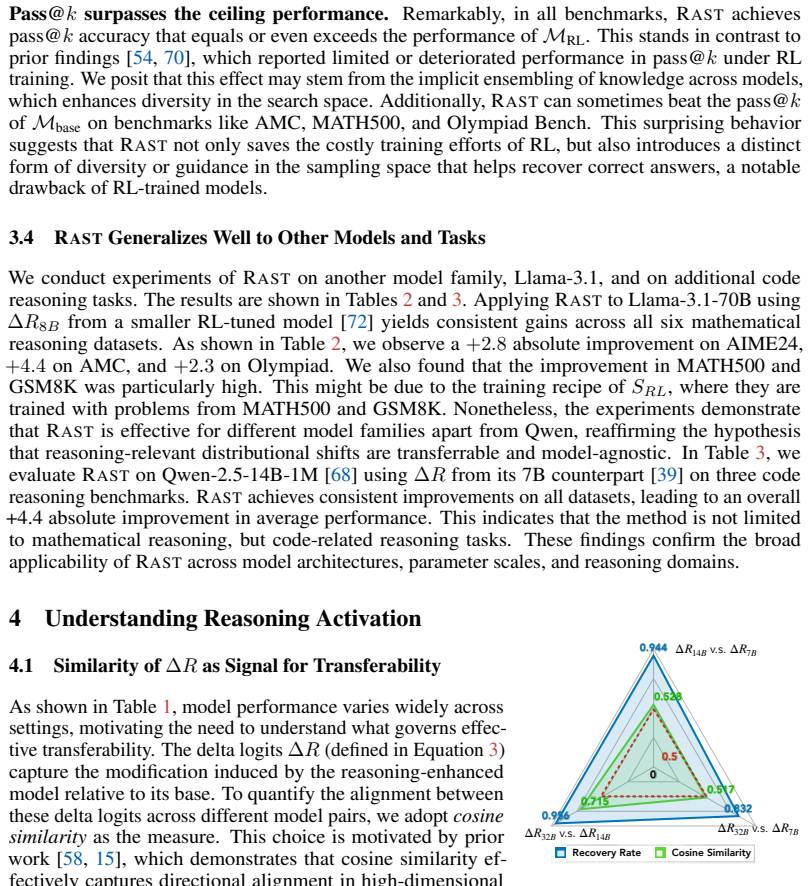
The load-bearing object is the delta-logit signal $\Delta_R(x_{<t}) = S_{\mathrm{RL}}(x_{<t}) - S_{\mathrm{base}}(x_{<t})$, the token-level difference in logits between a small RL-trained model and its own base twin, injected additively at every decoding step through $P = \mathrm{softmax}[M_{\mathrm{base}} + \lambda \Delta_R]$, which amplifies tokens tied to behaviors such as self-verification, branching, and backtracking while leaving ordinary tokens to the base model. Two diagnostics carry the empirical argument: path coverage rate (PCR), the fraction of an RL-produced trajectory that the base model regenerates token for token, which the paper measures above 95% and uses as direct evidence for the sparsity of RL-induced shifts; and cosine similarity between delta signals from different model pairs, which the paper shows correlates with recovery rate so that users can predict transferability before running experiments.
What would settle it
A concrete test: apply a delta computed from a small RL-trained model to a larger base that uses a different tokenizer or a mismatched prompt template, and measure path coverage rate plus recovery on the same benchmarks. The size-invariance hypothesis predicts PCR stays near 95% and recovery stays well above zero; the paper's own AIME24 results, where recovery is roughly 62% and the base gains are small, mark where the claim already starts to weaken, so a dataset or pairing that drives PCR below 90% with recovery near zero would falsify the transfer claim.
Extended reading notes
Core claim
The central claim is that RL-induced probability shifts are largely model-size invariant, so the logit-space correction $\Delta_R = S_{\mathrm{RL}} - S_{\mathrm{base}}$ learned on a small model pair carries reasoning behavior that can be activated in larger models at inference. The proposed decoding rule is $P(x_t \mid x_{<t}) = \mathrm{softmax}[M_{\mathrm{base}}(x_{<t}) + \lambda(S_{\mathrm{RL}}(x_{<t}) - S_{\mathrm{base}}(x_{<t}))]$, with $\lambda = 1.0$; path coverage rate, the fraction of the RL trajectory the base regenerates greedily, stays above 95% for 7B, 14B, and 32B models, which the paper reads as evidence that RL steers a small number of reasoning-critical tokens rather than rewriting outputs. On MATH500, AIME24, AMC, Minerva, OlympiadBench, and GSM8K, adding the transferred delta lifts every base model tested, with average recovery rates of the gap to the RL-trained ceiling ranging from 63.4% to 84.8% depending on the pairing, and recovery above 100% in some cells; on Llama-3.1-70B with an 8B delta and on a 14B coding model with a 7B delta the correction transfers across families and domains. The paper also claims the correction widens the sampling search space, so RAST's pass@k reaches or exceeds the RL-trained model's, and that cosine similarity between candidate deltas predicts recovery rate, giving a cheap pre-screening signal.
Load-bearing premise
The assumption that carries the argument is that the logit-space difference measured on a small model pair transfers unchanged to a larger model's logits, which requires a shared tokenizer, comparable logit scales, and matching prompt templates; the paper's own 1.5B experiments, where the template differed from the training prompt, produced visibly smaller gains, marking where the transfer starts to break.
Editorial extensions
If this is right
- Transplanting a 14B-trained delta into a 32B base yields an average recovery rate of 84.8% across the math benchmarks while needing roughly 160 GB of GPU memory against about 350 GB for full RL training of the 32B model, so most of the reasoning gain arrives at roughly half the memory cost.
- Recovery rates vary with the pairing and benchmark, from 63.4% to over 100%; on Minerva the 32B base with the 14B delta exceeds the RL-trained 32B model outright, so the transferred signal can sometimes beat its own ceiling.
- Sampling with the transferred delta yields pass@k curves that reach or exceed the RL-trained model's on all six math benchmarks, indicating the correction diversifies the search space instead of narrowing it.
- The correction transfers across model families and domains: an 8B Llama-3.1 delta lifts Llama-3.1-70B on all six math benchmarks, and a 7B code delta lifts a 14B coding model by 4.4 points on average, so the mechanism is not specific to one architecture or task type.
- Because recovery rate tracks the cosine similarity between candidate delta signals, a user can screen which small RL expert to train by measuring delta alignment first, without running full evaluations.
Reading between the lines
- Editorial extension: if RL-induced shifts are size-invariant beyond the two families tested, the economics of reasoning RL change — one small expert's delta becomes a reusable inference-time asset for any larger model sharing its tokenizer, decoupling reasoning quality from per-model training budgets.
- Editorial extension: the shared-tokenizer requirement is the hidden boundary of the claim, so a natural test is whether deltas survive cross-vocabulary transfer after a token-alignment or projection step, which the paper does not attempt.
- Editorial extension: RAST is a parameter-free distillation of RL behavior into decoding; distilling the delta into a lightweight adapter (as the paper's future-work section suggests) would make the correction persistent and avoid running three models at inference.
- Editorial extension: the fact that RAST's pass@k can exceed the RL-trained ceiling hints that the combination of base knowledge and transferred behavior searches more broadly than either alone, which suggests the enhanced sampler could itself generate training data for further RL — a loop the paper does not test.
Editorial analysis
A structured set of objections, weighed in public.
Referee Report
Summary. The paper proposes RAST, a decoding-time method that augments a large base model's logits with the logit difference ΔR = SRL − Sbase computed from a small RL-trained model and its base counterpart. The authors first present a hypothesis that RL-induced probability shifts are largely model-size invariant, supported by a path-coverage-rate analysis on 50 SimpleRL trajectories. They then evaluate RAST across Qwen-2.5 and Llama-3.1 math benchmarks and a code benchmark, reporting consistent pass@1 gains, a recovery-rate analysis, robustness sweeps over λ and temperature, and an estimated GPU-memory comparison with GRPO.
Significance. If the empirical results hold, RAST is a practical and inexpensive alternative to full-scale RL: it requires no RL training on the large model, only an additional forward pass through a small pair at inference time, and it is simple to implement. The paper's strongest assets are the breadth of the evaluation (three model families, nine benchmarks, multiple pass@k levels), the fixed λ=1.0 with a robustness sweep, and honest limitations. However, the paper's explanatory claim about size invariance is not yet supported by the evidence, because all alignment measurements are made on RL-expert trajectories rather than on the prefixes where RAST actually applies the delta. If the empirical gains are robust, the method could still be valuable even if the hypothesis is refined or replaced; the main contribution would then be empirical rather than mechanistic.
major comments (3)
- [Sections 2.1 and 4.1 (Eqs. 1-2, 6)] The size-invariance evidence is computed only on 50 trajectories generated by SimpleRL-32B. PCR measures whether Mbase can continue the RL expert's path, and AvgCosineSim is computed by feeding those same RL trajectories through Mbase and MRL. Neither measures the alignment between small-model and large-model deltas on the prefixes that RAST actually decodes from, namely prefixes generated by Mbase or by the augmented model in Eq. (3). Because SRL and Sbase may be off-distribution on those prefixes, the transferred ΔR could in principle be a fixed output bias (e.g., for longer or self-verification text) rather than a scale-invariant reasoning signal. I ask for a concrete test: compute PCR and AvgCosineSim(ΔR_small, ΔR_large) on prefixes sampled from Mbase and from RAST itself, not only from MRL, and report whether the observed alignment persists on those prefixes. This is needed to support the abstract's 'largely model-size invariant' claim.
- [Tables 1-3 and §3.2] The central empirical claim of consistent gains is reported without variance or significance statistics. Pass@1 is averaged over 32 runs, yet no confidence intervals, standard deviations, or paired tests are given, so several reported gains are difficult to interpret. For example, Qwen-2.5-32B on GSM8K goes from 93.1 to 93.3 with ΔR1.5B, and Llama-3.1-70B on AIME24 goes from 0.0 to 2.8; both are within the range one would expect from 32-sample sampling noise. The only error bars appear in Figure 6 for a single configuration. Please add bootstrap confidence intervals or paired significance tests for all main tables, or state explicitly which reported differences are not statistically distinguishable.
- [Table 1 footnote and Fig. 7] The 1.5B row is confounded with a prompt mismatch. The footnote says the prompt used for RAST does not match the one used to train the small RL-tuned model, and Appendix A.2 explains that a different template (Prompt b) is used for the 1.5B source. This means the observed smaller gains for ΔR1.5B, and the 'stronger experts yield greater gains' trend in §3.2, may be partly an artifact of prompt mismatch rather than model scale. The claim that RAST transfers across scales would be better supported by using a matched-prompt 1.5B RL model, or by an ablation in which the same mismatch is artificially applied to ΔR7B and ΔR14B.
minor comments (6)
- [Section 4.2] 'PRC' is used instead of 'PCR' in the sentence 'The PRC in this experiment is 96.37%'; the acronym is inconsistent with Eq. (2).
- [Figure 4] The figure is difficult to read as printed: the plotted points and axes are not clearly labeled, and the numbers in the caption are not mapped to visible axes. Please redraw with explicit axis labels and a legend.
- [Appendix E] 'MAHT500' is a typo for MATH500.
- [Section 3.3 and 4.2] There are several grammatical slips, including 'pass@k for MRL is large than Mbase' and 'the tn+1-th token based on the first n tokens'; these should be corrected.
- [Table 5] The decoding-configurations table mixes model names and hyperparameter rows; separating base-model and RAST rows would improve readability.
- [General] No code release is mentioned in the text beyond the project page; given the revised vLLM implementation and the reproducibility claims, an explicit code link would be valuable.
Circularity Check
No significant circularity: RAST's decoding rule is an empirical proposal tested on external benchmarks, and its supporting analyses do not construct the reported gains.
full rationale
RAST's central claim is an empirical one: adding ΔR = SRL − Sbase at decoding time (Eq. 3) improves a larger base model's reasoning performance. Equation 3 is a proposed decoding rule, not a consequence derived from the size-invariance hypothesis. The hypothesis is supported by PCR and cosine-similarity measurements, but neither quantity appears as a fitted parameter in Eq. 3, and the gains in Tables 1–3 are measured on MATH500, GSM8K, AIME, AMC, Minerva, OlympiadBench, and code benchmarks rather than being definitionally entailed by the delta. The PCR result quantifies how often the base model predicts the next token of an RL expert trajectory; it is evidence about the hypothesis, not a construction of the RAST output. No fitted input is renamed as a prediction: λ is fixed to 1.0 in the main experiments, with a robustness sweep reported in Fig. 6, and the paper explicitly presents the method as simple and fixed rather than optimized against the evaluation sets. The only self-citation with author overlap is [76] (Jiawei Han), which appears in a future-direction sentence about LoRA distillation and is not load-bearing. The paper's own Appendix F acknowledges the lack of theoretical understanding and the dependence on expert quality, which is consistent with an empirical, non-circular derivation chain. The skeptic concern that PCR and cosine similarity are measured on RL-expert trajectories rather than on the base/RAST prefixes where ΔR is actually applied is a correctness risk about the strength of the evidence, not a circularity, because RAST's measured improvements are not forced by those measurements. Overall, the derivation chain is self-contained: the method is defined explicitly, the hypothesis is tested separately, and the reported predictions are external to the definition.
Assumptions & free parameters
free parameters (1)
- lambda (deltaR strength) =
1.0
assumptions (3)
- domain assumption RL-from-scratch training does not add new knowledge; it reshapes the output distribution to activate latent reasoning behaviors
- domain assumption The 50 sampled MATH500 trajectories from a single RL-tuned model are representative for measuring PCR and delta-logit similarity across model scales
- domain assumption The logits of SRL, Sbase, and Mbase are directly comparable: shared tokenizer, comparable scales, and matched prompt templates
Cite this review
Pith. "Pith review of RAST: Reasoning Activation in LLMs via Small-model Transfer." pith.science (2026). https://pith.science/paper/4K5Z7M56
@misc{pith2026250615710,
  author       = {Pith},
  title        = {Pith review of: RAST: Reasoning Activation in LLMs via Small-model Transfer},
  year         = {2026},
  howpublished = {\url{https://pith.science/paper/4K5Z7M56}},
  note         = {Machine review of arXiv:2506.15710}
}
read the original abstract
Reinforcement learning (RL) has become a powerful approach for improving the reasoning capabilities of large language models (LLMs), as evidenced by recent successes such as OpenAI's o1 and Deepseek-R1. However, applying RL at scale remains intimidatingly resource-intensive, requiring multiple model copies and extensive GPU workloads. On the other hand, while being powerful, recent studies suggest that RL does not fundamentally endow models with new knowledge; rather, it primarily reshapes the model's output distribution to activate reasoning capabilities latent in the base model. Building on this insight, we hypothesize that the changes in output probabilities induced by RL are largely model-size invariant, opening the door to a more efficient paradigm: training a small model with RL and transferring its induced probability shifts to larger base models. To verify our hypothesis, we conduct a token-level analysis of decoding trajectories and find high alignment in RL-induced output distributions across model scales, validating our hypothesis. Motivated by this, we propose RAST, a simple yet effective method that transfers reasoning behaviors by injecting RL-induced probability adjustments from a small RL-trained model into larger models. Experiments across multiple mathematical reasoning benchmarks show that RAST substantially and consistently enhances the reasoning capabilities of base models while requiring significantly lower GPU memory than direct RL training, sometimes even yielding better performance than the RL-trained counterparts. Our findings offer new insights into the nature of RL-driven reasoning and practical strategies for scaling its benefits without incurring its full computational cost. The project page of RAST is available at https://ozyyshr.github.io/RAST/.
Figures


Figures from the paper (7 more)


Forward citations
Cited by 1 Pith paper
-
Procedural Knowledge at Scale Improves Reasoning
Retrieving compact procedural hints from 32M subquestion–subroutine pairs improves reasoning-model accuracy on math, science, and coding benchmarks beyond compute-matched test-time scaling.
Reference graph
Works this paper leans on
-
[1]
Program synthesis with large language models.arXiv preprint arXiv:2108.07732, 2021
Jacob Austin, Augustus Odena, Maxwell Nye, Maarten Bosma, Henryk Michalewski, David Dohan, Ellen Jiang, Carrie Cai, Michael Terry, Quoc Le, et al. Program synthesis with large language models.arXiv preprint arXiv:2108.07732, 2021
arXiv 2021
-
[2]
Mark Chen, Jerry Tworek, Heewoo Jun, Qiming Yuan, Henrique Ponde de Oliveira Pinto, Jared Kaplan, Harri Edwards, Yuri Burda, Nicholas Joseph, Greg Brockman, Alex Ray, Raul Puri, Gretchen Krueger, Michael Petrov, Heidy Khlaaf, Girish Sastry, Pamela Mishkin, Brooke Chan, Scott Gray, Nick Ryder, Mikhail Pavlov, Alethea Power, Lukasz Kaiser, Mohammad Bavarian...
2021
-
[3]
Xingyu Chen, Jiahao Xu, Tian Liang, Zhiwei He, Jianhui Pang, Dian Yu, Linfeng Song, Qiuzhi Liu, Mengfei Zhou, Zhuosheng Zhang, et al. Do not think that much for 2+ 3=? on the overthinking of o1-like llms.arXiv preprint arXiv:2412.21187, 2024
arXiv 2024
-
[4]
SFT memorizes, RL generalizes: A comparative study of foundation model post-training
Tianzhe Chu, Yuexiang Zhai, Jihan Yang, Shengbang Tong, Saining Xie, Sergey Levine, and Yi Ma. SFT memorizes, RL generalizes: A comparative study of foundation model post-training. InThe Second Conference on Parsimony and Learning (Recent Spotlight Track), 2025. 10
work page 2025
-
[5]
Glass, and Pengcheng He
Yung-Sung Chuang, Yujia Xie, Hongyin Luo, Yoon Kim, James R. Glass, and Pengcheng He. Dola: Decoding by contrasting layers improves factuality in large language models. InThe Twelfth International Conference on Learning Representations, 2024
2024
-
[6]
Training verifiers to solve math word problems.arXiv preprint arXiv:2110.14168, 2021
Karl Cobbe, Vineet Kosaraju, Mohammad Bavarian, Mark Chen, Heewoo Jun, Lukasz Kaiser, Matthias Plappert, Jerry Tworek, Jacob Hilton, Reiichiro Nakano, et al. Training verifiers to solve math word problems.arXiv preprint arXiv:2110.14168, 2021
-
[7]
Ultrafeedback: Boosting language models with high-quality feedback, 2024
Ganqu Cui, Lifan Yuan, Ning Ding, Guanming Yao, Wei Zhu, Yuan Ni, Guotong Xie, Zhiyuan Liu, and Maosong Sun. Ultrafeedback: Boosting language models with high-quality feedback, 2024
work page 2024
-
[8]
Assessing diversity collapse in reasoning
Xingyu Dang, Christina Baek, J Zico Kolter, and Aditi Raghunathan. Assessing diversity collapse in reasoning. InScaling Self-Improving Foundation Models without Human Supervision, 2025
2025
Show all 79 references
-
[9]
Dietterich
Thomas G. Dietterich. Ensemble methods in machine learning. InProceedings of the First International Workshop on Multiple Classifier Systems, MCS ’00, page 1–15, Berlin, Heidelberg,
-
[10]
Hierarchical neural story generation
Angela Fan, Mike Lewis, and Yann Dauphin. Hierarchical neural story generation. In Iryna Gurevych and Yusuke Miyao, editors,Proceedings of the 56th Annual Meeting of the Association for Computational Linguistics (Volume 1: Long Papers), pages 889–898, Melbourne, Australia, Jul...
2018
-
[11]
Cognitive behaviors that enable self-improving reasoners, or, four habits of highly effective stars.arXiv preprint arXiv:2503.01307, 2025
Kanishk Gandhi, Ayush Chakravarthy, Anikait Singh, Nathan Lile, and Noah D Goodman. Cognitive behaviors that enable self-improving reasoners, or, four habits of highly effective stars.arXiv preprint arXiv:2503.01307, 2025
2025 arXiv
-
[12]
Deepseek-r1t-chimera, April 2025
TNG Technology Consulting GmbH. Deepseek-r1t-chimera, April 2025
2025
-
[13]
The llama 3 herd of models.arXiv preprint arXiv:2407.21783, 2024
Aaron Grattafiori, Abhimanyu Dubey, Abhinav Jauhri, Abhinav Pandey, Abhishek Kadian, Ahmad Al-Dahle, Aiesha Letman, Akhil Mathur, Alan Schelten, Alex Vaughan, et al. The llama 3 herd of models.arXiv preprint arXiv:2407.21783, 2024
2024 arXiv
-
[14]
Deepseek-r1: Incentivizing reasoning capability in llms via reinforcement learning.arXiv preprint arXiv:2501.12948, 2025
Daya Guo, Dejian Yang, Haowei Zhang, Junxiao Song, Ruoyu Zhang, Runxin Xu, Qihao Zhu, Shirong Ma, Peiyi Wang, Xiao Bi, et al. Deepseek-r1: Incentivizing reasoning capability in llms via reinforcement learning.arXiv preprint arXiv:2501.12948, 2025
2025 arXiv
-
[15]
Cosine similarity knowledge distillation for individual class information transfer.arXiv preprint arXiv:2311.14307, 2023
Gyeongdo Ham, Seonghak Kim, Suin Lee, Jae-Hyeok Lee, and Daeshik Kim. Cosine similarity knowledge distillation for individual class information transfer.arXiv preprint arXiv:2311.14307, 2023
2023 arXiv
-
[16]
Teaching large language models to reason with reinforcement learning.arXiv preprint arXiv:2403.04642, 2024
Alex Havrilla, Yuqing Du, Sharath Chandra Raparthy, Christoforos Nalmpantis, Jane Dwivedi- Yu, Maksym Zhuravinskyi, Eric Hambro, Sainbayar Sukhbaatar, and Roberta Raileanu. Teaching large language models to reason with reinforcement learning.arXiv preprint arXiv:2403.04642, 2024
2024 arXiv
-
[17]
OlympiadBench: A challenging benchmark for promoting AGI with olympiad-level bilingual multimodal scientific problems
Chaoqun He, Renjie Luo, Yuzhuo Bai, Shengding Hu, Zhen Thai, Junhao Shen, Jinyi Hu, Xu Han, Yujie Huang, Yuxiang Zhang, Jie Liu, Lei Qi, Zhiyuan Liu, and Maosong Sun. OlympiadBench: A challenging benchmark for promoting AGI with olympiad-level bilingual multimodal scientific p...
2024
-
[18]
Measuring mathematical problem solving with the MATH dataset
Dan Hendrycks, Collin Burns, Saurav Kadavath, Akul Arora, Steven Basart, Eric Tang, Dawn Song, and Jacob Steinhardt. Measuring mathematical problem solving with the MATH dataset. InThirty-fifth Conference on Neural Information Processing Systems Datasets and Benchmarks Track (...
2021
-
[19]
A sober look at progress in language model reasoning: Pitfalls and paths to reproducibility.arXiv preprint arXiv:2504.07086, 2025
Andreas Hochlehnert, Hardik Bhatnagar, Vishaal Udandarao, Samuel Albanie, Ameya Prabhu, and Matthias Bethge. A sober look at progress in language model reasoning: Pitfalls and paths to reproducibility.arXiv preprint arXiv:2504.07086, 2025. 11
2025
-
[20]
The curious case of neural text degeneration
Ari Holtzman, Jan Buys, Li Du, Maxwell Forbes, and Yejin Choi. The curious case of neural text degeneration. InInternational Conference on Learning Representations, 2020
2020
-
[21]
LoRA: Low-rank adaptation of large language models
Edward J Hu, yelong shen, Phillip Wallis, Zeyuan Allen-Zhu, Yuanzhi Li, Shean Wang, Lu Wang, and Weizhu Chen. LoRA: Low-rank adaptation of large language models. In International Conference on Learning Representations, 2022
2022
-
[22]
Lorahub: Efficient cross-task generalization via dynamic loRA composition
Chengsong Huang, Qian Liu, Bill Yuchen Lin, Tianyu Pang, Chao Du, and Min Lin. Lorahub: Efficient cross-task generalization via dynamic loRA composition. InFirst Conference on Language Modeling, 2024
2024
-
[23]
Openai o1 system card.arXiv preprint arXiv:2412.16720, 2024
Aaron Jaech, Adam Kalai, Adam Lerer, Adam Richardson, Ahmed El-Kishky, Aiden Low, Alec Helyar, Aleksander Madry, Alex Beutel, Alex Carney, et al. Openai o1 system card.arXiv preprint arXiv:2412.16720, 2024
2024 arXiv
-
[24]
Livecodebench: Holistic and contamination free evaluation of large language models for code
Naman Jain, King Han, Alex Gu, Wen-Ding Li, Fanjia Yan, Tianjun Zhang, Sida Wang, Ar- mando Solar-Lezama, Koushik Sen, and Ion Stoica. Livecodebench: Holistic and contamination free evaluation of large language models for code. InThe Thirteenth International Conference on Lear...
2025
-
[25]
Reinforcement learning: A survey.Journal of artificial intelligence research, 4:237–285, 1996
Leslie Pack Kaelbling, Michael L Littman, and Andrew W Moore. Reinforcement learning: A survey.Journal of artificial intelligence research, 4:237–285, 1996
1996
-
[26]
On information and sufficiency.The annals of mathematical statistics, 22(1):79–86, 1951
Solomon Kullback and Richard A Leibler. On information and sufficiency.The annals of mathematical statistics, 22(1):79–86, 1951
1951
-
[27]
Gonzalez, Hao Zhang, and Ion Stoica
Woosuk Kwon, Zhuohan Li, Siyuan Zhuang, Ying Sheng, Lianmin Zheng, Cody Hao Yu, Joseph E. Gonzalez, Hao Zhang, and Ion Stoica. Efficient memory management for large lan- guage model serving with pagedattention. InProceedings of the ACM SIGOPS 29th Symposium on Operating System...
2023
-
[28]
T\" ulu 3: Pushing frontiers in open language model post-training.arXiv preprint arXiv:2411.15124, 2024
Nathan Lambert, Jacob Morrison, Valentina Pyatkin, Shengyi Huang, Hamish Ivison, Faeze Brahman, Lester James V Miranda, Alisa Liu, Nouha Dziri, Shane Lyu, et al. T\" ulu 3: Pushing frontiers in open language model post-training.arXiv preprint arXiv:2411.15124, 2024
2024 arXiv
-
[29]
Solving quantitative reasoning problems with language models
Aitor Lewkowycz, Anders Johan Andreassen, David Dohan, Ethan Dyer, Henryk Michalewski, Vinay Venkatesh Ramasesh, Ambrose Slone, Cem Anil, Imanol Schlag, Theo Gutman-Solo, Yuhuai Wu, Behnam Neyshabur, Guy Gur-Ari, and Vedant Misra. Solving quantitative reasoning problems with l...
2022
-
[30]
Contrastive decoding: Open-ended text generation as optimization
Xiang Lisa Li, Ari Holtzman, Daniel Fried, Percy Liang, Jason Eisner, Tatsunori Hashimoto, Luke Zettlemoyer, and Mike Lewis. Contrastive decoding: Open-ended text generation as optimization. In Anna Rogers, Jordan Boyd-Graber, and Naoaki Okazaki, editors,Proceedings of the 61s...
2023
-
[31]
Gonzalez, and Ion Stoica
Eric Liang, Zhanghao Wu, Michael Luo, Sven Mika, Joseph E. Gonzalez, and Ion Stoica. RLlib flow: Distributed reinforcement learning is a dataflow problem. In A. Beygelzimer, Y . Dauphin, P. Liang, and J. Wortman Vaughan, editors,Advances in Neural Information Processing Systems, 2021
2021
-
[32]
Let’s verify step by step
Hunter Lightman, Vineet Kosaraju, Yuri Burda, Harrison Edwards, Bowen Baker, Teddy Lee, Jan Leike, John Schulman, Ilya Sutskever, and Karl Cobbe. Let’s verify step by step. InThe Twelfth International Conference on Learning Representations, 2024
2024
-
[33]
The unlocking spell on base llms: Rethinking alignment via in-context learning
Bill Yuchen Lin, Abhilasha Ravichander, Ximing Lu, Nouha Dziri, Melanie Sclar, Khy- athi Raghavi Chandu, Chandra Bhagavatula, and Yejin Choi. The unlocking spell on base llms: Rethinking alignment via in-context learning. InThe Twelfth International Conference on Learning Repr...
2024
-
[34]
Critical tokens matter: Token-level contrastive estimation enhence llm’s reasoning capability.arXiv preprint arXiv:2411.19943, 2024
Zicheng Lin, Tian Liang, Jiahao Xu, Xing Wang, Ruilin Luo, Chufan Shi, Siheng Li, Yujiu Yang, and Zhaopeng Tu. Critical tokens matter: Token-level contrastive estimation enhence llm’s reasoning capability.arXiv preprint arXiv:2411.19943, 2024
2024 arXiv
-
[35]
Alisa Liu, Xiaochuang Han, Yizhong Wang, Yulia Tsvetkov, Yejin Choi, and Noah A. Smith. Tuning language models by proxy. InFirst Conference on Language Modeling, 2024
2024
-
[36]
Smith, and Yejin Choi
Alisa Liu, Maarten Sap, Ximing Lu, Swabha Swayamdipta, Chandra Bhagavatula, Noah A. Smith, and Yejin Choi. DExperts: Decoding-time controlled text generation with experts and anti-experts. In Chengqing Zong, Fei Xia, Wenjie Li, and Roberto Navigli, editors,Proceedings of the 5...
2021
-
[37]
Is your code generated by chatGPT really correct? rigorous evaluation of large language models for code generation
Jiawei Liu, Chunqiu Steven Xia, Yuyao Wang, and Lingming Zhang. Is your code generated by chatGPT really correct? rigorous evaluation of large language models for code generation. In Thirty-seventh Conference on Neural Information Processing Systems, 2023
2023
-
[38]
Evaluating language models for efficient code generation
Jiawei Liu, Songrun Xie, Junhao Wang, Yuxiang Wei, Yifeng Ding, and Lingming Zhang. Evaluating language models for efficient code generation. InFirst Conference on Language Modeling, 2024
2024
-
[39]
Code-r1: Reproducing r1 for code with reliable rewards
Jiawei Liu and Lingming Zhang. Code-r1: Reproducing r1 for code with reliable rewards. 2025
2025
-
[40]
There may not be aha moment in r1-zero-like training — a pilot study
Zichen Liu, Changyu Chen, Wenjun Li, Tianyu Pang, Chao Du, and Min Lin. There may not be aha moment in r1-zero-like training — a pilot study. https://oatllm.notion.site/ oat-zero, 2025. Notion Blog
2025
-
[41]
Understanding r1-zero-like training: A critical perspective.arXiv preprint arXiv:2503.20783, 2025
Zichen Liu, Changyu Chen, Wenjun Li, Penghui Qi, Tianyu Pang, Chao Du, Wee Sun Lee, and Min Lin. Understanding r1-zero-like training: A critical perspective.arXiv preprint arXiv:2503.20783, 2025
2025 arXiv
-
[42]
Cot-valve: Length-compressible chain-of-thought tuning.arXiv preprint arXiv:2502.09601, 2025
Xinyin Ma, Guangnian Wan, Runpeng Yu, Gongfan Fang, and Xinchao Wang. Cot-valve: Length-compressible chain-of-thought tuning.arXiv preprint arXiv:2502.09601, 2025
2025 arXiv
-
[43]
Deepseek-r1 thoughtology: Let’s< think> about llm reasoning.arXiv preprint arXiv:2504.07128, 2025
Sara Vera Marjanovi ´c, Arkil Patel, Vaibhav Adlakha, Milad Aghajohari, Parishad BehnamGhader, Mehar Bhatia, Aditi Khandelwal, Austin Kraft, Benno Krojer, Xing Han Lù, et al. Deepseek-r1 thoughtology: Let’s< think> about llm reasoning.arXiv preprint arXiv:2504.07128, 2025
2025
-
[44]
Locally typical sampling
Clara Meister, Tiago Pimentel, Gian Wiher, and Ryan Cotterell. Locally typical sampling. Transactions of the Association for Computational Linguistics, 11:102–121, 2023
2023
-
[45]
An emulator for fine-tuning large language models using small language models
Eric Mitchell, Rafael Rafailov, Archit Sharma, Chelsea Finn, and Christopher D Manning. An emulator for fine-tuning large language models using small language models. InThe Twelfth International Conference on Learning Representations, 2024
2024
-
[46]
Contrastive decoding improves reasoning in large language models.arXiv preprint arXiv:2309.09117, 2023
Sean O’Brien and Mike Lewis. Contrastive decoding improves reasoning in large language models.arXiv preprint arXiv:2309.09117, 2023
2023 arXiv
-
[47]
Long Ouyang, Jeff Wu, Xu Jiang, Diogo Almeida, Carroll L. Wainwright, Pamela Mishkin, Chong Zhang, Sandhini Agarwal, Katarina Slama, Alex Ray, John Schulman, Jacob Hilton, Fraser Kelton, Luke Miller, Maddie Simens, Amanda Askell, Peter Welinder, Paul Christiano, Jan Leike, and...
2022
-
[48]
Tinyzero
Jiayi Pan, Junjie Zhang, Xingyao Wang, Lifan Yuan, Hao Peng, and Alane Suhr. Tinyzero. https://github.com/Jiayi-Pan/TinyZero, 2025. Accessed: 2025-01-24
2025
-
[49]
Iterative reasoning preference optimization.Advances in Neural Information Processing Systems, 37:116617–116637, 2024
Richard Yuanzhe Pang, Weizhe Yuan, He He, Kyunghyun Cho, Sainbayar Sukhbaatar, and Jason Weston. Iterative reasoning preference optimization.Advances in Neural Information Processing Systems, 37:116617–116637, 2024. 13
2024
-
[50]
To backtrack or not to backtrack: When sequential search limits model reasoning.arXiv preprint arXiv:2504.07052, 2025
Tian Qin, David Alvarez-Melis, Samy Jelassi, and Eran Malach. To backtrack or not to backtrack: When sequential search limits model reasoning.arXiv preprint arXiv:2504.07052, 2025
2025
-
[51]
Entropy-based decoding for retrieval-augmented large language models
Zexuan Qiu, Zijing Ou, Bin Wu, Jingjing Li, Aiwei Liu, and Irwin King. Entropy-based decoding for retrieval-augmented large language models. 2025
2025
-
[52]
Proximal policy optimization algorithms.arXiv preprint arXiv:1707.06347, 2017
John Schulman, Filip Wolski, Prafulla Dhariwal, Alec Radford, and Oleg Klimov. Proximal policy optimization algorithms.arXiv preprint arXiv:1707.06347, 2017
2017 arXiv
-
[53]
Rewarding progress: Scaling automated process verifiers for LLM reasoning
Amrith Setlur, Chirag Nagpal, Adam Fisch, Xinyang Geng, Jacob Eisenstein, Rishabh Agarwal, Alekh Agarwal, Jonathan Berant, and Aviral Kumar. Rewarding progress: Scaling automated process verifiers for LLM reasoning. InThe Thirteenth International Conference on Learning Represe...
2025
-
[54]
Zhihong Shao, Peiyi Wang, Qihao Zhu, Runxin Xu, Junxiao Song, Mingchuan Zhang, Y .K. Li, Y . Wu, and Daya Guo. Deepseekmath: Pushing the limits of mathematical reasoning in open language models, 2024
2024
-
[55]
Hybridflow: A flexible and efficient RLHF framework
Guangming Sheng, Chi Zhang, Zilingfeng Ye, Xibin Wu, Wang Zhang, Ru Zhang, Yanghua Peng, Haibin Lin, and Chuan Wu. Hybridflow: A flexible and efficient RLHF framework. InProceedings of the Twentieth European Conference on Computer Systems, EuroSys 2025, Rotterdam, The Netherla...
2025
-
[56]
A thorough examination of decoding methods in the era of LLMs
Chufan Shi, Haoran Yang, Deng Cai, Zhisong Zhang, Yifan Wang, Yujiu Yang, and Wai Lam. A thorough examination of decoding methods in the era of LLMs. In Yaser Al-Onaizan, Mohit Bansal, and Yun-Nung Chen, editors,Proceedings of the 2024 Conference on Empirical Methods in Natura...
2024
-
[57]
Trusting your evidence: Hallucinate less with context-aware decoding
Weijia Shi, Xiaochuang Han, Mike Lewis, Yulia Tsvetkov, Luke Zettlemoyer, and Wen-tau Yih. Trusting your evidence: Hallucinate less with context-aware decoding. In Kevin Duh, Helena Gomez, and Steven Bethard, editors,Proceedings of the 2024 Conference of the North American Cha...
2024
-
[58]
Teaching where to look: Attention similarity knowledge distillation for low resolution face recognition
Sungho Shin, Joosoon Lee, Junseok Lee, Yeonguk Yu, and Kyoobin Lee. Teaching where to look: Attention similarity knowledge distillation for low resolution face recognition. In Computer Vision – ECCV 2022, pages 631–647, Cham, 2022. Springer Nature Switzerland
2022
-
[59]
MIT press Cambridge, 1998
Richard S Sutton, Andrew G Barto, et al.Reinforcement learning: An introduction, volume 1. MIT press Cambridge, 1998
1998
-
[60]
All roads lead to likelihood: The value of reinforcement learning in fine-tuning.arXiv preprint arXiv:2503.01067, 2025
Gokul Swamy, Sanjiban Choudhury, Wen Sun, Zhiwei Steven Wu, and J Andrew Bagnell. All roads lead to likelihood: The value of reinforcement learning in fine-tuning.arXiv preprint arXiv:2503.01067, 2025
2025
-
[61]
ReFT: Reason- ing with reinforced fine-tuning
Luong Trung, Xinbo Zhang, Zhanming Jie, Peng Sun, Xiaoran Jin, and Hang Li. ReFT: Reason- ing with reinforced fine-tuning. In Lun-Wei Ku, Andre Martins, and Vivek Srikumar, editors, Proceedings of the 62nd Annual Meeting of the Association for Computational Linguistics (Volume...
2024
-
[62]
Contrastive decoding reduces hallu- cinations in large multilingual machine translation models
Jonas Waldendorf, Barry Haddow, and Alexandra Birch. Contrastive decoding reduces hallu- cinations in large multilingual machine translation models. In Yvette Graham and Matthew Purver, editors,Proceedings of the 18th Conference of the European Chapter of the Association for C...
2024
-
[63]
Enhancing code llms with reinforcement learning in code generation.arXiv preprint arXiv:2412.20367, 2024
Junqiao Wang, Zeng Zhang, Yangfan He, Yuyang Song, Tianyu Shi, Yuchen Li, Hengyuan Xu, Kunyu Wu, Guangwu Qian, Qiuwu Chen, et al. Enhancing code llms with reinforcement learning in code generation.arXiv preprint arXiv:2412.20367, 2024. 14
2024 arXiv
-
[64]
When more is less: Understanding chain-of-thought length in llms.arXiv preprint arXiv:2502.07266, 2025
Yuyang Wu, Yifei Wang, Tianqi Du, Stefanie Jegelka, and Yisen Wang. When more is less: Understanding chain-of-thought length in llms.arXiv preprint arXiv:2502.07266, 2025
2025 arXiv
-
[65]
Tokenskip: Controllable chain-of-thought compression in llms, 2025
Heming Xia, Yongqi Li, Chak Tou Leong, Wenjie Wang, and Wenjie Li. Tokenskip: Controllable chain-of-thought compression in llms, 2025
2025
-
[66]
Logic-rl: Unleashing llm reasoning with rule-based reinforcement learning.arXiv preprint arXiv:2502.14768, 2025
Tian Xie, Zitian Gao, Qingnan Ren, Haoming Luo, Yuqian Hong, Bryan Dai, Joey Zhou, Kai Qiu, Zhirong Wu, and Chong Luo. Logic-rl: Unleashing llm reasoning with rule-based reinforcement learning.arXiv preprint arXiv:2502.14768, 2025
2025 arXiv
-
[67]
An Yang, Baosong Yang, Beichen Zhang, Binyuan Hui, Bo Zheng, Bowen Yu, Chengyuan Li, Dayiheng Liu, Fei Huang, Haoran Wei, et al. Qwen2. 5 technical report.arXiv preprint arXiv:2412.15115, 2024
2024 arXiv
-
[68]
An Yang, Bowen Yu, Chengyuan Li, Dayiheng Liu, Fei Huang, Haoyan Huang, Jiandong Jiang, Jianhong Tu, Jianwei Zhang, Jingren Zhou, et al. Qwen2. 5-1m technical report.arXiv preprint arXiv:2501.15383, 2025
2025 arXiv
-
[69]
Dapo: An open-source llm reinforcement learning system at scale.arXiv preprint arXiv:2503.14476, 2025
Qiying Yu, Zheng Zhang, Ruofei Zhu, Yufeng Yuan, Xiaochen Zuo, Yu Yue, Tiantian Fan, Gaohong Liu, Lingjun Liu, Xin Liu, et al. Dapo: An open-source llm reinforcement learning system at scale.arXiv preprint arXiv:2503.14476, 2025
2025 arXiv
-
[70]
Does reinforcement learning really incentivize reasoning capacity in llms beyond the base model? arXiv preprint arXiv:2504.13837, 2025
Yang Yue, Zhiqi Chen, Rui Lu, Andrew Zhao, Zhaokai Wang, Shiji Song, and Gao Huang. Does reinforcement learning really incentivize reasoning capacity in llms beyond the base model? arXiv preprint arXiv:2504.13837, 2025
2025 arXiv
-
[71]
Acecoder: Acing coder rl via automated test-case synthesis.arXiv preprint arXiv:2502.01718, 2025
Huaye Zeng, Dongfu Jiang, Haozhe Wang, Ping Nie, Xiaotong Chen, and Wenhu Chen. Acecoder: Acing coder rl via automated test-case synthesis.arXiv preprint arXiv:2502.01718, 2025
2025 arXiv
-
[72]
Simplerl-zoo: Investigating and taming zero reinforcement learning for open base models in the wild.arXiv preprint arXiv:2503.18892, 2025
Weihao Zeng, Yuzhen Huang, Qian Liu, Wei Liu, Keqing He, Zejun Ma, and Junxian He. Simplerl-zoo: Investigating and taming zero reinforcement learning for open base models in the wild.arXiv preprint arXiv:2503.18892, 2025
2025 arXiv
-
[73]
Entropy-based exploration conduction for multi-step reasoning.arXiv preprint arXiv:2503.15848, 2025
Jinghan Zhang, Xiting Wang, Fengran Mo, Yeyang Zhou, Wanfu Gao, and Kunpeng Liu. Entropy-based exploration conduction for multi-step reasoning.arXiv preprint arXiv:2503.15848, 2025
2025 arXiv
-
[74]
Echo chamber: Rl post-training amplifies behaviors learned in pretraining.arXiv preprint arXiv:2504.07912, 2025
Rosie Zhao, Alexandru Meterez, Sham Kakade, Cengiz Pehlevan, Samy Jelassi, and Eran Malach. Echo chamber: Rl post-training amplifies behaviors learned in pretraining.arXiv preprint arXiv:2504.07912, 2025
2025 arXiv
-
[75]
Easyr1: An efficient, scalable, multi-modality rl training framework
Yaowei Zheng, Junting Lu, Shenzhi Wang, Zhangchi Feng, Dongdong Kuang, and Yuwen Xiong. Easyr1: An efficient, scalable, multi-modality rl training framework. https://github. com/hiyouga/EasyR1, 2025
2025
-
[76]
Seeking neural nuggets: Knowledge transfer in large language models from a parametric perspective
Ming Zhong, Chenxin An, Weizhu Chen, Jiawei Han, and Pengcheng He. Seeking neural nuggets: Knowledge transfer in large language models from a parametric perspective. InThe Twelfth International Conference on Learning Representations, 2024
2024
-
[77]
aha moment
Hengguang Zhou, Xirui Li, Ruochen Wang, Minhao Cheng, Tianyi Zhou, and Cho-Jui Hsieh. R1-zero’s" aha moment" in visual reasoning on a 2b non-sft model.arXiv preprint arXiv:2503.05132, 2025. 15 A Implementation Details A.1 Datasets We provide the details for all the datasets us...
2025 arXiv
-
[79]
\boxed”. For both prompt templates, the “{input}
in AIME 2024 for testing purposes. AMCSimilar to AIME, AMC is another very challenging dataset that contain problems in competi- tions, specifically, the American Mathematics Competitions (AMC). The collection of AMC actually contains 40 problems (could be found athttps://hugg...
2024
-
[2024]
Association for Computational Linguistics
Reviewed August 7, 2026 · model on record in the stance chip above.
Discussion (0). Sign in to comment.