REVIEW 5 major objections 8 minor 64 references
UniMate: A Unified Model for Mechanical Metamaterial Generation, Property Prediction, and Condition Confirmation
T0 review · 5 major / 8 minor · reviewed 2026-08-07 · deepseek-v4-flash
Pith's one-line read A unified model treats mechanical metamaterial design as one three-way inference problem, where any two modalities—topology, density, properties—determine the third.
desk verdict The model and task framing are solid, but the rotation-augmented split likely leaks base topologies into test, so the headline empirical margins are not interpretable as generalization. read the letter →
The pith
A machine-rendered reading of the paper's core claim, the machinery that carries it, and where it could break.
The reading
What carries the argument
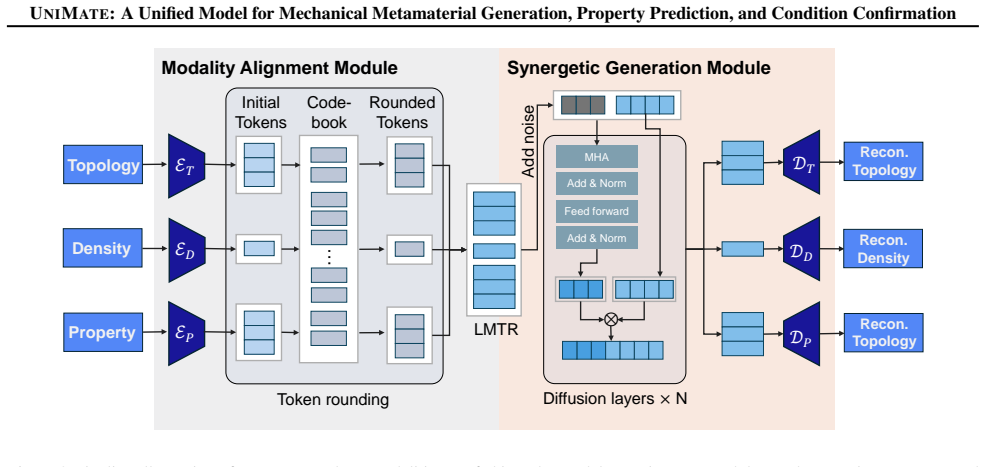
The load-bearing mechanism is the Latent MTR token sequence, a discrete codebook representation that unifies the three modalities. Each modality is passed through its own encoder (a graph network for topology, MLPs for density and properties) and rounded to the nearest prototype token; a tripartite optimal transport alignment, implemented by a generalized Sinkhorn iteration, pulls the three token distributions together. The synergetic generation module then runs a score-based diffusion process over the token sequence while freezing known tokens at their initial values, so unknown tokens are generated conditionally on any supplied subset. This combination is what lets a single pipeline switch between generation, prediction, and confirmation by changing only which tokens are masked.
What would settle it
Re-run the benchmark with a topology-wise split—putting all ten rotations of a selected topology in the same fold—and compare condition-confirmation NRMSE and property-prediction NRMSE; if those errors jump substantially while generation metrics stay similar, the original gains were inflated by rotated copies crossing the train/test boundary. A direct check is to search the training set for any test topology under a different rotation angle.
Extended reading notes
Core claim
UNIMATE's central claim is that the three modalities of a mechanical metamaterial—topology $T$, density condition $\rho$, and mechanical properties $p$—can be embedded into one token sequence, the Latent MTR, such that completing missing tokens by diffusion solves all three design tasks at once. The authors formalize the Metamaterial Trinity Representation $M=(T,\rho,p)$ and show that knowing any two entries should determine the third. Their experiments report that UNIMATE beats baseline models on every task, with improvements over the best baseline of up to 80.2% in topology generation, 5.1% in property prediction, and 50.2% in condition confirmation. They also present a benchmark covering all three modalities, built by selecting 500 topologies, assigning three densities to each, computing properties by homogenization simulation, and rotating each sample nine times.
Load-bearing premise
The results assume the random 70/15/15 split of the rotation-augmented data keeps all rotated copies of one topology in the same split; if the split is per-sample, the same topology can appear in both training and test, and the reported property and density errors could come partly from memorizing duplicates rather than generalizing to new topologies.
Editorial extensions
If this is right
- One trained UNIMATE model can act as an inverse design tool: given a target stiffness and a density budget, it generates a 3D topology; given a topology and density, it predicts the full property vector; given a topology and target properties, it confirms the needed density.
- Because the synergetic generation module accepts an arbitrary subset of known tokens, the same machinery covers any partial specification of the trinity, not just the three canonical tasks.
- The new 15,000-sample benchmark with homogenization-computed properties gives later work a common yardstick for evaluating all three tasks simultaneously.
- The ablation study indicates that the latent compression, the alignment operation, and the partially frozen diffusion technique each contribute measurable gains, so each module is load-bearing as claimed.
- The model's memory efficiency—no out-of-memory error at batch size 10,000 where several baselines fail—means it can scale to larger design searches.
Reading between the lines
- Editorial inference: because density is invariant under the rotation augmentation while topology and property rotate together, the evaluation should be re-run with a topology-wise split; if the original split was sample-wise, the condition-confirmation and property errors could be optimistically biased.
- Editorial inference: the same token-completion scheme may transfer to other 'trinity' design problems, such as molecular structure, solvent, and target property, since the alignment and frozen-diffusion modules are not metamaterial-specific.
- Editorial inference: the case study's intermediate structures, which the authors say are absent from the training set, suggest the model can interpolate within the design distribution; one can test this directly by asking whether generated intermediates satisfy finite-element-computed properties, not just the learned surrogate.
Editorial analysis
A structured set of objections, weighed in public.
Referee Report
Summary. The paper formalizes mechanical metamaterial design as three coupled tasks—topology generation from density/property, property prediction from topology/density, and condition (density) confirmation from topology/property—and proposes UniMate, a unified model combining a VQ-VAE-style discrete latent space, tripartite optimal transport alignment, and a partially frozen score-based diffusion module. A new benchmark is constructed from 500 topologies, each with 3 densities and 9 rotation augmentations, yielding 15,000 samples. Experiments compare UniMate against six baselines and report large improvements across all three tasks, with additional ablations, efficiency analysis, and parameter sensitivity studies.
Significance. If the reported results generalize, the paper would make a useful contribution: a single model handling three interlinked design modalities, a new benchmark for the community, and a principled alignment mechanism. The tripartite OT transport plan is used only as a learned prior for diffusion initialization, so I do not see a circularity problem in the method itself. The open-sourced repository and dataset are also positive elements. However, the central empirical claims currently rest on an ambiguous data-split protocol and single-run numbers; until the split granularity and baseline input protocols are clarified, the headline margins (80.2%, 5.1%, 50.2%) cannot be taken as evidence of generalization to new topologies.
major comments (5)
- [Appendix A.1 / Section B.1] The paper never states whether the 70/15/15 split is performed by base topology or by individual augmented sample. Because each of the 500 base topologies appears nine times under rotation with the same density and co-rotated properties, a sample-wise split places rotated copies of training topologies in the test set. Relative density is rotation-invariant, so the condition-confirmation task (NRMSEcc) can be solved by retrieving a memorized scalar for a seen topology, and property prediction can be solved by retrieving a memorized tensor; topology generation can likewise reproduce near-copies of training topologies. The reported margins in Table 2 would then reflect memorization rather than generalization to new topologies. Please state the split granularity, and if it was sample-wise, re-run all experiments with a topology-disjoint split and report both sets of numbers.
- [Table 2 / Section 4.2] No error bars, confidence intervals, or significance tests are reported for any comparison. All entries are single runs. The property-prediction margin (NRMSEpp 2.44 vs 2.57, about 5%) is small and could easily arise from random initialization; the generation and condition-confirmation margins are large but still need variance estimates. Report mean plus or minus standard deviation over multiple seeds for every task and perform a paired significance test (or equivalent) before claiming superiority.
- [Section 4.2] For the property-prediction task, the paper does not state whether the four prediction baselines (Equiformer, ViSNet, MACE-ve, uniTruss) were given the density condition as input, even though the task definition in Section 2.2 is 'Given the topology T and density condition ρ, predict property p.' If the baselines received only topology, they are handicapped by construction, making the 5.1% comparison uninterpretable. Please describe the exact inputs and any input-conditioning modifications for each baseline, or retrain them with density as an additional input feature.
- [Section 4.2 / Appendix A.2.1] Fcond (Eq. 26) is a nearest-neighbor distance from the generated vertices to a single ground-truth topology. For conditional topology generation, many topologies may satisfy the same density and property constraints, so this metric penalizes valid alternative designs and rewards reproducing the training sample; combined with rotation augmentation, a generated rotated copy of a training topology would score artificially well. Please complement the metric with a validity check on the generated structure's simulated properties, and report diversity or coverage metrics.
- [Section 4.2 / Table 2] The baseline adaptation for condition confirmation is underspecified. The sentence 'we revise the three prediction-oriented models by forcing them to predict density' does not explain the output head, loss function, or training protocol, so the 50.2% improvement may reflect an unfavorable adaptation rather than a genuine advantage. Please provide the exact architecture changes and training details for the adapted baselines, or replace them with task-specific condition-confirmation models.
minor comments (8)
- [Section 3.2] The phrase 'inspired by inspired by VQ-VAE' contains a duplicated word and should be corrected.
- [Equation (1)] The GCN update \tilde{X}^l = A\sigma(\tilde{X}^{l-1}, A)W^l appears to apply \sigma to two arguments; this is likely a typo and should read \sigma(\tilde{X}^{l-1}) or similar.
- [Table 3 / Section 4.5] The abbreviation 'NRMSE dp' is used in Table 3 and the ablation discussion, while Table 2 uses 'NRMSEcc' for the same task; please define the abbreviation and use consistent notation.
- [Figure 4 / Section 4.3] The legend label 'UniMetaMate' should be 'UniMate', and the figure omits baselines that appear in Table C.1; please make the figure consistent with the table.
- [Algorithm 1] Line 6 writes 'FT ,k ← −FT ,k + 1'; this should be an increment (FT,k ← FT,k + 1), and the symbols n and lT are not defined in the algorithm block.
- [Section 4.4] The codebook size is denoted κ in Section 3.2 but called n in Section 4.4; please align the notation.
- [Appendix B.1] Please report the number of diffusion steps, transformer depth, learning rate, batch size, and number of seeds to make the experiments reproducible beyond the released code.
- [Section 4.2] The claim of 'up to 80.2%' improvement in topology generation should specify the aggregation; it appears to be the average of the relative improvements in Fqua and Fcond rather than a single-metric improvement, and this should be stated explicitly.
Circularity Check
No significant circularity in the model derivation; the flagged item is an evaluation-support gap: the paper never states whether the 70/15/15 split of the 9x-rotated dataset is topology-disjoint, so the reported NRMSE and Fcond gains could partly reflect train/test overlap rather than generalization to unseen topologies.
-
fitted input called prediction
[Appendix A.1 (data augmentation) and Appendix B.1 (dataset division); governs the Table 2 effectiveness claims.]
"Based on these 1500 data points, we apply data augmentation by rotating the topology and the properties with the same random rotating angle. Each data point is rotated 9 times, so in total, our dataset contains 15000 samples. ... We use the same dataset division ratio (i.e.,70% for training, 15% for validation and 15% for testing) for each model."
The paper never states whether the 70/15/15 division is performed per base topology or per augmented sample. Rotation leaves the scalar density unchanged and co-rotates the property tensor, so under a sample-wise split every test sample has nine rotated siblings with identical density in the training set. Condition confirmation then reduces to retrieving the memorized rotation-invariant density of an already-seen topology, and property prediction reduces to retrieving a co-rotated tensor; the reported 50.2% (NRMSEcc) and 5.1% (NRMSEpp) margins would be explained by train/test overlap rather than by generalization to new topologies.
full rationale
UNIMATE's derivation chain is self-contained against external inputs. The three modalities (T, ρ, p) are encoded to discrete tokens (Eqs. 1-6), aligned via tripartite optimal transport (Eqs. 7-9), and completed by a partially frozen score-based diffusion (Eqs. 10-12); the training losses (Eqs. 13-14) are reconstruction and alignment objectives in the LMTR space. No evaluation metric (Fqua/Fsym/Fper/Fcond, NRMSEpp, NRMSEcc, Eqs. 17-28) appears in any training objective, so the reported numbers are not restatements of fitted losses. The TOT transport plan (Alg. 1) is computed from training-token frequencies and only initializes unknown tokens; it is a learned prior, not a parameter that encodes test answers. The model rests on external building blocks: dataset from Lumpe & Stankovic (2021), homogenization simulation (Silveirinha, 2007), codebook from VQ-VAE (Van Den Oord et al., 2017), diffusion from Song & Ermon (2019), and baselines from other groups. The group's own prior work (Metamat-bench, Chen et al., 2025b; Meta-scientist, Qi et al., 2024) appears in the reference list but is not invoked in the body to justify the model or to rule out alternatives, so there is no load-bearing self-citation and no imported uniqueness theorem. The one flagged step is conditional: Appendix A.1 creates 15,000 samples by nine rotations of 1,500 base samples, and Appendix B.1 specifies only the 70/15/15 ratio, never the granularity of the split. If the division is sample-wise, each test sample's rotated siblings (identical scalar density, co-rotated property tensor) sit in the training set, and condition confirmation and property prediction become memorization retrieval; the 80.2%, 5.1%, and 50.2% margins would then not measure transfer to unseen topologies. This is a missing-statement and support gap rather than an algebraic circularity: no equation of the paper forces the reported outputs from the inputs, and a stated topology-wise split would resolve it. Also flagged as missing support: Section 3.2 refers lattice-vector computation to "the method mentioned in Appendix A.2," but Appendix A.2 defines only the evaluation metrics and contains no lattice-vector method. These items belong to correctness and verification risk and keep the circularity score at 2.
Assumptions & free parameters
free parameters (4)
- Alignment loss weights α_T, α_ρ, α_p, α_w =
not reported
- Total loss weights λ_align, λ_gen =
not reported
- Codebook size κ and latent token dimension d =
not reported
- Number of densities per topology (3) and rotation augmentations (9) =
3 and 9
assumptions (4)
- domain assumption Homogenization simulation (Silveirinha 2007) yields accurate mechanical properties for the voxel-meshed unit cells.
- domain assumption The proposed Fqua and Fcond metrics reliably measure topology quality and condition matching.
- domain assumption Rotating topology and properties jointly is a valid augmentation that preserves the topology-property mapping.
- domain assumption Random sample-wise split of the augmented data does not create train/test leakage.
Cite this review
Pith. "Pith review of UniMate: A Unified Model for Mechanical Metamaterial Generation, Property Prediction, and Condition Confirmation." pith.science (2026). https://pith.science/paper/7RE24HFM
@misc{pith2026250615722,
  author       = {Pith},
  title        = {Pith review of: UniMate: A Unified Model for Mechanical Metamaterial Generation, Property Prediction, and Condition Confirmation},
  year         = {2026},
  howpublished = {\url{https://pith.science/paper/7RE24HFM}},
  note         = {Machine review of arXiv:2506.15722}
}
read the original abstract
Metamaterials are artificial materials that are designed to meet unseen properties in nature, such as ultra-stiffness and negative materials indices. In mechanical metamaterial design, three key modalities are typically involved, i.e., 3D topology, density condition, and mechanical property. Real-world complex application scenarios place the demanding requirements on machine learning models to consider all three modalities together. However, a comprehensive literature review indicates that most existing works only consider two modalities, e.g., predicting mechanical properties given the 3D topology or generating 3D topology given the required properties. Therefore, there is still a significant gap for the state-of-the-art machine learning models capturing the whole. Hence, we propose a unified model named UNIMATE, which consists of a modality alignment module and a synergetic diffusion generation module. Experiments indicate that UNIMATE outperforms the other baseline models in topology generation task, property prediction task, and condition confirmation task by up to 80.2%, 5.1%, and 50.2%, respectively. We opensource our proposed UNIMATE model and corresponding results at https://github.com/wzhan24/UniMate.
Figures


Figures from the paper (3 more)


Reference graph
Works this paper leans on
-
[1]
write newline
" write newline "" before.all 'output.state := FUNCTION n.dashify 't := "" t empty not t #1 #1 substring "-" = t #1 #2 substring "--" = not "--" * t #2 global.max substring 't := t #1 #1 substring "-" = "-" * t #2 global.max substring 't := while if t #1 #1 substring * t #2 global.max substring 't := if while FUNCTION format.date year duplicate empty "emp...
-
[2]
Mechanical metamaterials: a state of the art
Barchiesi, E., Spagnuolo, M., and Placidi, L. Mechanical metamaterials: a state of the art. Mathematics and Mechanics of Solids, 24 0 (1): 0 212--234, 2019
work page 2019
-
[3]
M., Dzamba, M., Gao, M., Rizvi, A., Zitnick, C
Barroso-Luque, L., Shuaibi, M., Fu, X., Wood, B. M., Dzamba, M., Gao, M., Rizvi, A., Zitnick, C. L., and Ulissi, Z. W. Open materials 2024 (omat24) inorganic materials dataset and models, 2024. URL https://arxiv.org/abs/2410.12771
arXiv 2024
-
[4]
Bastek, J.-H. and Kochmann, D. M. Inverse design of nonlinear mechanical metamaterials via video denoising diffusion models. Nature Machine Intelligence, 5 0 (12): 0 1466--1475, 2023
work page 2023
-
[5]
Bastek, J.-H., Kumar, S., Telgen, B., Glaesener, R. N., and Kochmann, D. M. Inverting the structure--property map of truss metamaterials by deep learning. Proceedings of the National Academy of Sciences, 119 0 (1): 0 e2111505119, 2022 a
work page 2022
-
[6]
Bastek, J.-H., Kumar, S., Telgen, B., Glaesener, R. N., and Kochmann, D. M. Inverting the structure--property map of truss metamaterials by deep learning. Proceedings of the National Academy of Sciences, 119 0 (1): 0 e2111505119, 2022 b
work page 2022
-
[7]
Batatia, I., Kovacs, D. P., Simm, G. N. C., Ortner, C., and Csanyi, G. MACE : Higher order equivariant message passing neural networks for fast and accurate force fields. In Oh, A. H., Agarwal, A., Belgrave, D., and Cho, K. (eds.), Advances in Neural Information Processing Systems, 2022. URL https://openreview.net/forum?id=YPpSngE-ZU
work page 2022
-
[8]
Chen, J., Ling, Y., Xu, J., Ren, Y., Huang, S., Pu, X., Hao, Z., Yu, P. S., and He, L. Variational graph generator for multiview graph clustering. IEEE Transactions on Neural Networks and Learning Systems, pp.\ 1--14, 2025 a
work page 2025
Show all 64 references
-
[9]
Metamatbench: Integrating heterogeneous data, computational tools, and visual interface for metamaterial discovery
Chen, J., Zhan, W., Wang, H., Jia, Z., Gan, J., Zhang, J., Qi, J., Chen, T., Huang, L., Chen, M., et al. Metamatbench: Integrating heterogeneous data, computational tools, and visual interface for metamaterial discovery. arXiv preprint arXiv:2505.20299, 2025 b
2025 arXiv
-
[10]
J., Yildirim, B., Jain, A., and Cole, J
Court, C. J., Yildirim, B., Jain, A., and Cole, J. M. 3-d inorganic crystal structure generation and property prediction via representation learning. Journal of Chemical Information and Modeling, 60 0 (10): 0 4518--4535, 2020
2020
-
[11]
C., Zhu, Y., Xie, T., Duan, C., Gregoire, J., and Gomes, C
Du, Y., Wang, Y., Huang, Y., Li, J. C., Zhu, Y., Xie, T., Duan, C., Gregoire, J., and Gomes, C. P. M ^ 2 hub: Unlocking the potential of machine learning for materials discovery. Advances in Neural Information Processing Systems, 36: 0 77359--77378, 2023
2023
-
[12]
Benchmarking materials property prediction methods: the matbench test set and automatminer reference algorithm
Dunn, A., Wang, Q., Ganose, A., Dopp, D., and Jain, A. Benchmarking materials property prediction methods: the matbench test set and automatminer reference algorithm. npj Computational Materials, 6 0 (1): 0 138, 2020
2020
-
[13]
and Ziolkowski, R
Engheta, N. and Ziolkowski, R. W. Metamaterials: physics and engineering explorations. John Wiley & Sons, 2006
2006
-
[14]
Symmetry-adapted generation of 3d point sets for the targeted discovery of molecules
Gebauer, N., Gastegger, M., and Sch \"u tt, K. Symmetry-adapted generation of 3d point sets for the targeted discovery of molecules. Advances in neural information processing systems, 32, 2019
2019
-
[15]
u ller, K.-R., and Sch \
Gebauer, N. W., Gastegger, M., Hessmann, S. S., M \"u ller, K.-R., and Sch \"u tt, K. T. Inverse design of 3d molecular structures with conditional generative neural networks. Nature communications, 13 0 (1): 0 973, 2022
2022
-
[16]
Energy-conserving equivariant GNN for elasticity of lattice architected metamaterials
Grega, I., Batatia, I., Csanyi, G., Karlapati, S., and Deshpande, V. Energy-conserving equivariant GNN for elasticity of lattice architected metamaterials. In ICLR, 2024. URL https://openreview.net/forum?id=smy4DsUbBo
2024
-
[17]
G., Zitnick, C
Gruver, N., Sriram, A., Madotto, A., Wilson, A. G., Zitnick, C. L., and Ulissi, Z. W. Fine-tuned language models generate stable inorganic materials as text. In The Twelfth International Conference on Learning Representations, 2024. URL https://openreview.net/forum?id=vN9fpfqoP1
2024
-
[18]
G., Vignac, C., and Welling, M
Hoogeboom, E., Satorras, V. G., Vignac, C., and Welling, M. Equivariant diffusion for molecule generation in 3d. In ICML, pp.\ 8867--8887. PMLR, 2022
2022
-
[19]
P., Karlapati, S., Shaikeea, A
Indurkar, P. P., Karlapati, S., Shaikeea, A. J. D., and Deshpande, V. S. Predicting deformation mechanisms in architected metamaterials using gnn. arXiv preprint arXiv:2202.09427, 2022
2022 arXiv
-
[20]
Designing three-dimensional lattice structures with anticipated properties through a deep learning method
Jia, Z., Gong, H., Liu, S., Zhang, J., and Zhang, Q. Designing three-dimensional lattice structures with anticipated properties through a deep learning method. Materials & Design, 244: 0 113139, 2024. ISSN 0264-1275. doi:https://doi.org/10.1016/j.matdes.2024.113139. URL https:...
2024
-
[21]
Crystal structure prediction by joint equivariant diffusion on lattices and fractional coordinates
Jiao, R., Huang, W., Lin, P., Han, J., Chen, P., Lu, Y., and Liu, Y. Crystal structure prediction by joint equivariant diffusion on lattices and fractional coordinates. In Workshop on ''Machine Learning for Materials'' ICLR 2023, 2023. URL https://openreview.net/forum?id=VPByphdu24j
2023
-
[22]
Kingma, D. P. Auto-encoding variational bayes. arXiv preprint arXiv:1312.6114, 2013
2013 arXiv
-
[23]
Kipf, T. N. and Welling, M. Variational graph auto-encoders. arXiv preprint arXiv:1611.07308, 2016
2016 arXiv
-
[24]
Lee, S., Zhang, Z., and Gu, G. X. Generative machine learning algorithm for lattice structures with superior mechanical properties. Materials Horizons, 9 0 (3): 0 952--960, 2022
2022
-
[25]
and Smidt, T
Liao, Y.-L. and Smidt, T. Equiformer: Equivariant graph attention transformer for 3d atomistic graphs. arXiv preprint arXiv:2206.11990, 2022
2022 arXiv
-
[26]
Equivariant diffusion for crystal structure prediction
Lin, P., Chen, P., Jiao, R., Mo, Q., Jianhuan, C., Huang, W., Liu, Y., Huang, D., and Lu, Y. Equivariant diffusion for crystal structure prediction. In Forty-first International Conference on Machine Learning, 2024
2024
-
[27]
Symmetry-informed geometric representation for molecules, proteins, and crystalline materials
Liu, S., Li, Y., Li, Z., Zheng, Z., Duan, C., Ma, Z.-M., Yaghi, O., Anandkumar, A., Borgs, C., Chayes, J., et al. Symmetry-informed geometric representation for molecules, proteins, and crystalline materials. Advances in neural information processing systems, 36, 2024
2024
-
[28]
Spherical message passing for 3d molecular graphs
Liu, Y., Wang, L., Liu, M., Lin, Y., Zhang, X., Oztekin, B., and Ji, S. Spherical message passing for 3d molecular graphs. In International Conference on Learning Representations, 2022. URL https://openreview.net/forum?id=givsRXsOt9r
2022
-
[29]
Lumpe, T. S. and Stankovic, T. Exploring the property space of periodic cellular structures based on crystal networks. Proceedings of the National Academy of Sciences, 118 0 (7): 0 e2003504118, 2021
2021
-
[30]
Deep learning generative model for crystal structure prediction
Luo, X., Wang, Z., Gao, P., Lv, J., Wang, Y., Chen, C., and Ma, Y. Deep learning generative model for crystal structure prediction. npj Computational Materials, 10 0 (1): 0 254, 2024 a
2024
-
[31]
Towards symmetry-aware generation of periodic materials
Luo, Y., Liu, C., and Ji, S. Towards symmetry-aware generation of periodic materials. Advances in Neural Information Processing Systems, 36, 2024 b
2024
-
[32]
Predicting stress, strain and deformation fields in materials and structures with graph neural networks
Maurizi, M., Gao, C., and Berto, F. Predicting stress, strain and deformation fields in materials and structures with graph neural networks. Scientific reports, 12 0 (1): 0 21834, 2022
2022
-
[33]
P., Bonatti, C., Tancogne-Dejean, T., and Mohr, D
Meyer, P. P., Bonatti, C., Tancogne-Dejean, T., and Mohr, D. Graph-based metamaterials: Deep learning of structure-property relations. Materials & Design, 223: 0 111175, 2022
2022
-
[34]
A., Bengio, Y., Sharma, D., Carrier, P
Mistal, Hern \'a ndez-Garc \' a, A., Volokhova, A., Duval, A. A., Bengio, Y., Sharma, D., Carrier, P. L., Koziarski, M., and Schmidt, V. Crystal- GFN : sampling materials with desirable properties and constraints. In AI for Accelerated Materials Design - NeurIPS 2023 Workshop,...
2023
-
[35]
A., Ramsden, S
O’keeffe, M., Peskov, M. A., Ramsden, S. J., and Yaghi, O. M. The reticular chemistry structure resource (rcsr) database of, and symbols for, crystal nets. Accounts of chemical research, 41 0 (12): 0 1782--1789, 2008
2008
-
[36]
D., et al
Qi, J., Jia, Z., Liu, M., Zhan, W., Zhang, J., Wen, X., Gan, J., Chen, J., Liu, Q., Ma, M. D., et al. Metascientist: A human-ai synergistic framework for automated mechanical metamaterial design. arXiv preprint arXiv:2412.16270, 2024
2024 arXiv
-
[37]
Three-dimensional euclidean nets from two-dimensional hyperbolic tilings: kaleidoscopic examples
Ramsden, S., Robins, V., and Hyde, S. Three-dimensional euclidean nets from two-dimensional hyperbolic tilings: kaleidoscopic examples. Acta Crystallographica Section A: Foundations of Crystallography, 65 0 (2): 0 81--108, 2009
2009
-
[38]
Inverse design of crystals using generalized invertible crystallographic representation
Ren, Z., Noh, J., Tian, S., Oviedo, F., Xing, G., Liang, Q., Aberle, A., Liu, Y., Li, Q., Jayavelu, S., et al. Inverse design of crystals using generalized invertible crystallographic representation. arXiv preprint arXiv:2005.07609, 3 0 (6): 0 7, 2020
2005 arXiv
-
[39]
u tt, K., Kindermans, P.-J., Sauceda Felix, H. E., Chmiela, S., Tkatchenko, A., and M \
Sch \"u tt, K., Kindermans, P.-J., Sauceda Felix, H. E., Chmiela, S., Tkatchenko, A., and M \"u ller, K.-R. Schnet: A continuous-filter convolutional neural network for modeling quantum interactions. Advances in neural information processing systems, 30, 2017
2017
-
[40]
Equivariant message passing for the prediction of tensorial properties and molecular spectra
Sch \"u tt, K., Unke, O., and Gastegger, M. Equivariant message passing for the prediction of tensorial properties and molecular spectra. In International Conference on Machine Learning, pp.\ 9377--9388. PMLR, 2021
2021
-
[41]
and Varadan, V
Sheng, Z. and Varadan, V. V. Tuning the effective properties of metamaterials by changing the substrate properties. Journal of applied physics, 101 0 (1), 2007
2007
-
[42]
Silveirinha, M. G. Metamaterial homogenization approach with application to the characterization of microstructured composites with negative parameters. Physical Review B—Condensed Matter and Materials Physics, 75 0 (11): 0 115104, 2007
2007
-
[43]
and Mukhopadhyay, T
Sinha, P. and Mukhopadhyay, T. Programmable multi-physical mechanics of mechanical metamaterials. Materials Science and Engineering: R: Reports, 155: 0 100745, 2023
2023
-
[44]
Diagonal equivalence to matrices with prescribed row and column sums
Sinkhorn, R. Diagonal equivalence to matrices with prescribed row and column sums. The American Mathematical Monthly, 74 0 (4): 0 402--405, 1967
1967
-
[45]
Octet-truss cellular materials for improved mechanical properties and specific energy absorption
Song, J., Zhou, W., Wang, Y., Fan, R., Wang, Y., Chen, J., Lu, Y., and Li, L. Octet-truss cellular materials for improved mechanical properties and specific energy absorption. Materials & Design, 173: 0 107773, 2019
2019
-
[46]
and Ermon, S
Song, Y. and Ermon, S. Generative modeling by estimating gradients of the data distribution. Advances in neural information processing systems, 32, 2019
2019
-
[47]
U., Gao, L., Du, H., Li, X., Xiong, X., Fang, N
Surjadi, J. U., Gao, L., Du, H., Li, X., Xiong, X., Fang, N. X., and Lu, Y. Mechanical metamaterials and their engineering applications. Advanced Engineering Materials, 21 0 (3): 0 1800864, 2019
2019
-
[48]
Neural discrete representation learning
Van Den Oord, A., Vinyals, O., et al. Neural discrete representation learning. Advances in neural information processing systems, 30, 2017
2017
-
[49]
Vogel, G., Sortino, P., and Weber, J. M. Graph-to-string variational autoencoder for synthetic polymer design. In AI for Accelerated Materials Design-NeurIPS 2023 Workshop, 2023
2023
-
[50]
A novel two-dimensional mechanical metamaterial with negative poisson’s ratio
Wang, H., Zhang, Y., Lin, W., and Qin, Q.-H. A novel two-dimensional mechanical metamaterial with negative poisson’s ratio. Computational Materials Science, 171: 0 109232, 2020 a
2020
-
[51]
Ultra-low density architectured metamaterial with superior mechanical properties and energy absorption capability
Wang, Q., Li, Z., Zhang, Y., Cui, S., Yang, Z., and Lu, Z. Ultra-low density architectured metamaterial with superior mechanical properties and energy absorption capability. Composites Part B: Engineering, 202: 0 108379, 2020 b
2020
-
[52]
Enhancing geometric representations for molecules with equivariant vector-scalar interactive message passing
Wang, Y., Wang, T., Li, S., He, X., Li, M., Wang, Z., Zheng, N., Shao, B., and Liu, T.-Y. Enhancing geometric representations for molecules with equivariant vector-scalar interactive message passing. Nature Communications, 15 0 (1): 0 313, 2024
2024
-
[53]
and Evans, R
Wortman, J. and Evans, R. Young's modulus, shear modulus, and poisson's ratio in silicon and germanium. Journal of applied physics, 36 0 (1): 0 153--156, 1965
1965
-
[54]
and Grossman, J
Xie, T. and Grossman, J. C. Crystal graph convolutional neural networks for an accurate and interpretable prediction of material properties. Physical review letters, 120 0 (14): 0 145301, 2018
2018
-
[55]
Xie, T., Fu, X., Ganea, O.-E., Barzilay, R., and Jaakkola, T. S. Crystal diffusion variational autoencoder for periodic material generation. In International Conference on Learning Representations, 2022. URL https://openreview.net/forum?id=03RLpj-tc_
2022
-
[56]
Complete and efficient graph transformers for crystal material property prediction
Yan, K., Fu, C., Qian, X., Qian, X., and Ji, S. Complete and efficient graph transformers for crystal material property prediction. arXiv preprint arXiv:2403.11857, 2024
2024 arXiv
-
[57]
Diffusion models: A comprehensive survey of methods and applications
Yang, L., Zhang, Z., Song, Y., Hong, S., Xu, R., Zhao, Y., Zhang, W., Cui, B., and Yang, M.-H. Diffusion models: A comprehensive survey of methods and applications. ACM Computing Surveys, 56 0 (4): 0 1--39, 2023
2023
-
[58]
Mechanical metamaterials associated with stiffness, rigidity and compressibility: A brief review
Yu, X., Zhou, J., Liang, H., Jiang, Z., and Wu, L. Mechanical metamaterials associated with stiffness, rigidity and compressibility: A brief review. Progress in Materials Science, 94: 0 114--173, 2018
2018
-
[59]
K., and Zhou, K
Yuan, S., Chua, C. K., and Zhou, K. 3d-printed mechanical metamaterials with high energy absorption. Advanced Materials Technologies, 4 0 (3): 0 1800419, 2019
2019
-
[60]
Zheng, L., Karapiperis, K., Kumar, S., and Kochmann, D. M. Unifying the design space and optimizing linear and nonlinear truss metamaterials by generative modeling. Nature Communications, 14 0 (1): 0 7563, 2023 a
2023
-
[61]
Zheng, L., Karapiperis, K., Kumar, S., and Kochmann, D. M. Unifying the design space and optimizing linear and nonlinear truss metamaterials by generative modeling. Nature Communications, 14 0 (1): 0 7563, 2023 b
2023
-
[62]
Fairgen: Towards fair graph generation
Zheng, L., Zhou, D., Tong, H., Xu, J., Zhu, Y., and He, J. Fairgen: Towards fair graph generation. In 2024 IEEE 40th International Conference on Data Engineering (ICDE), pp.\ 2285--2297. IEEE, 2024
2024
-
[63]
Misc-gan: A multi-scale generative model for graphs
Zhou, D., Zheng, L., Xu, J., and He, J. Misc-gan: A multi-scale generative model for graphs. Frontiers in big Data, 2: 0 3, 2019
2019
-
[64]
A data-driven graph generative model for temporal interaction networks
Zhou, D., Zheng, L., Han, J., and He, J. A data-driven graph generative model for temporal interaction networks. In Proceedings of the 26th ACM SIGKDD International Conference on Knowledge Discovery & Data Mining, pp.\ 401--411, 2020
2020
Reviewed August 7, 2026 · model on record in the stance chip above.
Discussion (0). Sign in to comment.