Collisional charging of a transmon quantum battery
Pith reviewed 2026-05-19 09:06 UTC · model grok-4.3
The pith
A transmon-based quantum battery charged by coherent ancillas achieves precise energy control and extraction.
A machine-rendered reading of the paper's core claim, the machinery that carries it, and where it could break.
Core claim
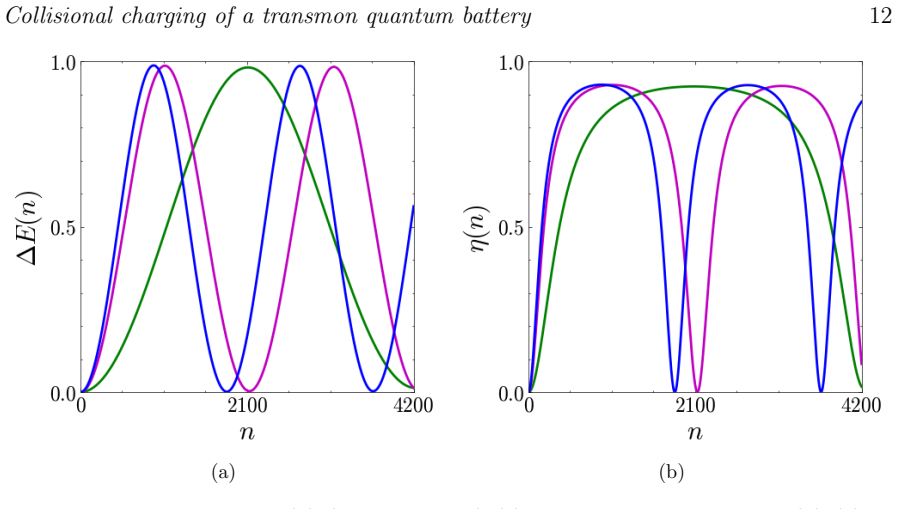
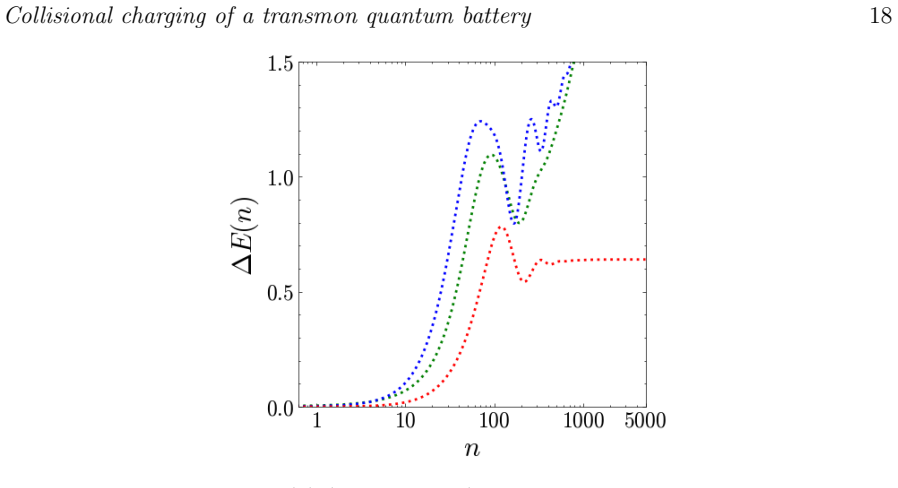
The central discovery is that collisional charging of a transmon quantum battery by a collection of identical coherent ancillary two-level systems enables remarkable control over the stored energy and its extraction, as demonstrated by numerical analysis in experimentally accessible regimes.
What carries the argument
The sequential interaction protocol with coherent ancillas that exploits the transmon's anharmonic level spacing to store and release energy controllably.
If this is right
- Energy storage levels can be finely tuned by adjusting the properties of the ancillary systems.
- Energy extraction processes become more efficient when ancilla coherence is preserved.
- The approach operates within the parameter space of existing superconducting quantum circuits.
- Performance relies on the ancillas staying coherent over the course of multiple collisions.
Where Pith is reading between the lines
- Similar charging methods could be explored in other platforms with anharmonic oscillators, such as trapped ions or quantum dots.
- Integration into larger quantum computing architectures might allow on-chip energy management.
- Future work could investigate the effects of decoherence on the charging efficiency to set practical limits.
- Optimizing the number and timing of ancilla interactions might yield even better performance.
Load-bearing premise
The ancillary two-level systems remain coherent throughout the entire sequence of charging interactions with the transmon.
What would settle it
A direct experimental test showing no significant difference in energy control or extraction efficiency between coherent and incoherent ancillas would falsify the performance advantage.
Figures









read the original abstract
Motivated by recent developments in the field of multilevel quantum batteries, we present the model of a quantum device for energy storage with anharmonic level spacing, based on a superconducting circuit in the transmon regime. It is charged via the sequential interaction with a collection of identical and independent ancillary two-level systems. By means of a numerical analysis we show that, in case these ancillas are coherent, this kind of quantum battery can achieve remarkable performances for what it concerns the control of the stored energy and its extraction in regimes of parameters within reach in nowadays quantum circuits.
Editorial analysis
A structured set of objections, weighed in public.
Referee Report
Summary. The paper models a transmon quantum battery with anharmonic level spacing, charged via sequential unitary collisions with a collection of identical coherent ancillary two-level systems. Numerical analysis is used to show that, when ancillas remain coherent, the device achieves improved control over stored energy and extraction efficiency in parameter regimes accessible with present-day superconducting circuits.
Significance. If the numerical results hold, the work provides a concrete superconducting-circuit realization of collisional quantum batteries, highlighting the role of ancilla coherence in performance. It connects abstract quantum-battery ideas to experimentally relevant transmon parameters and could inform future designs for energy storage in circuit-QED platforms.
major comments (2)
- [Abstract and §§4–5] Abstract and §§4–5: The central claims of 'remarkable performances' in energy control and extraction rest entirely on numerical simulations of the repeated unitary interactions. The manuscript supplies no description of the integration method, time-step size, convergence criteria, or error controls used to solve the time-dependent Schrödinger equation under the ancilla–transmon Hamiltonian. This omission is load-bearing for the quantitative conclusions.
- [Abstract] Abstract: The performance advantage is explicitly conditioned on the ancillas remaining coherent throughout the charging sequence. The model employs purely unitary evolution (Eq. 2) with no Lindblad terms for ancilla T1/T2 decay. No estimate is given for the cumulative interaction time required to reach the reported cycles relative to typical circuit-QED coherence times (∼20–100 μs), leaving the experimental accessibility of the claimed regime unverified.
minor comments (1)
- [Abstract] The abstract and main text repeatedly use the qualitative phrase 'remarkable performances' without stating the precise quantitative metrics (e.g., energy variance, extraction fidelity, or comparison baselines) against which this assessment is made.
Simulated Author's Rebuttal
We thank the referee for the careful reading of our manuscript and the constructive comments. We address each major point below and will revise the manuscript to incorporate the requested clarifications while preserving the scope of the unitary model.
read point-by-point responses
-
Referee: [Abstract and §§4–5] Abstract and §§4–5: The central claims of 'remarkable performances' in energy control and extraction rest entirely on numerical simulations of the repeated unitary interactions. The manuscript supplies no description of the integration method, time-step size, convergence criteria, or error controls used to solve the time-dependent Schrödinger equation under the ancilla–transmon Hamiltonian. This omission is load-bearing for the quantitative conclusions.
Authors: We agree that a clear description of the numerical procedure is required for reproducibility and to substantiate the quantitative results. In the revised manuscript we will add a new paragraph in Section 4 (or a short appendix) specifying the integration method (e.g., fourth-order Runge–Kutta or exact diagonalization for short-time segments), the time-step size employed, the convergence tests performed with respect to step size and total simulation time, and the estimated numerical error bounds. These details will be tied directly to the parameter regimes shown in the figures. revision: yes
-
Referee: [Abstract] Abstract: The performance advantage is explicitly conditioned on the ancillas remaining coherent throughout the charging sequence. The model employs purely unitary evolution (Eq. 2) with no Lindblad terms for ancilla T1/T2 decay. No estimate is given for the cumulative interaction time required to reach the reported cycles relative to typical circuit-QED coherence times (∼20–100 μs), leaving the experimental accessibility of the claimed regime unverified.
Authors: The unitary model is chosen deliberately to isolate the benefit of ancilla coherence, as stated in the abstract and introduction. To address experimental accessibility we will add, in the revised text, an order-of-magnitude estimate of the total charging time for the sequences presented. Using typical transmon–ancilla coupling strengths reported in the circuit-QED literature, we will show that the cumulative interaction time for the number of collisions considered remains well below 10 μs and therefore lies inside the 20–100 μs coherence window. We will also note that quantitative inclusion of ancilla decoherence constitutes a natural extension beyond the present scope. revision: yes
Circularity Check
No significant circularity; results are direct numerical simulations of the stated model
full rationale
The paper defines a transmon-based quantum battery model and charges it via sequential unitary interactions with coherent ancillary qubits (Eq. 2 and sequential collision protocol). The central performance claims in the abstract and §§4–5 are obtained by direct numerical integration of the time-dependent Schrödinger equation under the given Hamiltonian, without any parameter fitting, self-referential definitions, or load-bearing self-citations that reduce the output to the input by construction. The coherence assumption is explicitly stated as a modeling choice rather than derived; the numerics simply evaluate the consequences of that choice. No renaming of known results, ansatz smuggling, or uniqueness theorems imported from prior author work appear in the derivation chain.
Axiom & Free-Parameter Ledger
free parameters (1)
- interaction strengths and durations
axioms (2)
- domain assumption Transmon regime produces anharmonic level spacing suitable for battery operation
- domain assumption Ancillas are identical, independent, and can be prepared coherent
Lean theorems connected to this paper
-
IndisputableMonolith/Cost/FunctionalEquation.leanwashburn_uniqueness_aczel unclear?
unclearRelation between the paper passage and the cited Recognition theorem.
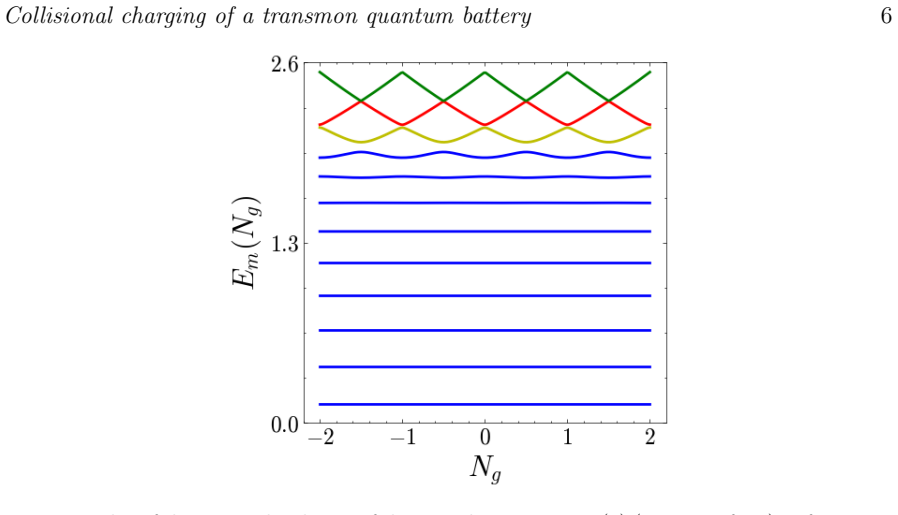
The Hamiltonian ... ˆHB = 4EC( ˆN − Ng)2 − EJ cos( ˆφ) ... approximated as Duffing oscillator ... numerical analysis ... QuTip toolbox
-
IndisputableMonolith/Foundation/ArithmeticFromLogic.leanembed_strictMono_of_one_lt unclear?
unclearRelation between the paper passage and the cited Recognition theorem.
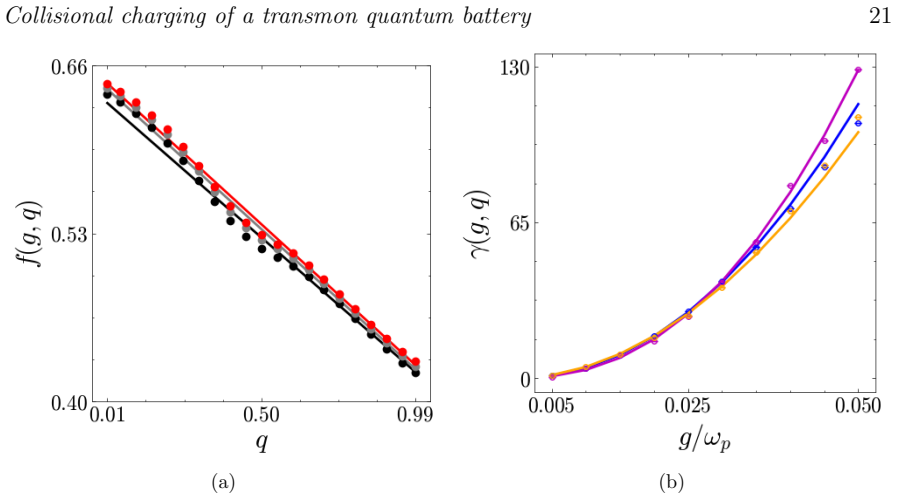
coherent charging protocol ... c = 1 ... oscillations ... frequency Ω(g, q) = Ω∗ g/ωp √[q(1−q)]
What do these tags mean?
- matches
- The paper's claim is directly supported by a theorem in the formal canon.
- supports
- The theorem supports part of the paper's argument, but the paper may add assumptions or extra steps.
- extends
- The paper goes beyond the formal theorem; the theorem is a base layer rather than the whole result.
- uses
- The paper appears to rely on the theorem as machinery.
- contradicts
- The paper's claim conflicts with a theorem or certificate in the canon.
- unclear
- Pith found a possible connection, but the passage is too broad, indirect, or ambiguous to say the theorem truly supports the claim.
Reference graph
Works this paper leans on
-
[1]
Koch C P, Boscain U, Calarco T, Dirr G, Filipp S, Glaser S J, Kosloff R, Montangero S, Schulte- Herbr¨ uggen T, Sugny D and Wilhelm F K 2022EPJ Quantum Technology 9 19 ISSN 2196-0763 URL https://doi.org/10.1140/epjqt/s40507-022-00138-x
- [2]
-
[3]
sciencedirect.com/science/article/pii/S2542435123003641
Quach J, Cerullo G and Virgili T 2023 Joule 7 2195–2200 ISSN 2542-4351 URL https://www. sciencedirect.com/science/article/pii/S2542435123003641
work page 2023
-
[4]
Campaioli F, Gherardini S, Quach J Q, Polini M and Andolina G M 2024 Rev. Mod. Phys. 96(3) 031001 URL https://link.aps.org/doi/10.1103/RevModPhys.96.031001
-
[5]
Alicki R and Fannes M 2013 Phys. Rev. E 87(4) 042123 URL https://link.aps.org/doi/10. 1103/PhysRevE.87.042123
work page 2013
-
[6]
Le T P, Levinsen J, Modi K, Parish M M and Pollock F A 2018 Phys. Rev. A 97(2) 022106 URL https://link.aps.org/doi/10.1103/PhysRevA.97.022106
-
[7]
Rossini D, Andolina G M and Polini M 2019 Phys. Rev. B 100(11) 115142 URL https: //link.aps.org/doi/10.1103/PhysRevB.100.115142
-
[8]
Rossini D, Andolina G M, Rosa D, Carrega M and Polini M 2020 Phys. Rev. Lett. 125(23) 236402 URL https://link.aps.org/doi/10.1103/PhysRevLett.125.236402
-
[9]
Grazi R, Sacco Shaikh D, Sassetti M, Traverso Ziani N and Ferraro D 2024 Phys. Rev. Lett. 133(19) 197001 URL https://link.aps.org/doi/10.1103/PhysRevLett.133.197001
-
[10]
Catalano A, Giampaolo S, Morsch O, Giovannetti V and Franchini F 2024 PRX Quantum 5(3) 030319 URL https://link.aps.org/doi/10.1103/PRXQuantum.5.030319
-
[11]
Porta S, Cavaliere F, Sassetti M and Traverso Ziani N 2020 Scientific Reports 10 12766 ISSN 2045-2322 URL https://doi.org/10.1038/s41598-020-69621-8
-
[12]
Grazi R, Cavaliere F, Sassetti M, Ferraro D and Traverso Ziani N 2025 Chaos, Solitons & Fractals 196 116383 ISSN 0960-0779 URL https://www.sciencedirect.com/science/article/pii/ S0960077925003960
work page 2025
-
[13]
Lu Z G, Tian G, L¨ u X Y and Shang C 2025 Phys. Rev. Lett. 134(18) 180401 URL https: //link.aps.org/doi/10.1103/PhysRevLett.134.180401
-
[14]
Ferraro D, Campisi M, Andolina G M, Pellegrini V and Polini M 2018 Phys. Rev. Lett. 120(11) 117702 URL https://link.aps.org/doi/10.1103/PhysRevLett.120.117702
-
[15]
Eckhardt C J, Passetti G, Othman M, Karrasch C, Cavaliere F, Sentef M A and Kennes D M 2022 Communications Physics 5 122 ISSN 2399-3650 URL https://doi.org/10.1038/ s42005-022-00880-9
work page 2022
-
[16]
Quach J Q, McGhee K E, Ganzer L, Rouse D M, Lovett B W, Gauger E M, Keeling J, Cerullo G, Lidzey D G and Virgili T 2022 Science Advances 8 eabk3160 ( Preprint https: //www.science.org/doi/pdf/10.1126/sciadv.abk3160) URL https://www.science.org/ doi/abs/10.1126/sciadv.abk3160
-
[17]
Carrasco J, Maze J R, Hermann-Avigliano C and Barra F 2022 Phys. Rev. E 105(6) 064119 URL https://link.aps.org/doi/10.1103/PhysRevE.105.064119
-
[18]
Dou F Q, Lu Y Q, Wang Y J and Sun J A 2022 Phys. Rev. B 105(11) 115405 URL https: //link.aps.org/doi/10.1103/PhysRevB.105.115405
-
[19]
Gemme G, Andolina G M, Pellegrino F M D, Sassetti M and Ferraro D 2023 Batteries 9 ISSN 2313-0105 URL https://www.mdpi.com/2313-0105/9/4/197
work page 2023
-
[20]
Wang L, Liu S Q, Wu F l, Fan H and Liu S Y 2024 Phys. Rev. A 110(4) 042419 URL https://link.aps.org/doi/10.1103/PhysRevA.110.042419
-
[21]
Yang D L, Yang F M and Dou F Q 2024 Phys. Rev. B 109(23) 235432 URL https://link.aps. org/doi/10.1103/PhysRevB.109.235432
-
[22]
Erdman P A, Andolina G M, Giovannetti V and No´ e F 2024 Phys. Rev. Lett. 133(24) 243602 URL https://link.aps.org/doi/10.1103/PhysRevLett.133.243602 Collisional charging of a transmon quantum battery 30
-
[23]
Hymas K, Muir J B, Tibben D, van Embden J, Hirai T, Dunn C J, G´ omez D E, Hutchison J A, Smith T A and Quach J Q 2025 Experimental demonstration of a scalable room-temperature quantum battery (Preprint 2501.16541) URL https://arxiv.org/abs/2501.16541
work page internal anchor Pith review Pith/arXiv arXiv 2025
-
[24]
Koch J, Yu T M, Gambetta J, Houck A A, Schuster D I, Majer J, Blais A, Devoret M H, Girvin S M and Schoelkopf R J 2007 Phys. Rev. A 76(4) 042319 URL https://link.aps.org/doi/ 10.1103/PhysRevA.76.042319
-
[25]
Krantz P, Kjaergaard M, Yan F, Orlando T P, Gustavsson S and Oliver W D 2019 App. Phys. Rev. 6 URL http://dx.doi.org/10.1063/1.5089550
-
[26]
Hu C K, Qiu J, Souza P J P, Yuan J, Zhou Y, Zhang L, Chu J, Pan X, Hu L, Li J, Xu Y, Zhong Y, Liu S, Yan F, Tan D, Bachelard R, Villas-Boas C J, Santos A C and Yu D 2022 Quantum Science and Technology 7 045018 URL https://dx.doi.org/10.1088/2058-9565/ac8444
-
[27]
Gemme G, Grossi M, Vallecorsa S, Sassetti M and Ferraro D 2024 Phys. Rev. Res. 6(2) 023091 URL https://link.aps.org/doi/10.1103/PhysRevResearch.6.023091
-
[28]
Cavaliere F, Gemme G, Benenti G, Ferraro D and Sassetti M 2025 Commun. Phys. 8 76 URL https://www.nature.com/articles/s42005-025-01993-7
work page 2025
-
[29]
Blais A, Grimsmo A L, Girvin S M and Wallraff A 2021 Rev. Mod. Phys. 93(2) 025005 URL https://link.aps.org/doi/10.1103/RevModPhys.93.025005
-
[30]
Hovhannisyan K V, Barra F and Imparato A 2020 Phys. Rev. Res. 2(3) 033413 URL https: //link.aps.org/doi/10.1103/PhysRevResearch.2.033413
-
[31]
Rodr´ ıguez R R, Ahmadi B, Mazurek P, Barzanjeh S, Alicki R and Horodecki P 2023 Phys. Rev. A 107(4) 042419 URL https://link.aps.org/doi/10.1103/PhysRevA.107.042419
-
[32]
Benenti G and Palma G M 2007 Phys. Rev. A 75(5) 052110 URL https://link.aps.org/doi/ 10.1103/PhysRevA.75.052110
-
[33]
Ziman M and Buˇ zek V 2005 Phys. Rev. A 72(2) 022110 URL https://link.aps.org/doi/10. 1103/PhysRevA.72.022110
work page 2005
-
[34]
Ciccarello F, Lorenzo S, Giovannetti V and Palma G M 2022 Phys. Rep. 954 1–70 URL https://www.sciencedirect.com/science/article/pii/S0370157322000035
work page 2022
-
[35]
Cusumano S 2022 Entropy 24 ISSN 1099-4300 URL https://www.mdpi.com/1099-4300/24/9/ 1258
work page 2022
-
[36]
Campbell S and Vacchini B 2021 Europhysics Letters 133 60001 URL https://dx.doi.org/10. 1209/0295-5075/133/60001
work page 2021
-
[37]
Strasberg P, Schaller G, Brandes T and Esposito M 2017 Phys. Rev. X 7(2) 021003 URL https://link.aps.org/doi/10.1103/PhysRevX.7.021003
-
[38]
Shaghaghi V, Palma G M and Benenti G 2022 Phys. Rev. E 105(3) 034101 URL https: //link.aps.org/doi/10.1103/PhysRevE.105.034101
-
[39]
Breuer H P and Petruccione F 2006 The Theory of Open Quantum Systems (Oxford University) ISBN 9780199213900
work page 2006
-
[40]
Weiss U 2012 Quantum Dissipative Systems 4th ed (WORLD SCIENTIFIC) ( Preprint https:// www.worldscientific.com/doi/pdf/10.1142/8334) URL https://www.worldscientific. com/doi/abs/10.1142/8334
-
[41]
Morrone D, Rossi M A C, Smirne A and Genoni M G 2023 Quantum Science and Technology, 8 035007 URL https://iopscience.iop.org/article/10.1088/2058-9565/accca4
-
[42]
Barra F 2019 Phys. Rev. Lett. 122(21) 210601 URL https://link.aps.org/doi/10.1103/ PhysRevLett.122.210601
work page 2019
-
[43]
Carrega M, Crescente A, Ferraro D and Sassetti M 2020 New Journal of Physics 22 083085 URL https://dx.doi.org/10.1088/1367-2630/abaa01
-
[44]
Seah S, Perarnau-Llobet M, Haack G, Brunner N and Nimmrichter S 2021Phys. Rev. Lett. 127(10) 100601 URL https://link.aps.org/doi/10.1103/PhysRevLett.127.100601
-
[45]
Landi G T 2021 Entropy 23 ISSN 1099-4300 URL https://www.mdpi.com/1099-4300/23/12/ 1627
work page 2021
-
[46]
Shaghaghi V, Singh V, Benenti G and Rosa D 2022 Quantum Sci. Technol. 7 04LT01 URL Collisional charging of a transmon quantum battery 31 https://iopscience.iop.org/article/10.1088/2058-9565/ac8829
-
[47]
Salvia R, Perarnau-Llobet M, Haack G, Brunner N and Nimmrichter S 2023 Phys. Rev. Res. 5(1) 013155 URL https://link.aps.org/doi/10.1103/PhysRevResearch.5.013155
-
[48]
Shaghaghi V, Singh V, Carrega M, Rosa D and Benenti G 2023 Entropy 25 430 URL https: //www.mdpi.com/1099-4300/25/3/430
work page 2023
-
[49]
Rodr´ ıguez C, Rosa D and Olle J 2023Phys. Rev. A 108(4) 042618 URL https://link.aps.org/ doi/10.1103/PhysRevA.108.042618
-
[50]
Haroche S 2013 Rev. Mod. Phys. 85(3) 1083–1102 URL https://link.aps.org/doi/10.1103/ RevModPhys.85.1083
work page 2013
-
[51]
Slosser J J, Meystre P and Braunstein S L 1989 Phys. Rev. Lett. 63(9) 934–937 URL https: //link.aps.org/doi/10.1103/PhysRevLett.63.934
-
[52]
Dou F Q and Yang F M 2023 Phys. Rev. A 107(2) 023725 URL https://link.aps.org/doi/10. 1103/PhysRevA.107.023725
work page 2023
-
[53]
Roth T E, Ma R and Chew W C 2023 IEEE Antennas and Propagation Magazine 65 8–20 ISSN 1558-4143 URL http://dx.doi.org/10.1109/MAP.2022.3176593
-
[54]
Devoret M H, Wallraff A and Martinis J M 2004 Superconducting qubits: A short review (Preprint cond-mat/0411174) URL https://arxiv.org/abs/cond-mat/0411174
work page internal anchor Pith review Pith/arXiv arXiv 2004
-
[55]
Jaklevic R C, Lambe J, Silver A H and Mercereau J E 1964 Phys. Rev. Lett. 12(7) 159–160 URL https://link.aps.org/doi/10.1103/PhysRevLett.12.159
-
[56]
Pietik¨ ainen I, Tuorila J, Golubev D S and Paraoanu G S 2019 Physical Review A 99 ISSN 2469- 9934 URL http://dx.doi.org/10.1103/PhysRevA.99.063828
-
[57]
Peano V and Thorwart M 2006 Chemical Physics 322 135–143 ISSN 0301-0104 URL http: //dx.doi.org/10.1016/j.chemphys.2005.06.047
-
[58]
Serban I and Wilhelm F K 2007 Phys. Rev. Lett. 99(13) 137001 URL https://link.aps.org/ doi/10.1103/PhysRevLett.99.137001
-
[59]
sciencedirect.com/science/article/pii/S0301010410002910
Vierheilig C and Grifoni M 2010 Chemical Physics 375 216–226 ISSN 0301-0104 stochastic processes in Physics and Chemistry (in honor of Peter H¨ anggi) URL https://www. sciencedirect.com/science/article/pii/S0301010410002910
work page 2010
-
[60]
Buluta I, Ashhab S and Nori F 2011 Reports on Progress in Physics 74 104401 ISSN 1361-6633 URL http://dx.doi.org/10.1088/0034-4885/74/10/104401
-
[61]
Johansson J, Nation P and Nori F 2012 Computer Physics Communications 183 1760–1772 ISSN 0010-4655 URL https://www.sciencedirect.com/science/article/pii/ S0010465512000835
work page 2012
-
[62]
Andolina G M, Farina D, Mari A, Pellegrini V, Giovannetti V and Polini M 2018 Phys. Rev. B 98(20) 205423 URL https://link.aps.org/doi/10.1103/PhysRevB.98.205423
-
[63]
Binder F C, Vinjanampathy S, Modi K and Goold J 2015 New Journal of Physics 17 075015 URL https://dx.doi.org/10.1088/1367-2630/17/7/075015
-
[64]
Bhattacharjee S and Dutta A 2021 The European Physical Journal B 94 239 ISSN 1434-6036 URL https://doi.org/10.1140/epjb/s10051-021-00235-3
-
[65]
Pusz W and Woronowicz S 1978Commun.Math. Phys. 58 273–290 URL https://link.springer. com/article/10.1007/BF01614224
-
[66]
Allahverdyan A E, Balian R and Nieuwenhuizen T M 2004 Europhysics Letters 67 565 URL https://dx.doi.org/10.1209/epl/i2004-10101-2
-
[67]
Barra F, Hovhannisyan K V and Imparato A 2022 New Journal of Physics 24 015003 URL https://dx.doi.org/10.1088/1367-2630/ac43ed
-
[68]
Frisk Kockum A, Miranowicz A, De Liberato S, Savasta S and Nori F 2019 Nature Reviews Physics 1 19–40 ISSN 2522-5820 URL http://dx.doi.org/10.1038/s42254-018-0006-2
-
[69]
Crescente A, Carrega M, Sassetti M and Ferraro D 2020 Phys. Rev. B 102(24) 245407 URL https://link.aps.org/doi/10.1103/PhysRevB.102.245407
-
[70]
Crescente A, Ferraro D and Sassetti M 2024 Phys. Rev. Res. 6(2) 023092 URL https://link. aps.org/doi/10.1103/PhysRevResearch.6.023092 Collisional charging of a transmon quantum battery 32
-
[71]
Kockum A F and Nori F 2019 Quantum Bits with Josephson Junctions (Cham: Springer International Publishing) pp 703–741 ISBN 978-3-030-20726-7 URL https://doi.org/10. 1007/978-3-030-20726-7_17
work page 2019
-
[72]
Sete E A, Chen A Q, Manenti R, Kulshreshtha S and Poletto S 2021 Phys. Rev. Appl. 15(6) 064063 URL https://link.aps.org/doi/10.1103/PhysRevApplied.15.064063
-
[73]
Campbell D L, Kamal A, Ranzani L, Senatore M and LaHaye M D 2023 Phys. Rev. Appl. 19(6) 064043 URL https://link.aps.org/doi/10.1103/PhysRevApplied.19.064043
-
[74]
Heunisch L, Eichler C and Hartmann M J 2023 Phys. Rev. Appl. 20(6) 064037 URL https: //link.aps.org/doi/10.1103/PhysRevApplied.20.064037
-
[75]
Muniz J A, Crow D, Kim H, Kindem J M, Cairncross W B, Ryou A, Bohdanowicz T C, Chen C A, Ji Y, Jones A M W, Megidish E, Nishiguchi C, Urbanek M, Wadleigh L, Wilkason T, Aasen D, Barnes K, Bello-Rivas J M, Bloomfield I, Booth G, Brown A, Brown M O, Cassella K, Cowan G, Epstein J, Feldkamp M, Griger C, Hassan Y, Heinz A, Halperin E, Hofler T, Hummel F, Jaff...
discussion (0)
Sign in with ORCID, Apple, or X to comment. Anyone can read and Pith papers without signing in.