REVIEW 3 major objections 6 minor 66 references
CP$^2$: Leveraging Geometry for Conformal Prediction via Canonicalization
T0 review · 3 major / 6 minor · reviewed 2026-08-06 · deepseek-v4-flash
Pith's one-line read Canonicalization restores conformal prediction guarantees under geometric shifts, keeping black-box predictors untouched.
desk verdict First learned-canonicalization-conformal-prediction combination with solid empirical support, but the coverage guarantee is undercut by training the canonicalizer on the calibration data; fixable with a disjoint split or a weakened claim. read the letter →
The pith
A machine-rendered reading of the paper's core claim, the machinery that carries it, and where it could break.
The reading
What carries the argument
The central object is the canonicalization network, a learned map c_theta: X -> G that predicts the (inverse) group element needed to bring an input back to a canonical pose, so that the invariance relation f_theta(x) = f_theta(c_theta(x)^{-1}·x) holds. The canonicalization prior loss L_prior = E[D_KL(P_G|x || P_hat_G|x)] trains this network with a prior concentrated on the identity, forcing it to learn the pose distribution of the calibration data. The paper's argument hinges on the equivariance identity c_theta(g·x)^{-1} = c_theta(x)^{-1}·$g^{{-1}}$, which, when satisfied, makes the distribution of canonicalized samples invariant under G^n and thereby restores exchangeability for conformal prediction.
What would settle it
Train a canonicalizer on C4-rotated CIFAR-10, then evaluate conformal prediction on C8-rotated test images (a group misspecification the paper reports as unstable in Table 3) and record whether empirical coverage drops below the target by more than the tolerated margin across many random splits; a sustained drop would falsify the claim that canonicalization alone reinstates coverage under geometric shifts.
Extended reading notes
Core claim
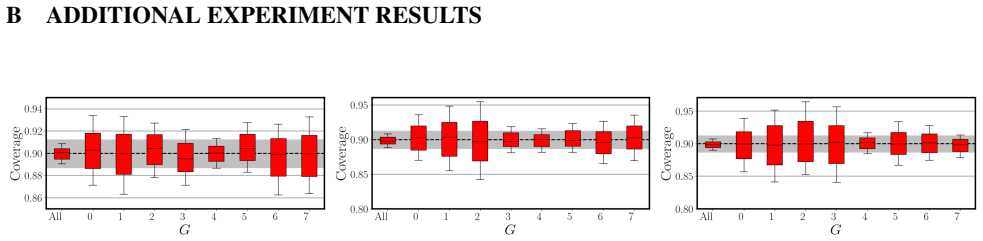
The paper's central claim is that integrating a canonicalization network into the conformal prediction pipeline—canonicalizing each test sample before scoring it with a frozen, non-equivariant predictor—reinstates well-calibrated nonconformity scores and efficient prediction sets under geometric shifts. Formally, if the canonicalizer c_theta satisfies c_theta(g·x)^{-1} = c_theta(x)^{-1}·$g^{{-1}}$, then the joint distribution of canonicalized samples is invariant under the product group G^n, extending exchangeability from permutation invariance alone to include sample-wise geometric transformations. This makes the canonicalized scores exchangeable, so split conformal prediction's coverage guarantee holds even when the original data are shifted. Empirically, on CIFAR-10/100 with C4/C8 rotation shifts and on ModelNet-40 with SO(3) shifts, the approach keeps coverage near its target while prediction set sizes stay close to the no-shift baseline, and it does so without retraining the predictor.
Load-bearing premise
The canonicalization network must be accurate enough that shifting a test sample and then canonicalizing it is equivalent to canonicalizing an unshifted sample, so that the distribution of canonicalized samples is the same for calibration and test data.
Editorial extensions
If this is right
- Coverage guarantees of split conformal prediction are maintained under geometric shifts when the canonicalizer is accurate, with prediction set sizes comparable to the no-shift setting.
- The canonicalizer's group distribution provides a per-sample geometric descriptor that can be aggregated over class or feature partitions to expose hidden geometric structure in the data.
- When a partition's group map shows a clear pattern, running mondrian conformal prediction on the geometric partition yields more balanced conditional coverage by proxy for the true partition of interest.
- In double-shift settings where the test shift introduces group elements unseen in calibration, geometric weighting of calibration scores based on the canonicalizer's output delays coverage breakdown.
- A broader group definition (e.g., C8 rather than C4) makes the method more robust when the exact shift group is unknown, at modest cost.
Reading between the lines
- The paper's exchangeability argument implicitly assumes the canonicalizer is equivariant in the exact sense of the identity; since real canonicalizers make errors (about 87% correct in the paper's own Table 5), the guarantees are approximate, and the method's practical reliability depends on how gracefully the conformal quantile tolerates those errors.
- The canonicalization prior, which anchors the network to the identity pose of the calibration distribution, suggests a direct connection to covariate-shift reweighting: the group distribution can be viewed as a ratio between shifted and unshifted data densities, potentially unifying geometric reweighting with existing weighted conformal methods.
- Because the canonicalizer is trained on calibration data only, it may fail when the test-time shift is much larger than anything seen during training; a testable extension is to update the canonicalizer online as new samples arrive, mirroring adaptive conformal procedures for time series.
- The diagnostic use of group maps could be extended to detect spurious correlations between geometric pose and sensitive attributes in classification tasks, providing a tool for auditing model behavior beyond coverage.
Editorial analysis
A structured set of objections, weighed in public.
Referee Report
Summary. The paper proposes CP^2, a framework that integrates a canonicalization network (CN) with split conformal prediction to maintain valid coverage and improve prediction-set efficiency under geometric shifts such as rotations. The authors motivate the approach by arguing that canonicalization restores exchangeability under the action of a symmetry group, and they present three uses: standard split conformal prediction with a canonicalized predictor, a diagnostics tool that constructs partition-conditional group maps to guide mondrian conformal prediction, and a geometric weighting scheme for weighted conformal prediction in double-shift settings. Experiments on CIFAR-10, CIFAR-100, and ModelNet-40 with C4, C8, and SO(3) rotation shifts compare against non-equivariant, augmented, and equivariant baselines, reporting empirical coverage near the target level and improved set sizes.
Significance. If the formal coverage claim were established, the paper would be a valuable bridge between geometric deep learning and conformal prediction, offering a post-hoc, model-agnostic way to handle geometric shifts without retraining the predictor. The empirical study is well structured: it covers two data modalities, multiple rotation groups, several baselines, and reports means and standard errors over 10 calibration/test splits. The code is publicly available, and the limitations section candidly discusses imperfect canonicalization and unknown group elements. However, the central theoretical claim, namely that CP^2 reinstates conformal coverage guarantees under geometric shifts, is not actually proven as stated: the CN is trained on the calibration set, which breaks the split-conformal condition that the score function be fixed before calibration, and the exchangeability argument assumes exact equivariance that the trained network does not satisfy. These issues are load-bearing for the paper's main claim, so a major revision is needed.
major comments (3)
- [§3, §2.3, Tab. 2] The split-conformal coverage theorem invoked in §2.1 requires the nonconformity score function to be fixed before the calibration scores are computed, independent of D_cal. Table 2 states explicitly that 'the CN is trained on D_cal', and §4 confirms that the canonicalizer is trained using the canonicalization prior. Since the canonicalizer is part of the score function, the calibration scores are in-sample with respect to the CN parameters while the test scores are out-of-sample, so the calibration and test scores are not exchangeable and Eq. (1) does not apply. The §3 argument silently treats c_theta as a fixed map, which is inconsistent with training it on D_cal. This is a formal gap in the central claim that CP^2 'guarantees well-calibrated nonconformity scores'. The authors should either train the CN on a disjoint hold-out set D_can and fix it before calibration, as suggested in §2.3, or provide a theorem that accounts for the data-dependent score function; the current manuscript does neither.
- [§3, Tab. 5, §6] The theoretical motivation assumes exact canonicalization, specifically c_theta(g·x)^{-1} = c_theta(x)^{-1}·g^{-1}, to conclude invariance of the joint distribution under G^n. Table 5 reports that the trained canonicalizer predicts the correct group element for only about 87% of samples, so the exact equivariance condition is not met. The paper acknowledges miscanonicalization only qualitatively in §6 and in Appendix A, but the exchangeability argument in §3 has no error term or robustness bound. As a result, the claimed formal guarantee is not established even if the CN were trained on a separate dataset; the empirical coverage near 1-α may still hold approximately, but the paper should state this as an approximate or heuristic claim, or provide a quantitative sensitivity analysis linking canonicalization accuracy to coverage deviation.
- [§3.1, §4.3, Eq. (3)] The weighted conformal variant in the double-shift setting uses weights w_i(x_{n+1}) computed from the canonicalizer's per-sample group distributions, which in turn depend on D_cal via training and on the test point. The cited weighted conformal results (Barber et al. 2023, Guan 2023) assume either fixed weights or specific conditions on data-dependent weights that are not verified here. Additionally, the modulation parameter p is selected on the calibration data. The paper does not claim a formal guarantee for this WCP variant, but the presentation in §3.1 and Tab. 2 suggests it as a robustness mechanism; the authors should clarify the formal status and specify the assumptions under which Eq. (3) with their geometric weights would be valid.
minor comments (6)
- [§3] The word 'exchangability' is misspelled; it should be 'exchangeability'.
- [§3.1] 'skewdness' should be 'skewness'.
- [Tabs. 3, 6, 9] The symbol 'oo' appears to be a rendering artifact for '∞'; please ensure the infinity symbol is typeset correctly.
- [Fig. 7 caption] 'caputed' should be 'captured'.
- [§2.3] The notation switches between using ρ explicitly and omitting it in Eq. (6); please clarify when ρ is suppressed for readability.
- [Tab. 2] The table lists three shift settings, but the text says only the first and third rows are empirically examined; please state this directly in the table caption or footnote.
Circularity Check
No load-bearing circularity: the central invariance argument is a conditional implication, and the empirical claims are measured rather than derived from fitted values.
full rationale
The paper's central theoretical claim in §3 is a conditional invariance argument: if the canonicalizer satisfies the equivariance relation c_theta(g·x)^{-1} = c_theta(x)^{-1}·g^{-1} (quoted from Kaba et al. 2023), then the distribution of canonicalized samples is invariant under Gn and split-conformal exchangeability is restored. This is a valid implication, not a tautology: the coverage conclusion does not appear among the assumptions, and the empirical coverage and set-size numbers in Tabs. 3, 4, and 7–9 are measured on held-out test splits rather than being forced by the fitted model. The weighting parameter p=2.0 is selected by ablation (Fig. 5) but does not define the reported coverage; the diagnostics group maps in Fig. 1 validate the canonicalizer against manually induced shifts, rather than predicting a quantity from its own fitted equations. Self-citations (Prinzhorn et al. 2024, van der Linden et al. 2024, Timans et al. 2024) appear only as background examples and related-method pointers, not as load-bearing justification for the main results. The real weakness is a validity gap rather than circularity: Tab. 2 states the CN is trained on Dcal, and §6 acknowledges imperfect pose accuracy (Tab. 5), so the formal coverage theorem of §2.1 is not automatically applicable to the experimental pipeline. The paper itself flags this downstream sensitivity as a limitation. Since no predicted quantity reduces by construction to a fitted value or to a self-citation chain, the circularity score is low.
Assumptions & free parameters
free parameters (3)
- p (weight modulation) =
2.0
- Confidence threshold for diagnostics =
not specified
- Distance metric D in weighting =
cross-entropy
assumptions (4)
- standard math Calibration and test data are exchangeable before any geometric shift is applied (Def. 3.1, classical split conformal setting).
- domain assumption The canonicalization network is G-equivariant and satisfies c_theta(g·x)^{-1} = c_theta(x)^{-1} · g^{-1} for all g in G and inputs x.
- domain assumption The shift group G (e.g., C4, C8, SO(3)) is known a priori and the CN is trained on Dcal under that group.
- domain assumption In the double-shift setting, the CN's predicted group distribution concentrates probability near the true test transformation, so that geometric distance to calibration samples is informative for weighting.
Cite this review
Pith. "Pith review of CP$^2$: Leveraging Geometry for Conformal Prediction via Canonicalization." pith.science (2026). https://pith.science/paper/S2B2SBXE
@misc{pith2026250616189,
  author       = {Pith},
  title        = {Pith review of: CP$^2$: Leveraging Geometry for Conformal Prediction via Canonicalization},
  year         = {2026},
  howpublished = {\url{https://pith.science/paper/S2B2SBXE}},
  note         = {Machine review of arXiv:2506.16189}
}
read the original abstract
We study the problem of conformal prediction (CP) under geometric data shifts, where data samples are susceptible to transformations such as rotations or flips. While CP endows prediction models with post-hoc uncertainty quantification and formal coverage guarantees, their practicality breaks under distribution shifts that deteriorate model performance. To address this issue, we propose integrating geometric information--such as geometric pose--into the conformal procedure to reinstate its guarantees and ensure robustness under geometric shifts. In particular, we explore recent advancements on pose canonicalization as a suitable information extractor for this purpose. Evaluating the combined approach across discrete and continuous shifts and against equivariant and augmentation-based baselines, we find that integrating geometric information with CP yields a principled way to address geometric shifts while maintaining broad applicability to black-box predictors.
Figures


Figures from the paper (4 more)



Reference graph
Works this paper leans on
-
[1]
Turner, Eric Nalisnick, and José Miguel Hernández-Lobato
James Urquhart Allingham, Bruno Kacper Mlodozeniec, Shreyas Padhy, Javier Antorán, David Krueger, Richard E. Turner, Eric Nalisnick, and José Miguel Hernández-Lobato. A generative model of symmetry transformations. Advances in Neural Information Processing Systems, 2024
work page 2024
-
[2]
Adaptive conformal prediction by reweighting nonconformity score
Salim I Amoukou and Nicolas JB Brunel. Adaptive conformal prediction by reweighting nonconformity score. arXiv Preprint (arXiv:2303.12695), 2023
arXiv 2023
-
[3]
Conformal pid control for time series prediction
Anastasios Angelopoulos, Emmanuel Candes, and Ryan J Tibshirani. Conformal pid control for time series prediction. Advances in Neural Information Processing Systems, 2024 a
work page 2024
-
[4]
Conformal prediction: A gentle introduction
Anastasios N Angelopoulos, Stephen Bates, et al. Conformal prediction: A gentle introduction. Foundations and Trends in Machine Learning, 2023
work page 2023
-
[5]
Theoretical foundations of conformal prediction
Anastasios N Angelopoulos, Rina Foygel Barber, and Stephen Bates. Theoretical foundations of conformal prediction. arXiv Preprint (arXiv:2411.11824), 2024 b
arXiv 2024
-
[6]
Anastasios N Angelopoulos, Stephen Bates, Adam Fisch, Lihua Lei, and Tal Schuster. Conformal risk control. International Conference on Learning Representations, 2024 c
work page 2024
-
[7]
Online conformal prediction with decaying step sizes
Anastasios Nikolas Angelopoulos, Rina Barber, and Stephen Bates. Online conformal prediction with decaying step sizes. International Conference on Machine Learning, 2024 d
work page 2024
-
[8]
Frame averaging for equivariant shape space learning
Matan Atzmon, Koki Nagano, Sanja Fidler, Sameh Khamis, and Yaron Lipman. Frame averaging for equivariant shape space learning. Conference on Computer Vision and Pattern Recognition, 2021
work page 2021
Show all 66 references
-
[9]
Conformal prediction beyond exchangeability
Rina Foygel Barber, Emmanuel J Candes, Aaditya Ramdas, and Ryan J Tibshirani. Conformal prediction beyond exchangeability. The Annals of Statistics, 2023
2023
-
[10]
Varshney
Sourya Basu, Pulkit Katdare, Prasanna Sattigeri, Vijil Chenthamarakshan, Katherine Driggs-Campbell, Payel Das, and Lav R. Varshney. Efficient equivariant transfer learning from pretrained models. Advances in Neural Information Processing Systems, 2023 a
2023
-
[11]
Varshney, Lav R
Sourya Basu, Prasanna Sattigeri, Karthikeyan Natesan Ramamurthy, Vijil Chenthamarakshan, Kush R. Varshney, Lav R. Varshney, and Payel Das. Equi-tuning: Group equivariant fine-tuning of pretrained models. The Thirty-Seventh AAAI Conference on Artificial Intelligence, 2023 b
2023
-
[12]
The need for uncertainty quantification in machine-assisted medical decision making
Edmon Begoli, Tanmoy Bhattacharya, and Dimitri Kusnezov. The need for uncertainty quantification in machine-assisted medical decision making. Nature Machine Intelligence, 2019
2019
-
[13]
B-spline cnns on lie groups
Erik J Bekkers. B-spline cnns on lie groups. International Conference on Learning Representations, 2020
2020
-
[14]
Probabilistic symmetries and invariant neural networks
Benjamin Bloem-Reddy, Yee Whye, et al. Probabilistic symmetries and invariant neural networks. Journal of Machine Learning Research, 2020
2020
-
[15]
Does equivariance matter at scale? arXiv Preprint (arXiv:2410.23179), 2024
Johann Brehmer, S \"o nke Behrends, Pim de Haan, and Taco Cohen. Does equivariance matter at scale? arXiv Preprint (arXiv:2410.23179), 2024
2024 arXiv
-
[16]
Geometric deep learning: Grids, groups, graphs, geodesics, and gauges
Michael M Bronstein, Joan Bruna, Taco Cohen, and Petar Veli c kovi \'c . Geometric deep learning: Grids, groups, graphs, geodesics, and gauges. arXiv Preprint (arXiv:2104.13478), 2021
2021 arXiv
-
[17]
Knowing what you know: Valid and validated confidence sets in multiclass and multilabel prediction
Maxime Cauchois, Suyash Gupta, and John C Duchi. Knowing what you know: Valid and validated confidence sets in multiclass and multilabel prediction. Journal of Machine Learning Research, 2021
2021
-
[18]
Group equivariant convolutional networks
Taco Cohen and Max Welling. Group equivariant convolutional networks. International Conference on Machine Learning, 2016
2016
-
[19]
Gauge equivariant convolutional networks and the icosahedral CNN
Taco Cohen, Maurice Weiler, Berkay Kicanaoglu, and Max Welling. Gauge equivariant convolutional networks and the icosahedral CNN . International Conference on Machine Learning, 2019
2019
-
[20]
Congyue Deng, Or Litany, Yueqi Duan, Adrien Poulenard, Andrea Tagliasacchi, and Leonidas J. Guibas. Vector neurons: A general framework for so(3)-equivariant networks. International Conference on Computer Vision, 2021
2021
-
[21]
Malliaros, Yoshua Bengio, and David Rolnick
Alexandre Agm Duval, Victor Schmidt, Alex Hern\' a ndez-Garc\' a, Santiago Miret, Fragkiskos D. Malliaros, Yoshua Bengio, and David Rolnick. FAEN et: Frame averaging equivariant GNN for materials modeling. International Conference on Machine Learning, 2023
2023
-
[22]
Nadav Dym, Hannah Lawrence, and Jonathan W. Siegel. Equivariant frames and the impossibility of continuous canonicalization. International Conference on Machine Learning, 2024
2024
-
[23]
Generalizing convolutional neural networks for equivariance to lie groups on arbitrary continuous data
Marc Finzi, Samuel Stanton, Pavel Izmailov, and Andrew Gordon Wilson. Generalizing convolutional neural networks for equivariance to lie groups on arbitrary continuous data. Proceedings of the 37th International Conference on Machine Learning, 2020
2020
-
[24]
A practical method for constructing equivariant multilayer perceptrons for arbitrary matrix groups
Marc Finzi, Max Welling, and Andrew Gordon Gordon Wilson. A practical method for constructing equivariant multilayer perceptrons for arbitrary matrix groups. International Conference on Machine Learning, 2021
2021
-
[25]
Guest editorial special issue on geometric deep learning in medical imaging
Huazhu Fu, Yitian Zhao, Pew-Thian Yap, Carola-Bibiane Sch \"o nlieb, and Alejandro F Frangi. Guest editorial special issue on geometric deep learning in medical imaging. IEEE Transactions on Medical Imaging, 2023
2023
-
[26]
A survey of uncertainty in deep neural networks
Jakob Gawlikowski, Cedrique Rovile Njieutcheu Tassi, Mohsin Ali, Jongseok Lee, Matthias Humt, Jianxiang Feng, Anna Kruspe, Rudolph Triebel, Peter Jung, Ribana Roscher, et al. A survey of uncertainty in deep neural networks. Artificial Intelligence Review, 2023
2023
-
[27]
Cand \`e s
Isaac Gibbs and Emmanuel J. Cand \`e s. Adaptive conformal inference under distribution shift. Advances in Neural Information Processing Systems, 2021
2021
-
[28]
Localized conformal prediction: A generalized inference framework for conformal prediction
Leying Guan. Localized conformal prediction: A generalized inference framework for conformal prediction. Biometrika, 2023
2023
-
[29]
Batch Multivalid Conformal Prediction
Christopher Jung, Georgy Noarov, Ramya Ramalingam, and Aaron Roth. Batch Multivalid Conformal Prediction . International Conference on Learning Representations, 2023
2023
-
[30]
Equivariance with learned canonicalization functions
S\' e kou-Oumar Kaba, Arnab Kumar Mondal, Yan Zhang, Yoshua Bengio, and Siamak Ravanbakhsh. Equivariance with learned canonicalization functions. International Conference on Machine Learning, 2023
2023
-
[31]
idecode: In-distribution equivariance for conformal out-of-distribution detection
Ramneet Kaur, Susmit Jha, Anirban Roy, Sangdon Park, Edgar Dobriban, Oleg Sokolsky, and Insup Lee. idecode: In-distribution equivariance for conformal out-of-distribution detection. AAAI Conference on Artificial Intelligence, 2022
2022
-
[32]
Comprehensive review of neural network-based prediction intervals and new advances
Abbas Khosravi, Saeid Nahavandi, Doug Creighton, and Amir F Atiya. Comprehensive review of neural network-based prediction intervals and new advances. IEEE Transactions on Neural Networks, 2011
2011
-
[33]
Learning probabilistic symmetrization for architecture agnostic equivariance
Jinwoo Kim, Tien Dat Nguyen, Ayhan Suleymanzade, Hyeokjun An, and Seunghoon Hong. Learning probabilistic symmetrization for architecture agnostic equivariance. Advances in Neural Information Processing Systems, 2023
2023
-
[34]
Wilds: A benchmark of in-the-wild distribution shifts
Pang Wei Koh, Shiori Sagawa, Henrik Marklund, Sang Michael Xie, Marvin Zhang, Akshay Balsubramani, Weihua Hu, Michihiro Yasunaga, Richard Lanas Phillips, Irena Gao, et al. Wilds: A benchmark of in-the-wild distribution shifts. International Conference on Machine Learning, 2021
2021
-
[35]
Empirical frequentist coverage of deep learning uncertainty quantification procedures
Benjamin Kompa, Jasper Snoek, and Andrew L Beam. Empirical frequentist coverage of deep learning uncertainty quantification procedures. Entropy, 2021
2021
-
[36]
Forecasting and uncertainty: A survey
Spyros Makridakis and Nikolas Bakas. Forecasting and uncertainty: A survey. Risk and Decision Analysis, 2016
2016
-
[37]
Equivariant adaptation of large pretrained models
Arnab Kumar Mondal, Siba Smarak Panigrahi, Sékou-Oumar Kaba, Sai Rajeswar, and Siamak Ravanbakhsh. Equivariant adaptation of large pretrained models. Advances in Neural Information Processing Systems, 2023
2023
-
[38]
Can you trust your model's uncertainty? evaluating predictive uncertainty under dataset shift
Yaniv Ovadia, Emily Fertig, Jie Ren, Zachary Nado, David Sculley, Sebastian Nowozin, Joshua Dillon, Balaji Lakshminarayanan, and Jasper Snoek. Can you trust your model's uncertainty? evaluating predictive uncertainty under dataset shift. Advances in Neural Information Processi...
2019
-
[39]
Uncertain about uncertainty: How qualitative expressions of forecaster confidence impact decision-making with uncertainty visualizations
Lace MK Padilla, Maia Powell, Matthew Kay, and Jessica Hullman. Uncertain about uncertainty: How qualitative expressions of forecaster confidence impact decision-making with uncertainty visualizations. Frontiers in Psychology, 2021
2021
-
[40]
Improved canonicalization for model agnostic equivariance
Siba Smarak Panigrahi and Arnab Kumar Mondal. Improved canonicalization for model agnostic equivariance. Conference on Computer Vision and Pattern Recognition (EquiVision Workshop), 2024
2024
-
[41]
Conformal prediction with Neural Networks
Harris Papadopoulos, Volodya Vovk, and Alex Gammerman. Conformal prediction with Neural Networks . IEEE International Conference on Tools with Artificial Intelligence (ICTAI), 2007
2007
-
[42]
Distribution-free uncertainty quantification for classification under label shift
Aleksandr Podkopaev and Aaditya Ramdas. Distribution-free uncertainty quantification for classification under label shift. Uncertainty in Artificial Intelligence, 2021
2021
-
[43]
Conformal validity guarantees exist for any data distribution (and how to find them)
Drew Prinster, Samuel Don Stanton, Anqi Liu, and Suchi Saria. Conformal validity guarantees exist for any data distribution (and how to find them). International Conference on Machine Learning, 2024
2024
-
[44]
Conformal time series decomposition with component-wise exchangeability
Derck Prinzhorn, Thijmen Nijdam, Putri Van der Linden, and Alexander Timans. Conformal time series decomposition with component-wise exchangeability. Symposium on Conformal and Probabilistic Prediction with Applications, 2024
2024
-
[45]
Smith, Ishan Misra, Aditya Grover, and Yaron Lipman
Omri Puny, Matan Atzmon, Heli Ben - Hamu, Edward J. Smith, Ishan Misra, Aditya Grover, and Yaron Lipman. Frame averaging for invariant and equivariant network design. International Conference on Learning Representations, 2021
2021
-
[46]
Charles Ruizhongtai Qi, Hao Su, Kaichun Mo, and Leonidas J. Guibas. Pointnet: Deep learning on point sets for 3d classification and segmentation. Conference on Computer Vision and Pattern Recognition, 2017
2017
-
[47]
Dataset shift in machine learning
Joaquin Qui \ n onero-Candela, Masashi Sugiyama, Anton Schwaighofer, and Neil D Lawrence. Dataset shift in machine learning. MIT Press, 2022
2022
-
[48]
With Malice Towards None : Assessing Uncertainty via Equalized Coverage
Yaniv Romano, Rina Foygel Barber, Chiara Sabatti, and Emmanuel J Cand \`e s. With Malice Towards None : Assessing Uncertainty via Equalized Coverage . Harvard Data Science Review, 2020 a
2020
-
[49]
Yaniv Romano, Matteo Sesia, and Emmanuel J. Candès. Classification with valid and adaptive coverage. Advances in Neural Information Processing Systems, 2020 b
2020
-
[50]
Romero and Suhas Lohit
David W. Romero and Suhas Lohit. Learning partial equivariances from data. Advances in Neural Information Processing Systems, 2022
2022
-
[51]
Clifford group equivariant neural networks
David Ruhe, Johannes Brandstetter, and Patrick Forré. Clifford group equivariant neural networks. Advances in Neural Information Processing Systems, 2023
2023
-
[52]
Least ambiguous set-valued classifiers with bounded error levels
Mauricio Sadinle, Jing Lei, and Larry Wasserman. Least ambiguous set-valued classifiers with bounded error levels. Journal of the American Statistical Association, 2019
2019
-
[53]
Conformal Prediction using Conditional Histograms
Matteo Sesia and Yaniv Romano. Conformal Prediction using Conditional Histograms . Advances in Neural Information Processing Systems , 2021 a
2021
-
[54]
Conformal prediction using conditional histograms
Matteo Sesia and Yaniv Romano. Conformal prediction using conditional histograms. Advances in Neural Information Processing Systems, 2021 b
2021
-
[55]
A tutorial on conformal prediction
Glenn Shafer and Vladimir Vovk. A tutorial on conformal prediction. Journal of Machine Learning Research, 2008
2008
-
[56]
Conformal prediction under covariate shift
Ryan J Tibshirani, Rina Foygel Barber, Emmanuel Candes, and Aaditya Ramdas. Conformal prediction under covariate shift. Advances in Neural Information Processing Systems, 2019
2019
-
[57]
Adaptive bounding box uncertainties via two-step conformal prediction
Alexander Timans, Christoph-Nikolas Straehle, Kaspar Sakmann, and Eric Nalisnick. Adaptive bounding box uncertainties via two-step conformal prediction. Proceedings of the European Conference on Computer Vision, 2024
2024
-
[58]
Combination of inductive mondrian conformal predictors
Paolo Toccaceli and Alexander Gammerman. Combination of inductive mondrian conformal predictors. Machine Learning, 2019
2019
-
[59]
Alonso Urbano and David W. Romero. Self-supervised detection of perfect and partial input-dependent symmetries. International Conference on Machine Learning (GRaM Workshop), 2024
2024
-
[60]
On the utility of equivariance and symmetry breaking in deep learning architectures on point clouds
Sharvaree Vadgama, Mohammad Mohaiminul Islam, Domas Buracus, Christian Shewmake, and Erik Bekkers. On the utility of equivariance and symmetry breaking in deep learning architectures on point clouds. arXiv Preprint (arXiv:2501.01999), 2025
2025 arXiv
-
[61]
van der Linden, Alejandro García-Castellanos, Sharvaree Vadgama, Thijs P
Putri A. van der Linden, Alejandro García-Castellanos, Sharvaree Vadgama, Thijs P. Kuipers, and Erik J. Bekkers. Learning symmetries via weight-sharing with doubly stochastic tensors. Advances in Neural Information Processing Systems, 2024
2024
-
[62]
Algorithmic learning in a random world
Vladimir Vovk, Alexander Gammerman, and Glenn Shafer. Algorithmic learning in a random world. Springer, 2005
2005
-
[63]
Sarma, Michael M
Yue Wang, Yongbin Sun, Ziwei Liu, Sanjay E. Sarma, Michael M. Bronstein, and Justin M. Solomon. Dynamic graph cnn for learning on point clouds. Association for Computing Machinery, 2019
2019
-
[64]
General e(2)-equivariant steerable cnns
Maurice Weiler and Gabriele Cesa. General e(2)-equivariant steerable cnns. Advances in Neural Information Processing Systems, 2019
2019
-
[65]
Can llms express their uncertainty? an empirical evaluation of confidence elicitation in llms
Miao Xiong, Zhiyuan Hu, Xinyang Lu, Yifei Li, Jie Fu, Junxian He, and Bryan Hooi. Can llms express their uncertainty? an empirical evaluation of confidence elicitation in llms. International Conference on Learning Representations, 2023
2023
-
[66]
Adaptive conformal predictions for time series
Margaux Zaffran, Olivier F \'e ron, Yannig Goude, Julie Josse, and Aymeric Dieuleveut. Adaptive conformal predictions for time series. International Conference on Machine Learning, 2022
2022
Reviewed August 6, 2026 · model on record in the stance chip above.
Discussion (0). Sign in to comment.