Category-based Galaxy Image Generation via Diffusion Models
Pith reviewed 2026-05-19 08:53 UTC · model grok-4.3
The pith
GalCatDiff generates galaxy images via diffusion models that match observed color and size distributions while using category embeddings to avoid training separate models per class.
A machine-rendered reading of the paper's core claim, the machinery that carries it, and where it could break.
Core claim
GalCatDiff is the first astronomy-specific diffusion framework that folds both image features and astrophysical category information into the network through an enhanced U-Net and a Residual Attention Block; category embeddings enable class-conditioned generation without separate per-category trainings, and experiments show the outputs match real color and size distributions more closely than prior generative methods while appearing visually realistic.
What carries the argument
Category embeddings combined with the Astro-RAB (Residual Attention Block) that merges attention mechanisms and convolution operations inside the diffusion U-Net to enforce both global consistency and local feature fidelity.
If this is right
- One trained model can produce galaxies from multiple categories without retraining separate networks for each class.
- The generated images can serve directly as augmented training data for downstream galaxy classification tasks.
- Galaxy simulations become less dependent on manual parameter tuning in semi-analytic models.
- The framework scales to larger catalogs while preserving distribution consistency across samples.
Where Pith is reading between the lines
- If physical consistency extends beyond color and size, the same conditioning approach could let researchers request galaxies with targeted properties such as specific star-formation rates.
- The category-embedding technique might transfer to other image domains where classes carry physical meaning, such as generating spectra or light curves conditioned on object type.
- Large synthetic catalogs produced this way could be used to stress-test cosmological inference pipelines before they are applied to real survey data.
Load-bearing premise
Matching color and size distributions plus visual inspection is enough to establish that the generated galaxies are physically consistent.
What would settle it
A test in which galaxies generated by the model are compared against an independent survey catalog on quantities such as redshift distribution, stellar mass, or morphological parameters that were never used as conditioning inputs.
Figures



read the original abstract
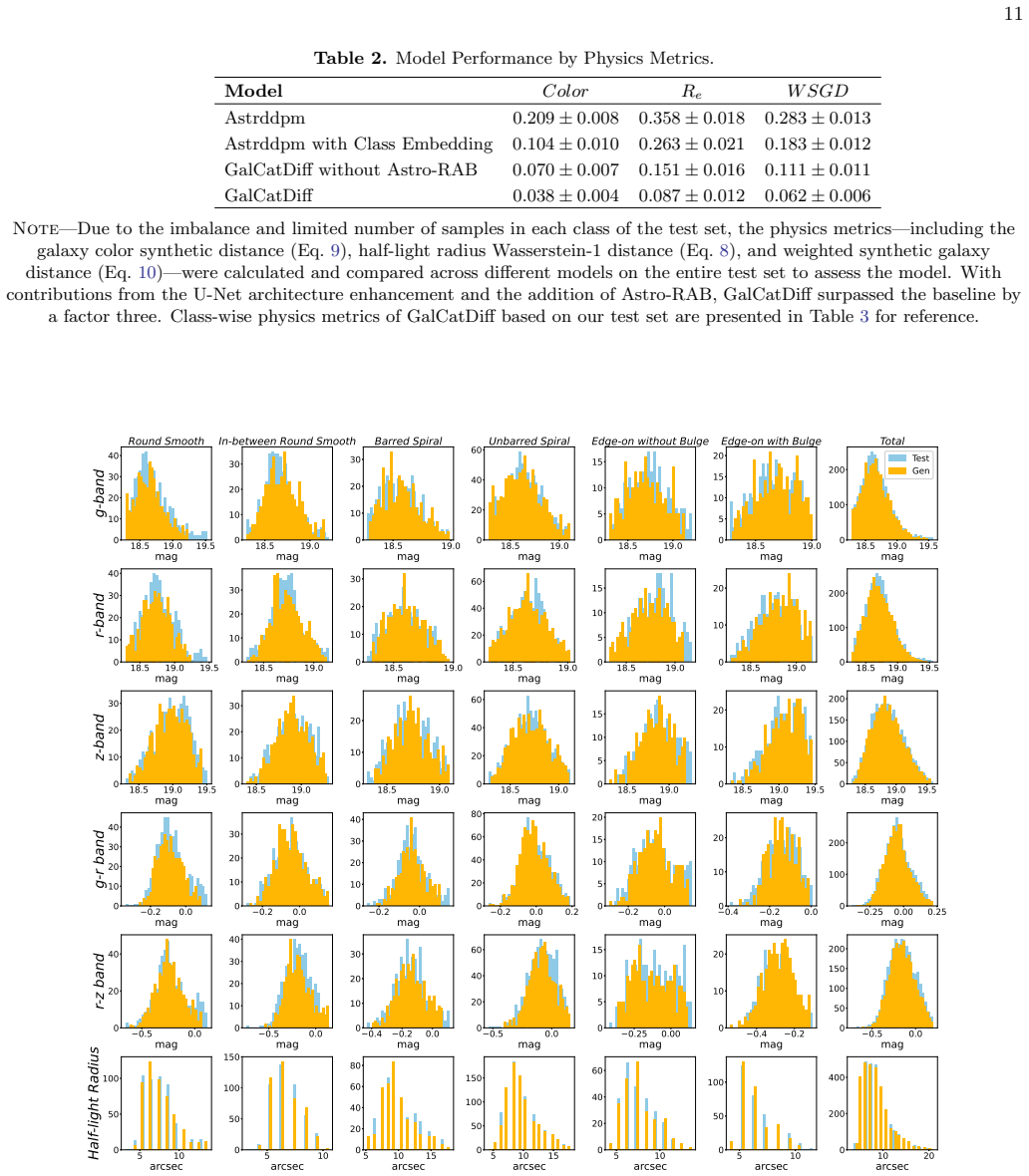
Conventional galaxy generation methods rely on semi-analytical models and hydrodynamic simulations, which are highly dependent on physical assumptions and parameter tuning. In contrast, data-driven generative models do not have explicit physical parameters pre-determined, and instead learn them efficiently from observational data, making them alternative solutions to galaxy generation. Among these, diffusion models outperform Variational Autoencoders (VAEs) and Generative Adversarial Networks (GANs) in quality and diversity. Leveraging physical prior knowledge to these models can further enhance their capabilities. In this work, we present GalCatDiff, the first framework in astronomy to leverage both galaxy image features and astrophysical properties in the network design of diffusion models. GalCatDiff incorporates an enhanced U-Net and a novel block entitled Astro-RAB (Residual Attention Block), which dynamically combines attention mechanisms with convolution operations to ensure global consistency and local feature fidelity. Moreover, GalCatDiff uses category embeddings for class-specific galaxy generation, avoiding the high computational costs of training separate models for each category. Our experimental results demonstrate that GalCatDiff significantly outperforms existing methods in terms of the consistency of sample color and size distributions, and the generated galaxies are both visually realistic and physically consistent. This framework will enhance the reliability of galaxy simulations and can potentially serve as a data augmentor to support future galaxy classification algorithm development.
Editorial analysis
A structured set of objections, weighed in public.
Referee Report
Summary. The manuscript introduces GalCatDiff, a diffusion-model framework for generating galaxy images conditioned on astrophysical categories. It employs an enhanced U-Net architecture augmented by a novel Astro-RAB (Residual Attention Block) that fuses attention mechanisms with convolutional operations, together with category embeddings to enable class-specific generation without training separate models per category. The central empirical claim is that GalCatDiff produces samples whose color and size distributions are more consistent with real data than those from prior methods, while the images are visually realistic and physically consistent, offering a data-driven alternative to semi-analytical models and hydrodynamic simulations.
Significance. If the reported improvements are robustly demonstrated, the work would constitute a useful methodological contribution to astronomical image synthesis by embedding category-level physical priors directly into the generative architecture. The Astro-RAB design and single-model multi-category approach could reduce computational overhead for producing mock catalogs and support data-augmentation pipelines for downstream classification tasks. Credit is due for the explicit attempt to incorporate astrophysical properties into the network rather than treating generation as a purely unsupervised image task.
major comments (2)
- [Abstract] Abstract: the assertion that GalCatDiff 'significantly outperforms existing methods in terms of the consistency of sample color and size distributions' is presented without any quantitative metrics, baseline names, error bars, dataset sizes, or statistical tests. This absence prevents evaluation of the claimed improvement and directly undermines the headline result.
- [Abstract] Abstract and results: the claim that generated galaxies are 'physically consistent' rests solely on alignment of color and size marginal distributions plus visual inspection. No validation is reported against independent observables (e.g., Sérsic indices, morphological statistics, or stellar-mass functions) or against outputs from hydrodynamic simulations withheld from training. Because this inference is load-bearing for the central contribution, additional quantitative checks are required.
minor comments (2)
- The acronym Astro-RAB is introduced without an immediate parenthetical expansion on first use; spelling out 'Residual Attention Block' at its initial appearance would improve readability for readers outside the immediate subfield.
- Figure captions and axis labels should explicitly state the sample sizes and number of generated versus real galaxies used for the distribution comparisons to allow direct assessment of statistical power.
Simulated Author's Rebuttal
We thank the referee for the constructive and detailed review. The comments highlight important points about clarity in the abstract and the strength of evidence for physical consistency. We address each major comment below and indicate where revisions will be made to the manuscript.
read point-by-point responses
-
Referee: [Abstract] Abstract: the assertion that GalCatDiff 'significantly outperforms existing methods in terms of the consistency of sample color and size distributions' is presented without any quantitative metrics, baseline names, error bars, dataset sizes, or statistical tests. This absence prevents evaluation of the claimed improvement and directly undermines the headline result.
Authors: We agree that the abstract would benefit from greater specificity to allow immediate evaluation of the headline claim. The results section (Section 4) already contains the relevant quantitative comparisons, including baseline methods, dataset sizes from the observational catalog, error estimates from multiple sampling runs, and statistical tests (e.g., distribution similarity metrics) demonstrating outperformance. We will revise the abstract to incorporate concise references to these elements, such as the specific baselines, sample scale, and key statistical outcomes, while remaining within length constraints. revision: yes
-
Referee: [Abstract] Abstract and results: the claim that generated galaxies are 'physically consistent' rests solely on alignment of color and size marginal distributions plus visual inspection. No validation is reported against independent observables (e.g., Sérsic indices, morphological statistics, or stellar-mass functions) or against outputs from hydrodynamic simulations withheld from training. Because this inference is load-bearing for the central contribution, additional quantitative checks are required.
Authors: Color and size distributions are fundamental observables that encode substantial physical information (stellar populations, dust, and structural scaling relations), and their close match to real data, combined with expert visual assessment, forms the primary support for the consistency claim in the current study. We acknowledge that further checks against Sérsic indices or morphological statistics would strengthen the argument. We will add a dedicated paragraph in the results and discussion sections that reports any available morphological comparisons from the dataset and explicitly discusses the limitations of the current validation. Comparisons to hydrodynamic simulations withheld from training fall outside the scope of this observational data-driven work; we will note this as a limitation and suggest it as a direction for future research. revision: partial
Circularity Check
No significant circularity; results are empirical outputs of a trained model
full rationale
The paper presents a data-driven diffusion model (GalCatDiff) that learns galaxy image generation from observational data without explicit physical parameters or algebraic derivations. Central claims rest on empirical comparisons of color/size distributions and visual realism from the trained network outputs. No load-bearing steps reduce by construction to inputs via self-definition, fitted parameters renamed as predictions, or self-citation chains. The model architecture (enhanced U-Net with Astro-RAB) and category embeddings are design choices evaluated experimentally, not forced equivalences. This is a standard self-contained ML training/evaluation setup with no circular reduction in the reported results.
Axiom & Free-Parameter Ledger
axioms (1)
- domain assumption Data-driven generative models can learn physical regularities directly from observational images without explicit pre-determined physical parameters.
invented entities (1)
-
Astro-RAB (Residual Attention Block)
no independent evidence
Lean theorems connected to this paper
-
IndisputableMonolith/Cost/FunctionalEquation.leanwashburn_uniqueness_aczel unclear?
unclearRelation between the paper passage and the cited Recognition theorem.
GalCatDiff incorporates an enhanced U-Net and a novel block entitled Astro-RAB (Residual Attention Block), which dynamically combines attention mechanisms with convolution operations
-
IndisputableMonolith/Foundation/RealityFromDistinction.leanreality_from_one_distinction unclear?
unclearRelation between the paper passage and the cited Recognition theorem.
We use the Wasserstein-1 distance ... galaxy color synthetic distance (Color) ... half-light radius Wasserstein-1 distance (Re) ... WSGD
What do these tags mean?
- matches
- The paper's claim is directly supported by a theorem in the formal canon.
- supports
- The theorem supports part of the paper's argument, but the paper may add assumptions or extra steps.
- extends
- The paper goes beyond the formal theorem; the theorem is a base layer rather than the whole result.
- uses
- The paper appears to rely on the theorem as machinery.
- contradicts
- The paper's claim conflicts with a theorem or certificate in the canon.
- unclear
- Pith found a possible connection, but the passage is too broad, indirect, or ambiguous to say the theorem truly supports the claim.
Reference graph
Works this paper leans on
-
[1]
2018, Monthly Notices of the Royal Astronomical Society, 477, 894
Vaghmare, K. 2018, Monthly Notices of the Royal Astronomical Society, 477, 894
work page 2018
- [2]
-
[3]
2020, Astronomy & Astrophysics, 643, A177
Angora, G., Rosati, P., Brescia, M., et al. 2020, Astronomy & Astrophysics, 643, A177
work page 2020
-
[4]
2017, The Astrophysical Journal Supplement Series, 230, 20
Aniyan, A., & Thorat, K. 2017, The Astrophysical Journal Supplement Series, 230, 20
work page 2017
-
[5]
Arcelin, B., Doux, C., Aubourg, E., Roucelle, C., & Collaboration), L. D. E. S. 2021, Monthly Notices of the Royal Astronomical Society, 500, 531
work page 2021
-
[6]
2024, Astronomy & Astrophysics, 683, A181
Baes, M., Gebek, A., Trˇ cka, A., et al. 2024, Astronomy & Astrophysics, 683, A181
work page 2024
-
[7]
Neural Machine Translation by Jointly Learning to Align and Translate
Bahdanau, D. 2014, arXiv preprint arXiv:1409.0473
work page internal anchor Pith review Pith/arXiv arXiv 2014
-
[8]
and Glazebrook, Karl and Brinkmann, Jon and Ivezić, Željko and Lupton, Robert H
Baldry, I. K., Glazebrook, K., Brinkmann, J., et al. 2004, ApJ, 600, 681, doi: 10.1086/380092
-
[9]
Bignone, L. A., Pedrosa, S. E., Trayford, J. W., Tissera, P. B., & Pellizza, L. J. 2020, Monthly Notices of the Royal Astronomical Society, 491, 3624
work page 2020
-
[10]
2020, Monthly Notices of the Royal Astronomical Society, 491, 2481
Boucaud, A., Huertas-Company, M., Heneka, C., et al. 2020, Monthly Notices of the Royal Astronomical Society, 491, 2481
work page 2020
-
[11]
Buta, R. J. 2013, in Secular Evolution of Galaxies, ed. J. Falc´ on-Barroso & J. H. Knapen, 155, doi: 10.48550/arXiv.1304.3529
work page internal anchor Pith review Pith/arXiv arXiv doi:10.48550/arxiv.1304.3529 2013
-
[12]
J., Sheth, K., Athanassoula, E., et al
Buta, R. J., Sheth, K., Athanassoula, E., et al. 2015, ApJS, 217, 32, doi: 10.1088/0067-0049/217/2/32
-
[13]
2016, ARA&A, 54, 597, doi: 10.1146/annurev-astro-082214-122432
Cappellari, M. 2016, ARA&A, 54, 597, doi: 10.1146/annurev-astro-082214-122432
-
[14]
Mode Regularized Generative Adversarial Networks
Che, T., Li, Y., Jacob, A. P., Bengio, Y., & Li, W. 2016, arXiv e-prints, arXiv:1612.02136, doi: 10.48550/arXiv.1612.02136
work page internal anchor Pith review Pith/arXiv arXiv doi:10.48550/arxiv.1612.02136 2016
-
[15]
J., Arag´ on-Salamanca, A., et al
Cheng, T.-Y., Conselice, C. J., Arag´ on-Salamanca, A., et al. 2020, Monthly Notices of the Royal Astronomical Society, 493, 4209 ´Ciprijanovi´ c, A., Kafkes, D., Downey, K., et al. 2021, Monthly Notices of the Royal Astronomical Society, 506, 677
work page 2020
-
[16]
Cole, D. R., Debattista, V. P., Erwin, P., Earp, S. W. F., & Roˇ skar, R. 2014, MNRAS, 445, 3352, doi: 10.1093/mnras/stu1985
-
[17]
A unified model for the evolution of galaxies and quasars , volume =
Cole, S., Lacey, C. G., Baugh, C. M., & Frenk, C. S. 2000, MNRAS, 319, 168, doi: 10.1046/j.1365-8711.2000.03879.x
-
[18]
Conselice, C. J. 2014, ARA&A, 52, 291, doi: 10.1146/annurev-astro-081913-040037
-
[19]
A., Schaye, J., Clauwens, B., et al
Correa, C. A., Schaye, J., Clauwens, B., et al. 2017, Monthly Notices of the Royal Astronomical Society: Letters, 472, L45
work page 2017
-
[20]
Crain, R. A., & van de Voort, F. 2023, Annual Review of Astronomy and Astrophysics, 61, 473
work page 2023
-
[21]
Croitoru, F.-A., Hondru, V., Ionescu, R. T., & Shah, M. 2023, IEEE Transactions on Pattern Analysis and Machine Intelligence, 45, 10850
work page 2023
-
[22]
M., Ward-Thompson, D., & Andr \'e , P.\ 2005, , 360, 4, 1506
Croton, D. J., Springel, V., White, S. D. M., et al. 2006, MNRAS, 365, 11, doi: 10.1111/j.1365-2966.2005.09675.x
-
[23]
Dai, Z., Liu, H., Le, Q. V., & Tan, M. 2021, Advances in neural information processing systems, 34, 3965
work page 2021
-
[24]
Dey, A., Schlegel, D. J., Lang, D., et al. 2019, The Astronomical Journal, 157, 168
work page 2019
-
[25]
2021, Advances in neural information processing systems, 34, 8780
Dhariwal, P., & Nichol, A. 2021, Advances in neural information processing systems, 34, 8780
work page 2021
-
[26]
Dieleman, S., Willett, K. W., & Dambre, J. 2015, Monthly notices of the royal astronomical society, 450, 1441
work page 2015
- [27]
-
[28]
Pal, C. 2016, in International workshop on deep learning in medical image analysis, international workshop on large-scale annotation of biomedical data and expert label synthesis, Springer, 179–187
work page 2016
-
[29]
El-Badry, K., Quataert, E., Wetzel, A., et al. 2018, Monthly Notices of the Royal Astronomical Society, 473, 1930 Euclid Collaboration, Bretonni` ere, H., Huertas-Company, M., et al. 2022, A&A, 657, A90, doi: 10.1051/0004-6361/202141393 Euclid Collaboration, Bretonni` ere, H., Kuchner, U., et al. 2023, A&A, 671, A102, doi: 10.1051/0004-6361/202245042 Eucl...
-
[30]
J., Kuchner, U., & Tohill, C.-B
Ferreira, L., Conselice, C. J., Kuchner, U., & Tohill, C.-B. 2022, The Astrophysical Journal, 931, 34
work page 2022
-
[31]
2019, Monthly Notices of the Royal Astronomical Society, 485, 3203
Fussell, L., & Moews, B. 2019, Monthly Notices of the Royal Astronomical Society, 485, 3203
work page 2019
-
[32]
2024, Advances in Neural Information Processing Systems, 36
Gao, Z., Shi, X., Han, B., et al. 2024, Advances in Neural Information Processing Systems, 36
work page 2024
-
[33]
Ghiasi, G., Lin, T.-Y., & Le, Q. V. 2018, Advances in neural information processing systems, 31
work page 2018
-
[34]
Gonzalez-Perez, V., Lacey, C. G., Baugh, C. M., et al. 2014, MNRAS, 439, 264, doi: 10.1093/mnras/stt2410
-
[35]
2014, Advances in neural information processing systems, 27
Goodfellow, I., Pouget-Abadie, J., Mirza, M., et al. 2014, Advances in neural information processing systems, 27
work page 2014
-
[36]
Galactic Centre region, longitudes 345 to 6
Guo, Q., White, S., Boylan-Kolchin, M., et al. 2011, MNRAS, 413, 101, doi: 10.1111/j.1365-2966.2010.18114.x
-
[37]
2016, in Proceedings of the IEEE conference on computer vision and pattern recognition, 770–778 17
He, K., Zhang, X., Ren, S., & Sun, J. 2016, in Proceedings of the IEEE conference on computer vision and pattern recognition, 770–778 17
work page 2016
-
[38]
2017, Advances in neural information processing systems, 30
Hochreiter, S. 2017, Advances in neural information processing systems, 30
work page 2017
-
[39]
2020, Advances in neural information processing systems, 33, 6840
Ho, J., Jain, A., & Abbeel, P. 2020, Advances in neural information processing systems, 33, 6840
work page 2020
-
[40]
Ho, L. C., Filippenko, A. V., & Sargent, W. L. W. 1997, ApJ, 487, 591, doi: 10.1086/304643
-
[41]
2021, Astronomy & Astrophysics, 653, A76
Holdship, J., Viti, S., Haworth, T., & Ilee, J. 2021, Astronomy & Astrophysics, 653, A76
work page 2021
-
[42]
2022, Monthly Notices of the Royal Astronomical Society, 515, 652
Rodriguez-Gomez, V., & Thuerey, N. 2022, Monthly Notices of the Royal Astronomical Society, 515, 652
work page 2022
-
[43]
2024a, A&A, 691, A125, doi: 10.1051/0004-6361/202451732
Hu, J., Cui, Q., Wang, L., Pei, W., & Ge, J. 2024a, A&A, 691, A125, doi: 10.1051/0004-6361/202451732
-
[44]
2024b, MNRAS, 529, 4565, doi: 10.1093/mnras/stae827
Hu, J., Wang, L., Ge, J., Zhu, K., & Zeng, G. 2024b, MNRAS, 529, 4565, doi: 10.1093/mnras/stae827
-
[45]
Hubble, E. P. 1926, ApJ, 64, 321, doi: 10.1086/143018
-
[46]
A., Martin, G., Kaviraj, S., et al
Jackson, R. A., Martin, G., Kaviraj, S., et al. 2020, Monthly Notices of the Royal Astronomical Society, 494, 5568
work page 2020
-
[47]
Joseph, V. R. 2022, Statistical Analysis and Data Mining: The ASA Data Science Journal, 15, 531
work page 2022
-
[48]
Karras, T., Laine, S., Aittala, M., et al. 2020, in Proceedings of the IEEE/CVF conference on computer vision and pattern recognition, 8110–8119
work page 2020
-
[49]
Kauffmann, G., White, S. D. M., & Guiderdoni, B. 1993, MNRAS, 264, 201, doi: 10.1093/mnras/264.1.201
-
[50]
Kelvin, L. S., Driver, S. P., Robotham, A. S. G., et al. 2014, MNRAS, 439, 1245, doi: 10.1093/mnras/stt2391
-
[51]
Kingma, D. P. 2013, arXiv preprint arXiv:1312.6114 —. 2014, arXiv preprint arXiv:1412.6980
work page internal anchor Pith review Pith/arXiv arXiv 2013
-
[52]
2014, Advances in neural information processing systems, 27
Welling, M. 2014, Advances in neural information processing systems, 27
work page 2014
-
[53]
Kormendy, J., & Bender, R. 2012, ApJS, 198, 2, doi: 10.1088/0067-0049/198/1/2
-
[54]
Krizhevsky, A., Sutskever, I., & Hinton, G. E. 2012, Advances in neural information processing systems, 25
work page 2012
-
[55]
2021, Monthly Notices of the Royal Astronomical Society, 504, 5543
Lanusse, F., Mandelbaum, R., Ravanbakhsh, S., et al. 2021, Monthly Notices of the Royal Astronomical Society, 504, 5543
work page 2021
-
[56]
Lee, G.-H., Woo, J.-H., Lee, M. G., et al. 2012, ApJ, 750, 141, doi: 10.1088/0004-637X/750/2/141
-
[57]
Li, Z., Shen, J., Gerhard, O., & Clarke, J. P. 2022, ApJ, 925, 71, doi: 10.3847/1538-4357/ac3823
-
[58]
2011, Monthly Notices of the Royal Astronomical Society, 410, 166
Lintott, C., Schawinski, K., Bamford, S., et al. 2011, Monthly Notices of the Royal Astronomical Society, 410, 166
work page 2011
-
[59]
2021, in Proceedings of the IEEE/CVF international conference on computer vision, 10012–10022
Liu, Z., Lin, Y., Cao, Y., et al. 2021, in Proceedings of the IEEE/CVF international conference on computer vision, 10012–10022
work page 2021
-
[60]
2016, Advances in neural information processing systems, 29
Mao, X., Shen, C., & Yang, Y.-B. 2016, Advances in neural information processing systems, 29
work page 2016
-
[61]
2018, Monthly Notices of the Royal Astronomical Society, 480, 2266
Pichon, C. 2018, Monthly Notices of the Royal Astronomical Society, 480, 2266
work page 2018
-
[62]
Attention U-Net: Learning Where to Look for the Pancreas
Oktay, O. 2018, arXiv preprint arXiv:1804.03999
work page internal anchor Pith review Pith/arXiv arXiv 2018
-
[63]
2022, in Proceedings of the IEEE/CVF conference on computer vision and pattern recognition, 815–825
Pan, X., Ge, C., Lu, R., et al. 2022, in Proceedings of the IEEE/CVF conference on computer vision and pattern recognition, 815–825
work page 2022
-
[64]
2019, Advances in neural information processing systems, 32
Paszke, A., Gross, S., Massa, F., et al. 2019, Advances in neural information processing systems, 32
work page 2019
-
[65]
Pfeffer, J., Cavanagh, M. K., Bekki, K., et al. 2023, Monthly Notices of the Royal Astronomical Society, 518, 5260
work page 2023
-
[66]
Qin, Y., Zheng, H., Yao, J., Zhou, M., & Zhang, Y. 2023, in Proceedings of the IEEE/CVF Conference on Computer Vision and Pattern Recognition, 18434–18443
work page 2023
- [67]
-
[68]
2017, in Proceedings of the AAAI Conference on Artificial Intelligence, Vol
Ravanbakhsh, S., Lanusse, F., Mandelbaum, R., Schneider, J., & Poczos, B. 2017, in Proceedings of the AAAI Conference on Artificial Intelligence, Vol. 31
work page 2017
-
[69]
Reddy, P., Toomey, M. W., Parul, H., & Gleyzer, S. 2024, Machine Learning: Science and Technology, 5, 035076
work page 2024
-
[70]
Regan, M. W., & Teuben, P. J. 2004, ApJ, 600, 595, doi: 10.1086/380116
-
[71]
Roberts, Jr., W. W., Huntley, J. M., & van Albada, G. D. 1979, ApJ, 233, 67, doi: 10.1086/157367
-
[72]
Rodriguez-Gomez, V., Snyder, G. F., Lotz, J. M., et al. 2019, Monthly Notices of the Royal Astronomical Society, 483, 4140
work page 2019
-
[73]
Ronneberger, O., Fischer, P., & Brox, T. 2015, in Medical image computing and computer-assisted intervention–MICCAI 2015: 18th international conference, Munich, Germany, October 5-9, 2015, proceedings, part III 18, Springer, 234–241
work page 2015
-
[74]
2016, Advances in neural information processing systems, 29 S´ anchez, H
Salimans, T., Goodfellow, I., Zaremba, W., et al. 2016, Advances in neural information processing systems, 29 S´ anchez, H. D., Martin, G., Damjanov, I., et al. 2023, Monthly Notices of the Royal Astronomical Society, 521, 3861
work page 2016
-
[75]
1961, The Hubble Atlas of Galaxies (Carnegie Institute of Washington, Washington)
Sandage, A. 1961, The Hubble Atlas of Galaxies (Carnegie Institute of Washington, Washington)
work page 1961
-
[76]
Shlosman, I., Frank, J., & Begelman, M. C. 1989, Nature, 338, 45, doi: 10.1038/338045a0
-
[77]
Siddique, N., Paheding, S., Elkin, C. P., & Devabhaktuni, V. 2021, IEEE access, 9, 82031
work page 2021
-
[78]
Very Deep Convolutional Networks for Large-Scale Image Recognition
Simonyan, K., & Zisserman, A. 2014, arXiv preprint arXiv:1409.1556
work page internal anchor Pith review Pith/arXiv arXiv 2014
-
[79]
Smith, M. J., & Geach, J. E. 2019, Monthly Notices of the Royal Astronomical Society, 490, 4985 18
work page 2019
-
[80]
Smith, M. J., Geach, J. E., Jackson, R. A., et al. 2022, Monthly Notices of the Royal Astronomical Society, 511, 1808
work page 2022
discussion (0)
Sign in with ORCID, Apple, or X to comment. Anyone can read and Pith papers without signing in.