REVIEW 3 major objections 8 minor 117 references
Multi-partonic interactions, iterated discontinuities and the virtuality expansion in deep inelastic scattering
T0 review · 3 major / 8 minor · reviewed 2026-08-15 · deepseek-v4-flash
Pith's one-line read At leading virtuality, multi-partonic DIS cross-section building blocks equal iterated discontinuities of Feynman-type embedding integrals; the NLO structure functions match the parton model up to a scheme change.
desk verdict A serious, internally consistent KLN-based model of multi-partonic DIS whose central doubled optical theorem is shown in examples, not proven in general, and whose physical relevance rests on an explicitly modeled uniform-density ansatz. read the letter →
The pith
A machine-rendered reading of the paper's core claim, the machinery that carries it, and where it could break.
The reading
What carries the argument
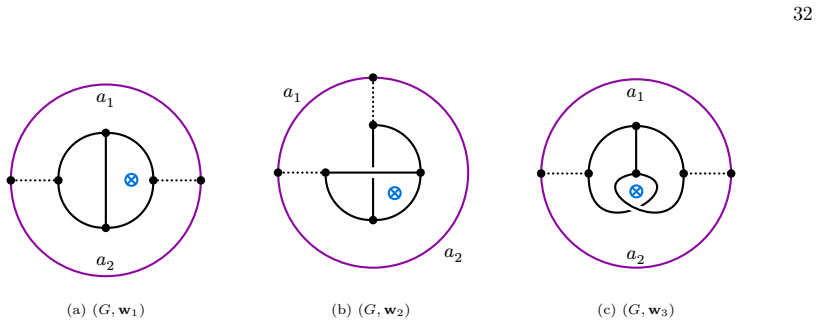
The load-bearing object is an "embedding": a vacuum Feynman graph together with a puncture whose position is encoded by winding numbers of the graph's cycles. An embedding groups all cuts that can be moved around the puncture into one equivalence class, and the sum of the corresponding interference diagrams is separately infrared finite by the KLN theorem. The second essential element is the simplest clustering criterion: the initial-state partons are taken to be a uniform density matrix constrained only by total momentum, so that in the $\Lambda^2\to0$ limit the density collapses to a function of the proton momentum $p$ alone. The identity carrying the argument is the doubled optical theorem, eq. (136), together with the expansion-by-regions form $I_\Gamma=(p^2)^{-1}H+(-p^2)^{-1-\epsilon}C+O((p^2)^0)$; applying $\operatorname{disc}_{p^2}\operatorname{disc}_{1-x}$ to that expression reproduces the sum of cut diagrams, with the hard and collinear coefficients $H$ and $C$ carrying the KLN cancellations.
What would settle it
Perform the same model's next-to-leading-order Drell-Yan calculation: the paper's equivalence claim requires that the same scheme redefinition that converts multi-parton DIS into parton-model DIS also converts multi-parton Drell-Yan into parton-model Drell-Yan; a difference in the two conversions would make the model experimentally distinguishable from the parton model.
Extended reading notes
Core claim
The central discovery is that at leading virtuality the partonic tensor of an embedding $\Gamma$ satisfies $$W_\Gamma(p,q)=\frac{1}{\operatorname{av}(q)}\,\operatorname{disc}_{$p^{2}$}\,\operatorname{disc}_{1-x}\,I_\Gamma($p^{2}$,$q^{2}$,1-x)+O(($p^{2}$)^0).$$ Interference diagrams that cancel infrared singularities through the KLN theorem are therefore obtained not one by one but as the iterated discontinuity of the embedding's loop integral, generalising the optical theorem and Cutkosky's cutting rules. The identity is checked in detail on triangle, box, and pentagon embeddings by direct Reverse Unitarity evaluation of the cut integrals. Using it, the paper computes next-to-leading order DIS structure functions: the longitudinal structure functions coincide with the parton model, the $F_2$ scale dependence is driven by the usual splitting kernels, and the finite pieces differ only by a scheme change, with genuinely new contributions such as $F_{2qq}$ appearing.
Load-bearing premise
The construction rests on modeling the proton as a uniform mixture of massless partons constrained only by total momentum, with no correlations among initial-state partons, together with the omission of multi-winding diagrams; if a real proton state has non-trivial initial-state correlations, or if those diagrams contribute, the claimed equivalence with the parton model is not guaranteed.
Editorial extensions
If this is right
- Every infrared-finite multi-parton contribution at leading virtuality can be computed by taking discontinuities of Feynman-type integrals, so standard integration-by-parts, differential-equation, and Reverse Unitarity technology applies.
- NLO DIS structure functions match the parton model up to a scheme change: the longitudinal structure functions are identical, and the $Q^2/\Lambda^2$ evolution of $F_{2q}$ and $F_{2g}$ is governed by the same Altarelli-Parisi kernels.
- Class-three and class-four embeddings introduce branch cuts at $x=1/2$ and new objects such as the double-quark structure function $F_{2qq}$, which are integrable, suppressed by $1/(2N_c)$, and carry no $\Lambda^2$ logarithms.
- The simplest clustering criterion generalises to Drell-Yan, where the cross-section becomes a sum of iterated discontinuities (one per incoming proton) and is finite after virtuality integration, with leading behaviour proportional to $\log(\Lambda_1^2/m_\star^2)\log(\Lambda_2^2/m_\star^2)$.
- At NNLO, an explicit two-loop example shows that double, single, and on-shell discontinuities cancel their infrared poles after virtuality integration, leaving a finite expression in terms of powers of $\log(Q^2/\Lambda^2)$.
Reading between the lines
- Editorial inference: because the scheme-change equivalence is established for only one process, the paper's own Drell-Yan roadmap makes it falsifiable; if the same redefinition does not convert the multi-parton Drell-Yan result into the parton-model one, the two models are experimentally distinguishable.
- Editorial inference: adopting simplest clustering as an effective definition rather than a derived fact, the doubled optical theorem gives a direct route to $\Lambda^2/Q^2$ power corrections in terms of the $p^2$ derivative of the initial-state density; precision Drell-Yan data could constrain those corrections.
- Editorial inference: the distinctive $\log|2x-1|$ term in $F_{2qq}$, though suppressed by $1/(2N_c)$, is a clean kinematic signature that could be searched for in low-virtuality DIS measurements to test the model against the parton model.
- Editorial inference: the mechanism points toward a general rule that one discontinuity corresponds to each clustered external state; if that pattern holds, any momentum-conservation-only clustering prescription would define an optical theorem for multi-jet observables, but the paper does not prove this generality.
Signed reviews
Editorial analysis
A structured set of objections, weighed in public.
Referee Report
Summary. The paper proposes a perturbative model for multi-partonic initial states in deep inelastic scattering. Initial-state partons are clustered into a proton-like object using momentum conservation alone, with a uniform Fock-space density and a cutoff Lambda^2 on the cluster virtuality. The authors organize the resulting diagrammatic contributions by graph embeddings, i.e. vacuum graphs endowed with a puncture and winding numbers, and show that at leading virtuality the contribution of each embedding is an iterated double discontinuity of the corresponding embedding integral (eq. (136)). The framework is applied to NLO DIS structure functions; the authors find the same Altarelli-Parisi scale evolution as the parton model, identical longitudinal structure functions, and finite pieces that differ from the parton model. They also present a two-loop example and a first extension to Drell-Yan. The paper contains extensive cross-checks, including the Ward identity, reproduction of parton-model results when MP diagrams are removed, embedding-by-embedding infrared cancellations, integrability tests, and supplementary code and embedding data.
Significance. If the doubled optical theorem in eq. (136) holds at the claimed level of generality, it is a substantial technical result: infrared-finite multi-parton building blocks would be computable by standard cut-integral and reverse-unitarity methods, and the model provides explicit, falsifiable NLO predictions. The paper is also valuable for introducing a systematic graph-theoretic classification of KLN-related embeddings and for releasing code and data. The central caveat is that the theorem and the parton-model equivalence rest on modeling assumptions, in particular the uniform initial-state density and the truncation of higher-winding embeddings, whose scope is not fully established. The strengths of the paper are real, but the strongest claims need to be delimited more carefully.
major comments (3)
- [§II.B, eqs. (20)–(22)] The collapse of the general diagonal density to the uniform density is asserted, not derived. The text moves from f(p1,...,pn) to a function of p alone via the statement that infrared safety 'by the usual degeneracy arguments' forces this collapse. The KLN theorem constrains cancellations among degenerate states; it does not fix the relative weights of different initial-state configurations. If f retains dependence on the individual momentum fractions, the sum over interference diagrams in eq. (90) is weighted by f, and the identification with the unweighted double discontinuity of a single embedding integral in eq. (136) is not guaranteed. This collapse is load-bearing for the doubled optical theorem and for the NLO comparison with the parton model. Please either provide an explicit derivation of the collapse or state it as a defining axiom of the model, and test its necessity, for example by computing an NLO embedding with a non-uniform f and showing what breaks in eq. (136).
- [§III.B.3, §VI.A.b, §VI.B.h] The exclusion of higher-winding embeddings is a truncation, not a derived property. The paper itself describes the |r_e| <= 1 condition as the least physically motivated constraint, and §VI.B.h states that the full KLN sum over windings is infinite and requires an additional truncation or resummation principle. In addition, the leading-order matching to the parton model requires the extra condition f_q(1/q) = q^alpha f_q(1), which is not fixed by the model. Consequently the NLO structure functions and the claimed scheme-change equivalence to the parton model are established only for the particular finite subset Embdis. The abstract and Section VI state the equivalence more strongly than what is proven. Please either give a physical principle that selects Embdis, bound the contribution of higher-winding embeddings at NLO, or rephrase the equivalence claim as applying only to the truncated set.
- [§V.D, eq. (136)] Equation (136) is presented as a general doubled optical theorem, but the evidence is an explicit match for NLO one-loop embeddings (triangle, box, pentagon) and one two-loop example. The derivation relies on the leading-virtuality analytic forms of eqs. (119)–(120) and the reverse-unitarity reduction of eqs. (132)–(135); these are checked, not proven, at arbitrary order. Furthermore, the text itself notes that the discontinuity and the virtuality expansion do not commute, so eq. (136) holds only order-by-order in the virtuality expansion. Please state the theorem with its actual domain (verified at NLO, conjectural beyond), or supply a proof, and make the order-by-order qualification part of the statement of eq. (136).
minor comments (8)
- [§II.B, eq. (22)] In eq. (22) the density is written as f(p), while the surrounding text says f does not depend on p^2 but can depend on the momentum fraction; please clarify the notation by writing f(ξ) or specifying the p-dependence after integration over the phase space.
- [§III.B.3] The sentence 'By using Z_n we bound the possible winding numbers to be less than n' uses an integer n that is not defined; it presumably depends on the edge or cut set, but this should be stated explicitly.
- [§VI.B.a] The validation tests a)–d) are listed but not documented in detail; a short table or a description of how the embedding-by-embedding cancellation and the integrability checks were performed would make these claims reproducible.
- [§II.D.c, eq. (50)] The claim that equality of the longitudinal structure functions is necessary and sufficient for a scheme change is stated without proof; please provide a derivation or a reference, since the sufficiency direction is not immediate for two structure functions that both depend on the PDF transformation.
- [§VII.B] There are several typos in this section, including 're-routing okk' and 'compeletely' in §II.B; a careful proofread is needed.
- [§III.B.3.d] The code is described as hosted on GitHub 'at this link', but no URL is given in the text; please include the actual repository address.
- [Acknowledgments] The acknowledgments thank 'the work of M.H.' but the author list contains M. Ruf; this should be corrected to M.R.
- [Appendix C] The embedding tables are very hard to read in the text version; since the .m data files are provided as supplementary material, it would help to keep a few illustrative rows in the paper and move the full tables to the supplementary material.
Circularity Check
No significant circularity: the NLO matching, scale dependence, and iterated-discontinuity identities are derived and externally checked, not fitted or defined into existence.
full rationale
The paper's central construction is explicitly model-based rather than derived from QCD: the density matrix in eq. (12) is introduced as 'the simplest model for the clustering of partons', and the reduction of a general f(p1,...,pn) to f(p) in eq. (22) is asserted from infrared safety and 'usual degeneracy arguments'. Even if this inference is under-derived, it is an assumption about the input state, not an output defined in terms of the structure functions or the doubled optical theorem. The main identity (136) is obtained by comparing two independent computations of the same NLO embeddings: the iterated-discontinuity evaluation of sect. VB and the Reverse Unitarity cut calculation of sect. VC. The agreement is checked explicitly for the triangle, box, and pentagon examples, and no parton-model result is substituted into the definition of WGamma. The NLO structure functions are not fitted: the Lambda^2/Q^2 logarithms emerge from integrating the (p^2)^(-1-epsilon) collinear term, the longitudinal structure functions agree exactly with the parton model, and the F2 finite parts differ, which is the opposite of what would happen if the parton-model answer were being projected onto the model. The pipeline is validated against the independent NLO parton-model calculation of ref. [93]. The LO higher-winding relation f_q(1/q)=q^alpha f_q(1) is explicitly introduced as one possible constraint 'to retrieve the parton model result', not as a predicted consequence; this is under-determination of the model rather than circularity. The truncation of higher-winding embeddings is admitted to be 'the least physically motivated constraint', but this limits the scope of the theorem rather than making the derivation feed on itself. Self-citations to Local Unitarity works are used as computational technology, not as the justification of the doubled optical theorem or of the matching to the parton model. No step reduces by construction to its own inputs.
Assumptions & free parameters
free parameters (2)
- Clustering scale Lambda^2 =
Not fitted; arbitrary input scale
- Exponent alpha in higher-winding PDF matching =
Not fitted; chosen to match parton model
assumptions (5)
- domain assumption KLN theorem applies to the summed multi-partonic initial and final states
- ad hoc to paper Uniform initial-state density with simplest clustering
- domain assumption Leading-virtuality truncation is physically meaningful
- ad hoc to paper Exclusion of higher-winding embeddings
- domain assumption Embedding analytic structure is captured by p^2, 1-x and 1-2x
invented entities (1)
-
Vacuum graph embedding (G,w) with a puncture
Cite this review
Pith. "Pith review of Multi-partonic interactions, iterated discontinuities and the virtuality expansion in deep inelastic scattering." pith.science (2026). https://pith.science/paper/H6MFI576
@misc{pith2026250616489,
  author       = {Pith},
  title        = {Pith review of: Multi-partonic interactions, iterated discontinuities and the virtuality expansion in deep inelastic scattering},
  year         = {2026},
  howpublished = {\url{https://pith.science/paper/H6MFI576}},
  note         = {Machine review of arXiv:2506.16489}
}
read the original abstract
We introduce a perturbative model that accounts for the contribution of multi-partonic interactions to collider observables. A key feature of this multi-parton model is that cross sections are organised in terms of building blocks that are separately infrared-finite in virtue of the KLN theorem. We find compact expressions for these building blocks in terms of double discontinuities of Feynman-type integrals obtained by endowing a vacuum graph with additional topological information. The framework is applied to the computation of next-to-leading order structure functions in deep inelastic scattering. We comment on the scale dependence of these structure functions and discuss the possibility of relating them by a scheme change to those computed in the parton model. Finally we lay down next steps for analogous computations for deep inelastic scattering at NNLO and Drell-Yan at NLO.
Figures


Figures from the paper (7 more)



Reference graph
Works this paper leans on
-
[1]
ground truth
Partonic tensor as an iterated discontinuity Having detailed the analytic properties of embeddings in sec. VB and those of interference diagrams in sec. VC, we are ready to establish a relationship between the two. We have, by direct comparison of the NLO coefficients in eq. (126),(127)(128) and the Reverse Unitarity calculation: WΓ(p,q ) = discp2disc1−xI...
-
[2]
MP cross-section and the KLN theorem Recall that the partonic tensorWq(p,q ) is related to the partonic cross-section by eq. (27). In other words, in order to obtain an object that gives the full cross-section by simple contraction with the leptonic tensor, we first have to integrateWq(p,q ) over p2 taking all values from 0 to the infrared regulator Λ2: W...
-
[3]
Triangle diagram Let us start by discussing the case of the embedding in fig. 5a. The embedding reads IΓ1 = T (p,q,−p−q) p2(p +q)2 . (143) 4 In general, the finiteness statement also requires UV renormalisation. In the case of NLO DIS no UV renormalisation procedure is needed, since the electric charge does not receive QCD corrections. Furthermore, contra...
-
[4]
7 can be obtained as double discontinuities of the integrand associated to the embedding of fig
Box diagram We will now show that the interference diagrams of fig. 7 can be obtained as double discontinuities of the integrand associated to the embedding of fig. 5b, which we identified with the box diagram of fig. 9b. The embedding is partial-fractioned into triangles: IΓ2 = B(p,q,−p,−q) p2 = T (p,q,−p−q) +T (−p,q,p −q) p2(p·q) . (152) Although the di...
-
[5]
higher- winding
Pentagon diagram The most involved example we study relates to the embedding of fig. 5c. As we have seen, its integrand is the same as the pentagon of fig. 9c. Upon partial fractioning, the pentagon diagram may be expressed in terms of triangles: IΓ3 =− T (p,q,−p−q) p2q· (p +q) + T (q,p +q,−p− 2q) 4q· (p +q)(p 2 +q)2 + T (p 2,q,−p 2−q) +T (p 2, p 2 +q,−p−...
-
[6]
(200) Note that this expression is fully symmetric in its arguments
= Z dDℓ1dDℓ2 (iπD/2)2 1 ℓ2 1ℓ2 2(ℓ1 +p1)2(ℓ2 +p2)2(ℓ1−ℓ2 +p1)2(ℓ2−ℓ1 +p2)2 . (200) Note that this expression is fully symmetric in its arguments. This integral has been studied frequently in the literature, for example in refs. [95, 96]. We will only compute in an expansion aboutΛ2 = 0, which means we can expand inp2. As for the NLO case we will need this...
-
[7]
Double discontinuity For the double discontinuity we directly evaluate the required cuts in the limit of smallp2 using the method of regions. In this way we can obtain expressions that are exact in the dimensional regulator 56 thus allowing to perform the integration inp2 and the extraction of the distributional part in(p +q)2. When expanding inϵ we find ...
-
[8]
For this we can specifyp2 1 = 0 and p2 2 > 0, p2 3 < 0 and then obtain the two cases needed for the problem at hand by settingp1 =p,p 2 = p +q and p1 =p +q,p 2 =p respectively
Single discontinuity We need the integral with a single discontinuity and a on-shell leg. For this we can specifyp2 1 = 0 and p2 2 > 0, p2 3 < 0 and then obtain the two cases needed for the problem at hand by settingp1 =p,p 2 = p +q and p1 =p +q,p 2 =p respectively. We proceed by computing univariate differential equations inz =p2 2/p2
Show all 117 references
-
[9]
in the limitp2→ 0
The boundary conditions can be fixed by the method of regions e.g. in the limitp2→ 0. From this we can obtain the discontinuity in a form, e.g. for case 2 F4(0,p 2 2,p 2
-
[10]
= (−p2 3/µ2)−2ϵf0(p2 2/p2
-
[11]
+ (−p2 3/µ2)−ϵ(p2 2/µ2)−ϵf1(p2 2/p2
-
[12]
(203) Wherefi are analytic atp2 = 0
+ (p2 2/µ2)−2ϵf2(p2 2/p2 3). (203) Wherefi are analytic atp2 = 0. From this expression, it is straightforward to obtain the discontinuity. In order to perform thep2 integration as required for case 2, we expand the functionsfi in small arguments. Keeping the leading order all ...
-
[13]
vertical particle
On-shell integral Finally, we also need the integral with two on-shell legs. Given that this is the hard region of the integral we can obtain it from Eq. (203) C4 =δ((p +q)2)F4(0, 0,q 2) =δ((p +q)2)(−q2/µ2)−2ϵf0(0). (205) Interestingly, the contribution from the double discont...
-
[14]
simplest clustering
In summary, including only the leading-virtuality diagram labellings, and dividing by 2 to average overP1↔P2 symmetry, the cross-section can be written as σ =2δ(x1x2s−m2 ⋆) Z dΠHH ˜δ(m2 1)˜δ(m2 2)Re[T (P1,P 2,−P1−P2)] +˜δ(m2 2) discm2 1 T (P1,P 2,−P1−P2) m2 1 + ˜δ(m2 1) discm2...
-
[15]
VC, the Reverse Unitarity calculation takes the virtual bubbleB(p2), the cut bubble /B(p2) and the doubly-cut triangle /T (p2 1,p 2 2,p 2
Cut masters As mentioned in sect. VC, the Reverse Unitarity calculation takes the virtual bubbleB(p2), the cut bubble /B(p2) and the doubly-cut triangle /T (p2 1,p 2 2,p 2
-
[16]
as inputs. The virtual bubble is obtained straight-forwardly by Feynman parametrisation (2π)dB(p2) = Z ddk 1 k2(p−k)2 = iπ d 2 Γ d−2 2 2 Γ 4−d 2 Γ (d− 2) (−p2) d−4 2 63 = iπ2−ϵΓ (1−ϵ)2 Γ (ϵ) Γ (2− 2ϵ) (−p2)−ϵ (A1) where we setd = 4−2ϵ. The cut bubble and the doubly cut triangl...
-
[17]
= Z ddk ˜δ−(k)˜δ+(k +p1)˜δ+(k−p3) =−4i (−p2 1p2 2p2 3) d−4 2 λ(p2 1,p 2 2,p 2 3) d−3 2 π d 2 +2 Γ d 2− 1 Θ(−p0 1)Θ(p2 1)Θ(p0 3)Θ(p2 3) =−4i (−p2 1p2 2p2 3)−ϵ λ(p2 1,p 2 2,p 2 3) 1 2−ϵ π4−ϵ Γ (1−ϵ)Θ(−p0 1)Θ(p2 1)Θ(p0 3)Θ(p2 3), (A3) where λ(x,y,z ) =x2 +y2 +z2− 2xy− 2xz− 2yz is...
-
[18]
VB is simply the two-mass triangle, which IBP-reduces to bubbles: Th(p,q ) = (d− 3)[B(q)−B(p +q)] (d− 4)p· (p +q)
Calculation of Th The hard functionTh required in the region expansion of sect. VB is simply the two-mass triangle, which IBP-reduces to bubbles: Th(p,q ) = (d− 3)[B(q)−B(p +q)] (d− 4)p· (p +q) . (A4) Using the result for the bubble of eq. (A1): (2π)dTh(p,q ) = iπd/2 Γ(1−ϵ)2Γ(...
-
[19]
β d−2 2 −α1, d−2 2 −α2 Γ(d/2− 1) #2 , (B16) F2(α1,α 2) = (p2 3)d−3−α1(p2 1)d−3−α1 π(−2p1·p3)d−2+α2−α1
Calculation of Tc The collinear function Tc required in the region expansion of sect. VB is computed in light-cone coordinates. It reads: (2π)d(−p2 1)−ϵTc(p1,p 2) = Z ddk 1 k2(k−p1)2(2k+(n+·p2) +p2 2). (A6) Where we have used light-cone variables,k =k+ˆn+ +k−ˆn− +k⊥, ˆn±·k⊥ = ...
-
[20]
R. P. Feynman, Behavior of hadron collisions at extreme energies., pp 237-58 of High Energy Collisions. New York Gordon and Breach, Science Publishers, Inc. (1969). (1969)
1969
-
[21]
V. N. Gribov, Inelastic processes at super high-energies and the problem of nuclear cross-sections, Sov. J. Nucl. Phys.9, 369 (1969)
1969
-
[22]
J. D. Bjorken, Asymptotic Sum Rules at Infinite Momentum, Phys. Rev.179, 1547 (1969)
1969
-
[23]
D. J. Gross and F. Wilczek, Asymptotically free gauge theories. i, Phys. Rev. D8, 3633 (1973)
1973
-
[24]
David Politzer, Asymptotic freedom: An approach to strong interactions, Physics Reports14, 129 (1974)
H. David Politzer, Asymptotic freedom: An approach to strong interactions, Physics Reports14, 129 (1974)
1974
-
[25]
Parisi, Experimental limits on the values of anomalous dimensions, Phys
G. Parisi, Experimental limits on the values of anomalous dimensions, Phys. Lett. B43, 207 (1973)
1973
-
[26]
Altarelli and G
G. Altarelli and G. Parisi, Asymptotic Freedom in Parton Language, Nucl. Phys. B126, 298 (1977)
1977
-
[27]
Y. L. Dokshitzer, Calculation of the Structure Functions for Deep Inelastic Scattering and e+ e- Annihi- lation by Perturbation Theory in Quantum Chromodynamics., Sov. Phys. JETP46, 641 (1977)
1977
-
[28]
V. N. Gribov and L. N. Lipatov, Deep inelastic e p scattering in perturbation theory, Sov. J. Nucl. Phys. 15, 438 (1972)
1972
-
[29]
Altarelli, Partons in Quantum Chromodynamics, Phys
G. Altarelli, Partons in Quantum Chromodynamics, Phys. Rept.81, 1 (1982)
1982
-
[30]
Forte, Asymptotic Freedom in Parton Language: the Birth of Perturbative QCD (2025) arXiv:2501.13158 [hep-ph]
S. Forte, Asymptotic Freedom in Parton Language: the Birth of Perturbative QCD (2025) arXiv:2501.13158 [hep-ph]
2025 arXiv
-
[31]
Parisi, From Bjorken Scaling to Scaling Violations, (2025), arXiv:2506.03383 [physics.hist-ph]
G. Parisi, From Bjorken Scaling to Scaling Violations, (2025), arXiv:2506.03383 [physics.hist-ph]
2025 arXiv
-
[32]
G. F. Sterman,An Introduction to quantum field theory(Cambridge University Press, 1993)
1993
-
[33]
Collins,Foundations of Perturbative QCD, Vol
J. Collins,Foundations of Perturbative QCD, Vol. 32 (Cambridge University Press, 2011)
2011
-
[34]
R. K. Ellis, W. J. Stirling, and B. R. Webber,QCD and collider physics, Vol. 8 (Cambridge University Press, 2011)
2011
-
[35]
Kinoshita, Mass singularities of Feynman amplitudes, J
T. Kinoshita, Mass singularities of Feynman amplitudes, J. Math. Phys.3, 650 (1962)
1962
-
[36]
T. D. Lee and M. Nauenberg, Degenerate systems and mass singularities, Phys. Rev.133, B1549 (1964)
1964
-
[37]
Agarwal, L
N. Agarwal, L. Magnea, C. Signorile-Signorile, and A. Tripathi, The infrared structure of perturbative gauge theories, Phys. Rept.994, 1 (2023), arXiv:2112.07099 [hep-ph]
2023 arXiv
-
[38]
R. K. Ellis, H. Georgi, M. Machacek, H. D. Politzer, and G. G. Ross, Perturbation Theory and the Parton Model in QCD, Nucl. Phys. B152, 285 (1979)
1979
-
[39]
Altarelli, R
G. Altarelli, R. K. Ellis, and G. Martinelli, Large Perturbative Corrections to the Drell-Yan Process in QCD, Nucl. Phys. B157, 461 (1979)
1979
-
[40]
J. C. Collins, D. E. Soper, and G. F. Sterman, All Order Factorization for Drell-Yan Cross-sections, Phys. Lett. B134, 263 (1984)
1984
-
[41]
J.C.Collins, D.E.Soper,andG.F.Sterman,FactorizationforShortDistanceHadron-HadronScattering, Nucl. Phys. B261, 104 (1985)
1985
-
[42]
G. T. Bodwin, S. J. Brodsky, and G. P. Lepage, Initial State Interactions and the Drell-Yan Process, Phys. Rev. Lett.47, 1799 (1981)
1981
-
[43]
G. T. Bodwin, Factorization of the Drell-Yan Cross-Section in Perturbation Theory, Phys. Rev. D31, 2616 (1985), [Erratum: Phys.Rev.D 34, 3932 (1986)]
1985
-
[44]
G. F. Sterman, Partons, factorization and resummation, TASI 95, inTheoretical Advanced Study Institute in Elementary Particle Physics (TASI 95): QCD and Beyond(1995) pp. 327–408, arXiv:hep-ph/9606312
1995 arXiv
-
[45]
J. C. Collins and G. F. Sterman, Soft Partons in QCD, Nucl. Phys. B185, 172 (1981)
1981
-
[46]
J. C. Collins, D. E. Soper, and G. F. Sterman, Relation of Parton Distribution Functions in Drell-Yan Process to Deeply Inelastic Scattering, Phys. Lett. B126, 275 (1983)
1983
-
[47]
P. V. Landshoff and W. J. Stirling, Spectator Interactions and theK Factor in the Drell-Yan Process, Z. Phys. C14, 251 (1982)
1982
-
[48]
I. Z. Rothstein and I. W. Stewart, An Effective Field Theory for Forward Scattering and Factorization Violation, JHEP08, 025, arXiv:1601.04695 [hep-ph]. 84
-
[49]
S. M. Aybat and G. F. Sterman, Soft-Gluon Cancellation, Phases and Factorization with Initial-State Partons, Phys. Lett. B671, 46 (2009), arXiv:0811.0246 [hep-ph]
2009 arXiv
-
[50]
Diehl, J
M. Diehl, J. R. Gaunt, D. Ostermeier, P. Plößl, and A. Schäfer, Cancellation of Glauber gluon exchange in the double Drell-Yan process, JHEP01, 076, arXiv:1510.08696 [hep-ph]
-
[51]
Catani, D
S. Catani, D. de Florian, and G. Rodrigo, Space-like (versus time-like) collinear limits in QCD: Is factor- ization violated?, JHEP07, 026, arXiv:1112.4405 [hep-ph]
-
[52]
Caola, K
F. Caola, K. Melnikov, D. Napoletano, and L. Tancredi, Noncancellation of infrared singularities in colli- sions of massive quarks, Phys. Rev. D103, 054013 (2021), arXiv:2011.04701 [hep-ph]
2021 arXiv
-
[53]
Zeng, Drell-Yan process with jet vetoes: breaking of generalized factorization, JHEP 10, 189, arXiv:1507.01652 [hep-ph]
M. Zeng, Drell-Yan process with jet vetoes: breaking of generalized factorization, JHEP 10, 189, arXiv:1507.01652 [hep-ph]
-
[54]
T. Liu, K. Melnikov, and A. A. Penin, Nonfactorizable QCD Effects in Higgs Boson Production via Vector Boson Fusion, Phys. Rev. Lett.123, 122002 (2019), arXiv:1906.10899 [hep-ph]
2019 arXiv
-
[55]
J. R. Forshaw, M. H. Seymour, and A. Siodmok, On the Breaking of Collinear Factorization in QCD, JHEP 11, 066, arXiv:1206.6363 [hep-ph]
-
[56]
C. W. Bauer, D. Pirjol, and I. W. Stewart, Soft-collinear factorization in effective field theory, Physical Review D65, 10.1103/physrevd.65.054022 (2002), arXiv:hep-ph/0109045
2002 arXiv
-
[57]
Becher, P
T. Becher, P. Hager, S. Jaskiewicz, M. Neubert, and D. Schwienbacher, Factorization restoration through glauber gluons (2024), arXiv:2408.10308 [hep-ph]
2024 arXiv
-
[58]
Beneke, A
M. Beneke, A. Chapovsky, M. Diehl, and T. Feldmann, Soft-collinear effective theory and heavy-to-light currents beyond leading power, Nuclear Physics B643, 431 (2002), arXiv:hep-ph/0206152
2002 arXiv
-
[59]
Becher, M
T. Becher, M. Neubert, L. Rothen, and D. Y. Shao, Effective field theory for jet processes, Physical Review Letters 116, 10.1103/physrevlett.116.192001 (2016), arXiv:1508.06645 [hep-ph]
2016 arXiv
-
[60]
J. C. Collins and D. E. Soper, Back-To-Back Jets in QCD, Nucl. Phys. B193, 381 (1981), [Erratum: Nucl.Phys.B 213, 545 (1983)]
1981
-
[61]
J. C. Collins, D. E. Soper, and G. F. Sterman, Transverse Momentum Distribution in Drell-Yan Pair and W and Z Boson Production, Nucl. Phys. B250, 199 (1985)
1985
-
[62]
Ji, J.-p
X.-d. Ji, J.-p. Ma, and F. Yuan, QCD factorization for semi-inclusive deep-inelastic scattering at low transverse momentum, Phys. Rev. D71, 034005 (2005), arXiv:hep-ph/0404183
2005 arXiv
-
[63]
A. V. Radyushkin, Nonforward parton distributions, Physical Review D 56, 5524 (1997), arXiv:hep- ph/9704207
1997
-
[64]
Ji, Deeply virtual compton scattering, Physical Review D55, 7114 (1997), arXiv:hep-ph/9609381
X. Ji, Deeply virtual compton scattering, Physical Review D55, 7114 (1997), arXiv:hep-ph/9609381
1997 arXiv
-
[65]
Diehl, Generalized parton distributions, Physics Reports388, 41 (2003), arXiv:hep-ph/0307382
M. Diehl, Generalized parton distributions, Physics Reports388, 41 (2003), arXiv:hep-ph/0307382
2003 arXiv
-
[66]
Diehl and A
M. Diehl and A. Schäfer, Theoretical considerations on multiparton interactions in QCD, Physics Letters B 698, 389 (2011), arXiv:1102.3081 [hep-ph]
2011 arXiv
-
[67]
B. Blok, Y. Dokshitzer, L. Frankfurt, and M. Strikman, pQCD physics of multiparton interactions, The European Physical Journal C72, 10.1140/epjc/s10052-012-1963-8 (2012), arXiv:1106.5533 [hep-ph]
2012 arXiv
-
[68]
Diehl, D
M. Diehl, D. Ostermeier, and A. Schäfer, Elements of a theory for multiparton interactions in QCD, JHEP (03), arXiv:1111.0910 [hep-ph]
-
[69]
B. Blok, Y. Dokshitzer, L. Frankfurt, and M. Strikman, Perturbative QCD correlations in multi-parton collisions, The European Physical Journal C74, 10.1140/epjc/s10052-014-2926-z (2014), arXiv:1306.3763 [hep-ph]
2014 arXiv
-
[70]
J. R. Andersen, P. F. Monni, L. Rottoli, G. P. Salam, and A. Soto-Ontoso, Exploring High-Purity Multi- parton Scattering at Hadron Colliders, Phys. Rev. Lett.132, 041901 (2024), arXiv:2307.05693 [hep-ph]
2024 arXiv
-
[71]
G. F. Sterman and S. Weinberg, Jets from Quantum Chromodynamics, Phys. Rev. Lett.39, 1436 (1977)
1977
-
[72]
Axelrod and C
A. Axelrod and C. A. Nelson, Degenerate States and the Kinoshita-lee-nauenberg Theorem in Deep In- elastic Scattering, Phys. Rev. D32, 2385 (1985)
1985
-
[73]
H. S. Hannesdottir, A. J. McLeod, M. D. Schwartz, and C. Vergu, Constraints on sequential discontinuities from the geometry of on-shell spaces, JHEP07, 236, arXiv:2211.07633 [hep-th]
-
[74]
Lavelle and D
M. Lavelle and D. McMullan, Collinearity, convergence and cancelling infrared divergences, JHEP (03), 85 026, arXiv:hep-ph/0511314
-
[75]
Blažek and P
T. Blažek and P. Maták, Cutting rules on a cylinder: a simplified diagrammatic approach to quantum kinetic theory, Eur. Phys. J. C81, 1050 (2021), arXiv:2104.06395 [hep-ph]
2021 arXiv
-
[76]
C. Frye, H. Hannesdottir, N. Paul, M. D. Schwartz, and K. Yan, Infrared Finiteness and Forward Scatter- ing, Phys. Rev. D99, 056015 (2019), arXiv:1810.10022 [hep-ph]
2019 arXiv
-
[77]
Khalil and W
A. Khalil and W. A. Horowitz, A complete diagrammatic implementation of the kinoshita-lee-nauenberg theorem at next-to-leading order (2017), arXiv:1701.00763 [hep-th]
2017 arXiv
-
[78]
Capatti,Singularities of Feynman diagrams and their local cancellation in collider cross-sections, Ph.D
Z. Capatti,Singularities of Feynman diagrams and their local cancellation in collider cross-sections, Ph.D. thesis, Zurich, ETH (2023)
2023
-
[79]
D. E. Soper, QCD calculations by numerical integration, Phys. Rev. Lett.81, 2638 (1998), arXiv:hep- ph/9804454
1998
-
[80]
D. E. Soper, Techniques for QCD calculations by numerical integration, Phys. Rev. D62, 014009 (2000), arXiv:hep-ph/9910292
2000 arXiv
-
[81]
Capatti, V
Z. Capatti, V. Hirschi, A. Pelloni, and B. Ruijl, Local Unitarity: a representation of differential cross- sections that is locally free of infrared singularities at any order, JHEP04, 104, arXiv:2010.01068 [hep-ph]
2010 arXiv
-
[82]
Capatti, Local Unitarity, SciPost Phys
Z. Capatti, Local Unitarity, SciPost Phys. Proc.7, 024 (2022), arXiv:2110.15662 [hep-ph]
2022 arXiv
-
[83]
Capatti, V
Z. Capatti, V. Hirschi, and B. Ruijl, Local unitarity: cutting raised propagators and localising renormali- sation, JHEP10, 120, arXiv:2203.11038 [hep-ph]
-
[84]
Anastasiou, L
C. Anastasiou, L. J. Dixon, and K. Melnikov, NLO Higgs boson rapidity distributions at hadron colliders, Nucl. Phys. B Proc. Suppl.116, 193 (2003), arXiv:hep-ph/0211141
2003 arXiv
-
[85]
Anastasiou and K
C. Anastasiou and K. Melnikov, Higgs boson production at hadron colliders in NNLO QCD, Nucl. Phys. B 646, 220 (2002), arXiv:hep-ph/0207004
2002 arXiv
-
[86]
Anastasiou, L
C. Anastasiou, L. J. Dixon, K. Melnikov, and F. Petriello, Dilepton rapidity distribution in the Drell-Yan process at NNLO in QCD, Phys. Rev. Lett.91, 182002 (2003), arXiv:hep-ph/0306192
2003 arXiv
-
[87]
C.Anastasiou, C.Duhr, F.Dulat, F.Herzog,andB.Mistlberger,Real-virtualcontributionstotheinclusive Higgs cross-section atN 3LO, JHEP12, 088, arXiv:1311.1425 [hep-ph]
-
[88]
Anastasiou, C
C. Anastasiou, C. Duhr, F. Dulat, and B. Mistlberger, Soft triple-real radiation for Higgs production at N3LO, JHEP07, 003, arXiv:1302.4379 [hep-ph]
-
[89]
Bagnaschi, M
E. Bagnaschi, M. Cacciari, A. Guffanti, and L. Jenniches, An extensive survey of the estimation of uncer- tainties from missing higher orders in perturbative calculations, JHEP02, 133, arXiv:1409.5036 [hep-ph]
-
[90]
Bonvini, Probabilistic definition of the perturbative theoretical uncertainty from missing higher orders, Eur
M. Bonvini, Probabilistic definition of the perturbative theoretical uncertainty from missing higher orders, Eur. Phys. J. C80, 989 (2020), arXiv:2006.16293 [hep-ph]
2020 arXiv
-
[91]
C. Duhr, A. Huss, A. Mazeliauskas, and R. Szafron, An analysis of Bayesian estimates for missing higher orders in perturbative calculations, JHEP09, 122, arXiv:2106.04585 [hep-ph]
-
[92]
F. J. Tackmann, Beyond Scale Variations: Perturbative Theory Uncertainties from Nuisance Parameters, (2024), arXiv:2411.18606 [hep-ph]
2024 arXiv
-
[93]
M. A. Lim and R. Poncelet, Robust estimates of theoretical uncertainties at fixed-order in perturbation theory, (2024), arXiv:2412.14910 [hep-ph]
2024
-
[94]
Muta and C
T. Muta and C. A. Nelson, Role of quark-gluon degenerate states in perturbative quantum chromodynam- ics, Phys. Rev. D25, 2222 (1982)
1982
-
[95]
Ramírez-Uribe, P
S. Ramírez-Uribe, P. K. Dhani, G. F. R. Sborlini, and G. Rodrigo, Rewording Theoretical Predictions at Colliders with Vacuum Amplitudes, Phys. Rev. Lett.133, 211901 (2024), arXiv:2404.05491 [hep-ph]
2024 arXiv
-
[96]
Ramírez-Uribe, A
S. Ramírez-Uribe, A. E. Rentería-Olivo, D. F. Rentería-Estrada, J. J. M. de Lejarza, P. K. Dhani, L. Cieri, R. J. Hernández-Pinto, G. F. R. Sborlini, W. J. Torres Bobadilla, and G. Rodrigo (LTD), Vacuum ampli- tudes and time-like causal unitary in the loop-tree duality, JHEP01...
-
[97]
Akhoury, M
R. Akhoury, M. G. Sotiropoulos, and V. I. Zakharov, Kinoshita-lee-nauenberg theorem and soft radiation in gauge theories: Abelian case, Phys. Rev. D56, 377 (1997)
1997
-
[98]
J. A. Bondy and U. S. R. Murty,Graph Theory, edited by S. Axler and K. A. Ribet, Graduate Texts in Mathematics, Vol. 244 (Springer London, London, 2008). 86
2008
-
[99]
Kavitha, C
T. Kavitha, C. Liebchen, K. Mehlhorn, D. Michail, R. Rizzi, T. Ueckerdt, and K. A. Zweig, Cycle bases in graphs characterization, algorithms, complexity, and applications, Computer Science Review3, 199 (2009)
2009
-
[100]
B. D. McKay and A. Piperno, Practical graph isomorphism, II, Journal of Symbolic Computation60, 94 (2014)
2014
-
[101]
R. E. Cutkosky, Singularities and discontinuities of Feynman amplitudes, J. Math. Phys.1, 429 (1960)
1960
-
[102]
Abreu, R
S. Abreu, R. Britto, C. Duhr, and E. Gardi, From multiple unitarity cuts to the coproduct of Feynman integrals, JHEP10, 125, arXiv:1401.3546 [hep-th]
-
[103]
Abreu, R
S. Abreu, R. Britto, C. Duhr, and E. Gardi, Algebraic Structure of Cut Feynman Integrals and the Diagrammatic Coaction, Phys. Rev. Lett.119, 051601 (2017), arXiv:1703.05064 [hep-th]
2017 arXiv
-
[104]
J. L. Bourjaily, H. Hannesdottir, A. J. McLeod, M. D. Schwartz, and C. Vergu, Sequential Discontinuities of Feynman Integrals and the Monodromy Group, JHEP01, 205, arXiv:2007.13747 [hep-th]
2007 arXiv
-
[105]
K. G. Chetyrkin, Operator Expansions in the Minimal Subtraction Scheme. 1: The Gluing Method, Theor. Math. Phys.75, 346 (1988)
1988
-
[106]
S. G. Gorishnii, Construction of Operator Expansions and Effective Theories in the Ms Scheme, Nucl. Phys. B319, 633 (1989)
1989
-
[107]
V. A. Smirnov, Asymptotic expansions in limits of large momenta and masses, Commun. Math. Phys. 134:1, 109 (1990)
1990
-
[108]
Beneke and V
M. Beneke and V. A. Smirnov, Asymptotic expansion of Feynman integrals near threshold, Nucl. Phys. B 522, 321 (1998), arXiv:hep-ph/9711391
1998 arXiv
-
[109]
V. A. Smirnov, Applied asymptotic expansions in momenta and masses, Springer Tracts Mod. Phys.177, 1 (2002)
2002
-
[110]
Jantzen, Foundation and generalization of the expansion by regions, JHEP12, 076, arXiv:1111.2589 [hep-ph]
B. Jantzen, Foundation and generalization of the expansion by regions, JHEP12, 076, arXiv:1111.2589 [hep-ph]
-
[111]
Capatti, Exposing the threshold structure of loop integrals, Phys
Z. Capatti, Exposing the threshold structure of loop integrals, Phys. Rev. D 107, L051902 (2023), arXiv:2211.09653 [hep-th]
2023 arXiv
-
[112]
W. A. Bardeen, A. J. Buras, D. W. Duke, and T. Muta, Deep Inelastic Scattering Beyond the Leading Order in Asymptotically Free Gauge Theories, Phys. Rev. D18, 3998 (1978)
1978
-
[113]
Vermaseren, A
J. Vermaseren, A. Vogt, and S. Moch, The third-order qcd corrections to deep-inelastic scattering by photon exchange, Nuclear Physics B724, 3–182 (2005)
2005
-
[114]
N. I. Usyukina and A. I. Davydychev, An Approach to the evaluation of three and four point ladder diagrams, Phys. Lett. B298, 363 (1993)
1993
-
[115]
Chavez and C
F. Chavez and C. Duhr, Three-mass triangle integrals and single-valued polylogarithms, JHEP11, 114, arXiv:1209.2722 [hep-ph]
-
[116]
Akhoury and V
R. Akhoury and V. I. Zakharov, Power corrections in qcd: A matter of energy resolution, Phys. Rev. Lett. 76, 2238 (1996), arXiv:hep-ph/9512433
1996 arXiv
-
[117]
Akhoury and V
R. Akhoury and V. I. Zakharov, On the universality of the leading, 1/Q power corrections in QCD, Phys. Lett. B357, 646 (1995), arXiv:hep-ph/9504248
1995 arXiv
Reviewed August 15, 2026 · model on record in the stance chip above.
Discussion (0). Continue with ORCID to comment.