REVIEW 4 major objections 7 minor 42 references
Automatic Speech Recognition Biases in Newcastle English: an Error Analysis
T0 review · 4 major / 7 minor · reviewed 2026-08-06 · deepseek-v4-flash
Pith's one-line read ASR misrecognitions of Newcastle English are chiefly caused by the dialect's own phonological, lexical, and morphosyntactic features, not by speaker age or gender.
desk verdict A useful, reproducible ASR error analysis for Newcastle English, but the headline causal claim is partly a selection artifact of the annotation rule. read the letter →
The pith
A machine-rendered reading of the paper's core claim, the machinery that carries it, and where it could break.
The reading
What carries the argument
The machinery is a two-stage error-analysis pipeline built on the DECTE corpus, a 72-hour collection of transcribed, naturalistic Tyneside speech from 160 speakers. Stage one is a manual word-level comparison between ASR output and human-checked transcriptions, with errors classified first by type (phonological, lexical, morphosyntactic, standardisation, spelling) and then by finer linguistic feature (vowel quality, glottalisation, monophthongisation, pronoun, verb paradigm, and so on). Stage two is an automated string-alignment search over the full dataset for misrecognitions of the regional pronouns "yous" and "wor," followed by mixed-effects logistic regression with age and gender as fixed effects, speaker as a random effect, and WADA-SNR-estimated noise as a covariate. This two-level design is what lets the authors separate language-internal dialectal explanations from language-external social explanations and thereby ground the central claim.
What would settle it
Re-code the 1,076 errors with independent annotators who are blind to the hypothesis and with automatic linguistic feature tagging, or compare ASR accuracy on matched Newcastle utterances with and without the named dialect features (e.g., glottalised /t/, "yous,", "wor") while controlling for speaker, noise, and lexical frequency; if accuracies do not differ, the claim that errors directly correlate with dialectal features fails.
Extended reading notes
Core claim
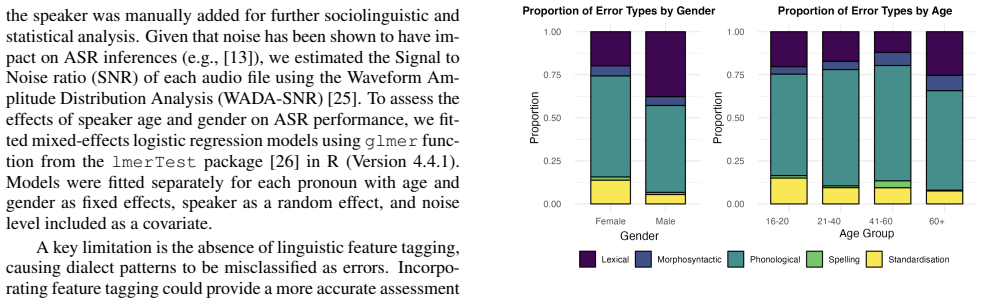
The paper's central claim is that ASR errors on Newcastle English directly correlate with regional dialectal features, while social factors such as speaker age and gender play a lesser role. In an error analysis of 1,076 ASR misrecognitions on a 16-file subsample of the DECTE corpus, the dominant error classes trace to Newcastle phonology—near-glottalised /t/, FACE and GOAT monophthongisation, g-dropping, and vowel quality—along with local lexical items like "nowt," "owt," "aye," and "lass," and morphosyntactic features including the pronouns "yous" and "wor." A full-corpus case study found that "yous" was recognised poorly across all speakers, while "wor" recognition was significantly better for the 21-40 age group and significantly worse with higher noise levels; the authors interpret this age pattern as age grading, a sociolinguistic process. The paper concludes that language-internal, dialect-specific factors outweigh language-external social factors in explaining ASR mismatches, and it advocates for greater dialectal diversity in ASR training data and for sociolinguistic analysis as a tool for diagnosing regional bias.
Load-bearing premise
The load-bearing premise is that the two coders' manual classification of ASR errors as 'dialectal' is accurate and consistent, since the coders were instructed to look for errors explained by dialectal variation and no inter-annotator agreement is reported.
Editorial extensions
If this is right
- If the dialect-feature account is correct, adding Newcastle English and comparable regional UK varieties to ASR training and test data should reduce a large share of the observed errors without changing the speaker demographics.
- Word error rate alone understates dialectal bias; qualitative error classification should become part of fairness evaluation for speech recognition systems.
- Regional morphosyntax and lexicon, not just accent, need explicit ASR coverage, since items like "yous," "wor," "nowt," and "owt" are reliable and recurring error triggers.
- ASR bias can interact with sociolinguistic age grading, so fairness metrics that ignore dialect features may misattribute recognition differences to speaker age or gender when the real driver is the dialect feature itself.
Reading between the lines
- An implication the authors leave implicit is that their 'dialectal error' label depends on coder judgement; the absence of automatic linguistic feature tagging, which they acknowledge in Section 2.3, means the correlation could be re-tested on the full corpus with tagging instead of manual selection.
- A testable extension is a matched-pair experiment in which the same speakers read minimal pairs with and without glottalised stops or with and without "yous" and "wor," to confirm that the dialectal variant itself drives the recognition gap.
- The findings suggest that demographic fairness audits of ASR should be stratified by dialect features, because a system that appears fair across age and gender groups may still be systematically failing the very features that index local identity.
- The pronoun case study implies a practical priority for data collection: high-frequency function words unique to a dialect, such as "yous" and "wor," may be more cost-effective targets for lexicon augmentation than broad accent adaptation.
Editorial analysis
A structured set of objections, weighed in public.
Referee Report
Summary. The paper investigates ASR performance on Newcastle English using the Diachronic Electronic Corpus of Tyneside English (DECTE) and the commercial ASR system Rev AI. It combines a manual error analysis of a subsample of 16 files, classifying 1,076 'meaningful' errors into phonological, lexical, standardisation, morphosyntactic, and spelling types, with an automated case study of the regional pronouns 'yous' and 'wor' across the full 160-speaker corpus. The authors conclude that ASR errors directly correlate with regional dialectal features while social factors (age and gender) play a lesser role, and they advocate for greater dialectal diversity in ASR training data.
Significance. If the central claim were established, the paper would be a valuable contribution to the understudied area of regional bias in ASR, complementing existing work on racial, age, and gender bias. The study has several strengths: it uses a large, publicly documented naturalistic dialect corpus (DECTE), a commercially deployed ASR system (Rev AI, English UK), automated string-alignment extraction for the pronoun case study, and mixed-effects regression with signal-to-noise ratio as a covariate. The paper also makes data and code available on OSF. However, the current design does not support the headline claim because the error sample is pre-selected for dialect explainability, no inter-annotator agreement is reported, and no baseline comparison with a mainstream variety is provided. The contribution is therefore best viewed at this stage as a rich descriptive case study rather than a validated causal analysis.
major comments (4)
- [§2.3] The central claim is partially circular. Section 2.3 defines the analyzed errors as 'the types of errors that can be explained by dialectal variation and directly correlated with dialectal features in the region' and explicitly excludes errors caused by noise, overlapping speech, or 'other indeterminate factors.' The later conclusion that ASR errors 'directly correlate with regional dialectal features' (Abstract, Conclusion) is therefore partly a restatement of the inclusion rule. To support the claim, the authors should either re-annotate all mismatches without such pre-filtering, or separately analyze and report the excluded errors and show that the dialect-related patterns are not an artifact of selection. The acknowledged absence of linguistic feature tagging at the end of §2.3—'causing dialect patterns to be misclassified as errors'—further weakens the internal validity of the error classification.
- [§2.3] No inter-annotator agreement is reported. Two trained sociophoneticians manually coded the errors, but the manuscript gives no measure of reliability (e.g., Cohen's kappa or percentage agreement) for either the coarse error-type classification or the finer-grained subcategories. Because the manual classification is the primary evidence for the paper's main claim, this omission is load-bearing; the authors should report agreement statistics on a subset of double-coded data.
- [§3.1] The gender and age comparisons are based on proportions of error types rather than error rates. The claim that 'male speakers in the dataset received higher error rates than their female counterparts' (53.7% vs. 46.3%) is derived from the distribution of the 1,076 errors, not from per-speaker error counts normalized by the number of words or tokens spoken. Without such normalization, the chi-square test only shows an imbalance in error counts, not a difference in error rates. The authors should report per-speaker or per-token error rates (e.g., errors per 1,000 words) or use mixed-effects models with an offset/exposure term, separately for each error type and for the overall WER.
- [§3.3 and §4] The claim that dialectal factors dominate over social factors is not tested by the pronoun case study. The mixed-effects models for 'yous' and 'wor' include only age, gender, and noise as predictors; they do not include any dialectal feature variable (e.g., whether the target form is dialectal, token frequency, or a dialectal pronunciation measure). Therefore, the regression cannot estimate the relative contribution of dialectal versus social factors. Moreover, no baseline comparison with a mainstream English corpus processed by the same ASR system is provided, so the assertion that errors are 'directly attributed to' dialect features (Conclusion) is unsupported. A matched baseline—for example, the same prompts or comparable spontaneous speech in Standard Southern British English—would be needed to establish dialect-specific causality.
minor comments (7)
- [Abstract] The phrase 'directly correlate' overstates the strength of the evidence given the observational, selection-based design; consider 'are associated with' or 'are predominantly explained by' to match the actual analyses.
- [§2.2] The system-selection paragraph reports that Rev AI achieved an average WER of 31.95% across the entire dataset, but it is unclear whether this figure refers to the full DECTE corpus or the pre-test subset; please clarify and also report the WER on the 16-file subsample used for manual error analysis.
- [§2.3] The sentence '10% of the dataset were selected' should be '10% of the dataset was selected' or 'were selected' with a plural subject; also, the subsection would benefit from stating the number of files and speakers in the pre-test explicitly.
- [§3.1] Footnote 4 explains that the lexical item 'aye' is omitted from Figure 1 because it could 'overwhelm the sample and skew the result.' This exclusion should be justified more transparently, ideally with a sensitivity analysis showing the effect of including or excluding this item.
- [§3.3] In Table 1, the random effect for Speaker has variance σ² = 0, which suggests that the mixed-effects model may not have converged or that there is no between-speaker variance to model; please report the number of observations, number of speakers, and convergence diagnostics, or justify the use of a mixed model.
- [§3.2.2] The IPA transcriptions in the phonological error examples (e.g., 'skipping' [skI >pPIn]) use nonstandard or ambiguous notation (e.g., '>', 'P'); please define the notation or use standard IPA with a clarification of diacritics.
- [References] Two preprints (Feng et al., 2021, and Torgbi et al., 2025) are cited as numbered footnotes rather than included in the reference list; please integrate them into the main reference list for consistency.
Circularity Check
The abstract's central claim that ASR errors 'directly correlate with regional dialectal features' is entailed by the §2.3 inclusion rule that defines analyzed errors as those 'explained by dialectal variation.'
-
self definitional
[Section 1.1.3 and Section 2.3; abstract states the result]
"By dialectal bias, we refer to systematic ASR errors that can be directly attributed to and explained by regionally specific linguistic features... The analysis focused on dialectal bias and meaningful errors. By this we understand the types of errors that can be explained by dialectal variation and directly correlated with dialectal features in the region. The errors that were caused by noise, overlapping speech, or other indeterminate factors were excluded."
The analyzed error set is defined as errors 'explained by dialectal variation and directly correlated with dialectal features,' and all other mismatches are excluded before analysis. The abstract's headline result—'ASR errors directly correlate with regional dialectal features'—uses the same phrase and restates the inclusion criterion rather than reporting an independent empirical estimate. Errors that could have diluted the correlation (noise, overlap, indeterminate causes) were removed by design, so the claimed correlation is built into the annotation instruction.
-
other
[Section 4 (Discussion)]
"It is also evident from our analyses that ASR errors are driven more by language-internal, dialect-specific factors than by language-external, social factors, despite some variation across speaker demographics."
This comparative claim is not independently tested because only errors preselected as 'explained by dialectal variation' enter the analysis, making every analyzed error dialect-specific by construction. Social factors are examined only as age/gender distributions over that preselected set, and the pronoun regressions test age, gender, and noise without jointly modeling dialectal features. Thus the conclusion that dialect-internal factors dominate social factors is an artifact of the sample definition, not a result of comparing alternative explanations over all ASR mismatches.
full rationale
The paper contains real empirical content: the pronoun case study ('yous' and 'wor') uses automated string alignment independent of the manual inclusion rule, and the error typology draws on externally documented Newcastle English features. However, the headline correlational claim is circular at the annotation level. Section 2.3 pre-filters the dataset to errors 'explained by dialectal variation and directly correlated with dialectal features,' and the abstract reports exactly that correlation as a discovery. The same preselection makes the Discussion's claim that language-internal, dialect-specific factors outweigh social factors untestable in the reported design: social factors are only tabulated within a dialect-explainable error set, while non-dialectal causes of mismatch were excluded before analysis. The paper's own limitation—the absence of linguistic feature tagging—and the lack of inter-annotator agreement further weaken the independent status of the manual counts. Because the automated pronoun analysis is not subject to the manual inclusion rule, the circularity is partial rather than total; the central correlational claim, however, is by construction.
Assumptions & free parameters
assumptions (4)
- domain assumption The DECTE human transcriptions are accurate.
- domain assumption The error classification categories map onto real dialectal features of Newcastle English established in the literature.
- domain assumption Rev AI is representative of state-of-the-art commercial ASR for the purpose of generalizing about 'ASR systems'.
- standard math The mixed-effects logistic regression assumptions, such as linear log-odds and no unmodeled confounds, hold for the pronoun case study.
Cite this review
Pith. "Pith review of Automatic Speech Recognition Biases in Newcastle English: an Error Analysis." pith.science (2026). https://pith.science/paper/D7ZVKMXH
@misc{pith2026250616558,
  author       = {Pith},
  title        = {Pith review of: Automatic Speech Recognition Biases in Newcastle English: an Error Analysis},
  year         = {2026},
  howpublished = {\url{https://pith.science/paper/D7ZVKMXH}},
  note         = {Machine review of arXiv:2506.16558}
}
read the original abstract
Automatic Speech Recognition (ASR) systems struggle with regional dialects due to biased training which favours mainstream varieties. While previous research has identified racial, age, and gender biases in ASR, regional bias remains underexamined. This study investigates ASR performance on Newcastle English, a well-documented regional dialect known to be challenging for ASR. A two-stage analysis was conducted: first, a manual error analysis on a subsample identified key phonological, lexical, and morphosyntactic errors behind ASR misrecognitions; second, a case study focused on the systematic analysis of ASR recognition of the regional pronouns ``yous'' and ``wor''. Results show that ASR errors directly correlate with regional dialectal features, while social factors play a lesser role in ASR mismatches. We advocate for greater dialectal diversity in ASR training data and highlight the value of sociolinguistic analysis in diagnosing and addressing regional biases.
Figures
Reference graph
Works this paper leans on
-
[1]
Introduction One of the major challenges of Automatic Speech Recognition (ASR) that has been repeatedly highlighted in research is social bias. While racial, age, and gender biases are well-documented [1, 2, 3, 4], the investigations of regional biases remain limited [5, 6, 7]. This paper zooms in on ASR biases in Newcastle English, which is one of the mo...
-
[2]
Method 2.1. Dataset To evaluate ASR performance on Newcastle English, we use the Diachronic Electronic Corpus of Tyneside English(DECTE), which is a representative corpus of dialect speech from the Ty- neside area of North-East England. It comprises 72 hours of naturalistic, spontaneous speech from a diverse range of 160 speakers (excluding the interviewe...
-
[3]
Results The errors were analyzed with i) language-external variables, gender and age, and ii) language-internal variables consisting of error specifications and the relevant dialectal features. 3.1. Language-external variables Figure 1 (left) shows the proportion of error types by gender. First, it is important to note that the male speakers in the datase...
-
[4]
The proportion of phonological errors is high- est across all speaker demographics
Discussion Overall, it is clear that the lexical and phonological features are the primary challenge for ASR and vary the most across gen- ders and ages. The proportion of phonological errors is high- est across all speaker demographics. Within these, errors that correlated with monophthongisation, glottalisation, and overall vowel quality were the most c...
-
[5]
fun” [fUn]); lack of BATH retraction (e.g., “path
found that sociophonetic variation contributes to ASR errors across ethnic dialects in the American Pacific Northwest. In the UK, ASR performance varies by region, with Southern British English speakers receiving the lowest WERs, while those from Northern England and Northern Ireland experience significantly higher error rates [6]. The study suggests that...
arXiv 2021
-
[6]
Conclusion The paper investigated ASR performance on Newcastle English and demonstrated that ASR errors can be directly attributed to local phonological, lexical, and morphosyntactic features. Through a manual error analysis that provided an overview of all error types, and a case study that looked into pronoun errors systematically, we established that l...
-
[7]
We are also grateful to Karen Corrigan for grant- ing us access to the DECTE corpus
Acknowledgements We would like to thank our research assistants, Paula Thees and Vincent Reichmann, for their support in data processing and analysis. We are also grateful to Karen Corrigan for grant- ing us access to the DECTE corpus. This work was supported by the Hochschulinterne Forschungsf ¨orderung (HiFF) of the Hochschule D¨usseldorf. JS and KT are...
-
[8]
Racial disparities in Automated Speech Recognition,
A. Koenecke, A. Nam, E. Lake, J. Nudell, M. Quartey, Z. Menge- sha, C. Toups, J. R. Rickford, D. Jurafsky, and S. Goel, “Racial disparities in Automated Speech Recognition,”Proceedings of the National Academy of Sciences, vol. 117, no. 14, pp. 7684–7689, 2020
work page 2020
Show all 42 references
-
[9]
Towards inclusive Automatic Speech Recognition,
S. Feng, B. M. Halpern, O. Kudina, and O. Scharenborg, “Towards inclusive Automatic Speech Recognition,”Computer Speech & Language, vol. 84, p. 101567, 2024
2024
-
[10]
Towards measuring fairness in speech recognition: Casual conversations dataset transcriptions,
C. Liu, M. Picheny, L. Sarı, P. Chitkara, A. Xiao, X. Zhang, M. Chou, A. Alvarado, C. Hazirbas, and Y . Saraf, “Towards measuring fairness in speech recognition: Casual conversations dataset transcriptions,” inICASSP 2022-2022 IEEE Interna- tional Conference on Acoustics, Spee...
2022
-
[11]
Age-and gender- related differences in speech alignment toward humans and voice- AI,
G. Zellou, M. Cohn, and B. Ferenc Segedin, “Age-and gender- related differences in speech alignment toward humans and voice- AI,”Frontiers in Communication, vol. 5, p. 600361, 2021
2021
-
[12]
Uneven suc- cess: Automatic Speech Recognition and ethnicity-related di- alects,
A. B. Wassink, C. Gansen, and I. Bartholomew, “Uneven suc- cess: Automatic Speech Recognition and ethnicity-related di- alects,”Speech Communication, vol. 140, pp. 50–70, 2022
2022
-
[13]
Language variation and algorithmic bias: understand- ing algorithmic bias in British English Automatic Speech Recog- nition,
N. Markl, “Language variation and algorithmic bias: understand- ing algorithmic bias in British English Automatic Speech Recog- nition,” inProceedings of the 2022 ACM Conference on Fairness, Accountability, and Transparency, 2022, pp. 521–534
2022
-
[14]
Dialect bias in Automatic Speech Recognition: Analysis of Appalachian English,
L.-F. Lai, J. G. van Hell, and J. Lipski, “Dialect bias in Automatic Speech Recognition: Analysis of Appalachian English,”Ameri- can Speech: A Quarterly of Linguistic Usage, pp. 1–17, 2024
2024
-
[15]
Tyneside,
A. Mearns, “Tyneside,” inResearching Northern English. John Benjamins Publishing Company, 2015, pp. 161–182
2015
-
[16]
Hughes, P
A. Hughes, P. Trudgill, and D. Watt,English Accents and Di- alects: An introduction to social and regional varieties of English in the British Isles. Routledge, 2013
2013
-
[17]
E. W. Schneider, K. Burridge, B. Kortmann, R. Mesthrie, and C. Upton,A Handbook of Varieties of English: A multimedia ref- erence tool two volumes plus CD-ROM. De Gruyter Mouton, 2004
2004
-
[18]
Hey ASR system! Why aren’t you more inclusive? Automatic Speech Recognition sys- tems’ bias and proposed bias mitigation techniques. A literature review,
M. K. Ngueajio and G. Washington, “Hey ASR system! Why aren’t you more inclusive? Automatic Speech Recognition sys- tems’ bias and proposed bias mitigation techniques. A literature review,” inInternational Conference on Human-Computer Inter- action. Springer, 2022, pp. 421–440
2022
-
[19]
Effects of talker dialect, gender & race on accuracy of Bing speech and YouTube automatic captions,
R. Tatman and C. Kasten, “Effects of talker dialect, gender & race on accuracy of Bing speech and YouTube automatic captions,” in Interspeech, 2017, pp. 934–938
2017
-
[20]
Understanding racial disparities in Au- tomatic Speech Recognition: The case of habitual
J. L. Martin and K. Tang, “Understanding racial disparities in Au- tomatic Speech Recognition: The case of habitual ”be”.” inInter- speech, 2020, pp. 626–630
2020
-
[21]
The Edinburgh international accents of English cor- pus: Towards the democratization of English ASR,
R. Sanabria, N. Bogoychev, N. Markl, A. Carmantini, O. Klejch, and P. Bell, “The Edinburgh international accents of English cor- pus: Towards the democratization of English ASR,” inICASSP 2023-2023 IEEE International Conference on Acoustics, Speech and Signal Processing (ICASS...
2023
-
[22]
The effect of proximity in perceptual dialec- tology,
C. Montgomery, “The effect of proximity in perceptual dialec- tology,”Journal of Sociolinguistics, vol. 16, no. 5, pp. 638–668, 2012
2012
-
[23]
English dialects in the North of England: Phonology,
J. Beal, “English dialects in the North of England: Phonology,”A Handbook of Varieties of English, vol. 1, pp. 113–133, 2004
2004
-
[24]
Sociophonetic variation in ‘glottals’ in Newcastle English,
G. Docherty and P. Foulkes, “Sociophonetic variation in ‘glottals’ in Newcastle English,” inProceedings of the 14th International Congress of Phonetic Sciences. University of California, Berke- ley, 1999, pp. 1037–1040
1999
-
[25]
Post-educator relaxation in the U-shaped curve: Evidence from a panel study of Tyneside (ing),
J. Grama, J. Mechler, L. Bauernfeind, M. E. Eiswirth, and I. Buch- staller, “Post-educator relaxation in the U-shaped curve: Evidence from a panel study of Tyneside (ing),”Language Variation and Change, vol. 35, no. 3, pp. 325–350, 2023
2023
-
[26]
Patterns of variation and change in three Newcastle vowels: Is this dialect levelling?
D. Watt and L. Milroy, “Patterns of variation and change in three Newcastle vowels: Is this dialect levelling?” inUrban Voices. Routledge, 2014, pp. 25–46
2014
-
[27]
The grammar of Tyneside and Northumbrian English,
J. Beal, “The grammar of Tyneside and Northumbrian English,” inReal English. Routledge, 1993, pp. 187–213
1993
-
[28]
Folk accounts of dialect differences in Tyne and Wear,
M. Pearce, “Folk accounts of dialect differences in Tyne and Wear,”Dialectologia et Geolinguistica, vol. 20, no. 1, pp. 5–25, 2012
2012
-
[29]
Navigating the vernacular across the lifespan: A panel study of the phonetic realisation of the first-person singu- lar possessive,
A.-M. Moelders, “Navigating the vernacular across the lifespan: A panel study of the phonetic realisation of the first-person singu- lar possessive,”English Language & Linguistics, pp. 1–27, 2025
2025
-
[30]
The Diachronic Electronic Corpus of Tyneside English,
K. P. Corrigan, I. Buchstaller, A. Mearns, and H. Moisl, “The Diachronic Electronic Corpus of Tyneside English,”Online at https://research.ncl.ac.uk/decte/index.htm (Accessed April 2, 2024), 2012
2024
-
[31]
Crisperwhisper: Accu- rate timestamps on verbatim speech transcriptions,
M. Zusag, L. Wagner, and B. Thallinger, “Crisperwhisper: Accu- rate timestamps on verbatim speech transcriptions,” inInterspeech 2024, 2024, pp. 1265–1269
2024
-
[32]
Robust signal-to-noise ratio estima- tion based on waveform amplitude distribution analysis,
C. Kim and R. M. Stern, “Robust signal-to-noise ratio estima- tion based on waveform amplitude distribution analysis,” inNinth Annual Conference of the International Speech Communication Association, 2008
2008
-
[33]
lmerTest package: Tests in linear mixed effects models,
A. Kuznetsova, P. B. Brockhoff, and R. H. B. Christensen, “lmerTest package: Tests in linear mixed effects models,”Jour- nal of Statistical Software, vol. 82, no. 13, pp. 1–26, 2017
2017
-
[34]
From categories to gradience: Auto-coding sociophonetic variation with random forests,
D. Villarreal, L. Clark, J. Hay, and K. Watson, “From categories to gradience: Auto-coding sociophonetic variation with random forests,”Laboratory Phonology: Journal of the Association for Laboratory Phonology, vol. 11, no. 1, p. 6, 2020
2020
-
[35]
Considering performance in the au- tomated and manual coding of sociolinguistic variables: Lessons from variable (ing),
T. Kendall, C. Vaughn, C. Farrington, K. Gunter, J. McLean, C. Tacata, and S. Arnson, “Considering performance in the au- tomated and manual coding of sociolinguistic variables: Lessons from variable (ing),”Frontiers in Artificial Intelligence, vol. 4, 2021
2021
-
[36]
Sex, covert prestige and linguistic change in the ur- ban British English of Norwich,
P. Trudgill, “Sex, covert prestige and linguistic change in the ur- ban British English of Norwich,”Language in Society, vol. 1, no. 2, pp. 179–195, 1972
1972
-
[37]
The social motivation of a sound change,
W. Labov, “The social motivation of a sound change,”Word, vol. 19, no. 3, pp. 273–309, 1963
1963
-
[38]
Milroy,Language and Social Networks
L. Milroy,Language and Social Networks. Blackwell, 1980
1980
-
[39]
Linguistic options and choices for Black women in the rural South,
P. Nichols, “Linguistic options and choices for Black women in the rural South,”Language, Gender and Society, pp. 54–68, 1983
1983
-
[40]
Change across the lifespan in goat: Evidence from a panel study of Tyneside English,
L. Bauernfeind, C. Ahrens, J. Grama, R. Skarnitzl, and J. V ol ´ın, “Change across the lifespan in goat: Evidence from a panel study of Tyneside English,” inProceedings of the 20th International Congress of Phonetic Science. Guarant International, 2023, pp. 2064–2068
2023
-
[41]
Tracking creak from early to late adulthood: A panel study from the North East of England,
J. Grama, M. E. Eiswirth, I. Buchstaller, R. Skarnitzl, and J. V ol´ın, “Tracking creak from early to late adulthood: A panel study from the North East of England,” inProceedings of the 20th Inter- national Congress of Phonetic Science. Guarant International, 2023, pp. 2049–2053
2023
-
[42]
The sociolinguistic foundations of language modeling,
J. Grieve, S. Bartl, M. Fuoli, J. Grafmiller, W. Huang, A. Jawer- baum, A. Murakami, M. Perlman, D. Roemling, and B. Winter, “The sociolinguistic foundations of language modeling,”Fron- tiers in Artificial Intelligence, vol. 7, 2025
2025
Reviewed August 6, 2026 · model on record in the stance chip above.
Discussion (0). Continue with ORCID to comment.