REVIEW 4 major objections 6 minor 38 references
TriCon-SF: A Triple-Shuffle and Contribution-Aware Serial Federated Learning Framework for Heterogeneous Healthcare Data
T0 review · 4 major / 6 minor · reviewed 2026-08-15 · deepseek-v4-flash
Pith's one-line read TriCon-SF claims that shuffling data, layers, and client order lets serial federated learning beat parallel aggregation in accuracy and communication cost.
desk verdict The empirical results on serial FL are plausible and worth engaging with, but the paper's privacy and accountability guarantees rest on a security analysis that does not match Algorithm 1. read the letter →
The pith
A machine-rendered reading of the paper's core claim, the machinery that carries it, and where it could break.
The reading
What carries the argument
The central mechanism is the triple-shuffle. At the data level, each client partitions its local set into $k$ disjoint segments and draws a segment at random for each update. At the model level, a random subset of layers receives Gaussian perturbation, and in the security analysis each intermediate feature vector is permuted, clipped to an $\ell^2$ ball of radius $c = 1.0$, and noised with $\sigma = 1.0$ before the gradient is computed. At the system level, the server re-samples a random permutation of clients each round, so the model handoff chain changes. Contribution awareness is carried by Monte Carlo Shapley values estimated from random client permutations, compared against a contribution threshold to label clients as honest or as free-riders or malicious. The shuffle components are load-bearing for the privacy claim; the Shapley estimator is load-bearing for the accountability claim.
What would settle it
Re-run the ORL gradient-inversion attack using the exact training loop of the pseudocode, where the layer shuffle and Gaussian noise appear only once at initialization, and compare the reconstructed images with the protected panel in the paper; if recognizable faces reappear, the claimed resilience does not hold for the implemented algorithm.
Extended reading notes
Core claim
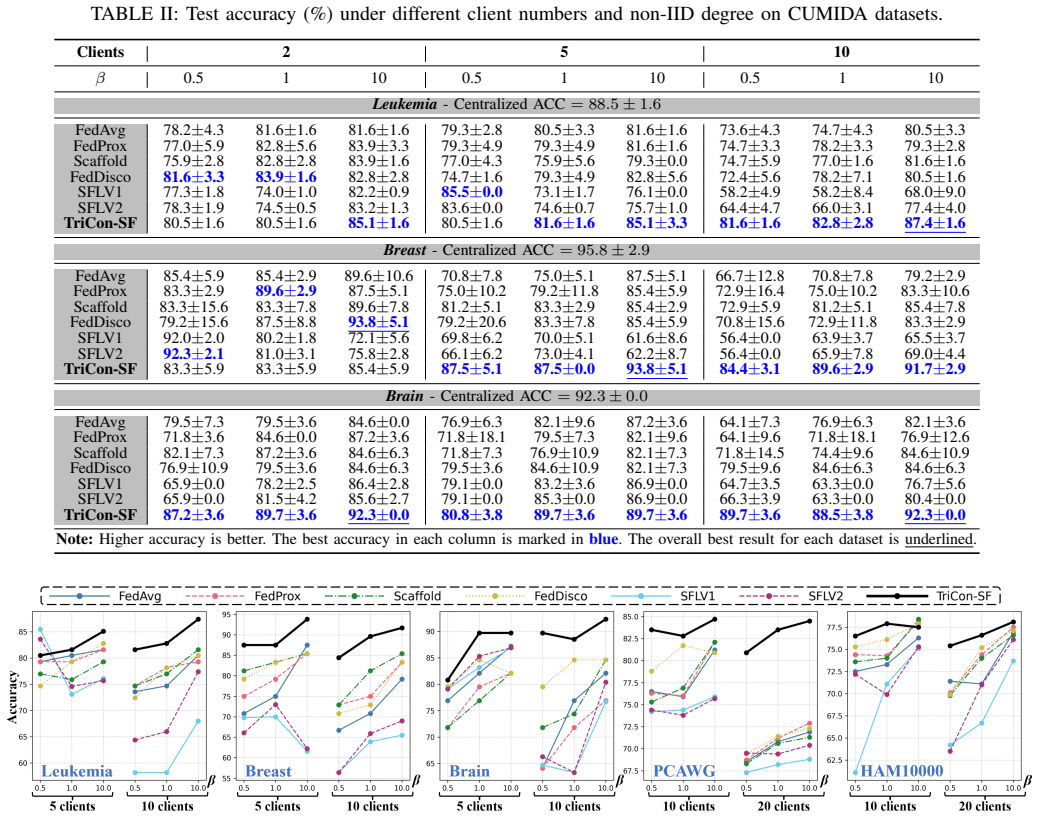
The paper's central claim is that three levels of randomization, shuffling each client's local data segments, perturbing selected model layers, and re-permuting the client execution order every round, let serial federated learning outperform parallel aggregation on heterogeneous healthcare data. The paper reports accuracy advantages over FedAvg, FedProx, SCAFFOLD, FedDisco, and two SplitFed-based serial baselines on five cancer-related datasets under heterogeneous label distributions created with Dirichlet sampling, with the largest margins at 10 to 20 clients. It also reports reaching target accuracy in fewer communication rounds, and because a serial round moves one model copy instead of two per client, total communication cost is about half the parallel baseline. For privacy, the paper claims the layer shuffle-and-perturb mechanism blocks gradient-inversion attacks: in its ORL face-dataset experiments, protected training yields reconstructions that remain noise-like even after 10,000 epochs, while unprotected serial FL leaks identifiable faces. For accountability, it claims Monte Carlo Shapley values with a contribution threshold can identify free-riders and malicious clients.
Load-bearing premise
The privacy guarantee stands or falls on whether the layer shuffling, norm clipping, and Gaussian noise described in the security analysis are actually applied to the data flowing through training; as written, the pseudocode perturbs only the initial model, so if the training loop never performs those steps the security proof does not cover the implemented framework.
Editorial extensions
If this is right
- A cross-silo hospital network could train on non-IID data without a central aggregator, because the serial handoff plus shuffling is claimed to match or exceed parallel aggregation accuracy.
- Communication cost per round drops by about half relative to parallel FL, since the model travels once around the chain instead of being uploaded and downloaded at every client.
- Free-riders and malicious clients can be flagged through Monte Carlo Shapley values, giving the federation an accountability mechanism without extra server-side data access.
- If the layer shuffle-and-perturb process matches the implementation, gradient-inversion attacks that succeed in naive serial FL are blocked; the ORL face reconstructions remain noise-like at 10,000 epochs.
Reading between the lines
- I read the security analysis as applying per-step feature permutation, norm clipping, and Gaussian noise to every transmitted representation, whereas the training pseudocode adds Gaussian noise only to the initial model; a reader should not assume the proof covers the algorithm exactly as written.
- A controlled ablation with fixed client order and no segment or layer shuffling would isolate whether the reported gains come from the serial training loop itself or from the shuffles.
- The conclusion identifies catastrophic forgetting as the framework's main limitation; coupling the segment shuffle with a small replay buffer or a regularization term is the natural next experiment.
Signed reviews
Editorial analysis
A structured set of objections, weighed in public.
Referee Report
Summary. The paper proposes TriCon-SF, a serial federated learning framework that combines three randomization mechanisms (data-segment partitioning, per-round client-order permutation, and one-time Gaussian perturbation of selected initial model layers) with a Shapley-value-based contribution evaluation intended to detect dishonest clients. The authors claim that TriCon-SF outperforms standard serial and parallel federated learning baselines in accuracy and communication efficiency on five healthcare datasets, and that a security analysis proves resilience against client-side gradient-inversion attacks. The manuscript includes accuracy tables with standard deviations, communication-cost tables, a convergence-round comparison, and an inversion-attack visualization on the ORL face dataset.
Significance. If the results were fully supported, the combination of shuffle-based obfuscation and contribution-aware accountability in serial federated learning would be of moderate interest to the healthcare cross-silo FL community. The paper reports accuracy on multiple public datasets with standard deviations, which is a positive feature. However, the two core non-accuracy claims—privacy resilience and dishonest-client detection—are not established by the implemented algorithm or by any experiment: the security theorem analyzes a mechanism different from Algorithm 1, and the Shapley detection module is never integrated or evaluated. The communication-efficiency comparison is also undermined by varying target accuracies across configurations. The present version does not provide reproducible code or machine-checked proofs, so the findings rest on the experimental and analytical text as written.
major comments (4)
- [Section V-B, Theorem 1 and Eqs. (16)-(20); Algorithm 1] The security analysis describes a per-example layer-shuffle-and-perturb mechanism: random permutation of each intermediate feature vector (Eq. 16), L2-norm clipping with c=1.0 (Eq. 17), and Gaussian noise with sigma=1.0 (Eq. 19) applied before gradient computation. Algorithm 1, by contrast, only adds Gaussian noise to a randomly selected subset of initial model parameters once (lines 5-7), then performs plain SGD on a randomly selected data segment with no layer-wise shuffling, no L2 clipping, and no noise injection during any local update (lines 15-18). Theorem 1 therefore does not apply to the actual TriCon-SF training procedure, and the differential-privacy claim is unsupported: no epsilon or delta is specified, no sensitivity bound on the transmitted model update is derived, and no composition analysis is provided. The ORL experiment in Section VI-D applies a generic stack of layer shuffle, clipping, and noise rather than the actual TriCon-SF pipeline, so it cannot validate the privacy of the framework's transmitted updates.
- [Section IV-C, Eqs. (10)-(12); Algorithm 1] The contribution-aware Shapley mechanism is described theoretically but never integrated into Algorithm 1 or evaluated experimentally. There are no experiments on free-rider or malicious-client detection, so the claim of 'enabling the detection of dishonest behavior' and 'enhancing system accountability' has no empirical support. Moreover, the paper does not explain how the utility function V(S) is evaluated in a serial setting, where forming a coalition S would presumably require training or evaluating submodels; this computational and methodological question is left open.
- [Section VI-C, Table V and Eqs. (22)-(23)] The communication-cost comparison uses different target accuracies for different configurations in Table V (e.g., PCAWG beta=0.5: target 72.6% for 10 clients but 63.34% for 20 clients; beta=10: target 77.88% for 10 clients but 65.77% for 20 clients). Reaching a lower target accuracy naturally requires fewer rounds, so the reported R-up and C-up improvement rates are not fair across rows. Additionally, for TriCon-SF the number of rounds to convergence decreases when the number of clients increases in some settings (e.g., PCAWG beta=1: 15 rounds for 10 clients versus 7 rounds for 20 clients), which is counterintuitive and deserves explanation. The serial cost formula in Eq. (23) also ignores the server's initial transmission to the first client in each round, which may be a minor omission but should be stated.
- [Section VI-B, Tables II and IV] The claim that TriCon-SF 'consistently achieves the highest accuracy across most datasets and experimental settings' is not supported by the tables in several cells. For example, on Leukemia with 2 clients and beta=0.5, TriCon-SF (80.5) is lower than FedDisco (81.6); on Breast with 2 clients and beta=10, TriCon-SF (85.4) is lower than FedDisco (93.8). The paper should either temper the claim or add statistical significance tests to justify that observed differences are meaningful.
minor comments (6)
- [Eq. (11)] The index m is used both for the number of Monte Carlo permutations and as the summation variable; using a different index, such as p, would improve readability.
- [Table III] Table III is misformatted: the column headers and the numeric entries are not aligned, making it difficult to read the hidden-layer sizes, dropout rates, weight decay, batch sizes, and learning rates for each dataset.
- [Section VI-A2] The description of SFLV1 and SFLV2 as 'based on the SFL paradigm [26]' is vague; it should clarify how these baselines are constructed from SplitFed and how they differ from standard serial methods such as CWT.
- [Section VI-D] The ORL Face Dataset is cited as reference [38], which is a PCA/SVM face-recognition paper rather than the original dataset source; the appropriate dataset citation should be provided.
- [Algorithm 1, line 5 and Figure 2] The term 'Layer-wise shuffle' is used for what is actually additive Gaussian noise on a random subset of initial layers; this terminology is inconsistent with the permutation operation analyzed in Section V-B and should be aligned to avoid confusion.
- [Section V-A] The communication model in Eq. (13) assumes a Shannon-Hartley rate per client, but the paper does not account for protocol overhead, handshake costs, or the server-client transmission at the start of each round; these simplifying assumptions should be stated explicitly.
Circularity Check
No circular derivation: accuracy and communication gains are externally measured; the security theorem's proof is disconnected from Algorithm 1, which is an evidentiary gap, not a circular reduction.
full rationale
The accuracy claims are benchmarked against external datasets and baselines (Tables II-IV, Figure 3), with no parameter fitted to reproduce TriCon-SF's own target results. The communication-cost comparison (Eqs. 22-23) is a definitional accounting of serial versus parallel transfer counts, but the round counts in Table V are measured convergence rounds, so the reported improvement is an empirical claim rather than an identity. The Shapley contribution estimator (Eqs. 10-11) is a standard Monte Carlo estimator, and the threshold decision (Eq. 12) is applied after training; it is not used to predict its own score, so this is not a fitted-input-called-prediction pattern. The only author self-citations ([9], [20]) are background and survey references and carry no load-bearing uniqueness or derivation claim. The serious weakness is in Section V-B: Theorem 1's proof analyzes a per-example layer-shuffle, L2-clipping, and Gaussian-noise pipeline (Eqs. 16-20, c=1.0, sigma=1.0), whereas Algorithm 1 only adds Gaussian noise once to initial model parameters (lines 5-7) and then performs plain SGD on a randomly selected data segment with no clipping and no per-example noise (lines 15-18). The ORL experiment in Section VI-D evaluates that generic protection stack, not the model exchanges actually produced by Algorithm 1. This means the differential-privacy and inversion-resilience conclusions are unsupported as stated. Under the hard rules, this is an omitted or mismatched proof rather than a case where an output is identical to an input by construction, so it does not raise the circularity score.
Assumptions & free parameters
free parameters (6)
- Segment count k
- Minimum segment size smin
- Gaussian noise scale sigma =
1.0 (security evaluation)
- L2 clipping threshold c =
1.0
- Contribution threshold phi_min
- Monte Carlo permutation count m
assumptions (5)
- standard math The serial FL objective in Equation (1) is the correct global objective and local SGD minimizes it.
- domain assumption The threat model includes a semi-honest server and semi-honest or malicious clients.
- ad hoc to paper Layer-wise shuffling breaks semantic feature alignment enough to prevent gradient inversion.
- ad hoc to paper L2 clipping and Gaussian noise provide (epsilon, delta)-differential privacy.
- domain assumption Random client order and random segment selection do not harm convergence.
Cite this review
Pith. "Pith review of TriCon-SF: A Triple-Shuffle and Contribution-Aware Serial Federated Learning Framework for Heterogeneous Healthcare Data." pith.science (2026). https://pith.science/paper/UN3AY5CS
@misc{pith2026250616723,
  author       = {Pith},
  title        = {Pith review of: TriCon-SF: A Triple-Shuffle and Contribution-Aware Serial Federated Learning Framework for Heterogeneous Healthcare Data},
  year         = {2026},
  howpublished = {\url{https://pith.science/paper/UN3AY5CS}},
  note         = {Machine review of arXiv:2506.16723}
}
read the original abstract
Serial pipeline training is an efficient paradigm for handling data heterogeneity in cross-silo federated learning with low communication overhead. However, even without centralized aggregation, direct transfer of models between clients can violate privacy regulations and remain susceptible to gradient leakage and linkage attacks. Additionally, ensuring resilience against semi-honest or malicious clients who may manipulate or misuse received models remains a grand challenge, particularly in privacy-sensitive domains such as healthcare. To address these challenges, we propose TriCon-SF, a novel serial federated learning framework that integrates triple shuffling and contribution awareness. TriCon-SF introduces three levels of randomization by shuffling model layers, data segments, and training sequences to break deterministic learning patterns and disrupt potential attack vectors, thereby enhancing privacy and robustness. In parallel, it leverages Shapley value methods to dynamically evaluate client contributions during training, enabling the detection of dishonest behavior and enhancing system accountability. Extensive experiments on non-IID healthcare datasets demonstrate that TriCon-SF outperforms standard serial and parallel federated learning in both accuracy and communication efficiency. Security analysis further supports its resilience against client-side privacy attacks.
Figures


Figures from the paper (2 more)


Reference graph
Works this paper leans on
-
[1]
Ai-aided geometric design of anti-infection catheters,
T. Zhou, X. Wan, D. Z. Huang, Z. Li, Z. Peng, A. Anandkumar, J. F. Brady, P. W. Sternberg, and C. Daraio, “Ai-aided geometric design of anti-infection catheters,” Science Advances, vol. 10, no. 1, p. eadj1741, 2024
work page 2024
-
[2]
The value of standards for health datasets in artificial intelligence- based applications,
A. Arora, J. E. Alderman, J. Palmer, S. Ganapathi, E. Laws, M. D. Mccradden, L. Oakden-Rayner, S. R. Pfohl, M. Ghassemi, F. McKay et al., “The value of standards for health datasets in artificial intelligence- based applications,” Nature medicine, vol. 29, no. 11, pp. 2929–2938, 2023
work page 2023
-
[3]
Hipaa regulations: a new era of medical-record privacy?
G. J. Annas, “Hipaa regulations: a new era of medical-record privacy?” New England Journal of Medicine , vol. 348, p. 1486, 2003
work page 2003
-
[4]
General data protection regulation (gdpr),
F. D. Protection, “General data protection regulation (gdpr),” Intersoft Consulting, Accessed in October , vol. 24, no. 1, 2018
work page 2018
-
[5]
Split learning on segmented healthcare data,
L. Hu, T. Zhou, Z. Liu, F. Liu, and Z. Cai, “Split learning on segmented healthcare data,” IEEE Transactions on Big Data , 2025
work page 2025
-
[6]
Advances and open problems in federated learning,
P. Kairouz, H. B. McMahan, B. Avent, A. Bellet, M. Bennis, A. N. Bhagoji, K. Bonawitz, Z. Charles, G. Cormode, R. Cummings et al. , “Advances and open problems in federated learning,” Foundations and trends® in machine learning , vol. 14, no. 1–2, pp. 1–210, 2021
2021
-
[7]
Communication-efficient learning of deep networks from decentralized data,
B. McMahan, E. Moore, D. Ramage, S. Hampson, and B. A. y Arcas, “Communication-efficient learning of deep networks from decentralized data,” in Artificial intelligence and statistics . PMLR, 2017, pp. 1273– 1282
2017
-
[8]
Distributed deep learning networks among institutions for medical imaging,
K. Chang, N. Balachandar, C. Lam, D. Yi, J. Brown, A. Beers, B. Rosen, D. L. Rubin, and J. Kalpathy-Cramer, “Distributed deep learning networks among institutions for medical imaging,” Journal of the American Medical Informatics Association , vol. 25, no. 8, pp. 945– 954, 2018
work page 2018
Show all 38 references
-
[9]
Federated learning on non-iid data: A survey,
H. Zhu, J. Xu, S. Liu, and Y . Jin, “Federated learning on non-iid data: A survey,” Neurocomputing, vol. 465, pp. 371–390, 2021
2021
-
[10]
Split learning for health: Distributed deep learning without sharing raw patient data,
P. Vepakomma, O. Gupta, T. Swedish, and R. Raskar, “Split learning for health: Distributed deep learning without sharing raw patient data,” arXiv preprint arXiv:1812.00564 , 2018
2018 arXiv
-
[11]
Rethinking architecture design for tackling data heterogeneity in federated learning,
L. Qu, Y . Zhou, P. P. Liang, Y . Xia, F. Wang, E. Adeli, L. Fei- Fei, and D. Rubin, “Rethinking architecture design for tackling data heterogeneity in federated learning,” in Proceedings of the IEEE/CVF conference on computer vision and pattern recognition , 2022, pp. 10 061–10 071
2022
-
[12]
Federated learning technology in serial topology for iot networks,
J. Sheng, J. Xiong, and B. Liu, “Federated learning technology in serial topology for iot networks,” in 2023 IEEE International Symposium on Broadband Multimedia Systems and Broadcasting (BMSB). IEEE, 2023, pp. 1–5
2023
-
[13]
{PrivateFL}: Accurate, differentially private federated learning via personalized data transfor- mation,
Y . Yang, B. Hui, H. Yuan, N. Gong, and Y . Cao, “{PrivateFL}: Accurate, differentially private federated learning via personalized data transfor- mation,” in 32nd USENIX Security Symposium (USENIX Security 23) , 2023, pp. 1595–1612
2023
-
[14]
Split ways: Privacy-preserving training of encrypted data using split learning,
T. Khan, K. Nguyen, and A. Michalas, “Split ways: Privacy-preserving training of encrypted data using split learning,” arXiv preprint arXiv:2301.08778, 2023
2023 arXiv
-
[15]
A principled approach to data valuation for federated learning,
T. Wang, J. Rausch, C. Zhang, R. Jia, and D. Song, “A principled approach to data valuation for federated learning,” Federated Learning: Privacy and Incentive , pp. 153–167, 2020
2020
-
[16]
Shapleyfl: Robust federated learning based on shapley value,
Q. Sun, X. Li, J. Zhang, L. Xiong, W. Liu, J. Liu, Z. Qin, and K. Ren, “Shapleyfl: Robust federated learning based on shapley value,” in Proceedings of the 29th ACM SIGKDD Conference on Knowledge Discovery and Data Mining , 2023, pp. 2096–2108
2023
-
[17]
Federated optimization in heterogeneous networks,
T. Li, A. K. Sahu, M. Zaheer, M. Sanjabi, A. Talwalkar, and V . Smith, “Federated optimization in heterogeneous networks,” Proceedings of Machine learning and systems , vol. 2, pp. 429–450, 2020
2020
-
[18]
Scaffold: Stochastic controlled averaging for federated learn- ing,
S. P. Karimireddy, S. Kale, M. Mohri, S. Reddi, S. Stich, and A. T. Suresh, “Scaffold: Stochastic controlled averaging for federated learn- ing,” in International conference on machine learning . PMLR, 2020, pp. 5132–5143
2020
-
[19]
Feddisco: Fed- erated learning with discrepancy-aware collaboration,
R. Ye, M. Xu, J. Wang, C. Xu, S. Chen, and Y . Wang, “Feddisco: Fed- erated learning with discrepancy-aware collaboration,” in International Conference on Machine Learning . PMLR, 2023, pp. 39 879–39 902
2023
-
[20]
Fedlabx: a practical and privacy-preserving framework for federated learning,
Y . Yan, M. B. Kamel, M. Zoltay, M. G ´al, R. Holl ´os, Y . Jin, L. P ´eter, and ´A. T ´enyi, “Fedlabx: a practical and privacy-preserving framework for federated learning,” Complex & Intelligent Systems , vol. 10, no. 1, pp. 677–690, 2024
2024
-
[21]
Tackling the objective inconsistency problem in heterogeneous federated optimiza- tion,
J. Wang, Q. Liu, H. Liang, G. Joshi, and H. V . Poor, “Tackling the objective inconsistency problem in heterogeneous federated optimiza- tion,” Advances in neural information processing systems , vol. 33, pp. 7611–7623, 2020
2020
-
[22]
Multi- institutional deep learning modeling without sharing patient data: A feasibility study on brain tumor segmentation,
M. J. Sheller, G. A. Reina, B. Edwards, J. Martin, and S. Bakas, “Multi- institutional deep learning modeling without sharing patient data: A feasibility study on brain tumor segmentation,” in Brainlesion: Glioma, Multiple Sclerosis, Stroke and Traumatic Brain Injuries: 4th In...
2018
-
[23]
Distributed learning of deep neural network over multiple agents,
O. Gupta and R. Raskar, “Distributed learning of deep neural network over multiple agents,” Journal of Network and Computer Applications , vol. 116, pp. 1–8, 2018
2018
-
[24]
Decentralized federated learning: A survey and perspective,
L. Yuan, Z. Wang, L. Sun, P. S. Yu, and C. G. Brinton, “Decentralized federated learning: A survey and perspective,” IEEE Internet of Things Journal, vol. 11, no. 21, pp. 34 617–34 638, 2024
2024
-
[25]
Peer-to-peer federated continual learning for naturalistic driving action recognition,
L. Yuan, Y . Ma, L. Su, and Z. Wang, “Peer-to-peer federated continual learning for naturalistic driving action recognition,” in Proceedings of the IEEE/CVF conference on computer vision and pattern recognition , 2023, pp. 5250–5259
2023
-
[26]
Splitfed: When federated learning meets split learning,
C. Thapa, P. C. M. Arachchige, S. Camtepe, and L. Sun, “Splitfed: When federated learning meets split learning,” in Proceedings of the AAAI conference on artificial intelligence , vol. 36, no. 8, 2022, pp. 8485– 8493
2022
-
[27]
Deep leakage from gradients,
L. Zhu, Z. Liu, and S. Han, “Deep leakage from gradients,” Advances in neural information processing systems , vol. 32, 2019
2019
-
[28]
Unleashing the tiger: Inference attacks on split learning,
D. Pasquini, G. Ateniese, and M. Bernaschi, “Unleashing the tiger: Inference attacks on split learning,” in Proceedings of the 2021 ACM SIGSAC Conference on Computer and Communications Security , 2021, pp. 2113–2129
2021
-
[29]
Split without a leak: Reduc- ing privacy leakage in split learning,
K. Nguyen, T. Khan, and A. Michalas, “Split without a leak: Reduc- ing privacy leakage in split learning,” in International Conference on Security and Privacy in Communication Systems . Springer, 2023, pp. 321–344
2023
-
[30]
Improving prediction of blood cancer using leukemia microarray gene data and chi2 features with weighted convo- lutional neural network,
E. A. Alabdulqader, A. A. Alarfaj, M. Umer, A. Eshmawi, S. Alsubai, T.-h. Kim, and I. Ashraf, “Improving prediction of blood cancer using leukemia microarray gene data and chi2 features with weighted convo- lutional neural network,” Scientific Reports , vol. 14, no. 1, p. 15625, 2024
2024
-
[31]
Bioinformatics analysis of potential core genes for glioblastoma,
Y . Zhang, X. Yang, X.-L. Zhu, J.-Q. Hao, H. Bai, Y .-C. Xiao, Z.-Z. Wang, C.-Y . Hao, and H.-B. Duan, “Bioinformatics analysis of potential core genes for glioblastoma,” Bioscience Reports , vol. 40, no. 7, p. BSR20201625, 2020
2020
-
[32]
Cumida: An extensively curated microarray database for benchmarking and testing of machine learning approaches in cancer research,
B. C. Feltes, E. B. Chandelier, B. I. Grisci, and M. Dorn, “Cumida: An extensively curated microarray database for benchmarking and testing of machine learning approaches in cancer research,” Journal of Computational Biology , vol. 26, no. 4, pp. 376–386, 2019, pMID: 30789283....
2019
-
[33]
A deep learning system accurately classifies primary and metastatic cancers using passenger mutation patterns,
W. Jiao, G. Atwal, P. Polak, R. Karlic, E. Cuppen, A. Danyi, J. de Ridder, C. van Herpen, M. P. Lolkema et al., “A deep learning system accurately classifies primary and metastatic cancers using passenger mutation patterns,” Nature communications, vol. 11, no. 1, p. 728, 2020
2020
-
[34]
The ham10000 dataset, a large collection of multi-source dermatoscopic images of common pigmented skin lesions,
P. Tschandl, C. Rosendahl, and H. Kittler, “The ham10000 dataset, a large collection of multi-source dermatoscopic images of common pigmented skin lesions,” Scientific data, vol. 5, no. 1, pp. 1–9, 2018
2018
-
[35]
Deep residual learning for image recognition,
K. He, X. Zhang, S. Ren, and J. Sun, “Deep residual learning for image recognition,” in Proceedings of the IEEE conference on computer vision and pattern recognition , 2016, pp. 770–778
2016
-
[36]
Adam: A method for stochastic optimization,
D. P. Kingma and J. Ba, “Adam: A method for stochastic optimization,” arXiv preprint arXiv:1412.6980 , 2014
2014 arXiv
-
[37]
Model-contrastive federated learning,
Q. Li, B. He, and D. Song, “Model-contrastive federated learning,” in Proceedings of the IEEE/CVF conference on computer vision and pattern recognition, 2021, pp. 10 713–10 722
2021
-
[38]
Face recognition using pca and svm,
M. O. Faruqe and M. A. M. Hasan, “Face recognition using pca and svm,” in 2009 3rd international conference on anti-counterfeiting, security, and identification in communication. IEEE, 2009, pp. 97–101
2009
Reviewed August 15, 2026 · model on record in the stance chip above.
Discussion (0). Continue with ORCID to comment.