REVIEW 3 major objections 6 minor 67 references
Co-VisiON: Co-Visibility ReasONing on Sparse Image Sets of Indoor Scenes
T0 review · 3 major / 6 minor · reviewed 2026-08-15 · deepseek-v4-flash
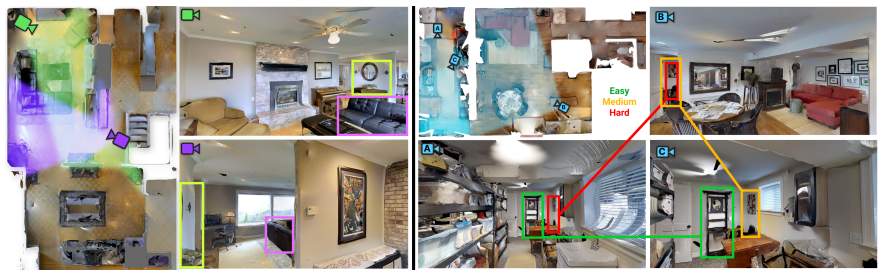
Pith's one-line read Co-VisiON argues that deciding which sparse indoor photos see the same 3D surface is a distinct skill current models lack: humans hit 0.72 graph IoU, GPT-4o 0.63, best vision-only 0.61.
desk verdict Useful benchmark, but the human-vs-model gap is likely a labeling-criterion artifact and should be fixed before the headline claim is trusted. read the letter →
The pith
A machine-rendered reading of the paper's core claim, the machinery that carries it, and where it could break.
The reading
What carries the argument
The object that carries the argument is the co-visibility graph: a binary graph whose nodes are images and whose edges connect exactly those pairs that share a non-zero visible surface, as determined by projecting rendered depth into a common point cloud. Evaluation reduces the whole task to computing graph intersection over union between predicted and ground-truth adjacency matrices, with AUC averaging graph IoU over thresholds. For the model side, the load-bearing mechanism is the learnable co-visibility mask in Covis: pixel-wise features are projected from the decoder tokens, a mask $M_i = \mathrm{conv}(X_i)$ is predicted for each view, features are filtered by $X' = X \odot M$, and the mask is supervised by ground-truth co-visible regions; this filtering prevents non-co-visible information from contaminating the representation and is what allows the multi-view variant to beat pairwise inputs. The multi-view setting itself uses cross-view attention in an encoder-decoder, following the MV-DUSt3R pattern.
What would settle it
Re-run the human annotation on the Gibson subset with one change to the instructions: count any pixel-level overlap of visible 3D surface as connected, including plain walls, and recompute human graph IoU against the automatic ground truth. If the human score stays at or near 0.72, the reported human-model gap is robust; if it rises substantially, the gap is in part an artifact of mismatched annotation criteria rather than a pure measure of human reasoning.
Extended reading notes
Core claim
The central claim, stated on the paper's own terms, is that co-visibility reasoning under sparse views — determining whether two images share any non-zero visible surface area — is a well-posed task that existing vision systems do not solve, and that the gap to human performance is large and consistent across method families. The paper establishes this by building a 1,000-plus scenario benchmark from photorealistic indoor simulations with pixel-level ground-truth co-visibility, by collecting human annotations as an upper bound, and by showing that feature matching, contrastive learning, pairwise classification, 3D reconstruction, and vision-language prompting all lag behind humans; the best result, GPT-4o at 0.63 graph IoU on Gibson, still trails the human score of 0.72. A secondary claim is that a multi-view classifier with an explicit learnable co-visible-region mask — Covis — is the strongest pure-vision baseline, outperforming its pairwise counterpart by about three IoU points and approaching the proprietary VLM, which the paper reads as evidence that multi-view context plus localized co-visibility supervision captures more of the spatial reasoning humans perform.
Load-bearing premise
The paper's headline human-versus-model comparison assumes that the automatically computed ground truth (any non-zero shared visible surface, including featureless walls) measures the same co-visibility ability that humans were instructed to judge, yet the human annotators were explicitly told that plain-wall overlaps do not count as connected.
Editorial extensions
If this is right
- If the benchmark measures what it claims, then any practical sparse-view system — a robot exploring a home, a structure-from-motion pipeline — should treat co-visibility as a first-class prediction target rather than a by-product of feature matching.
- The downstream experiments imply that a predicted co-visibility graph can replace the complete or ground-truth graph in DUSt3R-style reconstruction: the co-visibility graph gives an average pose error of 1.70 m versus 1.55 m for ground truth, while cutting memory from 10.2 GB to 6.7 GB per scene.
- For training-set labeling, the sparse co-visibility graph generates CroCo cross-view completion training pairs that reach PSNR 16.34, essentially matching the 16.32 of a high-overlap graph, which implies strict high-overlap filtering is unnecessary for effective self-supervision.
- The consistent ordering — humans, then a prompt-based VLM, then the best supervised vision model — implies that spatial-semantic integration, not just more training data on the same features, is the direction needed to close the gap.
- Hard-case breakdowns (image overlap under 10%, scene overlap under 4%) show all models collapse to near-chance, so the corollary is that improvements on easy cases should not be read as progress on the actual hard sparse-view regime.
Reading between the lines
- The human annotation rules and the automatic ground truth disagree on featureless overlaps (humans were told plain walls do not count as co-visible; the geometric ground truth counts any shared surface). Re-annotating Gibson with the geometric rule would likely move the human score and could shrink or expand the reported gap; the paper does not quantify this disagreement.
- Because the co-visibility graph transfers to DUSt3R and CroCo with little loss, the same graph could plausibly drive keyframing and view-selection policies in online SLAM and NeRF-style reconstruction, a use the paper mentions only implicitly.
- The sim2real result (Covis zero-shot AUC 0.61 on the AVD real-world set, in the appendix) suggests the benchmark's synthetic ground truth is not the only source of the human-model gap; a testable extension would be to collect human annotations directly on real sparse photo sets and compare.
- A model that combines Covis-style masked multi-view features with a language-model prior might exceed GPT-4o's 0.63; the paper's own analysis implies such a hybrid is the natural next step rather than a purely geometric refinement.
Signed reviews
Editorial analysis
A structured set of objections, weighed in public.
Referee Report
Summary. The paper introduces Co-VisiON, a benchmark for co-visibility reasoning from sparse sets of indoor images. The task is to predict, for every image pair in a scenario, whether the two images share any visible 3D surface, producing a binary co-visibility graph. The benchmark is built from Gibson and HM3D scenes rendered in Habitat-sim, with automatic ground-truth graphs computed from camera poses and depth, and with a small human-annotation subset on six Gibson scenes. The authors benchmark feature matching, contrastive learning, pairwise classifiers, 3D reconstruction methods, and several vision-language models, and they propose Covis, a multi-view masked classification baseline. The headline results are that GPT-4o reaches 0.63 Graph IoU on Gibson, Covis-freeze reaches 0.61, and human annotators reach 0.72, leading to the claim that all models fall significantly short of human performance. The paper also demonstrates downstream uses of predicted co-visibility graphs for DUSt3R-based reconstruction and CroCo-based training-pair selection.
Significance. If the human comparison were valid, this would be a useful and underexplored benchmark: co-visibility reasoning on sparse image sets is relevant to image matching, place recognition, SLAM, and scene reconstruction, and the paper provides a broad and fairly organized set of baselines. The automatic ground-truth generation from simulated depth and poses is clean and reproducible, and the authors release data and code. The proposed Covis model with mask supervision is a sensible baseline and the ablation isolating the effect of masking is informative. However, the central quantitative claim that humans outperform all models depends on a comparison between two different labeling criteria, as detailed in the major comments. The benchmark infrastructure and the Covis contribution remain valuable, but the headline human-vs-model gap is not currently supported by the evidence as presented.
major comments (3)
- [Sec. 3.1 and Appendix B.1.2] The automatic ground truth defines co-visibility as any non-zero shared visible surface, while the human annotation instructions in Appendix B.1.2 explicitly say that a pair whose overlap is a featureless region such as a plain wall is labeled as not connected. The human-annotated graph is therefore a stricter, semantic graph rather than the geometric graph used for all automatic and model evaluations. If the human graph H is a subset of the automatic graph G, then the reported human Graph IoU of 0.72 against G simplifies to |H|/|G|, so the value may simply reflect the fraction of automatically connected pairs whose overlap humans judged featureless. This means the human score is not measuring performance on the benchmark's own task definition, and Table 4's statement that "Human annotation performance represents the upper bound" is not supported. The comparison must be made consistent, either by collecting human annotations under the geometric criterion, by evaluating models against a human-style semantic ground truth, or by substantially qualifying the human-vs-model claim.
- [Appendix B.1.2 and Table 4] The human baseline is derived from only six Gibson scenes chosen arbitrarily, with no report of the number of annotators per scene, the number of annotated pairs, inter-annotator agreement, per-scene variance, or confidence intervals. It is also not stated whether these six scenes are part of the model test split or the training split. With this sample size and these omissions, the reported 0.72 human IoU cannot support the strong claim that "all models fall significantly short of human performance" or that the human score is a reliable upper bound. The authors should report per-scene human IoU, bootstrapped confidence intervals, and explicit details about how the human-annotated scenes relate to the model evaluation split.
- [Table 4 and Eq. (5)] The table note claims that for 3D reconstruction, VLM, and human annotation categories "AUC values are equivalent to IoU since they are not affected by thresholding." This is not justified by the AUC definition in Eq. (5), which averages Graph IoU over thresholds. For any method that outputs a binary graph directly, varying the threshold changes the binarized prediction at the threshold crossing, so the AUC is not generally equal to the IoU at a single operating point. The manuscript should clarify how AUC is computed for methods that do not produce continuous scores, or should report only IoU for those methods; as written, the AUC column mixes incompatible definitions across methods.
minor comments (6)
- [Sec. 1] The sentence "Modern vision models have shown achieved remarkable progress" contains a grammatical error and should be rewritten.
- [Sec. 4.3] The description of Covis says the backbone is CroCo v2 with a BCE loss, but the relationship between the pairwise and multi-view variants, the exact freezing procedure, and the training hyperparameters are only partially specified; please provide full training details in the appendix or supplement.
- [Table 2] The row "Applied GT Mask" reports 0.74/0.72 Gibson IoU/AUC and is substantially above all learned models; this is an oracle upper bound that should be explicitly interpreted as such in the main text, since it also indicates the headroom available with perfect masking.
- [Sec. 3.3] The dataset generation constrains pairwise IoU to the range 5%--30%, which may strongly influence the difficulty distribution and the reported "hard" cases in Table 3; please state whether this constraint applies to all scenarios and discuss its effect on the generality of the benchmark.
- [Appendix B.1.1] The scoring function uses alpha=0.9 and beta=0.1, but there is no sensitivity analysis for these parameters; a sentence acknowledging this would help.
- [Appendix D, Eq. (4)] The IoU formula uses A and A-hat in the text but the displayed equation uses Aij and Aij with hats missing in one place; please fix the notation for clarity.
Circularity Check
No significant circularity: the benchmark ground truth, human baseline, and Covis training/evaluation are distinct; only minor non-load-bearing self-citations appear.
full rationale
The paper's derivation chain is not circular. The automatic co-visibility ground truth is generated from rendered depth and meshes in Habitat-sim via pixel-level visibility, independently of any model output or fitted parameter. The human annotations are collected from trained annotators through a GUI and then compared against the same automatic ground truth; they are not constructed from automatic labels or from model predictions. Covis is trained with BCE supervision on the benchmark's training split and evaluated on held-out scenes, which is standard supervised learning; the mask supervision is derived from the same ground truth, but this is an ordinary training signal, not a 'prediction' masquerading as a fitted input. The Sim2Real evaluation on AVD (Appendix H) provides an external check. The only self-citation of note is reference [67], used for the Graph IoU metric definition; IoU is a standard external metric, so this citation is non-load-bearing and does not make the evaluation circular. The paper's own limitation statement notes the dataset is limited to Gibson and HM3D with limited human annotations. A separate validity concern, not a circularity, is that Appendix B.1.2 instructs human annotators to label featureless overlaps (e.g., plain walls) as 'not connected,' while the automatic ground truth treats any non-zero shared visible surface as co-visible; this could affect the human upper-bound comparison, but it is an annotation-consistency issue rather than a reduction of the paper's results to its own inputs.
Assumptions & free parameters
free parameters (5)
- alpha (α) =
0.9
- beta (β) =
0.1
- scene coverage threshold =
80%
- co-visibility IoU constraint =
5% to 30%
- edge threshold τ =
varied per method
assumptions (5)
- domain assumption Co-visibility is defined as any non-zero overlap of surface points visible in two views, computed from rendered depth in simulation.
- domain assumption Human annotations collected with subjective criteria (shared objects, object continuity, featureless surface exclusion) measure the same construct as the automatic geometric ground truth.
- domain assumption Scene-level splits (80/20 Gibson, 90/10 HM3D) prevent scene leakage between training and test.
- domain assumption HM3D floor plan recovery by clustering Y-axis camera pose values yields correct floor boundaries.
- domain assumption Pretrained CroCo v2 and MV-DUSt3R features provide a suitable backbone for co-visibility reasoning.
Cite this review
Pith. "Pith review of Co-VisiON: Co-Visibility ReasONing on Sparse Image Sets of Indoor Scenes." pith.science (2026). https://pith.science/paper/L4KVL6X6
@misc{pith2026250616805,
  author       = {Pith},
  title        = {Pith review of: Co-VisiON: Co-Visibility ReasONing on Sparse Image Sets of Indoor Scenes},
  year         = {2026},
  howpublished = {\url{https://pith.science/paper/L4KVL6X6}},
  note         = {Machine review of arXiv:2506.16805}
}
read the original abstract
Humans exhibit a remarkable ability to recognize co-visibility-the 3D regions simultaneously visible in multiple images-even when these images are sparsely distributed across a complex scene. This ability is foundational to 3D vision, robotic perception, and relies not only on low-level feature matching but also on high-level spatial reasoning and cognitive integration. Yet, it remains unclear whether current vision models can replicate this human-level proficiency. In this work, we introduce the Co-VisiON benchmark, designed to evaluate human-inspired co-visibility reasoning across more than 1,000 sparse-view indoor scenarios. Our results show that while co-visibility is often approached as a low-level feature-matching task, it remains challenging for existing vision models under sparse conditions. Notably, a proprietary vision-language model surpasses all vision-only baselines, but all models fall significantly short of human performance. This gap underscores the limitations of current architectures and motivates the need for models that integrate spatial and semantic information in a human-like manner. Inspired by human visual cognition, we propose a novel multi-view baseline, Covis, which achieves top performance among pure vision models and narrows the gap to the proprietary VLM. We hope our benchmark and findings will spur further advancements in developing vision models capable of robust, cognitively inspired reasoning in challenging, sparse environments. Our dataset and source code can be found at https://ai4ce.github.io/CoVISION.
Figures


Figures from the paper (3 more)


Reference graph
Works this paper leans on
-
[1]
Qwen2 technical report. 2024. 3
work page 2024
-
[2]
Planeformers: From sparse view planes to 3d re- construction
Samir Agarwala, Linyi Jin, Chris Rockwell, and David F Fouhey. Planeformers: From sparse view planes to 3d re- construction. InEuropean Conference on Computer Vision, pages 192–209. Springer, 2022. 3
work page 2022
- [3]
-
[4]
A dataset for develop- ing and benchmarking active vision
Phil Ammirato, Patrick Poirson, Eunbyung Park, Jana Koˇseck´a, and Alexander C Berg. A dataset for develop- ing and benchmarking active vision. In2017 IEEE Inter- national Conference on Robotics and Automation (ICRA), pages 1378–1385. IEEE, 2017. 16
work page 2017
-
[5]
Netvlad: Cnn architecture for weakly supervised place recognition
Relja Arandjelovic, Petr Gronat, Akihiko Torii, Tomas Pa- jdla, and Josef Sivic. Netvlad: Cnn architecture for weakly supervised place recognition. InProceedings of the IEEE conference on computer vision and pattern recognition, pages 5297–5307, 2016. 2, 3, 4, 7
work page 2016
-
[6]
Tim Bailey and Hugh Durrant-Whyte. Simultaneous local- ization and mapping (slam): Part ii.IEEE robotics & au- tomation magazine, 13(3):108–117, 2006. 2
work page 2006
-
[7]
Visual question answering on image sets
Ankan Bansal, Yuting Zhang, and Rama Chellappa. Visual question answering on image sets. InComputer Vision– ECCV 2020: 16th European Conference, Glasgow, UK, Au- gust 23–28, 2020, Proceedings, Part XXI 16, pages 51–67. Springer, 2020. 2
work page 2020
-
[8]
S ´ebastien Bubeck, Varun Chandrasekaran, Ronen Eldan, Jo- hannes Gehrke, Eric Horvitz, Ece Kamar, Peter Lee, Yin Tat Lee, Yuanzhi Li, Scott Lundberg, et al. Sparks of artificial general intelligence: Early experiments with gpt-4.arXiv preprint arXiv:2303.12712, 2023. 3
arXiv 2023
Show all 67 references
-
[9]
Self-supervised place recog- nition by refining temporal and featural pseudo labels from panoramic data.IEEE Robotics and Automation Letters,
Chao Chen, Zegang Cheng, Xinhao Liu, Yiming Li, Li Ding, Ruoyu Wang, and Chen Feng. Self-supervised place recog- nition by refining temporal and featural pseudo labels from panoramic data.IEEE Robotics and Automation Letters,
-
[10]
A simple framework for contrastive learning of visual representations
Ting Chen, Simon Kornblith, Mohammad Norouzi, and Ge- offrey Hinton. A simple framework for contrastive learning of visual representations. InInternational conference on ma- chine learning, pages 1597–1607. PMLR, 2020. 2, 3, 4
2020
-
[11]
Spatial- rgpt: Grounded spatial reasoning in vision-language mod- els
An-Chieh Cheng, Hongxu Yin, Yang Fu, Qiushan Guo, Rui- han Yang, Jan Kautz, Xiaolong Wang, and Sifei Liu. Spatial- rgpt: Grounded spatial reasoning in vision-language mod- els. InAdvances in Neural Information Processing Systems, pages 135062–135093. Curran Associates, Inc., 2...
2024
-
[12]
A transfer learning approach for multi-cue se- mantic place recognition
Gabriele Costante, Thomas A Ciarfuglia, Paolo Valigi, and Elisa Ricci. A transfer learning approach for multi-cue se- mantic place recognition. InIROS, 2013. 2
2013
-
[13]
Chang, Manolis Savva, Maciej Hal- ber, Thomas Funkhouser, and Matthias Nießner
Angela Dai, Angel X. Chang, Manolis Savva, Maciej Hal- ber, Thomas Funkhouser, and Matthias Nießner. Scannet: Richly-annotated 3d reconstructions of indoor scenes. In Proc. Computer Vision and Pattern Recognition (CVPR), IEEE, 2017. 3
2017
-
[14]
An image is worth 16x16 words: Trans- formers for image recognition at scale.arXiv preprint arXiv:2010.11929, 2020
Alexey Dosovitskiy, Lucas Beyer, Alexander Kolesnikov, Dirk Weissenborn, Xiaohua Zhai, Thomas Unterthiner, Mostafa Dehghani, Matthias Minderer, Georg Heigold, Syl- vain Gelly, et al. An image is worth 16x16 words: Trans- formers for image recognition at scale.arXiv preprint ar...
2010 arXiv
-
[15]
Simultaneous local- ization and mapping: part i.IEEE robotics & automation magazine, 13(2):99–110, 2006
Hugh Durrant-Whyte and Tim Bailey. Simultaneous local- ization and mapping: part i.IEEE robotics & automation magazine, 13(2):99–110, 2006. 2
2006
-
[16]
Learning-based relational object matching across views
Cathrin Elich, Iro Armeni, Martin R Oswald, Marc Polle- feys, and Joerg Stueckler. Learning-based relational object matching across views. In2023 IEEE International Confer- ence on Robotics and Automation (ICRA), pages 5999–6005. IEEE, 2023. 3
2023
-
[17]
Random sample consensus: a paradigm for model fitting with applications to image analysis and automated cartography.Communications of the ACM, 24(6):381–395, 1981
Martin A Fischler and Robert C Bolles. Random sample consensus: a paradigm for model fitting with applications to image analysis and automated cartography.Communications of the ACM, 24(6):381–395, 1981. 2, 3, 4, 7
1981
-
[18]
Continuous scene representations for embodied ai.CVPR, 2022
Samir Gadre, Kiana Ehsani, Shuran Song, and Roozbeh Mottaghi. Continuous scene representations for embodied ai.CVPR, 2022. 3
2022
-
[19]
Object- match: Robust registration using canonical object correspon- dences
Can G ¨umeli, Angela Dai, and Matthias Nießner. Object- match: Robust registration using canonical object correspon- dences. InProceedings of the IEEE/CVF Conference on Computer Vision and Pattern Recognition, pages 13082– 13091, 2023. 3
2023
-
[20]
Deep residual learning for image recognition
Kaiming He, Xiangyu Zhang, Shaoqing Ren, and Jian Sun. Deep residual learning for image recognition. InProceed- ings of the IEEE conference on computer vision and pattern recognition, pages 770–778, 2016. 2, 3, 4, 7
2016
-
[21]
Momentum contrast for unsupervised visual rep- resentation learning
Kaiming He, Haoqi Fan, Yuxin Wu, Saining Xie, and Ross Girshick. Momentum contrast for unsupervised visual rep- resentation learning. InProceedings of the IEEE/CVF con- ference on computer vision and pattern recognition, pages 9729–9738, 2020. 3
2020
-
[22]
Gqa: A new dataset for real-world visual reasoning and compositional question answering.Conference on Computer Vision and Pattern Recognition (CVPR), 2019
Drew A Hudson and Christopher D Manning. Gqa: A new dataset for real-world visual reasoning and compositional question answering.Conference on Computer Vision and Pattern Recognition (CVPR), 2019. 2
2019
-
[23]
Covispose: Co- visibility pose transformer for wide-baseline relative pose es- timation in 360 indoor panoramas
Will Hutchcroft, Yuguang Li, Ivaylo Boyadzhiev, Zhiqiang Wan, Haiyan Wang, and Sing Bing Kang. Covispose: Co- visibility pose transformer for wide-baseline relative pose es- timation in 360 indoor panoramas. InEuropean Conference on Computer Vision, pages 615–633. Springer, 2022. 2, 3
2022
-
[24]
Image retrieval using scene graphs
Justin Johnson, Ranjay Krishna, Michael Stark, Li-Jia Li, David Shamma, Michael Bernstein, and Li Fei-Fei. Image retrieval using scene graphs. InProceedings of the IEEE con- ference on computer vision and pattern recognition, pages 3668–3678, 2015. 2
2015
-
[25]
Clevr: A diagnostic dataset for compositional language and elementary visual reasoning
Justin Johnson, Bharath Hariharan, Laurens Van Der Maaten, Li Fei-Fei, C Lawrence Zitnick, and Ross Girshick. Clevr: A diagnostic dataset for compositional language and elementary visual reasoning. InProceedings of the IEEE conference on computer vision and pattern recognition...
2017
-
[26]
Dense visual slam for rgb-d cameras
Christian Kerl, J ¨urgen Sturm, and Daniel Cremers. Dense visual slam for rgb-d cameras. In2013 IEEE/RSJ Interna- tional Conference on Intelligent Robots and Systems, pages 2100–2106. IEEE, 2013. 2
2013
-
[27]
Large language models are zero-shot reasoners.Advances in neural information pro- cessing systems, 35:22199–22213, 2022
Takeshi Kojima, Shixiang Shane Gu, Machel Reid, Yutaka Matsuo, and Yusuke Iwasawa. Large language models are zero-shot reasoners.Advances in neural information pro- cessing systems, 35:22199–22213, 2022. 3
2022
-
[28]
Unleashing the power of data synthesis in visual localization.arXiv preprint arXiv:2412.00138, 2024
Sihang Li, Siqi Tan, Bowen Chang, Jing Zhang, Chen Feng, and Yiming Li. Unleashing the power of data synthesis in visual localization.arXiv preprint arXiv:2412.00138, 2024. 3
2024
-
[29]
Megadepth: Learning single- view depth prediction from internet photos
Zhengqi Li and Noah Snavely. Megadepth: Learning single- view depth prediction from internet photos. InProceedings of the IEEE Conference on Computer Vision and Pattern Recognition (CVPR), 2018. 3
2018
-
[30]
Vila: On pre-training for vi- sual language models
Ji Lin, Hongxu Yin, Wei Ping, Pavlo Molchanov, Moham- mad Shoeybi, and Song Han. Vila: On pre-training for vi- sual language models. InProceedings of the IEEE/CVF con- ference on computer vision and pattern recognition, pages 26689–26699, 2024. 4
2024
-
[31]
Alligat0r: Pre-training through co-visibility segmen- tation for relative camera pose regression.arXiv preprint arXiv:2503.07561, 2025
Thibaut Loiseau, Guillaume Bourmaud, and Vincent Lep- etit. Alligat0r: Pre-training through co-visibility segmen- tation for relative camera pose regression.arXiv preprint arXiv:2503.07561, 2025. 3
2025
-
[32]
Distinctive image features from scale- invariant keypoints.International journal of computer vi- sion, 60:91–110, 2004
David G Lowe. Distinctive image features from scale- invariant keypoints.International journal of computer vi- sion, 60:91–110, 2004. 2, 3, 7
2004
-
[33]
Visual place recognition: A survey.ieee transactions on robotics, 32(1):1–19, 2015
Stephanie Lowry, Niko S ¨underhauf, Paul Newman, John J Leonard, David Cox, Peter Corke, and Michael J Milford. Visual place recognition: A survey.ieee transactions on robotics, 32(1):1–19, 2015. 2
2015
-
[34]
Seqslam: Visual route-based navigation for sunny summer days and stormy winter nights
Michael J Milford and Gordon F Wyeth. Seqslam: Visual route-based navigation for sunny summer days and stormy winter nights. InICRA, 2012. 2
2012
-
[35]
Rat- slam: a hippocampal model for simultaneous localization and mapping
Michael J Milford, Gordon F Wyeth, and David Prasser. Rat- slam: a hippocampal model for simultaneous localization and mapping. InICRA, 2004. 2
2004
-
[36]
Orb-slam: a versatile and accurate monocular slam system.IEEE transactions on robotics, 31(5):1147–1163,
Raul Mur-Artal, Jose Maria Martinez Montiel, and Juan D Tardos. Orb-slam: a versatile and accurate monocular slam system.IEEE transactions on robotics, 31(5):1147–1163,
-
[37]
Repre- sentation learning with contrastive predictive coding.arXiv preprint arXiv:1807.03748, 2018
Aaron van den Oord, Yazhe Li, and Oriol Vinyals. Repre- sentation learning with contrastive predictive coding.arXiv preprint arXiv:1807.03748, 2018. 3, 4
2018 arXiv
-
[38]
Gpt-4 technical report, 2023
OpenAI. Gpt-4 technical report, 2023. 2, 3, 4, 7
2023
-
[39]
Global structure-from-motion revisited
Linfei Pan, D ´aniel Bar´ath, Marc Pollefeys, and Johannes L Sch¨onberger. Global structure-from-motion revisited. In European Conference on Computer Vision, pages 58–77. Springer, 2024. 2
2024
-
[40]
Megloc: A ro- bust and accurate visual localization pipeline.arXiv preprint arXiv:2111.13063, 2021
Shuxue Peng, Zihang He, Haotian Zhang, Ran Yan, Chut- ing Wang, Qingtian Zhu, and Xiao Liu. Megloc: A ro- bust and accurate visual localization pipeline.arXiv preprint arXiv:2111.13063, 2021. 3
2021 arXiv
-
[41]
Habitat-matterport 3d dataset (hm3d): 1000 large-scale 3d environments for embodied ai.arXiv preprint arXiv:2109.08238, 2021
Santhosh K Ramakrishnan, Aaron Gokaslan, Erik Wijmans, Oleksandr Maksymets, Alex Clegg, John Turner, Eric Un- dersander, Wojciech Galuba, Andrew Westbury, Angel X Chang, et al. Habitat-matterport 3d dataset (hm3d): 1000 large-scale 3d environments for embodied ai.arXiv preprin...
2021 arXiv
-
[42]
Pre- dicting visual overlap of images through interpretable non- metric box embeddings
Anita Rau, Guillermo Garcia-Hernando, Danail Stoyanov, Gabriel J Brostow, and Daniyar Turmukhambetov. Pre- dicting visual overlap of images through interpretable non- metric box embeddings. InComputer Vision–ECCV 2020: 16th European Conference, Glasgow, UK, August 23–28, 2020,...
2020
-
[43]
Superglue: Learning feature matching with graph neural networks
Paul-Edouard Sarlin, Daniel DeTone, Tomasz Malisiewicz, and Andrew Rabinovich. Superglue: Learning feature matching with graph neural networks. InProceedings of the IEEE/CVF conference on computer vision and pattern recognition, pages 4938–4947, 2020. 2, 3, 4, 7
2020
-
[44]
Habitat: A Platform for Embodied AI Research
Manolis Savva, Abhishek Kadian, Oleksandr Maksymets, Yili Zhao, Erik Wijmans, Bhavana Jain, Julian Straub, Jia Liu, Vladlen Koltun, Jitendra Malik, Devi Parikh, and Dhruv Batra. Habitat: A Platform for Embodied AI Research. In Proceedings of the IEEE/CVF International Conferen...
2019
-
[45]
Structure-from-Motion Revisited
Johannes Lutz Sch ¨onberger and Jan-Michael Frahm. Structure-from-Motion Revisited. InConference on Com- puter Vision and Pattern Recognition (CVPR), 2016. 2
2016
-
[46]
Visual place recognition: A tuto- rial.arXiv preprint arXiv:2303.03281, 2023
Stefan Schubert, Peer Neubert, Sourav Garg, Michael Mil- ford, and Tobias Fischer. Visual place recognition: A tuto- rial.arXiv preprint arXiv:2303.03281, 2023. 2
2023 arXiv
-
[47]
Multi-view classifica- tion with convolutional neural networks.Plos one, 16(1): e0245230, 2021
Marco Seeland and Patrick M ¨ader. Multi-view classifica- tion with convolutional neural networks.Plos one, 16(1): e0245230, 2021. 3
2021
-
[48]
Indoor segmentation and support inference from rgbd images
Nathan Silberman, Derek Hoiem, Pushmeet Kohli, and Rob Fergus. Indoor segmentation and support inference from rgbd images. InComputer Vision–ECCV 2012: 12th Eu- ropean Conference on Computer Vision, Florence, Italy, Oc- tober 7-13, 2012, Proceedings, Part V 12, pages 746–760. ...
2012
-
[49]
Very deep convo- lutional networks for large-scale image recognition.arXiv preprint arXiv:1409.1556, 2014
Karen Simonyan and Andrew Zisserman. Very deep convo- lutional networks for large-scale image recognition.arXiv preprint arXiv:1409.1556, 2014. 2, 3, 4, 7
2014 arXiv
-
[50]
Sturm, N
J. Sturm, N. Engelhard, F. Endres, W. Burgard, and D. Cre- mers. A benchmark for the evaluation of rgb-d slam systems. InProc. of the International Conference on Intelligent Robot Systems (IROS), 2012. 2
2012
-
[51]
Learning a dense multi-view representation for detection, viewpoint classification and synthesis of object categories
Hao Su, Min Sun, Li Fei-Fei, and Silvio Savarese. Learning a dense multi-view representation for detection, viewpoint classification and synthesis of object categories. In2009 IEEE 12th ICCV, pages 213–220. IEEE, 2009. 3
2009
-
[52]
LoFTR: Detector-free local feature matching with transformers.CVPR, 2021
Jiaming Sun, Zehong Shen, Yuang Wang, Hujun Bao, and Xiaowei Zhou. LoFTR: Detector-free local feature matching with transformers.CVPR, 2021. 2, 3
2021
-
[53]
Habitat 2.0: Training home assistants to rearrange their habitat
Andrew Szot, Alex Clegg, Eric Undersander, Erik Wijmans, Yili Zhao, John Turner, Noah Maestre, Mustafa Mukadam, Devendra Chaplot, Oleksandr Maksymets, Aaron Gokaslan, Vladimir V ondrus, Sameer Dharur, Franziska Meier, Woj- ciech Galuba, Angel Chang, Zsolt Kira, Vladlen Koltun,...
-
[54]
Mv-dust3r+: Single-stage scene reconstruction from sparse views in 2 seconds.arXiv preprint arXiv:2412.06974, 2024
Zhenggang Tang, Yuchen Fan, Dilin Wang, Hongyu Xu, Rakesh Ranjan, Alexander Schwing, and Zhicheng Yan. Mv-dust3r+: Single-stage scene reconstruction from sparse views in 2 seconds.arXiv preprint arXiv:2412.06974, 2024. 2, 3, 5, 7
2024 arXiv
-
[55]
A time sequence images matching method based on the siamese network.Sensors, 21(17):5900, 2021
Bo Tao, Licheng Huang, Haoyi Zhao, Gongfa Li, and Xil- iang Tong. A time sequence images matching method based on the siamese network.Sensors, 21(17):5900, 2021. 3
2021
-
[56]
Gemini: a family of highly capable multimodal models.arXiv preprint arXiv:2312.11805, 2023
Gemini Team, Rohan Anil, Sebastian Borgeaud, Jean- Baptiste Alayrac, Jiahui Yu, Radu Soricut, Johan Schalkwyk, Andrew M Dai, Anja Hauth, Katie Millican, et al. Gemini: a family of highly capable multimodal models.arXiv preprint arXiv:2312.11805, 2023. 3, 4, 7
2023 arXiv
-
[57]
Dust3r: Geometric 3d vi- sion made easy.arXiv preprint arXiv:2312.14132, 2023
Shuzhe Wang, Vincent Leroy, Yohann Cabon, Boris Chidlovskii, and Jerome Revaud. Dust3r: Geometric 3d vi- sion made easy.arXiv preprint arXiv:2312.14132, 2023. 2, 5, 7
2023 arXiv
-
[58]
Croco: Self-supervised pre-training for 3d vision tasks by cross-view completion.Advances in Neural Information Processing Systems, 35:3502–3516, 2022
Philippe Weinzaepfel, Vincent Leroy, Thomas Lucas, Ro- main Br´egier, Yohann Cabon, Vaibhav Arora, Leonid Ants- feld, Boris Chidlovskii, Gabriela Csurka, and J ´erˆome Re- vaud. Croco: Self-supervised pre-training for 3d vision tasks by cross-view completion.Advances in Neural...
2022
-
[59]
Croco v2: Improved cross-view completion pre- training for stereo matching and optical flow
Philippe Weinzaepfel, Thomas Lucas, Vincent Leroy, Yohann Cabon, Vaibhav Arora, Romain Br ´egier, Gabriela Csurka, Leonid Antsfeld, Boris Chidlovskii, and Jerome Revaud. Croco v2: Improved cross-view completion pre- training for stereo matching and optical flow. InProceedings ...
2023
-
[60]
Unsupervised feature learning via non-parametric instance discrimination
Zhirong Wu, Yuanjun Xiong, Stella X Yu, and Dahua Lin. Unsupervised feature learning via non-parametric instance discrimination. InProceedings of the IEEE conference on computer vision and pattern recognition, pages 3733–3742,
-
[61]
Zamir, Zhi-Yang He, Alexander Sax, Jiten- dra Malik, and Silvio Savarese
Fei Xia, Amir R. Zamir, Zhi-Yang He, Alexander Sax, Jiten- dra Malik, and Silvio Savarese. Gibson env: real-world per- ception for embodied agents. InComputer Vision and Pat- tern Recognition (CVPR), 2018 IEEE Conference on. IEEE,
2018
-
[62]
Scene graph generation by iterative message passing
Danfei Xu, Yuke Zhu, Christopher B Choy, and Li Fei-Fei. Scene graph generation by iterative message passing. InPro- ceedings of the IEEE conference on computer vision and pat- tern recognition, pages 5410–5419, 2017. 2
2017
-
[63]
An Yang, Baosong Yang, Beichen Zhang, Binyuan Hui, Bo Zheng, Bowen Yu, Chengyuan Li, Dayiheng Liu, Fei Huang, Haoran Wei, et al. Qwen2. 5 technical report.arXiv preprint arXiv:2412.15115, 2024. 2, 4, 7
2024 arXiv
-
[64]
Ec-sfm: Efficient covisibility-based structure-from-motion for both sequential and unordered im- ages.IEEE Transactions on Circuits and Systems for Video Technology, 2023
Zhichao Ye, Chong Bao, Xin Zhou, Haomin Liu, Hujun Bao, and Guofeng Zhang. Ec-sfm: Efficient covisibility-based structure-from-motion for both sequential and unordered im- ages.IEEE Transactions on Circuits and Systems for Video Technology, 2023. 2, 3
2023
-
[65]
Scannet++: A high-fidelity dataset of 3d in- door scenes
Chandan Yeshwanth, Yueh-Cheng Liu, Matthias Nießner, and Angela Dai. Scannet++: A high-fidelity dataset of 3d in- door scenes. InProceedings of the IEEE/CVF International Conference on Computer Vision, pages 12–22, 2023. 3
2023
-
[66]
A review on multi-view learn- ing.Frontiers of Computer Science, 19(7):197334, 2025
Zhiwen Yu, Ziyang Dong, Chenchen Yu, Kaixiang Yang, Zi- wei Fan, and CL Philip Chen. A review on multi-view learn- ing.Frontiers of Computer Science, 19(7):197334, 2025. 3
2025
-
[67]
#$# "&'#()*#≥,!
Juexiao Zhang, Gao Zhu, Sihang Li, Xinhao Liu, Haorui Song, Xinran Tang, and Chen Feng. Multiview scene graph. InThe Thirty-eighth Annual Conference on Neural Informa- tion Processing Systems, 2024. 3 Appendix This supplementary provides additional details and results that cou...
2024
Reviewed August 15, 2026 · model on record in the stance chip above.
Discussion (0). Continue with ORCID to comment.