REVIEW 5 major objections 7 minor 37 references
Neural Polar Decoders for DNA Data Storage
T0 review · 5 major / 7 minor · reviewed 2026-08-06 · deepseek-v4-flash
Pith's one-line read This paper claims that neural polar decoders, trained only on input-output samples, can decode insertion-deletion-substitution and DNA-storage channels at O(AN log N) complexity, matching or beating trellis and deep-learning baselines in…
desk verdict Solid empirical extension of the NPD framework to synchronization-error channels and DNA storage, but the near-optimal and accurate-MI claims outrun the evidence; needs calibration work and a referee. read the letter →
The pith
A machine-rendered reading of the paper's core claim, the machinery that carries it, and where it could break.
The reading
What carries the argument
The machinery is the neural polar decoder: a successive-cancellation decoder whose embedding, check-node, bit-node, and embedding-to-LLR functions are shallow neural networks, so each recursive step costs a fixed network pass and total complexity becomes O(AN log N), with A set by the network size. To handle synchronization errors, the embedding takes the whole received word as input, because a single output symbol no longer corresponds to a single input symbol; the paper tests a CNN-based embedding for deletions and an attention-based embedding for IDS channels, both augmented with positional encodings. The two-pass MI estimator shares the F, G, and H networks between a real-channel pass and a zero-output pass, giving a sample-based estimate of mutual information that is then optimized by a gradient rule.
What would settle it
Take a trained multi-trace NPD and replace Equation (12)'s plain average with a learned or alignment-aware aggregation, such as concatenating trace embeddings or first aligning the reads; if the alignment-aware version gives a clearly lower frame error rate on Nanopore data at the same code rate, the averaging rule is losing information the decoder needs. A simpler test: shift the positions of a fixed set of K traces by a known offset and check whether the frame error rate changes materially, since a sufficient embedding should be largely insensitive to such shifts except through learned positional information.
Extended reading notes
Core claim
On its own terms, the paper's central claim is that the NPD's embedding network is what unlocks synchronization-error channels: instead of mapping each received symbol to a belief, the embedding maps the entire received word to per-symbol belief vectors, using positional encodings and either a convolutional network for deletion channels or a two-layer attention mechanism for general IDS channels. It further claims that when K noisy reads of a strand arrive, averaging their embeddings with a 1/sqrt(K) normalization preserves enough information for the successive-cancellation recursion, and that this suffices for Poisson-distributed trace counts. The evidence offered is that NPD mutual-information estimates fall within published capacity bounds on deletion and IDS channels, and that on real Nanopore data the NPD reaches bit error rates comparable to a strong deep-learning baseline at a fraction of the parameter count.
Load-bearing premise
The load-bearing premise is that averaging the per-read embeddings with 1/sqrt(K) normalization keeps enough alignment information for the successive-cancellation recursion; if that averaging discards how noisy reads line up with the original strand, the multi-trace DNA-storage results would degrade even though single-trace decoding works.
Editorial extensions
If this is right
- Decoding complexity for deletion and IDS channels drops from O(N^4 log N) trellis decoding to O(AN log N), making long-block and list decoding practical.
- NPDs can estimate and optimize input distributions for IDS channels without knowing the channel model, producing numerical capacity estimates that sit between published bounds.
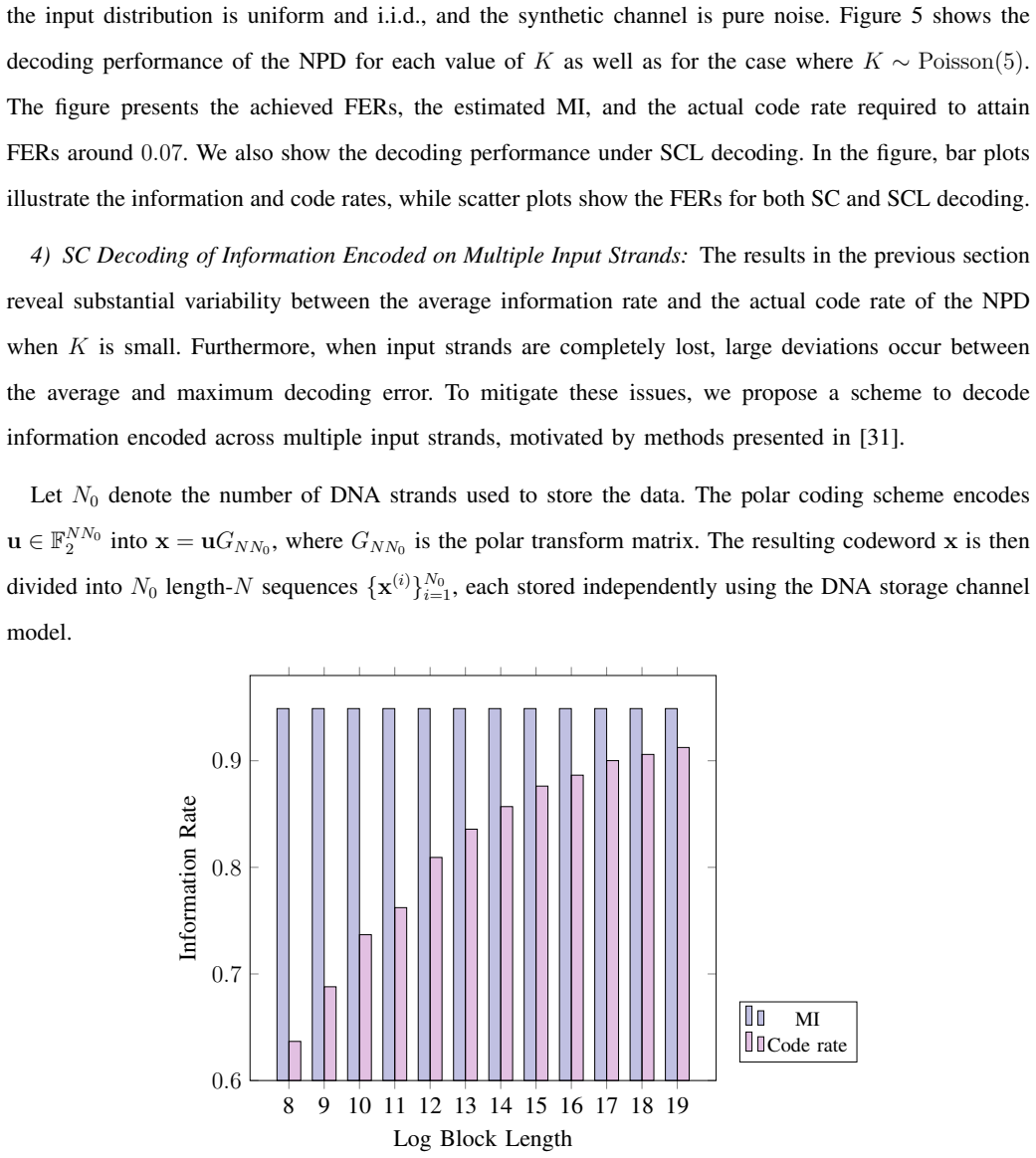
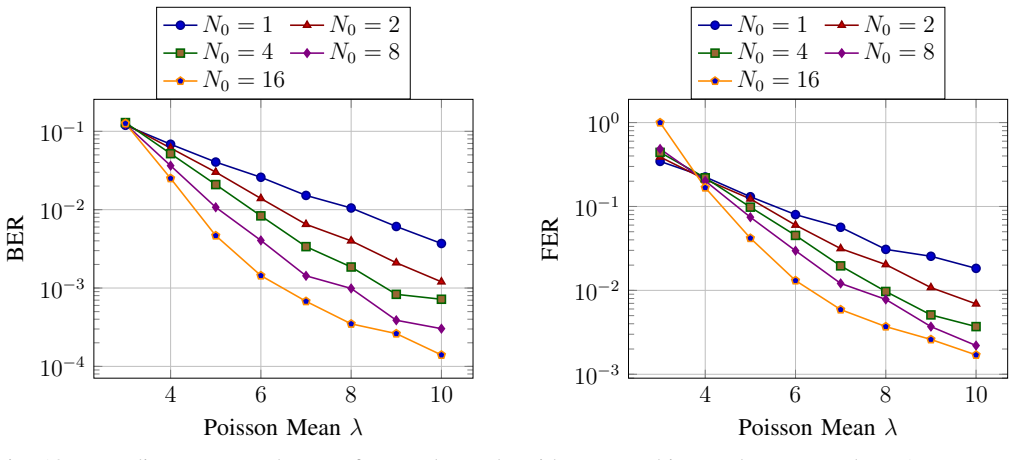
- On DNA channels with Poisson-distributed trace counts, the NPD inner code plus concatenated outer decoding reaches bit error rates around 0.02 for block lengths up to 2^19 bits.
- On real Nanopore data, the NPD matches a state-of-the-art deep decoder in bit error rate while using about 3 million parameters instead of 100 million.
- Because the decoder is trained from samples, new channel conditions only require new input-output pairs rather than a re-derived statistical channel model.
Reading between the lines
- Our inference: the same per-read embedding averaging could be tested on other repetition channels, such as multi-pass flash reads or repeated wireless transmissions, where the decoder observes multiple noisy versions of the same codeword.
- Our inference: because the NPD only needs samples, it could be retrained directly on reads from a new sequencing chemistry without re-deriving an error profile; the paper stops at fine-tuning a pre-trained model on one Nanopore dataset.
- Our inference: the MI estimation procedure, though not a rigorous bound, may serve as a practical code-design oracle for IDS channels at the short block lengths used in real DNA storage, a regime where asymptotic capacity bounds are loose.
Editorial analysis
A structured set of objections, weighed in public.
Referee Report
Summary. This paper extends neural polar decoders (NPDs) to insertion-deletion-substitution (IDS) and deletion channels by replacing the embedding function of a successive-cancellation polar decoder with CNN- or attention-based networks that process the entire received sequence. It proposes averaging per-trace embeddings for multiple noisy reads (Eq. 12), estimates mutual information and optimizes input distributions with the NPD, and evaluates the approach on synthetic deletion/IDS channels against trellis decoding and capacity bounds, and on synthetic and real Nanopore DNA storage data against DNAformer and other reconstruction methods. The main claims are that NPDs achieve near-optimal frame-error-rate performance on deletion channels, accurate mutual-information estimates, O(AN log N) decoding complexity, and competitive DNA-storage performance with far fewer parameters than DNAformer.
Significance. If the main claims hold, the paper offers a practical, model-free decoding route for synchronization-error channels and DNA storage, with much better complexity scaling than trellis SC decoding and with list decoding enabled. The paper is honest about several limitations: Remark 1 states that the MI estimates are not rigorous bounds, and Section IV-C labels the multi-trace aggregation rule as heuristic. The external benchmarking against trellis FERs and published capacity bounds is a strength, as is the use of real Nanopore data. However, the central 'near-optimal' and 'accurate MI' claims currently rest on comparisons that are either conjectured to be affected by numerical artifacts or are single-point estimates without error bars, so the significance is conditional on the additional validation described below.
major comments (5)
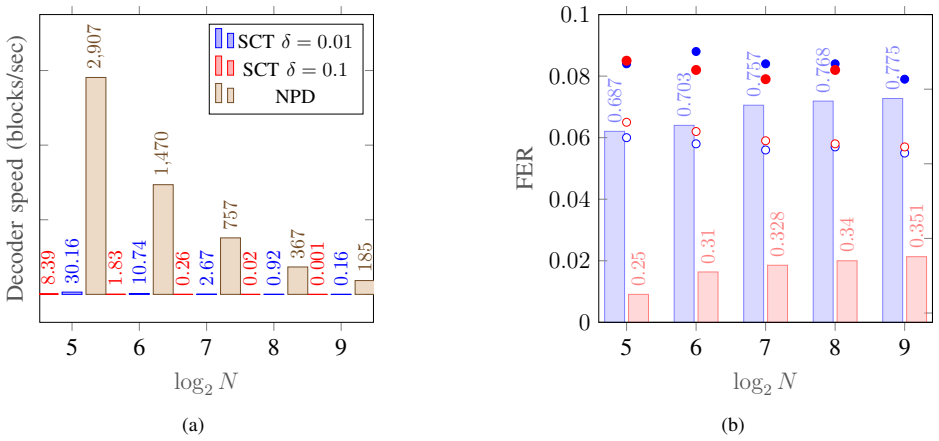
- [V-4, Fig. 3b] The near-optimal FER claim is supported only by a comparison in which the NPD slightly outperforms the trellis-based SC decoder, and the paper attributes this to 'numerical errors in the implementation of the trellis-based decoder' without demonstrating them. If the trellis implementation is accurate, the NPD may share or amplify those errors; if it is inaccurate, the comparison should be repeated with a corrected trellis or against exact posteriors for small N. This point is load-bearing because the abstract's 'near-optimal decoding performance' claim depends on it.
- [V-2, Remark 1, Table I] The MI estimates are reported as single-point values computed at finite block length as the difference of two numerical upper bounds on entropy, with no error bars, multiple seeds, or exact-MI reference for small N. A single value falling inside published bounds is weak evidence of accuracy, especially because the input-distribution optimization loop uses the same NPD to estimate MI. Please add seed statistics and validate against exact MI for small block lengths.
- [IV-C, Eq. (12)] The multi-trace aggregation rule, averaging per-trace embeddings with 1/sqrt(K) normalization, is explicitly acknowledged to be heuristic, yet it is the mechanism underlying all multi-trace DNA-storage results in Section VI. Without an ablation against alternatives (e.g., learned aggregation or per-trace trellis combination) or a theoretical justification, the DNA-storage claims are not fully supported. Please provide such an ablation or restrict the claims accordingly.
- [V-3, Fig. 3a] The decoding-speed comparison runs the NPD on a GPU and the trellis decoder on a CPU, a difference the authors acknowledge is 'not entirely fair.' Because the lower-complexity claim is central, the paper should either provide a same-hardware timing comparison or state the complexity advantage purely in terms of the O(AN log N) architecture and parameter counts.
- [VI-B2, Fig. 8b] The text says the NPD 'slightly underperforms DNAformer in terms of decoding error,' while the abstract claims the method 'match[es] or surpass[es] the performance of existing methods.' Please reconcile these statements and report whether the comparison is at uncoded rate only; if coding is applied, give coded BER/FER for all methods.
minor comments (7)
- [Section I] In the first paragraph, 'at allOnce a sequencing threshold' is missing a space; please fix typographical spacing throughout the manuscript.
- [Section VI-B] There are two subsections with the identical title 'SC Decoding Information Encoded on Multiple Input Strands' and nearly identical text; please consolidate them.
- [Figure 5 caption] The phrase 'The column labeled K shows results for K ~ Poisson(5)' is unclear because K is the x-axis; please clarify the caption.
- [Table I] Please state the block length N and the number of Monte Carlo samples used for each NPD estimate, and add standard deviations.
- [Figures 3 and 4] The figures use 'SCT' while the text refers to the 'trellis-based decoder'; please define SCT in the captions or use consistent terminology.
- [Section VI-B1] The role of the 36 random padding bits in the punctured polar code and the way the information set is selected should be stated more precisely; currently the reader must infer it from Figure 7a.
- [Eq. (11)] The normalization term in the denominator should be defined explicitly; as written, the notation is ambiguous.
Circularity Check
No significant circularity: decoding and MI estimates are trained from channel samples and benchmarked against external trellis and capacity bounds; the self-referential MI-optimization loop is a standard variational estimator, not a definitional reduction.
full rationale
The paper's derivation chain is self-contained in the relevant sense. The NPD training objective (Eqs. 5-6) is a standard cross-entropy fit to channel samples, and decoding FERs are compared against the external trellis SC decoder [31]. MI estimates (Eqs. 7-9) are plug-in estimates from the trained NPD; they are not defined as the bounds they are compared with in Fig. 2 and Table I. The alternating MI-optimization loop (Eqs. 10-11) is a score-function/policy-gradient estimator whose consistency the authors cite to their prior work [1], but the resulting estimates are calibrated against independent theoretical bounds, so the central claims do not reduce to a fitted parameter or to a self-citation. The multi-trace aggregation rule (Eq. 12) is explicitly labeled heuristic, which is a limitation rather than a circular step. The conjectured numerical-error explanation for the NPD outperforming the trellis decoder (Sec. V-4) and the absence of error bars on MI estimates (Remark 1) are correctness/validation concerns, not instances of definitional circularity. Overall, the strongest claims are not forced by construction.
Assumptions & free parameters
free parameters (5)
- NPD network weights theta_E, theta_F, theta_G, theta_H =
not enumerated; about 3M parameters in the real-data model
- Embedding dimension d =
d = N/2
- Hidden size h =
h = 2N
- Attention padding length Lmax =
Lmax = ceil(1.1*N/2) in DNA experiments
- Trace aggregation normalization coefficient =
1/sqrt(K)
assumptions (6)
- domain assumption The IDS channel model of Definition 1, with iid per-position insertion/deletion/substitution events and uniform inserted symbols, captures DNA synthesis and sequencing noise.
- standard math Polar codes polarize over deletion channels under Markov input distributions (Tal et al. [31]).
- standard math The trellis-based SC decoder of [31] provides exact posterior beliefs for deletion channels and is a fair benchmark.
- ad hoc to paper SGD training of the NPD converges to a close approximation of the synthetic-channel posteriors.
- ad hoc to paper Averaging per-trace embeddings with Equation (12) preserves sufficient statistics for SC decoding.
- domain assumption Real-data frozen bits can be assumed known to the decoder via shared randomness.
Cite this review
Pith. "Pith review of Neural Polar Decoders for DNA Data Storage." pith.science (2026). https://pith.science/paper/OAM5DNVK
@misc{pith2026250617076,
  author       = {Pith},
  title        = {Pith review of: Neural Polar Decoders for DNA Data Storage},
  year         = {2026},
  howpublished = {\url{https://pith.science/paper/OAM5DNVK}},
  note         = {Machine review of arXiv:2506.17076}
}
abstract
Synchronization errors, such as insertions and deletions, present a fundamental challenge in DNA-based data storage systems, arising from both synthesis and sequencing noise. These channels are often modeled as insertion-deletion-substitution (IDS) channels, for which designing maximum-likelihood decoders is computationally expensive. In this work, we propose a data-driven approach based on neural polar decoders (NPDs) to design low-complexity decoders for channels with synchronization errors. The proposed architecture enables decoding over IDS channels with reduced complexity $O(AN log N )$, where $A$ is a tunable parameter independent of the channel. NPDs require only sample access to the channel and can be trained without an explicit channel model. Additionally, NPDs provide mutual information (MI) estimates that can be used to optimize input distributions and code design. We demonstrate the effectiveness of NPDs on both synthetic deletion and IDS channels. For deletion channels, we show that NPDs achieve near-optimal decoding performance and accurate MI estimation, with significantly lower complexity than trellis-based decoders. We also provide numerical estimates of the channel capacity for the deletion channel. We extend our evaluation to realistic DNA storage settings, including channels with multiple noisy reads and real-world Nanopore sequencing data. Our results show that NPDs match or surpass the performance of existing methods while using significantly fewer parameters than the state-of-the-art. These findings highlight the promise of NPDs for robust and efficient decoding in DNA data storage systems.
Figures


Figures from the paper (7 more)




Reference graph
Works this paper leans on
-
[1]
Code Rate Optimization via Neural Polar Decoders
Ziv Aharoni et al. “Code Rate Optimization via Neural Polar Decoders”. In: 2024 IEEE International Symposium on Information Theory (ISIT) . 2024, pp. 2424–2429. DOI: 10.1109/ISIT57864.2024. 10619429
arXiv 2024
-
[2]
Data-Driven Neural Polar Decoders for Unknown Channels with and without Memory
Ziv Aharoni et al. “Data-Driven Neural Polar Decoders for Unknown Channels with and without Memory”. In: IEEE Transactions on Information Theory (2024)
work page 2024
-
[3]
E. Arikan. “Channel Polarization: A Method for Constructing Capacity-achieving Codes for Symmetric Binary-input Memoryless Channels”. In: IEEE Trans. Inf. Theory 55.7 (2009), pp. 3051– 3073
work page 2009
-
[4]
Long-Term Storage of Information in DNA
Carter Bancroft et al. “Long-Term Storage of Information in DNA”. In: Science 293.5536 (2001), pp. 1763–1765
work page 2001
-
[5]
Scalable and Robust DNA-based Storage via Coding Theory and Deep Learning
Daniella Bar-Lev et al. “Scalable and Robust DNA-based Storage via Coding Theory and Deep Learning”. In: Nat Mach Intell (2025), pp. 1–11. ISSN : 2522-5839. DOI: 10.1038/s42256- 025- 01003-z
doi:10.1038/s42256- 2025
-
[6]
Reconstructing Strings from Random Traces
Tugkan Batu et al. “Reconstructing Strings from Random Traces”. In: SODA. V ol. 4. 2004, pp. 910– 918
work page 2004
-
[7]
Trellis Based Lower Bounds on Capacities of Channels with Synchronization Errors
Jason Castiglione and Aleksandar Kavcic. “Trellis Based Lower Bounds on Capacities of Channels with Synchronization Errors”. In: 2015 IEEE Information Theory Workshop-Fall (ITW). IEEE, 2015, pp. 24–28
work page 2015
-
[8]
Next-Generation Digital Information Storage in DNA
George M Church, Yuan Gao, and Sriram Kosuri. “Next-Generation Digital Information Storage in DNA”. In: Science 337.6102 (2012), pp. 1628–1628
2012
Show all 37 references
-
[9]
Reliable Communication over Channels with Insertions, Deletions, and Substitutions
Matthew C Davey and David JC MacKay. “Reliable Communication over Channels with Insertions, Deletions, and Substitutions”. In: IEEE Transactions on Information Theory 47.2 (2001), pp. 687– 698
2001
-
[10]
Shannon’s Theorems for Channels with Synchronization Errors
Roland L’vovich Dobrushin. “Shannon’s Theorems for Channels with Synchronization Errors”. In: Problemy Peredachi Informatsii 3.4 (1967), pp. 18–36
1967
-
[11]
DNA Fountain Enables a Robust and Efficient Storage Architecture
Yaniv Erlich and Dina Zielinski. DNA Fountain Enables a Robust and Efficient Storage Architecture. https://www.science.org/doi/10.1126/science.aaj2038. 2017. DOI: 10.1126/science.aaj2038
2017 doi
-
[12]
Bounds on the Capacity of Channels with Insertions, Deletions and Substitutions
Dario Fertonani, Tolga M. Duman, and M. Fatih Erden. “Bounds on the Capacity of Channels with Insertions, Deletions and Substitutions”. In: IEEE Transactions on Communications 59.1 (2011), pp. 2–6. ISSN : 1558-0857. DOI: 10.1109/TCOMM.2010.110310.090039
2011 arXiv
-
[13]
Sequential Decoding for Binary Channels with Noise and Synchronization Errors
Robert G Gallager. Sequential Decoding for Binary Channels with Noise and Synchronization Errors. British Library, Reports & Microfilms, 1961
1961
- [14]
-
[15]
Trace Reconstruction from Noisy Polynucleotide Sequencer Reads
Parikshit S. GOPALAN et al. “Trace Reconstruction from Noisy Polynucleotide Sequencer Reads”. WO2017189469A1. 2017
2017
-
[16]
Robust Chemical Preservation of Digital Information on DNA in Silica with Error-Correcting Codes
Robert N. Grass et al. “Robust Chemical Preservation of Digital Information on DNA in Silica with Error-Correcting Codes”. In: Angewandte Chemie International Edition 54.8 (2015), pp. 2552–2555. ISSN : 1521-3773. DOI: 10.1002/anie.201411378
2015 doi
- [17]
-
[18]
Fundamental Limits of DNA Storage Systems
Reinhard Heckel et al. “Fundamental Limits of DNA Storage Systems”. In: 2017 IEEE International Symposium on Information Theory (ISIT) . 2017, pp. 3130–3134. DOI: 10.1109/ISIT.2017.8007106
2017
-
[19]
Achieving the Capacity of the DNA Storage Channel
Andreas Lenz et al. “Achieving the Capacity of the DNA Storage Channel”. In: ICASSP 2020 - 2020 IEEE International Conference on Acoustics, Speech and Signal Processing (ICASSP) . 2020, pp. 8846–8850. DOI: 10.1109/ICASSP40776.2020.9053049
2020
-
[20]
Coding Over Sets for DNA Storage
Andreas Lenz et al. “Coding Over Sets for DNA Storage”. In: IEEE Transactions on Information Theory 66.4 (2020), pp. 2331–2351. ISSN : 1557-9654. DOI: 10.1109/TIT.2019.2961265
2020
-
[21]
Synthesis of High-Quality Libraries of Long (150mer) Oligonucleotides by a Novel Depurination Controlled Process
Emily M. LeProust et al. “Synthesis of High-Quality Libraries of Long (150mer) Oligonucleotides by a Novel Depurination Controlled Process”. In: Nucleic Acids Research 38.8 (2010), pp. 2522–
2010
-
[22]
Efficient Reconstruction of Sequences
V .I. Levenshtein. “Efficient Reconstruction of Sequences”. In: IEEE Transactions on Information Theory 47.1 (2001), pp. 2–22. ISSN : 1557-9654. DOI: 10.1109/18.904499
2001 doi
-
[23]
Synthetic DNA Applications in Information Technology
Linda C. Meiser et al. “Synthetic DNA Applications in Information Technology”. In: Nat Commun 13.1 (2022), p. 352. ISSN : 2041-1723. DOI: 10.1038/s41467-021-27846-9
2022 doi
- [24]
-
[25]
Random Access in Large-Scale DNA Data Storage
Lee Organick et al. “Random Access in Large-Scale DNA Data Storage”. In: Nat Biotechnol 36.3 (2018), pp. 242–248. ISSN : 1087-0156, 1546-1696. DOI: 10.1038/nbt.4079
2018 doi
-
[26]
Mutual Information Upper Bounds for Uniform Inputs through the Deletion Channel
Francisco Pernice, Berivan Isik, and Tsachy Weissman. “Mutual Information Upper Bounds for Uniform Inputs through the Deletion Channel”. In: IEEE Transactions on Information Theory (2024)
2024
-
[27]
Upper Bounds on the Capacity of Deletion Channels Using Channel Fragmentation
Mojtaba Rahmati and Tolga M. Duman. “Upper Bounds on the Capacity of Deletion Channels Using Channel Fragmentation”. In: IEEE Transactions on Information Theory 61.1 (2015), pp. 146–156. ISSN : 1557-9654. DOI: 10.1109/TIT.2014.2368553
2015
-
[28]
Reconstruction Algorithms for DNA-storage Systems
Omer Sabary et al. “Reconstruction Algorithms for DNA-storage Systems”. In: Sci Rep 14.1 (2024), p. 1951. ISSN : 2045-2322. DOI: 10.1038/s41598-024-51730-3
2024 doi
-
[29]
Survey for a Decade of Coding for DNA Storage
Omer Sabary et al. “Survey for a Decade of Coding for DNA Storage”. In: IEEE Transactions on Molecular, Biological, and Multi-Scale Communications 10.2 (2024), pp. 253–271. ISSN : 2332-
2024
- [30]
-
[31]
Polar Codes for the Deletion Channel: Weak and Strong Polarization
I. Tal et al. “Polar Codes for the Deletion Channel: Weak and Strong Polarization”. In: IEEE Trans. Inf. Theory 68.4 (2021), pp. 2239–2265
2021
-
[32]
Codes Which Correct Single Asymmetric Errors
R. R. Varshamov and G. M. Tenengolts. “Codes Which Correct Single Asymmetric Errors”. In: Automation and Remote Control 26.2 (1965), pp. 286–290
1965
-
[33]
Attention Is All You Need
Ashish Vaswani et al. “Attention Is All You Need”. In: Advances in Neural Information Processing Systems. Ed. by I. Guyon et al. V ol. 30. Curran Associates, Inc., 2017
2017
-
[34]
Improved String Reconstruction over Insertion-Deletion Channels
Krishnamurthy Viswanathan and Ram Swaminathan. “Improved String Reconstruction over Insertion-Deletion Channels”. In: Proceedings of the Nineteenth Annual ACM-SIAM Symposium on Discrete Algorithms . SODA ’08. USA: Society for Industrial and Applied Mathematics, 2008, pp. 399–408
2008
-
[35]
Construction of Polar Codes for Channels with Memory
R. Wang et al. “Construction of Polar Codes for Channels with Memory”. In: 2015 IEEE Information Theory Workshop-Fall (ITW). IEEE, 2015, pp. 187–191
2015
- [2540]
-
[7804]
DOI: 10.1109/TMBMC.2024.3403488
2024
Reviewed August 6, 2026 · model on record in the stance chip above.
Discussion (0). Sign in to comment.