REVIEW 3 major objections 5 minor 68 references
Differentiable neural network representation of multi-well, locally-convex potentials
T0 review · 3 major / 5 minor · reviewed 2026-08-07 · deepseek-v4-flash
Pith's one-line read The paper proposes the LSE-ICNN — a log-sum-exponential blend of input-convex neural networks — as a smooth, everywhere-differentiable surrogate for multi-well potentials that stays convex inside each well and learns the number of wells…
desk verdict Useful smooth multi-well surrogate, but the stated convexity-within-basins guarantee is not established and as written is false; the method is still worth reviewing after reframing and stronger empirical checks. read the letter →
The pith
A machine-rendered reading of the paper's core claim, the machinery that carries it, and where it could break.
The reading
What carries the argument
The central object is the LSE-ICNN, Eq. (6): a log-sum-exponential mixture of input convex neural networks. An ICNN is a feedforward network with non-negative weights on the layer-to-layer connections and convex, non-decreasing activations (softplus here), which guarantees that each mode $\mathrm{NN}_i(x)$ is a convex function of the input $x$. The mixing formula $-\frac{1}{\rho}\log\left(\frac{1}{N}\sum_i \varsigma(\alpha_i)e^{-\rho \mathrm{NN}_i(x)}\right)$ is the smooth 'soft minimum' of the modes: as $\rho\to\infty$ it approaches the true minimum, and finite $\rho$ controls the sharpness of the crossover, analogous to inverse temperature. The strictly positive gating factors $\varsigma(\alpha_i)$ allow modes to be switched off under an $\ell^1$ penalty without breaking differentiability. This machinery does the work: each basin is represented by a single convex mode, the seams between basins are smoothed by the soft minimum, and the learned $\rho$ and sparse $\alpha_i$ make the representation adaptive in both transition scale and mode count.
What would settle it
Take a trained LSE-ICNN and evaluate the Hessian of the potential at a fine grid of points inside one of its learned basins; if any interior point has a negative eigenvalue of the Hessian, the surrogate is not convex within that basin, contradicting the paper's central guarantee. A simpler version: fit an equal-weight two-mode LSE-ICNN to two identical parabolas and check the midpoint, where the soft minimum is known to be non-convex for small $\rho$.
Extended reading notes
Core claim
The paper's central claim is that the LSE-ICNN defined by Eq. (6) — $-\frac{1}{\rho}\log\bigl(\frac{1}{N_{\text{modes}}}\sum_i \varsigma(\alpha_i)\exp(-\rho\,\mathrm{NN}_i(x))\bigr)$ — is a differentiable surrogate for multi-well potentials that retains convexity within basins and allows gradient-based learning and inference. Each mode $\mathrm{NN}_i$ is an input convex neural network, so every individual well is a convex function of the inputs; the weighted log-sum-exponential combines the modes smoothly, and a learnable inverse-temperature-like parameter $\rho$ sets the width of the transition zone between wells. Gating factors $\varsigma(\alpha_i)$, bounded strictly between 0 and 1, act as on-off switches, and an $\ell^1$ penalty on the gating parameters prunes unused modes during training, so the effective number of wells is inferred from data rather than fixed in advance. The paper reports accurate fits on three one-dimensional multi-well benchmarks and held-out predictions in mechanochemistry, a bistable chemical reaction, a two-phase metamaterial with hysteresis, a conservative two-gene cell-fate circuit, and variational inference for a multimodal posterior.
Load-bearing premise
The central guarantee is that the mixture stays convex inside each basin, which holds only when one mode dominates and the smoothing parameter is large enough; the paper assumes this rather than proving it or testing the learned potentials for convexity inside their wells.
Editorial extensions
If this is right
- Gradient- and Hessian-based solvers, adjoint sensitivity analysis, and automatic differentiation can be applied directly to a learned multi-well potential, because the surrogate is smooth everywhere, unlike the pointwise-minimum representations it replaces.
- The number of wells does not need to be fixed in advance: the $\ell^1$ penalty on gating weights deactivates unused modes during training, and the learned $\rho$ measures how sharp or gradual the barriers between wells are.
- Since every mode is an input convex network, each basin inherits a convexity guarantee, the property that underpins stability arguments and uniqueness of local minimizers in mechanics.
- The same architecture serves as a physical energy (as in the conservative gene-circuit example) and as a log-density in variational inference, so one differentiable surrogate covers both dynamical and probabilistic multi-well landscapes.
Reading between the lines
- One extension would be to treat the learned scale $\rho$ as a physical temperature and calibrate it against independently measured transition rates, which the paper does not attempt.
- A direct check of local convexity — sampling the Hessian of a fitted potential inside its basins — is not reported; without it, the convexity guarantee rests on the architecture argument alone.
- The same sparse-gating trick could be reused for smooth switching constitutive laws or mixture-of-experts regressors whenever automatic component counting is wanted.
- All demonstrations are low-dimensional (at most a handful of inputs), so whether the mode-counting and gradient training survive genuinely high-dimensional energy surfaces remains open.
Editorial analysis
A structured set of objections, weighed in public.
Referee Report
Summary. The paper proposes a log-sum-exponential mixture of input convex neural network modes (LSE-ICNN) as a differentiable surrogate for multi-well energy landscapes. The representation uses learnable inverse-temperature-like scale parameters and gating weights, with L1 regularization to prune unused modes. The authors demonstrate the method on one-dimensional multi-well fits and on four applications: mechanochemical phase transformations, multimodal probability distributions, microstructural elastic instabilities, and a Waddington-inspired gene circuit. The paper claims that the representation is smooth, retains convexity within basins, and can automatically discover the number of modes and transition scales.
Significance. If the local-convexity claim were established, this would be a useful and broadly applicable representation for multi-well potentials in mechanics, chemistry, and biology, and the held-out generalization tests and gradient-based training are genuine strengths. However, the central convexity property is unproven and, as stated, generally false: the soft-min composition does not preserve convexity even when each mode is an ICNN. The automatic mode-discovery claim is demonstrated only in one-dimensional illustrations, while the higher-dimensional applications fix the mode count a priori. These issues need to be resolved before the paper can be accepted.
major comments (3)
- [Sec. 3, Eq. (6)] The claim that the LSE-ICNN "retains convexity within basins" is not established. For F(x) = -(1/rho) log sum_i w_i exp(-rho NN_i(x)), the Hessian is Hess(F) = sum_i p_i Hess(NN_i) - rho ( sum_i p_i grad(NN_i)grad(NN_i)^T - (sum_i p_i grad(NN_i))(sum_i p_i grad(NN_i))^T ), where p_i are the softmax weights. The first term is positive semidefinite because each NN_i is an ICNN, but the second term is a positive semidefinite covariance term. Positivity of the gating weights and of rho does not guarantee that the first term dominates. A simple one-dimensional counterexample, F(x) = -(1/rho) log(0.5 exp(-rho x^2) + 0.5 exp(-rho (x-1)^2)) with rho=10, is nonconvex and has a local maximum at x=0.5. No demonstration in the paper reports a post-training check of the minimum eigenvalue of the learned Hessian. The authors should either prove a sufficient condition for local convexity, add a regularization or projection that enforces it, or substantially weaken the claim to approximate convexity and support that claim numerically.
- [Sec. 3, Eqs. (2)-(3)] The paper invokes Boyd and Vandenberghe for the statement that "the LSE function is smooth and convex," but Eq. (2) is not the standard log-sum-exp used as a smooth maximum. The function -1/rho log( (1/N) sum_i exp(-rho f_i(x)) ) is concave, not convex, as a function of the mode values (f_1, ..., f_N). Composition of a concave outer function with convex inner functions does not preserve convexity. This is the root of the problem with the local-convexity claim, and the citation does not support the assertion as written.
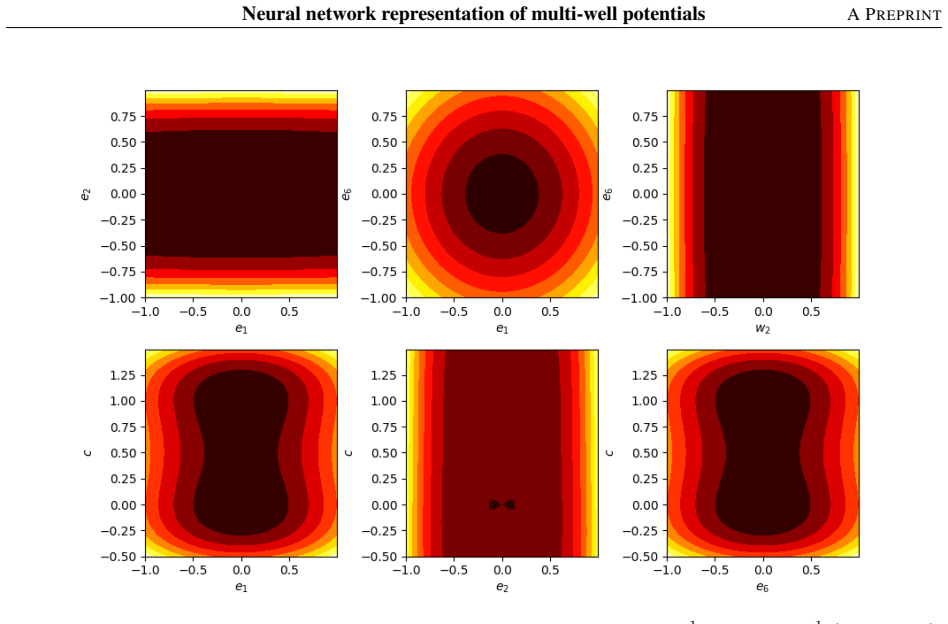
- [Sec. 4 (4.1, 4.3, 4.4)] The abstract and introduction advertise "automatic discovery of both the number of modes and the scale of transitions through sparse regression," but this capability is demonstrated only in the one-dimensional illustrations of Sec. 3. In the mechanochemical example Nmodes is fixed at 5, in the elastic-instability example it is fixed at 2 because the number of phases is known, and in the gene-circuit example it is fixed at 3. No high-dimensional demonstration reports an ablation study or a comparison between the discovered mode count and the true number of wells. The authors should clarify the scope of the automatic-discovery claim and report whether sparse pruning was actually used in each application.
minor comments (5)
- [Sec. 3, Eq. (7)] The notation ||y - LSE(x; theta)||^2 overloads y, which is used both for the target data and for the scalar output of the network; using different symbols for the data vector and the model output would improve clarity.
- [Sec. 4.2, Eqs. (20)-(22)] The variational inference formulation identifies an unnormalized LSE output with the log-density log q(y; theta) and then treats a term involving D_KL(q || pi) with a "uniform and zero-valued" prior as a regularizer. The normalization of q and the exact form of the ELBO should be stated more carefully, since a non-normalized q changes the KL term.
- [References] Reference [53] is incomplete: it should list all authors of the Adam paper, not just the first author with a placeholder title.
- [Fig. 4 caption] The caption reads "Multi-colored curves depicts the 10 {alpha_i}"; the verb should agree with the plural subject, and the sentence should be reworded for clarity.
- [Sec. 4.1, Eq. (11)] The displayed free energy contains apparent typographical issues, such as "E2 33" and unmatched parentheses in several terms; please check the transcription of the data-generating model.
Circularity Check
No significant circularity: the LSE-ICNN is fitted to data and validated on held-out data, and its central claims do not reduce to its inputs.
full rationale
The derivation chain in this paper is the model definition (Eq. 6), the sparse-regression loss (Eq. 7), and the demonstrations; none of these steps reduces a target result to its own fitted inputs. The LSE-ICNN is trained on data (e.g., derivatives in Sec. 4.1, trajectories in Sec. 4.3) and then compared against held-out test sets or extrapolation paths (Figs. 6-7, 10-11), which are genuine generalization checks rather than refitted quantities. The claim that the gating weights 'discover' the number of modes is a model-selection heuristic that reads active modes off the trained ς(α_i); this is not a statistical prediction and is not circular because the mode count is not a result derived from the fitted parameters. The paper's assertion that local convexity is preserved by requiring ς(α_i)>0 and ρ>0 (Sec. 3) is mathematically unsupported—the Hessian of Eq. (6) includes a negative covariance term—but that is an omitted proof or incorrect claim, not a circular reduction, since the claimed property is not defined in terms of the ICNN modes and no fitted parameter is renamed as the convexity result. Self-citations [35, 48] appear only as related-work context and as a suggested future improvement, not as load-bearing justification for the central model. Overall, no step in the paper's derivation is equivalent by construction to its inputs.
Assumptions & free parameters
free parameters (4)
- LSE temperature ρ =
Learned per experiment; final values roughly 1.5 to 4.5 in 1D examples (Fig. 4)
- Mode gating weights α_i =
Pruned by L1; effective mode count varies per run
- ICNN weights and biases =
Not enumerated; all mode networks trained from random initialization
- Architecture hyperparameters =
Nmodes initial (10, 5, 2, 3), layer sizes, learning rates, ε = 1e-4
assumptions (3)
- standard math Input convex neural networks are convex with nonnegative weights and convex nondecreasing activations (Amos et al. 2017).
- ad hoc to paper The LSE mixture with positive ς and ρ preserves convexity within basins.
- domain assumption The data-generating models in Sec. 4 are faithful proxies for the target physics.
Cite this review
Pith. "Pith review of Differentiable neural network representation of multi-well, locally-convex potentials." pith.science (2026). https://pith.science/paper/TLDVSA5Q
@misc{pith2026250617242,
  author       = {Pith},
  title        = {Pith review of: Differentiable neural network representation of multi-well, locally-convex potentials},
  year         = {2026},
  howpublished = {\url{https://pith.science/paper/TLDVSA5Q}},
  note         = {Machine review of arXiv:2506.17242}
}
read the original abstract
Multi-well potentials are ubiquitous in science, modeling phenomena such as phase transitions, dynamic instabilities, and multimodal behavior across physics, chemistry, and biology. In contrast to non-smooth minimum-of-mixture representations, we propose a differentiable and convex formulation based on a log-sum-exponential (LSE) mixture of input convex neural network (ICNN) modes. This log-sum-exponential input convex neural network (LSE-ICNN) provides a smooth surrogate that retains convexity within basins and allows for gradient-based learning and inference. A key feature of the LSE-ICNN is its ability to automatically discover both the number of modes and the scale of transitions through sparse regression, enabling adaptive and parsimonious modeling. We demonstrate the versatility of the LSE-ICNN across diverse domains, including mechanochemical phase transformations, microstructural elastic instabilities, conservative biological gene circuits, and variational inference for multimodal probability distributions. These examples highlight the effectiveness of the LSE-ICNN in capturing complex multimodal landscapes while preserving differentiability, making it broadly applicable in data-driven modeling, optimization, and physical simulation.
Figures


Figures from the paper (10 more)



Reference graph
Works this paper leans on
-
[1]
Classical dynamics of a coupled double well oscillator in condensed mediaa
Teresa Fonseca, JANF Gomes, Paolo Grigolini, and Fabio Marchesoni. Classical dynamics of a coupled double well oscillator in condensed mediaa. The Journal of chemical physics, 79(7):3320–3327, 1983
work page 1983
-
[2]
Relaxation of classical particles in anharmonic multi- well potentials
Surajit Sen, Robert S Sinkovits, and Soumya Chakravarti. Relaxation of classical particles in anharmonic multi- well potentials. Physica A: Statistical Mechanics and its Applications, 224(1-2):292–301, 1996
work page 1996
-
[3]
Evans M Harrell. Double wells. Communications in Mathematical Physics, 75:239–261, 1980
work page 1980
-
[4]
Multi-well potentials in quantum mechanics and stochastic processes
Victor P Berezovoj, Glib I Ivashkevych, Mikhail I Konchatnij, et al. Multi-well potentials in quantum mechanics and stochastic processes. SIGMA. Symmetry, Integrability and Geometry: Methods and Applications , 6:098, 2010
work page 2010
-
[5]
The double-well potential in quantum mechanics: a simple, numerically exact formula- tion
V Jelic and F Marsiglio. The double-well potential in quantum mechanics: a simple, numerically exact formula- tion. European Journal of Physics, 33(6):1651, 2012
work page 2012
-
[6]
The development of transition-state theory
Keith J Laidler and M Christine King. The development of transition-state theory. J. phys. Chem, 87(15):2657– 2664, 1983
work page 1983
-
[7]
Current status of transition-state theory
Donald G Truhlar, Bruce C Garrett, and Stephen J Klippenstein. Current status of transition-state theory. The Journal of physical chemistry, 100(31):12771–12800, 1996
work page 1996
-
[8]
Nonlocal phase transitions in homogeneous and periodic media
Matteo Cozzi, Serena Dipierro, and Enrico Valdinoci. Nonlocal phase transitions in homogeneous and periodic media. Journal of Fixed Point Theory and Applications, 19(1):387–405, 2017
work page 2017
Show all 68 references
-
[9]
Double-well potentials and structural phase transitions in polyphenyls
Herv ´e Cailleau, Jean-Louis Baudour, Jean Meinnel, Ary Dworkin, Fernande Moussa, and Claude ME Zeyen. Double-well potentials and structural phase transitions in polyphenyls. Faraday Discussions of the Chemical Society, 69:7–18, 1980
1980
-
[10]
On the limit behavior of lattice-type metamaterials with bi-stable mechanisms
Nestor Rossi, Ignacio Romero, and AE Huespe. On the limit behavior of lattice-type metamaterials with bi-stable mechanisms. International Journal of Mechanical Sciences, 276:109375, 2024
2024
-
[11]
Stacking for non-mixing bayesian computations: The curse and blessing of multimodal posteriors
Yuling Yao, Aki Vehtari, and Andrew Gelman. Stacking for non-mixing bayesian computations: The curse and blessing of multimodal posteriors. Journal of Machine Learning Research, 23(79):1–45, 2022
2022
-
[12]
Multimodal estimation of distribution algorithms
Qiang Yang, Wei-Neng Chen, Yun Li, CL Philip Chen, Xiang-Min Xu, and Jun Zhang. Multimodal estimation of distribution algorithms. IEEE transactions on cybernetics, 47(3):636–650, 2016
2016
-
[13]
Generalized multimodal elbo
Thomas M Sutter, Imant Daunhawer, and Julia E V ogt. Generalized multimodal elbo. arXiv preprint arXiv:2105.02470, 2021
2021 arXiv
-
[14]
The relaxation of a double-well energy
Robert V Kohn. The relaxation of a double-well energy. Continuum Mechanics and Thermodynamics, 3(3):193– 236, 1991
1991
-
[15]
Geometric parameters and the relaxation of multiwell energies
Nikan B Firoozye and Robert V Kohn. Geometric parameters and the relaxation of multiwell energies. Springer, 1993
1993
-
[16]
Solid–solid phase transition modelling
S Pagano, P Alart, and O Maisonneuve. Solid–solid phase transition modelling. local and global minimizations of non-convex and relaxed potentials. isothermal case for shape memory alloys.International journal of engineering science, 36(10):1143–1172, 1998
1998
-
[17]
On the relation of a three-well energy
VP Smyshlyaev and JR Willis. On the relation of a three-well energy. Proceedings of the Royal Society of London. Series A: Mathematical, Physical and Engineering Sciences, 455(1983):779–814, 1999
1983
-
[18]
Statistical Mechanics
Paul D Beale. Statistical Mechanics. Butterworth-Heinemann, 1996
1996
-
[19]
Pattern recognition and machine learning, volume 4
Christopher M Bishop and Nasser M Nasrabadi. Pattern recognition and machine learning, volume 4. Springer, 2006
2006
-
[20]
On the properties of the softmax function with application in game theory and reinforcement learning
Bolin Gao and Lacra Pavel. On the properties of the softmax function with application in game theory and reinforcement learning. arXiv preprint arXiv:1704.00805, 2017. 13 Neural network representation of multi-well potentials A PREPRINT
2017 arXiv
-
[21]
Accurately computing the log-sum-exp and softmax functions
Pierre Blanchard, Desmond J Higham, and Nicholas J Higham. Accurately computing the log-sum-exp and softmax functions. IMA Journal of Numerical Analysis, 41(4):2311–2330, 2021
2021
-
[22]
Convex optimization
Stephen Boyd, Stephen P Boyd, and Lieven Vandenberghe. Convex optimization. Cambridge university press, 2004
2004
-
[23]
Smoothing and first order methods: A unified framework
Amir Beck and Marc Teboulle. Smoothing and first order methods: A unified framework. SIAM Journal on Optimization, 22(2):557–580, 2012
2012
-
[24]
Smoothing method for minimax problems
Song Xu. Smoothing method for minimax problems. Computational Optimization and Applications, 20(3):267– 279, 2001
2001
-
[25]
Smooth minimization of non-smooth functions
Yu Nesterov. Smooth minimization of non-smooth functions. Mathematical programming, 103:127–152, 2005
2005
-
[26]
Variational models for microstructure and phase transitions
Fabrice Bethuel, Gerhard Huisken, Stefan M ¨uller, Klaus Steffen, and Stefan M ¨uller. Variational models for microstructure and phase transitions. Springer, 1999
1999
-
[27]
Input convex neural networks
Brandon Amos, Lei Xu, and J Zico Kolter. Input convex neural networks. In International Conference on Machine Learning, pages 146–155. PMLR, 2017
2017
-
[28]
Data-driven tissue mechanics with polyconvex neural ordinary differential equations
Vahidullah Tac, Francisco Sahli Costabal, and Adrian B Tepole. Data-driven tissue mechanics with polyconvex neural ordinary differential equations. Computer Methods in Applied Mechanics and Engineering, 398:115248, 2022
2022
-
[29]
Polyconvex neural networks for hyperelastic constitutive models: A rectifi- cation approach
Peiyi Chen and Johann Guilleminot. Polyconvex neural networks for hyperelastic constitutive models: A rectifi- cation approach. Mechanics Research Communications, 125:103993, 2022
2022
-
[30]
A mechanics-informed artificial neural network approach in data- driven constitutive modeling
Faisal As’ad, Philip Avery, and Charbel Farhat. A mechanics-informed artificial neural network approach in data- driven constitutive modeling. International Journal for Numerical Methods in Engineering, 123(12):2738–2759, 2022
2022
-
[31]
Learning constitutive relations using symmetric positive definite neural networks
Kailai Xu, Daniel Z Huang, and Eric Darve. Learning constitutive relations using symmetric positive definite neural networks. Journal of Computational Physics, 428:110072, 2021
2021
-
[32]
Polyconvex anisotropic hyperelasticity with neural networks
Dominik K Klein, Mauricio Fern ´andez, Robert J Martin, Patrizio Neff, and Oliver Weeger. Polyconvex anisotropic hyperelasticity with neural networks. Journal of the Mechanics and Physics of Solids , 159:104703, 2022
2022
-
[33]
Parametrized polyconvex hyperelasticity with physics-augmented neural networks
Dominik K Klein, Fabian J Roth, Iman Valizadeh, and Oliver Weeger. Parametrized polyconvex hyperelasticity with physics-augmented neural networks. Data-Centric Engineering, 4:e25, 2023
2023
-
[34]
Neural network-based multiscale modeling of finite strain magneto-elasticity with relaxed convexity criteria
Karl A Kalina, Philipp Gebhart, J ¨org Brummund, Lennart Linden, WaiChing Sun, and Markus K ¨astner. Neural network-based multiscale modeling of finite strain magneto-elasticity with relaxed convexity criteria. Computer Methods in Applied Mechanics and Engineering, 421:116739, 2024
2024
-
[35]
Learning hyperelastic anisotropy from data via a tensor basis neural network
Jan N Fuhg, Nikolaos Bouklas, and Reese E Jones. Learning hyperelastic anisotropy from data via a tensor basis neural network. Journal of the Mechanics and Physics of Solids, 168:105022, 2022
2022
-
[36]
Polyconvex neural network models of thermoelasticity
Jan N Fuhg, Asghar Jadoon, Oliver Weeger, D Thomas Seidl, and Reese E Jones. Polyconvex neural network models of thermoelasticity. Journal of the Mechanics and Physics of Solids, 192:105837, 2024
2024
-
[37]
Automated model discovery of finite strain elastoplasticity from uniaxial experiments
Asghar Arshad Jadoon, Knut Andreas Meyer, and Jan Niklas Fuhg. Automated model discovery of finite strain elastoplasticity from uniaxial experiments. Computer Methods in Applied Mechanics and Engineering , 435:117653, 2025
2025
-
[38]
Optimal transport mapping via input convex neural networks
Ashok Makkuva, Amirhossein Taghvaei, Sewoong Oh, and Jason Lee. Optimal transport mapping via input convex neural networks. In International Conference on Machine Learning, pages 6672–6681. PMLR, 2020
2020
-
[39]
Optimal control via neural networks: A convex approach
Yize Chen, Yuanyuan Shi, and Baosen Zhang. Optimal control via neural networks: A convex approach. arXiv preprint arXiv:1805.11835, 2018
2018 arXiv
-
[40]
On physics-informed data-driven isotropic and anisotropic constitutive mod- els through probabilistic machine learning and space-filling sampling
Jan N Fuhg and Nikolaos Bouklas. On physics-informed data-driven isotropic and anisotropic constitutive mod- els through probabilistic machine learning and space-filling sampling. Computer Methods in Applied Mechanics and Engineering, 394:114915, 2022
2022
-
[41]
Cdinn–convex difference neural networks
Parameswaran Sankaranarayanan and Raghunathan Rengaswamy. Cdinn–convex difference neural networks. Neurocomputing, 495:153–168, 2022
2022
-
[42]
Input specific neural networks
Asghar A Jadoon, D Thomas Seidl, Reese E Jones, and Jan N Fuhg. Input specific neural networks. arXiv preprint arXiv:2503.00268, 2025
2025 arXiv
-
[43]
Convexity conditions and existence theorems in nonlinear elasticity.Archive for rational mechanics and Analysis, 63:337–403, 1976
John M Ball. Convexity conditions and existence theorems in nonlinear elasticity.Archive for rational mechanics and Analysis, 63:337–403, 1976. 14 Neural network representation of multi-well potentials A PREPRINT
1976
-
[44]
Loss of polyconvexity by homogenization
Andrea Braides. Loss of polyconvexity by homogenization. Archive for rational mechanics and analysis , 127:183–190, 1994
1994
-
[45]
An assessment of numerical techniques to find energy-minimizing microstructures associated with nonconvex potentials
Siddhant Kumar, Ananthan Vidyasagar, and Dennis M Kochmann. An assessment of numerical techniques to find energy-minimizing microstructures associated with nonconvex potentials. International Journal for Numerical Methods in Engineering, 121(7):1595–1628, 2020
2020
-
[46]
Experiment-informed finite-strain inverse design of spinodal metamaterials
Prakash Thakolkaran, Michael Espinal, Somayajulu Dhulipala, Siddhant Kumar, and Carlos M Portela. Experiment-informed finite-strain inverse design of spinodal metamaterials. Extreme Mechanics Letters , 74:102274, 2025
2025
-
[47]
Discovering governing equation from data for multi-stable energy harvester under white noise
Yanxia Zhang, Jinqiao Duan, Yanfei Jin, and Yang Li. Discovering governing equation from data for multi-stable energy harvester under white noise. Nonlinear Dynamics, 106(4):2829–2840, 2021
2021
-
[48]
An attention-based neural ordinary differential equation framework for modeling inelastic processes
Reese E Jones and Jan N Fuhg. An attention-based neural ordinary differential equation framework for modeling inelastic processes. arXiv preprint arXiv:2502.10633, 2025
2025 arXiv
-
[49]
Density-preserving hierarchical em algorithm: Simplifying gaussian mixture models for approximate inference
Lei Yu, Tianyu Yang, and Antoni B Chan. Density-preserving hierarchical em algorithm: Simplifying gaussian mixture models for approximate inference. IEEE transactions on pattern analysis and machine intelligence , 41(6):1323–1337, 2018
2018
-
[50]
Melm-grbf: A modified version of the extreme learning machine for generalized radial basis function neural networks
Francisco Fern ´andez-Navarro, C´esar Herv´as-Mart´ınez, Javier Sanchez-Monedero, and Pedro Antonio Guti´errez. Melm-grbf: A modified version of the extreme learning machine for generalized radial basis function neural networks. Neurocomputing, 74(16):2502–2510, 2011
2011
-
[51]
Primal-gmm: Parametric manifold learning of gaussian mixture models
Ziquan Liu, Lei Yu, Janet H Hsiao, and Antoni B Chan. Primal-gmm: Parametric manifold learning of gaussian mixture models. IEEE Transactions on Pattern Analysis and Machine Intelligence, 44(6):3197–3211, 2021
2021
-
[52]
Sparse regression
Dimitris Bertsimas, Jean Pauphilet, and Bart Van Parys. Sparse regression. Statistical Science, 35(4):555–578, 2020
2020
-
[53]
Adam: A method for stochastic optimization
Kingma Diederik. Adam: A method for stochastic optimization. (No Title), 2014
2014
-
[54]
Perspectives on the mathematics of biological patterning and morphogenesis
Krishna Garikipati. Perspectives on the mathematics of biological patterning and morphogenesis. Journal of the Mechanics and Physics of Solids, 99:192–210, 2017
2017
-
[55]
Mechanochemical spinodal decomposition: a phenomenological theory of phase transformations in multi-component, crystalline solids
Shiva Rudraraju, Anton Van der Ven, and Krishna Garikipati. Mechanochemical spinodal decomposition: a phenomenological theory of phase transformations in multi-component, crystalline solids. npj Computational Materials, 2(1):1–9, 2016
2016
-
[56]
Bridging scales with machine learning: From first principles statistical mechanics to continuum phase field computations to study order disorder transitions in lixcoo2
GH Teichert, S Das, M Faghih Shojaei, J Holber, T Mueller, L Hung, V Gavini, and K Garikipati. Bridging scales with machine learning: From first principles statistical mechanics to continuum phase field computations to study order disorder transitions in lixcoo2. arXiv preprin...
2023 arXiv
-
[57]
Chemical reaction models for non-equilibrium phase transitions
Friedrich Schl ¨ogl. Chemical reaction models for non-equilibrium phase transitions. Zeitschrift f ¨ur physik , 253(2):147–161, 1972
1972
-
[58]
Stochastic dynamics and non-equilibrium thermodynamics of a bistable chemical system: the schl ¨ogl model revisited
Melissa Vellela and Hong Qian. Stochastic dynamics and non-equilibrium thermodynamics of a bistable chemical system: the schl ¨ogl model revisited. Journal of The Royal Society Interface, 6(39):925–940, 2009
2009
-
[59]
Exact stochastic simulation of coupled chemical reactions
Daniel T Gillespie. Exact stochastic simulation of coupled chemical reactions. The journal of physical chemistry, 81(25):2340–2361, 1977
1977
-
[60]
Stochastic simulation of chemical kinetics
Daniel T Gillespie. Stochastic simulation of chemical kinetics. Annu. Rev. Phys. Chem., 58(1):35–55, 2007
2007
-
[61]
Spectral representation and reduced order modeling of the dynamics of stochastic reaction networks via adaptive data partitioning
Khachik Sargsyan, Bert Debusschere, Habib Najm, and Olivier Le Ma ˆıtre. Spectral representation and reduced order modeling of the dynamics of stochastic reaction networks via adaptive data partitioning. SIAM Journal on Scientific Computing, 31(6):4395–4421, 2010
2010
-
[62]
Uncertainty quantification of neural network models of evolving processes via langevin sampling
Cosmin Safta, Reese E Jones, Ravi G Patel, Raelynn Wonnacot, Dan S Bolintineanu, Craig M Hamel, and Sharlotte LB Kramer. Uncertainty quantification of neural network models of evolving processes via langevin sampling. arXiv preprint arXiv:2504.14854, 2025
2025 arXiv
-
[63]
Variational inference: A review for statisticians
David M Blei, Alp Kucukelbir, and Jon D McAuliffe. Variational inference: A review for statisticians. Journal of the American statistical Association, 112(518):859–877, 2017
2017
-
[64]
A neural ordinary differential equation framework for modeling inelastic stress response via internal state variables
Reese E Jones, Ari L Frankel, and KL Johnson. A neural ordinary differential equation framework for modeling inelastic stress response via internal state variables. Journal of Machine Learning for Modeling and Computing, 3(3), 2022
2022
-
[65]
The epigenetic landscape in the course of time: Conrad hal waddington’s methodological impact on the life sciences
Jan Baedke. The epigenetic landscape in the course of time: Conrad hal waddington’s methodological impact on the life sciences. Studies in History and Philosophy of Science Part C: Studies in History and Philosophy of Biological and Biomedical Sciences, 44(4):756–773, 2013. 15...
2013
-
[66]
Quantifying the waddington landscape and biological paths for development and differentiation
Jin Wang, Kun Zhang, Li Xu, and Erkang Wang. Quantifying the waddington landscape and biological paths for development and differentiation. Proceedings of the National Academy of Sciences, 108(20):8257–8262, 2011
2011
-
[67]
Sur les mat ´eriaux standard g ´en´eralis´es
Bernard Halphen and Quoc Son Nguyen. Sur les mat ´eriaux standard g ´en´eralis´es. Journal de m ´ecanique, 14(1):39–63, 1975
1975
-
[68]
The derivation of constitutive relations from the free energy and the dissipa- tion function
Hans Ziegler and Christoph Wehrli. The derivation of constitutive relations from the free energy and the dissipa- tion function. Advances in applied mechanics, 25:183–238, 1987. A Elastic stability model For a two-phase material Rossi et al.[10] assume a mixture free energy fu...
1987
Reviewed August 7, 2026 · model on record in the stance chip above.
Discussion (0). Sign in to comment.