Magnetic Hysteresis Experiments Performed on Quantum Annealers
Pith reviewed 2026-05-19 07:49 UTC · model grok-4.3
The pith
A new protocol lets quantum annealers run magnetic hysteresis experiments on large spin systems, revealing non-monotonic loop areas driven by quantum fluctuations.
A machine-rendered reading of the paper's core claim, the machinery that carries it, and where it could break.
Core claim
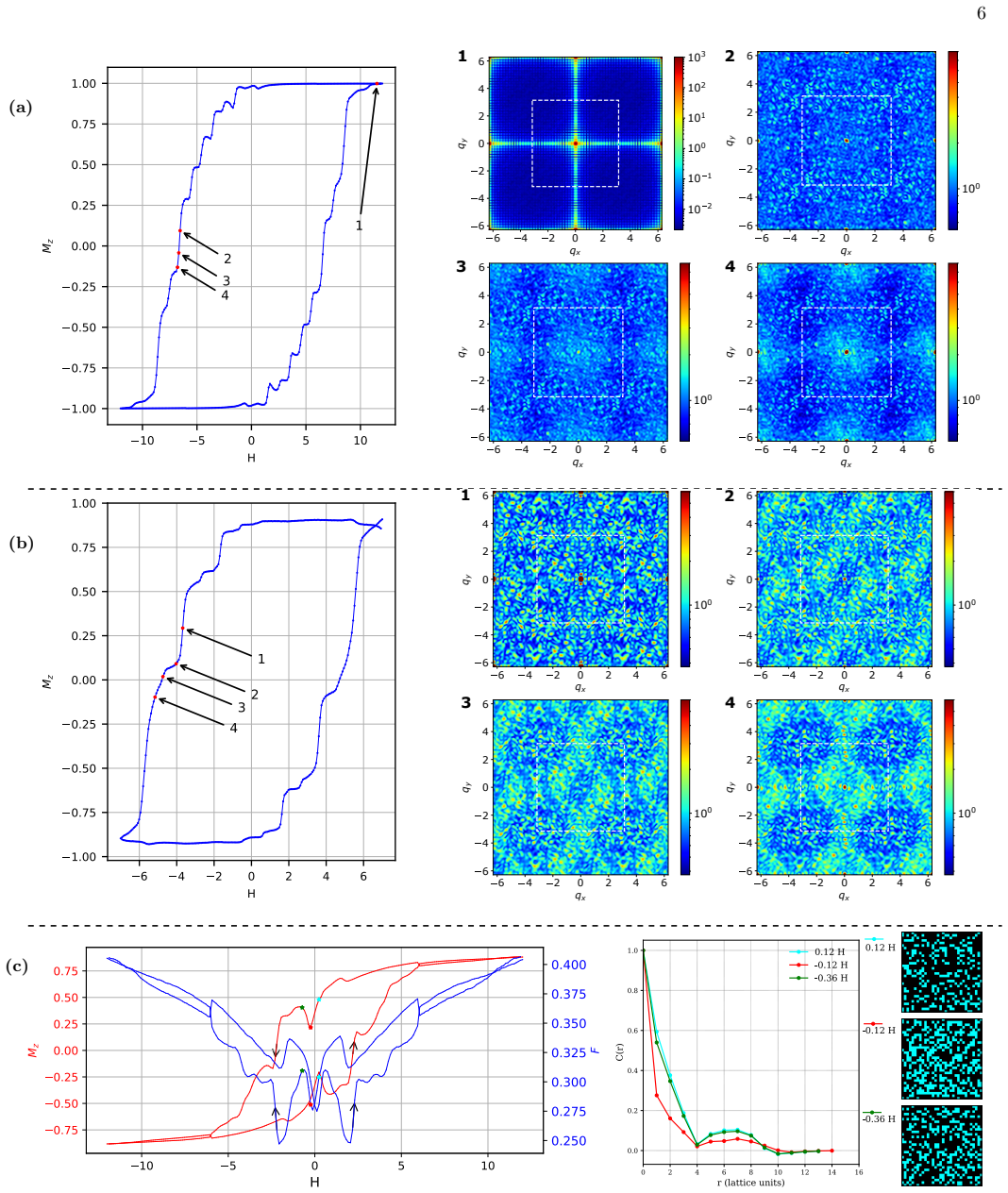
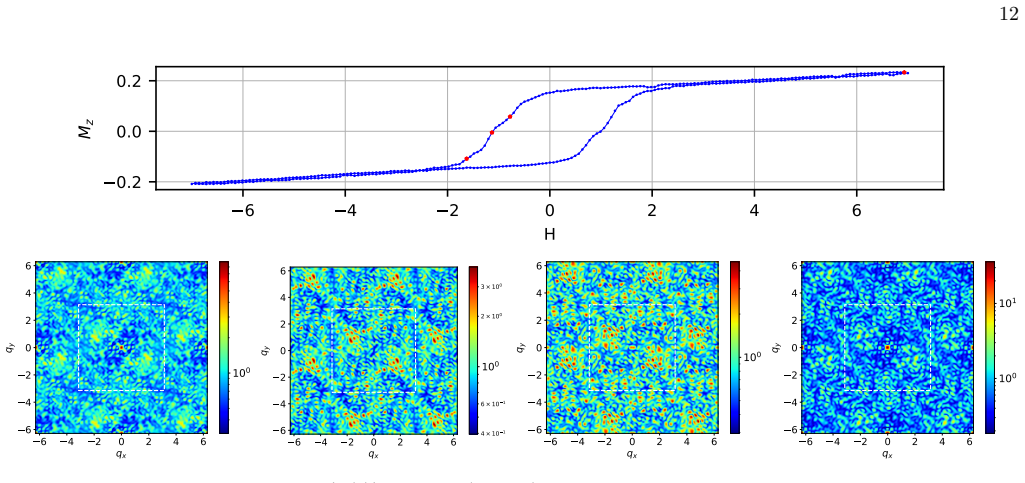
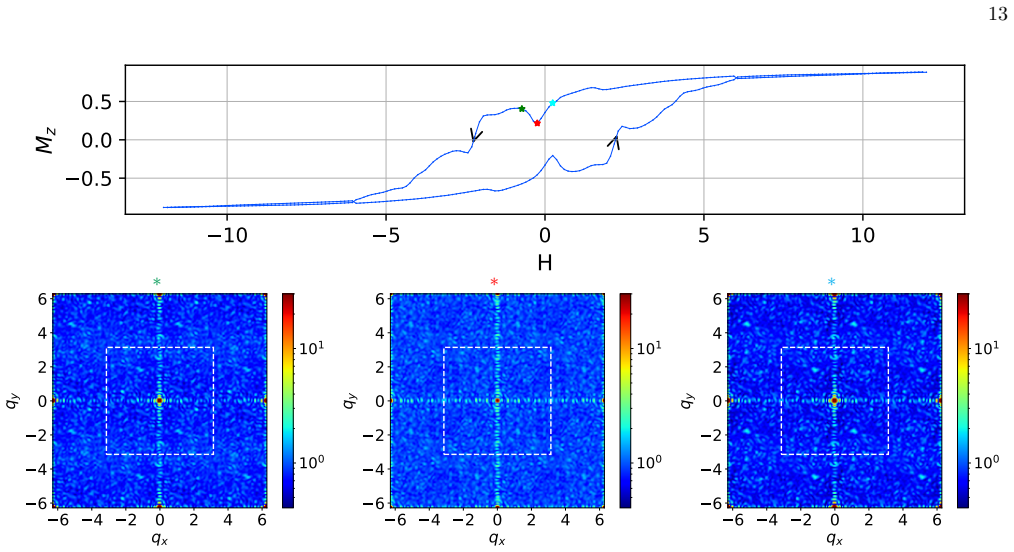
We present the first general protocol to experiment on magnetic hysteresis on programmable quantum annealers, and implement it on three D-Wave superconducting qubit quantum annealers, using up to thousands of spins, for both ferromagnetic and disordered Ising models, and across different graph topologies. We observe hysteresis loops whose area depends non-monotonically on quantum fluctuations, exhibiting both expected and unexpected features, such as disorder-induced steps and non-monotonicities.
What carries the argument
The general protocol that programs the quantum annealer to sweep an effective magnetic field while controlling the annealing schedule to allow quantum tunneling between metastable states.
If this is right
- Hysteresis loops become measurable on quantum annealers with system sizes of thousands of spins.
- Loop area varies non-monotonically with the strength of quantum fluctuations.
- Disorder in the Ising couplings produces distinct steps in the hysteresis curve.
- Quantum annealers can now address non-equilibrium magnetic phenomena in condensed-matter physics.
Where Pith is reading between the lines
- The same protocol could be adapted to study other history-dependent phenomena such as magnetic memory or training in spin glasses on existing hardware.
- Comparing results across different quantum annealing platforms would help separate universal quantum-tunneling signatures from device-specific effects.
- The observed non-monotonicities suggest an optimal fluctuation strength for certain memory or switching applications that future experiments could map systematically.
Load-bearing premise
The protocol isolates quantum-tunneling contributions to the observed hysteresis from classical thermal activation and from hardware noise or readout errors.
What would settle it
Repeating the same field-sweep experiments on the same models but with annealing schedules or device parameters that strongly suppress quantum tunneling, then checking whether the non-monotonic area dependence and disorder-induced steps remain.
Figures







read the original abstract
While quantum annealers have emerged as versatile and controllable platforms for experimenting on correlated spin systems, the important phenomenology of magnetic memory and hysteresis remain unexplored on hardware designed to escape metastable states via quantum tunneling. Here, we present the first general protocol to experiment on magnetic hysteresis on programmable quantum annealers, and implement it on three D-Wave superconducting qubit quantum annealers, using up to thousands of spins, for both ferromagnetic and disordered Ising models, and across different graph topologies. We observe hysteresis loops whose area depends non-monotonically on quantum fluctuations, exhibiting both expected and unexpected features, such as disorder-induced steps and non-monotonicities. Our work establishes quantum annealers as a platform for probing non-equilibrium emergent magnetic phenomena, thereby broadening the role of analog quantum computers into foundational questions in condensed matter physics.
Editorial analysis
A structured set of objections, weighed in public.
Referee Report
Summary. The manuscript presents the first general protocol for magnetic hysteresis experiments on programmable quantum annealers and implements it on three D-Wave superconducting qubit devices using up to thousands of spins for both ferromagnetic and disordered Ising models across different graph topologies. The authors report observing hysteresis loops whose area depends non-monotonically on quantum fluctuations, with features including disorder-induced steps and non-monotonicities, and position this as establishing quantum annealers as a platform for non-equilibrium magnetic phenomena in condensed matter.
Significance. If the quantum-tunneling attribution holds after controls, the work would broaden analog quantum computing into foundational questions of magnetic memory and hysteresis, with the large-scale experimental implementation on hardware being a notable strength. The direct measurement approach avoids some circularity risks common in fitted models.
major comments (2)
- [Abstract and Results] Abstract and main results: The claim that loop area depends non-monotonically on quantum fluctuations (and exhibits disorder-induced steps) is attributed to quantum tunneling, yet the protocol description does not include controls that hold all other parameters fixed while suppressing tunneling (e.g., classical limit runs or explicit temperature variation around the ~15 mK base). This leaves open whether the features arise from tunneling versus thermal activation or hardware noise, directly impacting the interpretation of both expected and unexpected features.
- [Protocol] Protocol and experimental methods: When sweeping the schedule parameter that controls transverse-field strength, the mapping from observed non-monotonicities to quantum origin requires explicit isolation from residual classical paths, finite-temperature effects, or D-Wave annealing/readout artifacts; without such tests the central inference remains the least-secured element of the work.
minor comments (2)
- [Methods] Clarify the precise spin counts, instance generation details, and readout error mitigation steps used for each topology to aid reproducibility.
- [Figures] Add explicit statements of data exclusion rules and error bar definitions in all presented hysteresis loop figures.
Simulated Author's Rebuttal
We thank the referee for their constructive and detailed comments on our manuscript. We address each major comment point by point below, with a focus on strengthening the interpretation of our results.
read point-by-point responses
-
Referee: [Abstract and Results] Abstract and main results: The claim that loop area depends non-monotonically on quantum fluctuations (and exhibits disorder-induced steps) is attributed to quantum tunneling, yet the protocol description does not include controls that hold all other parameters fixed while suppressing tunneling (e.g., classical limit runs or explicit temperature variation around the ~15 mK base). This leaves open whether the features arise from tunneling versus thermal activation or hardware noise, directly impacting the interpretation of both expected and unexpected features.
Authors: We agree that the current manuscript does not present explicit experimental controls, such as classical annealing schedules or systematic temperature variations, that would hold other parameters fixed while suppressing tunneling. Our attribution of the non-monotonic loop-area dependence to quantum tunneling rests on the systematic variation of the transverse-field schedule parameter (the primary experimental knob for quantum fluctuations on these devices) together with consistency across ferromagnetic and disordered models and multiple hardware topologies. To address the referee's concern, we will revise the manuscript to include a dedicated discussion of alternative explanations (thermal activation and readout noise) and add comparisons to classical Monte Carlo simulations of the same hysteresis protocol. revision: yes
-
Referee: [Protocol] Protocol and experimental methods: When sweeping the schedule parameter that controls transverse-field strength, the mapping from observed non-monotonicities to quantum origin requires explicit isolation from residual classical paths, finite-temperature effects, or D-Wave annealing/readout artifacts; without such tests the central inference remains the least-secured element of the work.
Authors: We acknowledge that the mapping from schedule-parameter sweeps to a purely quantum origin would be more secure with additional isolation tests. The protocol is constructed around the standard D-Wave annealing schedule, which varies the transverse field while the longitudinal couplings remain fixed; we have already mitigated device-specific artifacts by repeating the protocol on three distinct processors and two graph topologies. In the revised manuscript we will expand the methods section with an explicit analysis of residual classical paths and finite-temperature effects, and we will incorporate classical simulation benchmarks to quantify how much of the observed non-monotonicity can be reproduced without quantum tunneling. revision: yes
Circularity Check
No circularity: experimental protocol and direct measurements
full rationale
The paper describes an experimental protocol implemented on D-Wave quantum annealers and reports direct observations of hysteresis loops whose areas depend non-monotonically on quantum fluctuations. These are empirical measurements on hardware rather than quantities derived from equations, fitted parameters, or self-referential chains. No load-bearing derivations, self-definitions, or predictions that reduce to inputs by construction appear; the central claims rest on hardware execution and readout against external benchmarks.
Axiom & Free-Parameter Ledger
axioms (1)
- domain assumption The D-Wave device Hamiltonian can be programmed to realize the target Ising model with controllable transverse field for quantum fluctuations.
Lean theorems connected to this paper
-
IndisputableMonolith/Cost/FunctionalEquation.leanwashburn_uniqueness_aczel unclear?
unclearRelation between the paper passage and the cited Recognition theorem.
We present the first general protocol to experiment on magnetic hysteresis on programmable quantum annealers... observe hysteresis loops whose area depends non-monotonically on quantum fluctuations
-
IndisputableMonolith/Foundation/AlexanderDuality.leanalexander_duality_circle_linking unclear?
unclearRelation between the paper passage and the cited Recognition theorem.
H = −Γ ∑ σ̂i_x + ∑ hi σ̂i_z + ∑ Jij σ̂i_z σ̂j_z
What do these tags mean?
- matches
- The paper's claim is directly supported by a theorem in the formal canon.
- supports
- The theorem supports part of the paper's argument, but the paper may add assumptions or extra steps.
- extends
- The paper goes beyond the formal theorem; the theorem is a base layer rather than the whole result.
- uses
- The paper appears to rely on the theorem as machinery.
- contradicts
- The paper's claim conflicts with a theorem or certificate in the canon.
- unclear
- Pith found a possible connection, but the passage is too broad, indirect, or ambiguous to say the theorem truly supports the claim.
Reference graph
Works this paper leans on
-
[1]
A. D. King, J. Raymond, T. Lanting, S. V. Isakov, M. Mohseni, G. Poulin-Lamarre, S. Ejtemaee, W. Bernoudy, I. Ozfidan, A. Y. Smirnov, M. Reis, F. Altomare, M. Babcock, C. Baron, A. J. Berkley, K. Boothby, P. I. Bunyk, H. Christiani, C. Enderud, B. Evert, R. Harris, E. Hoskinson, S. Huang, K. Jooya, A. Khodabandelou, N. Ladizinsky, R. Li, P. A. Lott, A. J....
- [2]
-
[3]
A. D. King, J. Carrasquilla, J. Raymond, I. Ozfidan, E. Andriyash, A. Berkley, M. Reis, T. Lanting, R. Har- ris, F. Altomare, K. Boothby, P. I. Bunyk, C. En- derud, A. Fr´ echette, E. Hoskinson, N. Ladizinsky, T. Oh, G. Poulin-Lamarre, C. Rich, Y. Sato, A. Y. Smirnov, L. J. Swenson, M. H. Volkmann, J. Whittaker, J. Yao, E. Ladizinsky, M. W. Johnson, J. Hi...
work page 2018
-
[4]
P. Kairys, A. D. King, I. Ozfidan, K. Boothby, J. Ray- mond, A. Banerjee, and T. S. Humble, PRX Quantum 1 (2020), 10.1103/prxquantum.1.020320
- [5]
-
[6]
A. D. King, C. Nisoli, E. D. Dahl, G. Poulin-Lamarre, and A. Lopez-Bezanilla, Science 373, 576–580 (2021)
work page 2021
- [7]
-
[8]
G. Semeghini, H. Levine, A. Keesling, S. Ebadi, T. T. Wang, D. Bluvstein, R. Verresen, H. Pichler, M. Kali- nowski, R. Samajdar, et al., Science 374, 1242 (2021)
work page 2021
-
[9]
A. Lopez-Bezanilla, J. Raymond, K. Boothby, J. Car- rasquilla, C. Nisoli, and A. D. King, Nature communi- cations 14, 1105 (2023)
work page 2023
- [10]
-
[11]
S. Morita and H. Nishimori, Journal of Mathematical Physics 49 (2008), 10.1063/1.2995837
-
[12]
Quantum Computation by Adiabatic Evolution
E. Farhi, J. Goldstone, S. Gutmann, and M. Sipser, “Quantum Computation by Adiabatic Evolution,” (2000), arXiv:quant-ph/0001106 [quant-ph]
work page internal anchor Pith review Pith/arXiv arXiv 2000
-
[13]
A. D. King, C. D. Batista, J. Raymond, T. Lanting, I. Oz- fidan, G. Poulin-Lamarre, H. Zhang, and M. H. Amin, PRX Quantum 2, 030317 (2021)
work page 2021
-
[14]
G. E. Santoro, R. Martoˇ n´ ak, E. Tosatti, and R. Car, Science 295, 2427–2430 (2002)
work page 2002
-
[15]
A. Lopez-Bezanilla, A. D. King, C. Nisoli, and A. Sax- ena, Nature Communications 15, 589 (2024)
work page 2024
-
[16]
M. W. Johnson, M. H. Amin, S. Gildert, T. Lanting, F. Hamze, N. Dickson, R. Harris, A. J. Berkley, J. Jo- hansson, P. Bunyk, et al., Nature 473, 194 (2011)
work page 2011
-
[17]
T. Lanting, A. Przybysz, A. Smirnov, F. Spedalieri, M. Amin, A. Berkley, R. Harris, F. Altomare, S. Boixo, P. Bunyk, N. Dickson, C. Enderud, J. Hilton, E. Hoskinson, M. Johnson, E. Ladizinsky, N. Ladizin- sky, R. Neufeld, T. Oh, I. Perminov, C. Rich, M. Thom, E. Tolkacheva, S. Uchaikin, A. Wilson, and G. Rose, Physical Review X 4 (2014), 10.1103/physrevx.4.021041
-
[18]
P. I. Bunyk, E. M. Hoskinson, M. W. Johnson, E. Tolka- cheva, F. Altomare, A. J. Berkley, R. Harris, J. P. Hilton, T. Lanting, A. J. Przybysz, and J. Whittaker, IEEE Transactions on Applied Superconductivity 24, 1–10 (2014)
work page 2014
-
[19]
Pegasus: The second connectivity graph for large-scale quantum annealing hardware
N. Dattani, S. Szalay, and N. Chancellor, (2019), arXiv:1901.07636 [quant-ph]
work page internal anchor Pith review Pith/arXiv arXiv 2019
-
[20]
K. Boothby, P. Bunyk, J. Raymond, and A. Roy, (2020), arXiv:2003.00133 [quant-ph]
-
[21]
Zephyr topology of d-wave quantum processors,
K. Boothby, A. D. King, and J. Raymond, “Zephyr topology of d-wave quantum processors,” (2021)
work page 2021
-
[22]
De Gennes, Solid State Communications1, 132 (1963)
P. De Gennes, Solid State Communications1, 132 (1963)
work page 1963
-
[23]
A. D. King, S. Suzuki, J. Raymond, A. Zucca, T. Lanting, F. Altomare, A. J. Berkley, S. Ejtemaee, E. Hoskinson, S. Huang, et al., Nature Physics 18, 1324 (2022)
work page 2022
-
[24]
A. D. King, A. Nocera, M. M. Rams, J. Dziarmaga, R. Wiersema, W. Bernoudy, J. Raymond, N. Kaushal, N. Heinsdorf, R. Harris, K. Boothby, F. Altomare, A. J. Berkley, M. Boschnak, K. Chern, H. Chris- tiani, S. Cibere, J. Connor, M. H. Dehn, R. Desh- pande, S. Ejtemaee, P. Farr´ e, K. Hamer, E. Hoskin- son, S. Huang, M. W. Johnson, S. Kortas, E. Ladizin- sky,...
-
[25]
A. D. King, J. Raymond, T. Lanting, R. Harris, A. Zucca, F. Altomare, A. J. Berkley, K. Boothby, S. Ejtemaee, C. Enderud, et al., Nature 617, 61 (2023)
work page 2023
-
[26]
J. Tindall, A. Mello, M. Fishman, M. Stoudenmire, and D. Sels, (2025), arXiv:2503.05693 [quant-ph]
- [27]
-
[28]
M. H. Amin, Physical Review A92 (2015), 10.1103/phys- reva.92.052323
-
[29]
Z. Morrell, M. Vuffray, A. Y. Lokhov, A. B¨ artschi, T. Al- bash, and C. Coffrin, Phys. Rev. Appl. 19, 034053 (2023)
work page 2023
-
[30]
J. Marshall, E. G. Rieffel, and I. Hen, Phys. Rev. Appl. 8, 064025 (2017)
work page 2017
-
[31]
C. McCreesh, P. Prosser, and J. Trimble, inInternational Conference on Graph Transformation (Springer, 2020) pp. 316–324
work page 2020
-
[32]
Y. Ozeki and H. Nishimori, Journal of the Physical So- ciety of Japan 56, 3265 (1987)
work page 1987
-
[33]
G. Toulouse et al. , Spin Glass Theory and Beyond: An Introduction to the Replica Method and Its Applications 9, 99 (1987)
work page 1987
- [34]
-
[35]
O. Perkovi´ c, K. Dahmen, and J. P. Sethna, Physical review letters 75, 4528 (1995)
work page 1995
-
[36]
J. P. Sethna, K. A. Dahmen, and C. R. Myers, Nature 410, 242 (2001)
work page 2001
- [37]
-
[38]
L. Callegaro, E. Puppin, and M. Zani, Journal of Physics D: Applied Physics 36, 2036 (2003)
work page 2036
-
[39]
J. Krempask` y, G. Springholz, S. W. D’souza, O. Caha, M. Gmitra, A. Ney, C. Vaz, C. Piamonteze, M. Fan- ciulli, D. Kriegner, et al. , Nature Communications 14, 6127 (2023)
work page 2023
-
[40]
R. Yoshimi, K. Yasuda, A. Tsukazaki, K. Takahashi, M. Kawasaki, and Y. Tokura, Science advances 4, eaat9989 (2018)
work page 2018
-
[41]
E. ¨Ostman, U. B. Arnalds, E. Melander, V. Kapaklis, G. K. P´ alsson, A. Y. Saw, M. A. Verschuuren, F. Kro- nast, E. T. Papaioannou, C. S. Fadley,et al., New Journal of Physics 16, 053002 (2014)
work page 2014
-
[42]
J. A. Baldwin Jr and F. Milstein, Journal of Applied Physics 44, 4739 (1973)
work page 1973
-
[43]
S. Sabhapandit, D. Dhar, and P. Shukla, Physical Re- view Letters 88, 197202 (2002)
work page 2002
-
[44]
5 MSF plots used capped |S(q)| when plotting the heatmaps
For improved visualization clarity, Fig. 5 MSF plots used capped |S(q)| when plotting the heatmaps. Specifically, for all MSFs in panel (a), |S(q)| was capped at 8, and for panel (b) they were capped at |S(q)| = 6
-
[45]
This field is referred to as h-gain in the D-Wave hardware control parameters, but we will refer to this interchange- ably as the longitudinal field or the h-gain field
-
[46]
These QPUs do actually allow faster annealing times, down to 5 nanoseconds, but in that regime modified transverse field schedule control as well as longitudinal field control is not supported and therefore this protocol can not be applied in the anneal time regime of less than 500 nanoseconds
-
[47]
S. K. Lam, A. Pitrou, and S. Seibert, in Proceedings of the Second Workshop on the LLVM Compiler Infras- tructure in HPC , LLVM ’15 (Association for Computing Machinery, New York, NY, USA, 2015)
work page 2015
-
[48]
A. A. Hagberg, D. A. Schult, and P. J. Swart, in Proceed- ings of the 7th Python in Science Conference , edited by G. Varoquaux, T. Vaught, and J. Millman (Pasadena, CA USA, 2008) pp. 11 – 15
work page 2008
-
[49]
C. R. Harris, K. J. Millman, S. J. van der Walt, R. Gom- mers, P. Virtanen, D. Cournapeau, E. Wieser, J. Tay- lor, S. Berg, N. J. Smith, R. Kern, M. Picus, S. Hoyer, M. H. van Kerkwijk, M. Brett, A. Haldane, J. F. del R´ ıo, M. Wiebe, P. Peterson, P. G´ erard-Marchant, K. Shep- pard, T. Reddy, W. Weckesser, H. Abbasi, C. Gohlke, and T. E. Oliphant, Nature...
work page 2020
-
[50]
F. N. Fritsch and J. Butland, SIAM Journal on Scientific and Statistical Computing 5, 300 (1984), https://doi.org/10.1137/0905021
-
[51]
P. Virtanen, R. Gommers, T. E. Oliphant, M. Haber- land, T. Reddy, D. Cournapeau, E. Burovski, P. Pe- terson, W. Weckesser, J. Bright, S. J. van der Walt, M. Brett, J. Wilson, K. J. Millman, N. Mayorov, A. R. J. Nelson, E. Jones, R. Kern, E. Larson, C. J. Carey, ˙I. Po- lat, Y. Feng, E. W. Moore, J. VanderPlas, D. Laxalde, J. Perktold, R. Cimrman, I. Henr...
work page 2020
discussion (0)
Sign in with ORCID, Apple, or X to comment. Anyone can read and Pith papers without signing in.