REVIEW 4 major objections 7 minor 38 references
From Generality to Mastery: Composer-Style Symbolic Music Generation via Large-Scale Pre-training
T0 review · 4 major / 7 minor · reviewed 2026-08-06 · deepseek-v4-flash
Pith's one-line read A two-stage recipe—large-scale pre-training followed by lightweight adapter fine-tuning—yields more accurate composer-style generation and higher musicality than training from scratch or a much larger baseline.
desk verdict Solid engineering, but the style-accuracy claim rests on a classifier trained on the same corpus as the fine-tuning data. read the letter →
The pith
A machine-rendered reading of the paper's core claim, the machinery that carries it, and where it could break.
The reading
What carries the argument
The central mechanism is a two-stage training pipeline built on an extended REMI tokenization. REMI represents music as a sequence of bar, beat, tempo, note-pitch and note-duration events; the paper extends it with time-signature tokens and a tempo token quantized to four values. A transformer decoder is first trained for next-token prediction on a corpus of ~1.28M bars with a uniform [None] composer token, then fine-tuned on ~891 pieces from Bach, Mozart, Beethoven and Chopin with a composer token prepended. The 'style adapter' is a small two-layer MLP inserted after even decoder layers; it concatenates the composer embedding with the layer's hidden state, computes a style bias through a GELU nonlinearity, and adds it back to the hidden state through a residual connection. This adapter carries the composer-conditioning signal and keeps fine-tuning parameter-efficient. The extended REMI representation with finer grid resolution and five time signatures is what lets the model represent the structural variety in the training data.
What would settle it
A controlled listening test that removes the two-choose-one chance baseline — e.g., asking participants to rank or rate samples from Mastery and Scratch side by side for each composer, with Bach included — would settle whether the fine-tuned model's style fidelity is real. The paper's own data show user Bach selection at chance, so an experiment of this kind is the direct falsifier.
Extended reading notes
Core claim
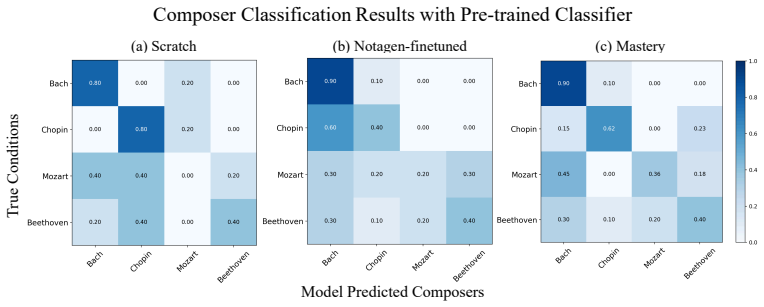
On the paper's own terms, the discovery is that a small (~46M parameter) transformer decoder, pre-trained on a large unlabeled corpus and then fine-tuned with a per-composer adapter, can match or beat a much larger (0.5B) system, NotaGen, at composer-style accuracy. The fine-tuned 'Mastery' model produced higher pitch-class entropy and competitive groove similarity, was classified as the correct composer more often for Mozart and Beethoven, and, in a 54-participant listening test, scored higher on musicality than the from-scratch ablation and the baselines. Chord-progression analysis shows the Mastery model's top progressions overlap more with real training data, and Fréchet distances to real data are lower for most composers. The authors interpret this as evidence that general pre-training builds a foundation of compositional patterns that prevents overfitting during composer-specific fine-tuning, while the adapters specialize the model without catastrophic forgetting.
Load-bearing premise
The paper's central claim stands on the assumption that its evaluation instruments — a composer classifier with 77.6% validation accuracy and a 54-participant listening test — faithfully measure composer-style accuracy and musicality in a way that generalizes beyond the specific generated samples.
Editorial extensions
If this is right
- If correct, the two-stage scheme (general pre-training + lightweight style adapters) becomes a recipe for style-conditioned generation on any scarce-data control modality, not only composer identity.
- The finding that pre-training prevents overfitting suggests that larger, more diverse pre-training corpora should improve composer-style fidelity further, even when composer-specific data stays small.
- The adapter's parameter efficiency implies that adding new composers requires retraining only the small adapter modules, not the full model.
- The chord-progression and Fréchet-distance analyses provide a template for evaluating stylistic fidelity beyond single classification accuracy.
- The observed reduction in generation choice diversity after fine-tuning indicates a trade-off between stylistic specificity and output diversity that future work must manage.
Reading between the lines
- A testable extension the paper does not run: applying the same two-stage recipe to a different condition, such as emotion tags or historical era, to see whether the generality-to-mastery transfer generalizes across control modalities.
- The composer classifier's 77.6% validation accuracy and the chance-level user identification of Bach samples suggest the style-accuracy results for Bach specifically may be weaker than the overall trend; a more discriminative Bach evaluation could flip the per-composer ranking.
- The paper's own limitation notes suggest the adapter's local stylistic bias might constrain long-term structure; one could measure structureness over longer windows (e.g., >9 seconds) to see whether the Mastery model's lower long-term structureness is a stable deficit or an artifact of the chosen metric.
- Pre-training on a corpus that includes the four target composers' works is explicitly excluded; including periphery works or other classical composers could change the transfer, so the recipe is sensitive to corpus composition.
Editorial analysis
A structured set of objections, weighed in public.
Referee Report
Summary. The paper proposes a two-stage training framework for composer-style symbolic music generation. In the first stage, a REMI-based transformer decoder is pre-trained on a large corpus of pop, folk, and classical music; in the second stage, it is fine-tuned on a small, human-curated dataset of works by Bach, Mozart, Beethoven, and Chopin using lightweight adapter modules that inject composer indicators. The authors evaluate the approach with objective metrics (pitch-class entropy, groove-pattern similarity, structureness), a composer-classification task on generated samples, chord-progression overlap analyses, Fréchet Audio Distances, and a 54-participant listening test. They report that the two-stage model outperforms the from-scratch and pre-training-only ablations, as well as NotaGen, REMI, and Emo-Disentangler, on style accuracy and musicality, and conclude that large-scale generality pre-training enhances composer-specific mastery.
Significance. If the reported results hold, the two-stage paradigm provides a simple and reproducible recipe for data-efficient style control in symbolic music generation, and the analysis of how pre-training shapes composer-specific fine-tuning is of interest to the AI-music-creation community. The paper ships open-source code and datasets, and its extensive post-hoc analyses of note choices, chord progressions, and embedding distances go beyond a bare generation benchmark. However, the central claim of 'more precise composer-style modeling' is currently supported by evaluation instruments whose independence is compromised, and the subjective results are partially contradictory to that claim; the significance is therefore conditional on a more rigorous evaluation.
major comments (4)
- [§4.1.1, §5.2, Figure 3] The composer classifier used to measure style accuracy is trained on the Drengskapur (2024) dataset, and Section 4.1.1 states that the four-composer fine-tuning set is also drawn from this same collection. The Mastery model is therefore judged by a classifier that was trained on the very corpus on which the model was fine-tuned; the high diagonal accuracy in Figure 3 may reflect distributional closeness to the exact training pieces rather than a generalizable composer-style representation. The same concern applies to the MIDI-Bert embedding 'fine-tuned for composer classification' used in Table 9. To substantiate the central claim, the authors should evaluate with a classifier trained on data that does not overlap with the fine-tuning set, report per-composer confidence intervals, and show that the classifier generalizes to held-out works of these composers from an independent collection.
- [§6, Figure 4] The subjective results do not support the abstract's claim that Mastery achieves 'more precise composer-style modeling.' For Bach, both Mastery and NotaGen performance is at chance level, and the Scratch model (without pre-training) attains the highest composer-style selection accuracy overall. The paper's explanation that Scratch overfits addresses musicality, not style accuracy, so the evidence as presented is contradictory. Moreover, with 54 participants and 10 questions each, the per-cell sample sizes are small, and no statistical tests are reported. The authors should provide per-composer response counts, exact binomial tests against chance, and a reconciliation of the objective and subjective results.
- [§5.1, Table 3] The objective quality metrics are reported as mean±std without significance tests, confidence intervals, or effect sizes, and several differences are within one standard deviation (e.g., GS 0.96±0.04 vs NotaGen 0.97±0.02; SI_short 0.31±0.07 vs 0.35±0.07). In addition, the interpretation of pitch-class entropy is ambiguous: Section 5.1.1 describes high entropy as indicating 'ambiguity,' yet the paper later treats the highest entropy as an advantage. The authors should report the number of generated samples, standard errors, paired significance tests, and a clear justification for the desired direction of each metric.
- [§4.2.1, §4.3] The adapter module is a stated contribution of the method, but no ablation compares adapter-based fine-tuning against full model fine-tuning or against a simple composer-token-conditioned baseline within the same two-stage pipeline. Without this comparison, the specific role of the adapter in the reported gains is not established. The authors should add such an ablation and evaluate it with the same objective and subjective protocols.
minor comments (7)
- [§3.1.3] The symbols for note durations appear as corrupted glyphs in the rendered text (e.g., 'ˇ' and '¯'); the intended musical notation should be typeset correctly.
- [§5.1.3] The structureness metric SI_l^u(S) is defined ambiguously: it should be written explicitly as a maximum over matrix entries S[i,j] with i in [l,u] and j in [1,N].
- [§5.2] The classifier details are incomplete: the authors should report the data split, the number of training and validation pieces per composer, and the preprocessing pipeline used for the classifier, since the 77.6% validation accuracy alone is insufficient context.
- [§7.3] For the Fréchet Audio Distance results, the paper should state how the 'real data' reference sample is obtained, including the number of sequences and whether they are the same pieces used in training, and how the embedding statistics are estimated.
- [§4.1.1] The sentence 'and the rest in Mastery' is ambiguous; the authors should clarify that the remaining classical pieces are used in the pre-training stage.
- [References and text] The spelling of the baseline model is inconsistent ('NotaGen' vs 'Notagen'), and the NotaGen reference (Wang et al., 2025) lacks a venue or arXiv identifier.
- [Table 3] The header 'SI' spans three columns; the columns should be separated into SI_short, SImid, and SI_long for readability.
Circularity Check
No significant circularity: the central two-stage training claim is tested against external baselines and ablations, and the evaluation-instrument overlaps noted by the reader are validity concerns, not reductions of the predictions to the model's own inputs.
full rationale
The paper's load-bearing claim is that large-scale generality pre-training followed by composer-specific fine-tuning outperforms training from scratch and existing baselines. This is supported by differential comparisons among the Mastery model, the Scratch ablation, and external models (NotaGen, REMI, Emo-Disentangler) on objective metrics computed from generated samples (Tables 3, 5, 8, 9; Figures 3-4). The composer classifier in Section 5.2 is trained on real compositions of the four target composers from Drengskapur (2024), and Section 4.1.1 states that the same collection is a source of the fine-tuning data. However, the classifier is not trained on the model's outputs and is used as a fixed evaluation instrument; the Mastery-vs-Scratch comparison is still a differential test of whether pre-training helps, not a tautology. Similarly, the chord-progression overlap and Fréchet Audio Distance comparisons in Sections 7.2-7.3 measure closeness to the training distribution, which is a relevant objective for a style-capture task; both Mastery and Scratch are trained on the same fine-tuning data, so the comparison remains informative. All self-citations (POP909, PianoTree, Emo-Disentangler) are dataset, representation, or baseline citations and are not load-bearing for the central derivation. No equation is used both as an input and as the predicted output, and no fitted parameter is relabeled as a prediction. The evaluation-instrument overlap noted in the reader's take is a legitimate external-validity limitation, not a circularity, and is better addressed as a correctness risk than as a circularity finding.
Assumptions & free parameters
free parameters (3)
- Tempo quantization categories =
40, 80, 120, 160 BPM
- Nucleus sampling parameters =
p=0.99, tau=1.1 for composer-conditioned models, tau=1.0 for generality
- Adapter placement and dimension =
five adapters after even layers except the last, two-layer MLP with GELU
assumptions (3)
- domain assumption The extended REMI representation with 12-grid quarter-note resolution and 6-grid eighth-note resolution captures sufficient musical detail for composer-style modeling.
- domain assumption The classification accuracy of a transformer classifier trained on the same data distribution is a valid proxy for 'composer style' of generated samples.
- domain assumption The audio embeddings used for Fréchet distances (CLaMP 3 and MIDI-Bert fine-tuned for composer classification) are sensitive to style differences in a meaningful way.
Cite this review
Pith. "Pith review of From Generality to Mastery: Composer-Style Symbolic Music Generation via Large-Scale Pre-training." pith.science (2026). https://pith.science/paper/QOLBEPIN
@misc{pith2026250617497,
  author       = {Pith},
  title        = {Pith review of: From Generality to Mastery: Composer-Style Symbolic Music Generation via Large-Scale Pre-training},
  year         = {2026},
  howpublished = {\url{https://pith.science/paper/QOLBEPIN}},
  note         = {Machine review of arXiv:2506.17497}
}
read the original abstract
Despite progress in controllable symbolic music generation, data scarcity remains a challenge for certain control modalities. Composer-style music generation is a prime example, as only a few pieces per composer are available, limiting the modeling of both styles and fundamental music elements (e.g., melody, chord, rhythm). In this paper, we investigate how general music knowledge learned from a broad corpus can enhance the mastery of specific composer styles, with a focus on piano piece generation. Our approach follows a two-stage training paradigm. First, we pre-train a REMI-based music generation model on a large corpus of pop, folk, and classical music. Then, we fine-tune it on a small, human-verified dataset from four renowned composers, namely Bach, Mozart, Beethoven, and Chopin, using a lightweight adapter module to condition the model on style indicators. To evaluate the effectiveness of our approach, we conduct both objective and subjective evaluations on style accuracy and musicality. Experimental results demonstrate that our method outperforms ablations and baselines, achieving more precise composer-style modeling and better musical aesthetics. Additionally, we provide observations on how the model builds music concepts from the generality pre-training and refines its stylistic understanding through the mastery fine-tuning.
Figures


Figures from the paper (2 more)


Reference graph
Works this paper leans on
-
[1]
Bang, H., Choi, E., Finch, M., Doh, S., Lee, S., Lee, G.-H., and Nam, J. (2024). PIAST : A multimodal piano dataset with audio, symbolic and text. In Kruspe, A., Oramas, S., Epure, E. V., Sordo, M., Weck, B., Doh, S., Won, M., Manco, I., and Meseguer-Brocal, G., editors, Proceedings of the 3rd Workshop on NLP for Music and Audio (NLP4MusA) , pages 5--10, ...
work page 2024
-
[2]
Burkholder, J. P., Grout, D. J., and Palisca, C. V. (2010). A History of Western Music . W. W. Norton & Company, New York, 8th edition
work page 2010
-
[3]
Carter, E. (2002). Harmony Book . Carl Fischer Music
work page 2002
-
[4]
Chen, K., i Wang, C., Berg-Kirkpatrick, T., and Dubnov, S. (2020). Music sketchnet: Controllable music generation via factorized representations of pitch and rhythm. In Proceedings of the 21th International Society for Music Information Retrieval Conference, ISMIR
work page 2020
-
[5]
Chou, Y.-H., Chen, I.-C., Chang, C.-J., Ching, J., and Yang, Y.-H. (2021). MidiBERT-Piano : Large-scale pre-training for symbolic music understanding. arXiv preprint arXiv:2107.05223
arXiv 2021
-
[6]
Dai, S., Zhang, H., and Dannenberg, R. B. (2020). Automatic analysis and influence of hierarchical structure on melody, rhythm and harmony in popular music. In Proc. AIMC
work page 2020
-
[7]
DCMLab (2023). dcml\_corpora. https://github.com/DCMLab/dcml_corpora. GitHub repository, accessed March 27, 2025
work page 2023
-
[8]
Drengskapur (2024). Midi classical music dataset. https://huggingface.co/datasets/drengskapur/midi-classical-music. Hugging Face dataset; accessed March 27, 2025
work page 2024
Show all 38 references
-
[9]
Hadjeres, G., Pachet, F., and Nielsen, F. (2017). D eep B ach: a steerable model for B ach chorales generation. In Proc. ICLR , pages 1362--1371
2017
-
[10]
Holtzman, A., Buys, J., Du, L., Forbes, M., and Choi, Y. (2020). The curious case of neural text degeneration. In Proc. ICLR
2020
-
[11]
Houlsby, N., Giurgiu, A., Jastrzebski, S., Morrone, B., De Laroussilhe, Q., Gesmundo, A., Attariyan, M., and Gelly, S. (2019). Parameter-efficient transfer learning for NLP . In Proc. ICML
2019
-
[12]
Hsiao, W., Liu, J., Yeh, Y., and Yang, Y.-H. (2021). Compound Word Transformer : Learning to compose full-song music over dynamic directed hypergraphs. In Proc. AAAI
2021
-
[13]
A., Vaswani, A., Uszkoreit, J., Simon, I., Hawthorne, C., Shazeer, N., Dai, A
Huang, C.-Z. A., Vaswani, A., Uszkoreit, J., Simon, I., Hawthorne, C., Shazeer, N., Dai, A. M., Hoffman, M. D., Dinculescu, M., and Eck, D. (2019). Music Transformer : Generating music with long-term structure. In Proc. ICLR
2019
-
[14]
Huang, J., Chen, K., and Yang, Y.-H. (2024). Emotion-driven piano music generation via two-stage disentanglement and functional representation. In Proc. ISMIR
2024
-
[15]
and Yang, Y.-H
Huang, Y.-S. and Yang, Y.-H. (2020). Pop Music Transformer : Beat-based modeling and generation of expressive pop piano compositions. In Proc. ACM Multimed
2020
-
[16]
Hung, H., Ching, J., Doh, S., Kim, N., Nam, J., and Yang, Y.-H. (2021). EMOPIA: A multi-modal pop piano dataset for emotion recognition and emotion-based music generation. In Proc. ISMIR
2021
-
[17]
and Kekäläinen, J
Järvelin, K. and Kekäläinen, J. (2002). Cumulated gain-based evaluation of ir techniques. ACM Trans. Inf. Syst. , 20:422--446
2002
-
[18]
Kilgour, K., Zuluaga, M., Roblek, D., and Sharifi, M. (2019). Fréchet audio distance: A metric for evaluating music enhancement algorithms. Proc. INTERSPEECH
2019
-
[19]
Kingma, D. P. and Ba, J. (2015). Adam: A method for stochastic optimization. In Proc. ICLR
2015
-
[20]
Classical piano music page
Krueger (1996). Classical piano music page. http://piano-midi.de/. Accessed March 27, 2025
1996
-
[21]
Long, P., Novack, Z., Berg-Kirkpatrick, T., and McAuley, J. (2025). Pdmx: A large-scale public domain musicxml dataset for symbolic music processing. In ICASSP 2025 - 2025 IEEE International Conference on Acoustics, Speech and Signal Processing (ICASSP) , pages 1--5
2025
-
[22]
Lu, P., Xu, X., Kang, C., Yu, B., Xing, C., Tan, X., and Bian, J. (2023). MuseCoco : Generating symbolic music from text. CoRR , abs/2306.00110
2023 arXiv
-
[23]
OpenAI (2019). Musenet. Accessed: March 27, 2025
2019
-
[24]
I nside the J azzomat - N ew P erspectives for J azz R esearch
Pfleiderer, M., Frieler, K., Abe er, J., Zaddach, W.-G., and Burkhart, B., editors (2017). I nside the J azzomat - N ew P erspectives for J azz R esearch . Schott Campus
2017
-
[25]
Roberts, A., Engel, J., Raffel, C., Simon, I., and Hawthorne, C. (2018). Musicvae: Creating a palette for musical scores with machine learning. https://magenta.tensorflow.org/music-vae. Accessed: 2025-03-29
2018
-
[26]
Sapp, C. S. (2005). Online database of scores in the humdrum file format. In Proc. ISMIR
2005
-
[27]
Shaw, P., Uszkoreit, J., and Vaswani, A. (2018). Self-attention with relative position representations. In Proc. North American Chapter of the Association for Computational Linguistics: Human Language Technologies
2018
-
[28]
N., Kaiser, L., and Polosukhin, I
Vaswani, A., Shazeer, N., Parmar, N., Uszkoreit, J., Jones, L., Gomez, A. N., Kaiser, L., and Polosukhin, I. (2017). Attention is all you need. In Proc. NeurIPS
2017
-
[29]
von Rütte, D., Biggio, L., Kilcher, Y., and Hofmann, T. (2023). Figaro: Controllable music generation using learned and expert features. In Proc. ICLR
2023
-
[30]
Wang, Y., Wu, S., Hu, J., Du, X., Peng, Y., Huang, Y., Fan, S., Li, X., Yu, F., and Sun, M. (2025). Notagen: Advancing musicality in symbolic music generation with large language model training paradigms
2025
-
[31]
Wang, Z., Chen, K., Jiang, J., Zhang, Y., Xu, M., Dai, S., and Xia, G. (2020a). POP909: A pop-song dataset for music arrangement generation. In Proc. ISMIR
2020
-
[32]
and Xia, G
Wang, Z. and Xia, G. (2021). Musebert: Pre-training of music representation for music understanding and controllable generation. In Proc. ISMIR
2021
-
[33]
Wang, Z., Zhang, Y., Zhang, Y., Jiang, J., Yang, R., Xia, G., and Zhao, J. (2020b). Pianotree vae: Structured representation learning for polyphonic music. In Proc. ISMIR , pages 368--375
2020
-
[34]
Wu, S., Guo, Z., Yuan, R., Jiang, J., Doh, S., Xia, G., Nam, J., Li, X., Yu, F., and Sun, M. (2025). Clamp 3: Universal music information retrieval across unaligned modalities and unseen languages
2025
-
[35]
and Yang, Y.-H
Wu, S.-L. and Yang, Y.-H. (2023). Compose & Embellish : Well-structured piano performance generation via a two-stage approach. In Proc. ICASSP
2023
-
[36]
Yang, R., Wang, D., Wang, Z., Chen, T., Jiang, J., and Xia, G. (2019). Deep music analogy via latent representation disentanglement. In Proc. ISMIR , pages 596--603
2019
-
[37]
Zeng, M., Tan, X., Wang, R., Ju, Z., Qin, T., and Liu, T.-Y. (2021). Musicbert: Symbolic music understanding with large-scale pre-training. In Proc. ACL
2021
-
[38]
Zhang, H., Karystinaios, E., Dixon, S., Widmer, G., and Cancino-Chac \'o n, C. E. (2023). Symbolic music representations for classification tasks: A systematic evaluation. In Proc. ISMIR
2023
Reviewed August 6, 2026 · model on record in the stance chip above.
Discussion (0). Sign in to comment.