REVIEW 4 major objections 6 minor 70 references
VReaves: Eavesdropping on Virtual Reality App Identity and Activity via Electromagnetic Side Channels
T0 review · 4 major / 6 minor · reviewed 2026-08-06 · deepseek-v4-flash
Pith's one-line read VReaves uses electromagnetic emanations from a VR headset to identify which of 15 apps a user is running and which of four activities they are performing, with 99% reported accuracy on both tasks.
desk verdict First EM side-channel on VR headsets with a credible core observation, but the 99% accuracy is built on same-session random splits that leak session context, so the generalization claim is unproven. read the letter →
The pith
A machine-rendered reading of the paper's core claim, the machinery that carries it, and where it could break.
The reading
What carries the argument
The load-bearing mechanism is a signal-processing pipeline that turns raw IQ samples into clean spectral images: movmedian noise-floor smoothing across scanned 10 MHz bands below 1 GHz, sliding-window spectrum subtraction to suppress quasi-stable ambient wireless signals, and non-coherent averaging of FFTs over time to lift weak emanation spikes above the noise. The classifiers are fine-tuned pre-trained ResNet18 networks, one fed with concatenated FFT outputs from multiple frequency bands for app identity and one fed with STFT spectrograms for activity recognition. The physical premise is that computational activity couples with clock signals through hardware components to produce emanation spikes, so the novel step is treating the entire headset as a multi-source radiator and letting a convolutional network separate the interleaved sources.
What would settle it
Collect emanation traces from the same VR apps on different days, in different rooms, and with different users, then train VReaves on one session and test it on another; if cross-session accuracy falls well below the reported 99%, the model was reading session-specific artifacts rather than a stable app-computation fingerprint.
Extended reading notes
Core claim
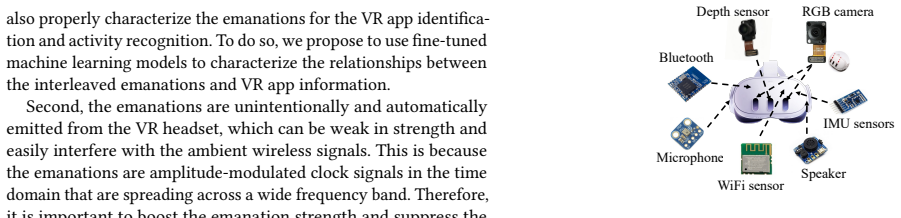
The paper claims that the electromagnetic emanations from a VR headset are amplitude-modulated clock signals whose frequency spectrum and time-frequency spectrogram encode the computational activity of the camera, display, microphone, radio, and memory subsystems. Because different apps impose different computational patterns, the averaged FFT profiles of the emanations differ enough that a fine-tuned ResNet can distinguish fifteen VR apps; because activities change the temporal structure of the emanations, STFT spectrograms allow a second ResNet to distinguish entering, configuring, running, and exiting. The reported result is 99% accuracy for app identification and 99% accuracy for activity recognition, with accuracy staying near that level across tested distances, orientations, frequency bands, and two headset models.
Load-bearing premise
The emanation pattern assigned to each app and activity is stable across users, sessions, and environments, yet the evaluation trains and tests on random splits of one data-collection campaign, so the reported 99% accuracy may reflect session-specific artifacts rather than the app's computational fingerprint alone.
Editorial extensions
If this is right
- A nearby attacker can silently track which VR app a person uses and when they enter, configure, run, or exit it, without installing anything on the victim's device.
- The same pipeline could plausibly be applied to other head-mounted displays and wearable devices, since the emanation sources are generic hardware components rather than app-specific code paths.
- Defenders cannot rely on shielding or jamming alone, because emanations are emitted automatically from multiple sensors, so countermeasures would need to alter the computational activity itself or obfuscate the emanation spectrum.
- Activity recognition can expose behavioral structure, such as how long a user spends configuring versus playing, which feeds into inferences about the user's habits and personality.
- If the relationship between emanations and computational activity holds, the attack may extend beyond app identity to video content and scene reconstruction, as the paper explicitly proposes as future work.
Reading between the lines
- This editorially inferred caveat is central: the evaluation uses random splits of a single data-collection campaign, so the 99% accuracy may partly reflect session-specific artifacts such as room RF background, user body position, or headset placement; a cross-session and cross-user test is the immediate test of generality.
- The accuracy differences are likely tied to rendering and sensor workload, so apps with similar graphics load or similar sensor usage may be harder to separate than the fifteen-app set suggests.
- The paper's proposed obfuscation countermeasure implies a testable defensive extension: running a daemon with randomized computational activity should measurably degrade the FFT and STFT separability of app classes.
- If this result generalizes, app stores and VR platforms face a new privacy trade-off: immersive apps that use more sensors and rendering produce stronger, more identifiable emanation fingerprints.
Editorial analysis
A structured set of objections, weighed in public.
Referee Report
Summary. This paper proposes VReaves, a passive electromagnetic (EM) side-channel attack against VR headsets. The authors use a USRP N210 and directional antenna to capture unintentional emanations from a Meta Quest 3 and HTC VIVE XR Elite, then apply a signal-processing pipeline of noise-floor smoothing, ambient interference subtraction, and averaging FFT/STFT to produce frequency-domain and spectrogram features. A fine-tuned ResNet is trained to identify 15 VR app identities and 4 app activities (entering, configuring, running, exiting), with reported accuracies around 99%. The paper also reports microbenchmarks for distance, orientation, number of frequency bands, emanation duration, and headset model, plus a case study with the receiver hidden in a backpack.
Significance. If the 99% accuracy held across users, sessions, and environments, VReaves would be a notable privacy threat: it would enable passive, malware-free identification of VR app identity and user activity from a distance using COTS hardware. The work is among the first to target VR headsets with EM side channels, and it has concrete strengths: real SDR measurements, two commercial headsets, a detailed signal-processing pipeline, a comparison against LSTM/transformer baselines, and an explicit limitations section (Sec. 8.2). I do not see a circularity problem in Eqs. (1)-(5); they are standard signal models, and the reported accuracy is an empirical supervised-learning result rather than a quantity derived from those equations. The central weakness is that the evaluation does not separate sessions or users, so the reported accuracy may reflect recording context rather than stable app/activity signatures.
major comments (4)
- [Sec. 6 / Sec. 7.1] The reported 99% accuracy is based on a single random 70/15/15 split of IQ chunks from continuous recordings (Sec. 7.1). Adjacent chunks share the same headset, user position, antenna placement, room RF background, and time period, so a random split leaks session context into the training set and can produce near-perfect accuracy even if the model has not learned app-specific features. The text does not state the number of participants or sessions, and Sec. 8.2 later restricts the attack to a single targeted user. Please add leave-one-session-out and leave-one-user-out evaluations, specify the collection timeline, and report per-session accuracy with confidence intervals.
- [Sec. 7.2] The case study claims a concealed-setup accuracy of about 0.99, but it uses the model 'well-trained in the subsection 7.1' on data whose temporal, room, and session relationship to the case-study recording is not reported. If the training set includes chunks from the same session or the same user position, the case study is not an independent validation of generalization. Please train the model only on data collected before the case-study session, or explicitly demonstrate that no training chunk overlaps the case-study recording.
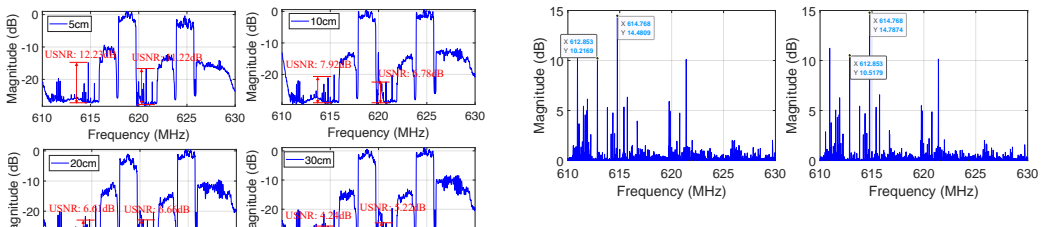
- [Sec. 7.3.6 / Figs. 30-31] Fig. 30 shows USNR below 1 dB at several orientations (e.g., 0°, 180°, 225°, 315°), yet Fig. 31 reports app identification and activity recognition accuracy near 0.96 at those same orientations. If the emanation spikes are below the noise floor after averaging, the classifier must be relying on some stable cue other than the claimed app/activity emanation signature; the most parsimonious candidate is recording context shared between training and test chunks. This tension needs a control experiment, such as testing at a low-USNR orientation on data from a different session, and an explanation of which feature drives classification there.
- [Sec. 7.3.1] The cross-headset experiment trains and evaluates a separate model for each headset, so it does not test cross-hardware transfer. The statement in that section that the subtraction method can 'eliminate the hardware-dependent artifacts' is therefore not supported by the reported experiment. Please include a transfer test (train on one headset and test on the other for overlapping apps) or explicitly restate the claim as device-specific performance.
minor comments (6)
- [Sec. 5.1 / Fig. 14] The averaging-gain calculation is incorrect: (14.7874-14.4809)/14.4809 is approximately 0.021, not 0.2, and expressing this as 'dB per second' is dimensionally inconsistent.
- [Sec. 5.2 / Eq. (3)] The text says 'rewrite the spectrum expression' but Eq. (3) is a time-domain sum of sinusoids; please correct the wording and specify the summation bounds.
- [Sec. 6 / Fig. 20 / Sec. 7.1] The app list contains 'Slupies' while Fig. 20 labels the same app 'Slurpies'; also Sec. 7.1 says 'beakroom' instead of 'break room'.
- [Sec. 7.3.5] The method paragraph contains an unresolved reference 'as shown in Fig. ??'; please fix the citation.
- [Sec. 8.1] The obfuscation countermeasure is evaluated only on simulated square waves (Figs. 32-33) with no description of the simulation or the daemon; please label it as a proof-of-concept and provide the simulation parameters.
- [Sec. 6 / Sec. 7] The four activities (entering, configuring, running, exiting) are used as labels throughout the evaluation but are never formally defined in terms of user actions or app states; adding precise definitions would support reproducibility.
Circularity Check
No significant circularity; the claimed accuracy is an empirical supervised-learning result on held-out chunks, not a reduction to inputs.
full rationale
The derivation chain in VReaves is not circular. The physical model of emanations (Eqs. 1-5) is a textbook amplitude-modulated clock/FM model with Bessel-function sidebands; it is not fitted to the classification outcome. The signal-processing pipeline (noise smoothing, interference subtraction, averaging FFT/STFT) is described independently of the app/activity labels and is evaluated with USNR measurements. The central 99% app-identification and activity-recognition results come from a supervised ResNet trained on labeled IQ chunks and evaluated on a held-out 15% test split (Section 6, 7.1); the test labels are not used to fit the model, so the accuracy is an empirical measurement rather than a quantity forced by construction. The self-citations to the first author's prior work ([52] for quasi-stable ambient artifacts and [53] for emanation state detection) appear in supporting roles and are corroborated by in-paper experiments (Figs. 9-10 and Fig. 8), so they are not load-bearing for the central claim. Section 8.2 explicitly limits the evaluation to a single targeted user and notes difficulty in multi-user scenarios, which is an external-validity limitation, not a logical circularity. The absence of cross-user/cross-session tests is a generalization risk; under the hard rules, that is a correctness concern, not a circular reduction, because no equation or fitted parameter is equivalent to the predicted output by construction.
Assumptions & free parameters
assumptions (3)
- domain assumption Emanations are amplitude-modulated clock signals whose spectrum is given by Bessel functions (Eqs. 1-5).
- ad hoc to paper The ambient wireless environment is quasi-static, so an idle-state reference spectrum can be subtracted from the attack measurement to isolate VR headset emanations.
- domain assumption Observed frequency and spectrogram differences between apps and activities are caused by the apps' computational activities, not by uncontrolled variables such as user motion, hand-controller use, or room RF changes.
Cite this review
Pith. "Pith review of VReaves: Eavesdropping on Virtual Reality App Identity and Activity via Electromagnetic Side Channels." pith.science (2026). https://pith.science/paper/CHR6JNLQ
@misc{pith2026250617570,
  author       = {Pith},
  title        = {Pith review of: VReaves: Eavesdropping on Virtual Reality App Identity and Activity via Electromagnetic Side Channels},
  year         = {2026},
  howpublished = {\url{https://pith.science/paper/CHR6JNLQ}},
  note         = {Machine review of arXiv:2506.17570}
}
read the original abstract
Virtual reality (VR) has recently proliferated significantly, consisting of headsets or head-mounted displays (HMDs) and hand controllers for an embodied and immersive experience. The VR device is usually embedded with different kinds of IoT sensors, such as cameras, microphones, communication sensors, etc. However, VR security has not been scrutinized from a physical hardware point of view, especially electromagnetic emanations (EM) that are automatically and unintentionally emitted from the VR headset. This paper presents VReaves, a system that can eavesdrop on the electromagnetic emanation side channel of a VR headset for VR app identification and activity recognition. To do so, we first characterize the electromagnetic emanations from the embedded IoT sensors (e.g., cameras and microphones) in the VR headset through a signal processing pipeline and further propose machine learning models to identify the VR app and recognize the VR app activities. Our experimental evaluation with commercial off-the-shelf VR devices demonstrates the efficiency of VR app identification and activity recognition via electromagnetic emanation side channel.
Figures


Figures from the paper (10 more)




Reference graph
Works this paper leans on
-
[1]
Abdullah Al Arafat, Zhishan Guo, and Amro Awad. 2021. Vr-spy: A side-channel attack on virtual key-logging in vr headsets. In2021 IEEE Virtual Reality and 3D User Interfaces (VR). IEEE, 564–572
2021
-
[2]
Apple. 2025. Apple vision pro. https://www.apple.com/apple-vision-pro/
work page 2025
-
[3]
Oluleke Bamodu and Xu Ming Ye. 2013. Virtual reality and virtual reality system components.Advanced materials research765 (2013), 1169–1172
work page 2013
-
[4]
Giovanni Camurati, Sebastian Poeplau, Marius Muench, Tom Hayes, and Aurélien Francillon. 2018. Screaming channels: When electromagnetic side channels meet radio transceivers. InProceedings of the 2018 ACM SIGSAC Conference on Computer and Communications Security. 163–177
work page 2018
-
[5]
Derin Cayir, Reham Mohamed, Riccardo Lazzeretti, Marco Angelini, Abbas Acar, Mauro Conti, Z Berkay Celik, and Selcuk Uluagac. 2025. Speak Up, I’m listening: Extracting speech from zero-permission VR sensors. InNDSS
work page 2025
-
[6]
Anadi Chaman, Jiaming Wang, Jiachen Sun, Haitham Hassanieh, and Romit Roy Choudhury. 2018. Ghostbuster: Detecting the presence of hidden eaves- droppers. InProceedings of the 24th annual international conference on mobile computing and networking. 337–351
work page 2018
-
[7]
Huiling Chen, Wenqiang Jin, Yupeng Hu, Zhenyu Ning, Kenli Li, Zheng Qin, Mingxing Duan, Yong Xie, Daibo Liu, and Ming Li. 2024. Eavesdropping on Black- box Mobile Devices via Audio Amplifier’s EMR. InProceedings of the 2018 Annual International Conference on Network and Distributed System Security (NDSS)
work page 2024
-
[8]
Jieun Choi, Hae-Yong Yang, and Dong-Ho Cho. 2020. Tempest comeback: A realistic audio eavesdropping threat on mixed-signal socs. InProceedings of the 2020 ACM SIGSAC Conference on Computer and Communications Security. 1085– 1101
work page 2020
Show all 70 references
-
[9]
Jesse De Meulemeester, Antoon Purnal, Lennert Wouters, Arthur Beckers, and Ingrid Verbauwhede. 2023. {SpectrEM}: Exploiting Electromagnetic Emana- tions During Transient Execution. In32nd USENIX Security Symposium (USENIX Security 23). 6293–sun2025revealing6310
2023
-
[10]
2023.{LocIn}: Inferring semantic location from spatial maps in mixed reality
Habiba Farrukh, Reham Mohamed, Aniket Nare, Antonio Bianchi, and Z Berkay Celik. 2023.{LocIn}: Inferring semantic location from spatial maps in mixed reality. In32nd USENIX Security Symposium (USENIX Security 23). 877–894
2023
-
[11]
Gonzalo Munilla Garrido, Vivek Nair, and Dawn Song. 2023. Sok: Data privacy in virtual reality.arXiv preprint arXiv:2301.05940(2023)
2023 arXiv
-
[12]
Daniel Genkin, Noam Nissan, Roei Schuster, and Eran Tromer. 2022. Lend Me Your Ear: Passive Remote Physical Side Channels on {PCs}. In31st USENIX Security Symposium (USENIX Security 22). 4437–4454
2022
-
[13]
Daniel Genkin, Lev Pachmanov, Itamar Pipman, and Eran Tromer. 2015. Stealing keys from PCs using a radio: Cheap electromagnetic attacks on windowed expo- nentiation. InCryptographic Hardware and Embedded Systems–CHES 2015: 17th International Workshop, Saint-Malo, France, Septe...
2015
-
[14]
Gabriel Goller and Georg Sigl. 2015. Side channel attacks on smartphones and embedded devices using standard radio equipment. InInternational Workshop on Constructive Side-Channel Analysis and Secure Design. Springer, 255–270
2015
-
[15]
Sindhu Reddy Kalathur Gopal, Diksha Shukla, James David Wheelock, and Nitesh Saxena. 2023. Hidden reality: Caution, your hand gesture inputs in the immersive virtual world are visible to all!. In32nd USENIX security symposium (USENIX Security 23). 859–876
2023
-
[16]
Mordechai Guri, Matan Monitz, and Yuval Elovici. 2016. USBee: Air-gap covert- channel via electromagnetic emission from USB. In2016 14th Annual Conference on Privacy, Security and Trust (PST). IEEE, 264–268
2016
-
[17]
Yuichi Hayashi, Naofumi Homma, Mamoru Miura, Takafumi Aoki, and Hideaki Sone. 2014. A threat for tablet pcs in public space: Remote visualization of screen images using em emanation. InProceedings of the 2014 ACM SIGSAC Conference on Computer and Communications Security. 954–965
2014
-
[18]
Yu-ichi Hayashi, Naofumi Homma, Yohei Toriumi, Kazuhiro Takaya, and Taka- fumi Aoki. 2016. Remote visualization of screen images using a pseudo-antenna that blends into the mobile environment.IEEE Transactions on Electromagnetic Compatibility59, 1 (2016), 24–33
2016
-
[19]
HTV. 2025. HTV vive. https://www.vive.com/us/
2025
-
[20]
Wenqiang Jin, Srinivasan Murali, Huadi Zhu, and Ming Li. 2021. Periscope: A keystroke inference attack using human coupled electromagnetic emanations. In Proceedings of the 2021 ACM SIGSAC Conference on Computer and Communications Security. 700–714
2021
-
[21]
Silvia Erika Kober and Christa Neuper. 2013. Personality and presence in virtual reality: Does their relationship depend on the used presence measure?Interna- tional Journal of Human-Computer Interaction29, 1 (2013), 13–25
2013
-
[22]
Ho Seong Lee, Dong Hoon Choi, Kyuhong Sim, and Jong-Gwan Yook. 2018. Information recovery using electromagnetic emanations from display devices under realistic environment.IEEE Transactions on Electromagnetic Compatibility 61, 4 (2018), 1098–1106
2018
-
[23]
Yue Li, Zhenxiong Yan, Wenqiang Jin, Zhenyu Ning, Daibo Liu, Zheng Qin, Yu Liu, Huadi Zhu, and Ming Li. 2024. GPSBuster: Busting out Hidden GPS Trackers via MSoC Electromagnetic Radiations. InProceedings of the 2024 on ACM SIGSAC Conference on Computer and Communications Secur...
2024
-
[24]
Zhen Ling, Zupei Li, Chen Chen, Junzhou Luo, Wei Yu, and Xinwen Fu. 2019. I know what you enter on gear vr. In2019 IEEE Conference on Communications and Network Security (CNS). IEEE, 241–249
2019
-
[25]
Ziwei Liu, Feng Lin, Chao Wang, Yijie Shen, Zhongjie Ba, Li Lu, Wenyao Xu, and Kui Ren. 2023. Camradar: Hidden camera detection leveraging amplitude- modulated sensor images embedded in electromagnetic emanations.Proceedings of the ACM on Interactive, Mobile, Wearable and Ubiq...
2023
-
[26]
Zhuoran Liu, Niels Samwel, Leo Weissbart, Zhengyu Zhao, Dirk Lauret, Lejla Batina, and Martha Larson. 2020. Screen gleaning: A screen reading TEMPEST attack on mobile devices exploiting an electromagnetic side channel.arXiv preprint arXiv:2011.09877(2020)
2020 arXiv
-
[27]
Yan Long, Qinhong Jiang, Chen Yan, Tobias Alam, Xiaoyu Ji, Wenyuan Xu, and Kevin Fu. [n. d.]. EM Eye: Characterizing Electromagnetic Side-channel Eavesdropping on Embedded Cameras. ([n. d.])
-
[28]
Yan Long, Qinhong Jiang, Chen Yan, Tobias Alam, Xiaoyu Ji, Wenyuan Xu, and Kevin Fu. 2024. EM Eye: Characterizing Electromagnetic Side-channel Eavesdropping on Embedded Cameras.Proceedings of ACM NDSS(2024)
2024
-
[29]
Shiqing Luo, Xinyu Hu, and Zhisheng Yan. 2022. Holologger: Keystroke inference on mixed reality head mounted displays. In2022 IEEE Conference on Virtual Reality and 3D User Interfaces (VR). IEEE, 445–454
2022
-
[30]
Shiqing Luo, Anh Nguyen, Hafsa Farooq, Kun Sun, and Zhisheng Yan. 2024. Eavesdropping on controller acoustic emanation for keystroke inference attack in virtual reality. InThe Network and Distributed System Security Symposium (NDSS)
2024
-
[31]
Shiqing Luo, Anh Nguyen, Chen Song, Feng Lin, Wenyao Xu, and Zhisheng Yan
-
[32]
Matlab. 2025. Movmedian filter for noise revmoval. https://de.mathworks.com/ help/matlab/ref/movmedian.html
2025
-
[33]
Meta. 2025. Meta Quest. https://www.meta.com/quest/?srsltid= AfmBOoonvAwvK-u3NuflVs2__NCZdvWczg0zW84XtikdjQwwsHEi54sB
2025
-
[34]
Ülkü Meteriz-Yıldıran, Necip Fazıl Yıldıran, Amro Awad, and David Mohaisen
-
[35]
Vivek Nair, Wenbo Guo, Justus Mattern, Rui Wang, James F O’Brien, Louis Rosenberg, and Dawn Song. 2023. Unique identification of 50,000+ virtual reality users from head & hand motion data. arXiv.Preprint posted online on Feb17 (2023)
2023
-
[36]
Anh Nguyen, Xiaokuan Zhang, and Zhisheng Yan. 2024. Penetration Vision through Virtual Reality Headsets: Identifying 360-degree Videos from Head Movements.CoRR(2024)
2024
-
[37]
Tao Ni, Guohao Lan, Jia Wang, Qingchuan Zhao, and Weitao Xu. 2023. Eaves- dropping mobile app activity via{Radio-Frequency} energy harvesting. In32nd USENIX Security Symposium (USENIX Security 23). 3511–3528
2023
-
[38]
Tao Ni, Xiaokuan Zhang, and Qingchuan Zhao. 2023. Recovering fingerprints from in-display fingerprint sensors via electromagnetic side channel. InPro- ceedings of the 2023 ACM SIGSAC Conference on Computer and Communications Security. 253–267
2023
-
[39]
Federica Pallavicini, Alessandro Pepe, and Maria Eleonora Minissi. 2019. Gaming in virtual reality: What changes in terms of usability, emotional response and sense of presence compared to non-immersive video games?Simulation & Gaming50, 2 (2019), 136–159
2019
-
[40]
Ken Pfeuffer, Matthias J Geiger, Sarah Prange, Lukas Mecke, Daniel Buschek, and Florian Alt. 2019. Behavioural biometrics in vr: Identifying people from body motion and relations in virtual reality. InProceedings of the 2019 CHI Conference on Human Factors in Computing Systems. 1–12
2019
-
[41]
Atieh Poushneh. 2018. Augmented reality in retail: A trade-off between user’s control of access to personal information and augmentation quality.Journal of Retailing and Consumer Services41 (2018), 169–176
2018
-
[42]
Ettus research. 2025. LP0410 Antenna. https://www.ettus.com/all-products/ lp0410/
2025
-
[43]
Ettus research. 2025. USRP N210. https://www.ettus.com/all-products/
2025
-
[44]
Ettus research. 2025. VERT900 Antenna. https://www.ettus.com/all-products/ vert900/
2025
-
[45]
2021.{EarFisher}: Detecting Wireless Eavesdrop- pers by Stimulating and Sensing Memory{EMR}
Cheng Shen and Jun Huang. 2021.{EarFisher}: Detecting Wireless Eavesdrop- pers by Stimulating and Sensing Memory{EMR}. In18th USENIX Symposium on Networked Systems Design and Implementation (NSDI 21). 873–886
2021
-
[46]
Cheng Shen, Tian Liu, Jun Huang, and Rui Tan. 2021. When LoRa meets EMR: Electromagnetic covert channels can be super resilient. In2021 IEEE Symposium on Security and Privacy (SP). IEEE, 1304–1317
2021
-
[47]
Carter Slocum, Yicheng Zhang, Nael Abu-Ghazaleh, and Jiasi Chen. 2023. Going through the motions:{AR/VR} keylogging from user head motions. In32nd USENIX Security Symposium (USENIX Security 23). 159–174
2023
-
[48]
Carter Slocum, Yicheng Zhang, Erfan Shayegani, Pedram Zaree, Nael Abu- Ghazaleh, and Jiasi Chen. 2024. That Doesn’t Go There: Attacks on Shared State in{Multi-User} Augmented Reality Applications. In33rd USENIX Security Symposium (USENIX Security 24). 2761–2778
2024
-
[49]
Sony. 2025. Sony Playstation. https://direct.playstation.com/en-us/buy-consoles/ playstationvr2
2025
-
[50]
Colin Stagner, Andrew Conrad, Christopher Osterwise, Daryl G Beetner, and Steven Grant. 2011. A practical superheterodyne-receiver detector using stim- ulated emissions.IEEE Transactions on Instrumentation and Measurement60, 4 (2011), 1461–1468
2011
-
[51]
Zihao Su, Kunlin Cai, Reuben Beeler, Lukas Dresel, Allan Garcia, Ilya Grishchenko, Yuan Tian, Christopher Kruegel, and Giovanni Vigna. 2024. Remote Keylogging Attacks in Multi-user{VR} Applications. In33rd USENIX Security Symposium (USENIX Security 24). 2743–2760
2024
-
[52]
Wei Sun, Hadi Givehchian, and Dinesh Bharadia. 2025. Revealing Hidden IoT Devices through Passive Detection, Fingerprinting, and Localization.Proceedings on Privacy Enhancing Technologies(2025)
2025
-
[53]
Wei Sun, Yuwei Xiao, Haojian Jin, and Dinesh Bharadia. 2023. On the Feasibility of Reasoning about the Internal States of Blackbox IoT Devices Using Side-Channel Information.arXiv preprint arXiv:2311.13761(2023)
2023 arXiv
-
[54]
Sasha Targ, Diogo Almeida, and Kevin Lyman. 2016. Resnet in resnet: Generaliz- ing residual architectures.arXiv preprint arXiv:1603.08029(2016)
2016 arXiv
-
[55]
Anastasios Theodoropoulos and Angeliki Antoniou. 2022. VR games in cultural heritage: A systematic review of the emerging fields of virtual reality and culture games.Applied Sciences12, 17 (2022), 8476
2022
-
[56]
Toshihide Tosaka, Kazumasa Taira, Yukio Yamanaka, Atsuhiro Nishikata, and Mit- suo Hattori. 2006. Feasibility study for reconstruction of information from near field observations of the magnetic field of laser printer. In2006 17th International Zurich Symposium on Electromagne...
2006
-
[57]
Martin Vuagnoux and Sylvain Pasini. 2009. Compromising electromagnetic emanations of wired and wireless keyboards.. InUSENIX security symposium, Vol. 8. 1–16
2009
-
[58]
Hanqiu Wang, Zihao Zhan, Haoqi Shan, Siqi Dai, Maximilian Panoff, and Shuo Wang. 2024. GAZEploit: Remote Keystroke Inference Attack by Gaze Estimation from Avatar Views in VR/MR Devices. InProceedings of the 2024 on ACM SIGSAC Conference on Computer and Communications Security...
2024
-
[59]
Litao Wang and Bin Yu. 2011. Analysis and measurement on the electromagnetic compromising emanations of computer keyboards. In2011 Seventh International Conference on Computational Intelligence and Security. IEEE, 640–643
2011
-
[60]
Yi Wu, Cong Shi, Tianfang Zhang, Payton Walker, Jian Liu, Nitesh Saxena, and Yingying Chen. 2023. Privacy leakage via unrestricted motion-position sensors in the age of virtual reality: A study of snooping typed input on virtual keyboards. In2023 IEEE Symposium on Security and...
2023
-
[61]
Zhuolin Yang, Zain Sarwar, Iris Hwang, Ronik Bhaskar, Ben Y Zhao, and Haitao Zheng. 2024. Can virtual reality protect users from keystroke inference attacks?. In33rd USENIX Security Symposium (USENIX Security 24). 2725–2742
2024
-
[62]
Sihan Yu, Jingjing Fu, Chenxu Jiang, Chunchih Lin, Zhenkai Zhang, Long Cheng, Ming Li, Xiaonan Zhang, and Linke Guo. 2024. FreeEM: Uncovering Parallel Memory EMR Covert Communication in Volatile Environments. InProceedings of the 22nd Annual International Conference on Mobile ...
2024
-
[63]
Zihao Zhan, Zhenkai Zhang, Sisheng Liang, Fan Yao, and Xenofon Koutsoukos
-
[64]
Qibo Zhang, Daibo Liu, Xinyu Zhang, Zhichao Cao, Fanzi Zeng, Hongbo Jiang, and Wenqiang Jin. 2024. Eye of Sauron: {Long-Range} Hidden Spy Camera Detection and Positioning with Inbuilt Memory{EM} Radiation. In33rd USENIX Security Symposium (USENIX Security 24). 109–126
2024
-
[65]
Tianfang Zhang, Zhengkun Ye, Ahmed Tanvir Mahdad, Md Mojibur Rahman Re- doy Akanda, Cong Shi, Yan Wang, Nitesh Saxena, and Yingying Chen. 2023. FaceReader: unobtrusively mining vital signs and vital sign embedded sensitive info via AR/VR motion sensors. InProceedings of the 20...
2023
-
[66]
In2022 IEEE Symposium on Security and Privacy (SP)
Graphics peeping unit: Exploiting em side-channel information of gpus to eavesdrop on your neighbors. In2022 IEEE Symposium on Security and Privacy (SP). IEEE, 1440–1457
-
[67]
Ruochen Zhou, Xiaoyu Ji, Chen Yan, Yi-Chao Chen, Wenyuan Xu, and Chaohao Li. 2023. Dehirec: Detecting hidden voice recorders via adc electromagnetic radiation. In2023 IEEE Symposium on Security and Privacy (SP). IEEE, 3113–3128
2023
-
[69]
Yicheng Zhang, Carter Slocum, Jiasi Chen, and Nael Abu-Ghazaleh. 2023. It’s all in your head (set): Side-channel attacks on{AR/VR} systems. In32nd USENIX Security Symposium (USENIX Security 23). 3979–3996
2023
-
[2020]
In2020 Network and Distributed System Security Symposium (NDSS)
OcuLock: Exploring human visual system for authentication in virtual reality head-mounted display. In2020 Network and Distributed System Security Symposium (NDSS)
-
[2022]
In2022 IEEE Conference on Virtual Reality and 3D User Interfaces (VR)
A keylogging inference attack on air-tapping keyboards in virtual envi- ronments. In2022 IEEE Conference on Virtual Reality and 3D User Interfaces (VR). IEEE, 765–774
Reviewed August 6, 2026 · model on record in the stance chip above.
Discussion (0). Continue with ORCID to comment.