REVIEW 4 major objections 6 minor 44 references
Programmable-Room: Interactive Textured 3D Room Meshes Generation Empowered by Large Language Models
T0 review · 4 major / 6 minor · reviewed 2026-08-15 · deepseek-v4-flash
Pith's one-line read The paper argues that a natural-language instruction can be turned into an editable, textured 3D room mesh by having an LLM write a modular visual program that drives specialized generation and editing modules.
desk verdict A genuinely new integration of visual programming with modular 3D room generation, but the missing evaluation of LLM program-generation reliability and weak quantitative evidence make the strong claims premature. read the letter →
The pith
A machine-rendered reading of the paper's core claim, the machinery that carries it, and where it could break.
The reading
What carries the argument
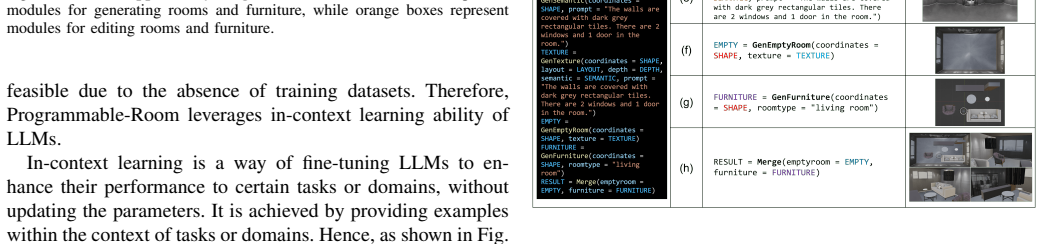
The central mechanism is the visual-programming loop: GPT-4 translates a natural-language instruction into a sequence of module calls, and an interpreter executes them while passing variables (coordinates, texture strings, image tensors, furniture lists) from each line to the next. The load-bearing component inside the texture module is PRIG, a latent-diffusion U-Net whose encoder and middle blocks are frozen from a pretrained text-to-image model, whose decoder is fine-tuned, and which conditions generation on a concatenation of layout, depth, and semantic maps through multi-scale feature injection with zero convolutions and feature denormalization. A bidirectional LSTM reads the panorama layout and predicts a 1D representation; the L2 distance between that prediction and the encoded layout coordinates is added to the latent-diffusion loss, which the paper shows improves geometric coherence.
What would settle it
Run Programmable-Room on a fixed set of, say, 100 instructions that combine two or three simultaneous edits, log how many times GPT-4 emits an executable program whose arguments are syntactically valid and within range, and compare the final meshes against the same instructions executed with ground-truth corner coordinates instead of LLM-inferred ones. If the program-generation success rate is low or the ground-truth-corner condition visibly improves panorama fidelity, then the LLM parsing and corner inference, not PRIG, are the limiting factors.
Extended reading notes
Core claim
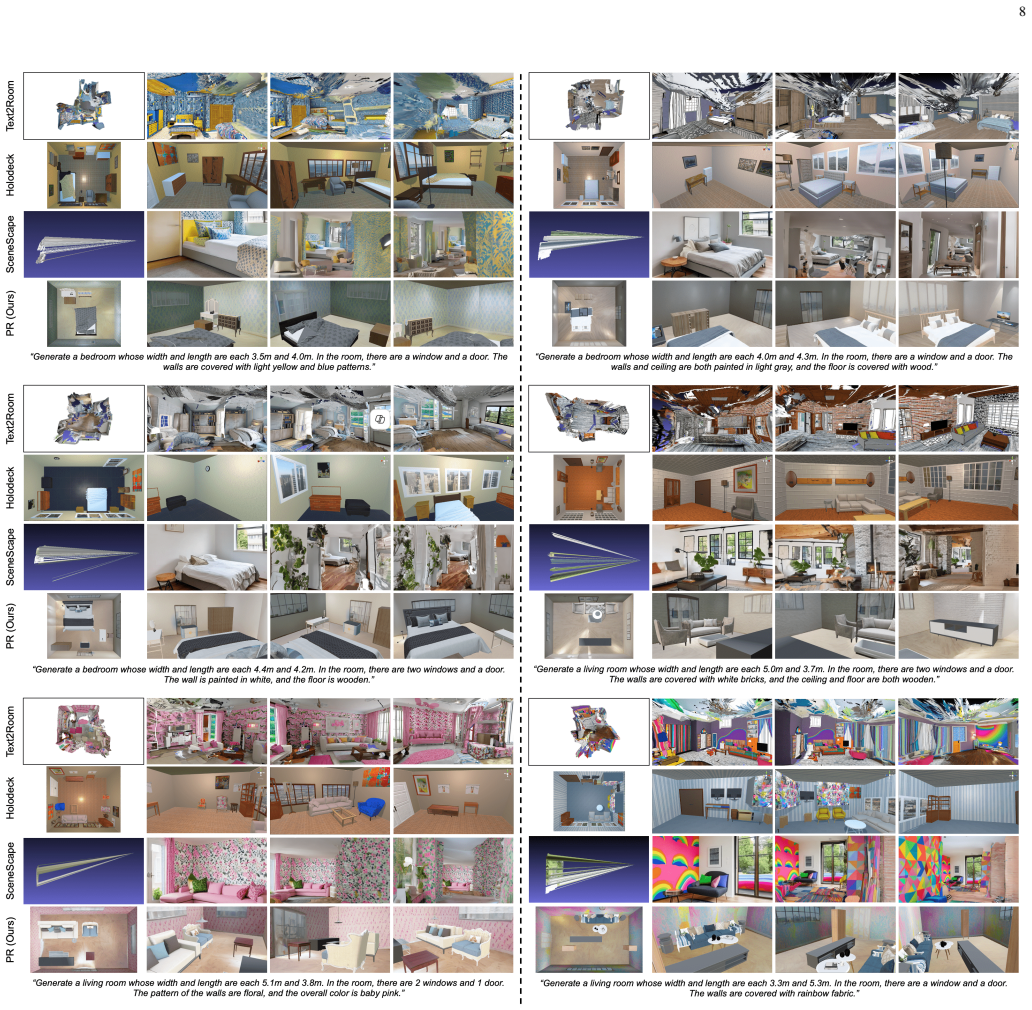
On its own terms, the paper's discovery is that interactive 3D indoor scene generation and editing can be organized as a visual-programming problem in which GPT-4, given a task description and in-context examples, writes an ordered Python-like list of calls to modules such as GenShape, GenTexture, GenEmptyRoom, and GenFurniture, and an interpreter executes the lines so that outputs of earlier calls become inputs of later ones. The same mechanism handles editing: EditShape, EditTexture, EditFurniture, and related modules modify stored variables, letting users iterate indefinitely on the same mesh. Within the texture module, PRIG concatenates a layout map, a depth map, and a semantic map into a nine-channel conditioning tensor, injects its features at four resolutions using multi-scale injection and feature denormalization, and trains a U-Net diffusion decoder with a latent diffusion loss plus a BiLSTM-based L2 loss on a 1D layout representation. The paper reports that PRIG with all three visual prompts and the BiLSTM loss achieves lower FID and KID than text-only panorama baselines, and that the full framework receives higher perceptual-quality and 3D-completeness scores than Text2Room, Holodeck, and SceneScape.
Load-bearing premise
The whole pipeline rests on the assumption that GPT-4, given a few in-context examples, will reliably translate any user instruction into the right ordered sequence of module calls with the right numbers, texture strings, and furniture names, because every later module consumes those outputs and the paper does not measure how often this translation succeeds.
Editorial extensions
If this is right
- Users can edit one room attribute at a time—shape, texture, or furniture—without disturbing the others, because each attribute is handled by a separate module operating on shared variables.
- New or better modules can be swapped into the framework without retraining the rest, since each module has fixed inputs and outputs.
- PRIG's panorama generation improves when all three visual prompts (layout, depth, semantic map) are used together, compared with any single prompt or pair of prompts.
- Furniture layouts are stored in a CSS-like format, so editing furniture positions and orientations reduces to editing that file.
- The reported inference time for a room mesh is about 154 seconds, two orders of magnitude faster than the slowest baseline and comparable to the fastest one.
Reading between the lines
- The paper never reports how often GPT-4 produces a syntactically valid program with correctly parsed arguments, so a natural follow-up is to measure program-generation accuracy on a held-out instruction set and correlate failures with instruction complexity.
- Because the layout, depth, and semantic maps are computed analytically from LLM-inferred corner coordinates, an ablation feeding ground-truth corners instead of inferred ones would isolate how much of any texture error comes from the LLM's geometry guesses rather than from PRIG itself.
- The authors note the framework currently works mainly for bedrooms and living rooms; extending it to kitchens, bathrooms, or offices would test whether the bottleneck is the furniture-generation module or the LLM's commonsense about other room types.
- The interactive editing loop suggests an evaluation that is absent from the paper: measuring how many instruction rounds a user needs to reach a target design and whether edits stay consistent across rounds.
Signed reviews
Editorial analysis
A structured set of objections, weighed in public.
Referee Report
Summary. The paper presents Programmable-Room, a framework that uses GPT-4-based visual programming to translate natural-language instructions into ordered module calls for generating and interactively editing textured 3D room meshes. The pipeline decomposes the task into shape generation, panorama texture generation, empty-room mesh construction, and furniture arrangement. The main technical contribution is PRIG, a diffusion-based panorama generator conditioned jointly on text and multiple visual prompts (layout, depth, and semantic maps), trained with an additional BiLSTM-based 1D layout loss. The authors report FID/KID improvements for panorama generation, a user study for 3D mesh quality, and qualitative demonstrations of editing and controllability.
Significance. If the claims are substantiated, the paper would make a useful contribution to text-driven 3D indoor scene generation by integrating LLM-based program synthesis with modular generation and editing, and PRIG's multi-conditioning with a BiLSTM layout loss is a plausible way to improve structural coherence in panorama generation. The paper provides clear qualitative demonstrations and reports quantitative comparisons on both panorama generation and 3D mesh generation. However, the evidence is currently incomplete: the central LLM program-generation step is not evaluated at all, the 3D mesh comparison relies on a small user study without statistical analysis and omits the most relevant baseline, and the panorama comparison gives PRIG privileged geometric conditioning. These issues need to be addressed before the claimed superiority and interactive-generality results can be accepted.
major comments (4)
- [Section III-A] The framework's central premise is that GPT-4 reliably translates arbitrary natural-language instructions into correct, ordered module calls with correctly parsed arguments, but no quantitative evaluation of program generation is provided. There is no success rate, parse rate, argument-accuracy metric, or failure analysis. Because every downstream module depends on the generated calls and arguments, the claimed interactive editing and 'superiority' results are not yet supported for the general instruction space. Please add a program-generation evaluation, for example a held-out instruction set with module-call and argument-accuracy metrics, plus a per-instruction failure analysis and a discussion of whether failures are recoverable.
- [Section IV-D, Table II] The 3D mesh comparison is based on only 10 rooms and a 30-participant user study with no error bars, confidence intervals, or significance tests, so the reported PQ/3DS advantages (3.57 vs 2.68 and 3.82 vs 2.67) may not be statistically reliable. Moreover, Ctrl-Room, the closest baseline that also generates room meshes from layout-constrained panoramas, is discussed in Section II but is absent from Table II. Please add Ctrl-Room and report per-room variance with significance testing, or justify why a 10-room study is sufficient for the claimed superiority.
- [Section IV-D, Table I] The panorama comparison is asymmetric: PRIG receives layout, depth, and semantic maps generated from the text prompt via Programmable-Room, while Text2Light, MVDiffusion, and PanFusion receive only the text caption. The FID/KID gains therefore conflate PRIG's generative model with the additional geometric information supplied by the framework. Please either give the baselines equivalent visual prompts through compatible conditioning mechanisms, or separate the evaluation of the full pipeline from that of PRIG as a generative model, and discuss the effect of the extra information.
- [Appendix VI-A, Eq. (6)] The spherical conversion is written as phi = arccos(r/z), which is not a valid spherical-coordinate conversion because the argument is generally outside [-1,1]; the standard relation is phi = arccos(z/r). Since this projection is used to generate the layout map and hence conditions PRIG and the final room mesh, please correct the formula and verify that the implementation matches the corrected version.
minor comments (6)
- [Introduction / Section III-B] In the paragraph beginning 'Especially for GenFurniture', the module that generates room texture images is called GenFurniture; this should be GenTexture (or the module naming should be clarified) to avoid confusion with the furniture-arrangement module.
- [Abstract / Project page] The project-page URL contains a space instead of an underscore in 'Programmable_Room_Page'; please correct it.
- [Section II-B] There is a typo: 'Howeverm' should be 'However'.
- [Section IV-D] The sentence 'The comparably high scores of our method implies that the baselines have difficulties...' should read 'The comparatively low FID/KID scores of our method imply...'.
- [Section III-B, Eq. (4)] The definition of S_1D and the BiLSTM encoder are underspecified. Please state how S is converted to S_1D, the hidden dimension used, and how the predicted S_1D is obtained from the panorama image, so that the loss in Eq. (4) is reproducible.
- [General] The paper does not state whether code or trained models will be released; for a framework with 18 modules, reproducibility would benefit from at least the PRIG training code and the module interface definitions.
Circularity Check
No circularity found: the core evaluations compare against external baselines and held-out Structure3D data, and no claimed prediction reduces to its inputs by construction.
full rationale
I examined the derivation chain for the seven circularity patterns. The main technical claim is PRIG, a diffusion model conditioned on text and multiple visual prompts, trained with the auxiliary loss L_BiLSTM = ||S_1D - S_hat_1D||^2_2 (Eq. 4), where S_1D is a 1D encoding of the ground-truth layout coordinates and S_hat_1D is predicted from the ground-truth panorama image I. This is a supervised auxiliary loss against dataset annotations, not a self-referential prediction; the predicted quantity is not the same as the input condition. At inference, the visual prompts L, D, and M are produced by deterministic geometric projections from GenShape's 3D corner coordinates (Eqs. 6-11 in the appendix); they are conditioning inputs to PRIG, not outputs of PRIG, and the resulting panoramas are scored against real Structure3D test images with FID/KID. The comparison gives PRIG additional geometric conditioning that baselines lack, which is an experimental-fairness concern rather than circularity. The BiLSTM ablation and the visual-prompt ablations in Table III are genuine controlled comparisons. The 3D mesh user study compares against external methods (Text2Room, Holodeck, SceneScape) with human ratings, not against quantities derived from the same model. The paper's self-citations, [29] and [32], appear only in a grouped related-work sentence about user control in text-to-image generation and are not load-bearing; no uniqueness theorem or ansatz is imported from the authors' own prior work. The main weakness, unquantified GPT-4 program-generation reliability in Section III-A, is a missing-evaluation and generalization risk, not a circular derivation. Thus no step in the paper's claimed derivation reduces by definition to its inputs, and the paper is self-contained against external benchmarks.
Assumptions & free parameters
free parameters (3)
- lambda_latent
- lambda_BiLSTM
- BiLSTM hidden state size / S_1D dimension
assumptions (4)
- domain assumption GPT-4 with in-context examples reliably generates correct module programs and parses arguments from natural language instructions (Section III-A).
- domain assumption GenShape infers 3D corner coordinates from language descriptions accurately enough for later projection into layout, depth, and semantic maps (Section III-B).
- domain assumption Structure3D empty-room data with Qwen-VL captions is a sufficient training distribution for PRIG (Section IV-A).
- standard math Pretrained Stable Diffusion, VQ-GAN, CLIP, and Uni-ControlNet components work as in their source papers (Section III-B).
invented entities (1)
-
1D layout representation S_1D
Cite this review
Pith. "Pith review of Programmable-Room: Interactive Textured 3D Room Meshes Generation Empowered by Large Language Models." pith.science (2026). https://pith.science/paper/DKSKLYVA
@misc{pith2026250617707,
  author       = {Pith},
  title        = {Pith review of: Programmable-Room: Interactive Textured 3D Room Meshes Generation Empowered by Large Language Models},
  year         = {2026},
  howpublished = {\url{https://pith.science/paper/DKSKLYVA}},
  note         = {Machine review of arXiv:2506.17707}
}
read the original abstract
We present Programmable-Room, a framework which interactively generates and edits a 3D room mesh, given natural language instructions. For precise control of a room's each attribute, we decompose the challenging task into simpler steps such as creating plausible 3D coordinates for room meshes, generating panorama images for the texture, constructing 3D meshes by integrating the coordinates and panorama texture images, and arranging furniture. To support the various decomposed tasks with a unified framework, we incorporate visual programming (VP). VP is a method that utilizes a large language model (LLM) to write a Python-like program which is an ordered list of necessary modules for the various tasks given in natural language. We develop most of the modules. Especially, for the texture generating module, we utilize a pretrained large-scale diffusion model to generate panorama images conditioned on text and visual prompts (i.e., layout, depth, and semantic map) simultaneously. Specifically, we enhance the panorama image generation quality by optimizing the training objective with a 1D representation of a panorama scene obtained from bidirectional LSTM. We demonstrate Programmable-Room's flexibility in generating and editing 3D room meshes, and prove our framework's superiority to an existing model quantitatively and qualitatively. Project page is available in https://jihyun0510.github.io/Programmable_Room_Page/.
Figures


Figures from the paper (9 more)




Reference graph
Works this paper leans on
-
[1]
Visual programming: Compositional visual reasoning without training,
T. Gupta and A. Kembhavi, “Visual programming: Compositional visual reasoning without training,” inProceedings of the IEEE/CVF Conference on Computer Vision and Pattern Recognition, 2023, pp. 14 953–14 962
work page 2023
-
[2]
J. Achiam, S. Adler, S. Agarwal, L. Ahmad, I. Akkaya, F. L. Aleman, D. Almeida, J. Altenschmidt, S. Altman, S. Anadkatet al., “Gpt-4 technical report,”arXiv preprint arXiv:2303.08774, 2023
arXiv 2023
-
[3]
Text2room: Extracting textured 3d meshes from 2d text-to-image models,
L. H ¨ollein, A. Cao, A. Owens, J. Johnson, and M. Nießner, “Text2room: Extracting textured 3d meshes from 2d text-to-image models,” in Proceedings of the IEEE/CVF International Conference on Computer Vision, 2023, pp. 7909–7920
work page 2023
-
[4]
Text2nerf: Text-driven 3d scene generation with neural radiance fields,
J. Zhang, X. Li, Z. Wan, C. Wang, and J. Liao, “Text2nerf: Text-driven 3d scene generation with neural radiance fields,”IEEE Transactions on Visualization and Computer Graphics, 2024
2024
-
[5]
Ctrl-room: Controllable text- to-3d room meshes generation with layout constraints,
C. Fang, X. Hu, K. Luo, and P. Tan, “Ctrl-room: Controllable text- to-3d room meshes generation with layout constraints,”arXiv preprint arXiv:2310.03602, 2023
arXiv 2023
-
[6]
Holodeck: Language guided generation of 3d embodied ai environments,
Y . Yang, F.-Y . Sun, L. Weihs, E. VanderBilt, A. Herrasti, W. Han, J. Wu, N. Haber, R. Krishna, L. Liuet al., “Holodeck: Language guided generation of 3d embodied ai environments,” inProceedings of the IEEE/CVF Conference on Computer Vision and Pattern Recognition, 2024, pp. 16 227–16 237
2024
-
[7]
Scenescape: Text- driven consistent scene generation,
R. Fridman, A. Abecasis, Y . Kasten, and T. Dekel, “Scenescape: Text- driven consistent scene generation,”Advances in Neural Information Processing Systems, vol. 36, 2024
work page 2024
-
[8]
High- resolution image synthesis with latent diffusion models,
R. Rombach, A. Blattmann, D. Lorenz, P. Esser, and B. Ommer, “High- resolution image synthesis with latent diffusion models,” inProceedings of the IEEE/CVF Conference on Computer Vision and Pattern Recogni- tion, 2022, pp. 10 684–10 695
2022
Show all 44 references
-
[9]
Taming stable diffusion for text to 360 panorama image generation,
C. Zhang, Q. Wu, C. C. Gambardella, X. Huang, D. Phung, W. Ouyang, and J. Cai, “Taming stable diffusion for text to 360 panorama image generation,” inProceedings of the IEEE/CVF Conference on Computer Vision and Pattern Recognition, 2024, pp. 6347–6357
2024
-
[10]
Text2light: Zero-shot text-driven hdr panorama generation,
Z. Chen, G. Wang, and Z. Liu, “Text2light: Zero-shot text-driven hdr panorama generation,”ACM Transactions on Graphics, vol. 41, no. 6, pp. 1–16, 2022
2022
-
[11]
Mvdiffusion: Enabling holistic multi-view image generation with correspondence- aware diffusion,
S. Tang, F. Zhang, J. Chen, P. Wang, and Y . Furukawa, “Mvdiffusion: Enabling holistic multi-view image generation with correspondence- aware diffusion,”Advances in Neural Information Processing Systems, 2023
2023
-
[12]
Uni-controlnet: All-in-one control to text-to-image diffusion models,
S. Zhao, D. Chen, Y .-C. Chen, J. Bao, S. Hao, L. Yuan, and K.-Y . K. Wong, “Uni-controlnet: All-in-one control to text-to-image diffusion models,”Advances in Neural Information Processing Systems, 2023
2023
-
[13]
Deep bidirectional and unidi- rectional lstm recurrent neural network for network-wide traffic speed prediction,
Z. Cui, R. Ke, Z. Pu, and Y . Wang, “Deep bidirectional and unidi- rectional lstm recurrent neural network for network-wide traffic speed prediction,”arXiv preprint arXiv:1801.02143, 2018
2018 arXiv
-
[14]
Sceneformer: Indoor scene generation with transformers,
X. Wang, C. Yeshwanth, and M. Nießner, “Sceneformer: Indoor scene generation with transformers,” inInternational Conference on 3D Vision, 2021, pp. 106–115
2021
-
[15]
Atiss: Autoregressive transformers for indoor scene synthesis,
D. Paschalidou, A. Kar, M. Shugrina, K. Kreis, A. Geiger, and S. Fidler, “Atiss: Autoregressive transformers for indoor scene synthesis,”Ad- vances in Neural Information Processing Systems, vol. 34, pp. 12 013– 12 026, 2021
2021
-
[16]
Commonscenes: Generating commonsense 3d indoor scenes with scene graphs,
G. Zhai, E. P. ¨Ornek, S.-C. Wu, Y . Di, F. Tombari, N. Navab, and B. Busam, “Commonscenes: Generating commonsense 3d indoor scenes with scene graphs,”Advances in Neural Information Processing Systems, vol. 36, 2024
2024
-
[17]
Diffuscene: Scene graph denoising diffusion probabilistic model for generative indoor scene synthesis,
J. Tang, Y . Nie, L. Markhasin, A. Dai, J. Thies, and M. Nießner, “Diffuscene: Scene graph denoising diffusion probabilistic model for generative indoor scene synthesis,”arXiv preprint arXiv:2303.14207, 2023
2023 arXiv
-
[18]
Gaudi: A neural architect for immersive 3d scene generation,
M. A. Bautista, P. Guo, S. Abnar, W. Talbott, A. Toshev, Z. Chen, L. Dinh, S. Zhai, H. Goh, D. Ulbrichtet al., “Gaudi: A neural architect for immersive 3d scene generation,”Advances in Neural Information Processing Systems, vol. 35, pp. 25 102–25 116, 2022
2022
-
[19]
Rgbd2: Generative scene synthesis via incre- mental view inpainting using rgbd diffusion models,
J. Lei, J. Tang, and K. Jia, “Rgbd2: Generative scene synthesis via incre- mental view inpainting using rgbd diffusion models,” inProceedings of the IEEE/CVF Conference on Computer Vision and Pattern Recognition, 2023, pp. 8422–8434
2023
-
[20]
Cc3d: Layout-conditioned generation of com- positional 3d scenes,
S. Bahmani, J. J. Park, D. Paschalidou, X. Yan, G. Wetzstein, L. Guibas, and A. Tagliasacchi, “Cc3d: Layout-conditioned generation of com- positional 3d scenes,” inProceedings of the IEEE/CVF International Conference on Computer Vision, 2023, pp. 7171–7181
2023
-
[21]
Roomdreamer: Text-driven 3d indoor scene synthesis with coherent geometry and texture,
L. Song, L. Cao, H. Xu, K. Kang, F. Tang, J. Yuan, and Y . Zhao, “Roomdreamer: Text-driven 3d indoor scene synthesis with coherent geometry and texture,”arXiv preprint arXiv:2305.11337, 2023
2023 arXiv
-
[22]
Roomdesigner: Encoding anchor-latents for style-consistent and shape-compatible indoor scene generation,
Y . Zhao, Z. Zhao, J. Li, S. Dong, and S. Gao, “Roomdesigner: Encoding anchor-latents for style-consistent and shape-compatible indoor scene generation,”arXiv preprint arXiv:2310.10027, 2023
2023 arXiv
-
[23]
Lego-net: Learning regular rearrangements of objects in rooms,
Q. A. Wei, S. Ding, J. J. Park, R. Sajnani, A. Poulenard, S. Sridhar, and L. Guibas, “Lego-net: Learning regular rearrangements of objects in rooms,” inProceedings of the IEEE/CVF Conference on Computer Vision and Pattern Recognition, 2023, pp. 19 037–19 047. 11
2023
-
[24]
Layoutgpt: Compositional visual planning and generation with large language models,
W. Feng, W. Zhu, T.-j. Fu, V . Jampani, A. Akula, X. He, S. Basu, X. E. Wang, and W. Y . Wang, “Layoutgpt: Compositional visual planning and generation with large language models,”Advances in Neural Information Processing Systems, vol. 36, 2024
2024
-
[25]
Virtuosotune: Hierarchical melody language model,
D. Jeong, “Virtuosotune: Hierarchical melody language model,”IEIE Transactions on Smart Processing & Computing, vol. 12, no. 4, pp. 329–333, 2023
2023
-
[26]
Cross-modal semantic match- ing generative adversarial networks for text-to-image synthesis,
H. Tan, X. Liu, B. Yin, and X. Li, “Cross-modal semantic match- ing generative adversarial networks for text-to-image synthesis,”IEEE Transactions on Multimedia, vol. 24, pp. 832–845, 2021
2021
-
[27]
Knowledge-driven generative adversarial network for text-to-image synthesis,
J. Peng, Y . Zhou, X. Sun, L. Cao, Y . Wu, F. Huang, and R. Ji, “Knowledge-driven generative adversarial network for text-to-image synthesis,”IEEE Transactions on Multimedia, vol. 24, pp. 4356–4366, 2021
2021
-
[28]
Semantic distance adversarial learning for text-to-image synthesis,
B. Yuan, Y . Sheng, B.-K. Bao, Y .-P. P. Chen, and C. Xu, “Semantic distance adversarial learning for text-to-image synthesis,”IEEE Trans- actions on Multimedia, 2023
2023
-
[29]
Controlling 3d human action with transformer variational autoencoder in latent space,
H. Kim, K. Kong, J. K. Kim, J. Lee, G. Cha, H.-D. Jang, D. Wee, and S.-J. Kang, “Controlling 3d human action with transformer variational autoencoder in latent space,”IEIE Transactions on Smart Processing & Computing, vol. 13, no. 3, pp. 209–214, 2024
2024
-
[30]
Adding conditional control to text-to-image diffusion models,
L. Zhang, A. Rao, and M. Agrawala, “Adding conditional control to text-to-image diffusion models,” inProceedings of the IEEE/CVF International Conference on Computer Vision, 2023, pp. 3836–3847
2023
-
[31]
T2i- adapter: Learning adapters to dig out more controllable ability for text- to-image diffusion models,
C. Mou, X. Wang, L. Xie, Y . Wu, J. Zhang, Z. Qi, and Y . Shan, “T2i- adapter: Learning adapters to dig out more controllable ability for text- to-image diffusion models,” inProceedings of the AAAI Conference on Artificial Intelligence, vol. 38, no. 5, 2024, pp. 4296–4304
2024
-
[32]
Attentionhand: Text-driven control- lable hand image generation for 3d hand reconstruction in the wild,
J. Park, K. Kong, and S.-J. Kang, “Attentionhand: Text-driven control- lable hand image generation for 3d hand reconstruction in the wild,” in European Conference on Computer Vision, 2024, pp. 329–345
2024
-
[33]
Structured3d: A large photo-realistic dataset for structured 3d modeling,
J. Zheng, J. Zhang, J. Li, R. Tang, S. Gao, and Z. Zhou, “Structured3d: A large photo-realistic dataset for structured 3d modeling,” inEuropean Conference on Computer Vision, 2020, pp. 519–535
2020
-
[34]
Qwen-vl: A frontier large vision-language model with versatile abilities,
J. Bai, S. Bai, S. Yang, S. Wang, S. Tan, P. Wang, J. Lin, C. Zhou, and J. Zhou, “Qwen-vl: A frontier large vision-language model with versatile abilities,”arXiv preprint arXiv:2308.12966, 2023
2023 arXiv
-
[35]
Semantic image synthesis with spatially-adaptive normalization,
T. Park, M.-Y . Liu, T.-C. Wang, and J.-Y . Zhu, “Semantic image synthesis with spatially-adaptive normalization,” inProceedings of the IEEE/CVF Conference on Computer Vision and Pattern Recognition, 2019, pp. 2337–2346
2019
-
[36]
Taming transformers for high- resolution image synthesis,
P. Esser, R. Rombach, and B. Ommer, “Taming transformers for high- resolution image synthesis,” inProceedings of the IEEE/CVF Confer- ence on Computer Vision and Pattern Recognition, 2021, pp. 12 873– 12 883
2021
-
[37]
Learning transferable visual models from natural language supervision,
A. Radford, J. W. Kim, C. Hallacy, A. Ramesh, G. Goh, S. Agarwal, G. Sastry, A. Askell, P. Mishkin, J. Clarket al., “Learning transferable visual models from natural language supervision,” inInternational Conference on Machine Learning, 2021, pp. 8748–8763
2021
-
[38]
Attention is all you need,
A. Vaswani, N. Shazeer, N. Parmar, J. Uszkoreit, L. Jones, A. N. Gomez, Ł. Kaiser, and I. Polosukhin, “Attention is all you need,”Advances in Neural Information Processing Systems, vol. 30, 2017
2017
-
[39]
U-net: Convolutional networks for biomedical image segmentation,
O. Ronneberger, P. Fischer, and T. Brox, “U-net: Convolutional networks for biomedical image segmentation,” inMedical Image Computing and Computer-Assisted Intervention, 2015, pp. 234–241
2015
-
[40]
3d-future: 3d furniture shape with texture,
H. Fu, R. Jia, L. Gao, M. Gong, B. Zhao, S. Maybank, and D. Tao, “3d-future: 3d furniture shape with texture,”International Journal of Computer Vision, vol. 129, pp. 3313–3337, 2021
2021
-
[41]
3d-front: 3d furnished rooms with layouts and semantics,
H. Fu, B. Cai, L. Gao, L.-X. Zhang, J. Wang, C. Li, Q. Zeng, C. Sun, R. Jia, B. Zhaoet al., “3d-front: 3d furnished rooms with layouts and semantics,” inProceedings of the IEEE/CVF International Conference on Computer Vision, 2021, pp. 10 933–10 942
2021
-
[42]
Gans trained by a two time-scale update rule converge to a local nash equilibrium,
M. Heusel, H. Ramsauer, T. Unterthiner, B. Nessler, and S. Hochreiter, “Gans trained by a two time-scale update rule converge to a local nash equilibrium,”Advances in Neural Information Processing Systems, vol. 30, 2017
2017
-
[43]
Demysti- fying mmd gans,
M. Bi ´nkowski, D. J. Sutherland, M. Arbel, and A. Gretton, “Demysti- fying mmd gans,”arXiv preprint arXiv:1801.01401, 2018
2018 arXiv
-
[44]
Adam: A method for stochastic optimization,
D. P. Kingma, “Adam: A method for stochastic optimization,”arXiv preprint arXiv:1412.6980, 2014. Jihyun Kimreceived the B.S. degree in business management from Sogang University, Seoul, South Korea, in 2021, and the M.S. degree in artifical intelligence from Sogang University,...
2014 arXiv
Reviewed August 15, 2026 · model on record in the stance chip above.
Discussion (0). Continue with ORCID to comment.