REVIEW 4 major objections 6 minor 1 cited by
Beyond instruction-conditioning, MoTE: Mixture of Task Experts for Multi-task Embedding Models
T0 review · 4 major / 6 minor · reviewed 2026-08-15 · deepseek-v4-flash
Pith's one-line read Task-expert blocks beat instruction prompts alone for text embeddings
desk verdict Promising architecture for embedding specialization, but the headline result is undercut by a missing IC+TA-CL baseline and sloppy percentage arithmetic. read the letter →
The pith
A machine-rendered reading of the paper's core claim, the machinery that carries it, and where it could break.
The reading
What carries the argument
The central object is the MoTE transformer block, a Mixture-of-Experts block with one MLP expert per task and instruction-based sequence-level routing instead of learned token-level routing. It carries the argument by decoupling task-specific gradients: each expert trains only on its task's examples, while the rest of the network stays shared. TA-CL is the accompanying training curriculum that supplies each expert with the batching strategy and contrastive temperature that suits its task.
What would settle it
Run the same contrastive training with the same task-aware batching and per-task temperatures on the instruction-conditioning model; if its retrieval NDCG@10 gain rises from +3.27 to near +5.21, the MoTE architecture is not the source of the improvement. Separately, recompute the seen-task gains after removing MTEB evaluation datasets whose training examples appear in the contrastive corpora; if the gains collapse, memorization rather than specialization explains them.
Extended reading notes
Core claim
MoTE replaces the dense transformer blocks of a pretrained encoder with mixture-of-task-experts blocks: each block contains one expert per task, all initialized from the original MLP weights, and a routing mechanism sends the full sequence to the expert named by its instruction. This gives the model task-specialized parameters without increasing the active parameter count or inference latency, because only one expert is active per forward pass and inactive experts can be offloaded. Trained with TA-CL, which builds task-homogeneous batches for retrieval and adjusts contrastive temperature per task, MoTE produces embeddings that are less entangled across tasks (lower inter-task cosine similarity) and achieve higher downstream performance than instruction-conditioning, both on tasks seen during training and on unseen tasks assigned to the closest expert.
Load-bearing premise
The comparison assumes the instruction-conditioning baseline and MoTE differ only in the added expert architecture, even though MoTE is also trained with the task-aware batching and temperature curriculum while the baseline is not, and an IC+TA-CL control is missing.
Editorial extensions
If this is right
- On seen tasks, MoTE raises the retrieval NDCG@10 gain from +3.27 to +5.21 and the classification gain from +3.37 to +3.79, with the same active parameter count and latency as instruction-conditioning.
- On unseen tasks, MoTE also beats instruction-conditioning on average (+1.25 vs +0.67), with the largest gains on STS and summarization, suggesting the task experts generalize when a new task is mapped to a related seen task.
- Routing the whole sequence through one expert (sequence-level routing) outperforms token-level routing by +1.33 average across all 56 MTEB datasets, indicating that task identity is a stronger routing signal than per-token routing.
- TA-CL alone adds +0.41 average dataset performance over static training, with a Welch's t-test p-value of 1e-4, and retrieval benefits most from homogeneous batching.
- Because only one expert is active per task, MoTE keeps memory comparable to dense models by offloading inactive experts to CPU or disk, and expert averaging offers a compression path that retains +0.17 over the instruction-conditioned model.
Reading between the lines
- The reported headline gains combine the MoTE architecture with TA-CL; an instruction-conditioning model trained with the same task-aware curriculum would isolate how much of the +5.21 retrieval gain is architectural.
- If MTEB evaluation datasets overlap with the contrastive training corpora, part of the 'seen task' improvement could reflect memorization rather than specialization, since the paper does not state whether they overlap.
- A natural extension is to make routing adaptive: keep the instruction-based assignment for known tasks but add a learned fallback for novel instructions, since the paper shows unseen tasks benefit even from nearest-task assignment.
- For bulk inference, averaging task experts into a single dense network, as sketched in the paper's expert-averaging experiment, should make MoTE practical where GPU memory is tight while retaining most of the retrieval gain.
Signed reviews
Editorial analysis
A structured set of objections, weighed in public.
Referee Report
Summary. The paper proposes MoTE (Mixture of Task Experts), a transformer block with task-specific expert MLPs and instruction-based sequence-level routing, for multi-task text embedding models. The authors argue that instruction-conditioning (IC) alone limits specialization in low-capacity models and that adding task-specialized parameters improves embedding specialization. They train the MoTE model with Task-Aware Contrastive Learning (TA-CL), which uses per-task batching and contrastive temperatures, and evaluate on MTEB. The central empirical claim is that MoTE outperforms IC by a large margin in performance gains over a non-specialized embedding model (+5.21 vs +3.27 NDCG@10 in retrieval; +3.23 vs +2.35 average gain across seen tasks), while keeping instructions, training data, inference time, and active parameter count unchanged. Additional ablations study TA-CL, sequence-level routing versus token-level routing, and integration of MoTE blocks at every versus every-other transformer layer.
Significance. If the central claim were fully substantiated, MoTE would be a useful architectural recipe for improving task specialization in embedding models without increasing active parameters or inference latency, and the TA-CL curriculum would be a practical training contribution. The paper includes a reasonable set of ablations (TA-CL, routing, block placement) and attempts to isolate the source of gains. The work is reproducible in principle: the base checkpoint, training data source, and hyperparameters are specified. However, the main MoTE-versus-IC comparison is currently confounded because the MoTE candidate trains with TA-CL while the IC baseline appears to use the static curriculum; without an IC+TA-CL condition, the headline gains cannot be attributed to the MoTE architecture. The statistical support for the headline result is also missing. The paper is therefore promising but not yet convincing.
major comments (4)
- [Section 4 and Appendix D.2; Tables 2 and 4] The headline comparison conflates architecture and training curriculum. Section 4 states that both IC and MoTE use the same instructions, training data, and training setup, but Appendix D.2 specifies that the MoTE candidate is trained with TA-CL (task-specific batching and contrastive temperatures), while no IC+TA-CL baseline is reported. The TA-CL ablation in Table 4 shows that within the MoTE architecture, switching from static training to TA-CL improves retrieval NDCG@10 by +1.04 and average dataset performance by +0.41. Since these gains are of the same order as parts of the reported MoTE-versus-IC differences, the reader cannot tell whether the IC baseline would narrow or close the gap if it also received TA-CL. Please add an IC+TA-CL condition (and preferably an IC+static condition) so that the architectural contribution of MoTE is separated from the curriculum contribution.
- [Section 5.1, Tables 2 and 3] No statistical significance or variance is reported for the central MoTE-versus-IC comparison. The paper reports single runs for the headline numbers and uses Welch's t-tests only for the TA-CL ablation (Section 5.4) and the SLR-versus-TLR routing ablation (Section 6). Since the main contribution is the claim that MoTE outperforms IC, please provide either multiple training runs with standard deviations, or a paired significance test across the MTEB datasets for Tables 2 and 3.
- [Section 4 and Tables 1-3] The paper does not state whether the contrastive training datasets overlap with the MTEB evaluation datasets. The training data are described as classification, clustering, and retrieval datasets from the cited contrastors configuration, while evaluation is on MTEB, which includes 15 retrieval, 12 classification, and 11 clustering datasets. Without a statement of which MTEB datasets (or their training splits) were used during contrastive training, the 'seen task' gains in Table 2 could reflect memorization rather than specialization. Please specify the overlap or evaluate on disjoint held-out datasets.
- [Abstract, Introduction, and Table 2] The percentage gains reported in the abstract and introduction are internally inconsistent with Table 2. The abstract reports '+3.27 to +5.21' as a 64% gain and '+1.81 to +2.60' as a 43% gain, but Table 2 lists IC average gain +2.35 and MoTE average gain +3.23, which is about a 37% relative improvement. The introduction separately claims '50% higher performance gains in critical tasks such as retrieval and 31% higher gains in other tasks'. Please reconcile these numbers and ensure that all reported percentages are computed from the tables or from clearly defined additional tables.
minor comments (6)
- [Abstract and Introduction] There is a typo: 'Task-Aware Contrastive Learnign' should be 'Learning'.
- [Section 2.2] The sentence 'Small models use a pre-defined set of instructions with task level information such such as' contains a duplicated 'such'.
- [Appendix B and Table 7] The abbreviation 'IEM' is used in Table 7 but is not defined earlier; the main text uses 'IC' for the instruction-conditioned model. Please define 'IEM' or replace it with 'IC' for consistency.
- [Section 6 and Table 5] The text defines routing as 'Token-Level Routing (TLR)' but the caption of Table 5 calls it 'Task-Level Routing (TLR)'. Please use one consistent name.
- [Table 2 and Table 4] The table footnotes say 'validity measure' for clustering; the standard term is 'V-measure'.
- [Section 5.2] The phrase 'we randomly 128 randomly generic Wikipedia articles' is ungrammatical; it should read 'we randomly sample 128 generic Wikipedia articles'.
Circularity Check
No circularity: MoTE's gains are empirical benchmark results, not derived from fitted constants or self-citation.
full rationale
The central comparison is empirical: MoTE and TA-CL are trained and then evaluated on MTEB, with reported gains (Tables 2-6) as measured differences rather than consequences of the definitions. The routing mechanism R:I→E is task-instruction based, but the claimed +5.21 vs +3.27 retrieval gain is not entailed by that mapping; it is observed on an external benchmark under controlled initialization, instructions, and training data. The per-task batching strategies and temperatures (Appendix A) are training choices, and Table 4 presents their marginal effect as an ablation rather than renaming a fit as a prediction. Citations to prior work, including two references co-authored by the present authors, support background claims (classification, search, MoE, contrastive training) and are not load-bearing in the derivation of the main result. The missing IC+TA-CL baseline is an attribution confound that affects interpreting the contribution split between architecture and curriculum, but it is an experimental-design limitation, not circularity. No equation or argument reduces the paper's predictions to its inputs, so no circular step is identified.
Assumptions & free parameters
free parameters (4)
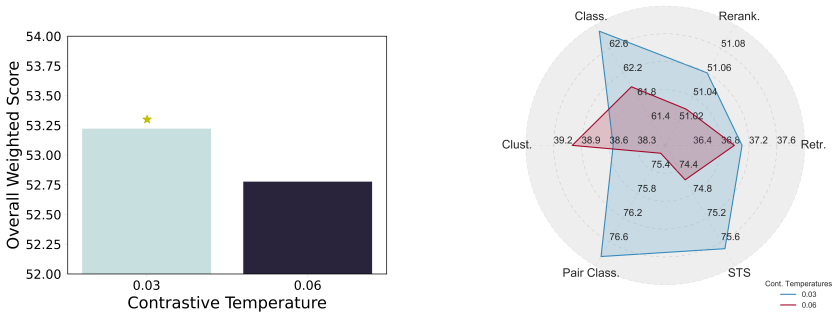
- Contrastive temperature for clustering =
0.06
- Per-task batching strategy =
homogeneous for retrieval, heterogeneous for classification and clustering
- Number of task experts per MoTE block =
4
- Placement of MoTE blocks =
every transformer block (EB)
assumptions (5)
- domain assumption Small input perturbations such as short instruction tokens produce only bounded changes in output embeddings (Lipschitz continuity), limiting instruction-conditioning capacity.
- domain assumption The MTEB benchmark is a valid and sufficient measure of embedding quality for the claims made.
- domain assumption The four instruction strings ('classification: ', 'clustering: ', 'search query: ', 'search document: ') correctly cover the training tasks and provide a sufficient routing signal.
- domain assumption Initializing all experts with a copy of the dense MLP weights preserves the useful pretrained knowledge.
- domain assumption The training datasets used for contrastive learning are sufficiently disjoint from the MTEB evaluation datasets that reported gains reflect generalization rather than memorization.
invented entities (1)
-
Task-specialized expert modules within MoTE transformer blocks
independent evidence
Cite this review
Pith. "Pith review of Beyond instruction-conditioning, MoTE: Mixture of Task Experts for Multi-task Embedding Models." pith.science (2026). https://pith.science/paper/VD6HYH3Y
@misc{pith2026250617781,
  author       = {Pith},
  title        = {Pith review of: Beyond instruction-conditioning, MoTE: Mixture of Task Experts for Multi-task Embedding Models},
  year         = {2026},
  howpublished = {\url{https://pith.science/paper/VD6HYH3Y}},
  note         = {Machine review of arXiv:2506.17781}
}
abstract
Dense embeddings are fundamental to modern machine learning systems, powering Retrieval-Augmented Generation (RAG), information retrieval, and representation learning. While instruction-conditioning has become the dominant approach for embedding specialization, its direct application to low-capacity models imposes fundamental representational constraints that limit the performance gains derived from specialization. In this paper, we analyze these limitations and introduce the Mixture of Task Experts (MoTE) transformer block, which leverages task-specialized parameters trained with Task-Aware Contrastive Learning (\tacl) to enhance the model ability to generate specialized embeddings. Empirical results show that MoTE achieves $64\%$ higher performance gains in retrieval datasets ($+3.27 \rightarrow +5.21$) and $43\%$ higher performance gains across all datasets ($+1.81 \rightarrow +2.60$). Critically, these gains are achieved without altering instructions, training data, inference time, or number of active parameters.
Figures


Figures from the paper (2 more)

Forward citations
Cited by 1 Pith paper
-
Position: Text Embeddings Should Capture Implicit Semantics, Not Just Surface Meaning
State-of-the-art text embeddings lag far behind on tasks requiring pragmatic inference, stance detection, and social meaning, relative to their strong performance on surface semantic benchmarks.
Reference graph
Works this paper leans on
-
[1]
Eneko Agirre, Daniel Cer, Mona Diab, and Aitor Gonzalez-Agirre. 2012. https://aclanthology.org/S12-1051 S em E val-2012 task 6: A pilot on semantic textual similarity . In * SEM 2012: The First Joint Conference on Lexical and Computational Semantics -- Volume 1: Proceedings of the main conference and the shared task, and Volume 2: Proceedings of the Sixth...
2012
-
[2]
Jimmy Lei Ba. 2016. Layer normalization. arXiv preprint arXiv:1607.06450
arXiv 2016
-
[3]
Chris Burges, Tal Shaked, Erin Renshaw, Ari Lazier, Matt Deeds, Nicole Hamilton, and Greg Hullender. 2005. https://doi.org/10.1145/1102351.1102363 Learning to rank using gradient descent . In Proceedings of the 22nd International Conference on Machine Learning, ICML '05, page 89–96, New York, NY, USA. Association for Computing Machinery
arXiv 2005
-
[4]
Dhivya Chandrasekaran and Vijay Mago. 2021. Evolution of semantic similarity—a survey. ACM Computing Surveys (CSUR), 54(2):1--37
work page 2021
-
[5]
Jacob Devlin, Ming-Wei Chang, Kenton Lee, and Kristina Toutanova. 2018. Bert: Pre-training of deep bidirectional transformers for language understanding. arXiv preprint arXiv:1810.04805
arXiv 2018
-
[6]
William Fedus, Barret Zoph, and Noam Shazeer. 2022. Switch transformers: Scaling to trillion parameter models with simple and efficient sparsity. Journal of Machine Learning Research, 23(120):1--39
2022
-
[7]
Tianyu Gao, Xingcheng Yao, and Danqi Chen. 2021. Simcse: Simple contrastive learning of sentence embeddings. arXiv preprint arXiv:2104.08821
arXiv 2021
-
[8]
Yunfan Gao, Yun Xiong, Xinyu Gao, Kangxiang Jia, Jinliu Pan, Yuxi Bi, Yi Dai, Jiawei Sun, and Haofen Wang. 2023. Retrieval-augmented generation for large language models: A survey. arXiv preprint arXiv:2312.10997
arXiv 2023
Show all 37 references
-
[9]
Ze-Feng Gao, Peiyu Liu, Wayne Xin Zhao, Zhong-Yi Lu, and Ji-Rong Wen. 2022. Parameter-efficient mixture-of-experts architecture for pre-trained language models. arXiv preprint arXiv:2203.01104
2022 arXiv
-
[10]
Jiawei Han, Micheline Kamber, and Jian Pei. 2012. https://doi.org/10.1016/B978-0-12-381479-1.00002-2 2 - getting to know your data . In Jiawei Han, Micheline Kamber, and Jian Pei, editors, Data Mining (Third Edition), third edition edition, The Morgan Kaufmann Series in Data M...
2012 doi
-
[11]
Ethan He, Abhinav Khattar, Ryan Prenger, Vijay Korthikanti, Zijie Yan, Tong Liu, Shiqing Fan, Ashwath Aithal, Mohammad Shoeybi, and Bryan Catanzaro. 2024. Upcycling large language models into mixture of experts. arXiv preprint arXiv:2410.07524
2024 arXiv
-
[12]
Albert Q Jiang, Alexandre Sablayrolles, Antoine Roux, Arthur Mensch, Blanche Savary, Chris Bamford, Devendra Singh Chaplot, Diego de las Casas, Emma Bou Hanna, Florian Bressand, et al. 2024. Mixtral of experts. arXiv preprint arXiv:2401.04088
2024 arXiv
-
[13]
Aran Komatsuzaki, Joan Puigcerver, James Lee-Thorp, Carlos Riquelme Ruiz, Basil Mustafa, Joshua Ainslie, Yi Tay, Mostafa Dehghani, and Neil Houlsby. 2022. Sparse upcycling: Training mixture-of-experts from dense checkpoints. arXiv preprint arXiv:2212.05055
2022 arXiv
-
[14]
Dmitry Lepikhin, HyoukJoong Lee, Yuanzhong Xu, Dehao Chen, Orhan Firat, Yanping Huang, Maxim Krikun, Noam Shazeer, and Zhifeng Chen. 2020. Gshard: Scaling giant models with conditional computation and automatic sharding. arXiv preprint arXiv:2006.16668
2020 arXiv
-
[15]
u ttler, Mike Lewis, Wen-tau Yih, Tim Rockt \
Patrick Lewis, Ethan Perez, Aleksandra Piktus, Fabio Petroni, Vladimir Karpukhin, Naman Goyal, Heinrich K \"u ttler, Mike Lewis, Wen-tau Yih, Tim Rockt \"a schel, et al. 2020. Retrieval-augmented generation for knowledge-intensive nlp tasks. Advances in Neural Information Proc...
2020
-
[16]
Yinhan Liu, Myle Ott, Naman Goyal, Jingfei Du, Mandar Joshi, Danqi Chen, Omer Levy, Mike Lewis, Luke Zettlemoyer, and Veselin Stoyanov. 2019. Roberta: A robustly optimized bert pretraining approach. arXiv preprint arXiv:1907.11692
2019 arXiv
-
[17]
Niklas Muennighoff, Hongjin Su, Liang Wang, Nan Yang, Furu Wei, Tao Yu, Amanpreet Singh, and Douwe Kiela. 2024. Generative representational instruction tuning. arXiv preprint arXiv:2402.09906
2024 arXiv
-
[18]
Niklas Muennighoff, Nouamane Tazi, Lo \" c Magne, and Nils Reimers. 2022. Mteb: Massive text embedding benchmark. arXiv preprint arXiv:2210.07316
2022 arXiv
-
[19]
Arvind Neelakantan, Tao Xu, Raul Puri, Alec Radford, Jesse Michael Han, Jerry Tworek, Qiming Yuan, Nikolas Tezak, Jong Wook Kim, Chris Hallacy, et al. 2022. Text and code embeddings by contrastive pre-training. arXiv preprint arXiv:2201.10005
2022 arXiv
-
[20]
Zach Nussbaum, John X Morris, Brandon Duderstadt, and Andriy Mulyar. 2024. Nomic embed: Training a reproducible long context text embedder. arXiv preprint arXiv:2402.01613
2024 arXiv
-
[21]
James O ' Neill, Polina Rozenshtein, Ryuichi Kiryo, Motoko Kubota, and Danushka Bollegala. 2021. https://doi.org/10.18653/v1/2021.emnlp-main.568 I wish I would have loved this one, but I didn ' t -- a multilingual dataset for counterfactual detection in product review . In Pro...
2021 doi
-
[22]
Aaron van den Oord, Yazhe Li, and Oriol Vinyals. 2018. Representation learning with contrastive predictive coding. arXiv preprint arXiv:1807.03748
2018 arXiv
-
[23]
Sachin Ravi, Sebastian Musslick, Maia Hamin, Theodore L Willke, and Jonathan D Cohen. 2020. Navigating the trade-off between multi-task learning and learning to multitask in deep neural networks. arXiv preprint arXiv:2007.10527
2020 arXiv
-
[24]
Andrew Rosenberg and Julia Hirschberg. 2007. https://aclanthology.org/D07-1043 V -measure: A conditional entropy-based external cluster evaluation measure . In Proceedings of the 2007 Joint Conference on Empirical Methods in Natural Language Processing and Computational Natura...
2007
-
[25]
Hongjin Su, Weijia Shi, Jungo Kasai, Yizhong Wang, Yushi Hu, Mari Ostendorf, Wen-tau Yih, Noah A Smith, Luke Zettlemoyer, and Tao Yu. 2022. One embedder, any task: Instruction-finetuned text embeddings. arXiv preprint arXiv:2212.09741
2022 arXiv
-
[26]
Eric Tang, Bangding Yang, and Xingyou Song. 2024. Understanding llm embeddings for regression. arXiv preprint arXiv:2411.14708
2024 arXiv
-
[27]
Naftali Tishby, Fernando C Pereira, and William Bialek. 2000. The information bottleneck method. arXiv preprint physics/0004057
2000 arXiv
-
[28]
Liang Wang, Nan Yang, Xiaolong Huang, Binxing Jiao, Linjun Yang, Daxin Jiang, Rangan Majumder, and Furu Wei. 2022. Text embeddings by weakly-supervised contrastive pre-training. arXiv preprint arXiv:2212.03533
2022 arXiv
-
[29]
Liang Wang, Nan Yang, Xiaolong Huang, Linjun Yang, Rangan Majumder, and Furu Wei. 2023. Improving text embeddings with large language models. arXiv preprint arXiv:2401.00368
2023 arXiv
-
[30]
Liang Wang, Nan Yang, Xiaolong Huang, Linjun Yang, Rangan Majumder, and Furu Wei. 2024. Multilingual e5 text embeddings: A technical report. arXiv preprint arXiv:2402.05672
2024 arXiv
-
[31]
Yining Wang, Liwei Wang, Yuanzhi Li, Di He, and Tie-Yan Liu. 2013. A theoretical analysis of ndcg type ranking measures. In Conference on learning theory, pages 25--54. PMLR
2013
-
[32]
Zichen Wang, Steven A Combs, Ryan Brand, Miguel Romero Calvo, Panpan Xu, George Price, Nataliya Golovach, Emmanuel O Salawu, Colby J Wise, Sri Priya Ponnapalli, et al. 2021. Lm-gvp: A generalizable deep learning framework for protein property prediction from sequence and struc...
2021
-
[33]
Colby Wise, Vassilis N Ioannidis, Miguel Romero Calvo, Xiang Song, George Price, Ninad Kulkarni, Ryan Brand, Parminder Bhatia, and George Karypis. 2020. Covid-19 knowledge graph: accelerating information retrieval and discovery for scientific literature. arXiv preprint arXiv:2...
2020 arXiv
-
[34]
Jiaming Xu, Peng Wang, Guanhua Tian, Bo Xu, Jun Zhao, Fangyuan Wang, and Hongwei Hao. 2015. Short text clustering via convolutional neural networks. In Proceedings of the 1st Workshop on Vector Space Modeling for Natural Language Processing, pages 62--69
2015
-
[35]
Tianhe Yu, Saurabh Kumar, Abhishek Gupta, Sergey Levine, Karol Hausman, and Chelsea Finn. 2020. Gradient surgery for multi-task learning. Advances in Neural Information Processing Systems, 33:5824--5836
2020
-
[36]
Seniha Esen Yuksel, Joseph N Wilson, and Paul D Gader. 2012. Twenty years of mixture of experts. IEEE transactions on neural networks and learning systems, 23(8):1177--1193
2012
-
[37]
Shengyu Zhang, Linfeng Dong, Xiaoya Li, Sen Zhang, Xiaofei Sun, Shuhe Wang, Jiwei Li, Runyi Hu, Tianwei Zhang, Fei Wu, et al. 2023. Instruction tuning for large language models: A survey. arXiv preprint arXiv:2308.10792
2023
Reviewed August 15, 2026 · model on record in the stance chip above.
Discussion (0). Continue with ORCID to comment.