REVIEW 4 major objections 5 minor 20 references
Feedback Driven Multi Stereo Vision System for Real-Time Event Analysis
T0 review · 4 major / 5 minor · reviewed 2026-08-06 · deepseek-v4-flash
Pith's one-line read Multiple stereo cameras can reconstruct a scene and trigger real-time event alerts.
desk verdict A well-scoped preliminary systems report: honest about its gaps, but the title promises multi-camera fusion and feedback that have no experimental support yet. read the letter →
The pith
A machine-rendered reading of the paper's core claim, the machinery that carries it, and where it could break.
The reading
What carries the argument
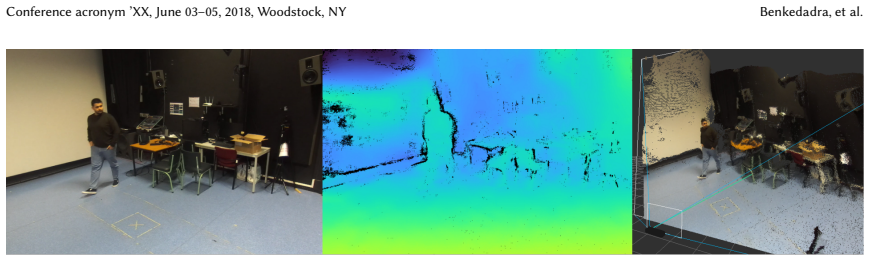
The load-bearing mechanism is the projection of 2D detections into 3D using the depth map and camera intrinsics: $Z$ is read from the depth map at pixel $(u,v)$, and $X=(u-c_x)Z/f_x$, $Y=(v-c_y)Z/f_y$ turn that pixel into a 3D position. This is what lets the system replace pixel-space heuristics with physical distances, zones, and event rules. Around this core sit the ZED stereo camera (the depth source), YOLOv5n (the detector), SORT/DeepSORT-style trackers, and rule-based logic that compares distances between projected bounding boxes to recognize events.
What would settle it
Set up two ZED cameras at the tested angles, fuse their pointclouds, and compare the fused 3D position of a person crossing a zone boundary against a laser rangefinder measurement; if the fused position errs by more than the zone margin (about 30 cm) in any tested condition, the notification logic would fire at the wrong time.
Extended reading notes
Core claim
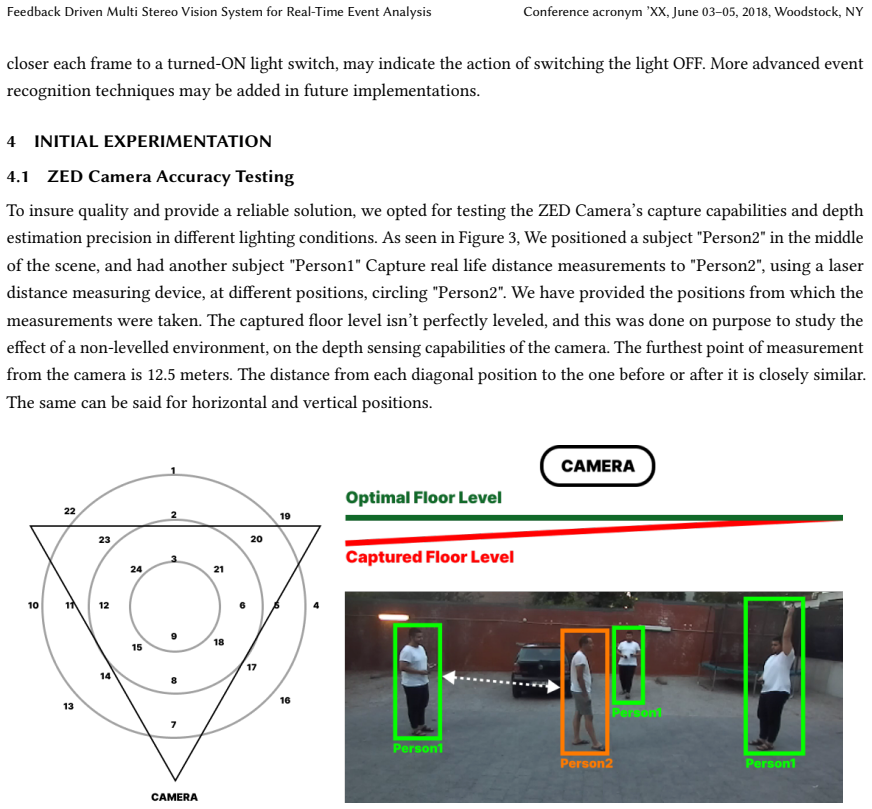
The paper's central claim is that robust scene understanding for interactive systems can be built from multiple stereo cameras rather than from a single 2D camera or a short-range gaming depth sensor. The proposed pipeline captures a scene from several angles, reconstructs it as a large 3D pointcloud, detects and tracks people and objects, and recognizes events by measuring distances between detected bounding boxes projected into 3D space. The authors report that the same pipeline addresses both ordinary use cases, such as smart-home lighting and music volume, and sensitive ones, such as construction-site zone alarms and dangerous-action logging. Their supporting evidence is a set of heatmaps showing where a ZED camera's depth-based distance measurements stay under 30 cm of error, plus FPS measurements across four device classes.
Load-bearing premise
The pipeline's reliability depends on the ZED camera's depth estimate at each detected object's pixel being accurate enough to place that object within the zone margin, and the paper's accuracy testing does not yet demonstrate this across lighting, floor, and angle variations.
Editorial extensions
If this is right
- A single ZED camera can support rule-based zoning, logging, and audio notification at 8–30 FPS, depending on the computing device.
- The same core pipeline transfers across construction sites, smart homes, and classrooms by swapping the object detector and zone definitions rather than the depth-projection machinery.
- Fusing multiple cameras' pointclouds should remove occlusion blind spots and enable whole-room tracking, which the authors identify as the necessary next step for complex scenes.
- Adding two-way feedback devices such as smartwatches or smart vests lets the system adapt its decisions from user input, going beyond one-way notification.
- If the reported accuracy holds, safety events can be logged with 3D positions and timestamps, supporting post-incident analysis in industrial settings.
Reading between the lines
- Editorial extension: the accuracy heatmaps suggest error grows with distance and changes with lighting, so a production system would need per-condition error bars and uncertainty estimation before zone decisions can be trusted; the paper reports neither.
- Editorial extension: the paper's planned registration-plus-voxelization fusion could double as a synthetic-data generator for training detectors, a use the authors mention only as a possibility.
- Editorial extension: the two-camera FPS numbers come from prerecorded files rather than live fusion, so live multi-camera throughput remains an open measurement.
Editorial analysis
A structured set of objections, weighed in public.
Referee Report
Summary. The paper proposes a pipeline for real-time event analysis using multiple ZED stereo cameras, combining depth-based 3D reconstruction, YOLO-based object detection and tracking, rule-based event recognition, and optional user feedback. Initial experiments include ZED depth accuracy heatmaps under different lighting and floor conditions, construction-site data collection and zoning tests, smart-home zone triggering, and FPS measurements on edge, laptop, and tablet devices. The authors conclude by outlining future work on accuracy testing, multi-camera fusion, and deployment optimization, stating that the work is a baseline rather than a complete system.
Significance. If successfully validated, the proposed pipeline would address a real gap in using commodity stereo cameras for safety-adjacent industrial and smart-environment monitoring. The paper's strength is its explicit pipeline architecture and honest acknowledgment of open challenges, supported by preliminary real-world data collection at construction sites. However, the significance is presently limited by the lack of quantitative validation: depth accuracy is reported only as qualitative heatmaps, multi-camera fusion is not evaluated, and event detection accuracy is not measured. The work is best viewed as a research roadmap with initial prototypes rather than a validated system.
major comments (4)
- [4.1, Figure 4] The depth accuracy evidence is insufficient to support the claimed robustness. The heatmaps use only a binary 30-cm threshold with no numeric error statistics, sample sizes, standard deviations, or per-condition tables for lighting or floor level. The authors themselves state in Section 5.1 that the accuracy testing 'is not sufficient to understand how the ZED's depth estimation accuracy effects the system.' Since the rule-based event logic (Section 3.3) and zoning (Section 4.3) rely on projected 3D positions and distances, a depth error exceeding 30 cm in relevant regions could produce false zone violations or misordered events. The manuscript must either provide a quantitative accuracy study or substantially temper the claimed robustness.
- [4.4] The title and abstract emphasize 'Multi Stereo Vision,' and Section 3 states that the system reconstructs the scene from multiple angles, but no multi-camera fusion results are presented. Section 4.4 describes only checkerboard calibration tests and states that the authors are 'experimenting' with registration and voxel grid fusion. There is no evaluation of registered pointcloud accuracy or multi-camera tracking, and all experimental results in Sections 4.1 through 4.3 appear to be single-camera. The multi-camera component is load-bearing for the proposed pipeline and is currently unvalidated.
- [4.5, Table 2] The real-time performance claim is not quantitatively supported. Table 2 reports averaged FPS values without variance, number of frames tested, resolution settings, or a clear specification of which pipeline stages (capture, detection, tracking, logging) are included. Some entries are missing ('/') with no explanation. The claim of 8–30 FPS across devices is therefore not statistically substantiated.
- [3.3] The paper claims 'event detection and action recognition' as core outputs, but the only implemented event logic is rule-based distance thresholds (e.g., a person near a light switch). No precision, recall, or other detection-quality metrics are reported for any event category, including the zone violations and collision-detection scenario described in Section 4.2. Without such evaluation, the system's usefulness for 'sensitive applications' is unsubstantiated.
minor comments (5)
- [Throughout] There are numerous typos and grammatical errors, including 'preforming' for 'performing' (abstract, Sections 2.1.1 and 3), 'insure' for 'ensure' (Section 4.1), 'wildly used' for 'widely used' (Section 2.2), and 'Ouput' in Table 3 heading.
- [Figure 4] Subfigure (d) labeled 'Average' is unclear; the manuscript should specify how the average is computed over the different conditions and whether the heatmap uses the same thresholding as the other subfigures.
- [Table 1] The caption reads 'Devices Used for Deployment and Testings'; 'Testings' should be 'Testing.' Also, the table would be clearer if the entries listed which specific resolutions and pipeline configurations were evaluated.
- [Section 5.3] The phrase 'From another point' is incomplete; it should read 'From another point of view' or similar.
- [Front matter] The paper uses an ACM 2018 template and references works from 2022, while the arXiv submission is dated 2025. The venue and date metadata should be updated or removed to avoid inconsistency.
Circularity Check
No circularity: standard pinhole projection, external laser-rangefinder benchmark, and zero self-citations leave the derivation chain self-contained.
full rationale
The derivation chain in this paper does not reduce to its own inputs. The 2D-to-3D projection of Section 3.2.2 uses the standard pinhole model (Eqs. 1-3) with focal lengths and principal points extracted from the ZED SDK and depth values read from the camera's depth map; these equations are textbook geometry, not a fit. The central quantitative evidence (Section 4.1) is an external benchmark: depth-based person-to-person distances are compared against measurements taken with a laser distance measuring device, an independent ground truth, with results reported as error heatmaps under 30 cm and 1 m thresholds. No parameter is fitted and then relabeled as a prediction, and the 30 cm green threshold is a presentation cutoff, not a fitted coefficient. The event-recognition rules in Section 3.3 are explicitly 'primitive hard-coded' definitions of events in terms of inter-object distances rather than validated predictions, so no statistical forcing occurs. There are no self-citations: none of the 20 references lists any author of this paper, so no load-bearing claim is imported from the authors' own prior work, and no uniqueness theorem or ansatz is smuggled via citation. The paper's own Section 5.1 concedes that the accuracy testing 'is not sufficient to understand how the ZED's depth estimation accuracy effects the system'; that is an evidence gap bearing on correctness risk, not circularity. The multi-camera pointcloud fusion described in Sections 4.4 and 5.2 is explicitly still experimental with no reported results that could be circular. Accordingly the paper is self-contained against external benchmarks and warrants a score of 0.
Assumptions & free parameters
assumptions (4)
- standard math Pinhole camera projection relates pixel coordinates and depth to 3D world coordinates using camera intrinsics (Eqs. 1-3).
- domain assumption YOLOv5n pretrained on COCO detects people and excavators with sufficient accuracy for the pipeline.
- domain assumption ZED depth estimates are accurate enough for the zone and event rules to make safe decisions.
- domain assumption Multiple camera pointclouds can be registered and fused into one reliable scene representation.
Cite this review
Pith. "Pith review of Feedback Driven Multi Stereo Vision System for Real-Time Event Analysis." pith.science (2026). https://pith.science/paper/HEBX5YMV
@misc{pith2026250617910,
  author       = {Pith},
  title        = {Pith review of: Feedback Driven Multi Stereo Vision System for Real-Time Event Analysis},
  year         = {2026},
  howpublished = {\url{https://pith.science/paper/HEBX5YMV}},
  note         = {Machine review of arXiv:2506.17910}
}
read the original abstract
2D cameras are often used in interactive systems. Other systems like gaming consoles provide more powerful 3D cameras for short range depth sensing. Overall, these cameras are not reliable in large, complex environments. In this work, we propose a 3D stereo vision based pipeline for interactive systems, that is able to handle both ordinary and sensitive applications, through robust scene understanding. We explore the fusion of multiple 3D cameras to do full scene reconstruction, which allows for preforming a wide range of tasks, like event recognition, subject tracking, and notification. Using possible feedback approaches, the system can receive data from the subjects present in the environment, to learn to make better decisions, or to adapt to completely new environments. Throughout the paper, we introduce the pipeline and explain our preliminary experimentation and results. Finally, we draw the roadmap for the next steps that need to be taken, in order to get this pipeline into production
Figures

Figures from the paper (5 more)


Reference graph
Works this paper leans on
-
[1]
Danilo Roberti Alves de Almeida, Scott C. Stark, Gang Shao, Juliana Schietti, Bruce Walker Nelson, Carlos Alberto Silva, Eric Bastos Gorgens, Ruben Valbuena, Daniel de Almeida Papa, and Pedro Henrique Santin Brancalion. 2019. Optimizing the Remote Detection of Tropical Rainforest Structure with Airborne Lidar: Leaf Area Profile Sensitivity to Pulse Densit...
work page 2019
- [2]
-
[3]
Martin S. Banks, Emily A. Cooper, and Elise A. Piazza. 2014. Camera Focal Length and the Perception of Pictures. Ecological Psychology 26, 1-2 (2014), 30–46. https://doi.org/10.1080/10407413.2014.877284 arXiv:https://doi.org/10.1080/10407413.2014.877284
-
[4]
Henriques, Andrea Vedaldi, and Philip H
Luca Bertinetto, Jack Valmadre, João F. Henriques, Andrea Vedaldi, and Philip H. S. Torr. 2016. Fully-Convolutional Siamese Networks for Object Tracking. In Computer Vision – ECCV 2016 Workshops , Gang Hua and Hervé Jégou (Eds.). Springer International Publishing, Cham, 850–865
work page 2016
-
[5]
Alex Bewley, ZongYuan Ge, Lionel Ott, Fabio Ramos, and Ben Upcroft. 2016. Simple Online and Realtime Tracking. CoRR abs/1602.00763 (2016). arXiv:1602.00763 http://arxiv.org/abs/1602.00763
arXiv 2016
-
[6]
Yulan Guo, Hanyun Wang, Qingyong Hu, Hao Liu, Li Liu, and Mohammed Bennamoun. 2021. Deep Learning for 3D Point Clouds: A Survey. IEEE Transactions on Pattern Analysis and Machine Intelligence 43, 12 (2021), 4338–4364. https://doi.org/10.1109/TPAMI.2020.3005434
arXiv 2021
-
[7]
Holte, Bhaskar Chakraborty, Jordi Gonzalez, and Thomas B
Michael B. Holte, Bhaskar Chakraborty, Jordi Gonzalez, and Thomas B. Moeslund. 2012. A Local 3-D Motion Descriptor for Multi-View Human Action Recognition from 4-D Spatio-Temporal Interest Points. IEEE Journal of Selected Topics in Signal Processing 6, 5 (2012), 553–565. https: //doi.org/10.1109/JSTSP.2012.2193556
-
[8]
Peiyuan Jiang, Daji Ergu, Fangyao Liu, Ying Cai, and Bo Ma. 2022. A Review of Yolo algorithm developments. Procedia Computer Science 199 (2022), 1066–1073
work page 2022
Show all 20 references
-
[9]
Yang Jiaxin, Wang Fang, and Yang Jieru. 2021. A review of action recognition based on convolutional neural network. In Journal of Physics: Conference Series, Vol. 1827. IOP Publishing, 012138
2021
-
[10]
Marina Kandroudi and Tharrenos Bratitsis. 2012. Exploring the educational perspectives of XBOX kinect based video games. Proc. ECGBL 2012 (2012), 219–227
2012
-
[11]
Bin Liang and Lihong Zheng. 2015. A Survey on Human Action Recognition Using Depth Sensors. In 2015 International Conference on Digital Image Computing: Techniques and Applications (DICTA). 1–8. https://doi.org/10.1109/DICTA.2015.7371223
2015
-
[12]
Wei Liu, Dragomir Anguelov, Dumitru Erhan, Christian Szegedy, Scott Reed, Cheng-Yang Fu, and Alexander C. Berg. 2016. SSD: Single Shot MultiBox Detector. Computer Vision – ECCV 2016 (2016), 21–37. https://doi.org/10.1007/978-3-319-46448-0_2
2016 doi
-
[13]
Sparsh Mittal. 2019. A survey on optimized implementation of deep learning models on the nvidia jetson platform. Journal of Systems Architecture 97 (2019), 428–442
2019
-
[14]
Miguel Pedraza-Hueso, Sergio Martín-Calzón, Francisco Javier Díaz-Pernas, and Mario Martínez-Zarzuela. 2015. Rehabilitation using kinect-based games and virtual reality. Procedia Computer Science 75 (2015), 161–168
2015
-
[15]
Shaoqing Ren, Kaiming He, Ross Girshick, and Jian Sun. 2015. Faster R-CNN: Towards Real-Time Object Detection with Region Proposal Networks. https://arxiv.org/abs/1506.01497
2015 arXiv
-
[16]
Vladimir Tadic, Attila Toth, Zoltan Vizvari, Mihaly Klincsik, Zoltan Sari, Peter Sarcevic, Jozsef Sarosi, and Istvan Biro. 2022. Perspectives of RealSense and ZED Depth Sensors for Robotic Vision Applications. Machines 10, 3 (2022). https://doi.org/10.3390/machines10030183
2022 doi
-
[17]
Vivek Veeriah, Naifan Zhuang, and Guo-Jun Qi. 2015. Differential recurrent neural networks for action recognition. In Proceedings of the IEEE international conference on computer vision . 4041–4049
2015
-
[18]
Le Wang, Jinliang Zang, Qilin Zhang, Zhenxing Niu, Gang Hua, and Nanning Zheng. 2018. Action Recognition by an Attention-Aware Temporal Weighted Convolutional Neural Network. Sensors 18, 7 (2018). https://doi.org/10.3390/s18071979
2018 doi
-
[19]
Nicolai Wojke, Alex Bewley, and Dietrich Paulus. 2017. Simple Online and Realtime Tracking with a Deep Association Metric. https://arxiv.org/abs/ 1703.07402#
2017 arXiv
-
[20]
Thi Thi Zin, Ye Htet, Yuya Akagi, Hiroki Tamura, Kazuhiro Kondo, Sanae Araki, and Etsuo Chosa. 2021. Real-Time Action Recognition System for Elderly People Using Stereo Depth Camera. Sensors 21, 17 (2021). https://doi.org/10.3390/s21175895 11
2021 doi
Reviewed August 6, 2026 · model on record in the stance chip above.
Discussion (0). Continue with ORCID to comment.