REVIEW 4 major objections 5 minor 48 references
Anomalies in G and 2D Raman Modes of Twisted Bilayer Graphene Near the Magic Angle
T0 review · 4 major / 5 minor · reviewed 2026-08-06 · deepseek-v4-flash
Pith's one-line read This paper claims that the G Raman mode of twisted bilayer graphene splits into two peaks near the magic angle, with the lower-frequency peak broadening strongly, and that both split components show roughly tenfold larger phonon…
desk verdict Plausible and potentially important G-mode splitting in t-BLG, but the central claim rests on two-Lorentzian fits that are asserted, not tested; the paper deserves peer review for the observation, not yet for the quantitative anharmonicity numbers. read the letter →
The pith
A machine-rendered reading of the paper's core claim, the machinery that carries it, and where it could break.
The reading
What carries the argument
The central object is the G Raman mode (the in-plane E2g-type phonon) and its evolution with twist angle. The key mechanism is phonon hybridization induced by the moiré potential: as the twist angle approaches the magic angle, atomic reconstruction strengthens the moiré potential, lowering the symmetry of the moiré unit cell and splitting the G mode into high- and low-frequency components. The quantitative analysis of anharmonicity uses the Klemens three-phonon decay model, fitting the temperature-dependent frequency shift to $\omega(T) = \omega_0 - A\left(1 + \frac{2}{e^{\hbar\omega_0/2k_B T} - 1}\right)$, where $A$ is the anharmonic coefficient. The magnitude of $A$ is taken as a direct measure of phonon-phonon coupling strength.
What would settle it
A statistical line-shape analysis of the G-mode spectra near 1° that compares a single Lorentzian against two Lorentzians using an information criterion (or an explicit residual analysis) would settle whether the splitting is real. If the single-Lorentzian fit is statistically sufficient or preferred, the claimed G+ / G− doublet and its anharmonicity would not be supported.
Extended reading notes
Core claim
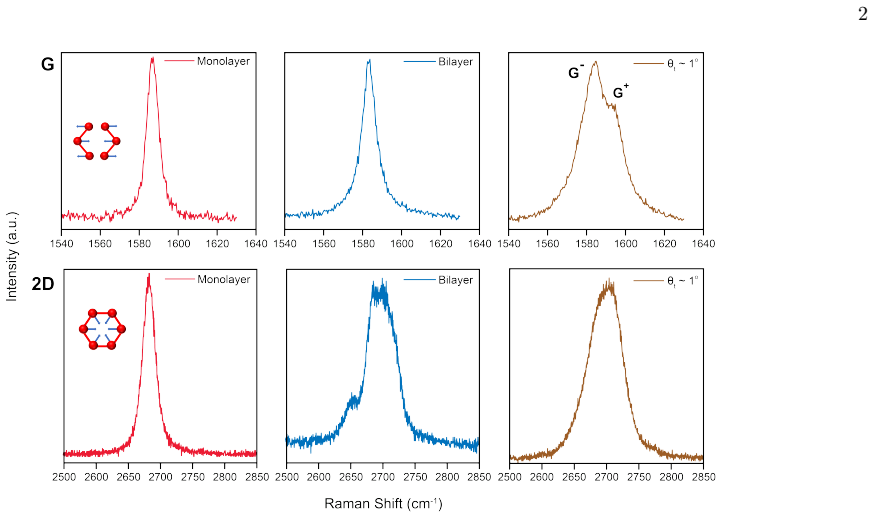
Near the magic angle, the otherwise single G Raman mode of twisted bilayer graphene splits into two components, G+ and G−, and this splitting is attributed to moiré-potential-induced phonon hybridization rather than intralayer resonance or asymmetric doping. The G− component has a distinctly larger linewidth than G+, and both components show enhanced electron-phonon coupling as the flat electronic bands emerge. In addition, the temperature-dependent red-shift of the split G modes is much stronger than in Bernal bilayer graphene, yielding anharmonic coefficients of about 280 and 226 cm−1 compared to about 25 cm−1 for Bernal bilayer, a roughly tenfold increase. The paper also reports that the 2D mode's components broaden near the magic angle, particularly the P2 component, while the characteristic P1 shoulder of Bernal bilayer reappears at twist angles above 2 degrees.
Load-bearing premise
The paper assumes that the G-mode spectra of the ~1° and ~1.1° samples genuinely contain two physically distinct Lorentzian peaks rather than one broadened peak, even though no comparison against a single-peak fit is reported for those samples.
Editorial extensions
If this is right
- The G mode in near-magic-angle twisted bilayer graphene should be treated as a doublet, not a single peak, in future Raman studies, since the splitting is a signature of the moiré potential's effect on phonons.
- The enhanced anharmonic coefficients imply stronger phonon-phonon scattering near the magic angle, which would reduce the phonon contribution to thermal conductivity in twisted bilayer graphene relative to Bernal bilayer.
- The broadening of the G− and 2D components with twist angle serves as a Raman-based probe of the flat-band-induced electron-phonon coupling enhancement near the magic angle.
- The reappearance of the Bernal-like 2D shoulder above 2 degrees suggests that flat-band effects on phonons are confined to small twist angles, consistent with the absence of flat bands beyond the magic-angle regime.
- The decomposition of the 2D band into three components P1, P2, and P3 across all twist angles implies that a fixed three-peak model remains valid even when the individual peaks are no longer visually resolved.
Reading between the lines
- The observed tenfold increase in the anharmonic coefficient suggests that phonon hybridization not only alters frequencies but also opens new decay channels for the optical phonon, which could be tested by directly measuring the thermal conductivity of magic-angle twisted bilayer graphene and comparing it with the Klemens-model prediction.
- A comparative study using multiple excitation energies could distinguish more rigorously between phonon-hybridization splitting and resonance-enhanced contributions, since the paper rules out one specific intralayer resonance but does not exhaust all possible resonance pathways.
- The two-Lorentzian decomposition of the G mode is applied only to the two samples closest to the magic angle; an explicit statistical comparison against a single-Lorentzian fit (for example, via reduced chi-squared or an information criterion) would independently validate that the splitting is physically real and not an artifact of fitting a broadened asymmetric peak.
- If the splitting is confirmed by higher-resolution or polarization-resolved Raman measurements, it would provide a direct optical signature of atomic reconstruction and moiré-potential strength, potentially serving as a non-contact thermometer for the local reconstruction state in twisted bilayers.
Signed reviews
Editorial analysis
A structured set of objections, weighed in public.
Referee Report
Summary. The paper reports micro-Raman measurements of the G and 2D modes in hBN-encapsulated twisted bilayer graphene (t-BLG) samples with twist angles from ~0.3° to ~3°, together with temperature-dependent measurements (6–300 K) on one ~1° sample and one Bernal bilayer sample. The central claims are that the G mode splits into G+ and G− components near the magic angle due to moiré-potential-induced phonon hybridization; that the linewidths of G− and of the main 2D component are enhanced near ~1°; and that the Klemens anharmonic coefficient extracted from the temperature shift of the split G modes is roughly ten times larger in ~1° t-BLG than in Bernal bilayer graphene.
Significance. If substantiated, the reported G-mode splitting near the magic angle would be a notable observation, extending the phonon-hybridization picture previously proposed for twisted WSe2 to twisted bilayer graphene and tying phonon behavior to flat-band physics. The systematic angle dependence across 0.3°–3°, the use of hBN encapsulation, and the temperature-dependent measurements on the same samples are definite strengths. However, the manuscript's quantitative conclusions are not currently supported by the presented analysis: the two-Lorentzian decomposition of the G mode is not tested against a single-peak model, no fit uncertainties are reported for the key linewidth and anharmonic-coefficient values, and the fragility of the 2D-mode decomposition is acknowledged in the text. The paper therefore has the potential to make a strong contribution, but the evidence as presented does not yet establish the central claims.
major comments (4)
- [Section III, Figure 2] The central claim of G-mode splitting rests on fitting the ~1° and ~1.1° spectra with two Lorentzians while all other spectra are fitted with one Lorentzian, but no comparison is made between the two models for those two spectra. The manuscript should report residuals, reduced chi-squared, and an information criterion (AIC or BIC) or an F-test for the one-versus-two Lorentzian fits, along with confidence intervals for the peak parameters. Without this, a single broadened peak (as would be expected from enhanced electron-phonon broadening at the magic angle, cf. Ref. [41]) cannot be excluded as the actual line shape.
- [Figures 3 and 5] The plots of G-mode and 2D-mode frequencies and FWHMs versus twist angle show no error bars, and the grey bands are described only as visual guides. The claimed maximum in the G− FWHM near 1° and the enhancement of the P2 linewidth are therefore unquantified. The authors should report uncertainties from the fits (covariance matrices or bootstrap) and, ideally, repeat measurements at nominally identical twist angles to assess sample-to-sample variation.
- [Section III, 2D-mode paragraph and Figure 5] The authors state that the three-peak decomposition of the 2D band is fragile and that the majority of the broadening is likely absorbed by the P2 component during fitting. This is a direct admission that the P2 linewidth trend may be an artifact of the fitting procedure. The manuscript needs a stability analysis (e.g., varying starting parameters, fixing peak positions, or using a different number of components) and reported uncertainties to show that the P2 FWHM enhancement near the magic angle is not a fitting artifact.
- [Section III, Figure 7 and Eq. (1)] The anharmonic coefficients A are quoted as 279.9 cm−1 and 226.3 cm−1 for the split G modes versus 24.8 cm−1 for Bernal bilayer graphene, but no uncertainties are given and each value comes from a single sample. The 'tenfold' claim thus has no statistical support. Additionally, the fit of Eq. (1) may have strong correlation between A and ω0; the authors should report the covariance or fit confidence region. The claim that thermal expansion is negligible should be backed by a quantitative estimate rather than a statement of temperature range.
minor comments (5)
- [Eq. (1)] The symbol K in Eq. (1) is not defined; it should be written as k_B (Boltzmann's constant) and 'KT' should be typeset as k_B T.
- [Abstract] The phrase 'phonon anharmonicity-induced temperature variation' is imprecise; the measured quantity is the temperature dependence of the phonon frequency, and the anharmonic coefficient is a derived fit parameter.
- [Figure 2 caption] The caption states that red lines show 'Lorentzian fits' without specifying that panels (c) and (d) use two Lorentzians; this should be clarified for the reader.
- [Reference [20]] Reference [20] is cited as 'ACS nano (2024)' without volume, article number, or DOI; please provide full publication details.
- [Section III] The sentence 'As can be seen that, the spectrum is distinct ...' is grammatically incomplete and should be revised.
Circularity Check
No load-bearing circularity; self-citations are analogical support, not derivational inputs.
full rationale
The paper's derivation chain is empirical: Raman spectra are fitted with Lorentzians, peak positions and FWHMs are extracted, and temperature-dependent shifts are fitted with the Klemens anharmonic model (Eq. 1). None of these steps reduces to the paper's conclusions by construction. The central claim—G-mode splitting near the magic angle—rests on fitting two Lorentzians to the ~1° and ~1.1° spectra, an interpretive modeling choice rather than a derivation from the inputs. The authors support this interpretation by analogy to their own prior t-WSe2 work ([20], 'similar to a recent study on t-WSe2') and by reference to a separate theory paper ([36], 'as seen in a recent theoretical study on t-BLG'). These citations are not load-bearing reductions: they are plausibility arguments, not uniqueness theorems or fitted parameters renamed as predictions. The reported tenfold anharmonicity is a comparison of the fitted Klemens coefficient A between the t-BLG and Bernal bilayer datasets, which is a legitimate empirical comparison rather than a circular re-statement of inputs. The lack of a single-Lorentzian fit comparison for the split samples is a robustness concern, not a circularity, and therefore does not raise the circularity score. Overall, the paper contains no step where a claimed prediction is equivalent by definition to its input.
Assumptions & free parameters
free parameters (5)
- Anharmonic coefficient A for G+ mode in ~1° t-BLG =
279.9 cm^-1
- Anharmonic coefficient A for G- mode in ~1° t-BLG =
226.3 cm^-1
- Anharmonic coefficient A for G mode in Bernal BLG =
24.8 cm^-1
- Lorentzian fit parameters for G mode (positions, FWHMs, amplitudes) =
not listed
- Lorentzian fit parameters for 2D mode (P1, P2, P3) =
not listed
assumptions (4)
- domain assumption The Raman G peak line shape can be represented as a sum of Lorentzians, with either one or two components depending on twist angle.
- domain assumption The 2D Raman band can always be decomposed into three Lorentzian components P1, P2, P3.
- domain assumption Thermal expansion contribution to the G-mode frequency shift is negligible over 6-300 K.
- standard math The Klemens model (Eq. 1) adequately describes the temperature dependence of the G mode frequency.
Cite this review
Pith. "Pith review of Anomalies in G and 2D Raman Modes of Twisted Bilayer Graphene Near the Magic Angle." pith.science (2026). https://pith.science/paper/4D26J4II
@misc{pith2026250618166,
  author       = {Pith},
  title        = {Pith review of: Anomalies in G and 2D Raman Modes of Twisted Bilayer Graphene Near the Magic Angle},
  year         = {2026},
  howpublished = {\url{https://pith.science/paper/4D26J4II}},
  note         = {Machine review of arXiv:2506.18166}
}
abstract
The role of twist angle ($\theta_t$) in tailoring the physical properties of heterostructures is emerging as a new paradigm in two-dimensional materials. The influence of flat electronic bands near the magic angle ($\sim$1.1$^{\circ}$) on the phononic properties of twisted bilayer graphene (t-BLG) is not well understood. In this work, we systematically investigate the G and 2D Raman modes of t-BLG samples with twist angles ranging from $\sim$0.3$^{\circ}$ to $\sim$3$^{\circ}$ using micro-Raman spectroscopy. A key finding of our work is the splitting of the G mode near the magic angle due to moir\'e potential induced phonon hybridization. The linewidth of the low-frequency component of the G mode (G$^-$), as well as the main component of the 2D mode, exhibits enhanced broadening near the magic angle due to increased electron-phonon coupling, driven by the emergence of flat electronic bands. Additionally, temperature-dependent Raman measurements (6-300 K) of magic-angle twisted bilayer graphene sample ($\theta_t \sim$ 1$^{\circ}$) reveal an almost tenfold increase in phonon anharmonicity-induced temperature variation in both components of the split G mode, as compared to Bernal-stacked bilayer graphene sample, further emphasizing the role of phonon hybridization in this system. These studies could be important for understanding the thermal properties of the twisted bilayer graphene systems.
Figures


Figures from the paper (4 more)


Reference graph
Works this paper leans on
-
[41]
However, they did not observe any splitting of the G mode
on t-BLG, where they attributed the broadening to enhanced electron-phonon coupling at the magic an- gle caused by an increased electronic density of states (DOS). However, they did not observe any splitting of the G mode. In contrast, our data show that instead of a simple broadening, the G mode splits into two distinct components: G − (lower frequency) ...
-
[1]
T. Ohta, J. T. Robinson, P. J. Feibelman, A. Bostwick, E. Rotenberg, and T. E. Beechem, Evidence for interlayer coupling and moir´ e periodic potentials in twisted bilayer 8 graphene, Physical Review Letters 109, 186807 (2012)
work page 2012
-
[2]
Y. Cao, V. Fatemi, S. Fang, K. Watanabe, T. Taniguchi, E. Kaxiras, and P. Jarillo-Herrero, Unconventional super- conductivity in magic-angle graphene superlattices, Na- ture 556, 43 (2018)
2018
- [3]
-
[4]
Yankowitz, S
M. Yankowitz, S. Chen, H. Polshyn, Y. Zhang, K. Watan- abe, T. Taniguchi, D. Graf, A. F. Young, and C. R. Dean, Tuning superconductivity in twisted bilayer graphene, Science 363, 1059 (2019)
2019
-
[5]
M. Oh, K. P. Nuckolls, D. Wong, R. L. Lee, X. Liu, K. Watanabe, T. Taniguchi, and A. Yazdani, Evidence for unconventional superconductivity in twisted bilayer graphene, Nature 600, 240 (2021)
2021
-
[6]
X. Lu, P. Stepanov, W. Yang, M. Xie, M. A. Aamir, I. Das, C. Urgell, K. Watanabe, T. Taniguchi, G. Zhang, et al., Superconductors, orbital magnets and correlated states in magic-angle bilayer graphene, Nature 574, 653 (2019)
work page 2019
-
[7]
K. S. Novoselov, E. McCann, S. Morozov, V. I. Fal’ko, M. Katsnelson, U. Zeitler, D. Jiang, F. Schedin, and A. Geim, Unconventional quantum hall effect and berry’s phase of 2 π in bilayer graphene, Nature physics 2, 177 (2006)
work page 2006
Show all 48 references
-
[8]
Grimvall, The electron-phonon interaction in normal metals, Physica Scripta 14, 63 (1976)
G. Grimvall, The electron-phonon interaction in normal metals, Physica Scripta 14, 63 (1976)
1976
-
[9]
H. Yoo, R. Engelke, S. Carr, S. Fang, K. Zhang, P. Cazeaux, S. H. Sung, R. Hovden, A. W. Tsen, T. Taniguchi, et al., Atomic and electronic reconstruction at the van der waals interface in twisted bilayer graphene, Nature materials 18, 448 (2019)
2019
-
[10]
Woods, L
C. Woods, L. Britnell, A. Eckmann, R. Ma, J. Lu, H. Guo, X. Lin, G. Yu, Y. Cao, R. V. Gorbachev, et al., Commensurate–incommensurate transition in graphene on hexagonal boron nitride, Nature physics 10, 451 (2014)
2014
-
[11]
N. Y. Kim, H. Y. Jeong, J. H. Kim, G. Kim, H. S. Shin, and Z. Lee, Evidence of local commensurate state with lattice match of graphene on hexagonal boron nitride, Acs Nano 11, 7084 (2017)
2017
-
[12]
N. N. Nam and M. Koshino, Lattice relaxation and en- ergy band modulation in twisted bilayer graphene, Phys- ical Review B 96, 075311 (2017)
2017
-
[13]
Gargiulo and O
F. Gargiulo and O. V. Yazyev, Structural and electronic transformation in low-angle twisted bilayer graphene, 2D Materials 5, 015019 (2017)
2017
-
[14]
Zhang and E
K. Zhang and E. B. Tadmor, Structural and electron diffraction scaling of twisted graphene bilayers, Journal of the Mechanics and Physics of Solids 112, 225 (2018)
2018
-
[15]
K. S. Novoselov, A. Mishchenko, A. Carvalho, and A. Castro Neto, 2d materials and van der waals het- erostructures, Science 353, aac9439 (2016)
2016
-
[16]
J. S. Alden, A. W. Tsen, P. Y. Huang, R. Hov- den, L. Brown, J. Park, D. A. Muller, and P. L. McEuen, Strain solitons and topological defects in bi- layer graphene, Proceedings of the National Academy of Sciences 110, 11256 (2013)
2013
-
[17]
X. Lin, D. Liu, and D. Tom´ anek, Shear instability in twisted bilayer graphene, Physical Review B 98, 195432 (2018)
2018
-
[18]
M. S. Dresselhaus, A. Jorio, M. Hofmann, G. Dressel- haus, and R. Saito, Perspectives on carbon nanotubes and graphene raman spectroscopy, Nano letters 10, 751 (2010)
2010
-
[19]
A. C. Ferrari and D. M. Basko, Raman spectroscopy as a versatile tool for studying the properties of graphene, Nature nanotechnology 8, 235 (2013)
2013
-
[20]
K. P. Bera, D. Solanki, S. Mandal, R. Biswas, T. Taniguchi, K. Watanabe, V. Raghunathan, M. Jain, A. Sood, and A. Das, Twist angle-dependent phonon hy- bridization in wse2/wse2 homobilayer, ACS nano (2024)
2024
-
[21]
Huang, Y.-H
Y. Huang, Y.-H. Pan, R. Yang, L.-H. Bao, L. Meng, H.- L. Luo, Y.-Q. Cai, G.-D. Liu, W.-J. Zhao, Z. Zhou, et al., Universal mechanical exfoliation of large-area 2d crystals, Nature communications 11, 2453 (2020)
2020
-
[22]
Gao, S.-Z
E. Gao, S.-Z. Lin, Z. Qin, M. J. Buehler, X.-Q. Feng, and Z. Xu, Mechanical exfoliation of two-dimensional materi- als, Journal of the Mechanics and Physics of Solids 115, 248 (2018)
2018
-
[23]
Yi and Z
M. Yi and Z. Shen, A review on mechanical exfoliation for the scalable production of graphene, Journal of Materials Chemistry A 3, 11700 (2015)
2015
-
[24]
K. Kim, M. Yankowitz, B. Fallahazad, S. Kang, H. C. Movva, S. Huang, S. Larentis, C. M. Corbet, T. Taniguchi, K. Watanabe, et al., van der waals het- erostructures with high accuracy rotational alignment, Nano letters 16, 1989 (2016)
2016
-
[25]
H.-W. Guo, Z. Hu, Z.-B. Liu, and J.-G. Tian, Stacking of 2d materials, Advanced Functional Materials31, 2007810 (2021)
2021
-
[26]
Holler, L
J. Holler, L. Bauriedl, T. Korn, A. Seitz, F. ¨Ozyigit, M. Eichinger, C. Sch¨ uller, K. Watanabe, T. Taniguchi, C. Strunk, et al., Air tightness of hbn encapsulation and its impact on raman spectroscopy of van der waals ma- terials, 2D Materials 7, 015012 (2019)
2019
-
[27]
Zhang, Y
K. Zhang, Y. Feng, F. Wang, Z. Yang, and J. Wang, Two dimensional hexagonal boron nitride (2d-hbn): syn- thesis, properties and applications, Journal of Materials Chemistry C 5, 11992 (2017)
2017
-
[28]
Taychatanapat, K
T. Taychatanapat, K. Watanabe, T. Taniguchi, and P. Jarillo-Herrero, Quantum hall effect and landau-level crossing of dirac fermions in trilayer graphene, Nature Physics 7, 621 (2011)
2011
-
[29]
C. R. Dean, A. F. Young, I. Meric, C. Lee, L. Wang, S. Sorgenfrei, K. Watanabe, T. Taniguchi, P. Kim, K. L. Shepard, et al., Boron nitride substrates for high- quality graphene electronics, Nature nanotechnology 5, 722 (2010)
2010
-
[30]
J. Xue, J. Sanchez-Yamagishi, D. Bulmash, P. Jacquod, A. Deshpande, K. Watanabe, T. Taniguchi, P. Jarillo- Herrero, and B. J. LeRoy, Scanning tunnelling mi- croscopy and spectroscopy of ultra-flat graphene on hexagonal boron nitride, Nature materials 10, 282 (2011)
2011
-
[31]
Decker, Y
R. Decker, Y. Wang, V. W. Brar, W. Regan, H.-Z. Tsai, Q. Wu, W. Gannett, A. Zettl, and M. F. Crommie, Lo- cal electronic properties of graphene on a bn substrate via scanning tunneling microscopy, Nano letters 11, 2291 (2011)
2011
-
[32]
A. C. Gadelha, D. A. Ohlberg, C. Rabelo, E. G. Neto, T. L. Vasconcelos, J. L. Campos, J. S. Lemos, V. Or- nelas, D. Miranda, R. Nadas, et al., Localization of lattice dynamics in low-angle twisted bilayer graphene, Nature 9 590, 405 (2021)
2021
-
[33]
T. A. de Jong, T. Benschop, X. Chen, E. E. Krasovskii, M. J. de Dood, R. M. Tromp, M. P. Allan, and S. J. Van der Molen, Imaging moir´ e deformation and dynamics in twisted bilayer graphene, Nature Communications 13, 70 (2022)
2022
-
[34]
R. N. Gontijo, M. V. Moutinho, A. Righi, P.-W. Chiu, P. Venezuela, and M. A. Pimenta, Resonant enhance- ment of the 2g raman band in twisted bilayer graphene, Materials Chemistry and Physics 319, 129279 (2024)
2024
-
[35]
In Figure 1, we show the G and 2D modes of mono- layer, bilayer and ∼1◦ t-BLG for comparison
shows a representative Raman spectrum of a mono- layer graphene sample, showcasing the absence of the characteristic D mode (disorder-induced mode) at ap- proximately 1350 cm−1, indicative of pristine, defect-free monolayer graphene. In Figure 1, we show the G and 2D modes of ...
-
[36]
Mandal, I
S. Mandal, I. Maity, H. Krishnamurthy, and M. Jain, Phonon linewidths in twisted bilayer graphene near the magic angle, Physical Review B 110, 125421 (2024)
2024
-
[37]
tem- perature for split peaks, relative intensity vs
See Supplemental Material at [URL will be inserted by publisher] for Raman spectra of monolayer graphene; step-by-step sample fabrication process; FWHM vs. tem- perature for split peaks, relative intensity vs. tempera- ture for split peaks, and Raman spectra of monolayer graph...
-
[38]
Moutinho, G
M. Moutinho, G. Eliel, A. Righi, R. Gontijo, M. Pail- let, T. Michel, P.-W. Chiu, P. Venezuela, and M. Pi- menta, Resonance raman enhancement by the intralayer and interlayer electron–phonon processes in twisted bi- layer graphene, Scientific Reports 11, 17206 (2021)
2021
-
[39]
Eliel, M
G. Eliel, M. Moutinho, A. Gadelha, A. Righi, L. Cam- pos, H. Ribeiro, P.-W. Chiu, K. Watanabe, T. Taniguchi, P. Puech, et al., Intralayer and interlayer electron– phonon interactions in twisted graphene heterostruc- tures, Nature communications 9, 1221 (2018)
2018
-
[40]
Chung, R
T.-F. Chung, R. He, T.-L. Wu, and Y. P. Chen, Optical phonons in twisted bilayer graphene with gate-induced asymmetric doping, Nano Letters 15, 1203 (2015)
2015
-
[42]
Mafra, P
D. Mafra, P. Gava, L. Malard, R. Borges, G. Silva, J. Leon, F. Plentz, F. Mauri, and M. Pimenta, Char- acterizing intrinsic charges in top gated bilayer graphene device by raman spectroscopy, Carbon 50, 3435 (2012)
2012
-
[43]
T. C. Barbosa, A. C. Gadelha, D. A. Ohlberg, K. Watan- abe, T. Taniguchi, G. Medeiros-Ribeiro, A. Jorio, and L. C. Campos, Raman spectra of twisted bilayer graphene close to the magic angle, 2D Materials 9, 025007 (2022)
2022
-
[44]
Bonini, M
N. Bonini, M. Lazzeri, N. Marzari, and F. Mauri, Phonon anharmonicities in graphite and graphene, Physical re- view letters 99, 176802 (2007)
2007
-
[45]
J. Lin, L. Guo, Q. Huang, Y. Jia, K. Li, X. Lai, and X. Chen, Anharmonic phonon effects in raman spectra of unsupported vertical graphene sheets, Physical Review B—Condensed Matter and Materials Physics 83, 125430 (2011)
2011
-
[46]
Tristant, A
D. Tristant, A. Cupo, X. Ling, and V. Meunier, Phonon anharmonicity in few-layer black phosphorus, ACS nano 13, 10456 (2019)
2019
-
[47]
Zhu and W
S. Zhu and W. Zheng, Temperature-dependent phonon shifts in van der waals crystals, The Journal of Physical Chemistry Letters 12, 5261 (2021)
2021
-
[48]
Klemens, Anharmonic decay of optical phonons, Phys- ical Review 148, 845 (1966)
P. Klemens, Anharmonic decay of optical phonons, Phys- ical Review 148, 845 (1966). 10 Supporting Information Appendix A: Raman Spectra of Monolayer Graphene FIG. S1. Raman spectrum of monolayer graphene. Figure S1 shows the Raman spectrum of mechanically exfoliated single-lay...
1966
Reviewed August 6, 2026 · model on record in the stance chip above.
Discussion (0). Continue with ORCID to comment.