REVIEW 6 major objections 5 minor 12 references
A Modular Taxonomy for Hate Speech Definitions and Its Impact on Zero-Shot LLM Classification Performance
T0 review · 6 major / 5 minor · reviewed 2026-08-06 · deepseek-v4-flash
Pith's one-line read The paper claims that the definition of hate speech supplied in a zero-shot prompt is a substantive variable that changes classifier performance, with the direction of the effect depending on the model.
desk verdict A genuinely useful taxonomy and definition collection, but the headline claim about Conceptual Elements overstates what the experiments can isolate; still worth a serious referee. read the letter →
The pith
A machine-rendered reading of the paper's core claim, the machinery that carries it, and where it could break.
The reading
What carries the argument
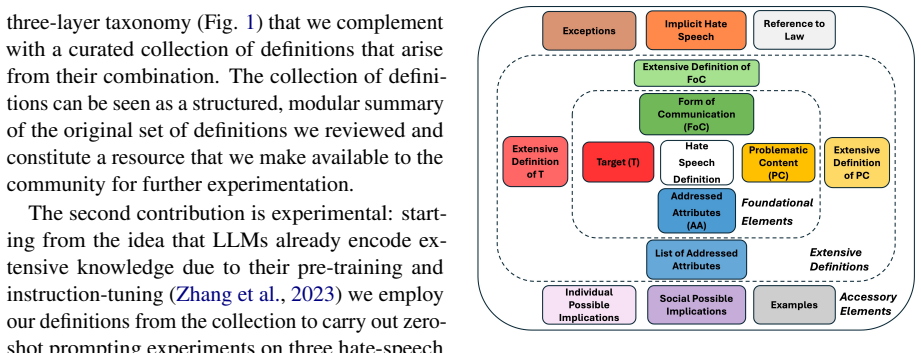
The central object is the three-layer taxonomy of 14 Conceptual Elements: four Foundational Elements (Form of Communication, Target, Problematic Content, Addressed Attributes) that form the Hate Speech Base definition; four Extensive Definitions (of Form of Communication, Target, Problematic Content, and a List of Addressed Attributes) that enrich those foundations; and six Accessory Elements including Possible Implications, Exceptions, and Implicit Hate Speech. The machinery's work is to make a definition decomposable and recombinable: each element has a fixed natural-language span, spans are reused verbatim across definitions, and definitions differ only in which spans are included. That design is what lets the experiments attribute performance differences to the presence or absence of conceptual content rather than to arbitrary wording.
What would settle it
Reprompt all models with several paraphrases of each Conceptual Element span while holding the underlying element fixed; if the macro-F1 differences across definitions vanish or reverse under rephrasing, the central claim that Conceptual Elements drive the effect is falsified. For the secondary claim, apply the Exceptions and Implicit Hate Speech elements to a dataset with corresponding fine-grained labels and test whether targeted error reductions appear outside HateCheck.
Extended reading notes
Core claim
On the paper's own terms, the discovery is that the definition of hate speech used in a zero-shot prompt is a substantive variable: prompting definitions built by adding or removing specific Conceptual Elements changes macro-F1 scores, and the direction of the change depends on the model and dataset. The paper further claims that definitions are modular, with the 14 Conceptual Elements combinable into a Hate Speech Base plus refinements, so the effect of a definition can be traced to the elements it contains. The error analysis adds that an element aimed at a particular type of hate reduces errors on that type: telling the model that offensive statements about personality traits are exceptions lowers errors on misleading non-hate items, and telling it that hate speech can be implicit lowers errors on implicitly hateful items, with the strongest evidence on the HateCheck suite.
Load-bearing premise
The experimental comparison assumes that the curated natural-language spans differ only in the Conceptual Elements they encode, so that performance differences come from conceptual content rather than from prompt wording, phrasing, or length.
Editorial extensions
If this is right
- Reported zero-shot hate speech scores are definition-dependent, so benchmark comparisons that do not fix the definition are not directly comparable.
- Definition prompting can be used to tune error profiles: models that reduce false negatives with detailed definitions fit high-recall moderation strategies, while models that primarily reduce false positives fit high-precision settings.
- A definition can be evaluated module by module, letting researchers identify which Conceptual Element drives performance on which hate type before deployment.
- The effect is not uniform across architectures, so a single best definition for hate speech detection should not be assumed to transfer across models.
- Targeted errors respond to targeted elements, as seen when adding exceptions or implicit hate speech reduces errors on the corresponding HateCheck macro classes.
Reading between the lines
- An implication the authors leave implicit is that the same modular technique could be applied to other contested constructs such as toxicity or misinformation, whose benchmark scores may be equally contingent on the definition baked into the prompt.
- A testable extension is to apply the Implicit Hate Speech and Exceptions elements to a non-HateCheck dataset with fine-grained labels for implicit hate and misleading non-hate content; the paper predicts targeted error reductions on those classes, so their absence would show the effect is specific to HateCheck.
- Because the authors concede that surface phrasing can matter even when the underlying elements are fixed, a natural follow-up is to paraphrase each Conceptual Element several times; if the performance differences vanish under rephrasing, the effect belongs to wording rather than conceptual content.
- The taxonomy could help reconcile annotation standards by mapping each dataset's operational definition onto Conceptual Elements, allowing predictions about when classifiers trained on one definition will transfer to another.
Editorial analysis
A structured set of objections, weighed in public.
Referee Report
Summary. The paper proposes a three-layer taxonomy of 14 Conceptual Elements (CEs) for hate speech definitions, derived from 20 definitions in the literature, social-media policies, official documents, and LLM-generated definitions. The authors construct a collection of definitions as modular combinations of CEs and use them as prompts in zero-shot binary hate-speech classification with three instruction-tuned LLMs (Llama-3-8B-Instruct, Mistral-7B-Instruct-v0.2, Flan-T5-XL) on three datasets (HateCheck, Learning from the Worst, Measuring Hate Speech). The main empirical claim is that varying the definition, specifically the degree of specificity in terms of encoded CEs, affects macro-F1 performance, but the effect is inconsistent across architectures. A secondary error analysis on HateCheck macro classes suggests that adding a CE aimed at a particular hate type (implicit hate, exceptions) reduces errors on the corresponding class. The paper also contributes a public code repository and appendices on robustness and sensitivity.
Significance. The taxonomy and the curated definition collection are valuable, transparent resources that could help researchers structure operational definitions of hate speech and compare benchmark results across definition choices. If the experimental claim were cleanly established, the paper would show that prompt definition is a substantive variable in zero-shot classification and that reported scores are contingent on the chosen definition. Strengths include the systematic recombination of CEs, the use of three datasets and three model families, and the appended robustness and sensitivity analyses. However, the quantitative evidence currently supports only a coarse version of the claim: definitions affect performance. The specific attribution to CE composition is confounded, and the cross-architecture comparison has methodological inconsistencies. The conceptual contribution stands on its own; the experimental conclusions require revision.
major comments (6)
- [§3.3; Appendix E; §8] The central claim in the abstract attributes performance differences to 'a different degree of specificity in terms of encoded elements.' Section 3.3 states that the curated wording was chosen so that 'variation stems solely from different combinations of CEs,' but the definitions in Appendix E differ simultaneously in CE set, surface wording, and length. Section 8 concedes that 'semantically different realization of the Conceptual Elements could have had a different impact' and that surface-level phrasing can influence model behavior; the Own-vs-HSB comparison on MHS is a within-paper demonstration that identical CEs with different wording produce different F1. Therefore Tables 2 and 3 do not isolate CE specificity as the causal variable. Please add paraphrase-level controls (multiple surface realizations per CE combination, or matched templates that vary a single clause) and report the resulting variance, or restrict the claim to 'prompt wording affects performance.'
- [§5.1; Tables 2 and 3] The paper reports macro-F1 point estimates from three runs (see also Appendix G) but no confidence intervals, error bars, or significance tests. Many contrasts are small, for example HateCheck Llama-3 HSB (80.02) vs HSB_EDT (80.14) in Table 2, and several Step 2 differences in Table 3 are on the order of 1 F1 point. The qualitative statements in Section 5.2, such as Mistral consistently improving in Step 2 or Flan-T5 never improving in Step 2, are not supported beyond descriptive trends. Please add paired significance tests or bootstrap confidence intervals across items and runs, or explicitly frame the results as exploratory.
- [§4.1; §5.2; Table 3] In Step 2, the base definition is selected as the Step 1 definition with the highest macro-F1 on the same test set used for the Step 2 evaluation. This is a form of test-set peeking: the selection of HSB_EDT (or the relevant best definition per model/dataset) is informed by the labels of the very instances that are then used to measure the accessory-element effects. The Step 2 improvements in Table 3 and the corresponding claims in Section 5.2 may therefore be inflated. Please use a validation split for selecting the base definition, pre-register the base, or report selection-corrected estimates.
- [Footnote 6; §5.2] The decoding setups differ across models: Mistral was run with constrained generation at temperature 0.7, while Llama-3 and Flan-T5 used temperature 0.95. The central claim includes the statement that the definition effect is 'not consistent across all architectures,' but cross-model differences in definition sensitivity (Section 5.2) could be driven by decoding temperature or constrained decoding rather than by architecture. Within-model comparisons are less affected because each model uses a fixed setup, but the architecture-level comparison should either match decoding settings across models or demonstrate robustness to temperature.
- [§5.1; Table 2] Section 5.1 notes that Llama-3 performs best with no definition (NO) in two of three datasets, which the authors attribute to potential data leakage from HateCheck. If Llama-3 has been exposed to HateCheck during pretraining or instruction tuning, its HateCheck results in Tables 2 and 3 are not a clean zero-shot evaluation, and the cross-architecture pattern that includes Llama-3 is compromised. Please perform a contamination check (for example, exact or near-duplicate matching against known pretraining corpora, or evaluation on a newly collected held-out set) and rerun or qualify the Llama-3 results accordingly.
- [§6; Table 4; Appendix J] The error-analysis claim that adding a targeted CE reduces errors on the corresponding macro class is partly built into the prompt. The IHS definition explicitly states that hate speech 'can also be implicit, portrayed as an indirect or coded language that uses Irony, Stereotypes, or Misinformation,' and the Special HS macro class in Appendix J is defined as implicitly phrased hate; similarly, the Exc definition enumerates what is not hate speech, matching the Misleading NHS class. The observed error reductions in Table 4 may therefore reflect keyword/instruction matching rather than a general conceptual effect. The authors acknowledge that this analysis is limited to HateCheck (Section 8), but the conclusion in Section 7 generalizes the finding. Please temper the claim or test it on held-out data for implicit hate and exceptions.
minor comments (5)
- [Throughout] Model names and definition names are inconsistent across text and tables (e.g., 'LLama3' vs 'Llama-3', 'FlanT5' vs 'Flan-T5', 'HSB_EDFoC' vs 'HSB + EDFoC'); please standardize.
- [Table 2 caption; Appendix K] There are several typos in tables and appendices, including 'Exstensive' in the Table 2 caption and 'couter_ref_nh' in Appendix K; a careful proofreading pass is needed.
- [§4.1] The sampling description uses European decimal commas ('31,84%') and a comma in '3901,' which is inconsistent with the rest of the paper; please use uniform decimal notation.
- [Appendices G-H] The robustness and sensitivity analyses are valuable but are only referenced as a sanity check in the main text; consider reporting the key robustness result (e.g., the NO condition being the frequent outlier) in the main Results section.
- [References] Reference formatting is inconsistent, including 'V oin' in the Wigand reference and 'Plaza-del arco' capitalization; the citations should be harmonized with the venue style.
Circularity Check
Main benchmark result is independent, but the Sec. 6 finding that adding an Implicit Hate Speech CE improves Special HS performance is self-definitional: the prompt text names the exact property used to define the outcome class.
-
self definitional
[Section 6 'Analysis of HateCheck functionalities'; Appendix J macro-class grouping; Table 1 / Appendix E IHS definition]
"Furthermore, we find that adding a CE specific to a class of instances reduces classification errors for that class. ... A similar effect is observed for implicit hate speech: clarifying that hate speech can be conveyed through coded language, irony, or sarcasm leads to performance gains in the Special HS class. This effect is most pronounced in Mistral, the only model that consistently improves in the second step."
The outcome class 'Special HS' is defined in Appendix J as 'data-points which are more implicitly phrased such as: "Never trust a single word said by a woman" or "I really do believe black people are just lesser beings"'. The IHS Conceptual Element is realized in the prompt as 'Hate Speech can also be implicit, portrayed as an indirect or coded language that uses Irony, Stereotypes, or Misinformation' (Table 1 and Appendix E). Thus the input condition literally contains the definition of the target phenomenon; improved performance on Special HS under +IHS is a direct consequence of telling the model what the test class contains, not an emergent empirical discovery about the taxonomy.
full rationale
The central experimental claim — that varying hate speech definitions, operationalized as different combinations of Conceptual Elements, affects zero-shot LLM performance in an architecture-dependent way — is not circular. The 14 Conceptual Elements are inductively derived from 20 external definitions (Section 3.1, Appendix A), and the F1 comparisons are run against external datasets (HateCheck, LFTW, MHS) with clearly specified prompts. The taxonomy is a structured summary of existing definitions, and the paper explicitly disclaims a one-to-one mapping between the original definitions and the experimental collection (Section 3.3), so the main benchmark result has independent empirical content. No load-bearing self-citation chain or imported uniqueness theorem is present. However, one secondary finding is close to tautological. In Section 6, the paper reports that adding the Implicit Hate Speech CE reduces errors on the Special HS macro class, but Special HS is defined by implicit phrasing while the IHS prompt text explicitly says that hate speech 'can also be implicit, portrayed as an indirect or coded language that uses Irony, Stereotypes, or Misinformation'. The alignment between the intervention and the outcome label is built in by the authors' own definitions, so this specific 'CE-specific error reduction' conclusion does not provide independent evidence for the taxonomy's predictive value. The paper's own Limitations section also concedes a wording confound: 'semantically different realization of the Conceptual Elements could have had a different impact on the models' performance... the Own definition contains the exact same CEs of the HSB definition, though leading to different results.' That concession weakens the causal attribution of F1 differences to CE content, but it is a validity threat rather than a circular derivation. Overall, the main derivation chain is self-contained; only the Section 6 error-analysis claim exhibits a self-definitional structure, yielding a moderate circularity score of 4.
Assumptions & free parameters
free parameters (4)
- CE-to-language mapping =
hand-written spans in Appendix E
- Step 2 base definition =
HSB_EDT for Llama-3 on HateCheck/LFTW; HSB_EDFoC_EDPC for MHS; etc. (Table 2)
- Random sampling of LFTW/MHS =
3901 instances per dataset, 68.16% HS
- Generation temperature =
0.95 for Llama-3 and Flan-T5; 0.7 for Mistral
assumptions (4)
- domain assumption Dataset labels are valid ground truth
- domain assumption The 20 collected definitions are representative and the inductive coding into 14 CEs is sound
- domain assumption HateCheck macro-class grouping preserves meaningful categories
- domain assumption Three repeated runs suffice to stabilize F1 estimates
invented entities (1)
-
14 Conceptual Elements and the three-layer taxonomy
independent evidence
Cite this review
Pith. "Pith review of A Modular Taxonomy for Hate Speech Definitions and Its Impact on Zero-Shot LLM Classification Performance." pith.science (2026). https://pith.science/paper/3LG2OWEL
@misc{pith2026250618576,
  author       = {Pith},
  title        = {Pith review of: A Modular Taxonomy for Hate Speech Definitions and Its Impact on Zero-Shot LLM Classification Performance},
  year         = {2026},
  howpublished = {\url{https://pith.science/paper/3LG2OWEL}},
  note         = {Machine review of arXiv:2506.18576}
}
read the original abstract
Detecting harmful content is a crucial task in the landscape of NLP applications for Social Good, with hate speech being one of its most dangerous forms. But what do we mean by hate speech, how can we define it, and how does prompting different definitions of hate speech affect model performance? The contribution of this work is twofold. At the theoretical level, we address the ambiguity surrounding hate speech by collecting and analyzing existing definitions from the literature. We organize these definitions into a taxonomy of 14 Conceptual Elements-building blocks that capture different aspects of hate speech definitions, such as references to the target of hate (individual or groups) or of the potential consequences of it. At the experimental level, we employ the collection of definitions in a systematic zero-shot evaluation of three LLMs, on three hate speech datasets representing different types of data (synthetic, human-in-the-loop, and real-world). We find that choosing different definitions, i.e., definitions with a different degree of specificity in terms of encoded elements, impacts model performance, but this effect is not consistent across all architectures.
Figures


Figures from the paper (13 more)


Reference graph
Works this paper leans on
-
[1]
If PC and AA are missing, the communication (FoC, T) is not Hate Speech, but it is just communica- tion
-
[2]
If T and AA are missing, the communication (FoC, PC) can still be offensive (or toxic), but not categorized as Hate Speech (i.e., “this is bul***it”, “Cauliflowers are fu**ing disgusting”)
-
[3]
[POLITICIAN NAME] is the dumbest politician in the US
If AA is missing, the communication (FoC, T, PC) it is not Hate Speech but Offensive Language (“[POLITICIAN NAME] is the dumbest politician in the US")
-
[4]
There are no cases in which there are only PC (FoC, PC, AA) and AA or T and AA (FoC, T, AA). This makes AA dependent from PC and T (other than from the FoC). It comes that, when it seems to have a case of this kind, actually AA overlaps with the apparent “missing Conceptual Element" (i.e., AA overlaps with PC “you are a [f-word]”). EXTENSIVE DEFINITIONS: ...
-
[5]
In Proceedings of the 1st Workshop on Perspectivist Approaches to NLP@ LREC2022, pages 83–94
The measuring hate speech corpus: Leverag- ing rasch measurement theory for data perspectivism. In Proceedings of the 1st Workshop on Perspectivist Approaches to NLP@ LREC2022, pages 83–94. Indira Sen, Dennis Assenmacher, Mattia Samory, Is- abelle Augenstein, Wil Aalst, and Claudia Wagner
-
[11]
undermines social cohesion, promotes division . . . in communities
social (sPI): it refers to the implication on the social level of one (or more) PC toward a T (i.e., “undermines social cohesion, promotes division . . . in communities”)
-
[12]
individual (iPI): it refers directly to the effects that one (or more) PC can have on the T (i.e., “can have serious consequences for individuals, often perpetuating discrimination, hostility, and violence”). Exceptions (Exc): provide information on what is not considered HS (i.e., ”attacks on people’s personality traits, ideas, or opinions”). Implicit Ha...
work page 2023
-
[2017]
Recognizing explicit and implicit hate speech using a weakly supervised two-path bootstrapping approach. In Proceedings of the Eighth International Joint Conference on Natural Language Processing (Volume 1: Long Papers) , pages 774–782, Taipei, Taiwan. Asian Federation of Natural Language Pro- cessing. S. Ghosh, M. Suri, P. Chiniya, U. Tyagi, S. Kumar, an...
work page Pith review arXiv 2023
Show all 12 references
-
[2019]
In Proceedings of the 13th International Work- shop on Semantic Evaluation , pages 54–63, Min- neapolis, Minnesota, USA
Semeval-2019 task 5: Multilingual detection of hate speech against immigrants and women in twit- ter. In Proceedings of the 13th International Work- shop on Semantic Evaluation , pages 54–63, Min- neapolis, Minnesota, USA. Association for Compu- tational Linguistics. Tilman Be...
2019 arXiv
-
[2022]
arXiv preprint
Scaling instruction-finetuned language models. arXiv preprint. Thomas Davidson, Dana Warmsley, Michael Macy, and Ingmar Weber. 2017. Automated hate speech de- tection and the problem of offensive language. In Proceedings of the International AAAI Conference on Web and Social M...
2017 arXiv
-
[2023]
vocabulary and grammar depicting a common enemy,
People make better edits: Measuring the effi- cacy of LLM-generated counterfactually augmented data for harmful language detection. In Proceedings of the 2023 Conference on Empirical Methods in Natural Language Processing, pages 10480–10504, Singapore. Association for Computat...
2023 arXiv
-
[2024]
ACM Transactions on the Web, 18(2):1–36
“hot” chatgpt: The promise of chatgpt in detecting and discriminating hateful, offensive, and toxic comments on social media. ACM Transactions on the Web, 18(2):1–36. Thomas Mandl, Sandip Modha, Gautam Kishore Shahi, Hiren Madhu, Shrey Satapara, Prasenjit Majumder, Johannes Sc...
2021 arXiv
Reviewed August 6, 2026 · model on record in the stance chip above.
Discussion (0). Sign in to comment.