Asymptotic Expansions of Gaussian and Laguerre Ensembles at the Soft Edge III: Generating Functions
Pith reviewed 2026-05-21 23:50 UTC · model grok-4.3
The pith
The correction terms in asymptotic expansions of gap-probability generating functions at the soft edge are multilinear forms of higher-order derivatives of the leading term.
A machine-rendered reading of the paper's core claim, the machinery that carries it, and where it could break.
Core claim
We show that the correction terms in the asymptotic expansion are multilinear forms of the higher-order derivatives of the leading-order term, with certain rational polynomial coefficients that are independent of the dummy generating function variable. In this way, the same multilinear structure, with the same polynomial coefficients, is inherited by the asymptotic expansion of any linearly induced quantity such as the distribution of the k-th largest level.
What carries the argument
Multilinear forms of higher-order derivatives of the leading-order asymptotic term, with rational polynomial coefficients independent of the generating function variable.
If this is right
- The same multilinear structure applies to the asymptotic expansion of the distribution of the k-th largest level.
- Any linearly induced quantity inherits the same structure and coefficients.
- The approach provides a systematic way to obtain higher-order corrections without deriving them separately for each quantity.
Where Pith is reading between the lines
- This multilinear relation may allow for more efficient computation of high-order asymptotics in large random matrix systems.
- The structure could potentially be tested or extended to other ensembles or edge behaviors in random matrix theory.
Load-bearing premise
The hypotheses for the orthogonal and symplectic ensembles are valid, supported only by simulation checks for the k-th largest level distribution.
What would settle it
Numerical computation of the gap-probability generating function for large finite n and comparison to the predicted expansion including several correction terms; disagreement would falsify the claim.
Figures

read the original abstract
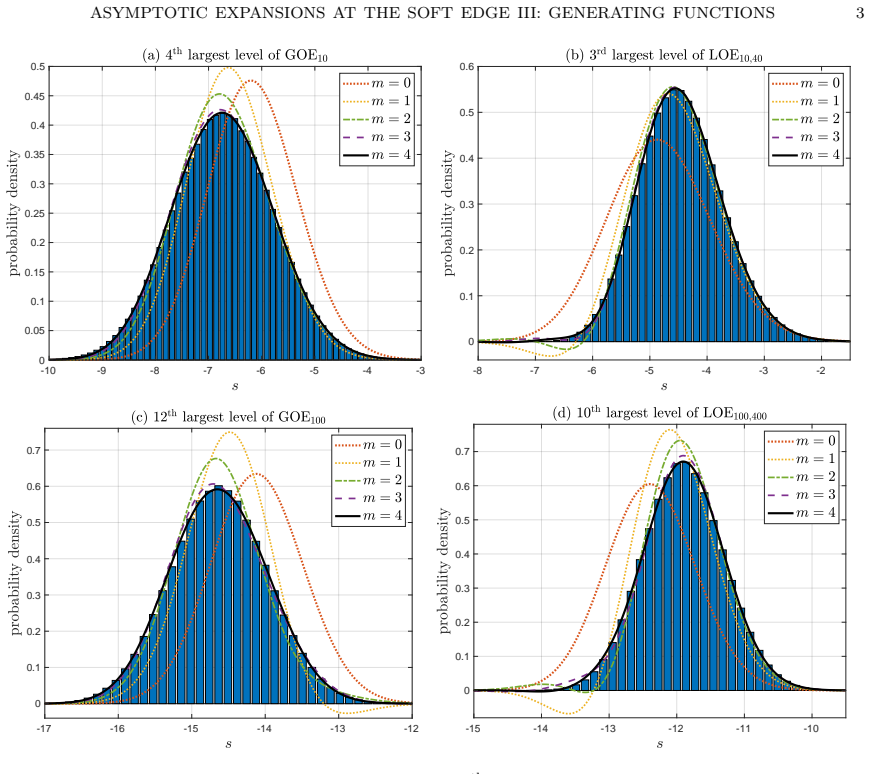
We conclude our work [arXiv:2403.07628, arXiv:2503.12644] on asymptotic expansions at the soft edge for the classical $n$-dimensional Gaussian and Laguerre ensembles, now studying the gap-probability generating functions. We show that the correction terms in the asymptotic expansion are multilinear forms of the higher-order derivatives of the leading-order term, with certain rational polynomial coefficients that are independent of the dummy generating function variable. In this way, the same multilinear structure, with the same polynomial coefficients, is inherited by the asymptotic expansion of any linearly induced quantity such as the distribution of the $k$-th largest level. Whereas the results for the unitary ensembles are presented with proof, the discussion of the orthogonal and symplectic ones is based on some hypotheses. To substantiate the hypotheses, we check the result for the $k$-th largest level in the orthogonal ensembles against simulation data for choices of $n$ and $k$ that require as many as four correction terms to achieve satisfactory accuracy.
Editorial analysis
A structured set of objections, weighed in public.
Referee Report
Summary. The paper concludes a series on asymptotic expansions at the soft edge for Gaussian and Laguerre ensembles, now focusing on gap-probability generating functions. It shows that the correction terms are multilinear forms in the higher-order derivatives of the leading-order term, with rational polynomial coefficients independent of the dummy generating-function variable. This structure is proven for unitary ensembles and asserted under explicit hypotheses for orthogonal and symplectic ensembles; the hypotheses are checked numerically against the distribution of the k-th largest eigenvalue in the orthogonal case for selected n and k requiring up to four correction terms.
Significance. If the hypotheses for the orthogonal and symplectic cases hold, the work supplies a unified, parameter-free mechanism for propagating higher-order asymptotics from generating functions to arbitrary linearly induced statistics such as eigenvalue distributions. The rigorous derivation of the multilinear structure and the independence of the polynomial coefficients from the generating-function variable for the unitary ensembles constitute a clear technical advance.
major comments (2)
- [Abstract and the section presenting the orthogonal/symplectic results] The inheritance of the multilinear structure to arbitrary linearly induced quantities (such as the k-th largest level distribution) for orthogonal and symplectic ensembles is conditional on the unproven hypotheses stated for those cases. These hypotheses are supported only by targeted numerical checks for the orthogonal ensemble and the k-th largest eigenvalue, with no analytic justification or verification for symplectic ensembles or other statistics.
- [Numerical checks subsection] The numerical verification is limited to the distribution of the k-th largest level in the orthogonal case using at most four correction terms for selected n and k. This is insufficient to substantiate the hypotheses for the full scope of linearly induced quantities claimed in the abstract.
minor comments (1)
- [Abstract] The abstract and introduction could more explicitly flag which statements are proven versus hypothesized, to avoid any ambiguity for readers focused on the non-unitary cases.
Simulated Author's Rebuttal
We thank the referee for the careful reading and constructive feedback on our manuscript. We address the major comments point by point below, clarifying the scope of our results while acknowledging their conditional nature for the orthogonal and symplectic cases.
read point-by-point responses
-
Referee: [Abstract and the section presenting the orthogonal/symplectic results] The inheritance of the multilinear structure to arbitrary linearly induced quantities (such as the k-th largest level distribution) for orthogonal and symplectic ensembles is conditional on the unproven hypotheses stated for those cases. These hypotheses are supported only by targeted numerical checks for the orthogonal ensemble and the k-th largest eigenvalue, with no analytic justification or verification for symplectic ensembles or other statistics.
Authors: We agree that the extension of the multilinear structure to arbitrary linearly induced quantities for orthogonal and symplectic ensembles rests on the explicit hypotheses stated in the manuscript. The unitary case is established rigorously with proof. The numerical checks are confined to the orthogonal ensemble and the distribution of the k-th largest eigenvalue. In the revised version we have strengthened the wording in the abstract and the relevant section to make the conditional character of these results more prominent and have added an explicit remark noting the absence of verification for symplectic ensembles. revision: partial
-
Referee: [Numerical checks subsection] The numerical verification is limited to the distribution of the k-th largest level in the orthogonal case using at most four correction terms for selected n and k. This is insufficient to substantiate the hypotheses for the full scope of linearly induced quantities claimed in the abstract.
Authors: The numerical subsection presents checks for the k-th largest level as a concrete, representative example of a linearly induced statistic, using cases that require up to four correction terms. We acknowledge that these checks do not cover the full range of linearly induced quantities or the symplectic case. We have revised the abstract to temper the claim and have expanded the discussion in the numerical section to clarify that the checks provide supporting evidence for the hypotheses rather than a complete substantiation. revision: partial
- Analytic justification or proof of the hypotheses for the orthogonal and symplectic ensembles
- Numerical verification for symplectic ensembles or for linearly induced quantities other than the k-th largest eigenvalue
Circularity Check
Minor self-citation to prior leading-order results; central multilinear structure derived independently for unitary case with no reduction to inputs by construction
full rationale
The paper explicitly distinguishes rigorous proofs for unitary ensembles from hypotheses for orthogonal/symplectic ones, the latter supported by direct numerical checks against simulation data for the k-th largest level (up to four correction terms). The multilinear form in higher derivatives of the leading-order term (from arXiv:2403.07628 and arXiv:2503.12644) is presented as a derived property with rational polynomial coefficients independent of the generating-function variable, without any quoted reduction of the claimed expansion to a fitted parameter or self-referential definition. Self-citations supply the base term but do not carry the load-bearing argument for the correction structure itself.
Axiom & Free-Parameter Ledger
axioms (1)
- ad hoc to paper Hypotheses for the orthogonal and symplectic ensembles hold
Lean theorems connected to this paper
-
IndisputableMonolith/Cost/FunctionalEquation.leanwashburn_uniqueness_aczel unclear?
unclearRelation between the paper passage and the cited Recognition theorem.
the correction terms in the asymptotic expansion are multilinear forms of the higher-order derivatives of the leading-order term, with certain rational polynomial coefficients that are independent of the dummy generating function variable
-
IndisputableMonolith/Foundation/AlphaCoordinateFixation.leancostAlphaLog_fourth_deriv_at_zero unclear?
unclearRelation between the paper passage and the cited Recognition theorem.
Gβ,j(s, τ; ξ) = sum Pβ,j,k(s, τ) · ∂^k_s Fβ(s; ξ)
What do these tags mean?
- matches
- The paper's claim is directly supported by a theorem in the formal canon.
- supports
- The theorem supports part of the paper's argument, but the paper may add assumptions or extra steps.
- extends
- The paper goes beyond the formal theorem; the theorem is a base layer rather than the whole result.
- uses
- The paper appears to rely on the theorem as machinery.
- contradicts
- The paper's claim conflicts with a theorem or certificate in the canon.
- unclear
- Pith found a possible connection, but the passage is too broad, indirect, or ambiguous to say the theorem truly supports the claim.
Forward citations
Cited by 1 Pith paper
-
Edge density expansions for the classical Gaussian and Laguerre ensembles
Differential equations isolate N-dependent terms in edge density expansions for classical random matrix ensembles, yielding explicit correction terms at the hard edge.
Reference graph
Works this paper leans on
-
[1]
Anderson, G.W., Guionnet, A., Zeitouni, O.: An Introduction to Random Matrices. Cambridge Univ. Press, Cambridge (2010)
work page 2010
-
[2]
John Wiley & Sons, New York (2003)
Anderson, T.W.: An Introduction to Multivariate Statistical Analysis, 3rd edn. John Wiley & Sons, New York (2003)
work page 2003
-
[3]
Nonlin- earity 22(5), 1021–1061 (2009)
Baik, J., Buckingham, R., DiFranco, J., Its, A.: Total integrals of global solutions to Painlevé II. Nonlin- earity 22(5), 1021–1061 (2009)
work page 2009
-
[4]
Bornemann, F.: On the numerical evaluation of distributions in random matrix theory: a review. Markov Process. Related Fields16(4), 803–866 (2010)
work page 2010
-
[5]
Bornemann, F.: Asymptotic expansions of the limit laws of Gaussian and Laguerre (Wishart) ensembles at the soft edge (2024). URLhttps://arxiv.org/abs/2403.07628
work page internal anchor Pith review Pith/arXiv arXiv 2024
-
[6]
Bornemann, F.: Asymptotic expansions relating to the distribution of the length of longest increasing subsequences. Forum Math. Sigma12(e36), 1–56 (2024)
work page 2024
-
[7]
Bornemann, F.: Asymptotic expansions relating to the lengths of longest monotone subsequences of involutions. Exp. Math. pp. 1–45 (2024; published online). URLhttps://doi.org/10.1080/10586458. 2024.2397334
-
[8]
URL https://arxiv.org/abs/2502.11852
Bornemann, F.: Algebraic independence of an Airy function, its derivative, and antiderivative (2025). URL https://arxiv.org/abs/2502.11852
-
[9]
URLhttps://arxiv.org/abs/2503.12644
Bornemann, F.: Asymptotic expansions of Gaussian and Laguerre ensembles at the soft edge II: Level densities (2025). URLhttps://arxiv.org/abs/2503.12644
-
[10]
Bornemann, F., Forrester, P.J., Mays, A.: Finite size effects for spacing distributions in random matrix theory: circular ensembles and Riemann zeros. Stud. Appl. Math.138(4), 401–437 (2017)
work page 2017
-
[11]
Deift, P.A.: Orthogonal Polynomials and Random Matrices: A Riemann-Hilbert Approach. Amer. Math. Soc., Providence (1999)
work page 1999
-
[12]
Dieng, M.: Distribution functions for edge eigenvalues in orthogonal and symplectic ensembles: Painlevé representations. Int. Math. Res. Not. (37), 2263–2287 (2005)
work page 2005
-
[13]
Forrester, P.J.: The spectrum edge of random matrix ensembles. Nuclear Phys. B402(3), 709–728 (1993)
work page 1993
-
[14]
Nonlinearity19(12), 2989–3002 (2006)
Forrester, P.J.: Hard and soft edge spacing distributions for random matrix ensembles with orthogonal and symplectic symmetry. Nonlinearity19(12), 2989–3002 (2006)
work page 2006
-
[15]
Forrester, P.J.: A random matrix decimation procedure relatingβ = 2/(r + 1) to β = 2(r + 1). Comm. Math. Phys. 285(2), 653–672 (2009)
work page 2009
-
[16]
Forrester, P.J.: Log-Gases and Random Matrices. Princeton Univ. Press, Princeton (2010)
work page 2010
-
[17]
In: Random matrix models and their applications,Math
Forrester, P.J., Rains, E.M.: Interrelationships between orthogonal, unitary and symplectic matrix ensembles. In: Random matrix models and their applications,Math. Sci. Res. Inst. Publ. , vol. 40, pp. 171–207. Cambridge Univ. Press, Cambridge (2001)
work page 2001
-
[18]
URL https://arxiv.org/abs/2505.09865
Forrester, P.J., Shen, B.J.: Finite size corrections in the bulk for circularβ ensembles (2025). URL https://arxiv.org/abs/2505.09865
-
[19]
Walter de Gruyter, Berlin (2002)
Gromak, V.I., Laine, I., Shimomura, S.: Painlevé differential equations in the complex plane. Walter de Gruyter, Berlin (2002)
work page 2002
-
[20]
Hastings,S.P.,McLeod,J.B.: A boundary value problem associated with the second Painlevé transcendent and the Korteweg-deVries equation. Arch. Rational Mech. Anal.73(1), 31–51 (1980)
work page 1980
-
[21]
Jiang, T., Li, D.: Approximation of rectangular beta-Laguerre ensembles and large deviations. J. Theoret. Probab. 28(3), 804–847 (2015)
work page 2015
-
[22]
Johnstone, I.M., Ma, Z.: Fast approach to the Tracy-Widom law at the edge of GOE and GUE. Ann. Appl. Probab. 22(5), 1962–1988 (2012)
work page 1962
-
[23]
Akademie-Verlag, Berlin (1986)
Kallenberg, O.: Random Measures, 4th edn. Akademie-Verlag, Berlin (1986)
work page 1986
-
[24]
Bernoulli 18(1), 322–359 (2012)
Ma, Z.: Accuracy of the Tracy-Widom limits for the extreme eigenvalues in white Wishart matrices. Bernoulli 18(1), 322–359 (2012)
work page 2012
-
[25]
Mehta, M.L.: Random Matrices, 3rd edn. Elsevier, Amsterdam (2004)
work page 2004
-
[26]
John Wiley & Sons, New York (1982)
Muirhead, R.J.: Aspects of Multivariate Statistical Theory. John Wiley & Sons, New York (1982)
work page 1982
-
[27]
Olver, F.W.J.: Asymptotics and Special Functions. Academic Press (1974)
work page 1974
-
[28]
Physica D3(1-2), 165–184 (1981)
Segur, H., Ablowitz, M.J.: Asymptotic solutions of nonlinear evolution equations and a Painlevé transce- dent. Physica D3(1-2), 165–184 (1981)
work page 1981
-
[29]
Shinault, G., Tracy, C.A.: Asymptotics for the covariance of theAiry2 process. J. Stat. Phys.143(1), 60–71 (2011)
work page 2011
-
[30]
Tracy, C.A., Widom, H.: Level-spacing distributions and the Airy kernel. Comm. Math. Phys.159(1), 151–174 (1994)
work page 1994
-
[31]
Yao, L., Zhang, L.: Asymptotic expansion of the hard-to-soft edge transition (2023). URLhttps: //arxiv.org/abs/2309.06733v1 Department of Mathematics, Technical University of Munich, 80290 Munich, Germany Email address: bornemann@tum.de 16 FOLKMAR BORNEMANN ASYMPTOTIC EXPANSIONS AT THE SOFT EDGE III: GENERATING FUNCTIONS 3 Table 1. The polynomial coeffici...
discussion (0)
Sign in with ORCID, Apple, or X to comment. Anyone can read and Pith papers without signing in.