REVIEW 4 major objections 5 minor 101 references
The gravitational wave echoes from the black hole with three-form fields
T0 review · 4 major / 5 minor · reviewed 2026-08-15 · deepseek-v4-flash
Pith's one-line read A massive three-form black hole acquires a double-peaked potential and its late-time ringdown contains gravitational wave echoes.
desk verdict The massless-sector analysis is clean and standard; the echo claim rests entirely on an inverse-power potential term that is proposed by hand, not derived from the three-form action. read the letter →
The pith
A machine-rendered reading of the paper's core claim, the machinery that carries it, and where it could break.
The reading
What carries the argument
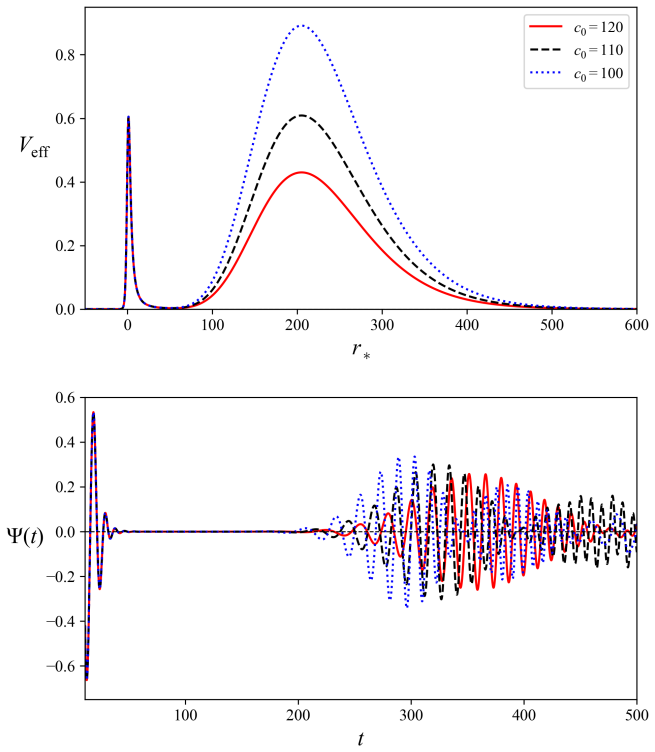
The key object is the Stueckelberg-modified massive three-form field, written as $A_\mu = B_\mu + \partial_\mu \pi$, whose equation of motion fixes $\pi'(r) = c_0/(r^2 f(r)) - \zeta(r)$. The mass term is projected onto the axial perturbation potential as $\Delta V = m_A^2 A_\mu A^\mu + \lambda(A_\mu A^\mu)^{-2}$, where the inverse-power piece is proposed, following the inverse-power potentials used in quintessence models, to be gauge invariant and to create the second peak. This modified potential sits beside the standard single-peak gravitational perturbation potential $V_{GP}$, and the separation of the two peaks is controlled by $a_1$ while $c_0$ controls the height and amplitude of the modified peak.
What would settle it
Compute the axial gravitational perturbation equation directly from the linearized Einstein equations with the massive three-form action and the Stueckelberg field, without inserting the $\lambda$ term, and check whether the effective potential has one peak or two; a single-peak result would show that the echoes come from the assumed $\Delta V$ rather than from the three-form black hole itself. A complementary check is to run the paper's time-domain integration with $\lambda = 0$ and confirm that no late-time echoes appear.
Extended reading notes
Core claim
On the paper's own terms, the central discovery is that a massless three-form black hole has a single-peak axial gravitational potential, so its ringdown shows only standard damped oscillations with no echoes, while a massive three-form field treated through the Stueckelberg mechanism acquires an additional potential $\Delta V = m_A^2 c_0^2/(r^4 f^3) + \lambda(c_0^2/(r^4 f^3))^{-2}$ that creates a second peak. For small values of the effective cosmological constant parameter $a_1$, the two peaks are widely separated and the time-domain waveform develops late-time gravitational wave echoes; for large $a_1$ the peaks merge and no echoes appear. The paper identifies $c_0$, which enters through the Stueckelberg field equation, as the parameter controlling echo phase and amplitude, and computes quasinormal frequencies with WKB and Prony methods, finding stable modes.
Load-bearing premise
The entire echo prediction rests on the extra inverse-power term $\lambda(A_\mu A^\mu)^{-2}$ in the modified potential, which the paper proposes rather than derives from the massive three-form action; if that term is not a genuine consequence of the theory, the double-peak potential and its echoes are an artifact of an inserted potential shape.
Editorial extensions
If this is right
- Massless three-form black holes reduce to ordinary Schwarzschild-de Sitter behavior in the $a_1 \to 0$ limit, with no echo signal in their ringdown.
- Massive three-form black holes with widely separated horizons should produce late-time echoes whose spacing, phase, and amplitude encode $c_0$ and the ratio $m_A/\lambda$.
- Echo timing is tied to the distance between the black hole and cosmological horizons, so a future detection could probe the effective cosmological constant and horizon separation.
- The computed quasinormal modes show no unstable modes, consistent with the perturbative stability of the de Sitter background and with the cosmological no-hair picture.
- Because WKB assumes a single-peak potential, the echo case is analyzed with the Prony method, which provides the relevant quasinormal frequencies for the double-peak configuration.
Reading between the lines
- A natural next step would be to derive the inverse-power correction from a concrete self-interaction potential for the three-form field and recompute the linearized perturbation; if a double peak survives, the echo prediction becomes a genuine consequence of the theory rather than an assumed potential shape.
- The same Stueckelberg-plus-inverse-power construction could be applied to other massive gauge fields, and echo spacing might then distinguish three-form fields from alternative exotic-compact-object models, since the paper's echo timing is set by horizon separation rather than by a reflective surface.
- The sharp transition from no echoes at large $a_1$ to echoes at small $a_1$ suggests that the presence or absence of echoes could serve as a diagnostic of whether the three-form field is exactly massless or has a small Stueckelberg mass, although the observability of such late-time signals in current detectors remains an open question.
Signed reviews
Editorial analysis
A structured set of objections, weighed in public.
Referee Report
Summary. The paper studies axial gravitational perturbations of a Schwarzschild-de Sitter-like black hole sourced by massless three-form fields. For the massless case the effective potential is single-peaked and no echoes are found, with quasinormal frequencies computed by WKB and Prony methods. The paper then introduces a Stueckelberg field to give the dual vector a mass, and adds a modified potential DeltaV in Eq. (57). With this addition the total effective potential becomes double-peaked, and the numerical time-domain profiles show late-time echoes whose phase and amplitude are said to depend on the parameters a_1, c_0, m_A, and lambda. The paper concludes that gravitational wave echoes emerge when the black-hole and cosmological horizons are sufficiently separated and that the results provide a possible observational probe of deviations from general relativity.
Significance. If the central claim were correct, the paper would identify a specific beyond-GR mechanism, massive three-form fields, that produces gravitational wave echoes with testable parameter dependence. The massless part of the analysis is clean and useful: the Sch-dS-like solution and the single-peak Regge-Wheeler potential are standard, and the WKB/Prony agreement in Table I is a reasonable consistency check. However, the headline result for echoes rests on a potential term that is inserted by hand rather than derived from the three-form action, and there are concrete algebraic and numerical inconsistencies in the double-peak analysis. These issues undermine the paper's central physical claim.
major comments (4)
- [Sec. IV.A.1, Eq. (57)] The inverse-power term lambda(A^mu A_mu)^{-2} is proposed, not derived. The action (43)-(46) contains only the Stueckelberg mass term, and the text itself states that the mass term alone cannot produce a second peak. The double-peak potential, and hence the late-time echoes, therefore follow from an arbitrary addition to the potential rather than from the massive three-form theory. Because the central claim of the paper is that massive three-form black holes produce echoes, this step is load-bearing; without the lambda term the echo signal is absent.
- [Eq. (57) and text after it] The contraction A^mu A_mu = (1/f)(zeta+pi')^2 appears to be incorrect. For the covariant components in Eq. (49) and metric (28), one obtains A^mu A_mu = g^{rr}(zeta+pi')^2 = f(zeta+pi')^2 = c_0^2/(r^4 f), not c_0^2/(r^4 f^3). Since the first term in Eq. (57) is presented as following from the derived mass term, this factor-of-f discrepancy affects the shape and amplitude of the modified potential in all double-peak plots and therefore the echo timings and quasinormal frequencies.
- [Sec. IV.A.1] The modified potential DeltaV in Eq. (57) diverges as f^{-3} at both horizons, so the total effective potential is singular at the boundaries of the tortoise-coordinate domain. The paper restricts the computation to regions 'sufficiently close to, but not exactly at' the horizons, but this does not define a consistent limiting procedure, and the QNM boundary conditions (62)-(63) are then not well posed on the domain used for the time-domain integration. The echo trains and Prony frequencies may depend on the arbitrary truncation.
- [Table II vs Sec. V.B] The parameter labels in Table II do not match the text. The table lists a_1 = 0.3 and a_1 = 0.0375 for the first two rows, whereas Sec. V.B.1 and V.B.2 analyze a_1 = 0.15 and a_1 = 0.009375, and the second row orders c_0 as 45, 50, 57 while the text uses 57, 50, 45. This prevents the reader from reproducing the quoted quasinormal frequencies for the double-peak case.
minor comments (5)
- [Abstract] The abstract contains a grammatical error: 'we study of massless three-form black hole' should be 'we study the massless three-form black hole'.
- [Sec. III.A] The text contains the typo 'matric' where 'metric' is intended.
- [Fig. 3] The caption of the upper panel does not state clearly whether the curves shown are V_GP and DeltaV separately or the total effective potential; this should be explicit.
- [Sec. V.B.1] The text writes 'm/lambda' instead of 'm_A/lambda' in one place; the notation should be uniform.
- [References] Reference [21] is incomplete: it appears as 'arXiv preprint arXiv:1709.01525 (????)' with no journal information or year.
Circularity Check
The echo claim reduces to a hand-inserted lambda(A_mu A^mu)^-2 term in Eq. (57), proposed precisely to create the double peak; the massless QNM part is non-circular.
-
fitted input called prediction
[Sec. IV.A.1, Eq. (57)]
"Noting that inclusion of the mass term of the three-form fields as the modified potential of the perturbation, we still cannot obtain the double peak structure of the effective potential. In order to produce the second peak as well as to keep the modified potential invariance under the gauge transformation with the Stueckelberg mechanism, it is necessary to introduce additional terms. Accordingly, we propose the following form for the perturbed potential inspired by the Ratra–Peebles potential (inverse power law field). It reads, ΔV(r)=m_A^2 A_μA^μ+λ(A_μA^μ)^{-2},"
Eq. (57) is the sole source of the second peak in V_eff, and it is not obtained by varying the three-form action (43)-(46) nor from the Stueckelberg EOM (48)-(51). The paper's own preceding sentence says the mass term alone cannot yield the double peak; the lambda(A_mu A^mu)^-2 term is then 'proposed' explicitly 'in order to produce the second peak'. The echo waveforms computed from this V_eff are therefore consequences of the assumed potential shape, not predictions of the massive three-form black hole. The central conclusion that a double-peak potential produces GW echoes is the standard barrier-scattering result imported as input, with the free parameters m_A/lambda and c_0 selected so that the double peak exists.
-
fitted input called prediction
[Sec. VI, Conclusion]
"To generate a double-peak effective potential, the ratio m_A/λ must be within 10^3−10^4, corresponding to c_0 on the order of 10^1−10^2."
This conclusion states a criterion for selecting parameters that generate the double peak, not a derived consequence. The paper runs the time-domain code only for (m_A/lambda, c_0) combinations that exhibit double peaks (ratios 10^3 to 10^4, c_0 about 10^1 to 10^2), then reports echo timing and amplitude as functions of those same chosen values. The dependence of the echoes on c_0 is therefore a property of the hand-inserted Delta V rather than an independent prediction of the three-form theory.
full rationale
The massless part of the paper is self-contained and not circular: V_GP follows from linearized Einstein equations, and the WKB and Prony QNM calculations are standard numerical exercises on that potential. The circularity is confined to the central massive-field claim. Eq. (57) is not derived from the massive three-form action (43)-(46). The paper states immediately before Eq. (57) that the Stueckelberg mass term alone cannot produce a double peak, and then introduces lambda(A_mu A^mu)^-2 by hand, explicitly 'in order to produce the second peak'. Thus the double-peak potential is an input rather than a consequence of the three-form theory. The late-time echoes are then the known mechanical result of wave scattering off a double-hump barrier, and the parameters m_A/lambda and c_0 are restricted to the ranges that create that barrier. The headline echo result therefore reduces to the inserted potential shape; it is not an independent prediction of the massive three-form black hole. No load-bearing self-citation chain is present. The independent, non-circular content is the massless single-peak analysis, which is why the score is not higher.
Assumptions & free parameters
free parameters (4)
- a_1 =
varied 0.3 down to 0.0046875; sets Λ_eff=9a_1^2/2
- c_0 =
0.70, 0.77, 0.90, 45, 50, 57, 100, 110, 120 depending on case
- m_A =
not given directly; only ratios m_A/λ=10^1,10^3,10^4 are set
- λ =
not fixed; only ratios m_A/λ are set
assumptions (5)
- domain assumption The Einstein-three-form action with V=0 for the massless case (Eq. 1).
- domain assumption The dual-vector radial ansatz B_σ=(0,ζ(r),0,0) and static spherical symmetry (Eqs. 7 and 9).
- domain assumption The Stueckelberg substitution B_μ -> B_μ + ∂_μ π restores gauge invariance for the massive three-form/dual vector theory (Eqs. 45-47).
- ad hoc to paper The modified potential is taken to be ΔV = m_A^2 A^2 + λ(A^2)^{-2}, with the inverse-power term proposed ad hoc (Eq. 57).
- standard math The axial gravitational perturbation obeys the Regge-Wheeler-like equation with potential (42).
invented entities (1)
-
Inverse-power interaction term λ(A^2)^{-2} in the effective potential
Cite this review
Pith. "Pith review of The gravitational wave echoes from the black hole with three-form fields." pith.science (2026). https://pith.science/paper/OGXCRWL5
@misc{pith2026250618815,
  author       = {Pith},
  title        = {Pith review of: The gravitational wave echoes from the black hole with three-form fields},
  year         = {2026},
  howpublished = {\url{https://pith.science/paper/OGXCRWL5}},
  note         = {Machine review of arXiv:2506.18815}
}
abstract
In this work, we study of massless three-form black hole, where the three-form fields are higher $p$-form gauge fields with $p=3$. These give rise to the Schwarzschild-de Sitter (Sch-dS)-like solution through an effective cosmological constant represented by $a_1$. We analyze this solution under gravitational perturbations and find that it exhibits a single-peak potential. For this case, no echoes are produced. Furthermore, we consider the massive case of the three-form fields by introducing a Stueckelberg field to restore gauge invariance and to investigate its effect on GWs at late times. In this case, the potential exhibits a double-peak structure, with the modified potential appearing beside the gravitational perturbation potential. We also examine the impact of the relevant parameters as well as the influence of the parameter $c_0$, which arises from the equation of motion of the Stueckelberg field. For a large value of $a_1$, the two peaks of the potentials are close together, while $c_0$ affects the amplitude and decay rate of the time-domain waveform, resulting in no echoes. For small values of $a_1$, the peaks of the potentials are widely separated and $c_0$ influences both the phase and the amplitude of the echoes. In addition, the quasinormal frequencies of the black hole are also calculated using both the WKB and Prony methods. As results, these provide a potential avenue for testing deviations from GR and probing possible signatures of quantum gravity through future GWs observations.
Figures


Figures from the paper (2 more)

Reference graph
Works this paper leans on
-
[1]
Specifically, the value ofa 1 starts from 0.3 and is successively halved down to 0.0046875, as shown by the red to green lines in Fig. 1. FIG. 1: Horizon radius as functions of the parametera 1, withM= 1/2. The blue and orange curves represent the black hole horizon radiusr h and the cosmological horizon radiusr c, respectively. Vertical dashed lines indi...
-
[2]
To evaluate the wavefunction Ψ(t,r ∗), we use the following discretization scheme [62]
Calculation of time-domain wavefunction We use the light cone coordinate, whereu=t−r ∗ is the retarded time andv=t+r ∗ is the advanced time, In terms of the light cone coordinateuandv, the wave equation (41) becomes [62] 4 ∂2Ψ ∂u∂v +V eff(u,v)Ψ = 0,(58) whereV eff =V GP in the case of massless three-form fields, andV eff =V GP + ∆Vfor the inclusion of the...
-
[3]
However, one can investigate how massive three-form fields affects to gravitational waves
The modified potential from massive three-form fields In the previous section, black hole solution with massless three-form fields is obtained. However, one can investigate how massive three-form fields affects to gravitational waves. In this section, we examine the effect of massive three-form fields to gravitational waves. We are interested in how the e...
-
[4]
F. J. Zerilli, Phys. Rev. D9, 860 (1974), URLhttps://link.aps.org/doi/10.1103/ PhysRevD.9.860
1974
-
[5]
The WKB method is based on the problem of waves scattering near the peak of the potential barrierV(r ∗) in quantum mechanics, whereω 2 acts as energy
WKB method The 1st-order WKB method is firstly introduced by Schutz and Will [76] and later is extended with higher order correction terms [77, 78, 82]. The WKB method is based on the problem of waves scattering near the peak of the potential barrierV(r ∗) in quantum mechanics, whereω 2 acts as energy. In this work, we consider the 6th-order WKB. In order...
-
[6]
In 1795, Prony proposes a generalized approach for fitting a sum of damped exponentials, known as the Prony method [91]
Prony method To evaluate the QNMs during the ringdown phase, we fit the time-domain profile by treating it as a sum of damped exponentials Ψ(t)≃ pX n=1 Cne−iωnt.(67) However, the calculation is complicated. In 1795, Prony proposes a generalized approach for fitting a sum of damped exponentials, known as the Prony method [91]. We assume that the ringdown p...
-
[7]
B. P. Abbott, R. Abbott, T. Abbott, M. Abernathy, F. Acernese, K. Ackley, C. Adams, T. Adams, P. Addesso, R. X. Adhikari, et al., Physical review letters116, 061102 (2016)
2016
-
[8]
Arzoumanian, P
Z. Arzoumanian, P. T. Baker, A. Brazier, S. Burke-Spolaor, S. Chamberlin, S. Chatterjee, B. Christy, J. M. Cordes, N. J. Cornish, F. Crawford, et al., The Astrophysical Journal859, 47 (2018)
2018
Show all 101 references
-
[9]
Regge and J
T. Regge and J. A. Wheeler, Physical Review108, 1063 (1957)
1957
-
[10]
Ponglertsakul and E
S. Ponglertsakul and E. Winstanley, Phys. Rev. D94, 044048 (2016), 1606.04644
2016 arXiv
-
[11]
S. A. Teukolsky, Phys. Rev. Lett.29, 1114 (1972), URLhttps://link.aps.org/doi/10. 1103/PhysRevLett.29.1114
1972
-
[12]
S. A. Teukolsky, Astrophys. J.185, 635 (1973)
1973
-
[13]
C. V. Vishveshwara, Nature227, 936 (1970)
1970
-
[14]
R. A. Konoplya and A. Zhidenko, Rev. Mod. Phys.83, 793 (2011), 1102.4014
2011 arXiv
-
[15]
S. R. Dolan, S. Ponglertsakul, and E. Winstanley, Phys. Rev. D92, 124047 (2015), 1507.02156. 26
2015 arXiv
-
[16]
M. S. Churilova, R. A. Konoplya, and A. Zhidenko, Phys. Lett. B802, 135207 (2020), 1911.05246
2020 arXiv
-
[17]
Promsiri, T
C. Promsiri, T. Tangphati, E. Hirunsirisawat, and S. Ponglertsakul, Phys. Rev. D108, 024015 (2023), 2302.04654
2023 arXiv
-
[18]
K. D. Kokkotas and B. G. Schmidt, Living Rev. Rel.2, 2 (1999), gr-qc/9909058
1999 arXiv
-
[19]
S. H. V¨ olkel and K. D. Kokkotas, Class. Quant. Grav.35, 105018 (2018), 1802.08525
2018 arXiv
- [20]
-
[21]
Dutta Roy, S
P. Dutta Roy, S. Aneesh, and S. Kar, Eur. Phys. J. C80, 850 (2020), 1910.08746
2020 arXiv
-
[22]
This series of late-time signals is called gravitational wave echoes
extend the calculation of the time-domain perturbation equation of relativistic stars and find the emergence of series of late-time signals after the ringdown phase. This series of late-time signals is called gravitational wave echoes. Gravitational wave echoes are ex- 2 pecte...
-
[23]
Ponglertsakul, P
S. Ponglertsakul, P. Burikham, and S. Pinkanjanarod, Phys. Rev. D107, 023020 (2023), 2208.02761
2023 arXiv
-
[24]
Nollert, Classical and Quantum Gravity16, R159 (1999)
H.-P. Nollert, Classical and Quantum Gravity16, R159 (1999)
1999
-
[25]
Berti, V
E. Berti, V. Cardoso, J. A. Gonzalez, and U. Sperhake, Physical Review D—Particles, Fields, Gravitation, and Cosmology75, 124017 (2007)
2007
-
[26]
Cardoso, E
V. Cardoso, E. Franzin, and P. Pani, Physical review letters116, 171101 (2016)
2016
- [27]
-
[28]
Ferrari and K
V. Ferrari and K. Kokkotas, Physical Review D62, 107504 (2000)
2000
-
[29]
Testa and P
A. Testa and P. Pani, Physical Review D98, 044018 (2018)
2018
-
[30]
H. Liu, P. Liu, Y. Liu, B. Wang, and J.-P. Wu, Physical Review D103, 024006 (2021)
2021
-
[31]
Q. Wang, N. Oshita, and N. Afshordi, Physical Review D101, 024031 (2020)
2020
-
[32]
S. Hui, B. Mu, and P. Wang, Physics of the Dark Universe43, 101396 (2024)
2024
-
[33]
A. Sang, M. Zhang, S.-W. Wei, and J. Jiang, The European Physical Journal C83, 291 (2023)
2023
-
[34]
Dong and D
R. Dong and D. Stojkovic, Physical Review D103, 024058 (2021)
2021
-
[35]
G. Guo, P. Wang, H. Wu, and H. Yang, Journal of High Energy Physics2022, 1 (2022)
2022
-
[36]
Dutta Roy, S
P. Dutta Roy, S. Aneesh, and S. Kar, The European Physical Journal C80, 850 (2020)
2020
-
[37]
Ou, M.-Y
M.-Y. Ou, M.-Y. Lai, and H. Huang, The European Physical Journal C82, 452 (2022)
2022
-
[38]
W.-L. Qian, Q. Pan, B. Wang, and R.-H. Yue, Physics Letters B856, 138874 (2024)
2024
-
[39]
K. Groh, J. Louis, and J. Sommerfeld, Journal of High Energy Physics2013, 1 (2013)
2013
-
[40]
S. S. Gubser, arXiv preprint hep-th/0010010 (2000)
2000 arXiv
-
[41]
T. S. Koivisto and N. J. Nunes, Physics Letters B685, 105 (2010). 27
2010
-
[42]
T. S. Koivisto and N. J. Nunes, Physical Review D—Particles, Fields, Gravitation, and Cos- mology80, 103509 (2009)
2009
-
[43]
Germani and A
C. Germani and A. Kehagias, Journal of Cosmology and Astroparticle Physics2009, 005 (2009)
2009
-
[44]
De Felice, K
A. De Felice, K. Karwan, and P. Wongjun, Physical Review D—Particles, Fields, Gravitation, and Cosmology85, 123545 (2012)
2012
-
[45]
K. S. Kumar, J. Marto, N. J. Nunes, and P. V. Moniz, Journal of Cosmology and Astroparticle Physics2014, 064 (2014)
2014
-
[46]
Chakraborty, S
S. Chakraborty, S. Mishra, and S. Chakraborty, The European Physical Journal C80, 1 (2020)
2020
-
[47]
Barreiro, U
T. Barreiro, U. Bertello, and N. J. Nunes, Physics Letters B773, 417 (2017)
2017
-
[48]
B. J. Barros and F. S. Lobo, Physical Review D98, 044012 (2018)
2018
-
[49]
B. J. Barros, B. Dˇ anilˇ a, T. Harko, and F. S. Lobo, The European Physical Journal C80, 617 (2020)
2020
-
[50]
Tangphati, M
T. Tangphati, M. Youk, and S. Ponglertsakul, Journal of High Energy Astrophysics43, 66 (2024)
2024
-
[51]
Samart, N
D. Samart, N. Autthisin, and P. Channuie, Annalen der Physik535, 2300039 (2023)
2023
-
[52]
Dubinsky, Modern Physics Letters A39, 2450108 (2024)
A. Dubinsky, Modern Physics Letters A39, 2450108 (2024)
2024
-
[53]
Fernando and A
S. Fernando and A. Manning, International Journal of Modern Physics D26, 1750100 (2017)
2017
-
[54]
P. R. Brady, C. M. Chambers, W. G. Laarakkers, and E. Poisson, Physical Review D60, 064003 (1999)
1999
-
[55]
Otsuki and T
H. Otsuki and T. Futamase, Progress of theoretical physics85, 771 (1991)
1991
-
[56]
Clough, T
K. Clough, T. Helfer, H. Witek, and E. Berti, arXiv preprint arXiv:2204.10868 (2022)
2022 arXiv
-
[57]
S. R. Dolan, Physical Review D98, 104006 (2018)
2018
-
[58]
W. E. East and F. Pretorius, Physical review letters119, 041101 (2017)
2017
-
[59]
Fierz and W
M. Fierz and W. Pauli, Proc. Roy. Soc. Lond. A173, 211 (1939)
1939
-
[60]
van Dam and M
H. van Dam and M. J. G. Veltman, Nucl. Phys. B22, 397 (1970)
1970
-
[61]
V. I. Zakharov, JETP Lett.12, 312 (1970)
1970
-
[62]
D. G. Boulware and S. Deser, Phys. Rev. D6, 3368 (1972)
1972
- [63]
-
[64]
de Rham, G
C. de Rham, G. Gabadadze, and A. J. Tolley, Phys. Rev. Lett.106, 231101 (2011), 1011.1232. 28
2011 arXiv
- [65]
-
[66]
P. J. E. Peebles and B. Ratra, Astrophys. J. Lett.325, L17 (1988)
1988
-
[67]
Ratra and P
B. Ratra and P. J. E. Peebles, Phys. Rev. D37, 3406 (1988)
1988
-
[68]
Gundlach, R
C. Gundlach, R. H. Price, and J. Pullin, Physical Review D49, 883 (1994)
1994
-
[69]
Chandrasekhar and S
S. Chandrasekhar and S. Detweiler, Proceedings of the Royal Society of London. A. Mathe- matical and Physical Sciences344, 441 (1975)
1975
-
[70]
Birmingham, Physical Review D64, 064024 (2001)
D. Birmingham, Physical Review D64, 064024 (2001)
2001
-
[71]
Kao and D
H.-c. Kao and D. Tomino, Physical Review D—Particles, Fields, Gravitation, and Cosmology 77, 127503 (2008)
2008
-
[72]
Dal Bosco Fontana, Classical and Quantum Gravity (2023)
R. Dal Bosco Fontana, Classical and Quantum Gravity (2023)
2023
-
[73]
Cao, L.-B
L.-M. Cao, L.-B. Wu, Y. Zhao, and Y.-S. Zhou, Physical Review D108, 124023 (2023)
2023
-
[74]
X. He, B. Wang, and S. Chen, Physical Review D—Particles, Fields, Gravitation, and Cos- mology79, 084005 (2009)
2009
-
[75]
Sadeghi, A
J. Sadeghi, A. Chatrabhuti, and B. Pourhassan, International Journal of Theoretical Physics 50, 129 (2011)
2011
-
[76]
Musiri and G
S. Musiri and G. Siopsis, Physics Letters B563, 102 (2003)
2003
-
[77]
H. Cho, A. Cornell, J. Doukas, and W. Naylor, Classical and Quantum Gravity27, 155004 (2010)
2010
-
[78]
Ciftci, R
H. Ciftci, R. L. Hall, and N. Saad, Journal of Physics A: Mathematical and General36, 11807 (2003)
2003
-
[79]
E. W. Leaver, Proceedings of the Royal Society of London. A. Mathematical and Physical Sciences402, 285 (1985)
1985
-
[80]
J. P. Boyd,Chebyshev and Fourier spectral methods(Courier Corporation, 2001)
2001
-
[81]
Arag´ on, R
A. Arag´ on, R. B´ ecar, P. Gonz´ alez, and Y. V´ asquez, Physical Review D103, 064006 (2021)
2021
-
[82]
B. F. Schutz and C. M. Will, The Astrophysical Journal291, L33 (1985)
1985
-
[83]
Iyer and C
S. Iyer and C. M. Will, Phys. Rev. D35, 3621 (1987), URLhttps://link.aps.org/doi/ 10.1103/PhysRevD.35.3621
1987 doi
-
[84]
Konoplya, Physical Review D68, 024018 (2003)
R. Konoplya, Physical Review D68, 024018 (2003)
2003
-
[85]
Zhidenko, Classical and Quantum Gravity21, 273 (2003)
A. Zhidenko, Classical and Quantum Gravity21, 273 (2003)
2003
-
[86]
Burikham, S
P. Burikham, S. Ponglertsakul, and L. Tannukij, Phys. Rev. D96, 124001 (2017), 1709.02716
2017 arXiv
-
[87]
Ponglertsakul, P
S. Ponglertsakul, P. Burikham, and L. Tannukij, Eur. Phys. J. C78, 584 (2018), 1803.09078. 29
2018 arXiv
-
[88]
Matyjasek and M
J. Matyjasek and M. Telecka, Physical Review D100, 124006 (2019)
2019
-
[89]
Konoplya, A
R. Konoplya, A. Zhidenko, and A. Zinhailo, Classical and Quantum Gravity36, 155002 (2019)
2019
-
[90]
Santos, J
E. Santos, J. Fabris, and J. de Freitas Pacheco, arXiv preprint arXiv:1903.04874 (????)
1903 arXiv
-
[91]
Ponglertsakul and B
S. Ponglertsakul and B. Gwak, Eur. Phys. J. C80, 1023 (2020), 2007.16108
2020 arXiv
-
[92]
D. J. Gogoi, A. ¨Ovg¨ un, and M. Koussour, The European Physical Journal C83, 700 (2023)
2023
-
[93]
D. J. Gogoi and S. Ponglertsakul, The European Physical Journal C84, 652 (2024)
2024
-
[94]
Konoplya and A
R. Konoplya and A. Zhidenko, Reviews of Modern Physics83, 793 (2011)
2011
-
[95]
Chowdhury and N
A. Chowdhury and N. Banerjee, Physical Review D102, 124051 (2020)
2020
-
[96]
B. K. Vishvakarma, D. V. Singh, and S. Siwach, The European Physical Journal Plus138, 536 (2023)
2023
-
[97]
Baron de Prony, J
G. Baron de Prony, J. l’ ´Ecole Polytech1, 24 (1795)
-
[98]
Giesler, M
M. Giesler, M. Isi, M. A. Scheel, and S. A. Teukolsky, Physical Review X9, 041060 (2019)
2019
-
[99]
N. Sago, S. Isoyama, and H. Nakano, Universe7, 357 (2021)
2021
-
[100]
G. W. Gibbons and S. W. Hawking, Physical Review D15, 2738 (1977)
1977
-
[101]
G. W. Gibbons, S. W. Hawking, and S. T. Siklos, Very Early Universe (1983). 30
1983
Reviewed August 15, 2026 · model on record in the stance chip above.
Discussion (0). Continue with ORCID to comment.