REVIEW 4 major objections 4 minor 43 references
Chelation of the mercury ions by polyethyleneimine: Atomistic molecular dynamics study
T0 review · 4 major / 4 minor · reviewed 2026-08-06 · deepseek-v4-flash
Pith's one-line read A single linear polyethyleneimine chain with ten amino groups chelates up to four Hg2+ ions in water, with molecular dynamics and density functional theory agreeing on the complex structures.
desk verdict Plausible preliminary estimate of PEI-10's Hg2+ capacity, but the unbenchmarked Hg-N force field and a 0.35 Å MD/DFT distance gap keep the four-ion maximum conditional. read the letter →
The pith
A machine-rendered reading of the paper's core claim, the machinery that carries it, and where it could break.
The reading
What carries the argument
The load-bearing object is the Hg2+–nitrogen coordination shell, quantified by the Hg-N radial distribution function $g(r)$ and its running coordination number $n(r)$ from the production MD trajectories. The models use the OPLS/AA all-atom force field for PEI, the SPC/E model for water, and Lennard-Jones plus Coulombic interactions for Hg2+, with cross-interactions set by the geometric combination rule. Stability is checked by computing adsorption energies in MD and Gibbs free energies of complexation from DFT geometry optimizations at the M06-2X/LanL2DZ level, with the solvent treated implicitly.
What would settle it
Measure Hg-N distances and coordination numbers for PEI-Hg2+ complexes by EXAFS or X-ray absorption spectroscopy; if a PEI-10 chain is found to bind five Hg2+ ions, or if the Hg-N distances deviate from the predicted 2.15-2.5 Å range by more than about 0.1 Å, the force-field combination and the four-ion capacity would be falsified. Alternatively, recomputing the capacity with a Hg2+ parameter set fitted to Hg-amine reference data would provide a direct test.
Extended reading notes
Core claim
The paper's central discovery is that a neutral linear PEI molecule with ten amino groups binds up to four Hg2+ ions in aqueous solution, forming stable complexes in which each ion is held by two to five nitrogen atoms of the polymer and completed by water molecules in the first hydration shell. Shorter chains PEI-4 and PEI-5 wrap around a single ion with Hg-N coordination numbers of 3 and 5; PEI-10 uses four nitrogens for one ion and fewer per ion as loading increases. DFT-optimized structures reproduce the MD conformations and give Hg-N distances around 2.5 Å, and the complexation free energy is negative in every stable case. Attempts to load a fifth ion onto PEI-10 did not produce a stable complex, which is why the paper states the chelating capacity as four ions per PEI-10 chain.
Load-bearing premise
The whole capacity result rests on the assumption that the Hg2+ Lennard-Jones parameters fitted to mercury hydration, combined with the OPLS/AA PEI parameters through the geometric combination rule, correctly capture Hg-amine binding; the paper never tests this combination against known Hg-amine structures or binding energies.
Editorial extensions
If this is right
- A single PEI-10 chain saturates at four Hg2+ ions; a fifth ion is not stably bound because Hg-Hg Coulombic repulsion wins.
- For one ion, shorter chains wrap more completely: PEI-5 coordinates five nitrogens and binds more strongly (MD binding energy -670 ± 21 kJ/mol) than PEI-4 or PEI-10.
- Each additional Hg2+ on PEI-10 lowers the per-ion binding strength, so the Gibbs free energy per ion becomes less negative, from -61 kJ/mol for one ion to -21 kJ/mol for four ions at the mixed-basis DFT level.
- In multi-ion complexes the chain stretches: Hg-Hg minimum distances are about 5.55 Å for four ions and larger for fewer ions, and each ion keeps only two nitrogen contacts.
- DFT-optimized structures agree qualitatively with MD for all stable complexes, supporting the use of this MD protocol to screen PEI architectures for mercury binding.
Reading between the lines
- Extending the paper's result, the four-ion ceiling is a property of a 10-nitrogen neutral chain; longer or branched PEI chains might bind more ions per molecule, but the per-amine ceiling may not scale linearly because Coulombic repulsion between bound ions becomes the limiting factor.
- The paper does not benchmark the Hg2+ force field against known Hg-amine complexes; a reparameterization using Hg-N reference data could change the predicted coordination numbers and the four-ion capacity, so the capacity should be read as model-dependent until such a benchmark exists.
- Since the simulations use neutral PEI chains, the capacity at low pH with protonated amines is likely lower; testing the same protocol at different protonation states would connect the model to realistic wastewater conditions.
- The DFT Hg-N distances of about 2.5 Å are systematically longer than the MD first-peak distances of about 2.15 Å, suggesting the MD force field underestimates Hg-N contact length; comparing against EXAFS could decide which is closer to reality.
Signed reviews
Editorial analysis
A structured set of objections, weighed in public.
Referee Report
Summary. The manuscript reports atomistic molecular dynamics simulations of linear polyethyleneimine chains (PEI-4, PEI-5, PEI-10) complexed with Hg2+ ions in explicit SPC/E water, using OPLS/AA parameters for PEI and Babu-Lim parameters for Hg2+. Complexes are pre-formed in vacuum (Stage 1), solvated and equilibrated for 3 ns, then simulated for 4 ns in the production stage. The authors compute Hg-N, Hg-Ow, N-N, and Hg-Hg radial distribution functions and coordination numbers, and they supplement the MD with M06-2X/LanL2DZ DFT geometry optimizations, adsorption energies, and Gibbs free energies of complexation. The central claim is that one linear PEI-10 chain can coordinate up to four Hg2+ ions, with five ions being unstable.
Significance. If established, the predicted capacity of four Hg2+ ions per PEI-10 chain is a concrete, design-relevant quantity for PEI-based water-treatment adsorbents, and the paper usefully combines MD structural analysis with DFT checks. The study is also clearly written and parameter-free in the sense that no new force-field parameters are fitted. However, the central claim is not yet supported at the required level because (i) the Hg2+-amine cross-interaction is unvalidated and internally inconsistent with the paper's own DFT distances, (ii) all simulations start from pre-formed complexes, and (iii) all structural numbers come from single short trajectories without error estimates. These issues are fixable in principle, so the manuscript merits major revision rather than rejection.
major comments (4)
- [Section 3 (Stage 1) and Section 4] The preparation protocol places the Hg2+ ion 'in close proximity' to the PEI molecule and runs Stage 1 in vacuum, so the production runs test only whether pre-formed Hg-N contacts remain bound, not whether complexes assemble from unbound components. Since the abstract's capacity claim ('capable of coordinating up to four Hg2+ ions') is about what a chain can do in solution, the manuscript should add simulations initialized from unbound or randomly placed ions (and from partially bound states) and show that the four-ion complex forms reproducibly. Without such a test, the 'up to four' statement could reflect kinetic trapping rather than thermodynamic capacity.
- [Section 4 and Table 2] The MD Hg-N first peak is reported at approximately 2.15 Å (Figs. 4, 7, 8), while all DFT-optimized Hg-N distances in Table 2 are 2.48-2.57 Å. This roughly 0.35 Å discrepancy is internal evidence that the Hg2+-amine Lennard-Jones interaction, built from Babu-Lim hydration-fitted parameters (Table 1, ref. 36) via the geometric combination rule (Section 3), is miscalibrated for Hg-amine binding. Because the DFT optimizations start from MD-selected conformations, they do not repair this issue. The authors should benchmark the Hg2+-amine model against known Hg2+-amine complexes or high-level calculations (e.g., binding energies and distances for small model amines) and/or perform a sensitivity analysis over the Hg2+ epsilon and sigma parameters; the capacity claim should be shown to be robust under that uncertainty.
- [Section 5] The DFT validation is not independent of the MD force field: the authors 'selected several typical configurations ... obtained from our MD simulations and used them as input for structure optimization using DFT.' This confirms that the MD-generated coordination topologies are local minima at the DFT level, but it cannot establish that the MD sampling produced the correct Hg-amine interaction or that the four-ion complex is the thermodynamically preferred state. The authors should also run DFT optimizations starting from alternative, non-MD initial geometries (e.g., unbound ions, different coordination numbers) and compare relative energies, to test whether the four-ion complex is preferred over other stoichiometries.
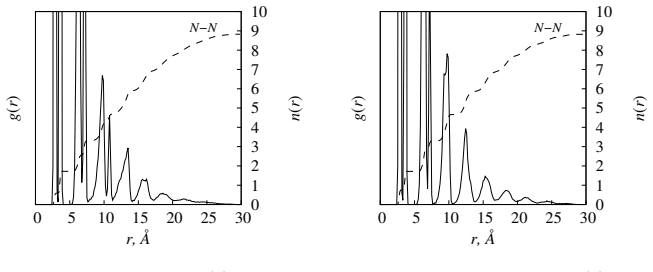
- [Section 4 and Stage 4] All coordination numbers and RDFs are derived from a single 4 ns production trajectory per system (trajectory stored at 1 ps), with no replicate simulations, block averaging, or error bars. Quantities like 'average Hg-N coordination number is 2.5' for PEI-10 + 2 Hg2+ are therefore presented without statistical uncertainty, and the conclusion that five ions are unstable rests on one short run. Please report statistical uncertainties and, ideally, multiple independent initial configurations; this is essential for the capacity claim because coordination numbers directly determine the maximum ion load.
minor comments (4)
- [Section 5, Table 3] The column header 'MD Binding enegry, MD' contains a typo ('enegry') and a duplicated 'MD'; the table would be clearer with explicit level-of-theory labels in each column header.
- [Section 2] The paper does not explicitly state the protonation state of PEI; the assigned charges correspond to neutral amines, but PEI chelation is pH-dependent. This assumption should be stated and justified in the context of water-treatment conditions.
- [Data Availability] 'Data will be made available on request' is not sufficient for a computational study of this type; depositing input topologies, force-field parameter files, and starting coordinates would substantially improve reproducibility.
- [Figures 11 and 12] The alignment procedure used to superimpose MD and DFT structures is not described, and the color code in the captions is not explained in the main text; a sentence in Section 5 describing the best-fit alignment would help.
Circularity Check
No circularity: no fitted parameters or self-citation chain; DFT is an independent check, and the MD/DFT distance discrepancy is a correctness risk, not a circular reduction.
full rationale
The prediction that a single PEI-10 chain coordinates up to four Hg2+ ions emerges from the simulation protocol rather than being encoded in the model. The force field uses OPLS/AA parameters for PEI, SPC/E water, and Babu-Lim Hg2+ parameters taken from previous publications; no parameter in this paper is fitted to the capacity claim. The four-ion maximum is inferred from the observed instability of the PEI-10 + 5 Hg2+ system and from running coordination numbers, not from a definition or from a fitted quantity. The DFT validation is an independent electronic-structure method applied to MD-derived starting geometries, and although starting from MD structures biases the conformational search, DFT optimizations are not equivalent by construction to the MD force field. There are no load-bearing self-citations and no uniqueness argument imported from the authors' prior work. The internal inconsistency between MD Hg-N distances (~2.15 Å) and DFT Hg-N distances (~2.5 Å) is a genuine accuracy concern about the Hg2+ amine cross-interaction, but it does not make the derivation circular. The central claim is therefore self-contained against the model assumptions, and any weakness lies in force-field transferability, not in circular reasoning.
Assumptions & free parameters
free parameters (1)
- Hg2+ Lennard-Jones parameters (epsilon, sigma) =
epsilon = 0.0409 kcal/mol, sigma = 2.36 Å
assumptions (5)
- domain assumption OPLS/AA force field accurately models linear PEI chains in water.
- domain assumption Geometric combination rule for cross Lennard-Jones interactions is appropriate for Hg-N and Hg-O pairs.
- domain assumption SPC/E water model adequately represents hydration of Hg2+ and PEI.
- ad hoc to paper 4 ns production runs are long enough to judge complex stability.
- domain assumption M06-2X/LanL2DZ with implicit water reliably ranks the relative stability of these complexes.
Cite this review
Pith. "Pith review of Chelation of the mercury ions by polyethyleneimine: Atomistic molecular dynamics study." pith.science (2026). https://pith.science/paper/UWKHO5J2
@misc{pith2026250618835,
  author       = {Pith},
  title        = {Pith review of: Chelation of the mercury ions by polyethyleneimine: Atomistic molecular dynamics study},
  year         = {2026},
  howpublished = {\url{https://pith.science/paper/UWKHO5J2}},
  note         = {Machine review of arXiv:2506.18835}
}
read the original abstract
Contamination of water by heavy metal ions represents a significant environmental concern. Among various remediation methods, chelation has proven to be an effective technique in water treatment processes. This study investigates the chelating properties of linear polyethyleneimine (PEI) and its complexation with divalent mercury ions (Hg2+) in aqueous solution. Atomistic molecular dynamics (MD) simulations were carried out using the OPLS/AA force field to examine the microscopic structure of PEI-Hg2+ complexes. PEI chains of varying lengths were considered, and it was found that a single linear PEI molecule containing ten amino groups is capable of coordinating up to four Hg2+ ions. The stability of the resulting complexes was further supported by density functional theory (DFT) calculations.
Figures


Figures from the paper (13 more)




Reference graph
Works this paper leans on
-
[1]
I. Wagner-Döbler, H. von Canstein, Y . Li, K. N. Timmis, W .-D. Deckwer, Removal of mercury from chem- ical wastewater by microoganisms in technical scale, Environ. Sci. Technol. 34 (21) (2000) 4628–4634. doi:10.1021/es0000652
-
[2]
C. T . Driscoll, R. P . Mason, H. M. Chan, D. J. Jacob, N. Pirrone, Mercury as a global pollutant: Sources, pathways, and effects, Environ. Sci. Technol. 47 (10) (2013) 4967–4983.doi:10.1021/es305071v
-
[3]
B. Gworek, W . Dmuchowski, A. H. Baczewska-Dąbrowska, Mercury in the terrestrial environment: a review, Environ. Sci. Eur . 32 (1).doi:10.1186/s12302-020-00401-x
-
[4]
N. Singh, G. Nagpal, S. Agrawal, Rachna, Water purification by using adsorbents: A review, Environ. Technol. Innovation 11 (2018) 187–240.doi:10.1016/j.eti.2018.05.006
-
[5]
N. A. A. Qasem, R. H. Mohammed, D. U. Lawal, Removal of heavy metal ions from wastewater: a comprehensive and critical review, npj Clean Water 4 (1).doi:10.1038/s41545-021-00127-0
-
[6]
A. Farrukh, A. Akram, A. Ghaffar, S. Hanif, A. Hamid, H. Duran, B. Yameen, Design of polymer-brush- grafted magnetic nanoparticles for highly efficient water remediation, ACS Appl. Mater . Interfaces 5 (9) (2013) 3784–3793.doi:10.1021/am400427n
-
[7]
T . Moja, S. Mishra, A. Mishra, Conductive polymer-based nanocomposites for the removal of hexava- lent chromium and trivalent arsenic from wastewater solution, in: Natural Polymers-Based Green Ad- sorbents for Water Treatment, Elsevier, 2021, pp. 243–266.doi:10.1016/b978-0-12-820541-9. 00006-5
-
[8]
Blaurock-Busch, DMPS in metal chelation, Biomed
E. Blaurock-Busch, DMPS in metal chelation, Biomed. J. Sci. Tech. Res. 30 (2).doi:10.26717/bjstr. 2020.30.004918
Show all 43 references
-
[9]
Kobayashi, K
S. Kobayashi, K. Hiroishi, M. Tokunoh, T . Saegusa, Chelating properties of linear and branched poly(ethylenimines), Macromolecules 20 (7) (1987) 1496–1500.doi:10.1021/ma00173a009
1987 doi
-
[10]
J. Jia, A. Wu, S. Luan, Spectrometry recognition of polyethyleneimine towards heavy metal ions, Col- loids Surf., A 449 (2014) 1–7 .doi:10.1016/j.colsurfa.2014.02.032
2014 doi
-
[11]
Zhang, Z.-L
J.-B. Zhang, Z.-L. Li, Y . Liu, K. Huang, Effective capture of carbon dioxide by tetraethylenepentamine as- sisted with 1-ethyl-3-methylimidazolium acetate: Experimental and thermodynamic analysis, Energy Fuels 33 (11) (2019) 11399–11407 .doi:10.1021/acs.energyfuels.9b02453
2019 doi
-
[12]
P .-L. Kuo, S. K. Ghosh, W .-J. Liang, Y .-T . Hsieh, Hyperbranched polyethyleneimine architecture onto poly(allylamine) by simple synthetic approach and the chelating characters, J. Polym. Sci., Part A: Polym. Chem. 39 (17) (2001) 3018–3023.doi:10.1002/pola.1282
2001 doi
-
[13]
K. Nam, S. Jung, J.-P . Nam, S. W . Kim, Poly(ethylenimine) conjugated bioreducible dendrimer for ef- ficient gene delivery, J. Controlled Release 220 (2015) 447–455.doi:10.1016/j.jconrel.2015. 11.005. 12
2015 doi
-
[14]
Z. M. Ayalew, X. Guo, X. Zhang, Synthesis and application of polyethyleneimine (PEI)-based compos- ite/nanocomposite material for heavy metals removal from wastewater: A critical review, J. Hazard. Mater . Adv. 8 (2022) 100158.doi:10.1016/j.hazadv.2022.100158
2022
-
[15]
Arshad, M
F. Arshad, M. Selvaraj, J. Zain, F. Banat, M. A. Haija, Polyethylenimine modified graphene oxide hydro- gel composite as an efficient adsorbent for heavy metal ions, Sep. Purif. Technol. 209 (2019) 870–880. doi:10.1016/j.seppur.2018.06.035
2019 doi
-
[16]
H. Shen, J. Chen, H. Dai, L. Wang, M. Hu, Q. Xia, New insights into the sorption and detoxifica- tion of chromium(VI) by tetraethylenepentamine functionalized nanosized magnetic polymer adsor- bents: Mechanism and pH effect, Ind. Eng. Chem. Res. 52 (36) (2013) 12723–12732.doi:10...
2013
-
[17]
Chen, Y .-F
Z. Chen, Y .-F. Wang, J. Zeng, Y . Zhang, Z.-B. Zhang, Z.-J. Zhang, S. Ma, C.-M. Tang, J.-Q. Xu, Chi- tosan/polyethyleneimine magnetic hydrogels for adsorption of heavy metal ions, Iran. Polym. J. 31 (10) (2022) 1273–1282.doi:10.1007/s13726-022-01075-3
2022 doi
-
[18]
X. Zhu, J. Tong, H. Lan, D. Pan, Fabrication of polyethyleneimine-functionalized magnetic cellulose nanocrystals for the adsorption of diclofenac sodium from aqueous solutions, Polymers 14 (4) (2022) 720.doi:10.3390/polym14040720
2022 doi
-
[19]
J. D. Ziebarth, Y . Wang, Understanding the Protonation Behavior of Linear Polyethylenimine in So- lutions through Monte Carlo Simulations, Biomacromolecules 11 (1) (2010) 29–38.doi:10.1021/ bm900842d
2010
-
[20]
C. E. Gallops, C. Yu, J. D. Ziebarth, Y . Wang, Effect of the Protonation Level and Ionic Strength on the Structure of Linear Polyethyleneimine, ACS Omega 4 (4) (2019) 7255–7264.doi:10.1021/ acsomega.9b00066
2019
-
[21]
C. K. Choudhury, S. Roy, Structural and dynamical properties of polyethylenimine in explicit water at different protonation states: a molecular dynamics study, Soft Matter 9 (7) (2013) 2269.doi: 10.1039/c2sm26290h
2013 doi
-
[22]
T . A. Beu, A. Ailenei, A. Farcaş, CHARMM force field for protonated polyethyleneimine, J. Comput. Chem. 39 (31) (2018) 2564–2575.doi:10.1002/jcc.25637
2018 doi
-
[23]
T . A. Beu, A. E. Ailenei, A. Farcas, , Atomistic and coarse-grained modeling of polyethyleneimine, Chem. Phys. Lett. 714 (2019) 94–98.doi:10.1016/j.cplett.2018.10.071
2019 doi
-
[24]
T . A. Beu, A.-E. Ailenei, R.-I. Costinaş, Martini force field for protonated polyethyleneimine, J. Comput. Chem. 41 (4) (2019) 349–361.doi:10.1002/jcc.26110
2019 doi
-
[25]
Terteci-Popescu, T
A.-E. Terteci-Popescu, T . A. Beu, Branched polyethyleneimine: CHARMM force field and molecular dynamics simulations, J. Comput. Chem. 43 (31) (2022) 2072–2083.doi:10.1002/jcc.27005
2022 doi
-
[26]
D. G. Mintis, T . S. Alexiou, V . G. Mavrantzas, Effect of pH and Molecular Length on the Structure and Dynamics of Linear and Short-Chain Branched Poly(ethylene imine) in Dilute Solution: Scaling Laws from Detailed Molecular Dynamics Simulations, J. Phys. Chem. B 124 (28) (202...
2020 doi
-
[27]
Buijs, CO 2 Capture with PEI: A Molecular Modeling Study of the Ultimate Oxidation Stability of LPEI and BPEI, ACS Eng
W . Buijs, CO 2 Capture with PEI: A Molecular Modeling Study of the Ultimate Oxidation Stability of LPEI and BPEI, ACS Eng. Au 3 (1) (2023) 28–36.doi:10.1021/acsengineeringau.2c00033
2023 doi
-
[28]
K. S. Hussan, S. Inoue, Y . Arai, K. Sasaki, R. Kita, T . Ito, N. Shinyashiki, Molecular insights into an elec- trolytic polymer, polyethylene imine, Polymer 321 (2025) 128101.doi:10.1016/j.polymer.2025. 128101
2025 doi
-
[29]
W . L. Jorgensen, D. S. Maxwell, J. Tirado-Rives, Development and testing of the OPLS all-atom force field on conformational energetics and properties of organic liquids, J. Am. Chem. Soc. 118 (45) (1996) 11225–11236.doi:10.1021/ja9621760
1996 doi
-
[30]
Kwolek, D
U. Kwolek, D. Jamroz, M. Janiczek, M. Nowakowska, P . Wydro, M. Kepczynski, Interactions of polyethylenimines with zwitterionic and anionic lipid membranes, Langmuir 32 (19) (2016) 5004– 5018.doi:10.1021/acs.langmuir.6b00490. 13
2016 doi
-
[31]
R. Li, Y . Zhang, Understanding the adsorption of branched polyamine on surface of gold nanoparticles by molecular dynamics simulations, Surface and Interface Analysis 48 (13) (2016) 1379–1383.doi: 10.1002/sia.6047
2016 doi
-
[32]
Tanis, E
I. Tanis, E. Kostarellou, K. Karatasos, Molecular dynamics simulations of hyperbranched poly (ethylene imine)–graphene oxide nanocomposites as dye adsorbents for water purification, Phys. Chem. Chem. Phys. 23 (40) (2021) 22874–22884.doi:10.1039/D1CP02461B
2021 doi
-
[33]
A. K. Giri, M. N. D. Cordeiro, Heavy metal ion separation from industrial wastewater using stacked graphene membranes: A molecular dynamics simulation study, J. Mol. Liq. 338 (2021) 116688.doi: 10.1016/j.molliq.2021.116688
2021
-
[34]
Y . Han, L. Wang, X. Guo, T . Jiao, H. Ding, Enhanced adsorption efficiency of graphene oxide by electro- static field for Hg (II) removal from water, J. Mol. Liq. 341 (2021) 117410.doi:10.1016/j.molliq. 2021.117410
2021
-
[35]
Anitha, S
K. Anitha, S. Namsani, J. K. Singh, Removal of heavy metal ions using a functionalized single-walled carbon nanotube: a molecular dynamics study, J. Phys. Chem. A 119 (30) (2015) 8349–8358.doi: 10.1021/acs.jpca.5b03352
2015 doi
-
[36]
C. S. Babu, C. Lim, Empirical force fields for biologically active divalent metal cations in water, J. Phys. Chem. A 110 (2) (2006) 691–699.doi:10.1021/jp054177x
2006 doi
-
[37]
A. P . Thompson, H. M. Aktulga, R. Berger, D. S. Bolintineanu, W . M. Brown, P . S. Crozier, P . J. in ’t Veld, A. Kohlmeyer, S. G. Moore, T . D. Nguyen, R. Shan, M. J. Stevens, J. Tranchida, C. Trott, S. J. Plimpton, LAMMPS – a flexible simulation tool for particle-based mater...
2022
-
[38]
A. I. Jewett, D. Stelter, J. Lambert, S. M. Saladi, O. M. Roscioni, M. Ricci, L. Autin, M. Maritan, S. M. Bashusqeh, T . Keyes, R. T . Dame, J.-E. Shea, G. J. Jensen, D. S. Goodsell, Moltemplate: A tool for coarse- grained modeling of complex biological matter and soft condens...
2021
-
[39]
H. J. C. Berendsen, J. R. Grigera, T . P . Straatsma, The missing term in effective pair potentials, J. Phys. Chem. 91 (24) (1987) 6269–6271.doi:10.1021/j100308a038
1987 doi
-
[40]
Frisch, G
M. Frisch, G. Trucks, H. Schlegel, G. Scuseria, M. Robb, J. Cheeseman, G. Scalmani, V . Barone, G. Pe- tersson, H. Nakatsuji, et al., Gaussian 16 rev. c. 01, wallingford, ct, Wallingford, CT
-
[41]
Y . Zhao, D. G. Truhlar, The M06 suite of density functionals for main group thermochemistry, thermo- chemical kinetics, noncovalent interactions, excited states, and transition elements: two new func- tionals and systematic testing of four M06-class functionals and 12 other f...
2008 doi
-
[42]
P . J. Hay, W . R. Wadt,Ab initioeffective core potentials for molecular calculations. Potentials for the transition metal atoms Sc to Hg, J. Chem. Phys. 82 (1) (1985) 270–283.doi:10.1063/1.448799
1985 doi
-
[43]
Schrödinger, W
L. Schrödinger, W . DeLano, Pymol (2020). 14
2020
Reviewed August 6, 2026 · model on record in the stance chip above.
Discussion (0). Continue with ORCID to comment.