REVIEW 4 major objections 6 minor 28 references
GLIMPSE: Holistic Cross-Modal Explainability for Large Vision-Language Models
T0 review · 4 major / 6 minor · reviewed 2026-08-15 · deepseek-v4-flash
Pith's one-line read GLIMPSE attributes an entire LVLM response to the visual and textual evidence that drove it, reporting human-gaze alignment scores well above earlier explainers.
desk verdict GLIMPSE is a useful combination of known ingredients aimed at a real gap, but the headline alignment numbers are not yet safe because the depth prior is tuned on the evaluation subset. read the letter →
The pith
A machine-rendered reading of the paper's core claim, the machinery that carries it, and where it could break.
The reading
What carries the argument
The load-bearing object is the gradient-fused layer relevance matrix $E_\ell = \sum_{h} w_h^\ell \mathrm{ReLU}(g_h^\ell \odot A_h^\ell)$, where $A_h^\ell$ is the attention matrix of head $h$ in layer $\ell$ and $g_h^\ell$ is its gradient with respect to the generated-token logit. Relevance is propagated by the additive update $R \leftarrow R + (I + \alpha_\ell E_\ell)R$, with layer weights $\alpha_\ell \propto g_\ell s_\ell$ combining each layer's gradient norm with the exponential depth prior $s_\ell = \exp(\lambda_d(\ell+1)) / \sum_k \exp(\lambda_d(k+1))$. This additive accumulation avoids the noise buildup of full-matrix Attention Rollout, while the depth prior (temperature $\lambda_d=0.2$) suppresses early-layer noise; per-token weights $\beta_t$ then aggregate the maps into one response-level heatmap.
What would settle it
Fix all GLIMPSE hyperparameters except the depth temperature, then estimate $\lambda_d$ on a training split of VQA-HAT and evaluate on a held-out split (or on a second human-attention benchmark); if the best $\lambda_d$ is far from 0.2, or if NSS with $\lambda_d=0.2$ falls below the TMME last-12-layer baseline, the reported state-of-the-art alignment is an artifact of tuning rather than a model-agnostic depth prior.
Extended reading notes
Core claim
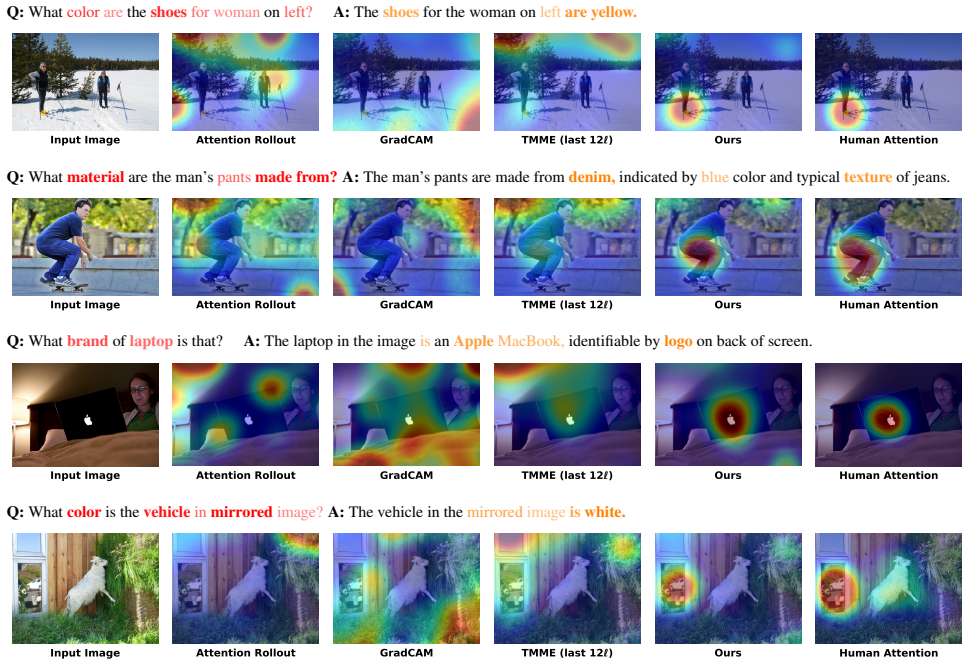
GLIMPSE's central claim is that a holistic, response-level saliency map for an autoregressive LVLM can be computed by treating each generated token as an explanation target: compute the layer-wise gradient-fused attention matrix $E_\ell$ from positive gradients and attention, accumulate relevance across layers with the update $R \leftarrow R + (I + \alpha_\ell E_\ell)R$, and aggregate per-token maps with weights $\beta_t$ that multiply softmax confidence by alignment with the complementary modality. The paper reports that this design reaches NSS 1.014 ± 0.032 and rank correlation 0.250 ± 0.008 on an open-ended VQA-HAT subset, a 71.5% NSS gain and 46.2% rank-correlation gain over the strongest baseline (TMME restricted to its last 12 layers), while deletion AUC matches human attention closely (0.855/0.718/0.617 at 5/15/30% perturbation vs. 0.852/0.707/0.589 for human maps). It further claims that token-level relevancy scores localize individual objects in generated text, expose a foreground bias, and trace hallucinated words to image regions that do not support them.
Load-bearing premise
The headline result rests on a hand-set depth schedule (temperature 0.2) that makes the deepest layers dominate the explanation; if that schedule was tuned to the human-gaze evaluation set rather than reflecting a general property of deep LVLMs, the alignment gains would not transfer to other models or benchmarks.
Editorial extensions
If this is right
- If the central claim holds, one heatmap can audit a complete multi-sentence answer, so practitioners can check which image region and which prompt words actually drove the response instead of inspecting token-by-token maps.
- Because the method needs only one forward pass plus one backward pass per generated token, it can be attached to any autoregressive vision-language model without retraining or architecture changes.
- The deletion and insertion results imply that the highlighted patches are causally load-bearing: deleting them lowers the model's confidence sharply and inserting them raises it, so the map reflects evidence the model truly used.
- Token-level relevance scores provide a hallucination diagnostic: hallucinated words carry low confidence and point at image regions without supporting features, allowing failures to be localized to specific visual evidence.
Reading between the lines
- Editorial inference: the same depth-prior mechanism should transfer to video question answering if the prior reflects a general property of deep autoregressive stacks; applying GLIMPSE to frame-based video tokens and checking whether $\lambda_d=0.2$ still outperforms a re-tuned value would test that.
- Editorial inference: a neighbouring problem the paper does not pursue is using the joint token relevance $\gamma_t$ as a training signal; the same score that diagnoses hallucination after the fact could regularize decoding or fine-tuning to suppress low-grounded tokens.
- Editorial inference: the contrast with the negative human-alignment rank correlation reported by a perturbation-based explainer suggests that earlier claims of intrinsic misalignment between LVLMs and human gaze may have measured the explainer rather than the model; a direct comparison on identical backbone and identical data subset would settle that.
Signed reviews
Editorial analysis
A structured set of objections, weighed in public.
Referee Report
Summary. The paper proposes GLIMPSE, a three-stage saliency attribution method for autoregressive large vision-language models: it fuses gradient-weighted attention across heads, propagates relevance through layers with an adaptive depth-dependent weighting, and combines token-level prompt alignment, visual grounding, and softmax confidence into a holistic response-level saliency map. The method is evaluated on VQA-HAT human-attention alignment and on deletion/insertion faithfulness using Qwen2.5-VL 32B. The authors report state-of-the-art alignment (NSS 1.014 and rank correlation 0.250) and faithfulness close to human attention, and they present qualitative cases for token-level grounding, hallucination diagnosis, and bias analysis.
Significance. If the empirical claims hold, GLIMPSE is a valuable lightweight explainability tool for free-form LVLM responses. The method is well motivated, the three components are clearly described, and the ablations are informative. The large margins over baseline explainers in both human-alignment and faithfulness experiments are encouraging, and the qualitative diagnostics demonstrate a plausible use case. However, the headline alignment result is not yet established: the depth-prior temperature is selected on the same evaluation subset, the evaluation subset size is not reported, and the experimental protocol for optional preprocessing cues is ambiguous. These issues are fixable but prevent accepting the state-of-the-art claim on the current evidence.
major comments (4)
- [Sec. 4.3, Eq. (10), Table 4] The central alignment claim is not yet established because the depth-prior temperature lambda_d is selected on the same evaluation subset used for the headline numbers. The text states that the paper reports the hyperparameter configuration that achieves the best quantitative performance, and Table 4 shows that removing the depth weighting collapses NSS from 1.014 to -0.210 and rank correlation from 0.250 to -0.167, while lambda_d = 0.5 and 1.0 give NSS 0.911 and 0.883. Since no validation split or cross-validation is described, the +71.5% NSS improvement over TMME (last 12 layers) could be an artifact of test-set tuning rather than evidence of a general explanation principle. Please add a validation protocol (for example, a separate split or cross-validation for lambda and lambda_d) and report performance on held-out data with fixed hyperparameters, or at least a systematic sensitivity analysis across multiple random splits.
- [Sec. 4.1] The number of VQA-HAT samples used in the evaluation is not reported. The paper only states that the QA set was restricted to open-ended questions with at least three annotator maps. The reported standard errors (for example, NSS 1.014 +/- 0.032) cannot be interpreted without the sample size, and the comparison between GLIMPSE and TMME (last 12 layers) is not accompanied by a statistical test. Please report the subset size, the retention rate relative to the full VQA-HAT set, and a paired significance test for the main alignment and faithfulness comparisons.
- [Sec. 4.3, paragraph after Table 4] The paragraph describing optional evaluation cues is ambiguous about whether those cues were used in Tables 2 and 3. Removing punctuation from the generated response changes the token sequence and therefore the gradient-based attribution; adding a system instruction cue changes the prompt; and applying a Gaussian blur alters the saliency map post hoc. If any of these were applied when producing the reported numbers, the baseline explainers were not evaluated on identical inputs, and the comparison is no longer on the standard VQA-HAT setting. Please state explicitly which configuration was used for each table, and if these cues were used, rerun all baselines under the same preprocessing and report the unmodified configuration as well.
- [Sec. 4.1 and contribution 1 (model-agnostic claim)] All experiments use a single backbone, Qwen2.5-VL 32B. The paper claims a model-agnostic framework and state-of-the-art alignment for LVLM interpretability, but no evidence is provided that the method transfers to another architecture or scale. A single additional backbone (for example, a LLaVA-style model or a smaller Qwen-VL variant) with the same hyperparameters would substantially strengthen the generality claim; without it, the 'model-agnostic' claim is undersupported.
minor comments (6)
- [Sec. 4.3, Table 4 and surrounding text] There is a numeric inconsistency: the text states that using the last 30% of layers without depth weighting reduces NSS to 0.490, but Table 4 reports 0.670 for that configuration.
- [Eq. (24)] The NSS computation uses the set of human-attention locations above the 95th percentile threshold rather than actual fixation locations; this is a non-standard NSS variant and should be justified, with a sensitivity analysis for the threshold theta.
- [Table 3] The faithfulness results are reported without standard errors or significance tests; given the small gap at 5% insertion AUC between GLIMPSE (0.134) and human attention (0.149), the claim that GLIMPSE 'closely matches' human attention needs statistical support.
- [Sec. 5.2] The comparison to the -0.20 rank correlation of reference [26] is presented as supporting evidence, but the paper itself acknowledges the different backbone and possibly different VQA-HAT subset; the abstract and introduction should qualify the state-of-the-art claim to the specific single-backbone and subset setting.
- [Abstract and Figure 1 caption] There are several copyediting issues, including the subject-verb disagreement 'Recent large vision-language models (LVLMs) has advanced' in the abstract and 'which is only applied to Ours method' in the Figure 1 caption.
- [Eq. (18)] The notation m in {V, P} overloads the index-set symbols V and P as modality labels; this is understandable but should be clarified to avoid confusion between the target modality and the token index sets.
Circularity Check
Headline human-alignment gain is partly a test-set fit: the depth-prior temperature lambda_d in Eq. (10) is selected on the same VQA-HAT subset used for evaluation and is decisive for the reported NSS.
-
fitted input called prediction
[Sec. 4.3 (Ablation Study), Eq. (10), Table 4]
"We report the hyperparameter configuration that achieves the best quantitative performance; in practice, although full propagation yields optimal scores, but using last 60% of depth-weighted layers trades a marginal performance loss for efficiency gains. ... Depth weighting is the most essential component among all factors, removing it causes performance to collapse to negative values (NSS=-0.210)."
Equation (10) introduces s_l = exp(lambda_d(l+1)) / sum exp(lambda_d(k+1)) with lambda_d = 0.2, and the paper states it reports the hyperparameter configuration with the best quantitative performance. This selection is made on the same VQA-HAT subset that produces the headline Table 2 result (NSS 1.014, rank 0.250). Table 4 shows the choice is decisive: removing depth weighting drops NSS to -0.210, and changing lambda_d to 0.5 or 1.0 lowers NSS to 0.911 or 0.883. Thus the claimed 71.5% NSS improvement over TMME is not an independent prediction of human alignment; it is the outcome of selecting the configuration on the evaluation metric itself, making the central alignment claim partly fitted rather than derived.
full rationale
GLIMPSE's attribution construction is not circular: saliency maps are computed from model gradients and attention (Eqs. 5-23) and scored against external human maps, with no target quantity inserted back into the gradient computation. No load-bearing self-citation appears; the method borrows Eq. (5) from Chefer et al., which is independent prior work. The one substantive circularity is empirical: the depth-prior temperature lambda_d in Eq. (10), together with the overall configuration, is chosen by reporting the best quantitative performance on the same VQA-HAT subset used for the headline Table 2 result. Since Table 4 shows NSS collapses from 1.014 to -0.210 without depth weighting, the state-of-the-art alignment claim is not a free prediction; it is partly a test-set fit. This warrants a score of 6 rather than 0, although the method itself remains mostly self-contained. The Sec. 5.2 admission that the comparison to prior work 'uses a different backbone and may involve a different subset of VQA-HAT' is an additional correctness risk, but it is not itself a circularity step.
Assumptions & free parameters
free parameters (3)
- Head attention temperature lambda =
0.5 (best in Table 4)
- Depth prior temperature lambda_d =
0.2 (best in Table 4)
- Token flow strength lambda_f =
not reported
assumptions (4)
- domain assumption Positive gradient times attention is a valid relevance signal (Eq. 5).
- ad hoc to paper Deeper layers carry more semantic relevance; exponential depth prior in Eq. (10).
- ad hoc to paper Softmax confidence of a generated token reflects grounding and reliability (Eq. 17).
- domain assumption Human attention maps are a meaningful evaluation target for interpretability.
Cite this review
Pith. "Pith review of GLIMPSE: Holistic Cross-Modal Explainability for Large Vision-Language Models." pith.science (2026). https://pith.science/paper/G2ZMMOIL
@misc{pith2026250618985,
  author       = {Pith},
  title        = {Pith review of: GLIMPSE: Holistic Cross-Modal Explainability for Large Vision-Language Models},
  year         = {2026},
  howpublished = {\url{https://pith.science/paper/G2ZMMOIL}},
  note         = {Machine review of arXiv:2506.18985}
}
read the original abstract
Recent large vision-language models (LVLMs) have advanced capabilities in visual question answering (VQA). However, interpreting where LVLMs direct their visual attention remains a significant challenge, yet is essential for understanding model behavior. We introduce GLIMPSE (Gradient-Layer Importance Mapping for Prompted Visual Saliency Explanation), a lightweight, model-agnostic framework that jointly attributes LVLM outputs to the most relevant visual evidence and textual signals that support open-ended generation. GLIMPSE fuses gradient-weighted attention, adaptive layer propagation, and relevance-weighted token aggregation to produce holistic response-level heat maps for interpreting cross-modal reasoning, outperforming prior methods in faithfulness and pushing the state-of-the-art in human-attention alignment. We demonstrate an analytic approach to uncover fine-grained insights into LVLM cross-modal attribution, trace reasoning dynamics, analyze systematic misalignment, diagnose hallucination and bias, and ensure transparency.
Figures


Figures from the paper (2 more)


Reference graph
Works this paper leans on
-
[1]
Quantifying attention flow in transformers
Samira Abnar and Willem Zuidema. Quantifying attention flow in transformers. In Proc. ACL, 2020. 1, 2, 5, 7
work page 2020
-
[2]
Attention-aware layer-wise relevance propagation for transformers
Reduan Achtibat, Sasan Vakilzadeh, Maximilian Dreyer, Se- bastian Lapuschkin, Wojciech Samek, and Gr ´egoire Mon- tavon. Attention-aware layer-wise relevance propagation for transformers. arXiv:2402.05602, 2024. 1, 2
arXiv 2024
-
[3]
XAI for trans- formers: better explanations through conservative propaga- tion
Akhtar Ali, Thomas Schnake, Oliver Eberle, Gr ´egoire Mon- tavon, Klaus-Robert M ¨uller, and Lior Wolf. XAI for trans- formers: better explanations through conservative propaga- tion. 2022. 1
work page 2022
-
[4]
On pixel-wise explanations for non-linear classifier decisions by layer-wise relevance propagation
Sebastian Bach, Alexander Binder, Gr ´egoire Montavon, Frederick Klauschen, Klaus-Robert M ¨uller, and Wojciech Samek. On pixel-wise explanations for non-linear classifier decisions by layer-wise relevance propagation. PLOS ONE, 10(7):e0130140, 2015. 2
work page 2015
-
[5]
Qwen2.5-VL: A multimodal large language model with en- hanced vision-language understanding
Shuai Bai, Keqin Chen, Xuejing Liu, Jialin Wang, Wenbin Ge, Sibo Song, Kai Dang, Peng Wang, Shijie Wang, Jun Tang, Humen Zhong, Yuanzhi Zhu, Mingkun Yang, Zhao- hai Li, Jianqiang Wan, Pengfei Wang, Wei Ding, Zheren Fu, Yiheng Xu, Jiabo Ye, Xi Zhang, Tianbao Xie, et al. Qwen2.5-VL: A multimodal large language model with en- hanced vision-language understan...
-
[6]
David Balduzzi, Marcus Frean, Lennox Leary, J. P. Lewis, Kurt Wan-Duo Ma, and Brian McWilliams. The shattered gradients problem: if ResNets are the answer, then what is the question? In Proc. ICML, 2017. 2
work page 2017
-
[7]
Visual Explanations via Iterated Integrated Attributions
Oren Barkan, Yonatan Elisha, Yair Asher, Jonathan Weill, and Noam Koenigstein. Visual explanations via iterated in- tegrated attributions. arXiv:2310.18585, 2023. 3
work page Pith review arXiv 2023
-
[8]
Generic attention- model explainability for interpreting bi-modal and encoder- decoder transformers
Hila Chefer, Shir Gur, and Lior Wolf. Generic attention- model explainability for interpreting bi-modal and encoder- decoder transformers. In Proceedings of the IEEE/CVF In- ternational Conference on Computer Vision (ICCV) , pages 397–406, 2021. 2, 4, 5, 7, 8
work page 2021
Show all 28 references
-
[9]
Human attention in visual question answer- ing: do humans and deep networks look at the same regions? In Proc
Abhishek Das, Harsh Agrawal, Larry Zitnick, Devi Parikh, and Dhruv Batra. Human attention in visual question answer- ing: do humans and deep networks look at the same regions? In Proc. EMNLP, 2016. 6
2016
-
[10]
AtMan: understanding transformer predictions through memory-efficient attention manipulation
Mayukh Deb, Boris Deiseroth, Samuel Weinbach, Patrick Schramowski, and Kristian Kersting. AtMan: understanding transformer predictions through memory-efficient attention manipulation. arXiv:2301.08110, 2023. 3
2023 arXiv
-
[11]
OWL-grounded LVLMs: bounding-box-aligned decoding for image–text models
Simone Giulivi and Giacomo Boracchi. OWL-grounded LVLMs: bounding-box-aligned decoding for image–text models. arXiv:2403.01911, 2024. 3
2024 arXiv
-
[12]
iGOS++: inte- grated gradient optimized saliency by bilateral perturbations
Soheil Khorram, Tyler Lawson, and Fuxin Li. iGOS++: inte- grated gradient optimized saliency by bilateral perturbations. In Proc. BMVC, 2021. 1, 3
2021
-
[13]
From representa- tion to reasoning: Towards both evidence and commonsense reasoning for video question-answering
Jiangtong Li, Li Niu, and Liqing Zhang. From representa- tion to reasoning: Towards both evidence and commonsense reasoning for video question-answering. In CVPR, 2022. 9
2022
-
[14]
Visual instruction tuning (LLaV A).arXiv:2304.08485, 2023
Haotian Liu, Chunyuan Li, Qingyang Wu, and Yong Jae Lee. Visual instruction tuning (LLaV A).arXiv:2304.08485, 2023. 1 10
2023 arXiv
-
[15]
Lundberg and Su-In Lee
Scott M. Lundberg and Su-In Lee. A unified approach to interpreting model predictions. In NeurIPS, 2017. 1, 3
2017
-
[16]
PixelSHAP: Shapley-based pixel importance for vision tasks
Taras Petsiuk, Arjun Jain, Mayank Mascarenhas, and Bish- waranjan Das. PixelSHAP: Shapley-based pixel importance for vision tasks. arXiv:2305.15943, 2023. 1, 3
2023 arXiv
-
[17]
Exploring human-like attention supervision in visual question answer- ing
Tingting Qiao, Jianfeng Dong, and Duanqing Xu. Exploring human-like attention supervision in visual question answer- ing. In AAAI, 2018. 1
2018
-
[18]
Qwen-VL: a versatile vision-language model with in-context learning
Qwen-VL Team. Qwen-VL: a versatile vision-language model with in-context learning. arXiv:2308.12966, 2023. 1
2023 arXiv
-
[19]
Q-GroundCAM: phrase grounding in LVLMs via gradient-based localization
Amirhossein Rajabi and Jana Ko ˇseck´a. Q-GroundCAM: phrase grounding in LVLMs via gradient-based localization. arXiv:2401.09245, 2024. 3
2024 arXiv
-
[20]
Selvaraju, Michael Cogswell, Abhishek Das, Ramakrishna Vedantam, Devi Parikh, and Dhruv Ba- tra
Ramprasaath R. Selvaraju, Michael Cogswell, Abhishek Das, Ramakrishna Vedantam, Devi Parikh, and Dhruv Ba- tra. Grad-CAM: visual explanations from deep networks via gradient-based localization. In ICCV, 2017. 1, 2, 7
2017
-
[21]
Selvaraju, Michael Cogswell, Abhishek Das, Ramakrishna Vedantam, Devi Parikh, and Dhruv Ba- tra
Ramprasaath R. Selvaraju, Michael Cogswell, Abhishek Das, Ramakrishna Vedantam, Devi Parikh, and Dhruv Ba- tra. Taking a HINT: leveraging explanations to make vision and language models more grounded. In ICCV, 2019. 1, 9
2019
-
[22]
Deep inside convolutional networks: visualising image clas- sification models and saliency maps
Karen Simonyan, Andrea Vedaldi, and Andrew Zisserman. Deep inside convolutional networks: visualising image clas- sification models and saliency maps. InICLR (Wkshp), 2014. 1, 2
2014
-
[23]
MULAN: multimodal unified local alignment net- work
Anmol Sood, Arman Sclar, Kristen Grauman, and Kate Saenko. MULAN: multimodal unified local alignment net- work. arXiv:2306.00997, 2023. 1
2023 arXiv
-
[24]
Rohekar, Yaniv Gurwicz, Nisim Harel, Lior Wolf, and Gal Chechik
Gur Ben-Melech Stan, Elad Aflalo, Roy Y . Rohekar, Yaniv Gurwicz, Nisim Harel, Lior Wolf, and Gal Chechik. LVLM-Interpret: an interpretability toolkit for large vision– language models. arXiv:2404.03118, 2024. 3
2024 arXiv
-
[25]
Axiomatic attribution for deep networks
Mukund Sundararajan, Ankur Taly, and Qiqi Yan. Axiomatic attribution for deep networks. In Proc. ICML, 2017. 1, 3
2017
-
[26]
Attention, please! Pix- elSHAP reveals what vision–language models attend to
Chen Xing, Yiming Zhang, et al. Attention, please! Pix- elSHAP reveals what vision–language models attend to. arXiv:2503.06670, 2025. 3, 9
2025 arXiv
-
[27]
VQA-MHUG: human gaze supervision for visual question answering
Yibing Xu, Mingliang Li, Shaoxiong Zhang, Wei Chen, and Kan Li. VQA-MHUG: human gaze supervision for visual question answering. In CVPR, 2022. 1
2022
-
[28]
What if the tv was off? examining counterfactual reasoning abilities of vision-language models
Huazheng Zhang, Meng Liu, V olker Tresp, et al. What if the tv was off? examining counterfactual reasoning abilities of vision-language models. In CVPR, 2024. 9 11
2024
Reviewed August 15, 2026 · model on record in the stance chip above.
Discussion (0). Continue with ORCID to comment.