REVIEW 1 major objections 1 minor 50 references
Interferometry Radii at RHIC BES Energies within the integrated HydroKinetic Model
T0 review · 1 major / 1 minor · reviewed 2026-08-15 · deepseek-v4-flash
Pith's one-line read Pion interferometry radii at RHIC BES energies favor a crossover QCD transition over a first-order phase transition.
desk verdict A genuine prediction of HBT radii from an already-calibrated model, but the central EoS-sensitivity claim is confounded because the crossover and first-order scenarios also differ in eta/s and eps_sw. read the letter →
The pith
A machine-rendered reading of the paper's core claim, the machinery that carries it, and where it could break.
The reading
What carries the argument
The central object is the extended integrated HydroKinetic Model (iHKMe), which joins five stages: UrQMD-generated initial conditions, a pre-equilibrium relaxation stage in which the energy-momentum tensor and baryon current interpolate between UrQMD and hydrodynamic forms through a weight function $P(\tau)$, viscous hydrodynamics with a chosen equation of state, Cooper-Frye particlization on a constant-energy-density hypersurface, and a final UrQMD hadron cascade that runs to $t=400$ fm/c. The free parameters ($R$, $\tau_0$, $\tau_{rel}$, $\tau_{th}$, $\eta/s$, $\varepsilon_{sw}$) are taken from earlier spectra calibrations, and the interferometry radii are extracted from Gaussian fits to the two-pion correlation function in the out–side–long (Bertsch–Pratt) parametrization. Comparing the crossover and first-order equations of state is what carries the argument: the first-order scenario's mixed phase lengthens the emission duration, and $R_{long}$ is the observable that registers this lengthening.
What would settle it
A decisive check is to rerun the 11.5 and 14.5 GeV cases with the crossover equation of state but the first-order scenario's viscosity and particlization density (and vice versa); if $R_{long}$ follows those parameters rather than the equation of state, the paper's EoS-sensitivity conclusion would collapse. A new measurement of interferometry radii at 14.5 GeV would also test the model's prediction at an energy now interpolated between 11.5 and 19.6 GeV.
Extended reading notes
Core claim
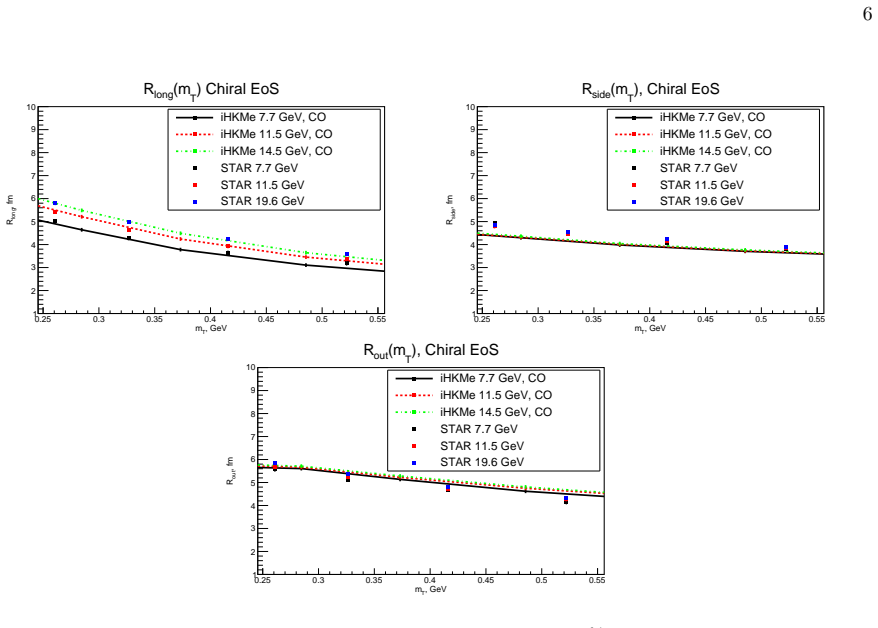
The central claim is that femtoscopic radii at intermediate collision energies can discriminate between equations of state. Within iHKMe, the crossover chiral equation of state reproduces the measured $R_{out}$, $R_{side}$, and $R_{long}$ across $\sqrt{s_{NN}}=7.7$–$39$ GeV, while the first-order phase transition equation of state, calibrated separately to match particle spectra, yields $R_{long}$ values noticeably above the data at 11.5 and 14.5 GeV and above. The authors trace this excess to a prolonged mixed-phase stage that extends emission duration. They conclude that the crossover scenario describes the interferometry radii better, especially at higher BES energies, and that both scenarios remain compatible with the 7.7 GeV data.
Load-bearing premise
The claim that the equation of state drives the better fit assumes that the two scenarios' other parameter differences—shear viscosity $\eta/s$ of 0.14 vs 0.08 and the energy density $\varepsilon_{sw}$ of 0.50 vs 0.35 at which the fluid becomes a hadron cascade—do not themselves explain the $R_{long}$ difference.
Editorial extensions
If this is right
- Above roughly 11.5 GeV, the crossover equation of state describes the measured interferometry radii better than the first-order phase transition, which overpredicts $R_{long}$.
- At 7.7 GeV both equations of state remain consistent with data, so low-energy femtoscopy alone cannot yet rule out a first-order transition.
- The model reproduces the observed pattern of $R_{long}$ rising with collision energy while $R_{side}$ and $R_{out}$ stay roughly flat, supporting the picture that higher energies mainly extend emission duration.
- The successful description from 7.7 to 39 GeV indicates that iHKMe's smooth stage coupling handles long nuclear overlap times and partial thermalization adequately.
- The trend seen in the comparison suggests that at even lower energies (around 2–4 GeV) the first-order equation of state could become the preferred description.
Reading between the lines
- The paper's EoS comparison is partly entangled with other parameter differences: the first-order sets use $\eta/s=0.08$ and $\varepsilon_{sw}=0.35$ while the crossover sets use $0.14$ and $0.50$, so a decisive test would vary the equation of state while holding these parameters fixed.
- The paper's own trend implies a testable prediction for future low-energy collider programs: below 7.7 GeV the first-order scenario should make $R_{long}$ rise more steeply with energy, which precise low-energy femtoscopy could confirm.
- Because no experimental 14.5 GeV data exist, the model's prediction at that energy is a direct, currently untested discriminator between the two equations of state.
- Combining $R_{long}$ with $R_{out}$ and $R_{side}$ as a lifetime-versus-geometry diagnostic may sharpen EoS discrimination in future correlation analyses, including non-Gaussian source shapes.
Signed reviews
Editorial analysis
A structured set of objections, weighed in public.
Referee Report
Summary. The paper applies the extended integrated HydroKinetic Model (iHKMe) to Au+Au collisions at RHIC BES energies, sqrt(s_NN) = 7.7-39 GeV, and computes the pion interferometry radii R_out, R_side, and R_long. The model combines UrQMD initial conditions, a relaxation stage, viscous hydrodynamics, particlization, and a hadronic cascade. The parameters are taken from a prior spectra-calibration study [22], so the HBT radii are genuine predictions rather than fitted quantities. Two equations of state are compared at 7.7, 11.5, and 14.5 GeV: a crossover EoS and a first-order phase-transition EoS. The central claim is that the crossover EoS describes the STAR interferometry data better, especially at higher BES energies, and that the first-order EoS produces too large R_long because of an extended mixed-phase stage; the paper also notes that the model overestimates the energy growth of R_long at high energies.
Significance. If the central claim were established, this would be a valuable result: femtoscopic radii from a realistic dynamical model, with parameters fixed by spectra, would provide independent evidence about the nature of the QCD transition at moderate baryon density. The work covers a broad energy range, uses two EoS scenarios, and reports a substantial number of events per parameter set. The main strength is that the HBT radii are computed from previously calibrated parameters rather than fitted to the femtoscopic data, giving the comparison with STAR a predictive character. However, the comparison is qualitative, and the two EoS scenarios differ in several other model parameters, so the attribution of the R_long difference to the EoS is not currently supported.
major comments (1)
- [Sec. III, Fig. 3; Sec. IV] The model "noticeably overestimates the increase of the long radii with energy" at 19.6, 27, and 39 GeV, yet Sec. IV summarizes the results as giving a "satisfactory description ... across the entire energy range." This acknowledged discrepancy is not analyzed in terms of its physical origin, nor is its impact on the overall conclusion discussed. The authors should report a quantitative measure for the high-energy R_long deviation and state explicitly whether this discrepancy weakens the claim that the crossover EoS scenario reproduces the femtoscopic data.
minor comments (1)
- [Sec. III, centrality definition] The 5% most central events are selected using 20,000 standalone UrQMD events, while the hydrodynamic simulations are a separate batch of 150 events. The possible bias from this two-step centrality selection is not quantified; a brief estimate of its effect on the extracted radii would be useful.
Circularity Check
No circularity found: HBT radii are genuine predictions computed from a full simulation chain, with model parameters taken from an earlier spectra-calibration study.
full rationale
The paper's central claim is that pion interferometry radii computed with iHKMe discriminate between a crossover and a first-order phase-transition equation of state. The radii are obtained from a multi-stage dynamical simulation (UrQMD initial conditions, relaxation, viscous hydrodynamics, particlization, and hadronic cascade) and compared with STAR data. No interferometry radius is fitted in this paper. The model parameters in Table I are taken from the authors' previous work [22], where they were calibrated using transverse-momentum spectra and compared with experimental data. That calibration is a separate observable and is externally falsifiable, so the self-citation provides independent support rather than circular input. A limitation exists: the CO and PT parameter sets differ not only in the EoS but also in eta/s, eps_sw, and sometimes tau_th, so the attribution of the R_long excess specifically to the first-order mixed phase is not uniquely isolated. However, this is a parameter-identifiability or confounding issue, not circularity: the paper does not define the EoS scenarios in terms of the HBT outcome, does not fit the radii, and does not rename a known result as a prediction. Therefore no specific circular step can be exhibited, and the circularity score is 0.
Assumptions & free parameters
free parameters (5)
- R (UrQMD smearing) =
0.5 fm
- tau0 (relaxation start) =
0.6 to 2.6 fm/c depending on energy and EoS
- tau_th (thermalization time) =
1.4 to 3.6 fm/c depending on energy and EoS
- eta/s =
0.08 (PT), 0.14 (CO)
- eps_sw (particlization energy density) =
0.35 GeV/fm3 (PT), 0.50 GeV/fm3 (CO)
assumptions (5)
- domain assumption UrQMD transport model provides realistic initial conditions and evolved final-state cascade at BES energies
- ad hoc to paper The relaxation stage ansatz P(tau) in Eq. (3) with tau_rel = tau_th - tau0 describes the approach to thermal equilibrium
- domain assumption Cooper-Frye particlization on a constant energy-density hypersurface with the Cornelius algorithm yields the correct hadron emission function
- standard math The smoothness and mass-shell approximations leading to Eq. (8) are valid for pion pairs at these energies
- domain assumption Interferometry radii vary smoothly with collision energy, used to compare 14.5 GeV results with 11.5 and 19.6 GeV data
Cite this review
Pith. "Pith review of Interferometry Radii at RHIC BES Energies within the integrated HydroKinetic Model." pith.science (2026). https://pith.science/paper/IO3O5OLD
@misc{pith2026250619101,
  author       = {Pith},
  title        = {Pith review of: Interferometry Radii at RHIC BES Energies within the integrated HydroKinetic Model},
  year         = {2026},
  howpublished = {\url{https://pith.science/paper/IO3O5OLD}},
  note         = {Machine review of arXiv:2506.19101}
}
abstract
The work is devoted to research of pion femtoscopic correlations in relativistic heavy-ion collisions across the RHIC Beam Energy Scan range using the extended integrated HydroKinetic Model (iHKMe). The model provides a comprehensive description of the system's dynamical evolution, starting from the initial collision state of colliding nuclei, passing through a possible thermalization process and hydrodynamic expansion to the hadron interacting cascade and formation of the observed particle spectra. The model smoothly couples all these stages of the matter evolution, ensuring a smooth transition between the stages. A primary focus of the current work, in contrast to the similar investigation within iHKM for high energies, concentrated in the energy region where extended nuclear overlap times and incomplete thermalization significantly influence the system's expansion comparing with very high energies. We extract the three-dimensional interferometry radii ($R_{out}$, $R_{side}$, $R_{long}$) in the region from 7.7 to 39 GeV per nucleon pair and evaluate their sensitivity to the features of the equation of state (EoS), specifically comparing crossover and first-order phase transition scenarios. The model demonstrates good agreement with experimental measurements in the crossover case. As for the first-order phase transition scenario, the $R_{long}$ component, at the optimal model parameters for particle spectra, is noticeably higher than the experimental data, and the difference is more pronounced with the growth of collision energy. Such a behavior is caused by the increased system's lifetime during the mixed-phase stage. The corresponding analysis within iHKMe below $\sqrt{s_{NN}} = 7.7$ GeV will be presented within a separate investigation.
Figures


Reference graph
Works this paper leans on
-
[22]
V. Y. Naboka, I. A. Karpenko, and Y. M. Sinyukov, Thermalization, evolution, and ob- servables at energies available at the CERN Large Hadron Collider in an integrated hydroki- netic model of A+A collisions, Phys. Rev. C93, 024902 (2016), arXiv:1508.07204 [hep-ph]
work page Pith review arXiv 2016
-
[1]
At high collision energies, we use the Monte Carlo Glauber model [32]
Initial state generation Accurate modeling of ultrarelativistic heavy- ion collisions begins with generating realistic ini- tial conditions. At high collision energies, we use the Monte Carlo Glauber model [32]. At lower en- ergies, however, the nuclear overlap time becomes comparable to the thermalization timescale—on the order of a few fm/c - necessitat...
-
[2]
Relaxation stage The matter produced in the early UrQMD evo- lution is far from equilibrium and requires ther- malization before hydrodynamics can be applied. This motivates the introduction of a relaxation stage, during which the system evolves gradu- ally toward local equilibrium. The approach is inspired by the relaxation-time approximation to the Bolt...
-
[3]
Hydrodynamic stage Once thermalization is achieved, the system evolves according to relativistic viscous hydrody- namics, governed by the conservation of energy- momentum and baryon number. A key input is the equation of state (EoS), which relates energy density, pressure, and con- served charge densities (baryon number, electric charge, strangeness) to t...
-
[4]
Particlization The hydrodynamic evolution continues until the system departs from local equilibrium. At this point, we use the Cooper-Frye prescrip- tion [33] to convert the fluid into individual hadrons—a process known as particlization. This transition occurs on a hypersurface of con- stant energy densityϵsw, which is a model param- eter and is fixed fo...
-
[5]
Hadron gas cascade The hadrons produced at particlization are fed into UrQMD for further evolution. Since 4 UrQMD operates on a constant-time hypersur- face t=const, while our particlization surface is not, particles are propagated backward in time (without interactions) to align with UrQMD in- put requirements. The subsequent evolution, in- cluding resca...
-
[6]
The equation of state that implies a cross- over transition from QGP to hadron gas (CO, Chiral EoS)
-
[7]
For higher energies, we consider only the Chiral (crossover) EoS
The equation of state that implies a first- order phase transition (PT, phase transi- tion EoS) Thus, by comparing the results obtained using different EoS for the same collision energy, we can conclude which transition type leads to a better description of observables: crossover or first-order phase transition. For higher energies, we consider only the C...
work page 2021
Show all 50 references
-
[8]
Rafelski, Connecting qgp-heavy ion physics to the early universe, Nuclear Physics B - Proceedings Supplements243-244, 155 (2013), arXiv:1306.2471 [astro-ph.CO]
J. Rafelski, Connecting qgp-heavy ion physics to the early universe, Nuclear Physics B - Proceedings Supplements243-244, 155 (2013), arXiv:1306.2471 [astro-ph.CO]
2013 arXiv
-
[9]
J. Adamset al.(STAR Collaboration), Experi- mental and theoretical challenges in the search for the quark gluon plasma: The star col- laboration’s critical assessment of the evidence from rhic collisions, Nuclear Physics A757, 102 (2005), arXiv:nucl-ex/0501009
2005 arXiv
-
[10]
K. Adcoxet al.(PHENIX Collaboration), For- mation of dense partonic matter in relativistic nucleus-nucleus collisions at rhic: Experimen- tal evaluation by the phenix collaboration, Nu- clear Physics A757, 184 (2005), arXiv:nucl- ex/0410003
2005
-
[11]
Odyniec, The RHIC Beam Energy Scan pro- gram in STAR and what’s next ..., inJournal of Physics: Conference Series, Vol
G. Odyniec, The RHIC Beam Energy Scan pro- gram in STAR and what’s next ..., inJournal of Physics: Conference Series, Vol. 455 (2013) p. 012037
2013
-
[12]
M. A. Stephanov, K. Rajagopal, and E. V. Shuryak, Signatures of the tricritical point in QCD, Physical Review Letters81, 4816 (1998), arXiv:hep-ph/9806219
1998 arXiv
-
[13]
M. A. Stephanov, K. Rajagopal, and E. V. Shuryak, Event-by-event fluctuations in heavy ion collisions and the qcd critical point, Phys- ical Review D60, 114028 (1999), arXiv:hep- 8 ph/9903292
1999
-
[14]
Goldhaber, S
G. Goldhaber, S. Goldhaber, W. Lee, and A. Pais, Influence of bose-einstein statistics on the antiproton-proton annihilation process, Physical Review120, 300 (1960)
1960
-
[15]
G. I. Kopylov, Like particle correlations as a tool to study the multiple production mecha- nism, Physics Letters B50, 472 (1974)
1974
-
[16]
Hanbury-Brown and R
R. Hanbury-Brown and R. Q. Twiss, A test of a new type of stellar interferometer on sirius, Na- ture178, 1046 (1956)
1956
-
[17]
Stefaniak and H
M. Stefaniak and H. Zbroszczyk, Examination of the heavy-ion collisions using EPOS model in the frame of BES program at RHIC, EPJ Web Conf. 164, 07013 (2017)
2017
-
[18]
Brzezi´ nski, P
K. Brzezi´ nski, P. Szyma´ nski, and H. Zbroszczyk, Two-particle correlations using THERMINA- TOR model for BES program, inActa Phys. Polon. B Proc. Suppl., Vol. 9 (2016) pp. 193–194
2016
-
[19]
P. Li, J. Steinheimer, T. Reichert, A. Kittirat- pattana, M. Bleicher, and Q. Li, Effects of a phase transition on two-pion interferometry in heavy ion collisions at √sNN = 2.4–7.7 GeV, Sci. China Phys. Mech. Astron.66, 232011 (2023)
2023
-
[20]
Zhang and J
C. Zhang and J. Xu, Effects of hadronic mean- field potentials on Hanbury–Brown–Twiss corre- lations in relativistic heavy-ion collisions, Phys. Rev. C96, 044907 (2017), arXiv:1707.07272 [nucl-th]
2017 arXiv
-
[21]
Batyuk, D
P. Batyuk, D. Blaschke, M. Bleicher, Y. B. Ivanov, I. Karpenko, L. Malinina, S. Merts, M. Nahrgang, H. Elfner, and O. Rogachevsky, Three-fluid hydrodynamics-based event simula- tor extended by UrQMD final state interactions (THESEUS) for FAIR-NICA-SPS-BES/RHIC energies, inProc...
2018 arXiv
-
[23]
S. V. Akkelin and Y. M. Sinyukov, Matching of nonthermal initial conditions and hydrodynamic stage in ultrarelativistic heavy-ion collisions, Phys. Rev. C81, 064901 (2010), arXiv:0912.4180 [nucl-th]
2010 arXiv
-
[24]
V. Y. Naboka, S. V. Akkelin, I. A. Karpenko, and Y. M. Sinyukov, Initialization of hydrodynamics in relativistic heavy ion collisions with an energy- momentum transport model, Phys. Rev. C91, 014906 (2015), arXiv:1411.4490 [nucl-th]
2015 arXiv
-
[25]
V. M. Shapoval, M. D. Adzhymambetov, and Y. M. Sinyukov, Femtoscopy scales and particle production in the relativistic heavy ion collisions from Au+Au at 200 AGeV to Xe+Xe at 5.44 ATeV within the integrated hydrokinetic model, Eur. Phys. J. A56, 260 (2020), arXiv:2006.16697 [nucl-th]
2020 arXiv
-
[26]
Adzhymambetov and Y
M. Adzhymambetov and Y. Sinyukov, Extension of the integrated HydroKinetic Model to BES RHIC and GSI-FAIR nuclear collision energies (2024), arXiv:2412.00458 [hep-ph]
2024
-
[27]
S. A. B. et al., Microscopic models for ultrarela- tivistic heavy ion collisions, Progress in Particle and Nuclear Physics41, 255 (1998), arXiv:nucl- th/9803035 [nucl-th]
1998
-
[28]
M. B. et al., Journal of Physics G25, 1859 (1999), arXiv:hep-ph/9909407 [hep-ph]
1999 arXiv
-
[29]
Rathod, Y
N. Rathod, Y. Sinyukov, M. Adzhymambetov, and H. Zbroszczyk, Particle Spectra in the Inte- grated HydroKinetic Model at RHIC BES Ener- gies (2025), arXiv:2506.13944 [nucl-th]
2025
-
[30]
Steinheimer, S
J. Steinheimer, S. Schramm, and H. Stocker, An Effective chiral Hadron-Quark Equation of State, J. Phys. G38, 035001 (2011), arXiv:1009.5239 [hep-ph]
2011 arXiv
-
[31]
P. F. Kolb and U. W. Heinz, Hydrodynamic description of ultrarelativistic heavy ion colli- sions, Part of Quark-gluon plasma 4 (2003), arXiv:nucl-th/0305084
2003 arXiv
-
[32]
Sinyukov, V
Y. Sinyukov, V. Shapoval, and V. Naboka, On mT dependence of femtoscopy scales for meson and baryon pairs, Nuclear Physics A946, 227 (2016), arXiv:1508.01812 [hep-ph]
2016 arXiv
-
[33]
Shapoval, Y
V. Shapoval, Y. Sinyukov, and V. Naboka, Proton-lambda correlation functions at energies available at the CERN Large Hadron Collider taking into account residual correlations, Phys. Rev. C92, 044910 (2015), arXiv:1509.04245 [hep-ph]
2015 arXiv
-
[34]
Naboka, Y
V. Naboka, Y. Sinyukov, and G. Zinovjev, Direct-photon spectrum and elliptic flow pro- duced from Pb+Pb collisions at energy 2.76 TeV at the CERN Large Hadron Collider within an integrated hydrokinetic model, Phys. Rev. C97, 054907 (2018), arXiv:1710.07689 [hep-ph]
2018 arXiv
-
[35]
Naboka, Y
V. Naboka, Y. Sinyukov, and G. Zinovjev, Photon spectra and anisotropic flow in heavy ion collisions at the top RHIC energy within the integrated hydrokinetic model with photon hadronization emission, Nuclear Physics A1000, 121843 (2020), arXiv:1912.01423 [nucl-th]
2020 arXiv
-
[36]
Y. M. Sinyukov, M. D. Adzhymambetov, V. Y. Naboka, and V. M. Shapoval, The prethermal stage of heavy-ion collision and the particle pro- duction, Acta Physica Polonica B, Proceedings Supplement11, 633 (2018)
2018
-
[37]
M. D. Adzhymambetov, V. Y. Naboka, V. M. Shapoval, and Y. M. Sinyukov, The fem- toscopy scales in Au+Au collisions at the top RHIC energy, Acta Physica Polonica B Pro- ceedings Supplement12, 10.5506/APhysPolB- Supp.12.235 (2019)
2019 doi
-
[38]
Y. M. Sinyukov, M. D. Adzhymambetov, V. M. Shapoval, and V. Y. Naboka, Femtoscopic struc- ture of relativistic heavy ion collisions in the in- tegrated hydrokinetic model, Physics of Particles and Nuclei51, 258 (2020)
2020
-
[39]
Alvioli, H.-J
M. Alvioli, H.-J. Drescher, and M. Strikman, A monte carlo generator of nucleon configurations in complex nuclei including nucleon-nucleon cor- relations, Physics Letters B680, 225 (2009)
2009
-
[40]
Cooper and G
F. Cooper and G. Frye, Comment on the sin- gle particle distribution in the hydrodynamic 9 and statistical thermodynamic models of multi- particle production, Physical Review D10, 186 (1974)
1974
-
[41]
Huovinen and H
P. Huovinen and H. Petersen, Particlization in hybrid models, European Physical Journal A48, 171 (2012), arXiv:1206.3371 [nucl-th]
2012 arXiv
-
[42]
Pratt, Accounting for backflow in hydrodynamic-boltzmann interfaces, Physi- cal Review C89, 024910 (2014)
S. Pratt, Accounting for backflow in hydrodynamic-boltzmann interfaces, Physi- cal Review C89, 024910 (2014)
2014
-
[43]
A. N. Makhlin and Y. M. Sinyukov, Hadron matter under pion interferometry microscope, Zeitschrift f¨ ur Physik C39, 69 (1988)
1988
-
[44]
Y. M. Sinyukov and V. M. Shapoval, Correlation femtoscopy of small systems, Physical Review D 87, 094024 (2013)
2013
-
[45]
U. Heinz, Hanbury-brown/twiss interferometry for relativistic heavy-ion collisions: Theoretical aspects (1997), lectures at NATO ASI ”Corre- lations and Clustering Phenomena in Subatomic Physics”, Dronten, Aug 4–18, 1996, arXiv:nucl- th/9609029 [nucl-th]
1997
-
[46]
Heinz and B
U. Heinz and B. V. Jacak, Two-Particle Correlations in Relativistic Heavy-Ion Colli- sions, Ann.Rev.Nucl.Part.Sci49, 529 (1999), arXiv:nucl-th/9902020 [nucl-th]
1999 arXiv
-
[47]
U. A. Wiedemann and U. Heinz, Particle interferometry for relativistic heavy-ion colli- sions, Physics Reports319, 145 (1999), nucl- th/9901094
1999
-
[48]
S. V. Akkelin and Y. M. Sinyukov, The HBT-interferometry of expanding inhomoge- neous sources, Z. Phys. C72, 501 (1996)
1996
-
[49]
Y. M. Sinyukov, S. V. Akkelin, and A. Y. Tol- stykh, Interferometry radii for expanding hadron resonance gas, Nuclear Physics A610, 278 (1996)
1996
-
[50]
L. A. et al. (STAR), Beam-energy-dependent two-pion interferometry and the freeze-out ec- centricity of pions measured in heavy ion col- lisions at the STAR detector, Phys. Rev. C92, 014904 (2015), arXiv:1403.4972v1 [nucl-ex]
2015 arXiv
Reviewed August 15, 2026 · model on record in the stance chip above.
Discussion (0). Continue with ORCID to comment.