REVIEW 2 major objections 4 minor 1 cited by
HoliGS: Holistic Gaussian Splatting for Embodied View Synthesis
T0 review · 2 major / 4 minor · reviewed 2026-08-06 · deepseek-v4-flash
Pith's one-line read Deformable Gaussian splatting reconstructs minute-long dynamic scenes from monocular video about ten times faster than prior neural radiance field pipelines while improving rendering quality.
desk verdict Solid deformable-Gaussian system with a useful hierarchy and honest ablations, but the monocular and embodied-view claims outrun the evaluation: initialization depends on stereo depth and ARKit poses, and the held-out views are the small-baseline right stereo camera. read the letter →
The pith
A machine-rendered reading of the paper's core claim, the machinery that carries it, and where it could break.
The reading
What carries the argument
The load-bearing object is the invertible deformation pipeline that combines three warping stages: a per-frame rigid SE(3) transform for the object root and background, dual-quaternion blend skinning over a learned bone hierarchy, and an invertible RealNVP flow for soft deformation. Because the flow is invertible, the model enforces a cycle-consistency loss between forward and inverse warps, which stabilizes training over long sequences. A second piece of machinery is the neural-SDF warm start: sampled points are centered on back-projected surface points from depth, and the warping network is pre-trained on photometric, depth, flow, cycle, and segmentation losses before dynamic Gaussian splatting takes over. Together these let the representation explain roughly ninety percent of visible motion with the skeleton, leaving the invertible flow to handle only low-amplitude residual detail, which is why the paper claims convergence in about two hours on a single GPU.
What would settle it
Run HoliGS on a monocular video with no paired depth and no external pose initialization. If the novel-view renderings reproduce the floating-foreground and scale-drift artifacts shown in the 'w/o L_depth' ablation (Table 4, row 2) or fail to converge as in the 'w/o root-body G_j' row, then the central claim of monocular embodied view synthesis is not sustained.
Extended reading notes
Core claim
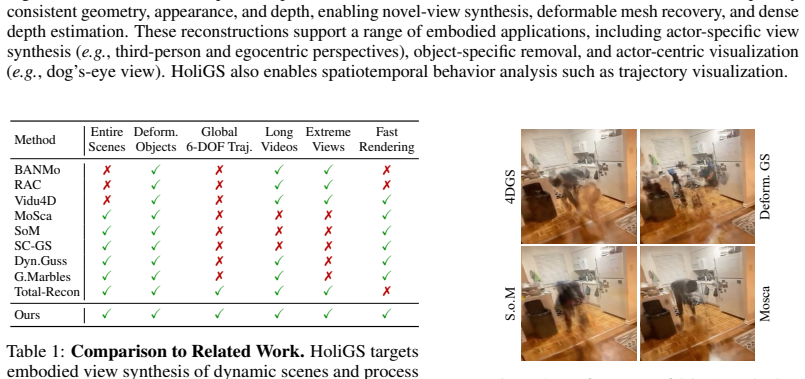
On its own terms, the paper claims that HoliGS outperforms state-of-the-art monocular deformable NeRFs on both reconstruction quality and speed for embodied view synthesis. The claim is supported by experiments on 11 stereo-captured sequences of humans and animals: the method reports the best LPIPS, PSNR, SSIM, and depth accuracy across all sequences, cutting training time to about 1.2 hours versus roughly 12 hours for Total-Recon on the same GPU, and rendering novel views at about 20 fps on consumer hardware. The mechanism the paper credits for this is the hierarchical warping decomposition, in which a canonical point is warped through the inverse soft flow, the skeleton skinning, and the object-root camera transform as $X_t = {G_t^o}^{-1} {J_t}^{-1} S^{-1}(X^*, \omega_t^d)$, together with a two-stage optimization that first fits a neural SDF to initialize poses and scale, then switches to Gaussian splatting for final refinement.
Load-bearing premise
The method needs trustworthy depth and body/camera pose estimates during initialization; if a video lacks those, as a truly monocular phone capture would, the scale consistency and stable convergence the paper reports are not established.
Editorial extensions
If this is right
- Minute-long monocular videos of dynamic scenes become tractable: full scenes with multiple deformable objects converge in about two hours on an H20 or A6000 GPU, roughly ten times faster than the strongest NeRF baseline.
- Novel views from embodied trajectories, including egocentric, third-person follow, and overhead perspectives, can be rendered at interactive rates of about 20 fps, making AR/VR and virtual cinematography practical.
- The same representation yields metric depth and deformable mesh recovery, enabling actor-specific view synthesis, object removal, and spatiotemporal trajectory analysis.
- The hierarchical motion decomposition removes the need for expensive point-tracking pipelines and helps the optimization stay stable under occlusion and extreme viewpoint changes.
Reading between the lines
- The paper's experiments use stereo-captured depth and device motion sensors for initialization, so its monocular claim is not yet demonstrated on a video without any depth signal; a natural next test is to run it on a standard phone clip and check whether the scale drift seen in the no-depth ablation reappears.
- Because the skeleton is learned without parametric body models, the method trades anatomical precision for generality; combining the learned bones with a parametric human or animal prior might benefit the human sequences while keeping the approach applicable to arbitrary articulated objects.
- The invertible flow formulation is general enough that the same three-way decomposition could in principle be applied to other articulated entities such as furniture or robots, though the paper only evaluates humans and animals.
- The reported speed-up depends on the warm-start initialization; without it, performance drops sharply (Appendix Table 5), so the practical benefit may shrink for sequences where reliable depth and pose are unavailable.
Editorial analysis
A structured set of objections, weighed in public.
Referee Report
Summary. The paper proposes HoliGS, a deformable Gaussian splatting framework for embodied view synthesis of long dynamic scenes. The scene is decomposed into a static background and time-varying foreground objects; motion is modeled hierarchically as global SE(3) transformations, skeleton-driven dual-quaternion blend skinning, and a residual invertible RealNVP soft-deformation field. A neural-SDF warm-start initializes the deformation network and Gaussian positions, after which a two-stage optimization (component pre-training and joint refinement) fits the full 4D representation. Experiments are conducted on a newly captured stereo dataset of 11 sequences of humans interacting with animals. The paper reports higher LPIPS/PSNR/SSIM and depth-accuracy numbers than dynamic NeRF and Gaussian baselines, as well as substantially lower training and rendering times.
Significance. If the stated claims are accepted, the paper would be a practical engineering contribution: it combines articulated motion priors with an invertible deformation model, avoids costly point-tracking pipelines, scales to minute-long captures, and reports 20 fps rendering on consumer hardware. The ablation study in Table 4 supports the value of the individual components, and the appendix provides useful implementation details. The main reservations concern the alignment between the claims in the abstract and the evaluation protocol: the method is demonstrated on stereo data with ground-truth depth and ARKit/PoseNet pose initialization, and the quantitative novel-view metrics are computed on right-stereo frames rather than on the egocentric or third-person trajectories that the paper identifies as the embodied-view setup. These gaps mean the headline claims of monocular input and embodied view synthesis are not currently established by the evidence presented.
major comments (2)
- [§3.2, Appendix A.1, Tables 4 and 5] The central claim that HoliGS works from long monocular RGB videos is not supported by the experimental setup. The deformation-network initialization samples points centered on the surface point derived from back-projecting ground-truth depth (Appendix A.1), and the background root pose is initialized from ARKit motion-sensor extrinsics while foreground poses come from PoseNet (§3.2). Table 4 shows that removing the depth loss (row 2) substantially degrades accuracy and that removing root-body poses entirely (row 7) prevents convergence (N/A); Table 5 shows that removing the initialization stage drops PSNR from 21.31 to 17.30. These results demonstrate that the method's success depends on stereo-derived depth and accurate pose priors, which are not available in a genuine monocular RGB capture. The authors should either evaluate on true monocular sequences with estimated depth and pose, or substantially reframe the claims to describe a stereo/pose-assisted system.
- [Appendix A.1, Table 2, Figure 4] The embodied-view-synthesis claim is not quantitatively validated. The held-out validation views in the quantitative NVS evaluation are the right-camera frames of a stereo pair, which have only a small baseline relative to the training views. The egocentric and third-person-follow trajectories that define EVS are only shown qualitatively in Figure 4, without metrics. This does not demonstrate robust free-viewpoint rendering under the extreme viewpoint changes claimed in the abstract and Table 1. The paper should add quantitative evaluation on embodied trajectories (or a proxy such as large-baseline re-rendering with ground-truth depth) and report numbers for those viewpoints, or restrict the EVS claims to what the current protocol supports.
minor comments (4)
- [Abstract and §1] The abstract repeatedly states the input is monocular RGB video, but the dataset and initialization rely on stereo depth and device motion sensors. The wording should be adjusted to reflect the actual input modalities or the experiments should be extended to include monocular captures.
- [Table 4 caption and §4.3] The row references in the text do not match the table. The caption says removing root-body poses entirely is row (5), but the table shows that row is the soft-deformation ablation and row (7) is the root-body-pose removal. Several other row citations in §4.3 are likewise inconsistent with the table. These references should be corrected.
- [Eq. (1) and Eq. (2)] The notation in Eq. (2) appears unbalanced: the left-hand side is a canonical point X*, while the right-hand side applies S, J_t, and G_t^o to a world-space point X^t. If this is intended as the forward warp, the inverse flow should be used or the notation should be clarified.
- [§4.1] The description of the loss weights is inconsistent: the text states default weights for λ_depth = 5 or 1.5 for HUMAN 1, but it is not stated whether these per-sequence weights are tuned on the validation set or fixed a priori. A brief statement about weight selection would improve reproducibility.
Circularity Check
No significant circularity: HoliGS is an empirical fitting/systems paper whose metrics are evaluated on held-out views, with no derivation step that reduces to its inputs.
full rationale
Walking the claimed derivation chain—hierarchical warping (Eqs. 1-2), neural-SDF pre-training (Sec. 3.2), Gaussian splatting optimization (Sec. 3.3), and embodied viewpoint transformation (Sec. 3.4)—no step defines a predicted quantity in terms of the same quantity or fits a parameter and then reports it as an independent prediction. The deformation field is initialized using external supervision (PoseNet, ARKit poses, RAFT flow, SAM masks, depth) and then optimized with photometric, depth, normal, and mask losses; this is parameter fitting, not circular derivation. Novel-view metrics (Table 2) are computed on the withheld right-camera frames while training uses left-camera frames, so the NVS comparison is an external evaluation. Depth metrics (Table 3) use stereo-derived ground truth, and depth supervision is applied on training views; even if the supervision source is described inconsistently (Sec. 3.2 says off-the-shelf monocular depth estimator [69], while Appendix A.1 describes paired depth images and the dataset details say stereo-derived ground truth), this is a data-supervision/correctness concern, not a self-referential loop. Ablations (Table 4) show expected component dependencies (removing depth or root-body poses hurts), but these are empirical sensitivity results, not circularity. No load-bearing self-citations appear: the cited deformation/skinning/pose tools (RealNVP [66], DQB [65], PoseNet [68], RAFT [70], SAM [71]) are external, independently published methods. Per-sequence loss-weight tuning (lambda_depth = 1.5 for HUMAN 1) is standard hyperparameter selection and does not constitute a fitted-input-called-prediction. The Limitations section's admission that generic pose estimation may mis-match SMPL-level anatomical accuracy is a stated weakness of robustness, not a circular step. Overall, the central claims stand on external benchmarks and held-out evaluation, so the circularity score is 0.
Assumptions & free parameters
free parameters (4)
- lambda_depth (depth loss weight) =
5.0 default, 1.5 for HUMAN 1
- global scale factor for depth and ARKit extrinsics =
0.2
- lambda_flow, lambda_cycle, lambda_SDF =
1, 1, 0.001
- number of bones B and RealNVP coupling layers =
not stated in the text
assumptions (5)
- domain assumption The neural SDF pre-fit, supervised by ground-truth stereo depth, provides a warm start that avoids local minima in Gaussian optimization.
- domain assumption Skeleton-driven DQB warping explains roughly 90% of motion energy, leaving only small residual deformations for the flow.
- domain assumption Off-the-shelf PoseNet, RAFT optical flow, UniDepth, and SAM masks provide sufficiently accurate supervision for optimization.
- ad hoc to paper The right-camera frames of a stereo pair are representative of embodied view synthesis.
- standard math RealNVP flow is invertible and can represent residual non-rigid deformations.
Cite this review
Pith. "Pith review of HoliGS: Holistic Gaussian Splatting for Embodied View Synthesis." pith.science (2026). https://pith.science/paper/VLCIZOMO
@misc{pith2026250619291,
  author       = {Pith},
  title        = {Pith review of: HoliGS: Holistic Gaussian Splatting for Embodied View Synthesis},
  year         = {2026},
  howpublished = {\url{https://pith.science/paper/VLCIZOMO}},
  note         = {Machine review of arXiv:2506.19291}
}
read the original abstract
We propose HoliGS, a novel deformable Gaussian splatting framework that addresses embodied view synthesis from long monocular RGB videos. Unlike prior 4D Gaussian splatting and dynamic NeRF pipelines, which struggle with training overhead in minute-long captures, our method leverages invertible Gaussian Splatting deformation networks to reconstruct large-scale, dynamic environments accurately. Specifically, we decompose each scene into a static background plus time-varying objects, each represented by learned Gaussian primitives undergoing global rigid transformations, skeleton-driven articulation, and subtle non-rigid deformations via an invertible neural flow. This hierarchical warping strategy enables robust free-viewpoint novel-view rendering from various embodied camera trajectories by attaching Gaussians to a complete canonical foreground shape (\eg, egocentric or third-person follow), which may involve substantial viewpoint changes and interactions between multiple actors. Our experiments demonstrate that \ourmethod~ achieves superior reconstruction quality on challenging datasets while significantly reducing both training and rendering time compared to state-of-the-art monocular deformable NeRFs. These results highlight a practical and scalable solution for EVS in real-world scenarios. The source code will be released.
Figures


Figures from the paper (8 more)


Forward citations
Cited by 1 Pith paper
-
MemoBench: Benchmarking World Modeling in Dynamically Changing Environments
None of ten tested video-generation models reliably remembers objects after occlusion in dynamic scenes; static-camera videos inflate consistency scores.
Reference graph
Works this paper leans on
-
[1]
Nerf: Representing scenes as neural radiance fields for view synthesis
Ben Mildenhall, Pratul P Srinivasan, Matthew Tancik, Jonathan T Barron, Ravi Ramamoor- thi, and Ren Ng. Nerf: Representing scenes as neural radiance fields for view synthesis. Communications of the ACM, 2021. 1
work page 2021
-
[2]
3d gaussian splatting for real-time radiance field rendering
Bernhard Kerbl, Georgios Kopanas, Thomas Leimkühler, and George Drettakis. 3d gaussian splatting for real-time radiance field rendering. ACM TOG, 2023. 1, 6
work page 2023
-
[3]
Total- recon: Deformable scene reconstruction for embodied view synthesis
Chonghyuk Song, Gengshan Yang, Kangle Deng, Jun-Yan Zhu, and Deva Ramanan. Total- recon: Deformable scene reconstruction for embodied view synthesis. In ICCV, 2023. 1, 2, 3, 7
work page 2023
-
[4]
Modgs: Dynamic gaussian splatting from casually-captured monocular videos
Qingming Liu, Yuan Liu, Jiepeng Wang, Xianqiang Lyv, Peng Wang, Wenping Wang, and Junhui Hou. Modgs: Dynamic gaussian splatting from casually-captured monocular videos. In ICLR, 2025. 1
work page 2025
-
[5]
Cotracker3: Simpler and better point tracking by pseudo-labelling real videos
Nikita Karaev, Iurii Makarov, Jianyuan Wang, Natalia Neverova, Andrea Vedaldi, and Christian Rupprecht. Cotracker3: Simpler and better point tracking by pseudo-labelling real videos. arXiv preprint arXiv:2410.11831, 2024. 1, 2
arXiv 2024
-
[6]
Shape of motion: 4d reconstruction from a single video
Qianqian Wang, Vickie Ye, Hang Gao, Jake Austin, Zhengqi Li, and Angjoo Kanazawa. Shape of motion: 4d reconstruction from a single video. arXiv preprint arXiv:2407.13764, 2024. 2
arXiv 2024
-
[7]
Mosca: Dynamic gaussian fusion from casual videos via 4d motion scaffolds
Jiahui Lei, Yijia Weng, Adam Harley, Leonidas Guibas, and Kostas Daniilidis. Mosca: Dynamic gaussian fusion from casual videos via 4d motion scaffolds. arXiv preprint arXiv:2405.17421, 2024
arXiv 2024
-
[8]
Dynamic gaussian marbles for novel view synthesis of casual monocular videos
Colton Stearns, Adam Harley, Mikaela Uy, Florian Dubost, Federico Tombari, Gordon Wet- zstein, and Leonidas Guibas. Dynamic gaussian marbles for novel view synthesis of casual monocular videos. In SIGGRAPH Asia, 2024. 2
work page 2024
Show all 73 references
-
[9]
Ppr: Physically plausible reconstruction from monocular videos
Gengshan Yang, Shuo Yang, John Z Zhang, Zachary Manchester, and Deva Ramanan. Ppr: Physically plausible reconstruction from monocular videos. In ICCV, 2023. 2
2023
-
[10]
Lawrence Zitnick, Sing Bing Kang, Matthew Uyttendaele, Simon Winder, and Richard Szeliski
C. Lawrence Zitnick, Sing Bing Kang, Matthew Uyttendaele, Simon Winder, and Richard Szeliski. High-quality video view interpolation using a layered representation. ACM TOG,
-
[11]
View and time interpo- lation in image space
Timo Stich, Christian Linz, Georgia Albuquerque, and Marcus Magnor. View and time interpo- lation in image space. Computer Graphics Forum, 2008
2008
-
[12]
X-fields: Implicit neural view-, light- and time-image interpolation
Mojtaba Bemana, Karol Myszkowski, Hans-Peter Seidel, and Tobias Ritschel. X-fields: Implicit neural view-, light- and time-image interpolation. In SIGGRAPH Asia, 2020
2020
-
[13]
4d visualization of dynamic events from unconstrained multi-view videos
Aayush Bansal, Minh V o, Yaser Sheikh, Deva Ramanan, and Srinivasa Narasimhan. 4d visualization of dynamic events from unconstrained multi-view videos. In CVPR, 2020
2020
-
[14]
Neural 3d video synthesis from multi-view video
Tianye Li, Mira Slavcheva, Michael Zollhoefer, Simon Green, Christoph Lassner, Changil Kim, Tanner Schmidt, Steven Lovegrove, Michael Goesele, Richard Newcombe, et al. Neural 3d video synthesis from multi-view video. In CVPR, 2022
2022
-
[15]
D-nerf: Neural radiance fields for dynamic scenes
Albert Pumarola, Enric Corona, Gerard Pons-Moll, and Francesc Moreno-Noguer. D-nerf: Neural radiance fields for dynamic scenes. In CVPR, 2021
2021
-
[16]
K-planes: Explicit radiance fields in space, time, and appearance
Sara Fridovich-Keil, Giacomo Meanti, Frederik Warburg, Benjamin Recht, and Angjoo Kanazawa. K-planes: Explicit radiance fields in space, time, and appearance. arXiv preprint arXiv:2301.10241, 2023
2023 arXiv
-
[17]
Hexplane: A fast representation for dynamic scenes
Ang Cao and Justin Johnson. Hexplane: A fast representation for dynamic scenes. arXiv preprint arXiv:2301.09632, 2023. 3
2023 arXiv
-
[18]
Hyperreel: High-fidelity 6-dof video with ray-conditioned sampling
Benjamin Attal, Jia-Bin Huang, Christian Richardt, Michael Zollhoefer, Johannes Kopf, Matthew O’Toole, and Changil Kim. Hyperreel: High-fidelity 6-dof video with ray-conditioned sampling. In CVPR, 2023. 10
2023
-
[19]
Dynamic 3d gaussians: Tracking by persistent dynamic view synthesis
Jonathon Luiten, Georgios Kopanas, Bastian Leibe, and Deva Ramanan. Dynamic 3d gaussians: Tracking by persistent dynamic view synthesis. arXiv preprint arXiv:2308.09713, 2023
2023 arXiv
-
[20]
High- fidelity and real-time novel view synthesis for dynamic scenes
Haotong Lin, Sida Peng, Zhen Xu, Tao Xie, Xingyi He, Hujun Bao, and Xiaowei Zhou. High- fidelity and real-time novel view synthesis for dynamic scenes. In SIGGRAPH Asia, 2023. 3
2023
-
[21]
Novel view synthesis of dynamic scenes with globally coherent depths from a monocular camera
Jae Shin Yoon, Kihwan Kim, Orazio Gallo, Hyun Soo Park, and Jan Kautz. Novel view synthesis of dynamic scenes with globally coherent depths from a monocular camera. In CVPR, 2020. 3
2020
-
[22]
Neural scene flow fields for space-time view synthesis of dynamic scenes
Zhengqi Li, Simon Niklaus, Noah Snavely, and Oliver Wang. Neural scene flow fields for space-time view synthesis of dynamic scenes. In CVPR, 2021. 3
2021
-
[23]
Space-time neural irradiance fields for free-viewpoint video
Wenqi Xian, Jia-Bin Huang, Johannes Kopf, and Changil Kim. Space-time neural irradiance fields for free-viewpoint video. In CVPR, 2021
2021
-
[24]
Neural trajectory fields for dynamic novel view synthesis
Chaoyang Wang, Ben Eckart, Simon Lucey, and Orazio Gallo. Neural trajectory fields for dynamic novel view synthesis. arXiv preprint arXiv:2105.05994, 2021
2021 arXiv
-
[25]
Dynamic view synthesis from dynamic monocular video
Chen Gao, Ayush Saraf, Johannes Kopf, and Jia-Bin Huang. Dynamic view synthesis from dynamic monocular video. In ICCV, 2021
2021
-
[26]
Non-rigid neural radiance fields: Reconstruction and novel view synthesis of a dynamic scene from monocular video
Edgar Tretschk, Ayush Tewari, Vladislav Golyanik, Michael Zollhöfer, Christoph Lassner, and Christian Theobalt. Non-rigid neural radiance fields: Reconstruction and novel view synthesis of a dynamic scene from monocular video. In ICCV, 2021
2021
-
[27]
D2 nerf: Self-supervised decoupling of dynamic and static objects from a monocular video
Tianhao Wu, Fangcheng Zhong, Andrea Tagliasacchi, Forrester Cole, and Cengiz Oztireli. D2 nerf: Self-supervised decoupling of dynamic and static objects from a monocular video. arXiv preprint arXiv:2205.15838, 2022
2022 arXiv
-
[28]
Nerfplayer: A streamable dynamic scene representation with decomposed neural radiance fields
Liangchen Song, Anpei Chen, Zhong Li, Zhang Chen, Lele Chen, Junsong Yuan, Yi Xu, and Andreas Geiger. Nerfplayer: A streamable dynamic scene representation with decomposed neural radiance fields. IEEE TVCG, 2023
2023
-
[29]
Mononerf: Learning a generalizable dynamic radiance field from monocular videos
Fengrui Tian, Shaoyi Du, and Yueqi Duan. Mononerf: Learning a generalizable dynamic radiance field from monocular videos. In ICCV, 2023
2023
-
[30]
Decoupling dynamic monocular videos for dynamic view synthesis
Meng You and Junhui Hou. Decoupling dynamic monocular videos for dynamic view synthesis. arXiv preprint arXiv:2304.01716, 2023
2023 arXiv
-
[31]
De- formable 3d gaussians for high-fidelity monocular dynamic scene reconstruction
Ziyi Yang, Xinyu Gao, Wen Zhou, Shaohui Jiao, Yuqing Zhang, and Xiaogang Jin. De- formable 3d gaussians for high-fidelity monocular dynamic scene reconstruction. arXiv preprint arXiv:2309.13101, 2023
2023 arXiv
-
[32]
Gaufre: Gaussian deformation fields for real-time dynamic novel view synthesis
Yiqing Liang, Numair Khan, Zhengqin Li, Thu Nguyen-Phuoc, Douglas Lanman, James Tompkin, and Lei Xiao. Gaufre: Gaussian deformation fields for real-time dynamic novel view synthesis. arXiv preprint arXiv:2312.11458, 2023
2023 arXiv
-
[33]
Robust dynamic radiance fields
Yu-Lun Liu, Chen Gao, Andreas Meuleman, Hung-Yu Tseng, Ayush Saraf, Changil Kim, Yung-Yu Chuang, Johannes Kopf, and Jia-Bin Huang. Robust dynamic radiance fields. In CVPR, 2023
2023
-
[34]
Dyblurf: Dynamic deblurring neural radiance fields for blurry monocular video
Minh-Quan Viet Bui, Jongmin Park, Jihyong Oh, and Munchurl Kim. Dyblurf: Dynamic deblurring neural radiance fields for blurry monocular video. arXiv preprint arXiv:2312.13528, 2023
2023 arXiv
-
[35]
Ctnerf: Cross-time transformer for dynamic neural radiance field from monocular video
Xingyu Miao, Yang Bai, Haoran Duan, Yawen Huang, Fan Wan, Yang Long, and Yefeng Zheng. Ctnerf: Cross-time transformer for dynamic neural radiance field from monocular video. arXiv preprint arXiv:2401.04861, 2024. 3
2024 arXiv
-
[36]
Barron, Sofien Bouaziz, Dan B Goldman, Ricardo Martin-Brualla, and Steven M
Keunhong Park, Utkarsh Sinha, Peter Hedman, Jonathan T. Barron, Sofien Bouaziz, Dan B Goldman, Ricardo Martin-Brualla, and Steven M. Seitz. Hypernerf: A higher-dimensional representation for topologically varying neural radiance fields. ACM TOG, 2021. 3 11
2021
-
[37]
Nerfies: Deformable neural radiance fields
Keunhong Park, Utkarsh Sinha, Jonathan T Barron, Sofien Bouaziz, Dan B Goldman, Steven M Seitz, and Ricardo Martin-Brualla. Nerfies: Deformable neural radiance fields. In ICCV, 2021. 3
2021
-
[38]
Plenoxels: Radiance fields without neural networks
Sara Fridovich-Keil and Alex Yu, Matthew Tancik, Qinhong Chen, Benjamin Recht, and Angjoo Kanazawa. Plenoxels: Radiance fields without neural networks. In CVPR, 2022. 3
2022
-
[39]
Tensorf: Tensorial radiance fields
Anpei Chen, Zexiang Xu, Andreas Geiger, Jingyi Yu, and Hao Su. Tensorf: Tensorial radiance fields. In ECCV, 2022. 3
2022
-
[40]
Fast dynamic radiance fields with time-aware neural voxels
Jiemin Fang, Taoran Yi, Xinggang Wang, Lingxi Xie, Xiaopeng Zhang, Wenyu Liu, Matthias Nießner, and Qi Tian. Fast dynamic radiance fields with time-aware neural voxels. In SIG- GRAPH Asia, 2022. 3
2022
-
[41]
Tensor4d: Efficient neural 4d decomposition for high-fidelity dynamic reconstruction and rendering
Ruizhi Shao, Zerong Zheng, Hanzhang Tu, Boning Liu, Hongwen Zhang, and Yebin Liu. Tensor4d: Efficient neural 4d decomposition for high-fidelity dynamic reconstruction and rendering. In CVPR, 2023. 3
2023
-
[42]
Monocular dynamic view synthesis: A reality check
Hang Gao, Ruilong Li, Shubham Tulsiani, Bryan Russell, and Angjoo Kanazawa. Monocular dynamic view synthesis: A reality check. In NeurIPS, 2022. 3
2022
-
[43]
Dynibar: Neural dynamic image-based rendering
Zhengqi Li, Qianqian Wang, Forrester Cole, Richard Tucker, and Noah Snavely. Dynibar: Neural dynamic image-based rendering. In CVPR, 2023. 3
2023
-
[44]
Smpl: A skinned multi-person linear model
Matthew Loper, Naureen Mahmood, Javier Romero, Gerard Pons-Moll, and Michael J Black. Smpl: A skinned multi-person linear model. ACM TOG, 2023. 3
2023
-
[45]
Silvia Zuffi, Angjoo Kanazawa, David Jacobs, and Michael J. Black. 3D menagerie: Modeling the 3D shape and pose of animals. In CVPR, 2017
2017
-
[46]
3d bird reconstruction: a dataset, model, and shape recovery from a single view
Marc Badger, Yufu Wang, Adarsh Modh, Ammon Perkes, Nikos Kolotouros, Bernd G Pfrommer, Marc F Schmidt, and Kostas Daniilidis. 3d bird reconstruction: a dataset, model, and shape recovery from a single view. In ECCV, 2020
2020
-
[47]
Bite: Beyond priors for improved three-d dog pose estimation
Nadine Rüegg, Shashank Tripathi, Konrad Schindler, Michael J Black, and Silvia Zuffi. Bite: Beyond priors for improved three-d dog pose estimation. In CVPR, 2023. 3
2023
-
[48]
End-to-end recovery of human shape and pose
Angjoo Kanazawa, Michael J Black, David W Jacobs, and Jitendra Malik. End-to-end recovery of human shape and pose. In CVPR, 2018. 3
2018
-
[49]
Learning to reconstruct 3d human pose and shape via model-fitting in the loop
Nikos Kolotouros, Georgios Pavlakos, Michael J Black, and Kostas Daniilidis. Learning to reconstruct 3d human pose and shape via model-fitting in the loop. In ICCV, 2019
2019
-
[50]
Humans in 4d: Reconstructing and tracking humans with transformers
Shubham Goel, Georgios Pavlakos, Jathushan Rajasegaran, Angjoo Kanazawa, and Jitendra Malik. Humans in 4d: Reconstructing and tracking humans with transformers. arXiv preprint arXiv:2305.20091, 2023
2023 arXiv
-
[51]
Refit: Recurrent fitting network for 3d human recovery
Yufu Wang and Kostas Daniilidis. Refit: Recurrent fitting network for 3d human recovery. In ICCV, 2023. 3
2023
-
[52]
Neural body: Implicit neural representations with structured latent codes for novel view synthesis of dynamic humans
Sida Peng, Yuanqing Zhang, Yinghao Xu, Qianqian Wang, Qing Shuai, Hujun Bao, and Xiaowei Zhou. Neural body: Implicit neural representations with structured latent codes for novel view synthesis of dynamic humans. In CVPR, 2021. 3
2021
-
[53]
Neural actor: Neural free-view synthesis of human actors with pose control
Lingjie Liu, Marc Habermann, Viktor Rudnev, Kripasindhu Sarkar, Jiatao Gu, and Christian Theobalt. Neural actor: Neural free-view synthesis of human actors with pose control. ACM TOG, 2021
2021
-
[54]
Humannerf: Free-viewpoint rendering of moving people from monocular video
Chung-Yi Weng, Brian Curless, Pratul P Srinivasan, Jonathan T Barron, and Ira Kemelmacher- Shlizerman. Humannerf: Free-viewpoint rendering of moving people from monocular video. In CVPR, 2022
2022
-
[55]
Snarf: Differ- entiable forward skinning for animating non-rigid neural implicit shapes
Xu Chen, Yufeng Zheng, Michael J Black, Otmar Hilliges, and Andreas Geiger. Snarf: Differ- entiable forward skinning for animating non-rigid neural implicit shapes. In ICCV, 2021. 12
2021
-
[56]
Fast-snarf: A fast deformer for articulated neural fields
Xu Chen, Tianjian Jiang, Jie Song, Max Rietmann, Andreas Geiger, Michael J Black, and Otmar Hilliges. Fast-snarf: A fast deformer for articulated neural fields. IEEE TPAMI, 2023
2023
-
[57]
Banmo: Building animatable 3d neural models from many casual videos
Gengshan Yang, Minh V o, Natalia Neverova, Deva Ramanan, Andrea Vedaldi, and Hanbyul Joo. Banmo: Building animatable 3d neural models from many casual videos. In CVPR, 2022. 5
2022
-
[58]
Reconstructing animatable categories from videos
Gengshan Yang, Chaoyang Wang, N Dinesh Reddy, and Deva Ramanan. Reconstructing animatable categories from videos. In CVPR, 2023
2023
-
[59]
Vidu4d: Single generated video to high-fidelity 4d reconstruction with dynamic gaussian surfels
Yikai Wang, Xinzhou Wang, Zilong Chen, Zhengyi Wang, Fuchun Sun, and Jun Zhu. Vidu4d: Single generated video to high-fidelity 4d reconstruction with dynamic gaussian surfels. In NeurIPS, 2024. 3
2024
-
[60]
Structure-from-motion revisited
Johannes Lutz Schönberger and Jan-Michael Frahm. Structure-from-motion revisited. In CVPR,
-
[61]
ORB-SLAM: a versatile and accurate monocular SLAM system
Raul Mur-Artal, Jose Maria Martinez Montiel, and Juan D Tardos. ORB-SLAM: a versatile and accurate monocular SLAM system. IEEE Transactions on Robotics, 2015
2015
-
[62]
DROID-SLAM: Deep visual SLAM for monocular, stereo, and RGB-D cameras
Zachary Teed and Jia Deng. DROID-SLAM: Deep visual SLAM for monocular, stereo, and RGB-D cameras. In NeurIPS, 2021. 3
2021
-
[63]
Robust consistent video depth estimation
Johannes Kopf, Xuejian Rong, and Jia-Bin Huang. Robust consistent video depth estimation. In CVPR, 2021. 3
2021
-
[64]
Zhoutong Zhang, Forrester Cole, Zhengqi Li, Michael Rubinstein, Noah Snavely, and William T. Freeman. Structure and motion from casual videos. In ECCV, 2022. 3
2022
-
[65]
Skinning with dual quaternions
Ladislav Kavan, Steven Collins, Jiˇrí Žára, and Carol O’Sullivan. Skinning with dual quaternions. SI3D, 2007. 4
2007
-
[66]
Density estimation using real nvp
Laurent Dinh, Jascha Sohl-Dickstein, and Samy Bengio. Density estimation using real nvp. arXiv preprint arXiv:1605.08803, 2016. 4
2016 arXiv
-
[67]
Tracking everything everywhere all at once
Qianqian Wang, Yen-Yu Chang, Ruojin Cai, Zhengqi Li, Bharath Hariharan, Aleksander Holynski, and Noah Snavely. Tracking everything everywhere all at once. In ICCV, 2023. 4
2023
-
[68]
Posenet: A convolutional network for real-time 6-dof camera relocalization
Alex Kendall, Matthew Grimes, and Roberto Cipolla. Posenet: A convolutional network for real-time 6-dof camera relocalization. In ICCV, 2015. 5
2015
-
[69]
Unidepth: Universal monocular metric depth estimation
Luigi Piccinelli, Yung-Hsu Yang, Christos Sakaridis, Mattia Segu, Siyuan Li, Luc Van Gool, and Fisher Yu. Unidepth: Universal monocular metric depth estimation. In CVPR, 2024. 5
2024
-
[70]
Raft: Recurrent all-pairs field transforms for optical flow
Zachary Teed and Jia Deng. Raft: Recurrent all-pairs field transforms for optical flow. In ECCV,
-
[71]
Sam 2: Segment anything in images and videos
Nikhila Ravi, Valentin Gabeur, Yuan-Ting Hu, Ronghang Hu, Chaitanya Ryali, Tengyu Ma, Haitham Khedr, Roman Rädle, Chloe Rolland, Laura Gustafson, et al. Sam 2: Segment anything in images and videos. arXiv preprint arXiv:2408.00714, 2024. 5
2024 arXiv
-
[72]
Deformable 3d gaussians for high-fidelity monocular dynamic scene reconstruction
Ziyi Yang, Xinyu Gao, Wen Zhou, Shaohui Jiao, Yuqing Zhang, and Xiaogang Jin. Deformable 3d gaussians for high-fidelity monocular dynamic scene reconstruction. In CVPR, 2024. 7
2024
-
[73]
4d gaussian splatting for real-time dynamic scene rendering
Guanjun Wu, Taoran Yi, Jiemin Fang, Lingxi Xie, Xiaopeng Zhang, Wei Wei, Wenyu Liu, Qi Tian, and Xinggang Wang. 4d gaussian splatting for real-time dynamic scene rendering. In CVPR, 2024. 7 13 A Appendix / supplemental material A.1 Implementation Details Data Preprocessing All...
2024
Reviewed August 6, 2026 · model on record in the stance chip above.
Discussion (0). Sign in to comment.