REVIEW 3 major objections 4 minor 1 cited by
Building multi-BTZ black holes through Riemann-Hilbert problem
T0 review · 3 major / 4 minor · reviewed 2026-08-06 · deepseek-v4-flash
Pith's one-line read Multi-BTZ black holes with an arbitrary number of bubbles can be built from a flat-space seed by factorizing its monodromy matrix and applying $SO(4,4)$ transformations.
desk verdict A genuine and mostly solid reconstruction of the multi-BTZ family in the BM/Riemann-Hilbert framework, with the general-N conformal-factor step resting on an explicitly unproven residue ansatz. read the letter →
The pith
A machine-rendered reading of the paper's core claim, the machinery that carries it, and where it could break.
The reading
What carries the argument
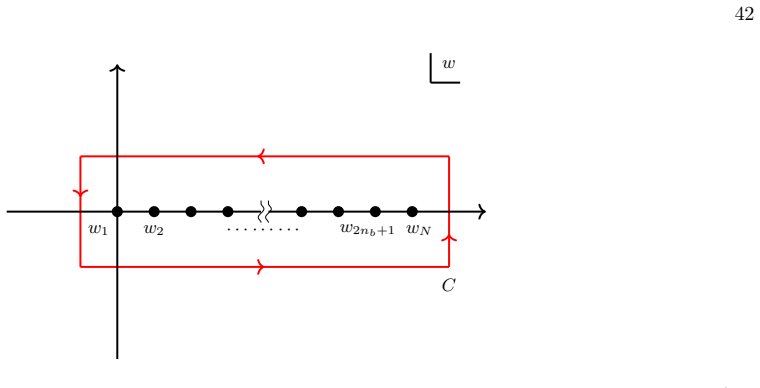
The load-bearing object is the monodromy matrix $M(w)$ of the Breitenlohner–Maison linear system, whose Riemann–Hilbert factorization $M(w) = X_-(\lambda) M(z,\rho) X_+(\lambda)$ yields the coset matrix that encodes the geometry. Three mechanisms carry the argument: the soliton ansatz $M(w) = Y + \sum_j A_j/(w-w_j)$ with rank-two residues $A_j$; the generalized inversion formulas (123)–(124) for the vectors defining $X_+$, which remain valid when the overlap matrices $\Gamma^{(a)}$ and $\Gamma^{(b)}$ do not vanish (the situation forced by bubbles); and the closed conformal-factor formula $e^{2\nu} = K_{BM} \prod_j (\lambda_j \nu_j)^{\mathrm{Tr}(B_j^2)/4} \prod_{p<q} (\lambda_p - \lambda_q)^{\mathrm{Tr}(B_p B_q)/2}$, which depends only on the residues $B_j$ of the current $\partial_\lambda X_+ X_+^{-1}$ at its simple poles and extends the isomonodromic approach of refs. [50,51]. Global $SO(4,4)$ transformations — charging, subtraction, scaling — act on the monodromy matrix by conjugation, preserving the factorization while changing the asymptotic structure from $R^{1,4} \times S^1 \times T^4$ to $AdS_3 \times S^3 \times T^4$.
What would settle it
Perform the $n_b=3$ (eight-pole) check directly from the paper's own formulas: construct $X_+(\lambda,z,\rho)$ from the stated residue matrices $C_j$, verify the factorization identity $M(w) = X_- M(z,\rho) X_+$, and form the current $\partial_\lambda X_+ X_+^{-1}$ to test whether its residues at $\lambda = -1/\lambda_j$ are independent of $(z,\rho)$ and match the assumed pattern. Then substitute those residues into the closed conformal-factor formula and compare term by term with the known multi-BTZ conformal factor for three bubbles; any mismatch would overturn the paper's central reconstruction claim.
Extended reading notes
Core claim
The paper's central claim is that the monodromy matrix of the multi-neutral black string — an $SO(4,4)$-valued meromorphic function of a spectral parameter with a constant part plus $2n_b+2$ simple poles whose residues have rank two — can be explicitly factorized as $M(w) = X_-(\lambda) M(z,\rho) X_+(\lambda)$, even though the bubbles invalidate the pairwise orthogonality assumptions of earlier treatments. The factorization produces explicit residue matrices $C_j$ for $X_+$, built from a bubble function $F_b(\lambda)$, and the conformal factor $e^{2\nu}$ is then obtained from a closed formula that uses only the analytic structure of $X_+$. Applying the $SO(4,4)$ transformations (charging, subtraction, scaling) to the factorized seed reproduces the multi-BTZ black hole and exhibits it as the subtracted geometry of the multi-black string. The paper claims this is the first successful factorization of monodromy matrices for black holes with an arbitrary number of bubbles, in both asymptotically flat and asymptotically $AdS_3$ spacetimes.
Load-bearing premise
The paper's metric formula for an arbitrary number of bubbles rests on an assumed pattern for the pole residues of a certain matrix current, a pattern verified only for one and two bubbles and never derived in general; if that pattern failed for three or more bubbles, the reconstructed multi-BTZ metric would not be recovered.
Editorial extensions
If this is right
- The multi-BTZ black hole solutions previously found through the Ernst equations are reproduced inside the Breitenlohner–Maison framework, showing that the soliton method reaches non-supersymmetric black holes with $AdS_3$ asymptotics.
- The subtraction procedure is extended to multiple black holes: the multi-BTZ black hole is the subtracted geometry of the multi-black string, in the same sense that a single BTZ black hole is subtracted from a single black string.
- Monodromy matrices with an arbitrary number of simple poles and rank-two residues can be factorized even when the bubble structure makes the overlap matrices non-zero; the new inversion formulas (123)–(124) handle that case.
- The new closed formula for the conformal factor depends only on traces of products of the current residues, so the multi-bubble conformal factor is computable without solving the full algebraic system.
- Because global $SO(4,4)$ transformations preserve the factorization, any $SO(4,4)$ image of the factorized seed yields a solvable Riemann–Hilbert problem, giving a recipe for generating new asymptotically $AdS_3 \times S^3 \times T^4$ black holes by modifying the residue matrices.
Reading between the lines
- Because the conformal factor is shared between the multi-black string and the multi-BTZ families, a failure of the assumed residue pattern would break the asymptotically flat construction as well as the $AdS_3$ one; the two claims stand or fall together.
- The natural next test is the stationary (rotating) case, where the Ernst equations no longer decouple and one must use the full coset model — precisely the machinery this paper develops.
- The paper's closing suggestion that more general rank-two residue matrices generate new solutions implies a concrete strategy: vary the residues in the final monodromy matrix and factorize, which could yield new non-BPS $AdS_3 \times S^3 \times T^4$ black holes, including non-BPS microstate geometries.
- If the residue pattern holds for all bubble numbers, the metric factor is controlled by pairwise traces of the pole residues, a structure reminiscent of isomonodromic tau functions; identifying that tau function explicitly would turn the assumed pattern into a derived one.
Editorial analysis
A structured set of objections, weighed in public.
Referee Report
Summary. The paper develops a Breitenlohner-Maison (BM) / Riemann-Hilbert construction of the recently found multi-BTZ black hole solutions in type IIB supergravity. The authors start from a multi-neutral black string seed, write down its monodromy matrix M_mString(w) with N=2n_b+2 simple poles, and factorize it as X_- M(z,rho) X_+ using an explicit ansatz for the residue matrices C_j. They then derive the conformal factor e^{2ν} from a formula (139) that relies on the residues B_j of the right-invariant current ∂_λ X_+ X_+^{-1}, with the B_j given by the ansatz (174). Applying the SO(4,4) transformations of charging, subtraction, and scaling, they obtain the multi-BTZ black hole solution and its monodromy matrix. The paper's central claim is that this is the first successful factorization of monodromy matrices for black holes with an arbitrary number of bubbles, both in asymptotically AdS_3 and asymptotically flat settings, and that the multi-BTZ solutions of [39] are recovered within the BM framework.
Significance. If the construction is fully established, the paper makes a valuable methodological contribution: it extends the inverse-scattering/Riemann-Hilbert approach to solutions with multiple horizons and bubbles, and it demonstrates that the subtraction procedure of [53,54] works for multiple black holes. The factorization proof in Appendix C is substantive and checks many nontrivial algebraic identities, including the vanishing of the constants γ_j via contour integrals; this part goes well beyond a formal statement. The paper also gives a clean account of the dimensional reduction and the coset structure. However, the derivation of the conformal factor for arbitrary n_b rests on an unproven ansatz for the residue matrices B_j, and the paper explicitly states that no derivation is provided, with verification only for n_b=1 and n_b=2. Since the final match with the known conformal factor (169) depends on that ansatz, the strongest claim—arbitrary number of bubbles—is not yet fully supported.
major comments (3)
- [Sec. IV.B.3, Eqs. (174) and (177)] The general-N conformal factor is obtained by substituting the residue matrices B_j of Eq. (174) into the formula (139), but the paper states immediately after (174) that 'we do not provide an explicit derivation of B_j' and verifies the form only for n_b=1,2. Since the exponents in (177) are fixed by Tr(B_i B_j), any error or hidden coordinate dependence in (174) would change e^{2ν} and invalidate the claimed reproduction of the known conformal factor (169) for general N. This is a load-bearing gap in the arbitrary-bubble claim. The authors should either prove (174) for all N by computing ∂_λ X_+ X_+^{-1} from the explicit C_j in (166), or explicitly present the general-N statement as a conjecture and restrict the theorem to the verified cases.
- [Sec. IV.B.3, Eq. (160) and prescription (104)] The monodromy matrix M_mString is constructed from the known multi-black string solution via the z-axis limit (104), so the Riemann-Hilbert procedure reconstructs a known solution rather than independently generating a new one. This is not by itself an error, but the Introduction and Conclusion frame the result as the 'first successful factorization of monodromy matrices describing black holes with an arbitrary number of bubbles.' The authors should clarify that the novel element is the explicit factorization of a monodromy matrix read off from a known solution, and separate this from any claim of having derived the multi-BTZ solution from flat spacetime as an independent construction.
- [Sec. V, Eqs. (194)-(200)] The paper shows that the sequence of SO(4,4) transformations acts on the scalar fields x_2,x_3,y_2,y_3 and that the conformal factor is invariant, but it does not explicitly verify that the regularity and thermal-equilibrium conditions (34)-(35) of the multi-BTZ solution are inherited from the regular multi-black string for arbitrary n_b. The rod-structure argument suggests this is true, but an explicit statement of how the constraints map under the transformations would strengthen the claim that the multi-BTZ solution is fully reproduced, not just matched at the level of the scalar fields.
minor comments (4)
- [Throughout] There are several typographical errors, including 'monodaromy' before Eq. (160), 'factrized' in Appendix C, 'eqautions' in Sec. II.A, and 'desribed' in the Introduction; these should be corrected.
- [Eqs. (168) and (C6)] The notation eFb(λ_{2j})-1 and eFb(λ_{2j+1}) is used for residues but is not defined in the text; please define it explicitly as a residue symbol or introduce a clearer notation.
- [Sec. V.A, after Eq. (82)] The sentence 'it should be noted from Eq. (82) that the conformal factor e^{2ν} is invariant under global SO(4,4) transformations' refers to Eq. (82) of Sec. III, not to any equation in Sec. V; please make the cross-reference explicit.
- [Appendix C.3] The reduction of the factorization check to the (11), (33), and (83) components is explained only briefly after Eq. (C43); since the component relations are essential to the proof, a short sentence summarizing why these three components imply the full matrix equality would improve readability.
Circularity Check
The monodromy matrix is read off from the known multi-black string via (104), so the construction returns the input solution by construction; the general-N conformal factor additionally rests on an unproven B_j ansatz.
-
self definitional
[Sec. IV.B.3, Eq. (160)]
"Although there is currently no systematic prescription for determining the residue matrices A_j from a given rod structure, candidate monodromy matrices can be constructed using (104) from the gauge invariant coset matrix associated with the neutral multi-black string"
The monodromy matrix M_mString(w) in (160) is not an independent datum of the Riemann-Hilbert problem: the paper constructs it by taking the limit (104) of the gauge-invariant matrix M_mString(z,rho) of the known neutral multi-black string (157). The subsequent factorization returns that same (157) via (107), and the conformal factor (177) is matched to the known (172). Hence the output of the construction is, by construction, the input solution expressed in monodromy language; the 'derivation' is a repackaging of the known solution rather than an independent derivation. The algebraic factorization proof in Appendix C remains independent content, but the claimed reproduction of the multi-BTZ solution inherits the target solution at the seed level.
-
other
[Sec. IV.B.3, after Eq. (174)]
"Although we do not provide an explicit derivation of B_j, we proceed using these expressions of B_j to derive the conformal factor (172)."
Formula (139) for e^{2nu} is applied to arbitrary bubble number by assuming the residue matrices B_j in (174), with the paper stating 'we do not provide an explicit derivation of B_j' and having verified the form only for n_b=1,2. The resulting expression (177) is then declared to 'precisely match' the known conformal factor (172), which was itself rewritten from the known multi-BTZ/multi-black-string solution (169). Because the target (172) is an input, the matching check cannot independently validate the general-N ansatz; for arbitrary N the conformal-factor 'derivation' is a consistency check with the known result, and the load-bearing step remains unproven.
full rationale
The paper makes no claim to be a self-citation-driven derivation: the multi-BTZ seed [39] and multi-black string [52] are external results, the SO(4,4) apparatus follows [54,58,65], and the factorization proof in Appendix C is a self-contained algebraic verification that does not use the B_j conformal-factor ansatz. The main circularity is the reconstruction loop: the monodromy matrix (160) is read off from the known solution via (104), so the subsequent 'derivation' returns the same known solution and the conformal factor is matched rather than independently predicted. This is acknowledged in the text ('candidate monodromy matrices can be constructed using (104) from the gauge invariant coset matrix...'), and it weakens the 'construction' claim but does not erase the value of the explicit factorization. The general-N conformal factor rests on an unproven B_j ansatz, which the authors explicitly flag; this is a missing-proof gap more than a fitted-parameter circularity, but it is the load-bearing step for the arbitrary-bubble claim. Because the central algebraic factorization has independent content and no external benchmark is manufactured, the overall circularity is moderate rather than total.
Assumptions & free parameters
free parameters (2)
- subtraction parameters d2,d3 =
1, 1
- scaling parameters c2,c3 =
-delta1 + 1/2 log(2m/Q1), -delta5 + 1/2 log(2m/Q5)
assumptions (6)
- domain assumption Static D1-D5-KKm ansatz (1) captures the class of solutions under study.
- domain assumption The dimensional reduction of type IIB on S^1(t)×S^1(y)×S^1(psi)×T^4 yields the 2D coset sigma model (79) with coset SO(4,4)/(SO(2,2)×SO(2,2)).
- domain assumption The monodromy matrix for the soliton solution has the simple-pole form (105) with rank-2 residue matrices.
- domain assumption The prescription (104) for reading the monodromy matrix off the known solution is valid.
- ad hoc to paper The ansatz (132) that the right-invariant current of X+ has only simple poles with coordinate-independent traces, and the explicit B_j matrices (174), hold for arbitrary N.
- domain assumption The factorization ansatz (113) with residues (114) and the solution (123)-(124) of the linear system (117) provides the correct X+ in the general case.
Cite this review
Pith. "Pith review of Building multi-BTZ black holes through Riemann-Hilbert problem." pith.science (2026). https://pith.science/paper/W4SJPPFG
@misc{pith2026250619310,
  author       = {Pith},
  title        = {Pith review of: Building multi-BTZ black holes through Riemann-Hilbert problem},
  year         = {2026},
  howpublished = {\url{https://pith.science/paper/W4SJPPFG}},
  note         = {Machine review of arXiv:2506.19310}
}
abstract
We construct a recently found class of non-BPS black hole solutions with asymptotically $AdS_3\times S^3\times T^4$ in type IIB supergravity, consisting of multiple BTZ black holes localized on an $S^3$, within the group theoretical framework of Breitenlohner and Maison (BM). Starting with the multi-neutral black string solution as a seed, we solve the associated Riemann-Hilbert problem for the BM linear system. First, we determine the monodromy matrix corresponding to this seed solution by generalizing the early work of Katsimpouri et al. on the four-charged black hole of STU supergravity, where some assumptions must be relaxed for the solutions with multiple horizons. By applying the Harrison transformation, a charge-generating transformation in the $SO(4,4)$ group, to the monodromy matrix, we obtain the multi-charged black string solution. Furthermore, through a ``subtraction'' procedure -- an $SO(4,4)$ transformation that changes the asymptotic structure from $R^{1,4}\times S^1\times T^4$ to $AdS_3\times S^3\times T^4$ spacetime -- we derive the multi-BTZ black hole solution. This is the first example in which the subtraction procedure is applied to multiple black holes, and it may also have potential applications to other cases.
Figures


Figures from the paper (7 more)



Forward citations
Cited by 1 Pith paper
-
Time-Dependent Integrability from Gauge Theory, I
Spacetime-dependent 4d Chern-Simons theory generates time-dependent integrable field theories whose allowed time dependence coincides with one-loop RG flow while preserving Lax integrability.
Reference graph
Works this paper leans on
-
[39]
Inverse Scattering Construction of a Dipole Black Ring,
J. V. Rocha, M. J. Rodriguez and A. Virmani, “Inverse Scattering Construction of a Dipole Black Ring,” JHEP11, 008 (2011) [arXiv:1108.3527 [hep-th]]. 53
arXiv 2011
-
[1]
Since the solution (46) asymptotically approachesR 1,4 ×S 1 ×T 4, we take the 10D flat spacetime as the seed solution
Asymptotic matrixYfor multi-neutral black string To this end, we must first determine the constant matrixY, which encodes the asymptotic behavior of the multi- neutral black string. Since the solution (46) asymptotically approachesR 1,4 ×S 1 ×T 4, we take the 10D flat spacetime as the seed solution. In general, the matrixM(z, ρ) could contain divergent co...
-
[2]
Neutral black string Let us first consider the Riemann-Hilbert problem for the simplest case, the black string solution (51) in the neutral limit. This calculation has already been performed in [48], but before considering the multi-black string case, we present the simplest example as a demonstration of solving the Riemann-Hilbert problem. Since the neut...
-
[3]
In general, solving the Riemann–Hilbert problem is a highly nontrivial task
Factorization of monodromy matrix Here, we explicitly perform the factorization of a specific type of monodromy matrices by following [47]. In general, solving the Riemann–Hilbert problem is a highly nontrivial task. Fortunately, whenM(w) only contains simple poles, the associated Riemann-Hilbert problem simplifies to an algebraic problem solving a system...
-
[4]
Conformal factor Finally, we present a closed expression for the conformal factore 2ν. In the special case Γ (a) = Γ(b) = 0, a simplified formula has been provided in [47] (see also [45]) and it is given by e2ν =k BM · NY j=1 (λjνj) det Γ(0) .(126) The overall constantk BM is determined from the asymptotic condition ofe 2ν. In principle, the formula (126)...
-
[5]
Harrison transformations
Multi-neutral black string Next we consider a derivation of the multi-black string solution (46) withn b bubbles whose the associated rod structure is illustrated in Fig. 8. We apply a dressing transformation to flat spacetime such that the transformed monodromy matrixM mString(w) hasN=n+ 1 = 2n b + 2 simple poles in thew-plane MmString(w) =Y flat + NX j=...
-
[6]
(i) Charging transformationg c The first transformation, generated byg c, known as charging transformation, adds D1 and D5 charges to the multi-neutral black string with (187), and then we obtain the multi-black string solution, characterized by the scalar fields (188). The group elementg c is defined such that it preserves the constant matrixY flat: g♮ c...
-
[7]
(ii) Subtractiong sub Next, we discuss the transformation generated by gsub = exp[d2F2 +d 3F3],(193) which changes the asymptotic structure of the gravitational solution. For general real deformation parametersd 2 and d3, the action ofg sub on the constant matrixY flat is given by g♮ sub Yflat gsub = (1−d 2 2)(1−d 2
Show all 86 references
-
[8]
(1−d 2 2)d3 0 0−d 2d3 (1−d 2 3)d2 0 0 −(1−d 2 2)d3 (1−d 2
-
[9]
subtracted geometry
0 0−d 2 −d2d3 0 0 0 0 0 0 0 0 0 1 0 0 0 0 0 0−1 0 −d2d3 d2 0 0 1d 3 0 0 −(1−d 2 3)d2 −d2d3 0 0−d 3 1−d 2 3 0 0 0 0 0 1 0 0 0 0 0 0−1 0 0 0 0 0 .(194) The transformed asymptotic matrix (194) indicates that setting the real parametersd 2 andd 3 to±1 significantly...
-
[10]
(iii) Scaling transformationg scale We already obtain a multi-BTZ black hole from the second transformation, but the D1 and D5 charges don’t match the multi-black string. If one wishes to preserve these charges during theSO(4,4) Harrison transformations, this can be done by co...
-
[11]
10D type IIB supergravity Here we present the action and the equations of motion for 10D type IIB supergravity in the string frame. The bosonic part of the type IIB supergravity action in the string frame is given by S10D = Z d10x p −ˆg10 e−2Φ10 ( ˆR10 + 4∂µΦ10∂µΦ10 − 1 2 | ˆH...
-
[12]
The resulting Euclidean 4D supergracity is theN= 2 Euclidean STU model
Dimensional reduction from 10D to 3D We first consider a dimensional reduction of the ten dimensional solution (1) overS 1(t)×S 1(y)×T 4. The resulting Euclidean 4D supergracity is theN= 2 Euclidean STU model. a. 10D to 6DTo see this, let us first consider a dimensional reduct...
-
[13]
Expressions of residue matrices The explicit expressions of the residue matricesA j corresponding to the multi-neutral black string are given by A1 = − l2 4 0 0 0 0 0 0 0 0 0 0 0 0 0 0 0 0 0−W b(0) 0 0 0 0− l2 8 Wb(0) 0 0 0 0 0 0 0 0 0 0 0 0 0 0 0 0 0 0 0 0 0 1...
-
[14]
V anishing ofγj Here, we will show that the constantsγ j defined in (122) vanish for allj(j= 1, . . . , N). a.γ 1 case Let us start by computing the constantγ 1 associated with the first rod. This can be obtained by substituting the factorized monodromy matrix (101) intoA 1ηη ...
-
[15]
Here, the matrixX+ is defined by taking the matricesC j given in (166)
F actorization of monodromy matrix We now explicitly show that the monodromy matrixM(w) given in (155) for the multi-neutral black string can be factorized into the expressionX −M(z, ρ)X+, which is denoted by fM(λ, z, ρ). Here, the matrixX+ is defined by taking the matricesC j...
-
[16]
EHLERS-HARRISON TYPE TRANSFORMATIONS FOR JORDAN’S EXTENDED THEORY OF GRA V- ITATION,
D. Maison, “EHLERS-HARRISON TYPE TRANSFORMATIONS FOR JORDAN’S EXTENDED THEORY OF GRA V- ITATION,” Gen. Rel. Grav.10, 717-723 (1979)
1979
-
[17]
Integration of the Einstein Equations by the Inverse Scattering Problem Technique and the Calculation of the Exact Soliton Solutions,
V. A. Belinsky and V. E. Zakharov, “Integration of the Einstein Equations by the Inverse Scattering Problem Technique and the Calculation of the Exact Soliton Solutions,” Sov. Phys. JETP48, 985-994 (1978)
1978
-
[18]
Stationary Gravitational Solitons with Axial Symmetry,
V. A. Belinsky and V. E. Sakharov, “Stationary Gravitational Solitons with Axial Symmetry,” Sov. Phys. JETP50, 1-9 (1979)
1979
-
[19]
Gravitational solitons,
V. Belinski and E. Verdaguer, “Gravitational solitons,” Cambridge University Press, 2005, ISBN 978-0-511-02876-2, 978- 0-521-80586-5, 978-0-521-01806-7, 978-0-511-53525-3
2005
-
[20]
Complete integrability of higher-dimensional Einstein equations with additional symmetry, and rotat- ing black holes,
A. A. Pomeransky, “Complete integrability of higher-dimensional Einstein equations with additional symmetry, and rotat- ing black holes,” Phys. Rev. D73, 044004 (2006) [arXiv:hep-th/0507250 [hep-th]]
2006 arXiv
-
[21]
Generalized Weyl solutions,
R. Emparan and H. S. Reall, “Generalized Weyl solutions,” Phys. Rev. D65, 084025 (2002) [arXiv:hep-th/0110258 [hep- th]]
2002 arXiv
-
[22]
Stationary and axisymmetric solutions of higher-dimensional general relativity,
T. Harmark, “Stationary and axisymmetric solutions of higher-dimensional general relativity,” Phys. Rev. D70, 124002 (2004) [arXiv:hep-th/0408141 [hep-th]]
2004 arXiv
-
[23]
New axisymmetric stationary solutions of five-dimensional vacuum Einstein equations with asymptotic flatness,
T. Mishima and H. Iguchi, “New axisymmetric stationary solutions of five-dimensional vacuum Einstein equations with asymptotic flatness,” Phys. Rev. D73, 044030 (2006) [arXiv:hep-th/0504018 [hep-th]]
2006 arXiv
-
[24]
Vacuum solutions of five dimensional Einstein equations generated by inverse scattering method,
S. Tomizawa, Y. Morisawa and Y. Yasui, “Vacuum solutions of five dimensional Einstein equations generated by inverse scattering method,” Phys. Rev. D73, 064009 (2006) [arXiv:hep-th/0512252 [hep-th]]
2006 arXiv
-
[25]
Relationship between solitonic solutions of five-dimensional Einstein equations,
S. Tomizawa, H. Iguchi and T. Mishima, “Relationship between solitonic solutions of five-dimensional Einstein equations,” Phys. Rev. D74, 104004 (2006) [arXiv:hep-th/0608169 [hep-th]]
2006 arXiv
-
[26]
Vacuum solutions of five-dimensional Einstein equations generated by inverse scattering method. II. Production of black ring solution,
S. Tomizawa and M. Nozawa, “Vacuum solutions of five-dimensional Einstein equations generated by inverse scattering method. II. Production of black ring solution,” Phys. Rev. D73, 124034 (2006) [arXiv:hep-th/0604067 [hep-th]]
2006 arXiv
-
[27]
Solitonic generation of five-dimensional black ring solution,
H. Iguchi and T. Mishima, “Solitonic generation of five-dimensional black ring solution,” Phys. Rev. D73, 121501 (2006) [arXiv:hep-th/0604050 [hep-th]]
2006 arXiv
-
[28]
Black Saturn,
H. Elvang and P. Figueras, “Black Saturn,” JHEP05, 050 (2007) [arXiv:hep-th/0701035 [hep-th]]
2007 arXiv
-
[29]
Rotating Black Holes on Kaluza-Klein Bubbles,
S. Tomizawa, H. Iguchi and T. Mishima, “Rotating Black Holes on Kaluza-Klein Bubbles,” Phys. Rev. D78, 084001 (2008) [arXiv:hep-th/0702207 [hep-th]]
2008 arXiv
-
[30]
Boosted black holes on Kaluza-Klein bubbles,
H. Iguchi, T. Mishima and S. Tomizawa, “Boosted black holes on Kaluza-Klein bubbles,” Phys. Rev. D76, 124019 (2007) [erratum: Phys. Rev. D78, 109903 (2008)] [arXiv:0705.2520 [hep-th]]
2007 arXiv
-
[31]
Black ring with two angular momenta,
A. A. Pomeransky and R. A. Sen’kov, “Black ring with two angular momenta,” [arXiv:hep-th/0612005 [hep-th]]
-
[32]
Black di-ring and infinite nonuniqueness,
H. Iguchi and T. Mishima, “Black di-ring and infinite nonuniqueness,” Phys. Rev. D75, 064018 (2007) [erratum: Phys. Rev. D78, 069903 (2008)] [arXiv:hep-th/0701043 [hep-th]]
2007 arXiv
-
[33]
The Black Di-Ring: An Inverse Scattering Construction,
J. Evslin and C. Krishnan, “The Black Di-Ring: An Inverse Scattering Construction,” Class. Quant. Grav.26, 125018 (2009) [arXiv:0706.1231 [hep-th]]
2009 arXiv
-
[34]
Bicycling Black Rings,
H. Elvang and M. J. Rodriguez, “Bicycling Black Rings,” JHEP04, 045 (2008) [arXiv:0712.2425 [hep-th]]
2008 arXiv
-
[35]
Orthogonal black di-ring solution,
K. Izumi, “Orthogonal black di-ring solution,” Prog. Theor. Phys.119, 757-774 (2008) [arXiv:0712.0902 [hep-th]]
2008 arXiv
-
[36]
Unbalanced Pomeransky-Sen’kov black ring,
Y. Chen, K. Hong and E. Teo, “Unbalanced Pomeransky-Sen’kov black ring,” Phys. Rev. D84, 084030 (2011) [arXiv:1108.1849 [hep-th]]
2011 arXiv
-
[37]
A Rotating black lens solution in five dimensions,
Y. Chen and E. Teo, “A Rotating black lens solution in five dimensions,” Phys. Rev. D78, 064062 (2008) [arXiv:0808.0587 [gr-qc]]
2008 arXiv
-
[38]
A Doubly rotating black ring with dipole charge,
Y. Chen, K. Hong and E. Teo, “A Doubly rotating black ring with dipole charge,” JHEP06, 148 (2012) [arXiv:1204.5785 [hep-th]]
2012 arXiv
-
[40]
An Electrically charged doubly spinning dipole black ring,
J. V. Rocha, M. J. Rodriguez and O. Varela, “An Electrically charged doubly spinning dipole black ring,” JHEP12, 121 (2012) [arXiv:1205.0527 [hep-th]]
2012 arXiv
-
[41]
Gravitational multisoliton solutions on flat space,
Y. Chen, “Gravitational multisoliton solutions on flat space,” Phys. Rev. D93, no.4, 044021 (2016) [arXiv:1512.00032 [gr-qc]]
2016 arXiv
-
[42]
Rotating black rings on Taub-NUT,
Y. Chen and E. Teo, “Rotating black rings on Taub-NUT,” JHEP06, 068 (2012) [arXiv:1204.3116 [hep-th]]
2012 arXiv
-
[43]
Moduli space of stationary vacuum black holes from integrability,
J. Lucietti and F. Tomlinson, “Moduli space of stationary vacuum black holes from integrability,” Adv. Theor. Math. Phys.26, no.2, 371 (2022) [arXiv:2008.12761 [gr-qc]]
2022 arXiv
-
[44]
On the nonexistence of a vacuum black lens,
J. Lucietti and F. Tomlinson, “On the nonexistence of a vacuum black lens,” JHEP21, 005 (2020) [arXiv:2012.00381 [gr-qc]]
2020 arXiv
-
[45]
Boundary Value Problem for Black Rings,
Y. Morisawa, S. Tomizawa and Y. Yasui, “Boundary Value Problem for Black Rings,” Phys. Rev. D77, 064019 (2008) [arXiv:0710.4600 [hep-th]]
2008 arXiv
-
[46]
Geometric Engineering 5d Black Holes with Rod Diagrams,
J. Evslin, “Geometric Engineering 5d Black Holes with Rod Diagrams,” JHEP09, 004 (2008) [arXiv:0806.3389 [hep-th]]
2008 arXiv
-
[47]
Charged black rings in supergravity with a single non-zero gauge field,
A. Feldman and A. A. Pomeransky, “Charged black rings in supergravity with a single non-zero gauge field,” JHEP07, 141 (2012) [arXiv:1206.1026 [hep-th]]
2012 arXiv
-
[48]
Black holes on gravitational instantons,
Y. Chen and E. Teo, “Black holes on gravitational instantons,” Nucl. Phys. B850, 253-272 (2011) [arXiv:1011.6464 [hep-th]]
2011 arXiv
-
[49]
Systematic solution-generation of five-dimensional black holes,
H. Iguchi, K. Izumi and T. Mishima, “Systematic solution-generation of five-dimensional black holes,” Prog. Theor. Phys. Suppl.189, 93-125 (2011) [arXiv:1106.0387 [gr-qc]]
2011 arXiv
-
[50]
Stationary and biaxisymmetric four-soliton solution in five dimensions,
S. Tomizawa and T. Mishima, “Stationary and biaxisymmetric four-soliton solution in five dimensions,” Phys. Rev. D99, no.10, 104053 (2019) [arXiv:1902.10544 [hep-th]]
2019 arXiv
-
[51]
Black lens in a bubble of nothing,
S. Tomizawa and R. Suzuki, “Black lens in a bubble of nothing,” Phys. Rev. D106, no.12, 124029 (2022) [arXiv:2209.11640 [hep-th]]
2022 arXiv
-
[52]
Capped black hole in five dimensions,
R. Suzuki and S. Tomizawa, “Capped black hole in five dimensions,” Phys. Rev. D109, no.12, L121503 (2024) [arXiv:2311.11653 [hep-th]]
2024 arXiv
-
[53]
Integrability of Five Dimensional Minimal Supergravity and Charged Rotating Black Holes,
P. Figueras, E. Jamsin, J. V. Rocha and A. Virmani, “Integrability of Five Dimensional Minimal Supergravity and Charged Rotating Black Holes,” Class. Quant. Grav.27, 135011 (2010) [arXiv:0912.3199 [hep-th]]
2010 arXiv
-
[54]
Non-BPS bubbling geometries in AdS 3,
I. Bah and P. Heidmann, “Non-BPS bubbling geometries in AdS 3,” JHEP02, 133 (2023) [arXiv:2210.06483 [hep-th]]
2023 arXiv
-
[55]
Localized Black Holes in AdS 3: What Happens Below c/12 Stays Below c/12,
I. Bena, R. Dulac, P. Heidmann and Z. Wei, “Localized Black Holes in AdS 3: What Happens Below c/12 Stays Below c/12,” [arXiv:2412.01885 [hep-th]]
-
[56]
New formulation of the axially symmetric gravitational field problem,
F. J. Ernst, “New formulation of the axially symmetric gravitational field problem,” Phys. Rev.167, 1175-1179 (1968)
1968
-
[57]
New Formulation of the Axially Symmetric Gravitational Field Problem. II,
F. J. Ernst, “New Formulation of the Axially Symmetric Gravitational Field Problem. II,” Phys. Rev.168, 1415-1417 (1968)
1968
-
[58]
Microstates of Non-extremal Black Holes: A New Hope,
S. Chakraborty and P. Heidmann, “Microstates of Non-extremal Black Holes: A New Hope,” [arXiv:2503.13589 [hep-th]]
-
[59]
On the Geroch Group,
P. Breitenlohner and D. Maison, “On the Geroch Group,” Ann. Inst. H. Poincare Phys. Theor.46, 215 (1987) MPI- PAE/PTh-70/86
1987
-
[60]
Inverse Scattering and the Geroch Group,
D. Katsimpouri, A. Kleinschmidt and A. Virmani, “Inverse Scattering and the Geroch Group,” JHEP02, 011 (2013) [arXiv:1211.3044 [hep-th]]
2013 arXiv
-
[61]
Geroch Group Description of Black Holes,
B. Chakrabarty and A. Virmani, “Geroch Group Description of Black Holes,” JHEP11, 068 (2014) [arXiv:1408.0875 [hep-th]]
2014 arXiv
-
[62]
An inverse scattering formalism for STU supergravity,
D. Katsimpouri, A. Kleinschmidt and A. Virmani, “An inverse scattering formalism for STU supergravity,” JHEP03, 101 (2014) [arXiv:1311.7018 [hep-th]]
2014 arXiv
-
[63]
An Inverse Scattering Construction of the JMaRT Fuzzball,
D. Katsimpouri, A. Kleinschmidt and A. Virmani, “An Inverse Scattering Construction of the JMaRT Fuzzball,” JHEP 12, 070 (2014) [arXiv:1409.6471 [hep-th]]
2014 arXiv
-
[64]
A Riemann-Hilbert approach to rotating attractors,
M. C. Camara, G. L. Cardoso, T. Mohaupt and S. Nampuri, “A Riemann-Hilbert approach to rotating attractors,” JHEP 06, 123 (2017) [arXiv:1703.10366 [hep-th]]
2017 arXiv
-
[65]
Separation of variables and Hamiltonian formulation for the Ernst equation,
D. Korotkin and H. Nicolai, “Separation of variables and Hamiltonian formulation for the Ernst equation,” Phys. Rev. Lett.74, 1272-1275 (1995) [arXiv:hep-th/9412072 [hep-th]]
1995 arXiv
-
[66]
Isomonodromic quantization of dimensionally reduced gravity,
D. Korotkin and H. Nicolai, “Isomonodromic quantization of dimensionally reduced gravity,” Nucl. Phys. B475, 397-439 (1996) [arXiv:hep-th/9605144 [hep-th]]
1996 arXiv
-
[67]
Smooth bubbling geometries without supersymmetry,
I. Bah and P. Heidmann, “Smooth bubbling geometries without supersymmetry,” JHEP09, 128 (2021) [arXiv:2106.05118 [hep-th]]
2021 arXiv
-
[68]
Conformal Symmetry for General Black Holes,
M. Cvetic and F. Larsen, “Conformal Symmetry for General Black Holes,” JHEP02, 122 (2012) [arXiv:1106.3341 [hep-th]]
2012 arXiv
-
[69]
General black holes, untwisted,
M. Cvetiˇ c, M. Guica and Z. H. Saleem, “General black holes, untwisted,” JHEP09, 017 (2013) [arXiv:1302.7032 [hep-th]]
2013 arXiv
-
[70]
Near horizon geometry of rotating black holes in five-dimensions,
M. Cvetic and F. Larsen, “Near horizon geometry of rotating black holes in five-dimensions,” Nucl. Phys. B531, 239-255 (1998) [arXiv:hep-th/9805097 [hep-th]]
1998 arXiv
-
[71]
General rotating five-dimensional black holes of toroidally compactified heterotic string,
M. Cvetic and D. Youm, “General rotating five-dimensional black holes of toroidally compactified heterotic string,” Nucl. Phys. B476, 118-132 (1996) [arXiv:hep-th/9603100 [hep-th]]
1996 arXiv
-
[72]
Subtracted Geometry From Harrison Transformations,
A. Virmani, “Subtracted Geometry From Harrison Transformations,” JHEP07, 086 (2012) [arXiv:1203.5088 [hep-th]]
2012 arXiv
-
[73]
Subtracted Geometry from Harrison Transformations: II,
A. Sahay and A. Virmani, “Subtracted Geometry from Harrison Transformations: II,” JHEP07, 089 (2013) [arXiv:1305.2800 [hep-th]]
2013 arXiv
-
[74]
Geroch Group Description of Bubbling Geometries,
P. Roy and A. Virmani, “Geroch Group Description of Bubbling Geometries,” JHEP08, 129 (2018) [arXiv:1806.01590 [hep-th]]
2018 arXiv
-
[75]
Extremal black holes, nilpotent orbits and the true fake superpotential,
G. Bossard, Y. Michel and B. Pioline, “Extremal black holes, nilpotent orbits and the true fake superpotential,” JHEP 01, 038 (2010) [arXiv:0908.1742 [hep-th]]. 54
2010 arXiv
-
[76]
A Method for generating solutions of Einstein’s equations,
R. P. Geroch, “A Method for generating solutions of Einstein’s equations,” J. Math. Phys.12, 918-924 (1971)
1971
-
[77]
A Method for generating new solutions of Einstein’s equation. 2,
R. P. Geroch, “A Method for generating new solutions of Einstein’s equation. 2,” J. Math. Phys.13, 394-404 (1972)
1972
-
[78]
Two-dimensional gravities and supergravities as integrable system,
H. Nicolai, “Two-dimensional gravities and supergravities as integrable system,” Lect. Notes Phys.396, 231-273 (1991)
1991
-
[79]
Stationary axisymmetric solutions of five dimensional gravity,
S. Giusto and A. Saxena, “Stationary axisymmetric solutions of five dimensional gravity,” Class. Quant. Grav.24, 4269- 4294 (2007) [arXiv:0705.4484 [hep-th]]
2007 arXiv
-
[80]
Conformal Symmetry for Black Holes in Four Dimensions,
M. Cvetic and F. Larsen, “Conformal Symmetry for Black Holes in Four Dimensions,” JHEP09, 076 (2012) [arXiv:1112.4846 [hep-th]]
2012 arXiv
-
[81]
Four-dimensional string-string-string triality,
M. J. Duff, J. T. Liu and J. Rahmfeld, “Four-dimensional string-string-string triality,” Nucl. Phys. B459, 125-159 (1996) [arXiv:hep-th/9508094 [hep-th]]
1996 arXiv
-
[82]
Duality transformations in supersymmetric Yang-Mills theories coupled to supergravity,
A. Ceresole, R. D’Auria, S. Ferrara and A. Van Proeyen, “Duality transformations in supersymmetric Yang-Mills theories coupled to supergravity,” Nucl. Phys. B444, 92-124 (1995) [arXiv:hep-th/9502072 [hep-th]]
1995 arXiv
-
[83]
Special geometry of Euclidean supersymmetry. 1. Vector multiplets,
V. Cortes, C. Mayer, T. Mohaupt and F. Saueressig, “Special geometry of Euclidean supersymmetry. 1. Vector multiplets,” JHEP03, 028 (2004) [arXiv:hep-th/0312001 [hep-th]]
2004 arXiv
-
[84]
Special geometry of euclidean supersymmetry. II. Hypermultiplets and the c-map,
V. Cortes, C. Mayer, T. Mohaupt and F. Saueressig, “Special geometry of euclidean supersymmetry. II. Hypermultiplets and the c-map,” JHEP06, 025 (2005) [arXiv:hep-th/0503094 [hep-th]]
2005 arXiv
-
[85]
Special Geometry of Euclidean Supersymmetry III: The Local r-map, instantons and black holes,
V. Cortes and T. Mohaupt, “Special Geometry of Euclidean Supersymmetry III: The Local r-map, instantons and black holes,” JHEP07, 066 (2009) [arXiv:0905.2844 [hep-th]]
2009 arXiv
-
[86]
Euclidean N=2 Supergravity,
J. B. Gutowski and W. A. Sabra, “Euclidean N=2 Supergravity,” Phys. Lett. B718, 610-614 (2012) [arXiv:1209.2029 [hep-th]]
2012 arXiv
Reviewed August 6, 2026 · model on record in the stance chip above.
Discussion (0). Sign in to comment.