REVIEW 4 major objections 5 minor 41 references
Deep Electromagnetic Structure Design Under Limited Evaluation Budgets
T0 review · 4 major / 5 minor · reviewed 2026-08-06 · deepseek-v4-flash
Pith's one-line read A progressive quadtree search with consistency-based selection designs electromagnetic structures in 1,000 simulations, beating generative baselines that use 4,000-7,000.
desk verdict Useful hierarchical quadtree search idea with a suggestive but under-validated empirical claim; worth reviewing, needs real-simulation repeats and a fair initialization control. read the letter →
The pith
A machine-rendered reading of the paper's core claim, the machinery that carries it, and where it could break.
The reading
What carries the argument
The quadtree representation is the dimensionality-reduction device: it recursively partitions the $m\times n$ binary layout into rectangular leaf blocks, each labeled 0 or 1, so the design space has size $2^{|L|}$ instead of $2^{mn}$, and the layout is reconstructed via Eqn. 5. The progressive tree search grows the tree by randomly resampling a leaf's state or splitting it into four children (Bernoulli with probability 1/2), maintains a Top-K list by surrogate score, and then applies depth-wise importance assignment to refine the most influential subregions of the Top-K designs. The Consistency-based Sample Selection uses Kendall's tau between successive predictor rankings (Eqn. 9) as a reliability signal, with the exploitation/exploration split $R_p=\tau R$, $R_r=(1-\tau)R$ (Eqn. 10). Together these mechanisms let an imperfect predictor guide optimization when its rankings are stable and force extra random evaluations when they are not.
What would settle it
Run PQS on a binary layout task whose known global optimum is a fine-grained pattern that cannot be assembled from 32 rectangles, and compare its best aggregate objective under 1,000 simulations with a pixel-level search using the same budget; if the pixel-level search consistently wins, the quadtree block budget is the limiting factor.
Extended reading notes
Core claim
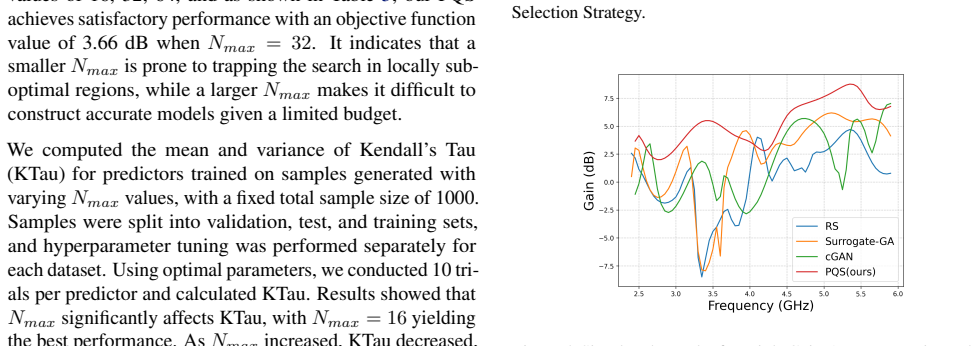
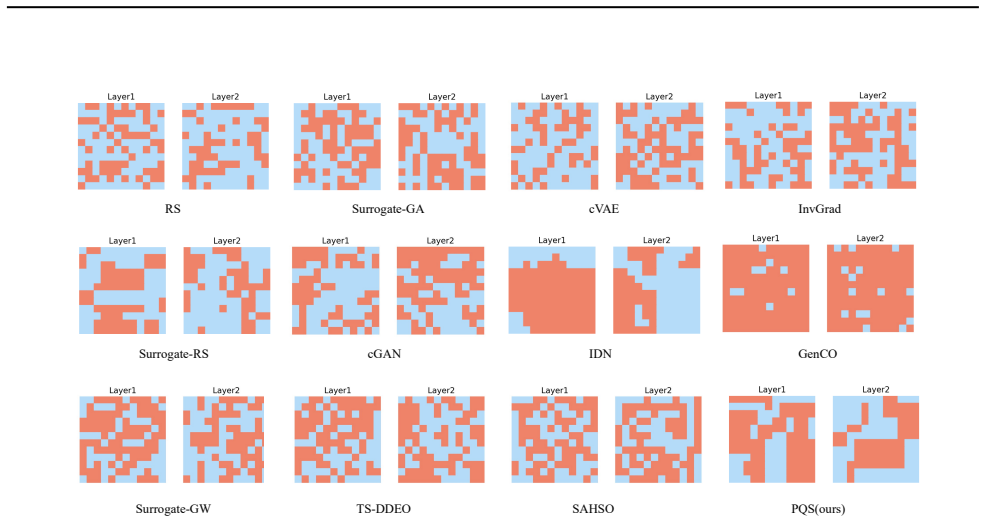
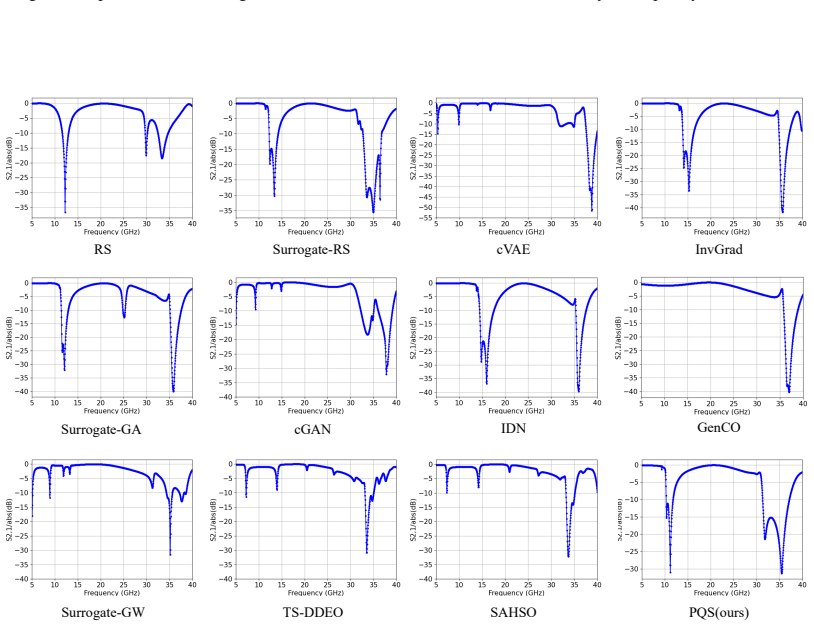
The central claim, stated on the paper's own terms, is that PQS makes EMS optimization dramatically more sample-efficient by changing the representation and the selection rule rather than by building a larger or better predictor. The quadtree representation stores each homogeneous rectangular region as a single bit and reconstructs the $m\times n$ layout from its leaf nodes (Eqn. 5), cutting the search space from $2^{mn}$ to $2^{|L|}$; progressive tree search expands from $|L|=1$ up to $N_{\max}=32$ leaves, resampling leaf states or splitting nodes, and then refines the Top-K candidates by depth-wise importance assignment. The Consistency-based Sample Selection computes Kendall's tau $\tau$ between the predictor rankings from iterations $t-1$ and $t$ (Eqn. 9) and allocates a fraction $\tau$ of the next batch to the surrogate's top-ranked candidates and $1-\tau$ to random ones (Eqn. 10). With a budget of 1,000 full-wave simulations on two real tasks, the method reports aggregate objectives of 15.20 dB (DualFSS) and 3.66 dB (HGA), and on the high-gain antenna robustness benchmark it reports the highest mean (4.34 dB) and lowest variance across 10 runs among all compared methods.
Load-bearing premise
The load-bearing premise is that near-optimal EMS layouts can be expressed with at most 32 homogeneous rectangular blocks; if the true optimum needs finer pixel-level detail, PQS cannot reach it no matter how well the search or sample selection works.
Editorial extensions
If this is right
- With 1,000 full-wave simulations, PQS reaches 15.20 dB on DualFSS and 3.66 dB on HGA, higher than every baseline tested, including generative methods that used 7,000 and 4,000 simulations.
- The reported budget cut of 75-85 percent relative to generative approaches corresponds to an estimated 20.27-38.80 days of saved simulation time per product design cycle.
- Surrogate-assisted methods that rely directly on predictor scores can underperform random sampling under a 1,000-sample budget, so the consistency-gated selection rule is a necessary part of the method, not a minor add-on.
- The ablation fixing $N_{\max}=32$ leaves indicates that moderate block granularity outperforms both 16 and 64 leaves on HGA, implying there is a representational sweet spot for the quadtree.
- Across 10 runs on the high-gain antenna task, PQS has the highest mean aggregate objective (4.34 dB) and the lowest variance among all compared methods, which supports the claim that the method is robust to initialization and data variability.
Reading between the lines
- The same quadtree-plus-consistency loop should transfer to other binary layout optimization problems, such as metasurface patterning, photonic-crystal design, or chip-level shielding, where manufacturability favors large homogeneous regions; the search would need no task-specific change beyond the geometry of the layout.
- The Kendall-tau gating rule encodes a general principle for surrogate-based optimization: trust the surrogate's recommendations in proportion to how stable its rankings have been, a rule that could be dropped into Bayesian optimization or evolutionary search with any learned model.
- A direct stress test would be to run PQS on a task whose known optimum has fine pixel-level texture; if performance degrades as the optimum becomes less block-representable, the $N_{\max}=32$ cap is a structural limitation rather than a benign default.
- The reported time savings assume simulation cost dominates; in settings where predictor training is the bottleneck, the benefit of the quadtree search would shrink, so the method's advantage is largest in exactly the expensive-simulation regime the paper targets.
Editorial analysis
A structured set of objections, weighed in public.
Referee Report
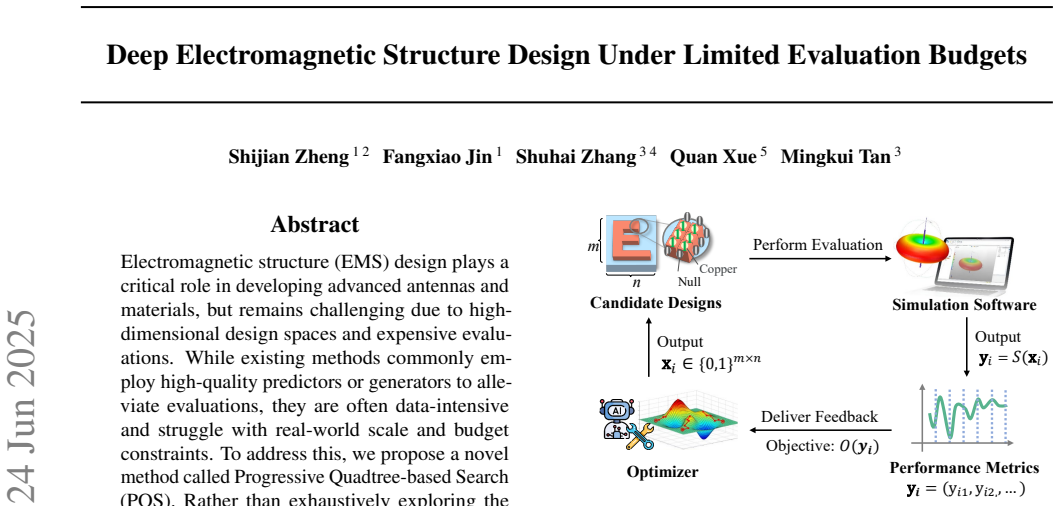
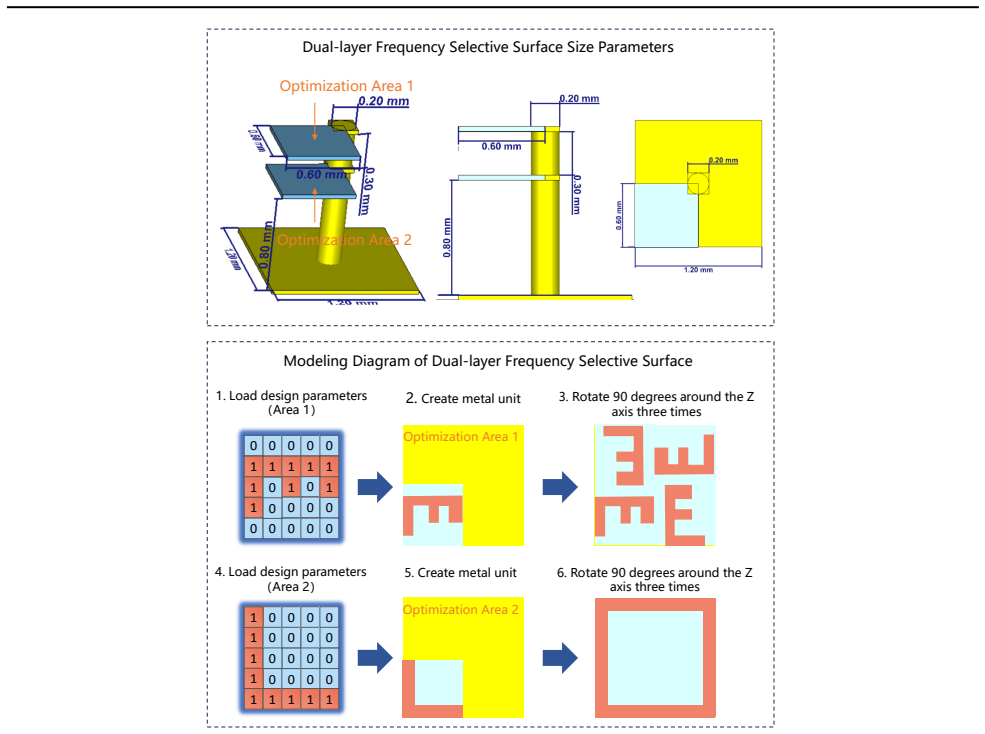
Summary. The paper proposes Progressive Quadtree-based Search (PQS), a method for electromagnetic structure (EMS) design under limited full-wave simulation budgets. PQS represents binary layouts as quadtrees that are progressively refined, and uses a consistency-based sample selection mechanism that measures the Kendall-tau agreement between consecutive surrogate predictions to balance exploitation and exploration. The method is evaluated on two real-world tasks, Dual-layer Frequency Selective Surface (DualFSS) and High-gain Antenna (HGA), where PQS uses 1000 simulations and is compared against predictor-based, generative, and random-sampling baselines, some of which use up to 7000 simulations. The paper reports that PQS achieves the best aggregate objective on both tasks and includes an ablation study of the quadtree depth and of the two proposed components.
Significance. If the reported empirical results are reliable, PQS offers a practically meaningful reduction in the number of expensive full-wave simulations required for EMS design, in some cases outperforming strong baselines with 75-85% fewer evaluations. The quadtree representation and the consistency-driven selection mechanism are novel and potentially transferable to other discrete design problems with costly evaluations. The paper also provides ablations investigating the effect of Nmax and the individual contributions of QSS and CSS. However, the statistical evidence supporting the headline comparative claim is currently incomplete: the central comparison rests on single real-simulation runs, and the multi-run robustness study uses a surrogate with only moderate rank correlation.
major comments (4)
- [5.1 / Table 3] The headline comparison that PQS 'markedly surpasses all baselines' is supported only by single runs for each method on the real simulators. No number of seeds, repeated runs, or error bars are reported for Table 3. Because the objective is a minimum over several performance criteria and the search itself involves randomness (random leaf selection, Bernoulli splits), the observed margins, such as 15.20 dB vs. 7.28 dB on DualFSS, could partly reflect run-to-run variation. This is load-bearing for the central claim; please provide repeated real-simulation runs (or a clearly justified statement that the simulators and pipelines are deterministic) and report means and variances.
- [5.2 / Table 4] The robustness study replaces the real simulator with a surrogate trained on 37,354 HGA samples with a Kendall-tau of 0.7969, and the paper asserts this 'is generally sufficient to capture relative performance trends.' A rank correlation of 0.80 does not guarantee that the method-level ordering under the surrogate matches the real simulator, especially for predictor-based methods that may exploit surrogate artifacts. Moreover, the absolute PQS value in Table 4 (4.34±0.34 dB) differs from the real-simulation value in Table 3 (3.66 dB), so Table 4 does not directly corroborate the main result. Please validate method-level ordering on a hold-out portion of the real simulator, or better, repeat a small number of real-simulation runs.
- [Appendix C, Time-saving Calculation] The simulation-count reduction used in the time-saving calculation is swapped between the two tasks. For DualFSS, generative methods use 7000 simulations and PQS uses 1000, so the reduction is 6000, not 3000; for HGA, the reduction is 3000, not 6000. As a result, the computed time savings of 20.27 days and 38.80 days are attributed to the wrong tasks, and the abstract's claim that PQS 'saves 20.27-38.80 days' rests on this arithmetic error. Please correct the calculation and the attribution, and rerun the associated cost-reduction percentages.
- [4.1 / Eq. (6) / Table 5] The quadtree representation caps all designs at Nmax=32 homogeneous rectangular leaf nodes, which implicitly assumes that near-optimal EMS layouts can be well approximated by at most 32 rectangular blocks. The paper provides an ablation on HGA (Nmax ∈ {16,32,64}) but no analogous evidence on DualFSS or a second task, and the generality of this 'blockiness' assumption across EMS problems is untested. Please state this limitation explicitly and, if possible, provide additional evidence that Nmax=32 is a reasonable default for other EMS design tasks.
minor comments (5)
- [5.2] The text refers to 'Table 5.1', which should be 'Table 4'.
- [Eq. (9)] The symbol n is used both for the number of candidate samples in the Kendall-tau computation and for a quadtree node; please disambiguate the notation.
- [Table 2] The column header 'xDesign Space Dimension' is garbled; it should read 'Design Space Dimension' or similar.
- [5.3 / Table 6] The ablation results in Table 6 appear to be single runs as well; please clarify whether these are single runs or averages, and if single, add error bars or repeated runs.
- [Abstract / Section 5.3] The claim that PQS 'cuts evaluation costs by 75-85%' should be recomputed after fixing the swapped simulation-count reduction in the supplementary calculation.
Circularity Check
No significant circularity: the reported results are evaluated against an external full-wave simulator, and PQS's representation and sample-selection heuristics are not defined in terms of the reported objective.
full rationale
The derivation chain is self-contained with respect to the paper's claims. The objective in Eqn. (1) is defined directly from the external simulator output S(x), and the headline numbers in Table 3 are full-wave simulation results, not predictions reconstructed from fitted quantities. The quadtree representation (Eqns. 3-6) and the consistency-based selection rule (Eqns. 9-10) are search heuristics whose success is measured against that external simulator; neither the representation nor the consistency metric is defined in terms of the final objective value, so no equation-level reduction to inputs occurs. Selecting Nmax=32 via ablation on one task (Table 5) is standard model selection rather than fitting a prediction to the benchmark. The Section 5.2 robustness study uses a surrogate with KTau=0.7969 as a stand-in for the simulator; this creates an evidentiary limitation (single real-simulation runs in Table 3, no error bars, and absolute PQS values differing between Table 3 and Table 4), but the surrogate is an approximation to an external evaluation function, not a fitted parameter that is being relabeled as a prediction. There is no load-bearing self-citation chain, no imported uniqueness theorem, and no ansatz smuggled in through a citation. The appendix time-saving calculation appears to swap the 3,000 and 6,000 simulation-count differences between the two tasks, but that is a numerical consistency issue, not circularity. Overall, no circular step is present.
Assumptions & free parameters
free parameters (5)
- Nmax =
32
- M =
10,000,000
- K =
10
- R =
10
- Initial simulation budget =
300
assumptions (4)
- domain assumption The true optimal EMS layouts can be well approximated by quadtrees with at most 32 leaf nodes (i.e., blocky designs).
- domain assumption Kendall's tau between the current and previous predictor rankings is a reliable indicator of whether the surrogate should be trusted for candidate selection.
- domain assumption A predictor trained on 300 initial samples can produce rankings informative enough to guide the quadtree search.
- domain assumption The full-wave simulator S is an accurate ground truth for performance.
Cite this review
Pith. "Pith review of Deep Electromagnetic Structure Design Under Limited Evaluation Budgets." pith.science (2026). https://pith.science/paper/N4UF5AK3
@misc{pith2026250619384,
  author       = {Pith},
  title        = {Pith review of: Deep Electromagnetic Structure Design Under Limited Evaluation Budgets},
  year         = {2026},
  howpublished = {\url{https://pith.science/paper/N4UF5AK3}},
  note         = {Machine review of arXiv:2506.19384}
}
read the original abstract
Electromagnetic structure (EMS) design plays a critical role in developing advanced antennas and materials, but remains challenging due to high-dimensional design spaces and expensive evaluations. While existing methods commonly employ high-quality predictors or generators to alleviate evaluations, they are often data-intensive and struggle with real-world scale and budget constraints. To address this, we propose a novel method called Progressive Quadtree-based Search (PQS). Rather than exhaustively exploring the high-dimensional space, PQS converts the conventional image-like layout into a quadtree-based hierarchical representation, enabling a progressive search from global patterns to local details. Furthermore, to lessen reliance on highly accurate predictors, we introduce a consistency-driven sample selection mechanism. This mechanism quantifies the reliability of predictions, balancing exploitation and exploration when selecting candidate designs. We evaluate PQS on two real-world engineering tasks, i.e., Dual-layer Frequency Selective Surface and High-gain Antenna. Experimental results show that our method can achieve satisfactory designs under limited computational budgets, outperforming baseline methods. In particular, compared to generative approaches, it cuts evaluation costs by 75-85%, effectively saving 20.27-38.80 days of product designing cycle.
Figures


Figures from the paper (10 more)




Reference graph
Works this paper leans on
-
[1]
write newline
" write newline "" before.all 'output.state := FUNCTION n.dashify 't := "" t empty not t #1 #1 substring "-" = t #1 #2 substring "--" = not "--" * t #2 global.max substring 't := t #1 #1 substring "-" = "-" * t #2 global.max substring 't := while if t #1 #1 substring * t #2 global.max substring 't := if while FUNCTION format.date year duplicate empty "emp...
-
[2]
Y., Zhou, L., Li, H., Kang, M., Richardson, K
An, S., Zheng, B., Tang, H., Shalaginov, M. Y., Zhou, L., Li, H., Kang, M., Richardson, K. A., Gu, T., Hu, J., et al. Multifunctional metasurface design with a generative adversarial network. Advanced Optical Materials, 9 0 (5): 0 2001433, 2021
work page 2021
-
[3]
Computational electromagnetics
Bondeson, A., Rylander, T., and Ingelstr \"o m, P. Computational electromagnetics. Springer, 2012
work page 2012
-
[4]
Conditioning by adaptive sampling for robust design
Brookes, D., Park, H., and Listgarten, J. Conditioning by adaptive sampling for robust design. In International conference on machine learning, pp.\ 773--782. PMLR, 2019
work page 2019
-
[5]
Correlating metasurface spectra with a generation-elimination framework
Chen, J., Qian, C., Zhang, J., Jia, Y., and Chen, H. Correlating metasurface spectra with a generation-elimination framework. Nature Communications, 14 0 (1): 0 4872, 2023
work page 2023
-
[6]
Chen, S., Montgomery, J., and Boluf \'e -R \"o hler, A. Measuring the curse of dimensionality and its effects on particle swarm optimization and differential evolution. Applied Intelligence, 42: 0 514--526, 2015
work page 2015
-
[7]
The policy-gradient placement and generative routing neural networks for chip design
Cheng, R., Lyu, X., Li, Y., Ye, J., Hao, J., and Yan, J. The policy-gradient placement and generative routing neural networks for chip design. Advances in Neural Information Processing Systems, 35: 0 26350--26362, 2022
work page 2022
-
[8]
Daulton, S., Wan, X., Eriksson, D., Balandat, M., Osborne, M. A., and Bakshy, E. Bayesian optimization over discrete and mixed spaces via probabilistic reparameterization. Advances in Neural Information Processing Systems, 35: 0 12760--12774, 2022
work page 2022
Show all 41 references
-
[9]
Benchmarking data-driven surrogate simulators for artificial electromagnetic materials
Deng, Y., Dong, J., Ren, S., Khatib, O., Soltani, M., Tarokh, V., Padilla, W., and Malof, J. Benchmarking data-driven surrogate simulators for artificial electromagnetic materials. In Thirty-fifth Conference on Neural Information Processing Systems Datasets and Benchmarks Trac...
2021
-
[10]
and Dong, Z
Dong, H. and Dong, Z. Surrogate-assisted grey wolf optimization for high-dimensional, computationally expensive black-box problems. Swarm and Evolutionary Computation, 57: 0 100713, 2020
2020
-
[11]
and Yang, Y
Dong, X. and Yang, Y. Nas-bench-201: Extending the scope of reproducible neural architecture search. arXiv preprint arXiv:2001.00326, 2020
2001 arXiv
-
[12]
M., Zharmagambetov, A., Huang, T., Dilkina, B., and Tian, Y
Ferber, A. M., Zharmagambetov, A., Huang, T., Dilkina, B., and Tian, Y. Gen CO : Generating diverse solutions to design problems with combinatorial nature, 2024. URL https://openreview.net/forum?id=V7uPprVelO
2024
-
[13]
Gao, Z., Tan, C., and Li, S. Z. Pifold: Toward effective and efficient protein inverse folding. In The Eleventh International Conference on Learning Representations, ICLR 2023, Kigali, Rwanda, May 1-5, 2023 . OpenReview.net, 2023
2023
-
[14]
P., Chambers, J., Mendez, D., Mutowo, P., Atkinson, F., Bellis, L
Gaulton, A., Hersey, A., Nowotka, M., Bento, A. P., Chambers, J., Mendez, D., Mutowo, P., Atkinson, F., Bellis, L. J., Cibri \'a n-Uhalte, E., et al. The chembl database in 2017. Nucleic acids research, 45 0 (D1): 0 D945--D954, 2017
2017
-
[15]
Progan: Protein solubility generative adversarial nets for data augmentation in dnn framework
Han, X., Zhang, L., Zhou, K., and Wang, X. Progan: Protein solubility generative adversarial nets for data augmentation in dnn framework. Computers & Chemical Engineering, 131: 0 106533, 2019
2019
-
[16]
A knowledge-inherited learning for intelligent metasurface design and assembly
Jia, Y., Qian, C., Fan, Z., Cai, T., Li, E.-P., and Chen, H. A knowledge-inherited learning for intelligent metasurface design and assembly. Light: Science & Applications, 12 0 (1): 0 82, 2023
2023
-
[17]
Neural network-based surrogate model for inverse design of metasurfaces
Jing, G., Wang, P., Wu, H., Ren, J., Xie, Z., Liu, J., Ye, H., Li, Y., Fan, D., and Chen, S. Neural network-based surrogate model for inverse design of metasurfaces. Photonics Research, 10 0 (6): 0 1462--1471, 2022
2022
-
[18]
Highly accurate protein structure prediction with alphafold
Jumper, J., Evans, R., Pritzel, A., Green, T., Figurnov, M., Ronneberger, O., Tunyasuvunakool, K., Bates, R., Z \' dek, A., Potapenko, A., et al. Highly accurate protein structure prediction with alphafold. Nature, 596 0 (7873): 0 583--589, 2021
2021
-
[19]
Kendall, M. G. A new measure of rank correlation. Biometrika, 30 0 (1-2): 0 81--93, 1938
1938
-
[20]
and Ogurtsov, S
Koziel, S. and Ogurtsov, S. Antenna design by simulation-driven optimization. Springer, 2014
2014
-
[21]
Koziel, S., C al k, N., Mahouti, P., and Belen, M. A. Low-cost and highly accurate behavioral modeling of antenna structures by means of knowledge-based domain-constrained deep learning surrogates. IEEE Transactions on Antennas and Propagation, 71 0 (1): 0 105--118, 2022
2022
-
[22]
A surrogate-assisted hybrid swarm optimization algorithm for high-dimensional computationally expensive problems
Li, F., Li, Y., Cai, X., and Gao, L. A surrogate-assisted hybrid swarm optimization algorithm for high-dimensional computationally expensive problems. Swarm and Evolutionary Computation, 72: 0 101096, 2022
2022
-
[23]
Machine-learning-assisted inverse design of scattering enhanced metasurface
Lin, H., Hou, J., Wang, Y., Tang, R., Shi, X., Tian, Y., Xu, W., et al. Machine-learning-assisted inverse design of scattering enhanced metasurface. Optics Express, 30 0 (2): 0 3076--3088, 2022
2022
-
[24]
Progressive neural architecture search
Liu, C., Zoph, B., Neumann, M., Shlens, J., Hua, W., Li, L.-J., Fei-Fei, L., Yuille, A., Huang, J., and Murphy, K. Progressive neural architecture search. In Proceedings of the European conference on computer vision (ECCV), pp.\ 19--34, 2018 a
2018
-
[25]
Darts: Differentiable architecture search
Liu, H., Simonyan, K., and Yang, Y. Darts: Differentiable architecture search. arXiv preprint arXiv:1806.09055, 2018 b
2018 arXiv
-
[26]
Inverse design of broadband metasurface absorber based on convolutional autoencoder network and inverse design network
Ma, J., Huang, Y., Pu, M., Xu, D., Luo, J., Guo, Y., and Luo, X. Inverse design of broadband metasurface absorber based on convolutional autoencoder network and inverse design network. Journal of Physics D: Applied Physics, 53 0 (46): 0 464002, 2020
2020
-
[27]
C., Bosc, T., Bengio, Y., and Malkin, N
Madan, K., Rector-Brooks, J., Korablyov, M., Bengio, E., Jain, M., Nica, A. C., Bosc, T., Bengio, Y., and Malkin, N. Learning gflownets from partial episodes for improved convergence and stability. In International Conference on Machine Learning, pp.\ 23467--23483. PMLR, 2023
2023
-
[28]
Magar, R., Wang, Y., Lorsung, C., Liang, C., Ramasubramanian, H., Li, P., and Farimani, A. B. Auglichem: data augmentation library of chemical structures for machine learning. Machine Learning: Science and Technology, 3 0 (4): 0 045015, 2022
2022
-
[29]
L., and Wiecha, P
Majorel, C., Girard, C., Arbouet, A., Muskens, O. L., and Wiecha, P. R. Deep learning enabled strategies for modeling of complex aperiodic plasmonic metasurfaces of arbitrary size. ACS photonics, 9 0 (2): 0 575--585, 2022
2022
-
[30]
J., and Hum, S
Naseri, P., Goussetis, G., Fonseca, N. J., and Hum, S. V. Synthesis of multi-band reflective polarizing metasurfaces using a generative adversarial network. Scientific Reports, 12 0 (1): 0 17006, 2022
2022
-
[31]
G., Joannopoulos, J
Peurifoy, J., Shen, Y., Jing, L., Yang, Y., Cano-Renteria, F., DeLacy, B. G., Joannopoulos, J. D., Tegmark, M., and Solja c i \'c , M. Nanophotonic particle simulation and inverse design using artificial neural networks. Science advances, 4 0 (6): 0 eaar4206, 2018
2018
-
[32]
A comprehensive survey of neural architecture search: Challenges and solutions
Ren, P., Xiao, Y., Chang, X., Huang, P.-Y., Li, Z., Chen, X., and Wang, X. A comprehensive survey of neural architecture search: Challenges and solutions. ACM Computing Surveys (CSUR), 54 0 (4): 0 1--34, 2021
2021
-
[33]
H., Manjiri, S
Shahane, A. H., Manjiri, S. V. S., Jain, A., and Kumar, S. Graph of circuits with gnn for exploring the optimal design space. In Thirty-seventh Conference on Neural Information Processing Systems, 2023
2023
-
[34]
Nas-bench-301 and the case for surrogate benchmarks for neural architecture search
Siems, J., Zimmer, L., Zela, A., Lukasik, J., Keuper, M., and Hutter, F. Nas-bench-301 and the case for surrogate benchmarks for neural architecture search. arXiv preprint arXiv:2008.09777, 4: 0 14, 2020
2008 arXiv
-
[35]
Design-bench: Benchmarks for data-driven offline model-based optimization
Trabucco, B., Geng, X., Kumar, A., and Levine, S. Design-bench: Benchmarks for data-driven offline model-based optimization. In International Conference on Machine Learning, pp.\ 21658--21676. PMLR, 2022
2022
-
[36]
End-to-end diverse metasurface design and evaluation using an invertible neural network
Wang, Y., Yang, Z., Hu, P., Hossain, S., Liu, Z., Ou, T.-H., Ye, J., and Wu, W. End-to-end diverse metasurface design and evaluation using an invertible neural network. Nanomaterials, 13 0 (18): 0 2561, 2023
2023
-
[37]
Nas-bench-101: Towards reproducible neural architecture search
Ying, C., Klein, A., Christiansen, E., Real, E., Murphy, K., and Hutter, F. Nas-bench-101: Towards reproducible neural architecture search. In International conference on machine learning, pp.\ 7105--7114. PMLR, 2019
2019
-
[38]
Zheng, L., Karapiperis, K., Kumar, S., and Kochmann, D. M. Unifying the design space and optimizing linear and nonlinear truss metamaterials by generative modeling. Nature Communications, 14 0 (1): 0 7563, 2023 a
2023
-
[39]
A two-stage surrogate-assisted meta-heuristic algorithm for high-dimensional expensive problems
Zheng, L., Shi, J., and Yang, Y. A two-stage surrogate-assisted meta-heuristic algorithm for high-dimensional expensive problems. Soft Computing, 27 0 (10): 0 6465--6486, 2023 b
2023
-
[40]
Adversarial-network regularized inverse design of frequency-selective surface with frequency-temporal deep learning
Zhu, E., Li, E., Wei, Z., and Yin, W.-Y. Adversarial-network regularized inverse design of frequency-selective surface with frequency-temporal deep learning. IEEE Transactions on Antennas and Propagation, 70 0 (10): 0 9460--9469, 2022
2022
-
[41]
Multiplexing the aperture of a metasurface: inverse design via deep-learning-forward genetic algorithm
Zhu, R., Qiu, T., Wang, J., Sui, S., Li, Y., Feng, M., Ma, H., and Qu, S. Multiplexing the aperture of a metasurface: inverse design via deep-learning-forward genetic algorithm. Journal of Physics D: Applied Physics, 53 0 (45): 0 455002, 2020
2020
Reviewed August 6, 2026 · model on record in the stance chip above.
Discussion (0). Continue with ORCID to comment.