REVIEW 5 major objections 7 minor 1 cited by
A Global-Local Cross-Attention Network for Ultra-high Resolution Remote Sensing Image Semantic Segmentation
T0 review · 5 major / 7 minor · reviewed 2026-08-06 · deepseek-v4-flash
Pith's one-line read A dual-branch cross-attention network posts top mIoU on DeepGlobe, Vaihingen, and Potsdam while keeping GPU memory low.
desk verdict The reported results cannot be attributed to GLCANet: the method section describes the earlier GLNet, the masked cross-attention equations have no mask, and no code is available to resolve the mismatch. read the letter →
The pith
A machine-rendered reading of the paper's core claim, the machinery that carries it, and where it could break.
The reading
What carries the argument
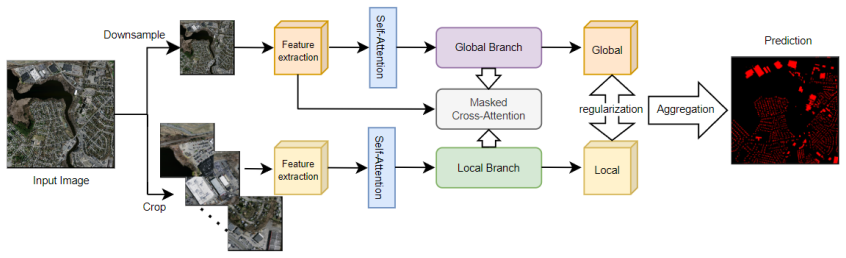
The load-bearing component is GLCA-FM (Global-Local Cross-Attention Fusion Module). It combines a self-attention mechanism, which enriches each branch's features by relating distant positions, with a masked cross-attention mechanism, in which a masking matrix constrains which region pairs can attend to each other while scaled dot-product attention uses one branch as query and the other as key and value, then symmetrically reverses the roles. The module produces two fused representations—global features refined with local detail and local features refined with global context—and this bidirectional interaction is what the paper credits for the accuracy and efficiency gains.
What would settle it
Re-run the DeepGlobe benchmark twice: once with GLCA-FM's masked cross-attention module and once with the Section 3.6 aggregation (a 3x3 convolution plus a penalty between branch outputs) in its place. The central claim stands only if the masked-attention version reproduces the reported 73.4% mIoU and 1,766 MB while the aggregation-only version falls clearly below those numbers.
Extended reading notes
Core claim
The paper's discovery, stated on its own terms, is that global context and local detail can be fused cheaply by a masked cross-attention module rather than by simple concatenation or weighted averaging. The global branch uses a downsampled full image with a ResNet-50 backbone to model macro-scale semantics; the local branch crops the original image into patches and preserves texture and edges. Self-attention is applied in both branches to model long-range dependencies, and then a masked cross-attention mechanism lets each branch query the other: global features retrieve fine-grained local details, and local features retrieve global semantic guidance. The paper asserts that this bidirectional exchange yields better semantic consistency and boundary accuracy than state-of-the-art baselines, and the reported tables support that assertion on the three benchmarks.
Load-bearing premise
The load-bearing premise is that the reported experiments are run with the GLCANet architecture described in Sections 3.2 through 3.5, not with the different GLNet-style aggregation scheme described in Section 3.6, because only then can the accuracy and memory gains be credited to the proposed masked cross-attention mechanism.
Editorial extensions
If this is right
- GLCANet would allow a full 2448 x 2448 DeepGlobe image to be segmented at 73.4% mIoU with about 1.8 GB of GPU memory, making single-GPU deployment of ultra-high-resolution segmentation practical.
- The reported margins on Vaihingen and Potsdam (82.4% and 80.4% mIoU) would place the method above strong recent baselines such as SegGPT and BSNet on the same benchmarks.
- The ablation in Table 4 attributes 73.4% mIoU to combining both mechanisms, with 72.4% without masked attention and 73.0% without self-attention, implying each module contributes and the two combine cleanly.
- A lightweight dual-branch design of this kind would be a natural fit for applications that need land-cover maps at city scale without access to large GPU clusters.
Reading between the lines
- If the memory figures hold, the masked cross-attention fusion could be reused as a drop-in module in other dual-branch or multi-scale segmentation pipelines, independent of the ResNet-50 backbone.
- The same global-context/local-detail trade-off appears in other high-resolution domains, such as digital pathology and large-scale aerial mapping, so the fusion idea may transfer to tasks where memory and fine boundaries compete.
- A direct comparison against GLNet with identical backbone, patch size, and training settings would isolate how much of the gain comes from the cross-attention module as opposed to the auxiliary losses and branch regularization described in the paper.
Editorial analysis
A structured set of objections, weighed in public.
Referee Report
Summary. The manuscript proposes GLCANet, a dual-branch global-local cross-attention network for ultra-high-resolution remote sensing semantic segmentation. It claims a self-attention mechanism and a masked cross-attention fusion module, and reports state-of-the-art mIoU on DeepGlobe (73.4%), Vaihingen (82.4%), and Potsdam (80.4%) with lower GPU memory than baselines. The paper also includes ablation and visualization results. However, the method description is internally inconsistent: the 'masked' attention equations are standard attention with no mask, Section 3.6 describes the earlier GLNet architecture, and the implementation details in Section 4.2 match GLNet/FPN rather than the proposed network. These mismatches prevent attribution of the reported results to GLCANet.
Significance. If the reported architecture worked as claimed, it could be a practically useful lightweight method for ultra-high-resolution remote sensing segmentation. However, the central novelty, the masked cross-attention mechanism, is never actually defined, and the experimental section does not establish that the reported numbers were produced by the proposed network. No code or model definitions are provided to resolve the ambiguity. The paper therefore does not currently provide a verifiable contribution, despite the potentially useful application domain.
major comments (5)
- [§3.4 and §3.5, Eqs. (1)–(4)] The claimed 'masked cross-attention' is the paper's central novelty, appearing in the abstract, contributions, Figure 3, and ablation Table 4. Yet the equations in Sections 3.4 and 3.5 are exactly standard scaled dot-product attention: A = Softmax(QK^T / sqrt(d_k)) and F_GLCA = A V. No mask matrix, masking pattern, or masking operation appears anywhere in the formulation. The paper must specify what the mask is, how it is constructed, and precisely where it is applied; otherwise the method reduces by its own equations to vanilla cross-attention.
- [§3.6] Section 3.6, titled 'Branch Aggregation with Regularization', describes the GLNet architecture, including the aggregation layer f_agg, spliced feature maps, auxiliary losses, and the weakly coupled regularization lambda * ||X_LocL - X_GlbL||^2. The text explicitly says 'The two branches in the GLNet architecture are aggregated...' and concludes that 'the GLNet architecture ... has proven highly effective'. This is not a description of GLCANet; it reads as recycled text about the authors' earlier GLNet method. Since this is the only section describing the losses and regularization used in training, the experimental setup is ambiguous at best.
- [§4.2] The implementation details describe a ResNet50-FPN backbone with a deep feature-map sharing strategy, 500x500 downsampling and local cropping, a 50-pixel overlap, Focal Loss with gamma=6, and lambda=0.15. None of these details specify the GLCANet-specific components, such as the self-attention module, the masked cross-attention module, or the GLCA-FM fusion module, nor their hyperparameters (number of heads, embedding dimensions, mask construction). The description closely matches the GLNet/FPN setup from Section 3.6. Consequently, the results in Tables 1-3 cannot be unambiguously attributed to the proposed GLCANet architecture.
- [§4.1 and Table 1] The DeepGlobe dataset description is internally inconsistent: one paragraph states the images are '2448 x 2448 pixels', while another states the dataset contains '10,146 satellite images with a size of 20448 x 20448 pixels', which is incorrect for DeepGlobe. In Table 1, the upper part has separate columns for 'Patch Inference' and 'Global Inference', but the lower part ('GLNet:G=>L', 'GLNet:G<=>L', 'Ours') reports only mIoU and memory without indicating whether these numbers refer to patch or global inference. This ambiguity makes the efficiency comparison and the claimed memory advantage difficult to evaluate.
- [§4.5, Table 4] The ablation study reports mIoU of 72.4 without Mask, 73.0 without Self-attention, and 73.4 with both. The contribution of the mask is therefore only 0.4 mIoU, which is within typical run-to-run variance for a single training run. No standard deviation, number of runs, or statistical significance is reported. Given that the mask is never defined, this small difference does not provide evidence for the effectiveness of the proposed masked cross-attention mechanism. The table format also makes the row labels unclear (e.g., whether 'Ours' with checkmarks refers to the configuration actually used).
minor comments (7)
- [§3.4] The paragraph beginning 'It is worth noting that a fundamental concept for understanding the attention mechanism is QKV...' is repeated verbatim twice in Section 3.4.
- [§1] In the Introduction, 'The international branch employs strategic downsampling...' should presumably read 'The global branch employs strategic downsampling...'.
- [§2] The text introduces 'A WMF-CNN' as a proposed method but never relates it to GLCANet or the rest of the paper; this appears to be leftover text from another manuscript.
- [§4.2] The phrase 'with the structure of FPN (Feature et al.)' contains an incomplete reference placeholder; the FPN citation should be to Lin et al.
- [Table 3] In Table 3, the Building column for 'Ours' reads '97.' with a missing digit; this should be corrected to a proper decimal value.
- [Tables 2 and 3] The method 'S-RA-FCN' is cited as reference [1], which is SegNet; this citation is incorrect and needs to be fixed.
- [References] The citation [33] is used for the PyTorch framework in Section 4.2, but reference [33] is the ENet paper (Paszke et al., 'Enet: A deep neural network architecture for real-time semantic segmentation'); a proper PyTorch reference is missing.
Circularity Check
The 'masked cross-attention' that anchors GLCANet's novelty is defined by equations identical to standard scaled dot-product attention, with no masking matrix appearing in the paper; the claimed novel mechanism reduces to a renamed known formula, while the benchmark results themselves remain externally grounded.
-
renaming known result
[Section 3.4 'Global-Local Cross-Attention Fusion Module (GLCA-FM)', equations for A and FGLCA; also Section 3.5 and the contribution bullet in Section 1]
"To compute cross-attention, the first step involves measuring the similarity between the query Q and key K using a scaled dot-product, followed by softmax normalization to obtain the attention weights: A = Softmax(QK^T/sqrt(dk)) ... The attention weights are then applied to the value V to generate the fused feature representation: FGLCA = AV."
GLCANet's central novel component is introduced as 'masked cross-attention', and the contribution bullet promises 'introducing a masking matrix to constrain attention computation.' Yet the only equations supplied define attention as the standard scaled dot-product A = Softmax(QK^T/sqrt(dk)) followed by F = AV, with no masking matrix appearing in Section 3.4 or 3.5. By the paper's own definition, the 'masked cross-attention' is therefore identical to textbook Transformer attention; the mask is a label rather than a term in the computation. Consequently any accuracy benefit claimed for the mask is not derived from a distinct mechanism, and the novel contribution reduces by construction to a renamed known formula.
full rationale
The numerical comparisons in Tables 1-3 are external evaluations on public datasets (DeepGlobe, Vaihingen, Potsdam), so the headline accuracy and memory claims are not produced by fitting a parameter to a target result and then re-predicting it. No fitted-input-called-prediction pattern is present. The main circular step is the naming of the central fusion mechanism: the paper repeatedly calls it 'masked cross-attention' and says a masking matrix constrains the attention computation, but the only equations given are exactly the standard scaled dot-product attention formula. Under the paper's own definitions, the claimed novelty collapses into a known result. A separate concern, noted in the manuscript, is that Section 3.6 and Section 4.2 describe GLNet-style branch aggregation, feature-map sharing, downsampling and cropping at 500x500, and the weakly coupled regularization term, without establishing that the reported tables were produced by a model containing the GLCA-FM module described earlier; this is a serious attribution and correctness risk, but it is not itself a circular reduction. The paper's many self-citations are not load-bearing for the external benchmark results. Overall score 4: the central novelty label reduces to a known formula, while the empirical content remains independently grounded in public benchmarks.
Assumptions & free parameters
free parameters (5)
- Regularization weight lambda =
0.15
- Focal loss focusing parameter gamma =
6
- Global and local processing size =
500x500 pixels
- Patch overlap =
50 pixels
- Branch learning rates =
1e-4 global, 2e-5 local
assumptions (3)
- ad hoc to paper Cross-attention between flattened global and local feature maps is computable and meaningful without explicit spatial alignment or positional encoding.
- ad hoc to paper A masking matrix constraining attention exists and is defined, although no form is specified in the paper.
- domain assumption Dual-branch global-local fusion improves segmentation over single-stream or simple concatenation for ultra-high-resolution remote sensing imagery.
invented entities (1)
-
Attention mask matrix for masked cross-attention
Cite this review
Pith. "Pith review of A Global-Local Cross-Attention Network for Ultra-high Resolution Remote Sensing Image Semantic Segmentation." pith.science (2026). https://pith.science/paper/USJGXIES
@misc{pith2026250619406,
  author       = {Pith},
  title        = {Pith review of: A Global-Local Cross-Attention Network for Ultra-high Resolution Remote Sensing Image Semantic Segmentation},
  year         = {2026},
  howpublished = {\url{https://pith.science/paper/USJGXIES}},
  note         = {Machine review of arXiv:2506.19406}
}
read the original abstract
With the rapid development of ultra-high resolution (UHR) remote sensing technology, the demand for accurate and efficient semantic segmentation has increased significantly. However, existing methods face challenges in computational efficiency and multi-scale feature fusion. To address these issues, we propose GLCANet (Global-Local Cross-Attention Network), a lightweight segmentation framework designed for UHR remote sensing imagery.GLCANet employs a dual-stream architecture to efficiently fuse global semantics and local details while minimizing GPU usage. A self-attention mechanism enhances long-range dependencies, refines global features, and preserves local details for better semantic consistency. A masked cross-attention mechanism also adaptively fuses global-local features, selectively enhancing fine-grained details while exploiting global context to improve segmentation accuracy. Experimental results show that GLCANet outperforms state-of-the-art methods regarding accuracy and computational efficiency. The model effectively processes large, high-resolution images with a small memory footprint, providing a promising solution for real-world remote sensing applications.
Figures


Figures from the paper (1 more)

Forward citations
Cited by 1 Pith paper
-
MAViE: A Multi-scale Adaptive Vision Encoder for Fine-grained Visual Perception and Efficient Multimodal Reasoning
A multi-scale gated fusion plus question-conditioned token router is specified to cut VLM visual tokens ~80% while improving accuracy, but all reported gains are simulated placeholders.
Reference graph
Works this paper leans on
-
[1]
Segnet: A deep convolutional encoder-decoder architecture for image segmentation
Vijay Badrinarayanan, Alex Kendall, and Roberto Cipolla. Segnet: A deep convolutional encoder-decoder architecture for image segmentation. IEEE transactions on pattern analysis and machine intelligence , 39(12):2481– 2495, 2017
work page 2017
-
[2]
Vision transformers for remote sensing image classification
Yakoub Bazi, Laila Bashmal, Mohamad M Al Rahhal, Reham Al Dayil, and 22 Naif Al Ajlan. Vision transformers for remote sensing image classification. Remote Sensing, 13(3):516, 2021
work page 2021
-
[3]
Derrick Bonafilia, Beth Tellman, Tyler Anderson, and Erica Issenberg. Sen1floods11: A georeferenced dataset to train and test deep learning flood algorithms for sentinel-1. In Proceedings of the IEEE/CVF conference on computer vision and pattern recognition workshops , pages 210–211, 2020
work page 2020
-
[4]
Crossvit: Cross-attention multi-scale vision transformer for image classification
Chun-Fu Richard Chen, Quanfu Fan, and Rameswar Panda. Crossvit: Cross-attention multi-scale vision transformer for image classification. In Proceedings of the IEEE/CVF international conference on computer vision, pages 357–366, 2021
work page 2021
-
[5]
Remote sensing image change detection with transformers
Hao Chen, Zipeng Qi, and Zhenwei Shi. Remote sensing image change detection with transformers. IEEE Transactions on Geoscience and Remote Sensing, 60:1–14, 2021
work page 2021
-
[6]
F2net: A frequency-fused network for ultra-high resolution remote sensing segmentation
Hengzhi Chen, Liqian Feng, Wenhua Wu, Xiaogang Zhu, Shawn Leo, and Kun Hu. F2net: A frequency-fused network for ultra-high resolution remote sensing segmentation. arXiv preprint arXiv:2506.07847 , 2025
arXiv 2025
-
[7]
Semantic image segmentation with deep convolutional nets and fully connected crfs
Liang-Chieh Chen, George Papandreou, Iasonas Kokkinos, Kevin Murphy, and Alan L Yuille. Semantic image segmentation with deep convolutional nets and fully connected crfs. arXiv preprint arXiv:1412.7062 , 2014
arXiv 2014
-
[8]
Liang-Chieh Chen, George Papandreou, Iasonas Kokkinos, Kevin Murphy, and Alan L Yuille. Deeplab: Semantic image segmentation with deep con- volutional nets, atrous convolution, and fully connected crfs. IEEE trans- actions on pattern analysis and machine intelligence , 40(4):834–848, 2017
work page 2017
Show all 65 references
-
[9]
Encoder-decoder with atrous separable convolution for semantic image segmentation
Liang-Chieh Chen, Yukun Zhu, George Papandreou, Florian Schroff, and Hartwig Adam. Encoder-decoder with atrous separable convolution for semantic image segmentation. In Proceedings of the European conference on computer vision (ECCV) , pages 801–818, 2018
2018
-
[10]
Lanet: Local attention embed- ding to improve the semantic segmentation of remote sensing images.IEEE Transactions on Geoscience and Remote Sensing , 59(1):426–435, 2020
Lei Ding, Hao Tang, and Lorenzo Bruzzone. Lanet: Local attention embed- ding to improve the semantic segmentation of remote sensing images.IEEE Transactions on Geoscience and Remote Sensing , 59(1):426–435, 2020
2020
-
[11]
Adversarial shape learning for building extraction in vhr remote sensing images
Lei Ding, Hao Tang, Yahui Liu, Yilei Shi, Xiao Xiang Zhu, and Lorenzo Bruzzone. Adversarial shape learning for building extraction in vhr remote sensing images. IEEE Transactions on Image Processing, 31:678–690, 2021
2021
-
[12]
Road ex- traction based on direction consistency segmentation
Lei Ding, Qimiao Yang, Jun Lu, Junfeng Xu, and Jintao Yu. Road ex- traction based on direction consistency segmentation. In Pattern Recog- nition: 7th Chinese Conference, CCPR 2016, Chengdu, China, November 5-7, 2016, Proceedings, Part I 7 , pages 131–144. Springer, 2016. 23
2016
-
[13]
The binary quantized neural network for dense prediction via spe- cially designed upsampling and attention.arXiv preprint arXiv:2405.17776, 2024
Xingyu Ding, Lianlei Shan, Guiqin Zhao, Meiqi Wu, Wenzhang Zhou, and Wei Li. The binary quantized neural network for dense prediction via spe- cially designed upsampling and attention.arXiv preprint arXiv:2405.17776, 2024
2024 arXiv
-
[14]
An image is worth 16x16 words: Transformers for image recognition at scale
Alexey Dosovitskiy, Lucas Beyer, Alexander Kolesnikov, Dirk Weissenborn, Xiaohua Zhai, Thomas Unterthiner, Mostafa Dehghani, Matthias Min- derer, Georg Heigold, Sylvain Gelly, et al. An image is worth 16x16 words: Transformers for image recognition at scale. arXiv preprint arX...
2010 arXiv
-
[15]
Transform dual-branch attention net: Efficient semantic seg- mentation of ultra-high-resolution remote sensing images
Bingyun Du, Lianlei Shan, Xiaoyu Shao, Dongyou Zhang, Xinrui Wang, and Jiaxi Wu. Transform dual-branch attention net: Efficient semantic seg- mentation of ultra-high-resolution remote sensing images. Remote Sensing, 17(3):540, 2025
2025
-
[16]
Multiscale refinement network for water- body segmentation in high-resolution satellite imagery
Lunhao Duan and Xiangyun Hu. Multiscale refinement network for water- body segmentation in high-resolution satellite imagery. IEEE Geoscience and Remote Sensing Letters , 17(4):686–690, 2019
2019
-
[17]
Deep residual learning for image recognition
Kaiming He, Xiangyu Zhang, Shaoqing Ren, and Jian Sun. Deep residual learning for image recognition. In Proceedings of the IEEE conference on computer vision and pattern recognition , pages 770–778, 2016
2016
-
[18]
Ldnet: Semantic segmentation of high- resolution images via learnable patch proposal and dynamic refinement
Yuyang Ji and Lianlei Shan. Ldnet: Semantic segmentation of high- resolution images via learnable patch proposal and dynamic refinement. In 2024 IEEE International Conference on Multimedia and Expo (ICME) , pages 1–6. IEEE, 2024
2024
-
[19]
A method for stochastic optimization
D Kinga, Jimmy Ba Adam, et al. A method for stochastic optimization. In International conference on learning representations (ICLR) , volume 5, page 6. San Diego, California, 2015
2015
-
[20]
Global-local attention network for semantic segmentation in aerial images
Minglong Li, Lianlei Shan, Xiaobin Li, Yang Bai, Dengji Zhou, Weiqiang Wang, Ke Lv, Bin Luo, and Si-Bao Chen. Global-local attention network for semantic segmentation in aerial images. In 2020 25th International Conference on Pattern Recognition (ICPR), pages 5704–5711. IEEE, 2021
2020
-
[21]
Energy mini- mum regularization in continual learning
Xiaobin Li, Lianlei Shan, Minglong Li, and Weiqiang Wang. Energy mini- mum regularization in continual learning. In 2020 25th International Con- ference on Pattern Recognition (ICPR) , pages 6404–6409. IEEE, 2021
2020
-
[22]
Fusing multitask mod- els by recursive least squares
Xiaobin Li, Lianlei Shan, and Weiqiang Wang. Fusing multitask mod- els by recursive least squares. In ICASSP 2021-2021 IEEE International Conference on Acoustics, Speech and Signal Processing (ICASSP) , pages 3640–3644. IEEE, 2021
2021
-
[23]
Refinenet: Multi-path refinement networks for high-resolution semantic segmentation
Guosheng Lin, Anton Milan, Chunhua Shen, and Ian Reid. Refinenet: Multi-path refinement networks for high-resolution semantic segmentation. 24 In Proceedings of the IEEE conference on computer vision and pattern recognition, pages 1925–1934, 2017
1925
-
[24]
Feature pyramid networks for object detection
Tsung-Yi Lin, Piotr Doll´ ar, Ross Girshick, Kaiming He, Bharath Hariha- ran, and Serge Belongie. Feature pyramid networks for object detection. In Proceedings of the IEEE conference on computer vision and pattern recog- nition, pages 2117–2125, 2017
2017
-
[25]
Focal loss for dense object detection
Tsung-Yi Lin, Priya Goyal, Ross Girshick, Kaiming He, and Piotr Doll´ ar. Focal loss for dense object detection. In Proceedings of the IEEE interna- tional conference on computer vision , pages 2980–2988, 2017
2017
-
[26]
Connecting image denoising and high-level vision tasks via deep learning
Ding Liu, Bihan Wen, Jianbo Jiao, Xianming Liu, Zhangyang Wang, and Thomas S Huang. Connecting image denoising and high-level vision tasks via deep learning. IEEE Transactions on Image Processing , 29:3695–3706, 2020
2020
-
[27]
When image denoising meets high-level vision tasks: A deep learn- ing approach
Ding Liu, Bihan Wen, Xianming Liu, Zhangyang Wang, and Thomas S Huang. When image denoising meets high-level vision tasks: A deep learn- ing approach. arXiv preprint arXiv:1706.04284 , 2017
2017 arXiv
-
[28]
Swin transformer: Hierarchical vision transformer using shifted windows
Ze Liu, Yutong Lin, Yue Cao, Han Hu, Yixuan Wei, Zheng Zhang, Stephen Lin, and Baining Guo. Swin transformer: Hierarchical vision transformer using shifted windows. In Proceedings of the IEEE/CVF international con- ference on computer vision , pages 10012–10022, 2021
2021
-
[29]
Llm- cot enhanced graph neural recommendation with harmonized group policy optimization
Hailong Luo, Bin Wu, Hongyong Jia, Qingqing Zhu, and Lianlei Shan. Llm- cot enhanced graph neural recommendation with harmonized group policy optimization. arXiv preprint arXiv:2505.12396 , 2025
2025
-
[30]
Geogrambench: Benchmarking the geometric program reasoning in modern llms
Shixian Luo, Zezhou Zhu, Yu Yuan, Yuncheng Yang, Lianlei Shan, and Yong Wu. Geogrambench: Benchmarking the geometric program reasoning in modern llms. arXiv preprint arXiv:2505.17653 , 2025
2025
-
[31]
Dlnet: A dual-level network with self-and cross-attention for high-resolution remote sensing segmentation
Weijun Meng, Lianlei Shan, Sugang Ma, Dan Liu, and Bin Hu. Dlnet: A dual-level network with self-and cross-attention for high-resolution remote sensing segmentation. Remote Sensing, 17(7):1119, 2025
2025
-
[32]
Learning decon- volution network for semantic segmentation
Hyeonwoo Noh, Seunghoon Hong, and Bohyung Han. Learning decon- volution network for semantic segmentation. In Proceedings of the IEEE international conference on computer vision , pages 1520–1528, 2015
2015
-
[33]
Enet: A deep neural network architecture for real-time semantic segmen- tation
Adam Paszke, Abhishek Chaurasia, Sangpil Kim, and Eugenio Culurciello. Enet: A deep neural network architecture for real-time semantic segmen- tation. arXiv preprint arXiv:1606.02147 , 2016
2016 arXiv
-
[34]
Synthetic lung x-ray generation through cross-attention and affinity transformation
Ruochen Pi and Lianlei Shan. Synthetic lung x-ray generation through cross-attention and affinity transformation. arXiv preprint arXiv:2503.07209, 2025. 25
2025 arXiv
-
[35]
U-net: Convo- lutional networks for biomedical image segmentation
Olaf Ronneberger, Philipp Fischer, and Thomas Brox. U-net: Convo- lutional networks for biomedical image segmentation. In Medical Image Computing and Computer-Assisted Intervention–MICCAI 2015: 18th In- ternational Conference, Munich, Germany, October 5-9, 2015, Proceedings, P...
2015
-
[36]
Incremental few shot se- mantic segmentation via class-agnostic mask proposal and language-driven classifier
Leo Shan, Wenzhang Zhou, and Grace Zhao. Incremental few shot se- mantic segmentation via class-agnostic mask proposal and language-driven classifier. In Proceedings of the 31st ACM International Conference on Multimedia, pages 8561–8570, 2023
2023
-
[37]
Uhrsnet: A semantic segmentation network specifically for ultra-high-resolution images
Lianlei Shan, Minglong Li, Xiaobin Li, Yang Bai, Ke Lv, Bin Luo, Si-Bao Chen, and Weiqiang Wang. Uhrsnet: A semantic segmentation network specifically for ultra-high-resolution images. In 2020 25th International Conference on Pattern Recognition (ICPR), pages 1460–1466. IEEE, 2021
2020
-
[38]
Decouple the high-frequency and low-frequency information of images for semantic segmentation
Lianlei Shan, Xiaobin Li, and Weiqiang Wang. Decouple the high-frequency and low-frequency information of images for semantic segmentation. In ICASSP 2021-2021 IEEE International Conference on Acoustics, Speech and Signal Processing (ICASSP) , pages 1805–1809. IEEE, 2021
2021
-
[39]
Cognitive memory in large language models
Lianlei Shan, Shixian Luo, Zezhou Zhu, Yu Yuan, and Yong Wu. Cognitive memory in large language models. arXiv preprint arXiv:2504.02441 , 2025
2025 arXiv
-
[40]
Densenet-based land cover classification network with deep fusion
Lianlei Shan and Weiqiang Wang. Densenet-based land cover classification network with deep fusion. IEEE Geoscience and Remote Sensing Letters , 19:1–5, 2021
2021
-
[41]
Mbnet: A multi-resolution branch net- work for semantic segmentation of ultra-high resolution images
Lianlei Shan and Weiqiang Wang. Mbnet: A multi-resolution branch net- work for semantic segmentation of ultra-high resolution images. InICASSP 2022-2022 IEEE International Conference on Acoustics, Speech and Signal Processing (ICASSP), pages 2589–2593. IEEE, 2022
2022
-
[42]
Class-incremental learning for semantic segmentation in aerial imagery via distillation in all aspects
Lianlei Shan, Weiqiang Wang, Ke Lv, and Bin Luo. Class-incremental learning for semantic segmentation in aerial imagery via distillation in all aspects. IEEE Transactions on Geoscience and Remote Sensing , 60:1–12, 2021
2021
-
[43]
Class-incremental semantic segmentation of aerial images via pixel-level feature generation and task-wise distillation
Lianlei Shan, Weiqiang Wang, Ke Lv, and Bin Luo. Class-incremental semantic segmentation of aerial images via pixel-level feature generation and task-wise distillation. IEEE Transactions on Geoscience and Remote Sensing, 60:1–17, 2022
2022
-
[44]
Boosting semantic segmentation of aerial images via decoupled and multilevel compaction and dispersion
Lianlei Shan, Weiqiang Wang, Ke Lv, and Bin Luo. Boosting semantic segmentation of aerial images via decoupled and multilevel compaction and dispersion. IEEE Transactions on Geoscience and Remote Sensing , 61:1– 16, 2023. 26
2023
-
[45]
Edge-guided and class- balanced active learning for semantic segmentation of aerial images
Lianlei Shan, Weiqiang Wang, Ke Lv, and Bin Luo. Edge-guided and class- balanced active learning for semantic segmentation of aerial images. arXiv preprint arXiv:2405.18078, 2024
2024 arXiv
-
[46]
A data-related patch proposal for semantic segmentation of aerial images
Lianlei Shan, Guiqin Zhao, Jun Xie, Peirui Cheng, Xiaobin Li, and Zhepeng Wang. A data-related patch proposal for semantic segmentation of aerial images. IEEE Geoscience and Remote Sensing Letters , 20:1–5, 2023
2023
-
[47]
Lifelong learning and selective forgetting via contrastive strategy
Lianlei Shan, Wenzhang Zhou, Wei Li, and Xingyu Ding. Lifelong learning and selective forgetting via contrastive strategy. arXiv preprint arXiv:2405.18663, 2024
2024 arXiv
-
[48]
Organizing back- ground to explore latent classes for incremental few-shot semantic segmen- tation
Lianlei Shan, Wenzhang Zhou, Wei Li, and Xingyu Ding. Organizing back- ground to explore latent classes for incremental few-shot semantic segmen- tation. arXiv preprint arXiv:2405.19568 , 2024
2024 arXiv
-
[49]
Gmm-based comprehensive feature extraction and relative distance preser- vation for few-shot cross-modal retrieval
Chengsong Sun, Weiping Li, Xiang Li, Yuankun Liu, and Lianlei Shan. Gmm-based comprehensive feature extraction and relative distance preser- vation for few-shot cross-modal retrieval. arXiv preprint arXiv:2505.13306, 2025
2025 arXiv
-
[50]
Max-deeplab: End-to-end panoptic segmentation with mask trans- formers
Huiyu Wang, Yukun Zhu, Hartwig Adam, Alan Yuille, and Liang-Chieh Chen. Max-deeplab: End-to-end panoptic segmentation with mask trans- formers. In Proceedings of the IEEE/CVF conference on computer vision and pattern recognition, pages 5463–5474, 2021
2021
-
[51]
Deep high-resolution representation learning for visual recognition
Jingdong Wang, Ke Sun, Tianheng Cheng, Borui Jiang, Chaorui Deng, Yang Zhao, Dong Liu, Yadong Mu, Mingkui Tan, Xinggang Wang, et al. Deep high-resolution representation learning for visual recognition. IEEE transactions on pattern analysis and machine intelligence , 43(10):334...
2020
-
[52]
Detect globally, refine locally: A novel approach to saliency detection
Tiantian Wang, Lihe Zhang, Shuo Wang, Huchuan Lu, Gang Yang, Xiang Ruan, and Ali Borji. Detect globally, refine locally: A novel approach to saliency detection. In Proceedings of the IEEE conference on computer vision and pattern recognition, pages 3127–3135, 2018
2018
-
[53]
Non- local neural networks
Xiaolong Wang, Ross Girshick, Abhinav Gupta, and Kaiming He. Non- local neural networks. In Proceedings of the IEEE conference on computer vision and pattern recognition, pages 7794–7803, 2018
2018
-
[54]
Continual learning for image segmentation with dynamic query
Weijia Wu, Yuzhong Zhao, Zhuang Li, Lianlei Shan, Hong Zhou, and Mike Zheng Shou. Continual learning for image segmentation with dynamic query. IEEE Transactions on Circuits and Systems for Video Technology , 34(6):4874–4886, 2023
2023
-
[55]
Segformer: Simple and efficient design for semantic segmentation with transformers
Enze Xie, Wenhai Wang, Zhiding Yu, Anima Anandkumar, Jose M Al- varez, and Ping Luo. Segformer: Simple and efficient design for semantic segmentation with transformers. Advances in neural information processing systems, 34:12077–12090, 2021. 27
2021
-
[56]
Geolocsft: Efficient visual geolocation via supervised fine-tuning of multimodal foundation models
Qiang Yi and Lianlei Shan. Geolocsft: Efficient visual geolocation via supervised fine-tuning of multimodal foundation models. arXiv preprint arXiv:2506.01277, 2025
2025 arXiv
-
[57]
Flexdataset: Crafting annotated dataset gen- eration for diverse applications
Ellen Yi-Ge and Leo Shawn. Flexdataset: Crafting annotated dataset gen- eration for diverse applications. In Proceedings of the AAAI Conference on Artificial Intelligence, volume 39, pages 9481–9489, 2025
2025
-
[58]
Bisenet: Bilateral segmentation network for real-time seman- tic segmentation
Changqian Yu, Jingbo Wang, Chao Peng, Changxin Gao, Gang Yu, and Nong Sang. Bisenet: Bilateral segmentation network for real-time seman- tic segmentation. In Proceedings of the European conference on computer vision (ECCV) , pages 325–341, 2018
2018
-
[59]
Multi-scale context aggregation by dilated convolutions
Fisher Yu and Vladlen Koltun. Multi-scale context aggregation by dilated convolutions. arXiv preprint arXiv:1511.07122 , 2015
2015 arXiv
-
[60]
Context encoding for semantic segmentation
Hang Zhang, Kristin Dana, Jianping Shi, Zhongyue Zhang, Xiaogang Wang, Ambrish Tyagi, and Amit Agrawal. Context encoding for semantic segmentation. In Proceedings of the IEEE conference on Computer Vision and Pattern Recognition, pages 7151–7160, 2018
2018
-
[61]
Road extraction by deep residual u-net
Zhengxin Zhang, Qingjie Liu, and Yunhong Wang. Road extraction by deep residual u-net. IEEE Geoscience and Remote Sensing Letters , 15(5):749– 753, 2018
2018
-
[62]
End-to-end remote sensing change detection of unregistered bi-temporal images for natural disasters
Guiqin Zhao, Lianlei Shan, and Weiqiang Wang. End-to-end remote sensing change detection of unregistered bi-temporal images for natural disasters. In International Conference on Artificial Neural Networks , pages 259–270. Springer, 2023
2023
-
[63]
Icnet for real-time semantic segmentation on high-resolution images
Hengshuang Zhao, Xiaojuan Qi, Xiaoyong Shen, Jianping Shi, and Jiaya Jia. Icnet for real-time semantic segmentation on high-resolution images. In Proceedings of the European conference on computer vision (ECCV) , pages 405–420, 2018
2018
-
[64]
Cooperative connection transformer for remote sensing image captioning
Kai Zhao and Wei Xiong. Cooperative connection transformer for remote sensing image captioning. IEEE Transactions on Geoscience and Remote Sensing, 62:1–14, 2024
2024
-
[65]
Dynrsl-vlm: Enhancing au- tonomous driving perception with dynamic resolution vision-language mod- els
Xirui Zhou, Lianlei Shan, and Xiaolin Gui. Dynrsl-vlm: Enhancing au- tonomous driving perception with dynamic resolution vision-language mod- els. arXiv preprint arXiv:2503.11265 , 2025. 28
2025 arXiv
Reviewed August 6, 2026 · model on record in the stance chip above.
Discussion (0). Sign in to comment.