REVIEW 4 major objections 5 minor 1 cited by
Black Holes in the Red-sequence Elliptical Galaxies at Redshifts $\sim 0.7-2.5$: Not Dark Energy Source but Remanants of Little Red Dots
T0 review · 4 major / 5 minor · reviewed 2026-08-15 · deepseek-v4-flash
Pith's one-line read JWST data on twelve high-redshift quiescent ellipticals reject black holes as a dark energy source at about 11 sigma and identify little red dots as their progenitors.
desk verdict A useful, plausible test of cosmologically coupled black holes whose headline 11-sigma exclusion is undermined by unmodeled selection effects and host misclassification. read the letter →
The pith
A machine-rendered reading of the paper's core claim, the machinery that carries it, and where it could break.
The reading
What carries the argument
The load-bearing object is the local black-hole-mass versus stellar-mass fundamental plane for red-sequence ellipticals, $\log_{10}(M_{\rm BH}/M_\odot)=8.66+1.32\,\log_{10}(M_{\star}/10^{11}M_\odot)$, used as a no-coupling baseline, together with a Gaussian likelihood that puts a redshift-dependent $k\log(1+z)$ term into the expected black-hole mass. The second mechanism is a Monte Carlo evolution simulation: mock little red dots drawn from JWST-observed stellar masses, black-hole masses, star-formation rates, and accretion rates are grown from $z\sim6$ to $z\sim0.85$ with quenched star formation and constant low accretion, reproducing the observed samples at $z\approx1.61$ and $z\approx0.85$.
What would settle it
A complete sample of quiescent ellipticals at z>2 selected by host stellar mass rather than AGN luminosity, with black-hole masses measured from rest-frame optical lines, should show whether the M_star–M_BH relation tracks k=3 once selection is accounted for. If the inferred coupling returns to about k=3 under that selection function, the 11-sigma rejection fails; if it stays near k=0, the claim stands.
Extended reading notes
Core claim
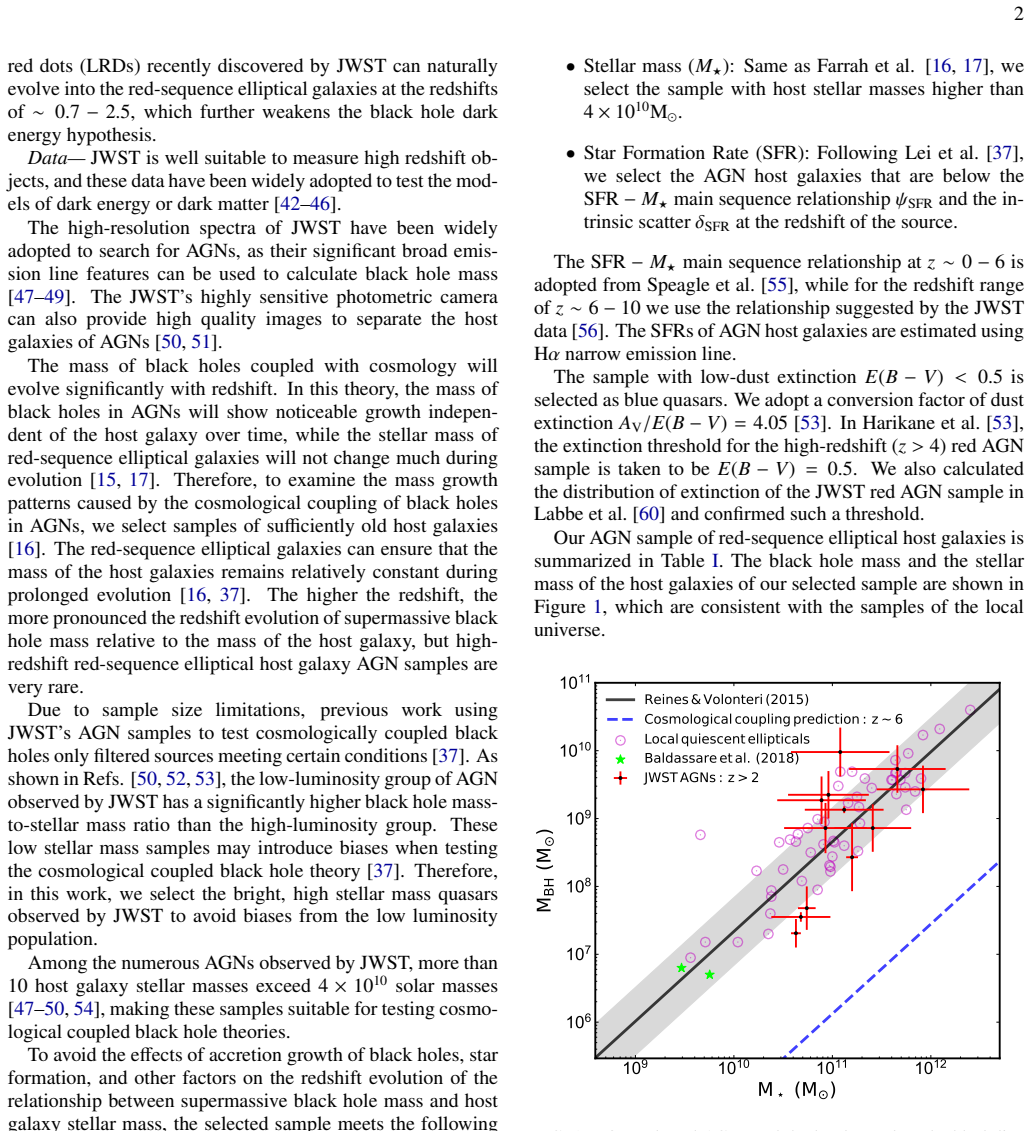
The central claim is that black holes in massive, quiescent elliptical galaxies have not grown with cosmic expansion: the coupling strength is $k=0.13\pm0.27$, i.e., consistent with $k=0$ and rejected at about $11\sigma$ relative to the $k=3$ required for a dark-energy source. The evidence is the location of 12 AGN host galaxies at $z=2.09$–$6.77$ on the local black-hole-mass versus stellar-mass plane; under $k=3$ their black holes should sit far below the observed masses. A Monte Carlo likelihood using the local fundamental plane with intrinsic scatter yields the bound. In a second step, the paper argues that little red dots—compact, red, low-accretion-rate AGNs at $z\sim5$–$8$—can grow, quench, and accrete slowly into exactly the red-sequence ellipticals with relatively low-mass black holes previously used to claim $k\approx3$, so no cosmological coupling is needed.
Load-bearing premise
The load-bearing premise is that the 12 JWST-selected AGNs fairly represent black holes in massive red-sequence ellipticals at these redshifts: that detection is not biased toward a particular black-hole mass range, the hosts are truly quiescent with constant stellar mass, and the virial black-hole masses carry no systematic offset relative to the local relation.
Editorial extensions
If this is right
- At $k=0.13\pm0.27$, cosmologically coupled stellar-remnant black holes cannot supply the measured dark-energy density; another mechanism must drive cosmic acceleration.
- The apparent growth of black holes in the earlier red-sequence sample is reinterpreted as an evolutionary track from little red dots rather than cosmological coupling, so those data no longer support $k\approx3$.
- Future space-telescope samples of quiescent ellipticals at $z>2$ should continue to follow the no-coupling plane, with scatter dominated by intrinsic scatter rather than redshift evolution.
- Little red dots at $z\approx5$–$8$ become viable progenitors for the relatively low-mass black holes seen in massive ellipticals at $z\approx0.7$–$2.5$, with growth driven by sustained low-level accretion.
Reading between the lines
- The quoted $11\sigma$ assumes the 12 detected AGNs are an unbiased sample of all massive red-sequence ellipticals at these redshifts; a flux-limited selection could in principle reject $k=3$ even if the coupling were real, because $k=3$ predicts black holes fainter than the detection threshold.
- A testable extension is to model the survey selection function and redo the likelihood; if the selection correction moves $k$ upward, the decisive constraint could weaken.
- The little-red-dot simulation keeps accretion rates roughly constant and quenches star formation after $z\approx1.6$; X-ray stacking of the presumed descendants at $z\approx1$ could check whether that accretion assumption holds.
- The same data could constrain other redshift-dependent growth laws, like Eddington-limited accretion histories, separating ordinary accretion from cosmological coupling.
Signed reviews
Editorial analysis
A structured set of objections, weighed in public.
Referee Report
Summary. The manuscript compiles a sample of 12 JWST-detected broad-line AGNs at redshifts z≈2–7 whose hosts are classified as red-sequence elliptical galaxies with stellar masses above 4×10^10 M_sun. Assuming the local Mstar–MBH fundamental plane (Eq. 1) evolves only through a cosmological coupling factor (1+z)^{-k}, the authors fit k = 0.13 ± 0.27 (68% CI) and claim that the cosmologically coupled black-hole dark-energy hypothesis (k = 3) is rejected at about 11σ. In a second part, the paper simulates the evolution of little red dots (LRDs) from z≈6 to z≈1.61 and z≈0.85 and argues that they can evolve into the red-sequence elliptical hosts without cosmological coupling.
Significance. If the central claim were correct, this would be a decisive observational disproof of a prominent and actively discussed dark-energy hypothesis, and the paper would also provide a plausible evolutionary link between JWST-discovered LRDs and lower-redshift red-sequence ellipticals. The compilation of high-redshift AGN host properties in Table I is useful, the MCMC implementation is straightforward, and the posterior for k is transparently presented. However, the headline significance is not supported: the likelihood ignores the strong luminosity selection of the sample, and the inference assumes no intrinsic redshift evolution of the Mstar–MBH relation. The LRD simulation is an interesting illustrative model but is not an independent test. The manuscript's main quantitative conclusion is therefore not established.
major comments (4)
- [Eqs. (2)–(4), Methods] The likelihood in Eq. (3) treats the 12 observed (Mstar, MBH) pairs as random draws from the underlying Mstar–MBH relation with only measurement scatter and intrinsic scatter. This is not valid for a flux-limited, luminosity-selected sample. The authors explicitly select 'bright, high stellar mass quasars observed by JWST' and impose Mstar > 4×10^10 M_sun and E(B-V) < 0.5; detection of a broad-line AGN depends on luminosity, hence on MBH at a given Eddington ratio. Under k = 3, Eq. (2) predicts log MBH roughly 5.8–7.2 for the stellar masses and redshifts in Table I, whereas the observed values are 7.3–10.0. A survey with a luminosity threshold would then only detect the high-mass tail of the k = 3 population, producing exactly the offset shown in Figure 1. The fitted k = 0.13 ± 0.27 and the quoted ~11σ exclusion therefore characterize the conditional distribution of detectable objects, not the coupling strength of the underlying population. The paper must include a selection function P(det | Mstar, MBH, z, survey limits) or otherwise demonstrate that the strong selection on AGN luminosity does not bias the inference; without this, the headline claim is unsupported.
- [Table I and Data] The classification of several hosts as red-sequence ellipticals with constant stellar mass is not secure. Table I lists SFR values up to 543.8 M_sun/yr (J1030+0524), 311.1 M_sun/yr (J1148+5251), and other sources with SFR > 100 M_sun/yr, and some E(B-V) values near the 0.5 threshold. At z~5–7, rest-frame optical morphology and SED fitting give limited constraints on quiescence, and broad-line AGN light can contaminate host photometry. If the stellar mass is not constant over the redshift baseline, or if the host stellar mass is overestimated, then the constant-Mstar assumption entering Eq. (2) biases k. The authors should show, for each source, the quantitative offset from the adopted SFR–Mstar main sequence and address host-light decomposition systematics.
- [Eq. (1) and Result] The inference assumes that the local Mstar–MBH fundamental plane (Eq. 1) is universal up to the (1+z)^{-k} factor. However, there is independent evidence that the Mstar–MBH relation evolves with redshift and that high-redshift quasars can host overmassive black holes; moreover, the authors' own LRD simulation includes stellar mass growth and BH accretion that would move objects relative to the local relation without any cosmological coupling. The analysis must either model this intrinsic evolution or argue quantitatively that it is negligible; otherwise the fitted k conflates astrophysical evolution of the relation with the cosmological coupling signal.
- [Result and discussion, Figure 3] The LRD evolution simulation is calibrated to the observed LRD population and adopts, without physical derivation, constant SFR and constant BH accretion rates from z~6 to z~1.61 and then SFR = 0 with continued accretion. The good match in Figure 3 is therefore an illustration that the assumed tracks can connect the two populations, not an independent test of the no-coupling hypothesis. The text should present it as such, and the abstract's claim that LRDs 'naturally evolve' into the red-sequence ellipticals should be softened accordingly.
minor comments (5)
- [Title] The word 'Remanants' should be 'Remnants'.
- [Eqs. (3)–(4)] Equation (4) defines sigma_tot, but Eq. (3) uses sigma_i; state explicitly that sigma_i = sigma_tot,i.
- [Figure 1] The caption does not label the grey region representing the intrinsic scatter of the local relation.
- [Data section] The sentence claiming that the impact of observational biases is 'relatively small' for hosts with Mstar > 4×10^10 M_sun requires quantitative support or should be deleted.
- [References] Several references are still arXiv preprints (e.g., [48]–[50]); update to published versions where available.
Circularity Check
No significant circularity: the coupling strength k is estimated from data against an external local relation, and the LRD evolution is a forward model rather than a restatement of its inputs.
full rationale
The paper's central inference is a maximum-likelihood estimate of the cosmological coupling strength k. Equation (2) is a redshift-adjusted form of the local M_BH-M_star relation in Equation (1), and Equation (3) compares the predicted black-hole mass to the 12 measured values; k is a free parameter, not an input, so the resulting k=0.13±0.27 and the approximate 11-sigma distance from k=3 are not circular. Equation (1) is attributed to the authors' previous work [37], but it is an empirical fit to local quiescent elliptical AGNs shown in Figure 1, not to the high-redshift sample used for the k test; it therefore counts as independent calibration under the review rules. The LRD section is a forward simulation: initial stellar and black-hole masses, star-formation rates, and accretion rates are taken from observed JWST LRD properties [50,55,69], and the mock population is evolved to z~1.61 and z~0.85 and then selected with Mstar>4e10 M_sun. The final agreement with the Farrah et al. samples is a consistency check, not a fit to those samples. The most serious concern about the paper is the absence of a flux-limited selection function in Equation (3), since the sample is composed of luminous broad-line AGNs; however, selection bias is a statistical validity issue rather than a self-definitional or by-construction circularity, and the instructions limit circularity findings to exhibited reductions of outputs to inputs. No such reduction is present in the derivation chain.
Assumptions & free parameters
free parameters (5)
- k (cosmological coupling strength) =
0.13 +/- 0.27 (68% CI)
- LRD initial stellar mass distribution (mean 9.05, sigma 0.4) =
log10(M*/Msun) = 9.05 +/- 0.4
- LRD initial black hole mass distribution (mean 7.35, sigma 0.5) =
log10(MBH/Msun) = 7.35 +/- 0.5
- SFR-main sequence relation coefficients (slope 0.7, intercept -5.3, scatter 0.8 dex) =
log10(SFR) = 0.7 log10(M*) - 5.3, scatter 0.8
- BH accretion rate relation (normalization -9.0, scatter 0.5 dex) =
log10(MBHdot) = log10(MBH) - 9.0, scatter 0.5
assumptions (4)
- domain assumption The local M*-MBH fundamental plane (Eq. 1) is redshift-independent and applies to z>2 red-sequence ellipticals.
- domain assumption The selected JWST AGN hosts are genuinely passive red-sequence ellipticals whose stellar masses are constant in time.
- domain assumption Virial BH mass estimates from broad lines are unbiased relative to the local relation, with no systematic offset beyond quoted errors.
- ad hoc to paper In the LRD simulation, SFR and BH accretion rate remain constant between z=6 and z=1.61, after which SFR is set to zero.
Cite this review
Pith. "Pith review of Black Holes in the Red-sequence Elliptical Galaxies at Redshifts $\sim 0.7-2.5$: Not Dark Energy Source but Remanants of Little Red Dots." pith.science (2026). https://pith.science/paper/ENFOQQFA
@misc{pith2026250619589,
  author       = {Pith},
  title        = {Pith review of: Black Holes in the Red-sequence Elliptical Galaxies at Redshifts $\sim 0.7-2.5$: Not Dark Energy Source but Remanants of Little Red Dots},
  year         = {2026},
  howpublished = {\url{https://pith.science/paper/ENFOQQFA}},
  note         = {Machine review of arXiv:2506.19589}
}
abstract
The nature of dark energy remains one of the most profound mysteries in modern cosmology. One intriguing proposal is that black holes (BHs) could be the astrophysical source of dark energy through a cosmological coupling mechanism, and strong evidence has been claimed via analyzing the growth of the black hole masses in the red-sequence elliptical galaxies at redshifts $\leq 2.5$. In this work, with a group of very high redshift AGNs detected by the James Webb Space Telescope (JWST) in the red-sequence elliptical galaxies, we show that the possibility of BHs being the astrophysical source of dark energy has been rejected at a confidence level exceeding 10$\sigma$. Moreover, it turns out that the Little Red Dots recently discovered by JWST, characterized by the low accretion rates, can naturally evolve into the red-sequence elliptical galaxies hosting the relatively low mass black holes at the redshifts of $\sim 0.7-2.5$, without the need of black hole cosmological coupling.
Figures


Forward citations
Cited by 1 Pith paper
-
Evaporating cosmologically coupled black holes
If a black hole's mass grows with cosmic expansion, Hawking evaporation is slowed or reversed, weakening gamma-ray bounds on primordial black holes.
Reference graph
Works this paper leans on
-
[1]
A. G. Riess, A. V . Filippenko, P. Challis, A. Clocchiatti, A. Diercks, P. M. Garnavich, R. L. Gilliland, C. J. Hogan, S. Jha, R. P. Kirshner, et al., Astron. J.116, 1009 (1998), astro- ph/9805201
arXiv 1998
-
[2]
S. Perlmutter, G. Aldering, G. Goldhaber, R. A. Knop, P. Nu- gent, P. G. Castro, S. Deustua, S. Fabbro, A. Goobar, D. E. Groom, et al., Astrophys. J.517, 565 (1999), astro-ph/9812133
arXiv 1999
-
[3]
J. Frieman, M. Turner, and D. Huterer, Ann. Rev. Astron. As- trophys.46, 385 (2008), 0803.0982
arXiv 2008
- [4]
-
[5]
R. R. Caldwell, R. Dave, and P. J. Steinhardt, Phys. Rev. Lett. 80, 1582 (1998), astro-ph/9708069
arXiv 1998
-
[6]
P. G. Ferreira and M. Joyce, Phys. Rev. D58, 023503 (1998), astro-ph/9711102
arXiv 1998
-
[7]
R. R. Caldwell and E. V . Linder, Phys. Rev. Lett.95, 141301 (2005), astro-ph/0505494
arXiv 2005
- [8]
Show all 70 references
-
[9]
R. R. Caldwell, M. Kamionkowski, and N. N. Weinberg, Phys. Rev. Lett.91, 071301 (2003), astro-ph/0302506
2003 arXiv
-
[10]
Y .-F. Cai, E. N. Saridakis, M. R. Setare, and J.-Q. Xia, Phys. Rept.493, 1 (2010), 0909.2776
2010 arXiv
-
[11]
Qiu, Modern Physics Letters A25, 909 (2010), 1002.3971
T. Qiu, Modern Physics Letters A25, 909 (2010), 1002.3971
2010 arXiv
-
[12]
Y .-F. Cai, S. Capozziello, M. De Laurentis, and E. N. Saridakis, Rept. Prog. Phys.79, 106901 (2016), 1511.07586
2016 arXiv
-
[13]
Amendola, C
L. Amendola, C. Quercellini, D. Tocchini-Valentini, and A. Pasqui, Astrophys. J. Lett.583, L53 (2003), astro- ph/0205097
2003
-
[14]
Amendola and C
L. Amendola and C. Quercellini, Phys. Rev. D68, 023514 (2003), astro-ph/0303228
2003 arXiv
-
[15]
K. S. Croker, K. A. Nishimura, and D. Farrah, Astrophys. J. 889, 115 (2020), 1904.03781
2020 arXiv
-
[16]
Farrah, S
D. Farrah, S. Petty, K. S. Croker, G. Tarl´e, M. Zevin, E. Hatzim- inaoglou, F. Shankar, L. Wang, D. L. Clements, A. Efstathiou, et al., Astrophys. J.943, 133 (2023), 2212.06854
2023 arXiv
-
[17]
The dashed contours in black, blue and red show our simulated LRDs redshiftz∼6,z∼1.61 and z∼0.85
are shown as red and blue points. The dashed contours in black, blue and red show our simulated LRDs redshiftz∼6,z∼1.61 and z∼0.85. Three contours correspond to sample density levels of 0.05, 0.1, and 0.3, respectively. The black points with error bars are JWST LRDs adopted fr...
-
[18]
Farrah et al., Astrophys
D. Farrah et al., Astrophys. J. Lett.944, L31 (2023), 2302.07878
2023 arXiv
- [19]
-
[20]
Cadoni, R
M. Cadoni, R. Murgia, M. Pitzalis, and A. P. Sanna, JCAP03, 026 (2024), 2309.16444
2024 arXiv
- [21]
- [22]
- [23]
-
[24]
P. P. Avelino, JCAP08, 005 (2023), 2303.06630
2023 arXiv
- [25]
- [26]
-
[27]
P. K. Dahal, S. Maharana, F. Simovic, I. Soranidis, and D. R. Terno, Phys. Rev. D110, 044032 (2024), 2312.16804
2024 arXiv
- [28]
-
[29]
K. S. Croker, G. Tarl ´e, S. P. Ahlen, B. G. Cartwright, D. Far- rah, N. Fernandez, and R. A. Windhorst, JCAP10, 094 (2024), 2405.12282
2024 arXiv
-
[30]
Ahlen, A
S. Ahlen, A. Aviles, B. Cartwright, K. S. Croker, W. Elbers, D. Farrah, N. Fernandez, G. Niz, J. Rohlf, G. Tarl´e, et al., arXiv e-prints arXiv:2504.20338 (2025), 2504.20338
2025 arXiv
-
[31]
R. Chan, M. F. A. da Silva, and P. Rocha, Gen. Rel. Grav.43, 2223 (2011), 1009.4403
2011 arXiv
- [32]
-
[33]
Mc Conville and E
R. Mc Conville and E. O. Colg ´ain, Phys. Rev. D108, 123533 (2023), 2304.02718
2023 arXiv
-
[34]
Cadoni, A
M. Cadoni, A. P. Sanna, M. Pitzalis, B. Banerjee, R. Murgia, N. Hazra, and M. Branchesi, JCAP11, 007 (2023), 2306.11588
2023 arXiv
-
[35]
M. Lacy, A. Engholm, D. Farrah, and K. Ejercito, Astrophys. J. Lett.961, L33 (2024), 2312.12344
2024 arXiv
-
[36]
Calz `a, F
M. Calz `a, F. Gianesello, M. Rinaldi, and S. Vagnozzi, Sci. Rep. 14, 31296 (2024), 2409.01801
2024 arXiv
- [37]
-
[38]
Lei et al., Sci
L. Lei et al., Sci. China Phys. Mech. Astron.67, 229811 (2024), 2305.03408
2024 arXiv
-
[39]
Amendola, D
L. Amendola, D. C. Rodrigues, S. Kumar, and M. Quartin, Mon. Not. Roy. Astron. Soc.528, 2377 (2024), 2307.02474
2024 arXiv
-
[40]
Mlinar and T
E. Mlinar and T. Zwitter, Mon. Not. Roy. Astron. Soc.528, 3000 (2024), 2311.09007
2024 arXiv
-
[41]
C. L. Rodriguez, Astrophys. J. Lett.947, L12 (2023), 2302.12386
2023 arXiv
-
[42]
Aghanim, Y
Planck Collaboration, N. Aghanim, Y . Akrami, M. Ashdown, J. Aumont, C. Baccigalupi, M. Ballardini, A. J. Banday, R. B. Barreiro, N. Bartolo, et al., Astron. Astrophys641, A6 (2020), 1807.06209
2020 arXiv
-
[43]
Y .-Y . Wang, L. Lei, G.-W. Yuan, and Y .-Z. Fan, Astrophys. J. Lett.954, L48 (2023), 2307.12487
2023 arXiv
- [44]
-
[45]
S. Roy, C. Blanco, C. Dessert, A. Prabhu, and T. Temim, Phys. Rev. Lett.134, 071003 (2025), 2311.04987. 6
2025 arXiv
-
[46]
Lei, Y .-Y
L. Lei, Y .-Y . Wang, G.-W. Yuan, T.-L. Wang, M. A. T. Groenewegen, and Y .-Z. Fan, Astrophys. J.980, 249 (2025), 2501.07119
2025 arXiv
-
[47]
Z.-F. Wang, L. Lei, L. Feng, and Y .-Z. Fan, Res. Astron. Astro- phys.24, 125012 (2024), 2411.08774
2024 arXiv
-
[48]
X. Ding, M. Onoue, J. D. Silverman, Y . Matsuoka, T. Izumi, M. A. Strauss, K. Jahnke, C. L. Phillips, J. Li, M. V olonteri, et al., Nature (London)621, 51 (2023), 2211.14329
2023 arXiv
-
[49]
Zhang, E
J. Zhang, E. Egami, F. Sun, X. Lin, J. Lyu, Y . Zhu, P. Rinaldi, Y . Sun, A. J. Bunker, R. Bhatawdekar, et al., arXiv e-prints arXiv:2505.02895 (2025), 2505.02895
2025
-
[50]
Juod ˇzbalis, R
I. Juod ˇzbalis, R. Maiolino, W. M. Baker, E. C. Lake, J. Scholtz, F. D’Eugenio, B. Trefoloni, Y . Isobe, S. Tacchella, A. J. Bunker, et al., arXiv e-prints arXiv:2504.03551 (2025), 2504.03551
2025
-
[51]
R. Li, L. C. Ho, and C.-H. Chen, arXiv e-prints arXiv:2505.12867 (2025), 2505.12867
2025
-
[52]
Yue, A.-C
M. Yue, A.-C. Eilers, R. A. Simcoe, R. Mackenzie, J. Matthee, D. Kashino, R. Bordoloi, S. J. Lilly, and R. P. Naidu, Astrophys. J.966, 176 (2024), 2309.04614
2024 arXiv
-
[53]
Maiolino et al., Astron
R. Maiolino et al., Astron. Astrophys.691, A145 (2024), 2308.01230
2024 arXiv
-
[54]
Harikane, Y
Y . Harikane, Y . Zhang, K. Nakajima, M. Ouchi, Y . Isobe, Y . Ono, S. Hatano, Y . Xu, and H. Umeda, Astrophys. J.959, 39 (2023), 2303.11946
2023 arXiv
-
[55]
Kokorev, J
V . Kokorev, J. Chisholm, R. Endsley, S. L. Finkelstein, J. E. Greene, H. B. Akins, V . Bromm, C. M. Casey, S. Fujimoto, I. Labb´e, et al., Astrophys. J.975, 178 (2024), 2407.20320
2024 arXiv
-
[56]
J. S. Speagle, C. L. Steinhardt, P. L. Capak, and J. D. Silverman, Astrophys. J. Suppl.214, 15 (2014), 1405.2041
2014 arXiv
-
[57]
K. E. Heintz et al., Nature Astron.7, 1517 (2023), 2212.02890
2023 arXiv
- [58]
- [59]
-
[60]
K. Ito, T. S. Tanaka, K. Shimasaku, M. Ando, M. Onoue, M. Tanaka, S. Matsui, T. Kakimoto, and F. Valentino, Monthly Notices of the Royal Astronomical Society538, 1501 (2025), ISSN 0035-8711, https://academic.oup.com/mnras/article- pdf/538/3/1501/62245817/staf372.pdf, URLhttps:...
2025 doi
-
[61]
Labbe, J
I. Labbe, J. E. Greene, R. Bezanson, S. Fujimoto, L. J. Furtak, A. D. Goulding, J. Matthee, R. P. Naidu, P. A. Oesch, H. Atek, et al., Astrophys. J.978, 92 (2025), 2306.07320
2025 arXiv
- [62]
-
[63]
Kormendy and L
J. Kormendy and L. C. Ho, Ann. Rev. Astron. Astrophys.51, 511 (2013), 1304.7762
2013 arXiv
-
[64]
A. E. Reines and M. V olonteri, Astrophys. J.813, 82 (2015), 1508.06274
2015 arXiv
- [65]
-
[66]
H. B. Akins, C. M. Casey, N. Allen, M. B. Bagley, M. Dick- inson, S. L. Finkelstein, M. Franco, S. Harish, P. Arrabal Haro, O. Ilbert, et al., Astrophys. J.956, 61 (2023), 2304.12347
2023 arXiv
- [67]
-
[68]
Y . Ma, J. E. Greene, D. J. Setton, A. D. Goulding, M. Annunzi- atella, X. Fan, V . Kokorev, I. Labbe, J. Li, X. Lin, et al., arXiv e-prints arXiv:2504.08032 (2025), 2504.08032
2025 arXiv
- [69]
-
[70]
R. A. Daly, Mon. Not. R. Astron. Soc.500, 215 (2021), 2010.06908
2021 arXiv
Reviewed August 15, 2026 · model on record in the stance chip above.
Discussion (0). Continue with ORCID to comment.