Decoherence and fidelity enhancement during shuttling of entangled spin qubits
Pith reviewed 2026-05-19 07:46 UTC · model grok-4.3
The pith
Encoding a logical qubit in two consecutively shuttled entangled spins achieves high fidelity even for very slow shuttling.
A machine-rendered reading of the paper's core claim, the machinery that carries it, and where it could break.
Core claim
The paper establishes that by encoding the logical qubit in a state of two consecutively shuttled entangled spins, high fidelity can be achieved even for very slow shuttling. The noises acting on the shuttled spins exhibit complex and unusual correlations due to interrelated paths; these correlations, appraised using trajectories on random sheets, can drastically affect the efficiency of coherence protection but can also be exploited to enhance shuttling fidelity in the entangled encoding.
What carries the argument
Trajectories on random sheets, the device used to appraise the complex noise correlations that arise when the paths of shuttled spins are interrelated.
If this is right
- The complex correlations in noise due to interrelated paths can drastically affect the efficiency of coherence protection.
- The entangled two-spin encoding yields high fidelity even when shuttling is very slow.
- Specific conditions are identified that favor the entangled encoding over single-spin shuttling.
- The improvement in shuttling fidelity relative to single-spin shuttling is quantified.
Where Pith is reading between the lines
- This encoding may allow slower shuttling speeds in hardware without loss of performance, reducing the technical demands of fast transport.
- The trajectory-on-random-sheets approach could be tested in other multi-qubit systems where paths cross or share noise sources.
- Similar use of entanglement during transport might improve coherence in other moving-qubit platforms such as trapped ions or superconducting circuits.
Load-bearing premise
The noises acting on the shuttled spins exhibit complex and unusual correlations due to their interrelated paths.
What would settle it
Direct comparison of measured shuttling fidelity for slow speeds using two consecutively shuttled entangled spins versus a single spin, under the specific noise model with correlated components.
Figures



read the original abstract
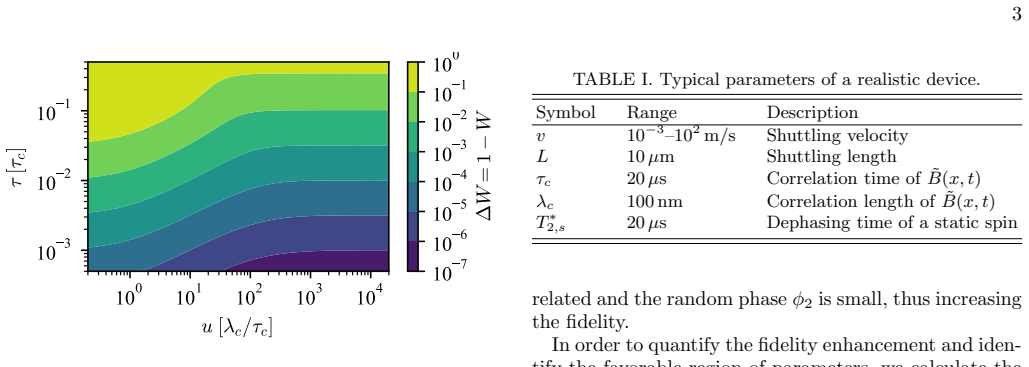
Shuttling of spin qubits between different locations is a key element in many prospective semiconductor systems for quantum information processing, but the shuttled qubits should be protected from decoherence created by time- and space-dependent noises. Since the paths of different spin qubits are interrelated, the noises acting on the shuttled spins exhibit complex and unusual correlations. We appraise the role of these correlations using the concept of trajectories on random sheets, and demonstrate that they can drastically affect efficiency of the coherence protection. These correlations can also be exploited to enhance the shuttling fidelity, and we show that by encoding logical qubit in a state of two consequtively shuttled entangled spins, high fidelity can be achieved even for very slow shuttling. We identify the conditions favoring this encoding, and quantify improvement in the shuttling fidelity in comparison with the single-spin shuttling.
Editorial analysis
A structured set of objections, weighed in public.
Referee Report
Summary. The manuscript investigates decoherence during shuttling of spin qubits in semiconductor systems, focusing on complex noise correlations arising from interrelated qubit paths. Using trajectories on random sheets to model these correlations, the authors demonstrate that the correlations can drastically affect coherence protection efficiency and can be exploited to enhance fidelity. The central claim is that encoding a logical qubit in the state of two consecutively shuttled entangled spins enables high fidelity even for very slow shuttling, with quantified improvement over single-spin shuttling and identification of favorable conditions.
Significance. If the modeling holds, the work provides a theoretically grounded strategy for coherence protection in shuttling-based spin qubit architectures without requiring fast shuttling speeds, which are often experimentally challenging. The exploitation of path-induced noise correlations via entanglement is a novel angle that could inform scalable quantum information processing designs. The quantitative fidelity comparisons add practical value, though the overall significance hinges on the fidelity of the random-sheets model to physical noise.
major comments (2)
- [§3] §3, Eq. (8): The correlation function derived from the trajectories-on-random-sheets construction is load-bearing for the fidelity-enhancement claim, yet the paper does not demonstrate that this specific space-time noise structure corresponds to realistic semiconductor noise (e.g., charge fluctuations or nuclear-spin baths); a mismatch would eliminate the reported advantage of the two-spin encoding at slow speeds.
- [§5] §5, fidelity plots: The quantitative improvement for the entangled encoding versus single-spin shuttling is shown only within the assumed correlation model; no sensitivity analysis or comparison to alternative noise spectra is provided, leaving the robustness of the central claim untested.
minor comments (2)
- [Abstract] Abstract: Typographical error in 'consequtively' (should be 'consecutively').
- [Notation] Notation throughout: The logical-qubit encoding states could be defined more explicitly to distinguish them clearly from the physical spin states.
Simulated Author's Rebuttal
We thank the referee for the careful reading and constructive feedback on our manuscript. The comments highlight important aspects of the noise model and its robustness, which we address below. We clarify the scope of the trajectories-on-random-sheets construction and provide additional analysis to strengthen the claims.
read point-by-point responses
-
Referee: §3, Eq. (8): The correlation function derived from the trajectories-on-random-sheets construction is load-bearing for the fidelity-enhancement claim, yet the paper does not demonstrate that this specific space-time noise structure corresponds to realistic semiconductor noise (e.g., charge fluctuations or nuclear-spin baths); a mismatch would eliminate the reported advantage of the two-spin encoding at slow speeds.
Authors: The trajectories-on-random-sheets model is introduced as a theoretical framework to capture the essential space-time correlations that arise whenever shuttled spins follow interrelated paths, a feature generic to any shuttling architecture. While the manuscript does not perform a direct microscopic mapping to specific microscopic baths, the construction is motivated by the fact that charge noise from shared electrostatic environments or nuclear-spin baths with spatially varying Overhauser fields naturally produce path-overlap correlations of this type. We have added a new paragraph in Section 3 and a brief discussion in the conclusions that references relevant literature on charge-noise correlations in quantum-dot shuttling experiments and explains under which conditions the random-sheets statistics are expected to be a reasonable approximation. This addition makes the physical context of the model explicit without altering the central analytic results. revision: partial
-
Referee: §5, fidelity plots: The quantitative improvement for the entangled encoding versus single-spin shuttling is shown only within the assumed correlation model; no sensitivity analysis or comparison to alternative noise spectra is provided, leaving the robustness of the central claim untested.
Authors: We agree that robustness checks strengthen the result. In the revised manuscript we have added a new subsection (5.3) containing sensitivity plots in which we vary the correlation length, introduce an uncorrelated noise component, and compare to a simple exponential-decay spectrum. The two-spin encoding retains a clear fidelity advantage whenever the correlated fraction exceeds approximately 30 percent, a regime consistent with typical shuttling distances in current devices. These additional figures are now referenced in the main text and included in the supplementary material. revision: yes
Circularity Check
No significant circularity; derivation self-contained in noise modeling
full rationale
The paper introduces a model of noise correlations arising from interrelated qubit paths and employs the trajectories-on-random-sheets construction to evaluate decoherence suppression for single-spin versus entangled two-spin shuttling. The fidelity enhancement claim follows directly from comparing the resulting decoherence rates under this model, without any fitted parameters being renamed as predictions, self-definitional loops, or load-bearing self-citations that reduce the central result to its own inputs. The derivation remains independent of the target fidelity outcome and is presented as a theoretical appraisal of a specific noise structure.
Axiom & Free-Parameter Ledger
Reference graph
Works this paper leans on
-
[1]
The two spins are shut- tled through the same channel with the delayT0 one after another, see Fig. 2. The spins shuttled along the trajecto- ries xc1(t) and xc2(t) will experience different but corre- lated noises B1(t) = ˜B(xc1(t), t) and B2(t) = ˜B(xc2(t), t) produced by the same random sheet ˜B(xc, t). The ran- dom phases acquired by the spins transfor...
-
[2]
J. M. Taylor, H.-A. Engel, W. D¨ ur, A. Yacoby, C. M. Marcus, P. Zoller, and M. D. Lukin, Fault-tolerant archi- tecture for quantum computation using electrically con- trolled semiconductor spins, Nature Phys. 1, 177 (2005)
work page 2005
-
[3]
S. Hermelin, S. Takada, M. Yamamoto, S. Tarucha, A. D. Wieck, L. Saminadayar, C. B¨ auerle, and T. Meunier, Electrons surfing on a sound wave as a platform for quan- tum optics with flying electrons, Nature 477, 435 (2011)
work page 2011
-
[4]
B. Buonacorsi, Z. Cai, E. B. Ramirez, K. S. Willick, S. M. Walker, J. Li, B. D. Shaw, X. Xu, S. C. Ben- jamin, and J. Baugh, Network architecture for a topolog- ical quantum computer in silicon, Quantum Sci. Technol. 4, 025003 (2019)
work page 2019
-
[5]
L. M. K. Vandersypen, H. Bluhm, J. S. Clarke, A. S. Dzu- rak, R. Ishihara, A. Morello, D. J. Reilly, L. R. Schreiber, and M. Veldhorst, Interfacing spin qubits in quantum dots and donors — hot, dense, and coherent, npj Quan- tum Inf. 3, 34 (2017)
work page 2017
-
[6]
V. Langrock, J. A. Krzywda, N. Focke, I. Seidler, L. R. Schreiber, and L. Cywi´ nski, Blueprint of a scalable spin qubit shuttle device for coherent mid-range qubit transfer in disordered Si/SiGe/SiO 2, PRX Quantum 4, 020305 (2023)
work page 2023
-
[7]
M. K¨ unne, A. Willmes, M. Oberl¨ ander, C. Gorjaew, J. D. Teske, H. Bhardwaj, M. Beer, E. Kammerloher, R. Ot- ten, I. Seidler, R. Xue, L. R. Schreiber, and H. Bluhm, The SpinBus architecture: Scaling spin qubits with elec- tron shuttling (2023), arXiv:2306.16348
-
[8]
J. Wang, S. Ota, H. Edlbauer, B. Jadot, P.-A. Morte- mousque, A. Richard, Y. Okazaki, S. Nakamura, A. Lud- wig, A. D. Wieck, M. Urdampilleta, T. Meunier, T. Kodera, N.-H. Kaneko, S. Takada, and C. B¨ auerle, Generation of a single-cycle acoustic pulse: A scalable solution for transport in single-electron circuits, Phys. Rev. X 12, 031035 (2022)
work page 2022
-
[9]
A. R. Mills, D. M. Zajac, M. J. Gullans, F. J. Schupp, T. M. Hazard, and J. R. Petta, Shuttling a single charge across a one-dimensional array of silicon quantum dots, Nature Communications 10, 1063 (2019)
work page 2019
- [10]
-
[11]
J. M. Boter, J. P. Dehollain, J. P. G. van Dijk, Y. Xu, T. Hensgens, R. Versluis, H. W. L. Naus, J. S. Clarke, M. Veldhorst, F. Sebastiano, and L. M. K. Vandersypen, Spiderweb array: A sparse spin-qubit array, Phys. Rev. Appl. 18, 024053 (2022)
work page 2022
- [12]
-
[13]
C.-A. Wang, V. John, H. Tidjani, C. X. Yu, A. S. Ivlev, C. D´ eprez, F. van Riggelen-Doelman, B. D. Woods, N. W. Hendrickx, W. I. L. Lawrie, L. E. A. Stehouwer, S. D. Oosterhout, A. Sammak, M. Friesen, G. Scappucci, S. L. de Snoo, M. Rimbach-Russ, F. Borsoi, and M. Veld- horst, Operating semiconductor quantum processors with hopping spins, Science 385, 447 (2024)
work page 2024
-
[14]
I. Seidler, T. Struck, R. Xue, N. Focke, S. Trellenkamp, H. Bluhm, and L. R. Schreiber, Conveyor-mode single- electron shuttling in Si/SiGe for a scalable quantum com- puting architecture, npj Quantum Information 8, 100 (2022)
work page 2022
- [15]
-
[16]
M. D. Smet, Y. Matsumoto, A.-M. J. Zwerver, L. Try- puten, S. L. de Snoo, S. V. Amitonov, A. Sam- mak, N. Samkharadze, ¨O. G¨ ul, R. N. M. Wasserman, M. Rimbach-Russ, G. Scappucci, and L. M. K. Vander- sypen, High-fidelity single-spin shuttling in silicon (2024), arXiv:2406.07267 [cond-mat.mes-hall]
- [17]
- [18]
-
[19]
B. Jadot, P.-A. Mortemousque, E. Chanrion, V. Thiney, A. Ludwig, A. D. Wieck, M. Urdampilleta, C. B¨ auerle, and T. Meunier, Distant spin entanglement via fast and coherent electron shuttling, Nat. Nanotechnol. 16, 570 (2021)
work page 2021
-
[20]
R. P. G. McNeil, M. Kataoka, C. J. B. Ford, C. H. W. Barnes, D. Anderson, G. A. C. Jones, I. Farrer, and D. A. Ritchie, On-demand single-electron transfer between dis- tant quantum dots, Nature 477, 439 (2011)
work page 2011
-
[21]
P. Huang and X. Hu, Spin qubit relaxation in a moving quantum dot, Phys. Rev. B 88, 075301 (2013)
work page 2013
-
[22]
F. van Riggelen-Doelman, C.-A. Wang, S. L. de Snoo, W. I. L. Lawrie, N. W. Hendrickx, M. Rimbach-Russ, A. Sammak, G. Scappucci, C. D´ eprez, and M. Veld- horst, Coherent spin qubit shuttling through germa- nium quantum dots (2023), arXiv:2308.02406 [cond-mat, physics:quant-ph]
-
[23]
J. M. Boter, X. Xue, T. Kr¨ ahenmann, T. F. Watson, V. N. Premakumar, D. R. Ward, D. E. Savage, M. G. Lagally, M. Friesen, S. N. Coppersmith, M. A. Eriksson, R. Joynt, and L. M. K. Vandersypen, Spatial noise cor- relations in a Si/SiGe two-qubit device from Bell state coherences, Phys. Rev. B 101, 235133 (2020)
work page 2020
-
[24]
P.-A. Mortemousque, B. Jadot, E. Chanrion, V. Thiney, C. B¨ auerle, A. Ludwig, A. D. Wieck, M. Urdampilleta, and T. Meunier, Enhanced spin coherence while displac- ing electron in a two-dimensional array of quantum dots, PRX Quantum 2, 030331 (2021)
work page 2021
- [25]
-
[26]
M. P. Losert, M. A. Eriksson, R. Joynt, R. Rahman, G. Scappucci, S. N. Coppersmith, and M. Friesen, Practi- cal strategies for enhancing the valley splitting in Si/SiGe quantum wells, Phys. Rev. B 108, 125405 (2023)
work page 2023
-
[27]
X. Hao, R. Ruskov, M. Xiao, C. Tahan, and H. Jiang, Electron spin resonance and spin-valley physics in a sili- 6 con double quantum dot, Nat. Commun. 5, 3860 (2014)
work page 2014
-
[28]
P. Zanardi and M. Rasetti, Noiseless quantum codes, Phys. Rev. Lett. 79, 3306 (1997)
work page 1997
- [29]
-
[30]
G. Burkard, T. D. Ladd, A. Pan, J. M. Nichol, and J. R. Petta, Semiconductor spin qubits, Rev. Mod. Phys. 95, 025003 (2023)
work page 2023
- [31]
-
[32]
M. Kepa, L. Cywi´ nski, and J. A. Krzywda, Correlations of spin splitting and orbital fluctuations due to 1/f charge noise in the Si/SiGe quantum dot, Applied Physics Let- ters 123, 034003 (2023)
work page 2023
-
[33]
J. Zou, S. Bosco, and D. Loss, Spatially correlated clas- sical and quantum noise in driven qubits: The good, the bad, and the ugly (2023)
work page 2023
- [34]
-
[35]
C. Spence, B. Cardoso-Paz, V. Michal, E. Chanrion, D. J. Niegemann, B. Jadot, P.-A. Mortemousque, B. Klemt, V. Thiney, B. Bertrand, L. Hutin, C. B¨ auerle, F. Bale- stro, M. Vinet, Y.-M. Niquet, T. Meunier, and M. Ur- dampilleta, Probing charge noise in few electron CMOS quantum dots (2022), arXiv:2209.01853 [cond-mat.mes- hall]
-
[36]
M. M. E. K. Shehata, G. Simion, R. Li, F. A. Mo- hiyaddin, D. Wan, M. Mongillo, B. Govoreanu, I. Radu, K. De Greve, and P. Van Dorpe, Modeling semiconductor spin qubits and their charge noise environment for quan- tum gate fidelity estimation, Phys. Rev. B 108, 045305 (2023)
work page 2023
-
[37]
We assume that the direction of the effective magnetic field is almost uniform in space and time, such that the longitudinal relaxation can be neglected; this is a good approximation for Si-based structures. In GaAs systems the longitudinal relaxation due to spin-orbit coupling is important [20], while for Ge-based systems the spatial variation of the dir...
-
[38]
Supplemental Material
-
[39]
N. Chentsov, Wiener random fields depending on sev- eral parameters, Doklady Akademii Nauk SSSR 106, 607 (1956)
work page 1956
-
[40]
T. Kitagava, Analysis of variance applied to function spaces, Memoirs of the Faculty of Science, Kyushu Uni- versity Series A 6, 41 (1951)
work page 1951
-
[41]
R. J. Adler, The geometry of random fields (John Wiley & Sons Inc, Chichester, 1981)
work page 1981
- [42]
-
[43]
R. Kubo, Note on the stochastic theory of resonance ab- sorption, Journal of the Physical Society of Japan 9, 935 (1954)
work page 1954
-
[44]
J. R. Klauder and P. W. Anderson, Spectral diffusion decay in spin resonance experiments, Phys. Rev. 125, 912 (1962)
work page 1962
-
[45]
Chandrasekhar, Stochastic problems in physics and astronomy, Rev
S. Chandrasekhar, Stochastic problems in physics and astronomy, Rev. Mod. Phys. 15, 1 (1943)
work page 1943
-
[46]
J. S. Rojas-Arias, A. Noiri, P. Stano, T. Nakajima, J. Yoneda, K. Takeda, T. Kobayashi, A. Sammak, G. Scappucci, D. Loss, and S. Tarucha, Spatial noise correlations beyond nearest neighbors in 28Si/Si-Ge spin qubits, Phys. Rev. Appl. 20, 054024 (2023)
work page 2023
- [47]
-
[48]
L. Cywi´ nski, W. M. Witzel, and S. Das Sarma, Pure quantum dephasing of a solid-state electron spin qubit in a large nuclear spin bath coupled by long-range hyperfine-mediated interactions, Phys. Rev. B79, 245314 (2009)
work page 2009
-
[49]
V. V. Dobrovitski, A. E. Feiguin, R. Hanson, and D. D. Awschalom, Decay of Rabi oscillations by dipolar- coupled dynamical spin environments, Phys. Rev. Lett. 102, 237601 (2009)
work page 2009
-
[50]
D. P. DiVincenzo, D. Bacon, J. Kempe, G. Burkard, and K. B. Whaley, Universal quantum computation with the exchange interaction, Nature 408, 339 (2000)
work page 2000
-
[51]
In contrast with OU sheet, where the temporal fluctu- ations have a clearly defined timescale τc, pink random sheet with its 1 /f noise power spectrum does not have such a single well-defined timescale; therefore, the shut- tling velocity is normalized differently for the two cases, and different notations are used, u and up
discussion (0)
Sign in with ORCID, Apple, or X to comment. Anyone can read and Pith papers without signing in.