REVIEW 3 major objections 5 minor 50 references
Cross-sections and experimental signatures for detection of a well-defined dark matter WIMP
T0 review · 3 major / 5 minor · reviewed 2026-08-15 · deepseek-v4-flash
Pith's one-line read This paper predicts that a bosonic dark matter WIMP called the higgson, with mass near 70 GeV, can be detected at the high-luminosity LHC with optimized cuts.
desk verdict A transparent, checkable phenomenology study for a specific bosonic DM model; the headline 5σ HL-LHC claim is not supported by the background treatment, but the work is worth a serious referee. read the letter →
The pith
A machine-rendered reading of the paper's core claim, the machinery that carries it, and where it could break.
The reading
What carries the argument
The load-bearing object is the higgson, $h^0$, a bosonic dark matter WIMP whose interactions are weak and second order, defined by the interaction Lagrangian of the earlier paper and closely related to the Higgs boson. The collider predictions run through Monte Carlo event generation for the signal (higgson pair plus two quark jets) and a single standard-model background (neutrino pair plus two quark jets), followed by nine sequential kinematic cuts; the final numbers come from counting surviving events at 500 fb$^{-1}$. For direct detection, the key identity is the loop integral $I=m(M)/(16\pi^2 M^2)$, which enters each amplitude and is tiny because the relevant quark mass $m(M)$ is treated as the current quark mass at high energy rather than a constituent mass; that suppression, combined with a coupling factor of order $g^4$, drives the WIMP-nucleon cross-section down to $\sim 10^{-51}\,\mathrm{cm}^2$.
What would settle it
Run the nine-cut analysis on the first 500 fb$^{-1}$ of high-luminosity LHC data: if the observed number of events with two high-energy jets and large missing transverse energy agrees with the standard-model neutrino-plus-jets prediction within uncertainties, and no excess of about 1,950 signal events appears, the principal prediction is falsified. In direct detection, a measured WIMP-nucleon cross-section above roughly $10^{-48}$ cm$^2$ at a mass near 70 GeV would contradict the paper's predicted $\sim 10^{-51}$ cm$^2$.
Extended reading notes
Core claim
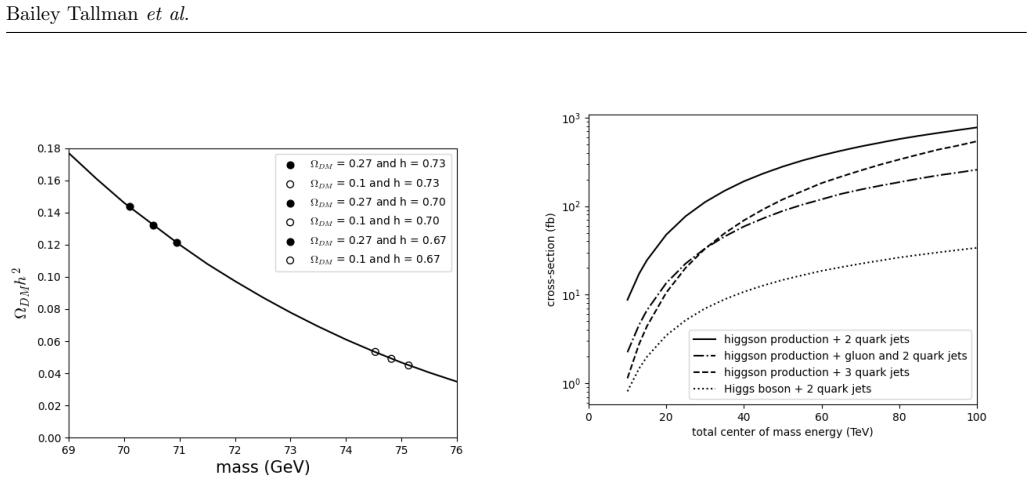
The central claim is that the higgson, a bosonic WIMP introduced in the authors' earlier work, has a mass close to 70 GeV, an annihilation cross-section $\langle\sigma_{\mathrm{ann}}v\rangle = 1.19\times 10^{-26}$ cm$^3$/s, and a pair-production cross-section of 20 fb at 14 TeV when produced with two quark jets. The principal conclusion is that, if the particle exists, the high-luminosity LHC can detect it with optimized cuts: at 500 fb$^{-1}$, after nine cuts on jet transverse momenta, pseudorapidities, missing transverse energy, and invariant mass, roughly 1,950 signal events survive against about 114,000 standard-model background events (neutrino pairs plus two quark jets), giving a statistical significance above $5\sigma$ by the prescription $n_s/\sqrt{n_b+n_s}$ used in the analysis. The paper also predicts an independent approximately $6\sigma$ signature at a 100 TeV proton collider through higgson pair plus $Z$ jet, small production rates in electron-positron and muon colliders, and a direct-detection cross-section of $\sim 10^{-51}$ cm$^2$ that lies below current and planned detector sensitivities.
Load-bearing premise
The significance estimate assumes that the same Monte Carlo samples used to optimize the nine cuts, and the assumption that the only standard-model background is a neutrino pair with two quark jets, transfer directly to real HL-LHC data without systematic uncertainties, detector effects, or a look-elsewhere penalty.
Editorial extensions
If this is right
- A dedicated HL-LHC search for events with two quark jets and large missing transverse energy, using the nine listed cuts, should observe roughly 1,950 signal events over 114,000 background events at 500 fb$^{-1}$, a $>5\sigma$ excess under the paper's counting rule.
- At a 100 TeV proton collider with 3000 fb$^{-1}$, a higgson pair plus a $Z$ jet provides an independent channel with about 2,500 signal events over 169,000 background events, corresponding to roughly $6\sigma$.
- Astrophysical probes remain viable: a 70 GeV particle with $\langle\sigma_{\mathrm{ann}}v\rangle = 1.19\times10^{-26}$ cm$^3$/s is consistent with the Galactic-center gamma-ray excess and the antiproton excess under a dark-matter interpretation.
- Lepton colliders will not easily discover this particle, since the observable production channels fall below roughly 0.3 fb even with polarized beams at 10 TeV.
- Direct detection experiments, current or planned, are unlikely to see this candidate because its predicted WIMP-nucleus cross-section of $\sim 10^{-51}$ cm$^2$ sits in the neutrino fog.
Reading between the lines
- The discovery claim would be much stronger if the nine cuts were fixed on one Monte Carlo sample and then evaluated on an independent sample; the absence of such a validation is the most direct target for a follow-up study.
- If the higgson exists with the stated couplings, existing LHC Run 2 data at 13 TeV with about 100 fb$^{-1}$ should already constrain the model, since the paper's own extrapolation gives less than $3\sigma$ significance; recasting public missing-energy searches would test this.
- The same loop mechanism that suppresses direct detection might generate small but measurable loop-level corrections to Higgs or electroweak processes, a consequence the paper does not develop.
Signed reviews
Editorial analysis
A structured set of objections, weighed in public.
Referee Report
Summary. This paper presents cross-section calculations and experimental search strategies for a bosonic dark matter candidate, the 'higgson' h0, whose interactions are defined in a previous paper by the same group. Using MicrOMEGAs, the authors fit the relic abundance to find a mass near 70 GeV and compute the present-day annihilation cross-section. Using MadGraph and MadAnalysis, they calculate production cross-sections for h0 pairs (with jets or a Z boson) at pp colliders from 13 to 100 TeV, at e+e− and muon colliders, and they propose optimized cuts for observing the signal at the high-luminosity LHC and a future 100 TeV collider. They also provide an analytic estimate of the direct detection cross-section, ~10−51 cm2. The principal claim is that at 14 TeV with 500 fb−1, after nine cuts, about 1946 signal events survive against 113,735 background events from Z(νν)+jj, corresponding to a significance above 5σ.
Significance. If the higgson model is correct, the collider cross-sections are concrete, testable predictions, and the paper's explicit cut tables and event counts are useful for designing experimental searches. The use of standard public tools (MicrOMEGAs, MadGraph, MadAnalysis) makes the parton-level results reproducible, and the paper is transparent about the leading-order nature of the calculations. The direct detection estimate is honestly labeled as approximate. However, the central discovery claim at the HL-LHC is only as strong as the completeness of the background model and the statistical validity of the cut optimization, both of which are currently insufficient. The paper would be strengthened by a more realistic background estimate, a validation procedure for the optimized cuts, and a quantitative treatment of systematic uncertainties.
major comments (3)
- [First example – higgson pair accompanied by 2 quark jets, Table 1] The background treatment is incomplete. The paper assumes that the only standard model background is Z(νν)+jj (p.2), but after the modest /ET>70 GeV requirement, other processes—W+jets with an undetected lepton, ttbar, single top, and QCD multijets with mismeasured /ET—also produce two jets plus missing transverse momentum. These processes have large cross-sections and can populate the high-jet-energy, large-|η|, and high-invariant-mass regions selected by cuts 2, 4, 6, 7, and 9. A factor-of-two increase in the total background would reduce the quoted significance from 5.7σ to about 4.0σ, so the >5σ claim is not robust. The same issue affects the 100 TeV example in Table 2.
- [First example – higgson pair accompanied by 2 quark jets, p.3] The nine cuts were optimized on the same Monte Carlo samples used for the final significance, as stated in the text ('obtained after many one-million-event runs'). This is an in-sample optimization, so the quoted significance is biased upward and cannot be interpreted as the expected discovery significance in data. A validation sample or a penalty for the number of cut configurations tried is needed. In addition, no detector simulation, jet energy scale uncertainties, or systematic uncertainties on the background are included; these are required before claiming a >5σ discovery.
- [p.4, leading-order reliability argument] The argument that leading-order results are quantitative at 14 TeV because the LO and N3LO VBF Higgs pair production cross-sections are nearly equal is not a valid estimate for the higgson pair + 2 jets process, which involves different particles, couplings, and diagrams. The paper should provide a scale-uncertainty estimate for the signal and background cross-sections at 14 TeV; without such an estimate, the significance is not reliable. The same applies to the 100 TeV predictions, for which the paper itself allows for factors of 2–3 uncertainty.
minor comments (5)
- [p.2] The statement that the annihilation cross-section is consistent with dwarf galaxy limits for a 70 GeV particle annihilating 'into e.g. W+W− pairs' is kinematically impossible, since a 70 GeV particle cannot produce two on-shell W bosons (MW ≈ 80.4 GeV); the relevant final states at this mass are, for example, b bbar or τ+τ−.
- [Cross-section for direct detection, Eq. (3)] The factor λ is asserted to be 0.02–0.1 'depending on the diagram' without a derivation or a list of the contributing diagrams, and the use of current quark masses in the loop integral rather than running masses at the scale M is not justified. Since the paper itself states that an accurate result would require a sophisticated treatment, the quoted ~10−51 cm2 should be presented as a rough order-of-magnitude estimate rather than a precise cross-section.
- [p.3, typo] The phrase 'production of ah0 pair' should be 'production of a h0 pair'.
- [p.3, 13 TeV result] The claim that the same cuts at 13 TeV with 100 fb−1 give a significance below 3σ is quoted without supporting numbers or a table; the authors should either provide the event counts or omit the statement.
- [Introduction and Conclusions] The paper does not summarize the existing experimental constraints on the higgson model from [1–4], despite stating in the Conclusions that the particle is consistent with all current experimental and observational constraints; a brief summary would help readers assess the model's viability without consulting the earlier literature.
Circularity Check
The principal HL-LHC detection claim is an in-sample optimized significance: the nine cuts and the quoted post-cut event counts come from the same Monte Carlo samples, so the >5σ 'prediction' is statistically forced by the cut optimization.
-
fitted input called prediction
[Section 'First example – higgson pair accompanied by 2 quark jets...' and Table 1 (p.3)]
"The final optimized cuts (obtained after many one-million-event runs) are the following: ... In Table 1 we show the number of signal and background events kept and rejected by each cut ... after the cuts there are about 1950 signal events and 114,000 background events, so that the significance, according to the simple prescription ns/√(nb+ns) used here and in [12] and [13], is > 5σ. This is, in fact, our principal conclusion: If it exists, the present dark matter candidate can be detected at the high-luminosity LHC with optimized cuts."
The nine cut thresholds were selected by iterating on the same one-million-event MadGraph/MadAnalysis samples whose post-cut counts are then quoted as the predicted signal and background in Table 1. The quoted significance is therefore the optimized objective of the cut search, not an out-of-sample prediction: the 'predicted' event counts are the training-set counts by construction. No validation sample, independent background sample, or systematic uncertainty is applied, so the >5σ claim inherits the in-sample optimum and is statistically forced by the fitting procedure. The same in-sample pattern appears in the second example's two cuts and 6σ significance.
full rationale
The only genuinely circular element is the paper's headline detection significance. The nine optimized cuts of Table 1 are explicitly described as 'obtained after many one-million-event runs', and the same one-million-event signal and background samples are then used to produce the post-cut counts (1946 signal, 113735 background) from which the >5σ significance is computed. Thus the quoted significance is the in-sample objective of the cut search: the cut thresholds were chosen to maximize separation on these samples, so the surviving counts are not an independent prediction. This is a fitted-input-called-prediction pattern for the principal conclusion. The model itself is adopted from the authors' earlier work [1]; that is an input assumption, not a derivation, and since the conclusion is explicitly conditional ('If it exists'), I do not count it as circularity. The mass is obtained by fitting Ωh^2 to the observed relic abundance—again a fit, honestly labeled 'determined by fitting'—and the subsequent annihilation and collider cross-sections are computed at that mass rather than fit to collider or indirect-detection data. The direct-detection estimate is a parameter-free loop estimate. Apart from the in-sample significance, the paper's other numbers are genuine predictions/estimates conditional on the model. Score 6 reflects that the central claim's quantitative significance is forced by the cut-optimization procedure.
Assumptions & free parameters
free parameters (2)
- higgson mass m_h0 =
~70 GeV
- direct detection loop factor λ =
~0.02 to 0.1
assumptions (5)
- ad hoc to paper The higgson exists and its interactions are defined by Eq. (47) of [1].
- domain assumption Leading-order parton-level cross-sections are quantitatively reliable for the 14 TeV signal.
- domain assumption The SM background for the HL-LHC search is dominated by neutrino pair plus two quark jets.
- domain assumption A discovery can be claimed from ns/sqrt(nb+ns) > 5 without systematic uncertainties or look-elsewhere correction.
- domain assumption The relevant quark mass in the direct detection loop is the current mass, not the constituent mass.
invented entities (1)
-
higgson (h0)
Cite this review
Pith. "Pith review of Cross-sections and experimental signatures for detection of a well-defined dark matter WIMP." pith.science (2026). https://pith.science/paper/2XUIEJQL
@misc{pith2026250619719,
  author       = {Pith},
  title        = {Pith review of: Cross-sections and experimental signatures for detection of a well-defined dark matter WIMP},
  year         = {2026},
  howpublished = {\url{https://pith.science/paper/2XUIEJQL}},
  note         = {Machine review of arXiv:2506.19719}
}
abstract
We report the following calculations for a recently proposed bosonic dark matter WIMP with well-defined interactions: (1)~the mass as determined by fitting to the relic abundance; (2)~the current annihilation cross-section for indirect detection; (3)~cross-sections for pair production accompanied by jets in proton colliders with center-of-mass energies ranging from 13 to 100 TeV; (4)~for the high-luminosity LHC, and planned 100 TeV proton collider, detailed plots of experimentally accessible quantities before and after optimal cuts; (5)~cross-sections, and plots of experimentally accessible quantities, for production in e$^+$e$^-$ or muon colliders with center-of-mass energies up to 10 TeV; (6)~cross-section per nucleon for direct detection. The conclusions are given in the text, including the principal prediction that (with optimal cuts) this particle should be detectable at the high-luminosity LHC, perhaps after only two years with an integrated luminosity of 500 fb$^{-1}$.
Figures


Figures from the paper (4 more)


Reference graph
Works this paper leans on
-
[1]
Reagan Thornberry et al., EPL [Europhysics Letters] 134, 49001 (2021), arXiv:2104.11715 [hep-ph]
work page Pith review arXiv 2021
-
[2]
Caden LaFontaine et al., Universe 7, 270 (2021), arXiv: 2107.14390 [hep-ph]
work page Pith review arXiv 2021
-
[3]
Bailey Tallman et al., Letters in High Energy Physics LHEP-342 (2023), arXiv:2210.15019 [hep-ph]
work page Pith review arXiv 2023
-
[4]
Bailey Tallman et al., proceedings of the 41st Interna- tional Conference on High Energy Physics, ICHEP 2022, arXiv:2210.05380 [hep-ph]
work page Pith review arXiv 2022
-
[5]
“Dark Matter”, Section 27 of S. Navas et al. (Parti- cle Data Group), Phys. Rev. D 110, 030001 (2024), https://pdg.lbl.gov/2024/reviews/contents sports.html, and references therein
work page 2024
-
[6]
Rebecca K. Leane et al. (Topical Group on the Cosmic Frontier for Snowmass 2021), arXiv:2203.06859 [hep-ph]
arXiv 2021
-
[7]
(Topical Group on Particle Dark Mat- ter for Snowmass 2021), arXiv:2209.07426 [hep-ph]
Jodi Cooley et al. (Topical Group on Particle Dark Mat- ter for Snowmass 2021), arXiv:2209.07426 [hep-ph]
arXiv 2021
-
[8]
(Topical Group on Dark Matter Complementarity for Snowmass 2021), arXiv:2211.07027 [hep-ex]
Antonio Boveia et al. (Topical Group on Dark Matter Complementarity for Snowmass 2021), arXiv:2211.07027 [hep-ex]
arXiv 2021
Show all 50 references
-
[9]
2023 Particle Physics Project Prioritization Panel, https://arxiv.org/pdf/2407.19176
2023 arXiv
-
[10]
Marco Cirelli, Alessandro Strumia, and Jure Zupan, arXiv:2406.01705 [hep-ph]
-
[11]
B´ elanger, F
G. B´ elanger, F. Boudjema, and A. Pukhov, arXiv:1402.0787 [hep-ph]; G. Alguero, G. B´ elanger, F. Boudjema, et al., arXiv:2312.14894 [hep-ph]; https://lapth.cnrs.fr/micromegas/
-
[12]
Alwall et al., JHEP 07, 079 (2014), arXiv:1405.0301 [hep-ph]; http://madgraph.phys.ucl.ac.be/
J. Alwall et al., JHEP 07, 079 (2014), arXiv:1405.0301 [hep-ph]; http://madgraph.phys.ucl.ac.be/
2014 arXiv
-
[13]
Eric Conte, Benjamin Fuks, and Guil- laume Serret, Comput. Phys. Commun. 184, 222 (2013), arXiv:1206.1599 [hep-ph]; https://github.com/MadAnalysis/madanalysis5, https://madanalysis.irmp.ucl.ac.be/
2013 arXiv
-
[14]
Quantum Grav
Eleonora Di Valentino et al., Class. Quantum Grav. 38, 153001 (2021), arXiv:2103.01183 [astro-ph.CO], and ref- erences therein
2021 arXiv
-
[15]
M. L. Ahnen et al. (MAGIC Collaboration), JCAP 02, 039 (2016), arXiv:1601.06590 [astro-ph.HE]
2016 arXiv
-
[16]
Alexandre Alvarez et al., JCAP 09, 004 (2020), arXiv:2002.01229 [astro-ph.HE]
2020 arXiv
- [17]
-
[18]
Lisa Goodenough and Dan Hooper, arXiv:0910.2998 [hep-ph]
-
[19]
Vincenzo Vitale and Aldo Morselli (for the Fermi/LAT Collaboration), arXiv:0912.3828 [astro-ph.HE]
-
[20]
Lisa Goodenough and Dan Hooper, Phys. Lett. B 697, 412 (2011), arXiv:1010.2752 [hep-ph]
2011 arXiv
-
[21]
Christopher Karwin et al., Phys. Rev. D 95, 103005 (2017), arXiv:1612.05687 [hep-ph], and references therein
2017 arXiv
-
[22]
Leane et al., Phys
Rebecca K. Leane et al., Phys. Rev. D 98, 023016 (2018), arXiv:1805.10305 [hep-ph]
2018 arXiv
-
[23]
Leane and Tracy R
Rebecca K. Leane and Tracy R. Slatyer, Phys. Rev. Lett. 123, 241101 (2019), arXiv:1904.08430 [astro-ph.HE], and references therein
2019 arXiv
-
[24]
Alessandro Cuoco, Michael Kr¨ amer, and Michael Korsmeier, Phys. Rev. Lett. 118, 191102 (2017), arXiv:1610.03071 [astro-ph.HE]
2017 arXiv
-
[25]
Ming-Yang Cui et al., Phys. Rev. Lett. 118, 191101 (2017), arXiv:1610.03840 [astro-ph.HE]
2017 arXiv
-
[26]
Alessandro Cuoco et al., JCAP 10, 053 (2017), arXiv:1704.08258 [astro-ph.HE]
2017 arXiv
-
[27]
Alessandro Cuoco et al., Phys. Rev. D 99, 103014 (2019), arXiv:1903.01472 [astro-ph.HE]
2019 arXiv
-
[28]
Ilias Cholis, Tim Linden, and Dan Hooper, Phys. Rev. D 99, 103026 (2019), arXiv:1903.02549 [astro-ph.HE]
2019 arXiv
-
[29]
Minjin Jeong (on behalf of the IceCube Collaboration), arXiv:2407.16371 [astro-ph.HE]
-
[30]
Planck Collaboration, arXiv:1807.06209 [astro-ph.CO]. See Fig. 46
-
[31]
Dan Hooper et al., Phys. Rev. D 96, 103013 (2017), arXiv:1702.08436 [astro-ph.HE]
2017 arXiv
-
[32]
Katherine Freese et al., Rep. Prog. Phys. 79, 066902 (2016), arXiv:1501.02394 [astro-ph.CO], and references therein
2016 arXiv
-
[33]
FCC Collaboration, Eur. Phys. J. Special Topics 228, 755 (2019), https://www.usparticlephysics.org/2023-p5- report/
2019
-
[34]
Baglio et al., JHEP, 04, 151 (2013), arXiv:1212.5581 [hep-ph]
J. Baglio et al., JHEP, 04, 151 (2013), arXiv:1212.5581 [hep-ph]
2013 arXiv
-
[35]
Frederix et al., Phys
R. Frederix et al., Phys. Lett. B 732, 142 (2014), arXiv:1401.7340 [hep-ph]
2014 arXiv
-
[36]
Rev., D 89, 073001 (2014), arXiv:1401.7754 [hep-ph]
Liu-Sheng Ling et al., Phys. Rev., D 89, 073001 (2014), arXiv:1401.7754 [hep-ph]
2014 arXiv
-
[37]
Dolan et al., Eur
Matthew J. Dolan et al., Eur. Phys. J. C 75, 387 (2015), arXiv:1506.08008 [hep-ph]
2015 arXiv
- [38]
-
[39]
Fady Bishara, Roberto Contino, and Juan Rojo, Eur. Phys. J. C 77, 481 (2017), arXiv:1611.03860 [hep-ph]
2017 arXiv
-
[40]
Dreyer and Alexander Karlberg, Phys
Fr´ ed´ eric A. Dreyer and Alexander Karlberg, Phys. Rev. D 98, 114016 (2018), arXiv:1811.07906 [hep-ph]
2018 arXiv
-
[41]
Ernesto Arganda, Claudia Garcia-Garcia, and Maria Jose Herrero, Nuclear Physics B 945 (2019), arXiv:1807.09736 [hep-ph]
2019 arXiv
- [42]
-
[43]
Di Micco et al., Reviews in Physics 5, 100045 (2020), arXiv:1910.00012 [hep-ph]
B. Di Micco et al., Reviews in Physics 5, 100045 (2020), arXiv:1910.00012 [hep-ph]
2020 arXiv
-
[44]
Mangano, Giacomo Ortona, and Michele Selvagg, Eur
Michelangelo L. Mangano, Giacomo Ortona, and Michele Selvagg, Eur. Phys. J. C 80, 1030 (2020), arXiv:2004.03505 [hep-ph]
2020 arXiv
-
[45]
Carena et al., in R.L
M. Carena et al., in R.L. Workman et al. (Particle Data Group), Prog. Theor. Exp. Phys. 2022, 083C01 (2022) and 2023 update, https://pdg.lbl.gov/index.html
2022
-
[46]
Olive, Eur
John Ellis, Natsumi Nagata, and Keith A. Olive, Eur. Phys. J. C 78, 569 (2018), arXiv:1805.09795 [hep-ph]
2018 arXiv
-
[47]
Yann Mambrini, Particles in the Dark Universe (Springer, 2021)
2021
-
[48]
Aprile et al
E. Aprile et al. (XENON), arXiv:2502.18005 [hep-ex]
-
[49]
Aalbers et al
J. Aalbers et al. (LZ), Phys. Rev. Lett. 131, 041002 (2023), arXiv:2207.03764 [hep-ex]
2023 arXiv
-
[50]
Bo et al
Z. Bo et al. (PandaX), Phys. Rev. Lett. 134, 011805 (2025), arXiv:2408.00664 [hep-ex]. p-7
2025 arXiv
Reviewed August 15, 2026 · model on record in the stance chip above.
Discussion (0). Continue with ORCID to comment.