REVIEW 2 major objections 5 minor 1 cited by
Fast readout of quantum dot spin qubits via Andreev spins
T0 review · 2 major / 5 minor · reviewed 2026-08-15 · deepseek-v4-flash
Pith's one-line read A switchable coupler between a quantum-dot spin qubit and an Andreev spin qubit can read out the dot spin with fidelity above 99.9% in well under a microsecond, and can be switched off during gate operations to suppress crosstalk.
desk verdict New and plausible architecture for fast Ge spin-qubit readout, but the headline >99.9% sub-microsecond claim rests on an effective Hamiltonian used outside its derivation regime; worth refereeing with revisions. read the letter →
The pith
A machine-rendered reading of the paper's core claim, the machinery that carries it, and where it could break.
The reading
What carries the argument
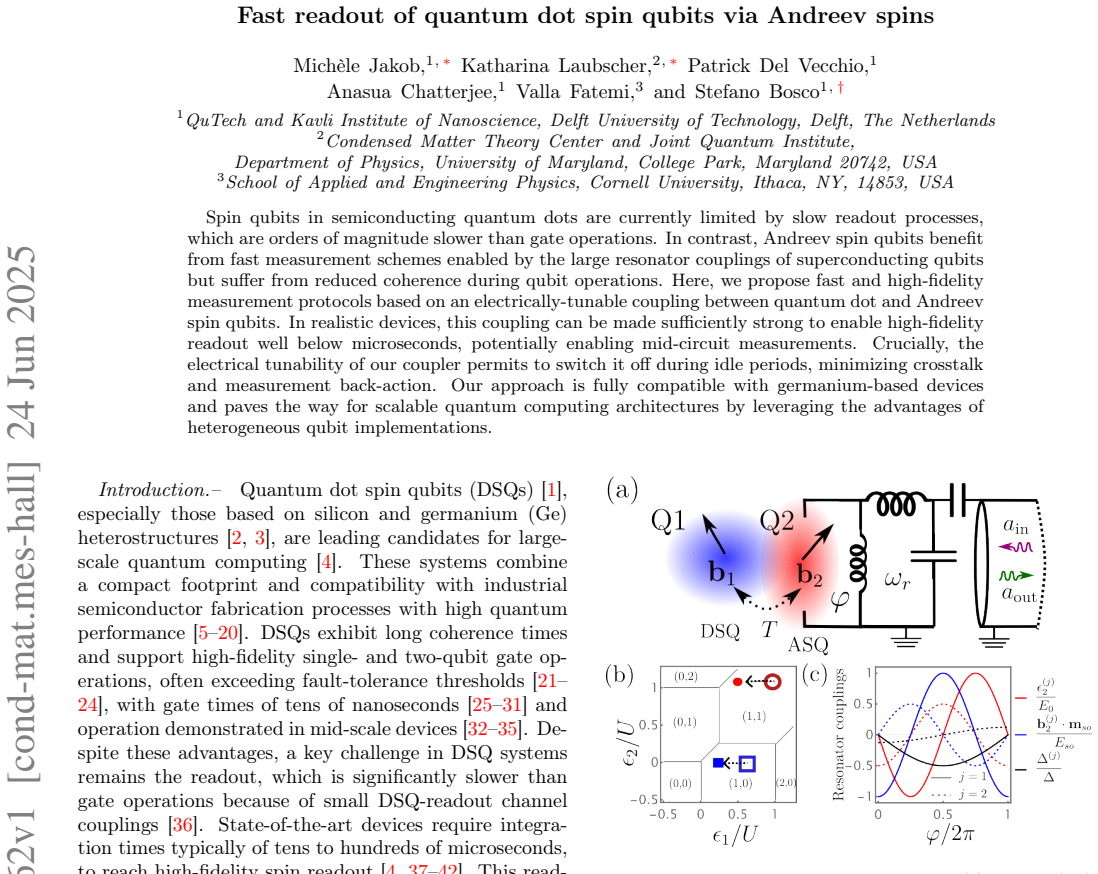
The central object is the effective double-dot Hamiltonian H=H0+HT of Eqs. (1)-(2) and (S2), obtained by Schrieffer-Wolff perturbation theory from a Hubbard model with superconducting leads integrated out. It contains a phase-dependent ASQ energy ε2(φ)=μ2+E0 cos φ, an ASQ Zeeman field b2(φ)=μB B g2 - Eso sin(φ) mso, an induced pairing Δφ=Δ cos(φ/2), and an interdot tunnel term -T(c1† Sso c2 + h.c.) with spin-orbit rotation Sso. The readout mechanism runs through the hybridization parameter η≈$T_φ^{2}$/$ε_φ^{2}$, which converts the ASQ's flux susceptibility into spin-dependent resonator couplings γ(j), and through the exchange-mediated Ising coupling J∥ in the two-particle sector; these produce the spin-dependent shifts χ1 and χ2 that turn a resonator measurement into a spin measurement.
What would settle it
Measure the dispersive shift χ1 or χ2 as a function of resonator frequency, flux φ, and tunnel coupling T in a fabricated Ge DSQ-ASQ device and compare to the predictions of Eqs. (7) and (13); alternatively, run a numerical renormalization-group calculation of the full model at U=1 meV, Δ/h=8 GHz, and check whether the effective couplings change by more than the ~1 MHz shifts claimed.
Extended reading notes
Core claim
On its own terms, the paper establishes that a quantum-dot spin qubit can be read out quickly and non-destructively by hybridizing it with an Andreev spin qubit that is inductively coupled to a microwave resonator. In the single-particle regime, the hybridization parameter η tilts the DSQ Zeeman energy and produces a spin-dependent AC Stark shift χ1, combining a dispersive coupling proportional to |γ(1)×e_z|^2 and a direct inductive coupling proportional to γ(2)·e_z, both of order 1 MHz. In the two-particle regime, a phase-dependent exchange interaction J between the two spins yields a three-body dispersive shift χ2 σ_z^(1) σ_z^(2) a†a, also in the MHz range. With germanium-compatible parameters (Δ/h=8 GHz, E_so/h=350 MHz, E_0/h=900 MHz, zero-point phase φ_r=0.16), the paper's SNR analysis gives readout infidelity below $10^{-3}$ for integration times below one microsecond for all three schemes.
Load-bearing premise
The quantitative predictions assume the simplified effective Hamiltonian remains valid in the realistic regime where electron-electron repulsion is stronger than the superconducting gap, even though the Hamiltonian was derived in the opposite limit.
Editorial extensions
If this is right
- The same physical device can perform both gate operations and fast readout, with the coupler switched on only during measurement to avoid back-action on the DSQ.
- Dispersive, direct, and longitudinal readout all reach infidelity below 0.1% in under a microsecond; the direct and longitudinal schemes avoid the detuning and critical-photon-number constraints of the dispersive regime.
- The exchange-mediated two-particle protocol provides sub-microsecond readout with the ASQ in its ground state, and suppresses SWAP-induced errors by operating at J≪|b1-b2| so that flip-flop times exceed 10 μs.
- The coupler is compatible with germanium-based devices, including unstrained Ge channels with strong spin-orbit coupling, and could mediate entangling operations between distant DSQs.
- If demonstrated, this removes the readout bottleneck that currently dominates spin-qubit error-correction overhead and opens the door to mid-circuit measurements.
Reading between the lines
- Beyond the paper's readout protocols, the same tunable coupler could double as a high-fidelity two-qubit entangling gate between the DSQ and ASQ, merging measurement and connectivity into one hardware element.
- A decisive quantitative test is to measure the flux dependence of the resonator shift: the complementary φ-dependence of the dispersive and direct couplings at φ=0 and φ=π/2 is a sharp fingerprint that would confirm the model or rule it out.
- The quantitative estimates assume independent control of the spin-orbit field and the Josephson phase; any deviation from the assumed Eso sin(φ) dependence would appear as an asymmetry between φ and -φ in the measured shifts and would need calibration.
- Because the zero-bandwidth exact-diagonalization check in the supplemental material is qualitative and more limited for double dots, the sub-microsecond numbers would be on firmer ground after a numerical renormalization-group or multi-site calculation at U=1 meV and Δ/h=8 GHz.
Signed reviews
Editorial analysis
A structured set of objections, weighed in public.
Referee Report
Summary. The paper proposes a hybrid readout architecture in which a germanium quantum-dot spin qubit (DSQ) is tunnel-coupled to an Andreev spin qubit (ASQ), which is in turn inductively coupled to a microwave resonator. The coupling is electrically switchable, so it can be turned off during DSQ gate operations and activated only for measurement. Starting from a model of a proximitized double quantum dot, the authors derive effective low-energy Hamiltonians in the one-particle and two-particle sectors, compute first- and second-order resonator susceptibilities, and use a standard input-output SNR formula to estimate readout infidelity. They report that readout fidelities beyond 99.9% can be achieved in times well below one microsecond via dispersive, direct, or longitudinal coupling, and they give material-specific parameter estimates for unstrained germanium channels.
Significance. If the quantitative prediction survives closer scrutiny, the proposal addresses a real bottleneck: DSQ readout times of tens to hundreds of microseconds are orders of magnitude slower than gate operations, and a sub-microsecond high-fidelity readout would enable mid-circuit measurement and improve quantum error correction overheads. The paper has several genuine strengths: it derives and presents an internally consistent effective Hamiltonian and charge-stability analysis; it gives concrete, material-informed parameter ranges for unstrained Ge devices; it proposes multiple readout protocols (dispersive, direct, longitudinal, and exchange-mediated) with complementary operating points; and it explicitly addresses crosstalk via an electrically switchable coupler. The central quantitative claim is not obtained by fitting any parameter to the claimed fidelity: it is a computed consequence of independently estimated device parameters, which lowers circularity concerns.
major comments (2)
- [Supplemental Material, 'Effective double-dot Hamiltonian'; Fig. 2] Eq. (S2) is derived by Schrieffer-Wolff perturbation theory in the large-gap limit Delta0 >> Uij, but the central Fig. 2 uses U = 1 meV and Delta/h = 8 GHz, i.e. U/Delta ~ 30, which is the opposite regime. The zero-bandwidth exact-diagonalization check in the SM is performed at Delta0 = 0.1U and only compares the phase dependence of low-energy levels qualitatively (Figs. S2, S3); it does not compute the resonator couplings gamma^(1), gamma^(2), chi1, or J at the Fig. 2 parameters. The SM itself states that the ZBA is less reliable for double dots and that NRG or a multi-site ZBA would be needed for quantitative verification. If the large-gap formulas (S6)-(S8) for E0, Eso, and Delta are renormalized by the large charging energy U, the resulting chi1 could drop below kappa/2, and the sub-microsecond >99.9% readout claim would not follow from the presented calculation. A quantitative check of chi1 in the realistic U >> Delta regime is therefore load-bearing for the main claim.
- [Main text, 'Readout fidelity', Eq. (8) and Fig. 2(d)] The headline fidelity, 'beyond 99.9% well below microseconds', is computed from the ideal shot-noise SNR formula in Eq. (8) with the maximal steady-state condition chi1/hbar = kappa/2, and the text explicitly states that reductions from readout chain efficiency and improvements from pulse shaping are neglected. No error budget is given for qubit relaxation during the integration time, measurement-induced dephasing in the dispersive protocol, thermal photon population, or finite detection efficiency. For a claim that is a central motivation of the paper, the authors should either provide a quantitative error-budget analysis or soften the headline to reflect that it is a shot-noise-limited upper bound. This is not a request for a fully detailed experimental analysis, but the sensitivity of the 99.9% figure to realistic inefficiencies should be stated.
minor comments (5)
- [SM, 'Effective double-dot Hamiltonian'] There is a blank cross-reference in the sentence 'Therefore, in Sec. , we will additionally study...'; the section number is missing and should be inserted.
- [SM, 'Estimation of ASQ parameters in germanium'] In the sentence 'In paricular, we use E_so/h = 350 MHz...' there is a typo: 'paricular' should be 'particular'.
- [Main text, 'Tunable ASQ-DSQ coupler' versus SM, 'Estimation of ASQ parameters in germanium'] The main text states E_so/h in [10-500] MHz while the SM estimates E_so/h in [10-600] MHz; the ranges should be made consistent or the discrepancy explained.
- [Main text, Eqs. (6a)-(6b)] The symbols eta^(1) and eta^(2) are used as derivatives of eta with respect to phi, but this notation is not defined in the main text; a brief definition in the main text would improve readability.
- [Main text, 'Readout fidelity', Eq. (8)] The input amplitude A in Eq. (8) is not explicitly related to the drive power or the photon number nbar; adding this relation would make the SNR formula directly reproducible.
Circularity Check
No circular derivation found: the sub-microsecond, >99.9% readout claim is a computed consequence of independently estimated device parameters, with only a minor overlapping-author SOI calibration and an admitted validity-regime caveat.
full rationale
The paper's central quantitative claim is a forward calculation, not a fit. Equation (4) is obtained by third-order perturbation theory from the model Eqs. (S1)-(S2); Eqs. (6)-(7) then give the resonator-spin couplings chi1 from the hybridization eta and the ASQ susceptibilities; Eq. (8) is the standard input-output SNR formula. No parameter in this chain is fitted to the 99.9% fidelity or to the sub-microsecond integration time. The readout curves in Fig. 2(d) use the textbook optimal condition chi1/hbar = kappa/2 and set the drive amplitude through the photon number, but they do not reverse-engineer chi1 from the desired fidelity. The device parameters (U = 1 meV, T/h = 5 GHz, Delta/h = 8 GHz, E_so/h = 0.35 GHz, E_0/h = 0.9 GHz, phi_r = 0.16) are estimated in the Supplemental Material from a 6-band k.p calculation for unstrained Ge and from experimental proximity gaps, with explicit ranges and formulas. The only overlapping-author input is Ref. [71], which supplies beta2 for the buried unstrained Ge channel; that is a parameter-free microscopic material calculation, not a fit to the readout target, so it does not make the central claim circular. The biggest caveat is the regime mismatch: the effective Hamiltonian Eq. (S2) is derived for Delta0 >> U_ij, while Fig. 2 uses U >> Delta. The authors acknowledge this and provide a zero-bandwidth exact-diagonalization check, explicitly stating that a more quantitative NRG or multi-site ZBA verification is needed. This is a correctness and robustness concern, not a circularity: the prediction does not reduce to its inputs by construction. There is also no imported uniqueness theorem and no ansatz smuggled in solely through self-citation. The paper is therefore essentially non-circular; the score of 2 reflects only the minor calibration inheritance from the overlapping-author preprint, which is not load-bearing for the derivation itself.
Assumptions & free parameters
free parameters (7)
- Eso/h (ASQ spin-orbit energy) =
350 MHz
- E0/h (ASQ Josephson energy) =
900 MHz
- Delta/h (effective induced pairing) =
8 GHz
- T/h (interdot tunneling during readout) =
5 GHz
- U11 = U22 and U12 with U = 1 meV =
1 meV, 0.25 meV
- phi_r (zero-point phase) =
0.16
- Readout operating point (nbar, kappa = 2 chi1) =
nbar = 2 or 10, kappa = 2 chi1/hbar
assumptions (6)
- domain assumption Valid effective low-energy Hamiltonian for the ASQ-DSQ hybrid in the parameter regime of the headline numbers.
- domain assumption Large spin-orbit interaction in unstrained Ge channels (beta2 ~ 850 meV nm^3) is available as assumed.
- domain assumption The DSQ spin remains confined and unperturbed during readout; hybridization is captured by eta without charge transfer.
- domain assumption The interdot tunneling T can be switched off during idle periods without residual crosstalk or measurement back-action.
- standard math Standard circuit-QED dispersive and direct readout formulas, Eqs. (7) and (8), apply.
- domain assumption The ASQ retains a spin-doublet ground state for the chosen parameters, with no full Kondo screening.
Cite this review
Pith. "Pith review of Fast readout of quantum dot spin qubits via Andreev spins." pith.science (2026). https://pith.science/paper/A6T63OK5
@misc{pith2026250619762,
  author       = {Pith},
  title        = {Pith review of: Fast readout of quantum dot spin qubits via Andreev spins},
  year         = {2026},
  howpublished = {\url{https://pith.science/paper/A6T63OK5}},
  note         = {Machine review of arXiv:2506.19762}
}
read the original abstract
Spin qubits in semiconducting quantum dots are currently limited by slow readout processes, which are orders of magnitude slower than gate operations. In contrast, Andreev spin qubits benefit from fast measurement schemes enabled by the large resonator couplings of superconducting qubits but suffer from reduced coherence during qubit operations. Here, we propose fast and high-fidelity measurement protocols based on an electrically-tunable coupling between quantum dot and Andreev spin qubits. In realistic devices, this coupling can be made sufficiently strong to enable high-fidelity readout well below microseconds, potentially enabling mid-circuit measurements. Crucially, the electrical tunability of our coupler permits to switch it off during idle periods, minimizing crosstalk and measurement back-action. Our approach is fully compatible with germanium-based devices and paves the way for scalable quantum computing architectures by leveraging the advantages of heterogeneous qubit implementations.
Figures


Forward citations
Cited by 1 Pith paper
-
Andreev spin qubits based on the helical edge states of magnetically doped two-dimensional topological insulators
Magnetic doping of the weak link in a quantum spin Hall Josephson junction enables electric-dipole microwave control of Andreev spin qubits.
Reference graph
Works this paper leans on
-
[1]
Loss and D
D. Loss and D. P. DiVincenzo, Quantum computation with quantum dots, Phys. Rev. A57, 120 (1998)
1998
-
[2]
AtZr = 300 Ωandp= 0.3,φ r = 0.16
The effective zero- point-phaseφ r =p p 2πZr/Rq∈[0.02−1]depends on the resonator impedanceZr∈[0.05−1]kΩ, the super- conducting resistance quantumRq =h/4e 2 [96], and is rescaled by the participation ratiop∈[0.1−1]account- ingforthepartialfractionoftheresonatorphasereaching the ASQ. AtZr = 300 Ωandp= 0.3,φ r = 0.16. We restrict to low-impedance resonators ...
-
[3]
This coupling en- ablesanefficientreadout[111,121]intheshort-timelimit with SNRz =|g z| p 8tm/κ 1−2 1−e −κtm/2 /κtm , see black lines in Fig
We estimate that by modulatingT,g z/hcan reach the MHz range also when the DSQ and ASQ are detuned. This coupling en- ablesanefficientreadout[111,121]intheshort-timelimit with SNRz =|g z| p 8tm/κ 1−2 1−e −κtm/2 /κtm , see black lines in Fig. 2(d), offering another fast DSQ- readout option. Two-particle regime.–We also examine the (1,1) sec- tor of the cha...
-
[4]
Scappucci, C
G. Scappucci, C. Kloeffel, F. A. Zwanenburg, D. Loss, M. Myronov, J.-J. Zhang, S. De Franceschi, G. Kat- saros, and M. Veldhorst, The germanium quantum information route, Nature Reviews Materials6, 926 (2021)
2021
-
[5]
Burkard, T
G. Burkard, T. D. Ladd, A. Pan, J. M. Nichol, and J. R. Petta, Semiconductor spin qubits, Rev. Mod. Phys.95, 025003 (2023)
2023
-
[6]
Stano and D
P. Stano and D. Loss, Review of performance metrics of spin qubits in gated semiconducting nanostructures, Nature Reviews Physics4, 672 (2022)
2022
-
[7]
Neyens, O
S. Neyens, O. K. Zietz, T. F. Watson, F. Luthi, A. Neth- wewala, H. C. George, E. Henry, M. Islam, A. J. Wag- ner, F. Borjans, E. J. Connors, J. Corrigan, M. J. Curry, D. Keith, R. Kotlyar, L. F. Lampert, M. T. Mądzik, K. Millard, F. A. Mohiyaddin, S. Pellerano, R. Pil- larisetty, M.Ramsey, R.Savytskyy, S.Schaal, G.Zheng, J. Ziegler, N. C. Bishop, S. Boja...
2024
-
[8]
Maurand, X
R. Maurand, X. Jehl, D. Kotekar-Patil, A. Corna, H. Bohuslavskyi, R. Laviéville, L. Hutin, S. Barraud, M. Vinet, M. Sanquer, and S. De Franceschi, A cmos silicon spin qubit, Nature communications7, 1 (2016)
2016
Show all 128 references
-
[9]
N.Piot, B.Brun, V.Schmitt, S.Zihlmann, V.P.Michal, A. Apra, J. C. Abadillo-Uriel, X. Jehl, B. Bertrand, H. Niebojewski, L. Hutin, M. Vinet, M. Urdampilleta, T. Meunier, Y.-M. Niquet, R. Maurand, and S. D. Franceschi, A single hole spin with enhanced coher- ence in natural sili...
2022
-
[10]
L. C. Camenzind, S. Geyer, A. Fuhrer, R. J. Warbur- ton, D. M. Zumbühl, and A. V. Kuhlmann, A hole spin qubit in a fin field-effect transistor above 4kelvin, Na- ture Electronics 10.1038/s41928-022-00722-0 (2022)
2022 doi
-
[11]
Bosco, S
S. Bosco, S. Geyer, L. C. Camenzind, R. S. Eggli, A. Fuhrer, R. J. Warburton, D. M. Zumbühl, J. C. Egues, A. V. Kuhlmann, and D. Loss, Phase-driving hole spin qubits, Phys. Rev. Lett.131, 197001 (2023)
2023
-
[12]
Bosco, B
S. Bosco, B. Hetényi, and D. Loss, Hole spin qubits inSi finfets with fully tunable spin-orbit coupling and sweet spots for charge noise, PRX Quantum2, 010348 (2021)
2021
-
[13]
Petit, H
L. Petit, H. G. J. Eenink, M. Russ, W. I. L. Lawrie, N. W. Hendrickx, S. G. J. Philips, J. S. Clarke, L. M. K. Vandersypen, and M. Veldhorst, Universal quantum logic in hot silicon qubits, Nature580, 355 (2020)
2020
-
[14]
X. Xue, B. Patra, J. P. G. van Dijk, N. Samkharadze, S. Subramanian, A. Corna, B. Paquelet Wuetz, C. Jeon, F.Sheikh, E.Juarez-Hernandez, B.P.Esparza, H.Ram- purawala, B. Carlton, S. Ravikumar, C. Nieva, S. Kim, H.-J. Lee, A. Sammak, G. Scappucci, M. Veldhorst, F. Sebastiano, M...
2021
-
[15]
A. M. J. Zwerver, T. Krähenmann, T. F. Watson, L. Lampert, H. C. George, R. Pillarisetty, S. A. Bojarski, P. Amin, S. V. Amitonov, J. M. Boter, R. Caudillo, D. Correas-Serrano, J. P. Dehollain, G. Droulers, E. M. Henry, R. Kotlyar, M. Lodari, F. Lüthi, D. J. Michalak, B. K. Mu...
2022
-
[16]
H. C. George, M. T. Mądzik, E. M. Henry, A. J. Wag- ner, M. M. Islam, F. Borjans, E. J. Connors, J. Cor- rigan, M. Curry, M. K. Harper, D. Keith, L. Lam- pert, F. Luthi, F. A. Mohiyaddin, S. Murcia, R. Nair, R. Nahm, A. Nethwewala, S. Neyens, B. Patra, R. D. Raharjo, C. Rogan,...
2025
-
[17]
Steinacker, N
P. Steinacker, N. D. Stuyck, W. H. Lim, T. Tanttu, M. Feng, A. Nickl, S. Serrano, M. Candido, J. D. Ci- fuentes, F. E. Hudson,et al., A 300 mm foundry silicon spin qubit unit cell exceeding 99% fidelity in all opera- tions, arXiv:2410.15590 (2024)
2024 arXiv
-
[18]
Jirovec, A
D. Jirovec, A. Hofmann, A. Ballabio, P. M. Mutter, G. Tavani, M. Botifoll, A. Crippa, J. Kukucka, O. Sagi, F. Martins, J. Saez-Mollejo, I. Prieto, M. Borovkov, J. Arbiol, D. Chrastina, G. Isella, and G. Katsaros, A singlet-triplet hole spin qubit in planar ge, Nature Ma- teria...
2021
-
[19]
Yoneda, K
J. Yoneda, K. Takeda, T. Otsuka, T. Nakajima, M. R. Delbecq, G. Allison, T. Honda, T. Kodera, S. Oda, Y. Hoshi, N. Usami, K. M. Itoh, and S. Tarucha, A quantum-dot spin qubit with coherence limited by charge noise and fidelity higher than 99.9%, Nature Nanotechnology13, 102 (2018)
2018
-
[20]
Takeda, A
K. Takeda, A. Noiri, T. Nakajima, T. Kobayashi, and S. Tarucha, Quantum error correction with silicon spin qubits, Nature608, 682 (2022)
2022
-
[21]
S. D. Liles, D. J. Halverson, Z. Wang, A. Shamim, R. S. Eggli, I. K. Jin, J. Hillier, K. Kumar, I. Vorreiter, M. J. Rendell, J. Y. Huang, C. C. Escott, F. E. Hudson, W. H. Lim, D. Culcer, A. S. Dzurak, and A. R. Hamilton, A singlet-triplet hole-spin qubit in mos silicon, Natur...
2024
-
[22]
Borsoi, N
F. Borsoi, N. W. Hendrickx, V. John, M. Meyer, S. Motz, F. van Riggelen, A. Sammak, S. L. de Snoo, G. Scappucci, and M. Veldhorst, Shared control of a 16semiconductor quantum dot crossbar array, Nature Nanotechnology 10.1038/s41565-023-01491-3 (2023)
2023 doi
-
[23]
X. Xue, M. Russ, N. Samkharadze, B. Undseth, A. Sam- mak, G. Scappucci, and L. M. K. Vandersypen, Quan- tum logic with spin qubits crossing the surface code threshold, Nature601, 343 (2022)
2022
-
[24]
A. R. Mills, C. R. Guinn, M. J. Gullans, A. J. Sig- illito, M. M. Feldman, E. Nielsen, and J. R. Petta, Two- qubit silicon quantum processor with operation fidelity exceeding 99%, Science Advances8, eabn5130 (2022)
2022
-
[25]
Noiri, K
A. Noiri, K. Takeda, T. Nakajima, T. Kobayashi, A. Sammak, G. Scappucci, and S. Tarucha, Fast univer- sal quantum gate above the fault-tolerance threshold in silicon, Nature601, 338 (2022)
2022
-
[26]
W. I. L. Lawrie, M. Rimbach-Russ, F. v. Riggelen, N. W. Hendrickx, S. L. d. Snoo, A. Sammak, G. Scap- pucci, J. Helsen, and M. Veldhorst, Simultaneous single- qubit driving of semiconductor spin qubits at the fault- tolerant threshold, Nature Communications14, 3617 (2023)
2023
-
[27]
Hendrickx, D
N. Hendrickx, D. Franke, A. Sammak, G. Scappucci, and M. Veldhorst, Fast two-qubit logic with holes in germanium, Nature577, 487 (2020)
2020
-
[28]
Geyer, B
S. Geyer, B. Hetényi, S. Bosco, L. C. Camenzind, R. S. Eggli, A. Fuhrer, D. Loss, R. J. Warburton, D. M. Zum- bühl, and A. V. Kuhlmann, Anisotropic exchange inter- action of two hole-spin qubits, Nature Physics20, 1152 (2024)
2024
-
[29]
C.-A. Wang, V. John, H. Tidjani, C. X. Yu, A. S. Ivlev, C. Déprez, F. van Riggelen-Doelman, B. D. Woods, N. W. Hendrickx, W. I. L. Lawrie, L. E. A. Stehouwer, S. D. Oosterhout, A. Sammak, M. Friesen, G. Scap- pucci, S. L. de Snoo, M. Rimbach-Russ, F. Borsoi, and M. Veldhorst, ...
2024
-
[30]
M. J. Carballido, S. Svab, R. S. Eggli, T. Patlatiuk, P. C. Kwon, J. Schuff, R. M. Kaiser, L. C. Camenzind, A. Li, N. Ares,et al., Compromise-free scaling of qubit speed and coherence, arXiv:2402.07313 (2024)
2024 arXiv
-
[31]
Bassi, E.-A
M. Bassi, E.-A. Rodrıguez-Mena, B. Brun, S. Zihlmann, T. Nguyen, V. Champain, J. C. Abadillo-Uriel, B. Bertrand, H. Niebojewski, R. Maurand,et al., Op- timal operation of hole spin qubits, arXiv:2412.13069 (2024)
2024
-
[32]
F. N. M. Froning, L. C. Camenzind, O. A. H. van der Molen, A. Li, E. P. A. M. Bakkers, D. M. Zumbühl, and F. R. Braakman, Ultrafast hole spin qubit with gate- tunable spin–orbit switch functionality, Nature Nan- otechnology16, 308 (2021)
2021
-
[33]
K. Wang, G. Xu, F. Gao, H. Liu, R.-L. Ma, X. Zhang, Z. Wang, G. Cao, T. Wang, J.-J. Zhang, D. Culcer, X. Hu, H.-W. Jiang, H.-O. Li, G.-C. Guo, and G.-P. Guo, Ultrafast coherent control of a hole spin qubit in a germanium quantum dot, Nature Communications13, 206 (2022)
2022
-
[34]
V. John, C. X. Yu, B. van Straaten, E. A. Rodríguez- Mena, M. Rodríguez, S. Oosterhout, L. E. Stehouwer, G. Scappucci, S. Bosco, M. Rimbach-Russ,et al., A two- dimensional 10-qubit array in germanium with robust and localised qubit control, arXiv:2412.16044 (2024)
2024
-
[35]
S. G. J. Philips, M. T. Madzik, S. V. Amitonov, S. L. de Snoo, M. Russ, N. Kalhor, C. Volk, W. I. L. Lawrie, D. Brousse, L. Tryputen, B. P. Wuetz, A. Sammak, M. Veldhorst, G. Scappucci, and L. M. K. Vandersypen, Universal control of a six-qubit quantum processor in silicon, Na...
2022
-
[36]
N. W. Hendrickx, W. I. L. Lawrie, M. Russ, F. van Riggelen, S. L. de Snoo, R. N. Schouten, A. Sammak, G. Scappucci, and M. Veldhorst, A four-qubit germa- nium quantum processor, Nature591, 580 (2021)
2021
-
[37]
Zhang, E
X. Zhang, E. Morozova, M. Rimbach-Russ, D. Jirovec, T.-K. Hsiao, P. C. Fariña, C.-A. Wang, S. D. Oost- erhout, A. Sammak, G. Scappucci, M. Veldhorst, and L. M. K. Vandersypen, Universal control of four singlet– triplet qubits, Nature Nanotechnology20, 209 (2025)
2025
-
[38]
Vigneau, F
F. Vigneau, F. Fedele, A. Chatterjee, D. Reilly, F. Kuemmeth, M. F. Gonzalez-Zalba, E. Laird, and N. Ares, Probing quantum devices with radio-frequency reflectometry, Applied Physics Reviews10, 021305 (2023)
2023
-
[39]
Harvey-Collard, B
P. Harvey-Collard, B. D’Anjou, M. Rudolph, N. T. Ja- cobson, J. Dominguez, G. A. Ten Eyck, J. R. Wendt, T. Pluym, M. P. Lilly, W. A. Coish, M. Pioro-Ladrière, and M. S. Carroll, High-fidelity single-shot readout for a spin qubit via an enhanced latching mechanism, Phys. Rev. X...
2018
-
[40]
G. A. Oakes, V. N. Ciriano-Tejel, D. F. Wise, M. A. Fogarty, T. Lundberg, C. Lainé, S. Schaal, F. Martins, D. J. Ibberson, L. Hutin, B. Bertrand, N. Stelmashenko, J. W. A. Robinson, L. Ibberson, A. Hashim, I. Sid- diqi, A. Lee, M. Vinet, C. G. Smith, J. J. L. Morton, and M. F....
2023
-
[41]
E. J. Connors, J. Nelson, and J. M. Nichol, Rapid high- fidelity spin-state readout inSi/Si-Gequantum dots via rf reflectometry, Phys. Rev. Appl.13, 024019 (2020)
2020
-
[42]
Zheng, N
G. Zheng, N. Samkharadze, M. L. Noordam, N. Kalhor, D. Brousse, A. Sammak, G. Scappucci, and L. M. K. Vandersypen, Rapid gate-based spin read-out in silicon using an on-chip resonator, Nature Nanotechnology14, 742 (2019)
2019
-
[43]
Urdampilleta, D
M. Urdampilleta, D. J. Niegemann, E. Chanrion, B. Jadot, C. Spence, P.-A. Mortemousque, C. Bäuerle, L. Hutin, B. Bertrand, S. Barraud, R. Maurand, M. Sanquer, X. Jehl, S. De Franceschi, M. Vinet, and T. Meunier, Gate-based high fidelity spin readout in a cmos device, Nature Na...
2019
-
[44]
R. Zhao, T. Tanttu, K. Y. Tan, B. Hensen, K. W. Chan, J. C. C. Hwang, R. C. C. Leon, C. H. Yang, W. Gilbert, F. E. Hudson, K. M. Itoh, A. A. Kiselev, T. D. Ladd, A. Morello, A. Laucht, and A. S. Dzurak, Single-spin qubits in isotopically enriched silicon at low magnetic field,...
2019
-
[45]
N. M. Chtchelkatchev and Y. V. Nazarov, Andreev quantum dots for spin manipulation, Phys. Rev. Lett. 90, 226806 (2003)
2003
-
[46]
Park and A
S. Park and A. L. Yeyati, Andreev spin qubits in mul- tichannel rashba nanowires, Phys. Rev. B96, 125416 (2017)
2017
-
[47]
M. Hays, V. Fatemi, D. Bouman, J. Cerrillo, S. Di- amond, K. Serniak, T. Connolly, P. Krogstrup, J. Nygård, A. L. Yeyati, A. Geresdi, and M. H. De- voret, Coherent manipulation of an andreev spin qubit, Science373, 430 (2021)
2021
-
[48]
M. Hays, V. Fatemi, K. Serniak, D. Bouman, S. Di- amond, G. de Lange, P. Krogstrup, J. Nygård, A. Geresdi, and M. H. Devoret, Continuous monitor- ing of a trapped superconducting spin, Nature Physics 16, 1103 (2020)
2020
-
[49]
Pita-Vidal, A
M. Pita-Vidal, A. Bargerbos, R. Žitko, L. J. Splitthoff, L. Grünhaupt, J. J. Wesdorp, Y. Liu, L. P. Kouwen- hoven, R. Aguado, B. van Heck, A. Kou, and C. K. An- dersen, Direct manipulation of a superconducting spin qubit strongly coupled to a transmon qubit, Nature Physics19, ...
2023
-
[50]
Pita-Vidal, J
M. Pita-Vidal, J. J. Wesdorp, L. J. Splitthoff, A. Barg- erbos, Y. Liu, L. P. Kouwenhoven, and C. K. Andersen, Strong tunable coupling between two distant supercon- ducting spin qubits, Nature Physics20, 1158 (2024)
2024
-
[51]
Bargerbos, M
A. Bargerbos, M. Pita-Vidal, R. Žitko, L. J. Splitthoff, L. Grünhaupt, J. J. Wesdorp, Y. Liu, L. P. Kouwen- hoven, R. Aguado, C. K. Andersen, A. Kou, and B. van Heck, Spectroscopy of spin-split andreev levels in a quantum dot with superconducting leads, Phys. Rev. Lett.131, 09...
2023
-
[52]
Bargerbos, M
A. Bargerbos, M. Pita-Vidal, R. Žitko, J. Ávila, L. J. Splitthoff, L. Grünhaupt, J. J. Wesdorp, C. K. Ander- sen, Y. Liu, L. P. Kouwenhoven, R. Aguado, A. Kou, and B. van Heck, Singlet-doublet transitions of a quan- tum dot josephson junction detected in a transmon cir- cuit, ...
2022
-
[53]
L.Tosi, C.Metzger, M.F.Goffman, C.Urbina, H.Poth- ier, S. Park, A. L. Yeyati, J. Nygård, and P. Krogstrup, Spin-orbit splitting of andreev states revealed by mi- crowave spectroscopy, Phys. Rev. X9, 011010 (2019)
2019
-
[54]
H. Lu, D. F. Bofill, Z. Sun, T. Kanne, J. Nygard, M. Kjaergaard, and V. Fatemi, Andreev spin relax- ation time in a shadow-evaporated inas weak link, arXiv:2501.11627 (2025)
2025 arXiv
-
[55]
Hoffman, M
S. Hoffman, M. Hays, K. Serniak, T. Hazard, and C. Tahan, Decoherence in andreev spin qubits, Phys. Rev. B111, 045304 (2025)
2025
-
[56]
Lakic, W
L. Lakic, W. I. L. Lawrie, D. van Driel, L. E. A. Ste- houwer, Y. Su, M. Veldhorst, G. Scappucci, F. Kuem- meth, and A. Chatterjee, A quantum dot in germanium proximitized by a superconductor, Nature Materials24, 552 (2025)
2025
-
[57]
Hinderling, S
M. Hinderling, S. C. ten Kate, M. Coraiola, D. Hax- ell, M. Stiefel, M. Mergenthaler, S. Paredes, S. Be- dell, D. Sabonis, and F. Nichele, Direct microwave spec- troscopy of andreev bound states in planarGejosephson junctions, PRX Quantum5, 030357 (2024)
2024
-
[58]
Adelsberger, H
C. Adelsberger, H. F. Legg, D. Loss, and J. Klinovaja, Microscopic analysis of proximity-induced supercon- ductivity and metallization effects in superconductor- germanium hole nanowires, Phys. Rev. B108, 155433 (2023)
2023
-
[59]
S. S. Babkin, B. Joecker, K. Flensberg, M. Serbyn, and J. Danon, Superconducting proximity effect in two-dimensional hole gases, Phys. Rev. B111, 214518 (2025)
2025
-
[60]
P. D. Johannsen, H. F. Legg, S. Bosco, D. Loss, and J. Klinovaja, Anomalous josephson effect in hybrid superconductor-hole systems, arXiv:2504.21817 (2025)
2025
-
[61]
D. M. Pino, R. S. Souto, M. J. Calderón, R. Aguado, and J. C. Abadillo-Uriel, Theory of superconducting proximity effect in hole-based hybrid semiconductor- superconductor devices, Phys. Rev. B111, 235443 (2025)
2025
-
[62]
Luethi, K
M. Luethi, K. Laubscher, S. Bosco, D. Loss, and J. Kli- novaja, Planar josephson junctions in germanium: Ef- fect of cubic spin-orbit interaction, Phys. Rev. B107, 035435 (2023)
2023
-
[63]
Laubscher, J
K. Laubscher, J. D. Sau, and S. Das Sarma, Majorana zero modes in gate-defined germanium hole nanowires, Phys. Rev. B109, 035433 (2024)
2024
-
[64]
Tosato, V
A. Tosato, V. Levajac, J.-Y. Wang, C. J. Boor, F. Bor- soi, M. Botifoll, C. N. Borja, S. Martí-Sánchez, J. Ar- biol, A. Sammak, M. Veldhorst, and G. Scappucci, Hard superconducting gap in germanium, Communications Materials4, 23 (2023)
2023
-
[65]
Scappucci, J
K.Aggarwal, A.Hofmann, D.Jirovec, I.Prieto, A.Sam- mak, M.Botifoll, S.Martí-Sánchez, M.Veldhorst, J.Ar- biol, G. Scappucci, J. Danon, and G. Katsaros, En- hancement of proximity-induced superconductivity in a planar ge hole gas, Phys. Rev. Res.3, L022005 (2021)
2021
-
[66]
J. A. Steele, P. J. Strohbeen, C. Verdi, A. Baktash, A. Danilenko, Y.-H. Chen, J. van Dijk, L. Wang, E. Demler, S. Salmani-Rezaie, P. Jacobson, and J. Sha- bani, Coherent superconductor-semiconductor epitaxy for integrated quantum electronics, arXiv:2412.15421 (2024). 8
2024
-
[67]
O. Sagi, A. Crippa, M. Valentini, M. Janik, L. Baghumyan, G. Fabris, L. Kapoor, F. Hassani, J. Fink, S. Calcaterra, D. Chrastina, G. Isella, and G. Katsaros, A gate tunable transmon qubit in planar ge, Nature Communications15, 6400 (2024)
2024
-
[68]
Kiyooka, C
E. Kiyooka, C. Tangchingchai, L. Noirot, A. Leblanc, B. Brun, S. Zihlmann, R. Maurand, V. Schmitt, É. Du- mur, J.-M. Hartmann, F. Lefloch, and S. De Franceschi, Gatemon qubit on a germanium quantum-well het- erostructure, Nano Letters25, 562 (2025)
2025
-
[69]
Moutanabbir, S
O. Moutanabbir, S. Assali, A. Attiaoui, G. Daligou, P. Daoust, P. D. Vecchio, S. Koelling, L. Luo, and N. Rotaru, Nuclear spin-depleted, isotopically enriched 70ge/28si70ge quantum wells, Advanced Materials36, 2305703 (2024)
2024
-
[70]
Fischer, W
J. Fischer, W. A. Coish, D. V. Bulaev, and D. Loss, Spin decoherence of a heavy hole coupled to nuclear spins in a quantum dot, Phys. Rev. B78, 155329 (2008)
2008
-
[71]
Bosco and D
S. Bosco and D. Loss, Fully tunable hyperfine interac- tions of hole spin qubits in si and ge quantum dots, Phys. Rev. Lett.127, 190501 (2021)
2021
-
[72]
Philippopoulos, S
P. Philippopoulos, S. Chesi, and W. A. Coish, First- principles hyperfine tensors for electrons and holes in gaas and silicon, Phys. Rev. B101, 115302 (2020)
2020
-
[73]
Costa, K
D. Costa, K. Hudson, P. D. Vecchio, L. E. A. Ste- houwer, A. Tosato, D. D. Esposti, M. Lodari, S. Bosco, and G. Scappucci, Buried unstrained ge channels: a lattice-matched platform for quantum technology, arXiv:2506.04724 (2025)
2025 arXiv
-
[74]
Bosco, M
S. Bosco, M. Benito, C. Adelsberger, and D. Loss, Squeezed hole spin qubits in ge quantum dots with ul- trafast gates at low power, Phys. Rev. B104, 115425 (2021)
2021
-
[75]
Mauro, M
L. Mauro, M. J. Rodriguez, E. A. Rodriguez-Mena, and Y.-M. Niquet, Hole spin qubits in unstrained germa- nium layers, arXiv:2506.04977 (2025)
2025 arXiv
-
[76]
Del Vecchio, S
P. Del Vecchio, S. Bosco, D. Loss, and O. Moutanab- bir, Fully tunable strong spin-orbit interactions in light hole germanium quantum channels, arXiv:2506.14759 (2025)
2025 arXiv
-
[77]
Del Vecchio and O
P. Del Vecchio and O. Moutanabbir, Light-hole gate- defined spin-orbit qubit, Phys. Rev. B107, L161406 (2023)
2023
-
[78]
Del Vecchio and O
P. Del Vecchio and O. Moutanabbir, Light-hole spin confined in germanium, Phys. Rev. B110, 045409 (2024)
2024
-
[79]
Leblanc, C
A. Leblanc, C. Tangchingchai, Z. Sadre Momtaz, E. Kiyooka, J.-M. Hartmann, F. Gustavo, J.-L. Thomassin, B. Brun, V. Schmitt, S. Zihlmann, R. Mau- rand, É. Dumur, S. De Franceschi, and F. Lefloch, Gate- and flux-tunable sin(2ϕ) josephson element with planar- ge junctions, Natur...
2025
-
[80]
Valentini, O
M. Valentini, O. Sagi, L. Baghumyan, T. de Gi- jsel, J. Jung, S. Calcaterra, A. Ballabio, J. Aguil- era Servin, K. Aggarwal, M. Janik, T. Adletzberger, R. Seoane Souto, M. Leijnse, J. Danon, C. Schrade, E. Bakkers, D. Chrastina, G. Isella, and G. Katsaros, Parity-conserving co...
2024
-
[81]
Spethmann, S
M. Spethmann, S. Bosco, A. Hofmann, J. Klinovaja, and D. Loss, High-fidelity two-qubit gates of hybrid superconducting-semiconducting singlet-triplet qubits, Phys. Rev. B109, 085303 (2024)
2024
-
[82]
H.-S. Goan, G. J. Milburn, H. M. Wiseman, and H. Bi Sun, Continuous quantum measurement of two coupled quantum dots using a point contact: A quan- tum trajectory approach, Phys. Rev. B63, 125326 (2001)
2001
-
[83]
Boissonneault, J
M. Boissonneault, J. M. Gambetta, and A. Blais, Dis- persive regime of circuit qed: Photon-dependent qubit dephasingandrelaxationrates,Phys.Rev.A79,013819 (2009)
2009
-
[84]
Svastits, B
D. Svastits, B. Hetényi, G. Széchenyi, J. Wootton, D. Loss, S. Bosco, and A. Pályi, Readout sweet spots for spin qubits with strong spin-orbit interaction, arXiv:2505.15878 (2025)
2025 arXiv
-
[85]
Pita-Vidal, J
M. Pita-Vidal, J. J. Wesdorp, and C. K. Andersen, Blueprint for all-to-all-connected superconducting spin qubits, PRX Quantum6, 010308 (2025)
2025
-
[86]
H. Lu, I. A. Day, A. R. Akhmerov, B. van Heck, and V. Fatemi, Kramers-protected hardware-efficient error correction with andreev spin qubits, arXiv:2412.16116 (2024)
2024
-
[87]
L. M. K. Vandersypen, H. Bluhm, J. S. Clarke, A. S. Dzurak, R. Ishihara, A. Morello, D. J. Reilly, L. R. Schreiber, and M. Veldhorst, Interfacing spin qubits in quantum dots and donors—hot, dense, and coherent, npj Quantum Information3, 34 (2017)
2017
-
[88]
See the Supplemental Material for more details on the derivation of the effective Hamiltonian for the coupler used in the main text and on the estimation of Andreev spin qubit parameters in planar germanium heterostruc- tures
-
[89]
W. G. van der Wiel, S. De Franceschi, J. M. Elzerman, T. Fujisawa, S. Tarucha, and L. P. Kouwenhoven, Elec- trontransportthroughdoublequantumdots,Rev.Mod. Phys.75, 1 (2002)
2002
-
[90]
J. C. Abadillo-Uriel, E. A. Rodríguez-Mena, B. Mar- tinez, and Y.-M. Niquet, Hole-spin driving by strain- induced spin-orbit interactions, Phys. Rev. Lett.131, 097002 (2023)
2023
-
[91]
C.-A. Wang, H. E. Ercan, M. F. Gyure, G. Scappucci, M. Veldhorst, and M. Rimbach-Russ, Modeling of pla- nar germanium hole qubits in electric and magnetic fields, npj Quantum Information10, 102 (2024)
2024
-
[92]
Rimbach-Russ, V
M. Rimbach-Russ, V. John, B. van Straaten, and S. Bosco, A spinless spin qubit, arXiv:2412.13658 (2024)
2024
-
[93]
L. A. Terrazos, E. Marcellina, Z. Wang, S. N. Copper- smith, M. Friesen, A. R. Hamilton, X. Hu, B. Koiller, A. L. Saraiva, D. Culcer, and R. B. Capaz, Theory of hole-spin qubits in strained germanium quantum dots, Phys. Rev. B103, 125201 (2021)
2021
-
[94]
Seoane Souto and R
R. Seoane Souto and R. Aguado, Subgap states in semiconductor-superconductor devices for quantum technologies: Andreev qubits and minimal majorana chains,inNew Trends and Platforms for Quantum Tech- nologies, edited by R. Aguado, R. Citro, M. Lewenstein, and M. Stern (Springer...
-
[95]
Žonda, P
M. Žonda, P. Zalom, T. c. v. Novotný, G. Loukeris, J. Bätge, and V. Pokorný, Generalized atomic limit of a double quantum dot coupled to superconducting leads, Phys. Rev. B107, 115407 (2023)
2023
-
[96]
Vecino, A
E. Vecino, A. Martín-Rodero, and A. L. Yeyati, Joseph- son current through a correlated quantum level: An- dreev states andπjunction behavior, Phys. Rev. B68, 9 035105 (2003)
2003
-
[97]
Zalom, K
P. Zalom, K. Wrześniewski, T. c. v. Novotný, and I. Weymann, Double quantum dot andreev molecules: Phase diagrams and critical evaluation of effective mod- els, Phys. Rev. B110, 134506 (2024)
2024
-
[98]
Blais, A
A. Blais, A. L. Grimsmo, S. M. Girvin, and A. Wallraff, Circuit quantum electrodynamics, Rev. Mod. Phys.93, 025005 (2021)
2021
-
[99]
Dijkema, X
J. Dijkema, X. Xue, P. Harvey-Collard, M. Rimbach- Russ, S. L. de Snoo, G. Zheng, A. Sammak, G. Scap- pucci, and L. M. K. Vandersypen, Cavity-mediated iswap oscillations between distant spins, Nature Physics 21, 168 (2025)
2025
-
[100]
C. X. Yu, S. Zihlmann, J. C. Abadillo-Uriel, V. P. Michal, N. Rambal, H. Niebojewski, T. Bedecarrats, M. Vinet, É. Dumur, M. Filippone, B. Bertrand, S. De Franceschi, Y.-M. Niquet, and R. Maurand, Strong coupling between a photon and a hole spin in silicon, Nature Nanotechnolo...
2023 doi
-
[101]
De Palma, F
F. De Palma, F. Oppliger, W. Jang, S. Bosco, M. Janík, S. Calcaterra, G. Katsaros, G. Isella, D. Loss, and P. Scarlino, Strong hole-photon coupling in planar ge: probing the charge degree and wigner molecule states, arXiv:2310.20661 (2023)
2023 arXiv
-
[102]
Janík, K
M. Janík, K. Roux, C. Borja-Espinosa, O. Sagi, A. Baghdadi, T. Adletzberger, S. Calcaterra, M. Bo- tifoll, A. Garzón Manjón, J. Arbiol, D. Chrastina, G. Isella, I. M. Pop, and G. Katsaros, Strong charge- photon coupling in planar germanium enabled by granu- lar aluminium super...
2025
-
[103]
A. J. Landig, J. V. Koski, P. Scarlino, U. C. Mendes, A. Blais, C. Reichl, W. Wegscheider, A. Wallraff, K. En- sslin, and T. Ihn, Coherent spin–photon coupling using a resonant exchange qubit, Nature560, 179 (2018)
2018
-
[104]
X. Mi, M. Benito, S. Putz, D. M. Zajac, J. M. Taylor, G. Burkard, and J. R. Petta, A coherent spin–photon interface in silicon, Nature555, 599 (2018)
2018
-
[105]
Bosco, P
S. Bosco, P. Scarlino, J. Klinovaja, and D. Loss, Fully tunable longitudinal spin-photon interactions in si and ge quantum dots, Phys. Rev. Lett.129, 066801 (2022)
2022
-
[106]
Benito, X
M. Benito, X. Mi, J. M. Taylor, J. R. Petta, and G. Burkard, Input-output theory for spin-photon cou- pling in si double quantum dots, Phys. Rev. B96, 235434 (2017)
2017
-
[107]
Harvey-Collard, J
P. Harvey-Collard, J. Dijkema, G. Zheng, A. Sammak, G. Scappucci, and L. M. K. Vandersypen, Coherent spin-spin coupling mediated by virtual microwave pho- tons, Phys. Rev. X12, 021026 (2022)
2022
-
[108]
van Riggelen-Doelman, C.-A
F. van Riggelen-Doelman, C.-A. Wang, S. L. de Snoo, W. I. L. Lawrie, N. W. Hendrickx, M. Rimbach-Russ, A. Sammak, G. Scappucci, C. Déprez, and M. Veld- horst, Coherent spin qubit shuttling through germa- nium quantum dots, Nature Communications15, 5716 (2024)
2024
-
[109]
Croot, X
X. Croot, X. Mi, S. Putz, M. Benito, F. Borjans, G. Burkard, and J. R. Petta, Flopping-mode electric dipole spin resonance, Phys. Rev. Res.2, 012006 (2020)
2020
-
[110]
P. M. Mutter and G. Burkard, Natural heavy-hole flop- ping mode qubit in germanium, Phys. Rev. Research3, 013194 (2021)
2021
-
[111]
A. Sen, G. Frank, B. Kolok, J. Danon, and A. Pályi, Classification and magic magnetic field directions for spin-orbit-coupled double quantum dots, Phys. Rev. B 108, 245406 (2023)
2023
-
[112]
Saez-Mollejo, D
J. Saez-Mollejo, D. Jirovec, Y. Schell, J. Kukucka, S. Calcaterra, D. Chrastina, G. Isella, M. Rimbach- Russ, S. Bosco, and G. Katsaros, Exchange anisotropies in microwave-driven singlet-triplet qubits, Nature Com- munications16, 3862 (2025)
2025
-
[113]
Didier, J
N. Didier, J. Bourassa, and A. Blais, Fast quantum non- demolition readout by parametric modulation of lon- gitudinal qubit-oscillator interaction, Phys. Rev. Lett. 115, 203601 (2015)
2015
-
[114]
Gambetta, A
J. Gambetta, A. Blais, M. Boissonneault, A. A. Houck, D. I. Schuster, and S. M. Girvin, Quantum trajectory approach to circuit qed: Quantum jumps and the zeno effect, Phys. Rev. A77, 012112 (2008)
2008
-
[115]
A.Clerk, M.H
A. A.Clerk, M.H. Devoret, S.M. Girvin, F. Marquardt, and R. J. Schoelkopf, Introduction to quantum noise, measurement, and amplification, Rev. Mod. Phys.82, 1155 (2010)
2010
-
[116]
Walter, P
T. Walter, P. Kurpiers, S. Gasparinetti, P. Mag- nard, A. Potočnik, Y. Salathé, M. Pechal, M. Mondal, M. Oppliger, C. Eichler, and A. Wallraff, Rapid high- fidelity single-shot dispersive readout of superconduct- ing qubits, Phys. Rev. Appl.7, 054020 (2017)
2017
-
[117]
J. Hu, A. L. Manesco, A. Melo, T. V. Stefanski, C. K. Andersen, and V. Fatemi, Mixed spin-boson coupling for qubit readout with suppressed residual shot-noise dephasing, arXiv:2503.13411 (2025)
2025 arXiv
-
[118]
Jeffrey, D
E. Jeffrey, D. Sank, J. Y. Mutus, T. C. White, J. Kelly, R. Barends, Y. Chen, Z. Chen, B. Chiaro, A. Dunsworth, A. Megrant, P. J. J. O’Malley, C. Neill, P. Roushan, A. Vainsencher, J. Wenner, A. N. Cleland, and J. M. Martinis, Fast accurate state measurement with superconducti...
2014
-
[119]
D. T. McClure, H. Paik, L. S. Bishop, M. Steffen, J. M. Chow, and J. M. Gambetta, Rapid driven reset of a qubit readout resonator, Phys. Rev. Appl.5, 011001 (2016)
2016
-
[120]
C. C. Bultink, M. A. Rol, T. E. O’Brien, X. Fu, B. C. S. Dikken, C. Dickel, R. F. L. Vermeulen, J. C. de Sterke, A. Bruno, R. N. Schouten, and L. DiCarlo, Active res- onator reset in the nonlinear dispersive regime of circuit qed, Phys. Rev. Appl.6, 034008 (2016)
2016
-
[121]
P. D. Kurilovich, T. Connolly, C. G. Bøttcher, D. K. Weiss, S. Hazra, V. R. Joshi, A. Z. Ding, H. Nho, S. Diamond, V. D. Kurilovich,et al., High-frequency readout free from transmon multi-excitation resonances, arXiv:2501.09161 (2025)
2025 arXiv
-
[122]
Connolly, P
T. Connolly, P. D. Kurilovich, V. D. Kurilovich, C. G. Bøttcher, S. Hazra, W. Dai, A. Z. Ding, V. R. Joshi, H. Nho, S. Diamond,et al., Full characterization of measurement-induced transitions of a superconducting qubit, arXiv:2506.05306 (2025)
2025 arXiv
-
[123]
Harpt, J
B. Harpt, J. Corrigan, N. Holman, P. Marciniec, D. Rosenberg, D. Yost, R. Das, R. Ruskov, C. Tahan, W. D. Oliver, R. McDermott, M. Friesen, and M. A. Eriksson, Ultra-dispersive resonator readout of a quantum-dot qubit using longitudinal coupling, npj Quantum Information11, 5 (2025)
2025
-
[124]
Bosco and M
S. Bosco and M. Rimbach-Russ, Exchange-only spin- orbit qubits in silicon and germanium, arXiv:2410.05461 (2024). 10
2024
-
[125]
Y. P. Kandel, H. Qiao, S. Fallahi, G. C. Gardner, M. J. Manfra, and J. M. Nichol, Coherent spin-state transfer via heisenberg exchange, Nature573, 553 (2019)
2019
-
[126]
M. T. Nguyen, M. Rimbach-Russ, L. M. Vandersypen, and S. Bosco, Single-step high-fidelity three-qubit gates by anisotropic chiral interactions, arXiv:2503.12182 (2025)
2025 arXiv
-
[127]
Jirovec, P
D. Jirovec, P. M. Mutter, A. Hofmann, A. Crippa, M. Rychetsky, D. L. Craig, J. Kukucka, F. Mar- tins, A. Ballabio, N. Ares, D. Chrastina, G. Isella, G. Burkard, and G. Katsaros, Dynamics of hole singlet- triplet qubits with largeg-factor differences, Phys. Rev. Lett.128, 12680...
2022
-
[128]
Then, we perform a Schrieffer-Wolff transformation to third order in the tunnel couplings and Zeeman field to obtain an effective low-energy Hamiltonian describing the DSQ-ASQ hybrid, where the leads have now effectively been removed from the problem. This results in the effec...
Reviewed August 15, 2026 · model on record in the stance chip above.
Discussion (0). Continue with ORCID to comment.