High-Efficiency Tunable Microwave Photon Detector Based on a Semiconductor Double Quantum Dot Coupled to a Superconducting High-Impedance Cavity
Pith reviewed 2026-05-19 07:26 UTC · model grok-4.3
The pith
A double quantum dot charge qubit coupled to a high-impedance superconducting cavity detects single microwave photons at nearly 70 percent efficiency.
A machine-rendered reading of the paper's core claim, the machinery that carries it, and where it could break.
Core claim
We demonstrate microwave photon detection with an efficiency approaching 70% in the single-photon regime using a DQD charge qubit coupled to a high-impedance JJ array cavity. Incoming cavity photons coherently excite the DQD qubit, which in turn generates a measurable electrical current, realizing deterministic photon-to-charge conversion. By exploiting the independent tunability of both the DQD transition energy and the cavity resonance frequency, we characterize the system efficiency over a range of 3-5.2 GHz.
What carries the argument
The hybrid DQD-cavity system, where the double quantum dot serves as a tunable charge qubit that absorbs photons from the high-impedance Josephson junction array cavity and produces charge current via coherent excitation.
If this is right
- The device achieves deterministic conversion of microwave photons into electrical current.
- Efficiency is maximized by adjusting the charge-photon coupling strength and the DQD tunnel coupling rates.
- Independent tuning of the DQD energy and cavity frequency enables characterization over 3 to 5.2 GHz.
- Semiconductor cavity-QED systems form a scalable platform for microwave quantum optics and hybrid quantum technologies.
Where Pith is reading between the lines
- Integration with existing semiconductor qubit platforms could allow on-chip microwave photon routing and processing.
- The tunable frequency range suggests possible use in multi-band quantum sensing experiments.
- Similar hybrid designs might be tested in other heterostructures to improve coherence times or raise efficiency further.
Load-bearing premise
The measured current arises from deterministic absorption of single photons rather than multi-photon processes or background noise, with efficiency calculated under the assumption of single-photon cavity occupation.
What would settle it
A direct calibration of input photon flux showing that the detected current scales linearly with photon number at mean occupancies well below one and remains unchanged when background noise is subtracted.
Figures




read the original abstract
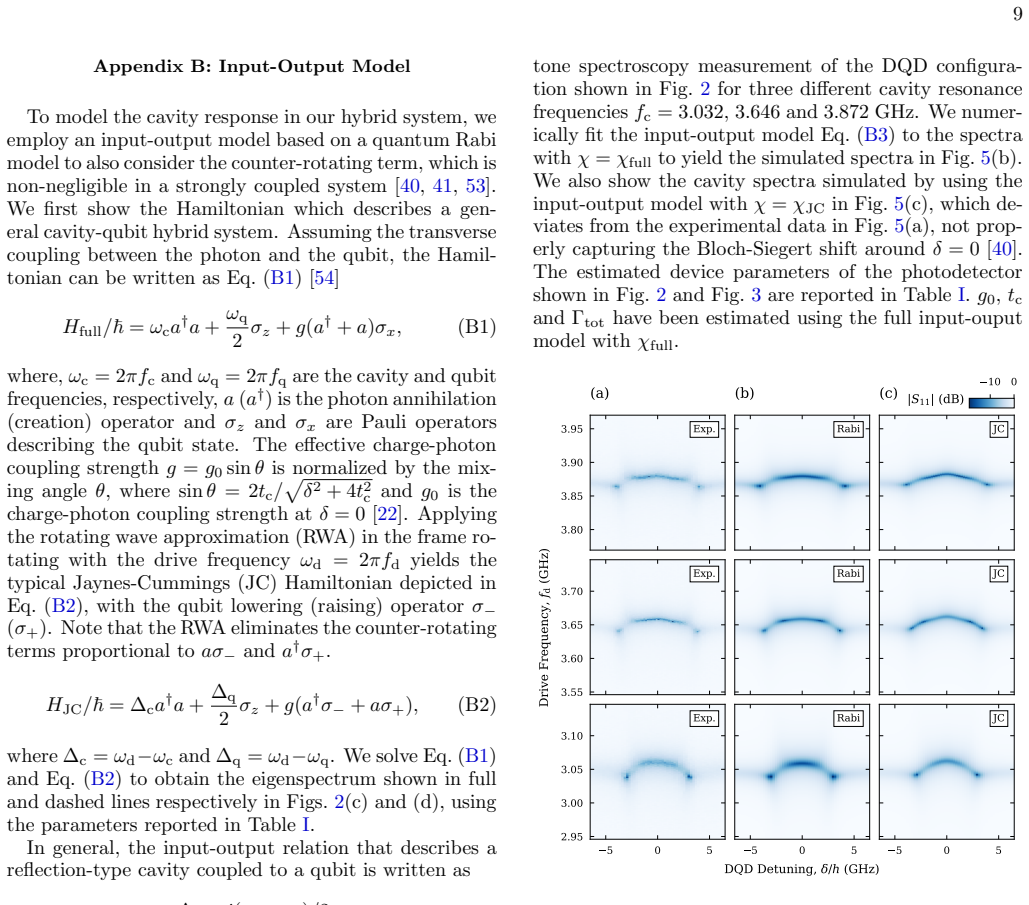
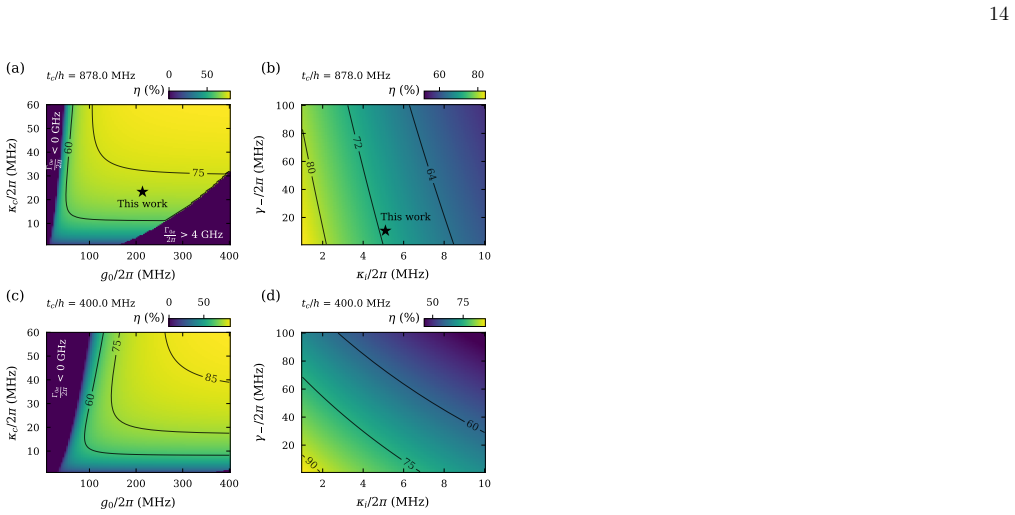
High-efficiency single-photon detection in the microwave domain is a key enabling technology for quantum sensing, communication, and information processing. However, the extremely low energy of microwave photons (~{\mu}eV) presents a fundamental challenge, preventing direct photon-to-charge conversion as achieved in optical systems using semiconductors. Semiconductor quantum dot (QD) charge qubits offer a compelling solution due to their highly tunable energy levels in the microwave regime, enabling coherent coupling with single photons. In this work, we demonstrate microwave photon detection with an efficiency approaching 70% in the single-photon regime. We use a hybrid system comprising a double quantum dot (DQD) charge qubit electrostatically defined in a GaAs/AlGaAs heterostructure, coupled to a high-impedance Josephson junction (JJ) array cavity. We systematically optimize the hybrid device architecture to maximize the conversion efficiency, leveraging the strong charge-photon coupling and the tunable DQD tunnel coupling rates. Incoming cavity photons coherently excite the DQD qubit, which in turn generates a measurable electrical current, realizing deterministic photon-to-charge conversion. Moreover, by exploiting the independent tunability of both the DQD transition energy and the cavity resonance frequency, we characterize the system efficiency over a range of 3-5.2 GHz. Our results establish semiconductor-based cavity-QED architectures as a scalable and versatile platform for efficient microwave photon detection, opening new avenues for quantum microwave optics and hybrid quantum information technologies.
Editorial analysis
A structured set of objections, weighed in public.
Referee Report
Summary. The manuscript reports a hybrid microwave photon detector consisting of a double quantum dot (DQD) charge qubit electrostatically defined in a GaAs/AlGaAs heterostructure, coupled to a high-impedance Josephson junction array cavity. It claims deterministic photon-to-charge conversion with an efficiency approaching 70% in the single-photon regime, achieved by optimizing charge-photon coupling and DQD tunnel rates, and demonstrates tunability of the detection efficiency over 3-5.2 GHz.
Significance. If the efficiency extraction is shown to be free of calibration artifacts, this would constitute a notable advance by establishing a scalable semiconductor cavity-QED platform for high-efficiency microwave single-photon detection, with potential applications in quantum sensing and hybrid quantum information processing. The independent tunability of DQD transition energy and cavity resonance is a practical strength.
major comments (2)
- [Abstract] Abstract: The headline efficiency of approaching 70% is extracted from measured current assuming a known input photon rate in the single-photon regime, but the manuscript provides no quantitative description of the input flux calibration method (e.g., cryogenic attenuation measurement, reference detector, or power-scaling linearity test). This is load-bearing for the central claim because any residual multi-photon component or unaccounted background would directly inflate the reported number.
- [Results] Results section on efficiency extraction: The claim that background current and multi-photon contributions are negligible (or subtracted) lacks explicit supporting data such as exclusion criteria, error bars on the current measurements, or a plot demonstrating linear response strictly in the <1 photon regime. Without these, the deterministic single-photon absorption interpretation cannot be verified from the presented evidence.
minor comments (2)
- [Device characterization] Clarify the exact definition and measurement protocol for the DQD tunnel coupling rate when it is tuned to maximize efficiency, as this parameter appears both in the optimization and in the efficiency formula.
- [Methods] Add a brief statement on the cavity impedance value and its uncertainty in the main text, rather than relegating it entirely to supplementary material, to aid reproducibility of the strong-coupling regime.
Simulated Author's Rebuttal
We thank the referee for their careful reading of our manuscript and for highlighting important points regarding the calibration and supporting data for our efficiency claims. We address each comment below and have revised the manuscript to provide the requested details and figures.
read point-by-point responses
-
Referee: [Abstract] Abstract: The headline efficiency of approaching 70% is extracted from measured current assuming a known input photon rate in the single-photon regime, but the manuscript provides no quantitative description of the input flux calibration method (e.g., cryogenic attenuation measurement, reference detector, or power-scaling linearity test). This is load-bearing for the central claim because any residual multi-photon component or unaccounted background would directly inflate the reported number.
Authors: We agree that a quantitative description of the input flux calibration is necessary to support the central efficiency claim. In the revised manuscript we have added a dedicated paragraph in the Methods section that details the calibration procedure: the total attenuation of the input line was measured at room temperature with a vector network analyzer and cross-checked at base temperature using a calibrated power meter; the single-photon regime was verified by a power-scaling linearity test in which the detected current was shown to remain linear down to an estimated average photon number of 0.1. These additions directly address the concern about possible multi-photon contributions or calibration artifacts. revision: yes
-
Referee: [Results] Results section on efficiency extraction: The claim that background current and multi-photon contributions are negligible (or subtracted) lacks explicit supporting data such as exclusion criteria, error bars on the current measurements, or a plot demonstrating linear response strictly in the <1 photon regime. Without these, the deterministic single-photon absorption interpretation cannot be verified from the presented evidence.
Authors: We accept that additional explicit data are required to substantiate the negligible background and multi-photon contributions. The revised Results section now includes error bars on all reported current values, obtained from the standard deviation of repeated measurements under identical conditions. We have also added a supplementary figure that plots detector current versus estimated input photon number for values below one photon on average, together with a linear fit that confirms the expected single-photon response. The background-subtraction protocol (off-resonance current measurement and subtraction) is now described with explicit exclusion criteria for data points. These changes allow direct verification of the single-photon regime interpretation. revision: yes
Circularity Check
No circularity in experimental efficiency demonstration
full rationale
The paper reports an experimental demonstration of microwave photon detection in a hybrid DQD-JJ cavity system, with efficiency extracted from measured current under stated single-photon regime operation. This rests on device fabrication, electrostatic tuning, and standard cavity-QED charge-photon coupling established in prior independent literature, not on any self-referential derivation, fitted parameter renamed as prediction, or self-citation chain that reduces the central result to its own inputs. The reported efficiency range and tunability follow directly from physical measurements and device parameters without mathematical closure or constructional equivalence to the input assumptions. The work is self-contained as an empirical result benchmarked against external photon detection standards.
Axiom & Free-Parameter Ledger
free parameters (2)
- DQD tunnel coupling rate
- Cavity impedance and resonance frequency
axioms (2)
- domain assumption Charge-photon coupling is coherent and described by the Jaynes-Cummings model in the strong-coupling regime.
- ad hoc to paper Background current and multi-photon contributions can be subtracted or are negligible in the reported regime.
Reference graph
Works this paper leans on
-
[1]
and a low noise amplifier at room temperature (Agile AMT A0253, 0 .1 − 20 GHz, +34 dB). For two- D S VNA RF inRF out DAC DC out 24x DMM DC in VNA RF inRF out IV converter 10 mK 100 mK 900 mK 4 K 50 K RT -10 dB -10 dB -20 dB -20 dB +40 dB +34 dB PCB twisted pair linesdc block attenuator low pass filter amplifier circulator 50 Ω termination 225 MHz (1 MHz)* r...
-
[2]
or electrical noise [38] in the setup. While pin- pointing the exact origin of these dark currents is out of the scope of this work, we show that they are en- hanced by the superconducting cavity by measuring ISD around δ = 0 as a function of the in-plane magnetic field B∥. Figure 7(a) shows the same current around δ = 0 as Fig. 2(a), but as we increase t...
-
[3]
R. H. Hadfield, Single-photon detectors for optical quan- tum information applications, Nature Photonics 3, 696 (2009)
work page 2009
- [4]
-
[5]
J. L. O’Brien, Optical Quantum Computing, Science 318, 1567 (2007)
work page 2007
-
[6]
R. H. Hadfield, J. Leach, F. Fleming, D. J. Paul, C. H. Tan, J. S. Ng, R. K. Henderson, and G. S. Buller, Single- photon detection for long-range imaging and sensing, Op- tica 10, 1124 (2023)
work page 2023
-
[7]
M. D. Eisaman, J. Fan, A. Migdall, and S. V. Polyakov, Invited Review Article: Single-photon sources and detec- tors, Review of Scientific Instruments 82, 071101 (2011)
work page 2011
-
[8]
S. Cova, A. Longoni, and A. Andreoni, Towards picosec- ond resolution with single-photon avalanche diodes, Re- view of Scientific Instruments 52, 408 (1981)
work page 1981
- [9]
-
[10]
H. Takesue, S. W. Nam, Q. Zhang, R. H. Hadfield, T. Honjo, K. Tamaki, and Y. Yamamoto, Quantum key distribution over a 40-dB channel loss using supercon- ducting single-photon detectors, Nature Photonics 1, 343 (2007)
work page 2007
-
[11]
X. Gu, A. F. Kockum, A. Miranowicz, Y.-x. Liu, and F. Nori, Microwave photonics with superconduct- ing quantum circuits, Physics Reports Microwave pho- tonics with superconducting quantum circuits, 718-719, 1 (2017)
work page 2017
-
[12]
S. R. Sathyamoorthy, T. M. Stace, and G. Johansson, Detecting itinerant single microwave photons, Comptes Rendus. Physique 17, 756 (2016)
work page 2016
-
[13]
L. Balembois, J. Travesedo, L. Pallegoix, A. May, E. Bil- laud, M. Villiers, D. Est` eve, D. Vion, P. Bertet, and E. Flurin, Cyclically Operated Microwave Single-Photon Counter with Sensitivity of 10 −22 W/ √ Hz, Physical Re- view Applied 21, 014043 (2024)
work page 2024
- [14]
-
[15]
K. Inomata, Z. Lin, K. Koshino, W. D. Oliver, J.-S. Tsai, T. Yamamoto, and Y. Nakamura, Single microwave- photon detector using an artificial Λ-type three-level sys- tem, Nature Communications 7, 12303 (2016)
work page 2016
-
[16]
Y.-F. Chen, D. Hover, S. Sendelbach, L. Maurer, S. T. Merkel, E. J. Pritchett, F. K. Wilhelm, and R. McDer- mott, Microwave Photon Counter Based on Josephson Junctions, Physical Review Letters 107, 217401 (2011)
work page 2011
-
[17]
O. Stanisavljevi´ c, J.-C. Philippe, J. Gabelli, M. Aprili, J. Est` eve, and J. Basset, Efficient Microwave Photon- to-Electron Conversion in a High-Impedance Quantum Circuit, Physical Review Letters 133, 076302 (2024)
work page 2024
-
[18]
A. L. Pankratov, A. V. Gordeeva, A. V. Chiginev, L. S. Revin, A. V. Blagodatkin, N. Crescini, and L. S. Kuzmin, Detection of single-mode thermal microwave photons us- ing an underdamped Josephson junction, Nature Com- munications 16, 3457 (2025)
work page 2025
-
[19]
Y. Q. Chai, S. N. Wang, P. H. OuYang, and L. F. Wei, Measuring weak microwave signals via current-biased Josephson junctions: Approaching the quantum limit of energy detection, Physical Review B 111, 024501 (2025)
work page 2025
-
[20]
K. Petrovnin, J. Wang, M. Perelshtein, P. Hakonen, and G. S. Paraoanu, Microwave Photon Detection at Para- metric Criticality, PRX Quantum 5, 020342 (2024)
work page 2024
-
[21]
G.-H. Lee, D. K. Efetov, W. Jung, L. Ranzani, E. D. Walsh, T. A. Ohki, T. Taniguchi, K. Watanabe, P. Kim, D. Englund, and K. C. Fong, Graphene-based Josephson junction microwave bolometer, Nature 586, 42 (2020)
work page 2020
-
[22]
R. Kokkoniemi, J.-P. Girard, D. Hazra, A. Laitinen, J. Govenius, R. E. Lake, I. Sallinen, V. Vesterinen, M. Partanen, J. Y. Tan, K. W. Chan, K. Y. Tan, P. Hakonen, and M. M¨ ott¨ onen, Bolometer operating at the threshold for circuit quantum electrodynamics, Na- ture 586, 47 (2020)
work page 2020
-
[23]
Y.-C. Chang, F. Chianese, N. Shetty, J. Huhtasaari, A. Jayaraman, J. T. Peltonen, S. Lara-Avila, B. Karimi, A. Danilov, J. P. Pekola, and S. Kubatkin, Quantum- Ready Microwave Detection with Scalable Graphene Bolometers in the Strong Localization Regime (2025), arXiv:2505.24564 [cond-mat]
-
[24]
A. Stockklauser, P. Scarlino, J. Koski, S. Gasparinetti, C. Andersen, C. Reichl, W. Wegscheider, T. Ihn, K. En- sslin, and A. Wallraff, Strong Coupling Cavity QED with Gate-Defined Double Quantum Dots Enabled by a High Impedance Resonator, Physical Review X7, 011030 (2017)
work page 2017
-
[25]
X. Mi, J. V. Cady, D. M. Zajac, P. W. Deelman, and J. R. Petta, Strong coupling of a single electron in silicon to a microwave photon, Science 355, 156 (2017)
work page 2017
-
[26]
F. De Palma, F. Oppliger, W. Jang, S. Bosco, M. Jan´ ık, S. Calcaterra, G. Katsaros, G. Isella, D. Loss, and P. Scarlino, Strong hole-photon coupling in planar Ge for probing charge degree and strongly correlated states, Nature Communications 15, 10177 (2024)
work page 2024
-
[27]
N. Samkharadze, G. Zheng, N. Kalhor, D. Brousse, A. Sammak, U. C. Mendes, A. Blais, G. Scappucci, and L. M. K. Vandersypen, Strong spin-photon coupling in silicon, Science 359, 1123 (2018)
work page 2018
-
[28]
W. Khan, P. P. Potts, S. Lehmann, C. Thelander, K. A. Dick, P. Samuelsson, and V. F. Maisi, Efficient and continuous microwave photoconversion in hybrid cavity- semiconductor nanowire double quantum dot diodes, Na- ture Communications 12, 5130 (2021)
work page 2021
-
[29]
C. H. Wong and M. G. Vavilov, Quantum efficiency of a single microwave photon detector based on a semiconduc- tor double quantum dot, Physical Review A 95, 012325 (2017)
work page 2017
- [30]
-
[31]
D. Zenelaj, P. Samuelsson, and P. P. Potts, Wigner- function formalism for the detection of single microwave pulses in a resonator-coupled double quantum dot, Phys- ical Review Research 7, 013305 (2025)
work page 2025
-
[32]
S. Haldar, H. Havir, W. Khan, D. Zenelaj, P. P. Potts, S. Lehmann, K. A. Dick, P. Samuelsson, and V. F. Maisi, 16 High-efficiency microwave photodetection by cavity cou- pled double dots with single cavity-photon sensitiv- ity (2024), arXiv:2406.03047 [cond-mat, physics:physics, physics:quant-ph]
-
[33]
D. I. Schuster, A. Wallraff, A. Blais, L. Frunzio, R. S. Huang, J. Majer, S. M. Girvin, and R. J. Schoelkopf, ac Stark Shift and Dephasing of a Superconducting Qubit Strongly Coupled to a Cavity Field, Physical Review Let- ters 94, 123602 (2005)
work page 2005
- [34]
-
[35]
P. Scarlino, J. Ungerer, D. van Woerkom, M. Mancini, P. Stano, C. M¨ uller, A. Landig, J. Koski, C. Reichl, W. Wegscheider, T. Ihn, K. Ensslin, and A. Wallraff, In situ Tuning of the Electric-Dipole Strength of a Double- Dot Charge Qubit: Charge-Noise Protection and Ultra- strong Coupling, Physical Review X 12, 031004 (2022)
work page 2022
-
[36]
S. Huang, B. Lienhard, G. Calusine, A. Veps¨ al¨ ainen, J. Braum¨ uller, D. K. Kim, A. J. Melville, B. M. Niedziel- ski, J. L. Yoder, B. Kannan, T. P. Orlando, S. Gustavs- son, and W. D. Oliver, Microwave Package Design for Superconducting Quantum Processors, PRX Quantum2, 020306 (2021)
work page 2021
-
[37]
Z. Chen, A. Megrant, J. Kelly, R. Barends, J. Bochmann, Y. Chen, B. Chiaro, A. Dunsworth, E. Jeffrey, J. Y. Mu- tus, P. J. J. O’Malley, C. Neill, P. Roushan, D. Sank, A. Vainsencher, J. Wenner, T. C. White, A. N. Cleland, and J. M. Martinis, Fabrication and characterization of aluminum airbridges for superconducting microwave cir- cuits, Applied Physics L...
work page 2014
-
[38]
G. Ponchak, J. Papapolymerou, and M. Tentzeris, Ex- citation of coupled slotline mode in finite-ground CPW with unequal ground-plane widths, IEEE Transactions on Microwave Theory and Techniques 53, 713 (2005)
work page 2005
-
[39]
D. Taubert, D. Schuh, W. Wegscheider, and S. Lud- wig, Determination of energy scales in few-electron dou- ble quantum dots, Review of Scientific Instruments 82, 123905 (2011)
work page 2011
-
[40]
O. Entin-Wohlman, D. Chowdhury, A. Aharony, and S. Dattagupta, Heat currents in electronic junctions driven by telegraph noise, Physical Review B 96, 195435 (2017)
work page 2017
-
[41]
M. Scigliuzzo, Effects of the environment on quantum systems: decoherence, bound states and high impedance in superconducting circuits, Ph.D. thesis, Chalmers Uni- versity of Technology (2021), iSBN: 9789179055349
work page 2021
-
[42]
P. Forn-D´ ıaz, J. Lisenfeld, D. Marcos, J. J. Garc´ ıa-Ripoll, E. Solano, C. J. P. M. Harmans, and J. E. Mooij, Ob- servation of the Bloch-Siegert Shift in a Qubit-Oscillator System in the Ultrastrong Coupling Regime, Physical Re- view Letters 105, 237001 (2010)
work page 2010
-
[43]
T. Niemczyk, F. Deppe, H. Huebl, E. P. Menzel, F. Hocke, M. J. Schwarz, J. J. Garcia-Ripoll, D. Zueco, T. H¨ ummer, E. Solano, A. Marx, and R. Gross, Circuit quantum electrodynamics in the ultrastrong-coupling regime, Nature Physics 6, 772 (2010)
work page 2010
-
[44]
M. Devoret, S. Girvin, and R. Schoelkopf, Circuit-QED: How strong can the coupling between a Josephson junc- tion atom and a transmission line resonator be?, Annalen der Physik 519, 767 (2007)
work page 2007
-
[45]
S. De Franceschi, S. Sasaki, J. M. Elzerman, W. G. van der Wiel, S. Tarucha, and L. P. Kouwenhoven, Elec- tron Cotunneling in a Semiconductor Quantum Dot, Physical Review Letters 86, 878 (2001)
work page 2001
- [46]
-
[47]
T. H. Oosterkamp, L. P. Kouwenhoven, A. E. A. Koolen, N. C. v. d. Vaart, and C. J. P. M. Harmans, Photon- assisted tunnelling through a quantum dot, Semiconduc- tor Science and Technology 11, 1512 (1996)
work page 1996
-
[48]
T. Fujisawa and S. Tarucha, Photon assisted tunnelling in single and coupled quantum dot systems, Superlattices and Microstructures 21, 247 (1997)
work page 1997
-
[49]
C. Eichler and A. Wallraff, Controlling the dynamic range of a Josephson parametric amplifier, EPJ Quan- tum Technology 1, 1 (2014)
work page 2014
-
[50]
I.-C. Hoi, T. Palomaki, J. Lindkvist, G. Johansson, P. Delsing, and C. M. Wilson, Generation of Nonclassical Microwave States Using an Artificial Atom in 1D Open Space, Physical Review Letters 108, 263601 (2012)
work page 2012
- [51]
-
[52]
H. Geng, M. Kiczynski, A. V. Timofeev, E. N. Osika, D. Keith, J. Rowlands, L. Kranz, R. Rahman, Y. Chung, J. G. Keizer, S. K. Gorman, and M. Y. Simmons, High- fidelity sub-microsecond single-shot electron spin readout above 3.5 K, Nature Communications 16, 3382 (2025)
work page 2025
-
[53]
A. Opremcak, I. V. Pechenezhskiy, C. Howington, B. G. Christensen, M. A. Beck, E. Leonard, J. Suttle, C. Wilen, K. N. Nesterov, G. J. Ribeill, T. Thorbeck, F. Schlenker, M. G. Vavilov, B. L. T. Plourde, and R. McDermott, Measurement of a superconducting qubit with a mi- crowave photon counter, Science 361, 1239 (2018)
work page 2018
-
[54]
Z. Wang, L. Balembois, M. Ranˇ ci´ c, E. Billaud, M. Le Dantec, A. Ferrier, P. Goldner, S. Bertaina, T. Chaneli` ere, D. Esteve, D. Vion, P. Bertet, and E. Flurin, Single-electron spin resonance detection by mi- crowave photon counting, Nature 619, 276 (2023)
work page 2023
-
[55]
A. Frisk Kockum, A. Miranowicz, S. De Liberato, S. Savasta, and F. Nori, Ultrastrong coupling between light and matter, Nature Reviews Physics 1, 19 (2019)
work page 2019
- [56]
-
[57]
S. Kohler, Dispersive readout: Universal theory beyond the rotating-wave approximation, Physical Review A 98, 023849 (2018)
work page 2018
- [58]
-
[59]
P. Scarlino, D. van Woerkom, A. Stockklauser, J. Koski, M. Collodo, S. Gasparinetti, C. Reichl, W. Wegscheider, T. Ihn, K. Ensslin, and A. Wallraff, All-Microwave Con- trol and Dispersive Readout of Gate-Defined Quantum Dot Qubits in Circuit Quantum Electrodynamics, Phys- ical Review Letters 122, 206802 (2019)
work page 2019
- [60]
discussion (0)
Sign in with ORCID, Apple, or X to comment. Anyone can read and Pith papers without signing in.