REVIEW 4 major objections 4 minor 17 references
CycleDistill: Bootstrapping Machine Translation using LLMs with Cyclical Distillation
T0 review · 4 major / 4 minor · reviewed 2026-08-06 · deepseek-v4-flash
Pith's one-line read CycleDistill claims that repeatedly fine-tuning an LLM on its own zero-shot translations of monolingual text can lift low-resource MT by 20–30 chrF points.
desk verdict The paper's central 'monolingual-only' claim is contradicted by its own Section 4.3, which fine-tunes on 20,000 gold parallel pairs; reported gains likely conflate supervised fine-tuning with cyclical distillation. read the letter →
The pith
A machine-rendered reading of the paper's core claim, the machinery that carries it, and where it could break.
The reading
What carries the argument
The load-bearing mechanism is the cyclic distillation loop: model $M_i$ produces synthetic parallel pairs from monolingual source sentences via zero- or few-shot prompting, $M_i$ is fine-tuned on those pairs to become $M_{i+1}$, and the cycle repeats up to three times. A second mechanism, soft distribution-preserving distillation, records the top-$k$ token predictions and their softmax probabilities at each position and trains the student to match the teacher's distribution through a KL-divergence loss $L_{KD} = \sum_{t=1}^{T} \mathrm{KL}(P^{(t)}_{teacher} \parallel P^{(t)}_{student})$. The synthetic data is the teacher's own output, so the loop is a form of self-training; the soft targets are intended to carry richer information than the single best token.
What would settle it
A controlled run in which synthetic training pairs are deliberately corrupted—for example, pairing each source sentence with an unrelated translation—and chrF still improves would show that the gains do not depend on the teacher's translation competence. Conversely, a language whose base model outputs are unusable, like the Manipuri setting in the paper, already provides the negative case: if no filtering or additional shots can make CycleDistill improve chrF there, the method's scope is bounded by the teacher's initial ability.
Extended reading notes
Core claim
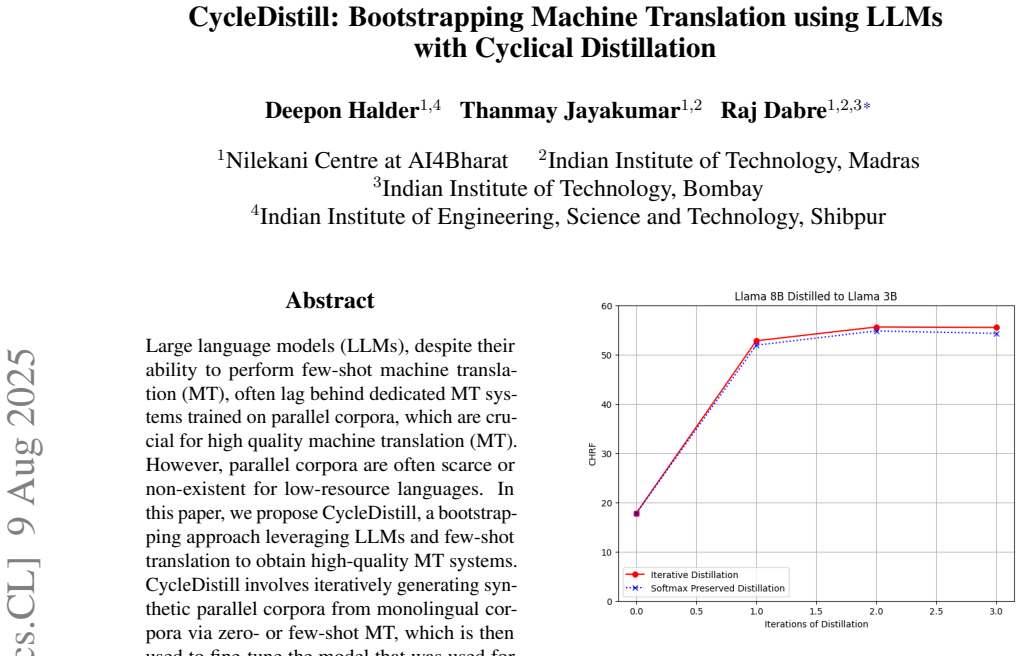
On its own terms, the paper establishes that cyclical self-distillation can convert an LLM's weak zero- or few-shot translation ability into a substantially stronger translation model. Starting from a base model that translates an Indic language into English, the authors generate synthetic parallel data by translating a fixed set of 20,000 monolingual source sentences, then fine-tune the generator on that data to produce the next model, and repeat for up to three cycles. The first iteration yields the largest gains—20–30 chrF points over the few-shot baseline—with one-shot prompting giving the best results. Preserving the teacher's top-20 softmax distributions as extra training targets produces only mild gains over plain sequence-level distillation. The authors are explicit that the loop's success depends on the teacher's initial competence: Nepali, with partial pretraining coverage, improves, while Manipuri, which none of the tested models can translate into usable English, does not.
Load-bearing premise
The teacher model's zero- or few-shot translations of the source sentences are accurate enough to serve as training targets for fine-tuning, and errors in one cycle do not cascade irrecoverably into later cycles.
Editorial extensions
If this is right
- Low-resource languages with an LLM that can translate at a basic level can get an MT system from monolingual corpora plus a handful of example pairs, bypassing the need for gold parallel data.
- The same loop can compress a large teacher into a smaller student, so the final system can be deployed at a fraction of the teacher's compute cost with much of the gain retained.
- One-shot prompting is the recommended operating point; four-shot prompts degrade performance, especially for morphologically rich languages, because longer prompts dilute context.
- Because a bad cycle can drop chrF by 30–40 points, each round of synthetic data generation needs quality control before it is used for fine-tuning.
- The method's applicability ends where the base LLM's translation competence ends; for languages such as Manipuri under the tested models, CycleDistill does not bootstrap.
Reading between the lines
- A natural extension the paper leaves untested is inserting a quality filter between generation and fine-tuning; the error-propagation results suggest that such a filter could prevent the 30–40 point collapses.
- The 20–30 chrF gain is measured against a few-shot prompting baseline, not against a dedicated supervised MT system; comparing CycleDistill with a model trained on gold parallel data would show how much of the gap to fully supervised MT remains.
- The failure on Manipuri hints at a threshold effect: if a language's teacher outputs fall below some quality level, self-distillation cannot lift them. Estimating that threshold from a small gold set would turn the boundary condition into a practical guideline.
- The softmax-preserving variant's mild gains suggest that most of the improvement comes from the self-training loop itself, not from the richer distillation signal; ablating the KL term would make this decomposition explicit.
Editorial analysis
A structured set of objections, weighed in public.
Referee Report
Summary. CycleDistill proposes a bootstrapping procedure for low-resource Indic-to-English machine translation in which a base LLM generates synthetic English translations from source sentences, the model is fine-tuned on those synthetic pairs, and the procedure is repeated for up to three cycles; a variant additionally records top-k softmax distributions during generation and trains the student to match them via a KL term. The paper claims that this method needs no parallel corpora beyond 1-4 few-shot examples and reports first-iteration gains of 20-30 chrF points over few-shot prompting baselines for Hindi, Bengali, and Malayalam, with additional experiments on Nepali and Manipuri.
Significance. If the central claim were supported by the experiments, the paper would be a useful contribution to low-resource MT: it would show that self-generated synthetic data can bootstrap usable translation systems from monolingual text, and the systematic comparison of hard versus soft iterative distillation across two model families would be informative. The authors are to be credited for releasing code, for reporting the Nepali and Manipuri results, and for candidly discussing error propagation and performance plateaus in the Limitations section. However, the experimental protocol in Section 4.3 directly contradicts the central claim by using 20,000 gold parallel sentence pairs, so the reported gains cannot currently be attributed to CycleDistill. The significance of the method therefore cannot be assessed from the present evidence without a major experimental revision.
major comments (4)
- [Abstract; §4.3–§4.4] The central claim that CycleDistill 'does not need parallel corpora beyond 1 to 4 few-shot examples' and relies 'solely on monolingual corpora' is contradicted by §4.3, where models are fine-tuned on 20,000 sentence pairs from the BPCC seed corpus, a parallel Indic-to-English dataset, and by §4.4, where the same 20,000 source sentences are reused to generate synthetic English outputs. Because the only comparison in Table 1 is against a few-shot prompting baseline, the first-iteration gains conflate ordinary supervised fine-tuning on 20,000 gold parallel pairs with the proposed cyclical distillation. The paper must either add a baseline that receives the same 20k gold supervision without iterative distillation, or rerun the experiments starting from a truly monolingual source corpus; otherwise the attribution of the gains to CycleDistill is unsupported.
- [§5.1; Table 1] The claims of 'consistent performance trend' and 'consistent chrF score gains across three Indian low-resource languages' are not supported by Table 1. For example, L8B Hindi zero-shot drops from 33.6 at Base to 29.8 at DD1; L8B Bengali DD2 to DD3 drops from 48.3 to 38.9; and the L8B Malayalam 4-shot entries remain essentially flat at 17.4 across all cycles. The 20–30 chrF headline is a column average over widely varying cells and should be reported as a distribution, with explicit discussion of the non-improving or deteriorating settings.
- [§5.3; Table 2] The Manipuri results directly contradict the generalization claim. Section 5.3 states that none of the evaluated models could produce usable distillation data, and Table 2 shows no chrF improvement over iterations for either L8B or L3B, with several values declining below the baseline (e.g., L3B Manipuri SD3 0-shot 17.08 versus Base 17.13). The Limitations section acknowledges this, but the main text still presents the method as achieving high-quality MT for low-resource languages. The boundary condition under which CycleDistill fails should be a central part of the empirical claim, not a peripheral caveat.
- [§3.2; Table 1] The soft distribution-preserving distillation is not shown to be beneficial. In Table 1, SD entries are frequently lower than the corresponding DD entries (e.g., G2B Bengali zero-shot DD1 50.9 versus SD1 40.1; L3B Malayalam one-shot DD1 27.4 versus SD1 18.2), and the abstract's 'mild improvements' claim is not supported by a systematic paired comparison. In addition, the KL objective in §3.2 is written over top-k softmax distributions whose probabilities are only constrained to sum to ≤ 1, so the normalization of the teacher distribution is unspecified. The paper should report a paired hard-versus-soft comparison and specify how the top-k distribution is normalized before computing KL divergence.
minor comments (4)
- [References] The reference list contains the placeholder author 'Anoop Kunchukuttan and 1 others'; the Kunchukuttan et al. (2023) entry should be completed with the full author list and correct venue details.
- [§5.1] The text says the second and third iterations show a 'small increase of 1-2% of chrF with each iteration,' but Table 1 contains several declines from DD1/DD2 to DD2/DD3 (e.g., G9B Bengali DD3 61.0 versus DD1 61.1; L8B Bengali DD3 38.9 versus DD2 48.3). This statement should be revised or quantified.
- [§5.4] The Absorption Rate defined as Student Peak Gain divided by Teacher Base Score is a ratio of a maximum over iterations to a single base score, not a temporal rate; the metric name and its interpretation should be justified, and the lack of variance or significance information should be noted.
- [§5.4; Figures 5–6] The claims of a positive correlation, a vanishing correlation, and suppressed gains in Figure 5 are not accompanied by correlation coefficients or any quantitative fit; please provide the numerical summaries so readers can verify the qualitative claims.
Circularity Check
No definitional circularity: improvements are measured on a held-out benchmark and the self-distillation loop demonstrably can fail. The abstract's monolingual-only claim is internally contradicted by the 20k gold BPCC fine-tuning, but that is an attribution/ablation flaw rather than a circular reduction.
full rationale
The paper's derivation chain is not circular by construction. The claimed improvements (DD1/SD1 and later cycles) are evaluated on the IN22 Gen held-out benchmark, and the iterative self-distillation loop is not guaranteed to improve: the Manipuri experiments (Table 2) show flat or declining chrF scores, and Section 5.4 documents drops of 30-40 chrF points after bad cycles. Thus the success of CycleDistill is an empirical outcome, not a definitional tautology. The softmax-preserving variant is also empirically tested with only mild and mixed gains. The main circularity-adjacent concern is an internal contradiction between the abstract, which says CycleDistill 'does not need parallel corpora beyond 1 to 4 few-shot examples' and relies 'solely on monolingual corpora,' and Sections 4.3-4.4, which state that models are 'fine-tuned using the BPCC seed corpus' with '20,000 sentence pairs for training and distillation' and that the same 20,000 source sentences are reused for synthetic English generation. This means the reported 20-30 chrF gain over the few-shot base cannot be cleanly attributed to cyclical distillation; it may partly or largely reflect ordinary supervised fine-tuning on gold parallel data, and no SFT-only baseline is reported. This is a serious experimental attribution flaw and correctness risk, but it is not a circular reduction: the evaluation target is not defined in terms of the fine-tuning labels, and the method can fail. There is minor self-citation in that the BPCC/IN22 resources are cited to Gala et al. (2023), which includes co-author Raj Dabre, but because the benchmark is held-out and standard, that citation is not load-bearing. Hyperparameters k=20 and n=3 were selected by observing the same experimental setup, but they are not presented as predictions. Overall, no step of the claimed derivation reduces to its own input, so circularity is minimal.
Assumptions & free parameters
free parameters (3)
- top-k tokens for softmax distillation =
20
- Number of distillation iterations =
3
- Training set size =
20,000 sentence pairs
assumptions (3)
- domain assumption Synthetic translations generated by the teacher model are accurate enough to serve as training targets for fine-tuning.
- domain assumption The IN22 Gen evaluation set is disjoint from the 20,000 training samples and is an unbiased test set for the fine-tuned models.
- domain assumption Fine-tuning on a model's own synthetic outputs does not overfit to the model's errors in a way that destroys generalization by the third cycle.
Cite this review
Pith. "Pith review of CycleDistill: Bootstrapping Machine Translation using LLMs with Cyclical Distillation." pith.science (2026). https://pith.science/paper/XY2SJYIP
@misc{pith2026250619952,
  author       = {Pith},
  title        = {Pith review of: CycleDistill: Bootstrapping Machine Translation using LLMs with Cyclical Distillation},
  year         = {2026},
  howpublished = {\url{https://pith.science/paper/XY2SJYIP}},
  note         = {Machine review of arXiv:2506.19952}
}
read the original abstract
Large language models (LLMs), despite their ability to perform few-shot machine translation (MT), often lag behind dedicated MT systems trained on parallel corpora, which are crucial for high quality machine translation (MT). However, parallel corpora are often scarce or non-existent for low-resource languages. In this paper, we propose CycleDistill, a bootstrapping approach leveraging LLMs and few-shot translation to obtain high-quality MT systems. CycleDistill involves iteratively generating synthetic parallel corpora from monolingual corpora via zero- or few-shot MT, which is then used to fine-tune the model that was used for generating said data for MT. CycleDistill does not need parallel corpora beyond 1 to 4 few-shot examples, and in our experiments focusing on three Indian languages, by relying solely on monolingual corpora, it can achieve high-quality machine translation, improving upon a few-shot baseline model by over 20-30 chrF points on average in the first iteration. We also study the effect of leveraging softmax activations during the distillation process and observe mild improvements in translation quality.
Figures


Figures from the paper (8 more)


Reference graph
Works this paper leans on
-
[1]
Angela Fan, Mike Lewis, and Yann Dauphin. 2018. Hierarchical neural story generation. In Proceedings of the 56th Annual Meeting of the Association for Computational Linguistics (Volume 1: Long Papers), pages 889--898
2018
-
[2]
Tommaso Furlanello, Zachary Chase Lipton, Michael Tschannen, Laurent Itti, and Anima Anandkumar. 2018. Born-again neural networks. In Proceedings of the 35th International Conference on Machine Learning (ICML)
work page 2018
-
[3]
Jay Gala, Pranjal A. Chitale, Raghavan AK, Varun Gumma, Sumanth Doddapaneni, Aswanth Kumar, Janki Nawale, Anupama Sujatha, Ratish Puduppully, Vivek Raghavan, Pratyush Kumar, Mitesh M. Khapra, Raj Dabre, and Anoop Kunchukuttan. 2023. https://arxiv.org/abs/2305.16307 Indictrans2: Towards high-quality and accessible machine translation models for all 22 sche...
arXiv 2023
-
[4]
Google. 2024. Gemma 2: Next-generation open models from google. https://ai.google.dev/gemma/. Accessed: 2025-05-17
work page 2024
-
[5]
Jianping Gou, Baosheng Yu, Stephen J. Maybank, and Dacheng Tao. 2021. Knowledge distillation: A survey. International Journal of Computer Vision
work page 2021
-
[6]
Jiatao Gu, Hany Hassan, Jacob Devlin, and Victor O.K. Li. 2018. Universal neural machine translation for extremely low resource languages. In Proceedings of the 2018 Conference of the North American Chapter of the Association for Computational Linguistics: Human Language Technologies (NAACL-HLT)
work page 2018
-
[7]
Pengcheng He, Xiaodong Liu, Jianfeng Gao, and Weizhu Chen. 2020. Revisiting self-training for neural sequence generation. In International Conference on Learning Representations (ICLR)
work page 2020
-
[8]
Geoffrey Hinton, Oriol Vinyals, and Jeff Dean. 2015. Distilling the knowledge in a neural network. In NIPS Deep Learning and Representation Learning Workshop
work page 2015
Show all 17 references
-
[9]
Yoon Kim and Alexander M. Rush. 2016. Sequence-level knowledge distillation. In Proceedings of the 2016 Conference on Empirical Methods in Natural Language Processing (EMNLP)
2016
-
[10]
Yunsu Kim, Jaesong Lee, Jooyoul Lee, and Hermann Ney. 2021. Improving low-resource neural machine translation with iterative back-translation. In Proceedings of the 2021 Conference on Empirical Methods in Natural Language Processing (EMNLP)
2021
-
[11]
Philipp Koehn, Hieu Hoang, Alexandra Birch, Chris Callison-Burch, Marcello Federico, Nicola Bertoldi, Brooke Cowan, Wade Shen, Christine Moran, Richard Zens, Chris Dyer, Ondrej Bojar, Alexandra Constantin, and Evan Herbst. 2017. Six challenges for neural machine translation. P...
2017
-
[12]
Kullback and R
S. Kullback and R. A. Leibler. 1951. On information and sufficiency. The Annals of Mathematical Statistics, 22(1):79--86
1951
-
[13]
Anoop Kunchukuttan and 1 others. 2023. The indicnlp corpus: A large-scale multilingual corpus for indic languages. In Proceedings of the 2023 Conference on Empirical Methods in Natural Language Processing (EMNLP)
2023
-
[14]
Meta. 2024. Llama 3: Open foundation and instruction models. https://llama.meta.com/llama3. Accessed: 2025-05-17
2024
-
[15]
Subhajit Mukherjee and Mitesh M. Khapra. 2021. Distilling large-scale teacher models into compact student models for neural machine translation. Transactions of the Association for Computational Linguistics
2021
-
[16]
Maja Popović. 2015. chrf: Character n-gram f-score for automatic mt evaluation. In Proceedings of the Tenth Workshop on Statistical Machine Translation (WMT)
2015
-
[17]
Xinyi Tan, Longyue Wang, Tao Qin, Xiang-Yang Li, and Tie-Yan Liu. 2019. Multilingual neural machine translation with knowledge distillation. In Proceedings of the 8th International Conference on Learning Representations (ICLR)
2019
Reviewed August 6, 2026 · model on record in the stance chip above.
Discussion (0). Continue with ORCID to comment.