REVIEW 4 major objections 4 minor 1 cited by
New Insights on Unfolding and Fine-tuning Quantum Federated Learning
T0 review · 4 major / 4 minor · reviewed 2026-08-06 · deepseek-v4-flash
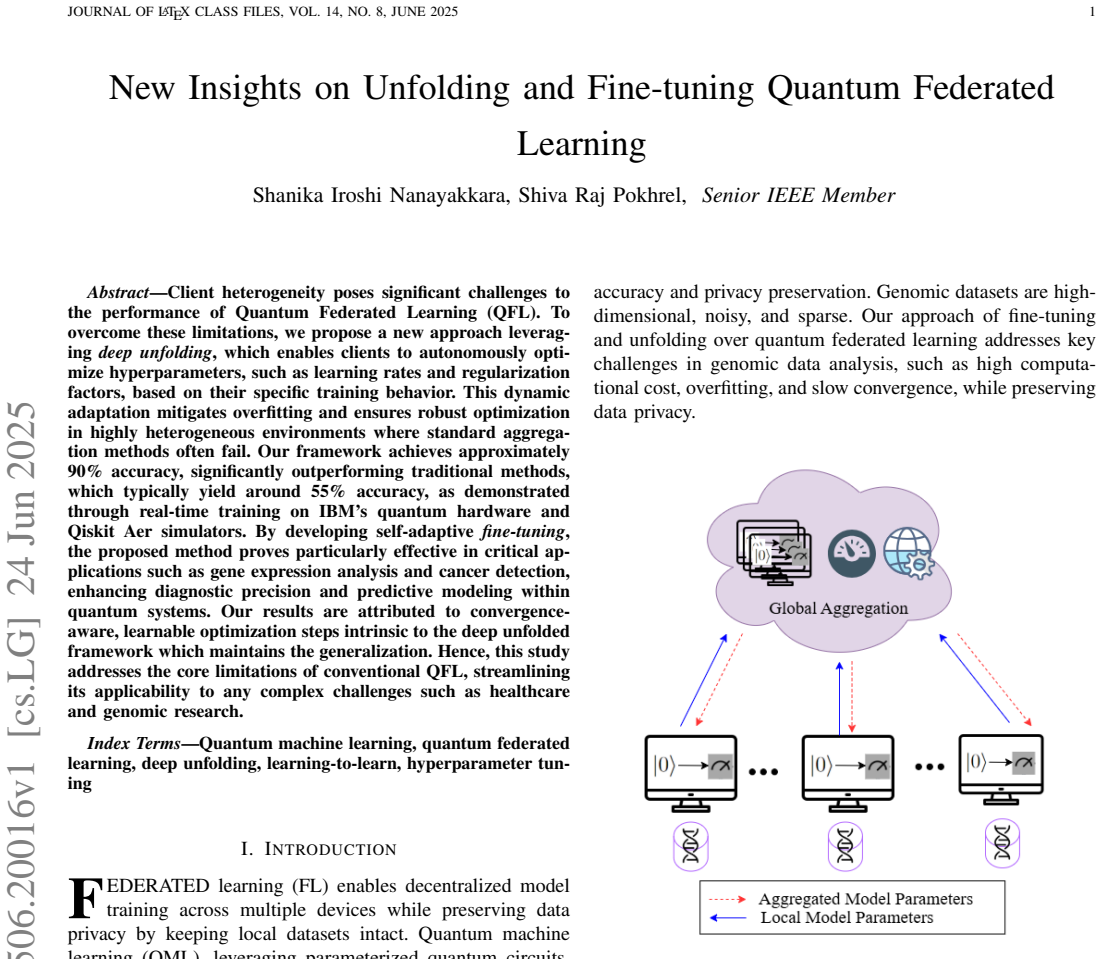
Pith's one-line read This paper proposes DUQFL, a quantum federated learning method that unrolls local optimization and learns each client's learning rate and perturbation, reaching about 90% accuracy versus about 55% for conventional QFL.
desk verdict Deep unfolding for QFL is a plausible idea, but the central convergence theorem is circular and the headline accuracy claim lacks a baseline table. read the letter →
The pith
A machine-rendered reading of the paper's core claim, the machinery that carries it, and where it could break.
The reading
What carries the argument
The machinery is a deep-unfolded local optimizer: each iteration of SPSA is represented as a layer whose step size $\eta_t$ and perturbation $\delta_t = \gamma\|\nabla U_{i,t}^{l,j}\|$ are updated by meta-gradients $\partial L/\partial \eta_t$ and $\partial L/\partial \delta_t$, with momentum smoothing. This makes the optimization trajectory itself trainable. The argument that it works is the sublinear gradient decay identity $\mathbb{E}[\|\nabla F(U_t)\|^2] = O(1/t^\alpha)$, which the paper claims emerges from the learned learning-rate schedule rather than being imposed.
What would settle it
Measure the per-client quantity $\langle \nabla F_i(U_t), U_t - U^*\rangle$ on a non-convex quantum local loss, for instance a two-layer ansatz initialized far from a minimizer. If it is not positive, the convexity inequality in the appendix fails, and the predicted decay $\mathbb{E}[\|\nabla F(U_t)\|^2] = O(1/t^\alpha)$ should be re-tested empirically; absence of the predicted decay would show the proof, not the dynamics, was doing the work.
Extended reading notes
Core claim
The central claim is that deep unfolding, which rewrites iterative gradient updates as layers of a trainable network, turns each quantum client's local optimization into a learning problem: the client learns its own learning rate $\eta_t$ and perturbation size $\delta_t$ via meta-gradients computed along the unfolded trajectory. With those learnable hyperparameters, the local update becomes $U_{i,t+1}^{l,j} = U_{i,t}^{l,j} - \eta_t \nabla U_{i,t}^{l,j}$, and server-side aggregation can simply copy the best-performing client. The paper claims this produces about 90% test accuracy on genomic and breast-cancer data versus about 55% for standard QFL, with the accuracy gain directly tied to a learned, emergent gradient-norm decay $\mathbb{E}[\|\nabla F(U_t)\|^2] = O(1/t^\alpha)$, $0.5 < \alpha \le 1$, rather than to overfitting; the near-zero train-test gap at ten unfolding steps is offered as evidence.
Load-bearing premise
The convergence proof uses a convexity inequality for each local quantum loss, but the paper assumes only Lipschitz smoothness; if that inequality fails, the $O(1/t^\alpha)$ gradient-decay guarantee does not follow.
Editorial extensions
If this is right
- If correct, each quantum client can discard manual learning-rate decay schedules and adapt its own step sizes from its loss landscape, making deployment on heterogeneous hardware more practical.
- If correct, the roughly 90% versus 55% accuracy gap on genomic and breast-cancer data means standard QFL's main weakness under non-IID data is addressable without new quantum hardware.
- If correct, the near-zero train-test gap at $t=10$ implies deeper unfolding buys accuracy through better optimization, not through memorizing training samples.
- If correct, the rotating best-client pattern means best-client aggregation can serve as a fairness mechanism, not just an accuracy boost.
- If correct, the strong simulator-to-hardware agreement (about 1% difference) argues that future QFL design can be prototyped on simulators with high fidelity.
Reading between the lines
- Beyond the paper: the same deep-unfolding recipe could be lifted into classical federated learning, where per-client adaptive learning rates and perturbation schedules are also unresolved; the paper's evaluations target quantum baselines only.
- Beyond the paper: a direct way to test whether the gradient decay is genuinely learned rather than inherited from the optimization path is to reset $\eta_t$ to a large value after convergence and see whether the meta-updates re-adapt it; the paper does not run this control.
- Beyond the paper: the fairness-efficiency trade-off index could be used as a training signal, e.g., by adding a penalty on meta-gradients that concentrate best-client selection, turning FETI from a metric into a regularizer.
- Beyond the paper: extending the experiments to datasets with more clients and higher-dimensional gene-expression spaces would show whether the ~90% accuracy and near-zero train-test gap persist beyond the two small tabular sets reported.
Editorial analysis
A structured set of objections, weighed in public.
Referee Report
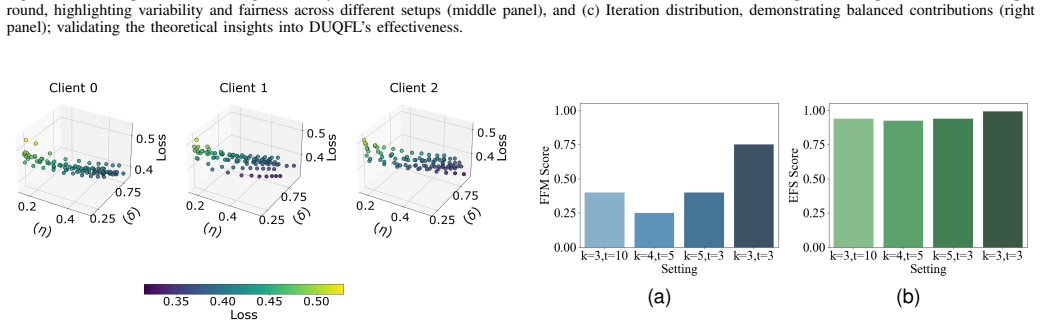
Summary. DUQFL is proposed as a deep-unfolding extension of quantum federated learning in which each client learns its own learning rate and perturbation through meta-gradients, with server-side best-client selection. The paper claims approximately 90% accuracy versus around 55% for conventional QFL on genomic and breast-cancer tasks, on IBM hardware and Qiskit Aer, and attributes the improvement to an 'emergent' sublinear gradient-norm decay O(1/t^α) established by Theorem III.6. It also proposes fairness metrics (FFM, EFS, FETI) and reports a fairness–efficiency balance.
Significance. If the convergence theorem and the empirical comparison were valid, the paper would make a practical contribution by replacing manually tuned hyperparameters with data-driven adaptation in QFL and by demonstrating a concrete application to biomedical data. The idea of unrolling local SPSA updates and meta-learning hyperparameters is interesting and aligns with an active literature on learned optimizers; the deployment on real IBM hardware is also a useful data point. However, the paper's own theoretical proof is circular, and the headline accuracy comparison is not reported with the statistical detail needed to support a 90%-versus-55% claim. At present the contribution is therefore mostly an algorithm proposal with suggestive plots rather than an established result.
major comments (4)
- [Theorem III.6 / Appendix Steps 3–4 (Eqs. 27–32)] The theorem's conclusion E||∇F||^2 = O(1/t^α) follows from assuming η_k = O(1/t^α) in the hypothesis; the proof explicitly substitutes η_t = O(1/t^α) (Eqs. 27 and 29–32) and recovers the same decay. No step shows that meta-learned hyperparameters produce this decay, and any SGD-type method with the same exogenous schedule satisfies the same bound. Thus the paper does not establish that deep unfolding causes or explains the observed convergence; at best it shows consistency with a pre-existing rate.
- [Appendix, Eq. (23)] The proof uses the convexity inequality F_i(U) − F* ≤ ⟨∇F_i(U), U − U*⟩, which is valid only for convex F_i. Assumption III.1 assumes only Lipschitz smoothness; no convexity assumption is stated for the local quantum objectives. For parameterized quantum circuit losses, which are in general nonconvex, Eq. (23) is not justified, and hence the telescoping argument in Eqs. (24)–(28) and Proposition III.5 is unsupported.
- [Section IV, Fig. 5 and Table VI] The central empirical claim, 90% vs 55% accuracy, is not backed by a quantitative baseline table. No table reports QFL accuracy versus DUQFL accuracy, error bars, number of trials, seeds, or train/validation splits; Table VI reports only DUQFL settings, and Figure 5 shows curves without error bars. Therefore the claimed >30% improvement is not verifiable from the manuscript. This is especially important because the theoretical mechanism meant to explain the gain is not established.
- [Proposition III.10] The fairness–efficiency Pareto improvement ∃t*, k* with A(k*, t*) ≫ A_QFL(k*, t*) and F(k*, t*) ≥ F_QFL(k*, t*) is asserted as a proposition, but its justification is only a reference to Figure 3 and Section IV; it is a post hoc observation from a few settings, not a derived statement. Since it depends on the same unsupported convergence claims and on unreported error bars, it does not constitute theoretical support for fairness properties.
minor comments (4)
- [References] There are numerous duplicate references (e.g., [2]/[13]/[14], [3]/[15], [4]/[16], [17]/[6], [57]/[19]); the bibliography should be cleaned.
- [Equations and notation] Notation is inconsistent: Eq. (13) and Table IV contain malformed complexity terms ('O(TurLi/ϵα +/ϵ α)' in Table IV, and Eq. (13) has an ungrammatical 'O(TurLi/ϵα + k/ϵα)' with undefined r); Figures 5b and 5c use 'DQFL' whereas the acronym is DUQFL.
- [Proposition III.5, Eq. (9)] Eq. (9) in Proposition III.5 has an RHS that is independent of T, so the bound does not show decay; the statement should be clarified or corrected.
- [Section V, Discussion] The sentence 'DUQFL surpassing standard QFL by over 30%' is not anchored to a specific table or figure with numerical baseline values, making the claim unverifiable.
Circularity Check
Theorem III.6 assumes the O(1/t^α) learning-rate decay it then 'proves' as the gradient-norm rate; the appendix substitutes the assumed schedule, so the central emergence claim restates its premise.
-
self definitional
[Section III-A, Theorem III.6, Eq. (10); Appendix STEP 4, Eqs. (27)-(32)]
"Following Assumptions III.1, III.2, III.3 and proposition III.5, if the learning rate η_k is dynamically learned through deep unfolding and follows an implicit decay of η_k = O(1/t^α) with 0.5<α≤1, then the DUQFL optimization process satisfies: E[||∇θF(U_t)||^2] = O(1/t^α). ... Using the dynamically learned rate η_t with meta-optimization, which follows a sublinear decay η_t = O(1/t^α), the learning rate sum behaves as ... Thus, we obtain: E[||∇F(U^l,j_k)||^2] = O(1/t^α)."
The theorem's premise contains its conclusion: an assumed learning-rate schedule η_k = O(1/t^α) is restated as the gradient-norm bound E[||∇F||^2] = O(1/t^α). The appendix does not derive the decay from deep unfolding or meta-gradients; it posits that η_t 'follows a sublinear decay' (Eq. 29), substitutes that schedule into the sums (Eqs. 30-31), and then writes the gradient bound (Eq. 32). This would hold for any SGD-type method fed the same exogenous schedule. The paper itself concedes that 'in conventional optimization, when η_t = O(1/t^α), the expected squared gradient norm typically decays at a comparable rate.' Thus the claimed 'emergent' sublinear convergence is the input hypothesis renamed as a theorem; Theorems III.7 and III.8 inherit it.
full rationale
The central theoretical support for DUQFL's claimed accuracy gain is Theorem III.6, and it is circular by construction: the hypothesis already states η_k = O(1/t^α), and the appendix proof substitutes that same schedule to obtain E[||∇F||^2] = O(1/t^α) without invoking any meta-learned dynamics. This is a self-definitional reduction, not independent evidence of emergence. Separately, the appendix's Step 3 uses the convexity inequality F_i(U)-F* ≤ ⟨∇F_i(U), U-U*⟩ (Eq. 23) although only Lipschitz smoothness is assumed (Assumption III.1), so the proof is also invalid for the nonconvex parameterized quantum circuits considered. Proposition III.10 is an empirical post-hoc assertion rather than a derivation. None of this makes the empirical 90% vs 55% claim false, and the paper does present real IBM/Qiskit comparisons, but the theoretical 'emergence' explanation for that gain reduces to an assumed learning-rate schedule; hence the high circularity score.
Assumptions & free parameters
free parameters (5)
- Decay exponent α =
0.5 < α ≤ 1 (assumed)
- Momentum coefficient β =
0 < β < 1, unspecified
- Initial learning rate η0 and perturbation δ0 =
unspecified
- Meta step size λ/α =
unspecified
- FETI weighting λ =
0.5 in Table VI
assumptions (6)
- domain assumption Local quantum objective is Lipschitz smooth (Assumption III.1)
- domain assumption Unbiased quantum gradients with bounded variance (Assumption III.2)
- domain assumption Momentum stabilizer definitions (Assumption III.3)
- domain assumption Client function dissimilarity bound (Assumption III.4)
- ad hoc to paper Convexity of the local objective (unstated)
- ad hoc to paper Learning rate decays as η_t=O(1/t^α)
Cite this review
Pith. "Pith review of New Insights on Unfolding and Fine-tuning Quantum Federated Learning." pith.science (2026). https://pith.science/paper/ZFWN4TVZ
@misc{pith2026250620016,
  author       = {Pith},
  title        = {Pith review of: New Insights on Unfolding and Fine-tuning Quantum Federated Learning},
  year         = {2026},
  howpublished = {\url{https://pith.science/paper/ZFWN4TVZ}},
  note         = {Machine review of arXiv:2506.20016}
}
read the original abstract
Client heterogeneity poses significant challenges to the performance of Quantum Federated Learning (QFL). To overcome these limitations, we propose a new approach leveraging deep unfolding, which enables clients to autonomously optimize hyperparameters, such as learning rates and regularization factors, based on their specific training behavior. This dynamic adaptation mitigates overfitting and ensures robust optimization in highly heterogeneous environments where standard aggregation methods often fail. Our framework achieves approximately 90% accuracy, significantly outperforming traditional methods, which typically yield around 55% accuracy, as demonstrated through real-time training on IBM quantum hardware and Qiskit Aer simulators. By developing self adaptive fine tuning, the proposed method proves particularly effective in critical applications such as gene expression analysis and cancer detection, enhancing diagnostic precision and predictive modeling within quantum systems. Our results are attributed to convergence-aware, learnable optimization steps intrinsic to the deep unfolded framework, which maintains the generalization. Hence, this study addresses the core limitations of conventional QFL, streamlining its applicability to any complex challenges such as healthcare and genomic research.
Figures


Figures from the paper (5 more)


Forward citations
Cited by 1 Pith paper
-
A Drift Stable Quantum Federated Learning for Intelligent Services
DUQFL-Prox combines deep-unfolded SPSA optimization, proximal drift control, and a validation-guided controller to stabilize quantum federated learning under heterogeneous clients.
Reference graph
Works this paper leans on
-
[1]
Shadows of quantum machine learning,
S. Jerbi, C. Gyurik, S. C. Marshall, R. Molteni, and V . Dunjko, “Shadows of quantum machine learning,”Nature Communications, vol. 15, no. 1, p. 5676, 2024
work page 2024
-
[4]
A personalized quantum federated learn- ing,
D. Gurung and S. R. Pokhrel, “A personalized quantum federated learn- ing,” inProceedings of the 8th Asia-Pacific Workshop on Networking, pp. 175–176, 2024
work page 2024
-
[5]
Cryptoqfl: Quantum federated learning on encrypted data,
C. Chu, L. Jiang, and F. Chen, “Cryptoqfl: Quantum federated learning on encrypted data,” inProc. 2023 IEEE International Conference on Quantum Computing and Engineering (QCE), vol. 1, pp. 1231–1237, 2023
work page 2023
-
[8]
Analyzing convergence in quantum neural networks: Deviations from neural tangent kernels,
X. You, S. Chakrabarti, B. Chen, and X. Wu, “Analyzing convergence in quantum neural networks: Deviations from neural tangent kernels,” in International Conference on Machine Learning, pp. 40199–40224, 2023
work page 2023
-
[11]
Qiskit: An open-source framework for quantum computing,
H. Abrahamet al., “Qiskit: An open-source framework for quantum computing,”Zenodo, vol. 2562111, 2019. Available: https://doi.org/10. 5281/zenodo.2562111
work page 2019
-
[12]
Slimmable quantum federated learning,
W. J. Yun, J. P. Kim, S. Jung, J. Park, M. Bennis, and J. Kim, “Slimmable quantum federated learning,”arXiv preprint arXiv:2207.10221, 2022
arXiv 2022
-
[14]
Real time adaptive PID controller based on quantum neural network for nonlinear systems,
Y . F. Hanna, A. A. Khater, M. El-Bardini, and A. M. El-Nagar, “Real time adaptive PID controller based on quantum neural network for nonlinear systems,”Engineering Applications of Artificial Intelligence, vol. 126, p. 106952, 2023
work page 2023
-
[15]
Stability and Generalization of Quantum Neural Networks,
J. Yang, W. Xie, and X. Xu, “Stability and Generalization of Quantum Neural Networks,”arXiv preprint arXiv:2501.12737, 2025
arXiv 2025
Show all 49 references
-
[16]
A personalized quantum federated learning,
D. Gurung and S. R. Pokhrel, “A personalized quantum federated learning,” inProceedings of the 8th Asia-Pacific Workshop on Networking, 2024, pp. 175–176
2024
-
[17]
Deep Unfolding-Based Weighted Averaging for Federated Learning Under Device and Statistical Hetero- geneous Environments,
A. Nakai-Kasav and T. Wadayama, “Deep Unfolding-Based Weighted Averaging for Federated Learning Under Device and Statistical Hetero- geneous Environments,”IEICE Transactions on Communications, vol. E107-B, no. 4, pp. 1–11, 2024. doi:10.23919/transcom.2024EBP3068
2024 doi
-
[18]
Tackling the ob- jective inconsistency problem in heterogeneous federated optimization,
J. Wang, Q. Liu, H. Liang, G. Joshi, and H. V . Poor, “Tackling the ob- jective inconsistency problem in heterogeneous federated optimization,” Advances in Neural Information Processing Systems, vol. 33, pp. 7611– 7623, 2020
2020
-
[20]
Analyzing convergence in quantum neural networks: Deviations from neural tangent kernels,
X. You, S. Chakrabarti, B. Chen, and X. Wu, “Analyzing convergence in quantum neural networks: Deviations from neural tangent kernels,” in International Conference on Machine Learning, 2023, pp. 40199–40224
2023
-
[21]
Performance comparison of optimization methods on variational quantum algorithms,
X. Bonet-Monroig, H. Wang, D. Vermetten, B. Senjean, C. Moussa, T. B ¨ack, V . Dunjko, and T. E. O’Brien, “Performance comparison of optimization methods on variational quantum algorithms,”Physical Review A, vol. 107, no. 3, p. 032407, 2023
2023
-
[22]
Supervised learning with quantum- enhanced feature spaces,
V . Havl ´ıˇcek, A. D. C ´orcoles, K. Temme, A. W. Harrow, A. Kandala, J. M. Chow, and J. M. Gambetta, “Supervised learning with quantum- enhanced feature spaces,”Nature, vol. 567, no. 7747, pp. 209–212, 2019
2019
-
[23]
Qiskit: An open-source framework for quantum computing,
H. Abrahamet al., “Qiskit: An open-source framework for quantum computing,”URL https://doi.org/10.5281/zenodo.2562111, 2019
2019 doi
-
[24]
Decentralized Quantum Federated Learning for Metaverse: Analysis, Design and Implementation,
D. Gurung, S. R. Pokhrel, and G. Li, “Decentralized Quantum Federated Learning for Metaverse: Analysis, Design and Implementation,”arXiv preprint arXiv:2306.11297, 2023
2023 arXiv
-
[25]
Quantum federated learning for wireless communications,
R. M. Pujahari and A. Tanwar, “Quantum federated learning for wireless communications,” inFederated Learning for IoT Applications, Springer, 2022, pp. 215–230
2022
-
[26]
Federated quantum machine learning,
S. Y .-C. Chen and S. Yoo, “Federated quantum machine learning,” Entropy, vol. 23, no. 4, p. 460, 2021
2021
-
[27]
Foundations of quantum federated learning over classical and quantum networks,
M. Chehimi, S. Y .-C. Chen, W. Saad, D. Towsley, and M. Debbah, “Foundations of quantum federated learning over classical and quantum networks,”IEEE Network, 2023
2023
-
[28]
Towards Quantum Federated Learning,
C. Renet al., “Towards Quantum Federated Learning,”arXiv preprint arXiv:2306.09912, 2023
2023 arXiv
-
[30]
OQFL: An optimized quantum-based federated learning framework for defending against ad- versarial attacks in intelligent transportation systems,
W. Yamany, N. Moustafa, and B. Turnbull, “OQFL: An optimized quantum-based federated learning framework for defending against ad- versarial attacks in intelligent transportation systems,”IEEE Transactions on Intelligent Transportation Systems, 2021
2021
-
[31]
Quantum federated learning through blind quantum computing,
W. Li, S. Lu, and D.-L. Deng, “Quantum federated learning through blind quantum computing,”Science China Physics, Mechanics & Astron- omy, vol. 64, no. 10, p. 100312, 2021
2021
-
[32]
Quantumfed: A federated learning framework for collaborative quantum training,
Q. Xia and Q. Li, “Quantumfed: A federated learning framework for collaborative quantum training,” inProc. IEEE GLOBECOM, 2021, pp. 1–6
2021
-
[33]
Decentralizing feature extraction with quantum convolutional neural network for automatic speech recognition,
C.-H. H. Yanget al., “Decentralizing feature extraction with quantum convolutional neural network for automatic speech recognition,” inProc. IEEE ICASSP, 2021, pp. 6523–6527. JOURNAL OF LATEX CLASS FILES, VOL. 14, NO. 8, JUNE 2025 12
2021
-
[34]
Quantum Federated Learning: Remarks and Challenges,
H. T. Larasati, M. Firdaus, and H. Kim, “Quantum Federated Learning: Remarks and Challenges,” inProc. IEEE CSCloud/EdgeCom, 2022, pp. 1–5
2022
-
[35]
Non-IID quantum federated learning with one-shot commu- nication complexity,
H. Zhao, “Non-IID quantum federated learning with one-shot commu- nication complexity,”Quantum Machine Intelligence, vol. 5, no. 1, p. 3, 2023
2023
-
[36]
Quantum federated learning with quantum data,
M. Chehimi and W. Saad, “Quantum federated learning with quantum data,” inProc. IEEE ICASSP, 2022, pp. 8617–8621
2022
-
[38]
Quantum federated learning based on gradient descent,
K. Yu, X. Zhang, Z. Ye, G.-D. Guo, and S. Lin, “Quantum federated learning based on gradient descent,”arXiv preprint arXiv:2212.12913, 2022
2022 arXiv
-
[39]
Optimizing Quantum Federated Learning Based on Federated Quantum Natural Gradient Descent,
J. Qi, X.-L. Zhang, and J. Tejedor, “Optimizing Quantum Federated Learning Based on Federated Quantum Natural Gradient Descent,” in Proc. IEEE ICASSP, 2023, pp. 1–5
2023
-
[40]
Quantum federated learning with decen- tralized data,
R. Huang, X. Tan, and Q. Xu, “Quantum federated learning with decen- tralized data,”IEEE Journal of Selected Topics in Quantum Electronics, vol. 28, no. 4, pp. 1–10, 2022
2022
-
[41]
Model-Driven Quantum Feder- ated Learning (QFL),
A. Moin, A. Badii, and M. Challenger, “Model-Driven Quantum Feder- ated Learning (QFL),”arXiv e-prints, p. arXiv:2304.XXXX, 2023
2023
-
[42]
Defending against byzantine attacks in quantum federated learning,
Q. Xia, Z. Tao, and Q. Li, “Defending against byzantine attacks in quantum federated learning,” inProc. IEEE MSN, 2021, pp. 145–152
2021
-
[43]
Federated Quantum Neural Network with Quantum Teleportation for Resource Optimization in Future Wireless Communication,
B. Narottama and S. Y . Shin, “Federated Quantum Neural Network with Quantum Teleportation for Resource Optimization in Future Wireless Communication,”IEEE Transactions on Vehicular Technology, 2023
2023
-
[44]
Quantum Federated Learning with Entanglement Controlled Circuits and Superposition Coding,
W. J. Yun, J. P. Kim, H. Baek, S. Jung, J. Park, M. Bennis, and J. Kim, “Quantum Federated Learning with Entanglement Controlled Circuits and Superposition Coding,”arXiv preprint arXiv:2212.01732, 2022
2022 arXiv
-
[45]
Federated Learning with Quantum Secure Aggregation,
Y . Zhang, C. Zhang, C. Zhang, L. Fan, B. Zeng, and Q. Yang, “Federated Learning with Quantum Secure Aggregation,”arXiv preprint arXiv:2207.07444, 2022
2022 arXiv
-
[46]
Dimensionality reduction: Challenges and solutions,
N. Ahmad and A. B. Nassif, “Dimensionality reduction: Challenges and solutions,” inITM Web of Conferences, vol. 43, p. 01017, 2022
2022
-
[47]
Predicting structure/property relation- ships in multi-dimensional nanoparticle data using t-distributed stochastic neighbour embedding and machine learning,
A. S. Barnard and G. Opletal, “Predicting structure/property relation- ships in multi-dimensional nanoparticle data using t-distributed stochastic neighbour embedding and machine learning,”Nanoscale, vol. 11, no. 48, pp. 23165–23172, 2019
2019
-
[48]
Quantum Federated Learning Experiments in the Cloud with Data Encoding,
S. R. Pokhrel, N. Yash, J. Kua, G. Li, and L. Pan, “Quantum Federated Learning Experiments in the Cloud with Data Encoding,”arXiv preprint arXiv:2405.00909, 2024
2024 arXiv
-
[49]
Federated learning on Riemannian manifolds,
J. Li and S. Ma, “Federated learning on Riemannian manifolds,”arXiv preprint arXiv:2206.05668, 2022
2022 arXiv
-
[50]
Riemannian Federated Learning via Averaging Gradient Stream,
Z. Huang, W. Huang, P. Jawanpuria, and B. Mishra, “Riemannian Federated Learning via Averaging Gradient Stream,”arXiv preprint arXiv:2409.07223, 2024
2024
-
[51]
Algorithm unrolling: Interpretable, efficient deep learning for signal and image processing,
V . Monga, Y . Li, and Y . C. Eldar, “Algorithm unrolling: Interpretable, efficient deep learning for signal and image processing,”IEEE Signal Processing Magazine, vol. 38, no. 2, pp. 18–44, 2021
2021
-
[52]
Breast Can- cer Wisconsin (Diagnostic),
W. Wolberg, O. Mangasarian, N. Street, and W. Street, “Breast Can- cer Wisconsin (Diagnostic),”UCI Machine Learning Repository, 1993. [Online]. Available: https://doi.org/10.24432/C5DW2B
1993 doi
-
[53]
FedDCS: A distributed client selection framework for cross device federated learning,
Monalisa Panigrahi, Sourabh Bharti, and Arun Sharma, “FedDCS: A distributed client selection framework for cross device federated learning,” Future Generation Computer Systems, vol. 144, pp. 24–36, 2023
2023
-
[54]
Multi-objective federated learning: Balancing global performance and individual fairness,
Yuhao Shen, Wei Xi, Yunyun Cai, Yuwei Fan, He Yang, and Jizhong Zhao, “Multi-objective federated learning: Balancing global performance and individual fairness,”Future Generation Computer Systems, vol. 162, p. 107468, 2025
2025
-
[55]
Towards fairness-aware multi-objective optimization,
Guo Yu, Lianbo Ma, Xilu Wang, Wei Du, Wenli Du, and Yaochu Jin, “Towards fairness-aware multi-objective optimization,”Complex & Intelligent Systems, vol. 11, no. 1, p. 50, 2025
2025
-
[56]
A survey on Pareto front learn- ing for multi-objective optimization,
Shida Kang, Kaiwen Li, and Rui Wang, “A survey on Pareto front learn- ing for multi-objective optimization,”Journal of Membrane Computing, pp. 1–7, 2024
2024
-
[57]
Deep Unfolded Local Quantum Annealing,
S. Arai and S. Takabe, “Deep Unfolded Local Quantum Annealing,” arXiv preprint arXiv:2408.03026, 2024
2024 arXiv
-
[58]
Exponential concentration and control of measurement noise in quantum circuits,
S. Thanasilp, S. Cerezo, and P. J. Coles, “Exponential concentration and control of measurement noise in quantum circuits,”arXiv:2210.10682, 2022
2022 arXiv
-
[59]
Quantum circuit learning,
K. Mitarai, M. Negoro, M. Kitagawa, and K. Fujii, “Quantum circuit learning,”Physical Review A, vol. 98, no. 3, p. 032309, 2018
2018
Reviewed August 6, 2026 · model on record in the stance chip above.
Discussion (0). Sign in to comment.