REVIEW 2 major objections 5 minor 26 references
Automated Generation of Diverse Courses of Actions for Multi-Agent Operations using Binary Optimization and Graph Learning
T0 review · 2 major / 5 minor · reviewed 2026-08-06 · deepseek-v4-flash
Pith's one-line read GenCOA generates diverse multi-agent plans by splitting allocation and sequencing, matching an exact solver within 4 percent on task completion.
desk verdict Decomposition is new and the sequencing results hold up, but the diversity metric is an unvalidated proxy for robustness, which the authors admit. read the letter →
The pith
A machine-rendered reading of the paper's core claim, the machinery that carries it, and where it could break.
The reading
What carries the argument
The key machinery is the decomposition of COA pool generation into a simulation-free binary optimization for allocation and a graph-learning policy for sequencing. The diversity metric is the total weight of the minimum spanning tree over a meta-graph of flattened assignment matrices, which abstracts the pool as a graph and lets the genetic algorithm evaluate candidate pools without running simulators. The sequencing side uses CapAM, an encoder-decoder policy with a graph capsule convolutional encoder and masked multi-head self-attention decoder, trained by PPO with an exponential penalty on expired tasks, to generate task sequences adapted to feature vectors of location, arrival time, compatibility, and deadline.
What would settle it
Run the same 5-agent, 100-task scenario with two pools of 20 COAs: one generated to maximize the MST diversity metric and one generated by random allocation filtered to have the same average compatibility. Subject both pools to the same edge-removal and travel-time noise levels (5% to 20%). If the MST-diverse pool does not keep more COAs valid or does not yield better best-case completion rates under noise than the random pool, then the MST diversity metric is not the driver of robustness and the core motivation for the GA-based allocation would be unsupported.
Extended reading notes
Core claim
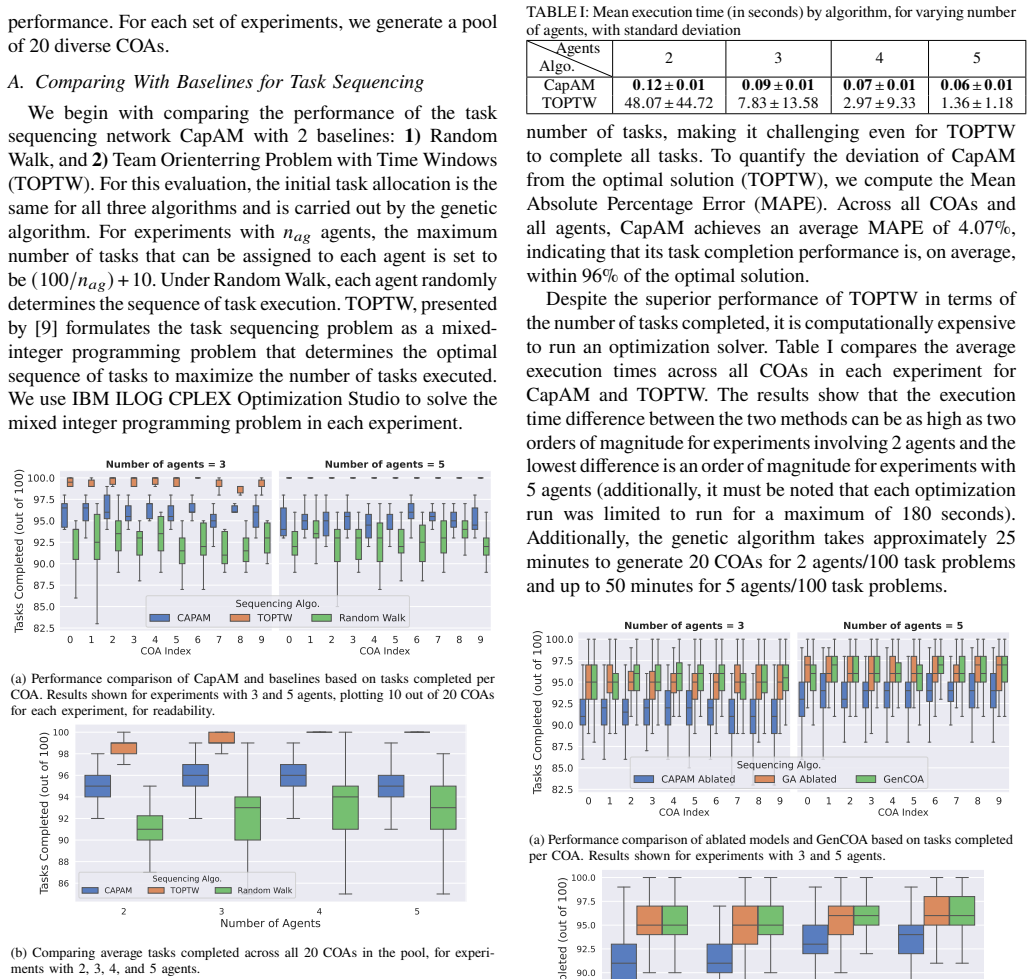
A diverse pool of high-quality COAs can be generated by separating the problem into two sub-problems: (1) allocating tasks to agents in each COA so that the pool is diverse and compatible, and (2) sequencing each agent's tasks to maximize completion rate. Sub-problem (1) is solved by an elitist genetic algorithm that maximizes the sum of a diversity function and a compatibility function. Diversity is quantified without simulation as the total weight of the minimum spanning tree of a meta-graph whose nodes are flattened assignment matrices, so the GA can run quickly. Sub-problem (2) is solved by CapAM, a graph capsule attention policy trained with PPO, which selects the next task per agent per COA. The paper reports that CapAM's completion counts average within 4.07% MAPE of TOPTW, while running orders of magnitude faster, and that the GA improves pool diversity by about 10% over random allocation, leading to statistically significant completion gains in most COAs.
Load-bearing premise
The claim that a diverse pool improves operational robustness rests on whether the MST-based distance between assignment matrices truly captures the differences that matter when the environment changes; if that metric does not track operational distinctness, the genetic algorithm may produce pools that look diverse on paper but fail to offer genuinely different fallback plans.
Editorial extensions
If this is right
- If GenCOA's diversity metric and decomposition hold up, pre-mission planners can get a pool of operationally distinct COAs in under an hour for 100-task missions, instead of solving each COA separately with expensive optimizers.
- The task-sequencing policy's near-optimal completion rates (within about 4% of TOPTW) mean that learning-based sequencing can serve as a fast surrogate when CPLEX-style solvers are too slow for replanning.
- The robustness experiments suggest that a diverse pool protects against traverse uncertainties: when edges are disabled or travel times increase, at least one COA remains valid and top-ranked COAs are more stable, providing a concrete reason to plan multiple alternatives.
- Because the GA is environment-agnostic, the allocation stage does not need rerunning when task locations change, only the sequencing policy, which may enable rapid replanning in dynamic disasters or military settings.
Reading between the lines
- The diversity metric based on minimum spanning tree of assignment matrices is a proxy for operational robustness; the paper's perturbation experiments show pools help, but they do not isolate whether this specific metric causes the robustness, so a direct test comparing MST-diverse pools against randomly diverse pools under the same noise would clarify that.
- The two-stage decomposition suggests a modular design where the compatibility matrix can be learned from historical data and plugged in without changing the GA or the policy, which could extend GenCOA to scenarios where agent-task compatibility is uncertain or changing.
- The exponential penalty reward in CapAM implicitly encodes a risk-averse objective; one could extend the framework by varying the penalty coefficient to generate COAs that trade off expected completion against worst-case failure, connecting to the diversity idea at the sequencing level.
- The approach assumes fixed task locations and known deadlines during training; extending to dynamic task arrival or moving targets would require the task graph to be updated online, which the current event-based MDP could accommodate with additional state features.
Editorial analysis
A structured set of objections, weighed in public.
Referee Report
Summary. The paper proposes GenCOA, a two-stage framework for generating a pool of diverse Courses of Action (COA) for multi-agent operations. In the first stage, an elitist genetic algorithm solves a binary optimization that maximizes a graph-based diversity metric (total weight of a minimum spanning tree over a meta-graph of flattened assignment matrices) plus a task-agent compatibility term. In the second stage, a graph-attention reinforcement learning policy (CapAM, reused from the authors' prior work) sequences each agent's assigned tasks. Experiments in a simulated 100-task environment with 2-5 agents show that CapAM achieves task-completion rates within about 4% MAPE of a TOPTW/CPLEX solver while running much faster, that the GA improves the internal diversity metric by roughly 10% over random allocation, and that the generated pool retains valid COAs and rank structure under edge removals and travel-time noise (Sec. IV).
Significance. If the diversity metric is validated, the paper offers a practically relevant decomposition of COA pool generation into allocation and sequencing, with a runtime of about 50 minutes for a 20-COA, 5-agent, 100-task problem, which is suitable for pre-mission planning. The pipeline is clearly specified in Algorithm 1, the comparison against TOPTW is an appropriate optimality benchmark, and the ablation structure is reasonable. The paper is honest about its limitations, explicitly deferring the correlation between diversity and robustness to future work. However, the central motivating claim that the MST-based diversity metric provides operational robustness is currently a definitional heuristic rather than a derived or empirically validated guarantee; this needs to be addressed before the main contribution can be fully accepted.
major comments (2)
- [Sec. III-A, Sec. IV-C, Sec. V (Future Work)] The paper's motivating premise is that a diverse pool of COAs is operationally beneficial under traverse uncertainty, and the formal diversity objective in Sec. III-A is the total weight of a minimum spanning tree of a meta-graph whose nodes are flattened assignment matrices. This metric is presented as a proxy for operational robustness, but no experiment in Sec. IV establishes that proxy. Sec. IV-C shows that a pool of 20 COAs preserves rank order and retains valid COAs under noise and edge removals, yet it never varies the diversity metric, compares alternative diversity definitions, or correlates MST diversity with robustness outcomes. The only quantified diversity benefit, a roughly 10% increase in MST diversity over random allocation in the 2-agent case, is internal to the metric itself. The paper explicitly acknowledges this gap in its Future Work section: 'More detailed analysis is also needed in future work to understand and assess how diversity evolves and correlates to the robustness of the COA pool as a whole.' Because the operational value of the pool is the central contribution, this unvalidated link between the MST metric and robustness is the most load-bearing weakness.
- [Sec. III-A, Eq. (4)] The objective function in Eq. (4) is an unweighted sum of f_div and f_comp, but the two terms have incomparable units and scales. f_div is a Euclidean MST weight over flattened assignment matrices, while f_comp is a sum of compatibility values (each at most 1) over all assignments in the pool; depending on matrix dimensions and compatibility levels, one term can dominate the other. The paper states in Sec. IV-B that the GA uses an 'equally weighted combination' of diversity and compatibility, but it does not normalize the terms or report a sensitivity study over their relative weighting. This makes the claimed joint maximization of diversity and compatibility, as well as the reported 10% diversity improvement, difficult to interpret. A normalization scheme and a small weighting sensitivity study would substantially strengthen the formulation.
minor comments (5)
- [Sec. III-B1] The sentence ending the reward description, 'This reward function penalizes the age', is incomplete; it should specify what is penalized (e.g., the number or age of expired tasks).
- [Fig. 5a] The text states that each COA result is obtained from 10 sequencing runs, but no error bars or variance statistics are shown; the visual gap between CapAM and TOPTW should be accompanied by confidence intervals or standard deviations.
- [Eq. (3)] The notation I_{T_i}=1 should be defined explicitly as an indicator variable, and the expression max_{tau subset of Gamma_j(t,a_j)} |tau| conflates a sequence tau with its set of tasks; this makes the definition of a COA difficult to parse.
- [Sec. III-B3] The random variables for task deadlines and compatibilities are both denoted by C in the training description ('C ~ U(0,1)' and 'C ~ U(500, 5x10^4)'), which conflicts with the compatibility matrix C used in Sec. III-A and could confuse readers.
- [Sec. IV-C] The rank transition probabilities in Fig. 7 appear to be computed from a single noise realization per noise level; reporting multiple random trials would strengthen the claim that top-ranked COAs remain robust under dynamic disturbances.
Circularity Check
No circular reduction found; the diversity metric and sequencing network are independently defined and benchmarked, with only minor non-load-bearing reuse of the authors' prior CapAM work.
full rationale
Walking the derivation chain: the pool-diversity objective f_div is defined directly as the MST weight over a meta-graph of flattened assignment matrices (Sec. III-A), and compatibility f_comp is a Hadamard-product sum with a prescribed compatibility matrix; neither is defined in terms of the completion-rate or robustness outcomes it is later compared against. The GA maximizes this explicit objective, so reporting a ~10% increase in MST diversity versus random allocation is an optimizer verification, not a prediction. Task sequencing is a separate MDP/PPO sub-problem (Sec. III-B), and its completion rates are benchmarked against an external TOPTW/CPLEX solver and a random-walk baseline under identical GA allocations (Sec. IV-A), giving an independent optimality-gap estimate (MAPE 4.07%). The perturbation tests in Sec. IV-C measure rank shifts, valid-COA counts, and task completion under noise/edge removal, none of which are defined by the MST diversity objective. The paper reuses the authors' prior CapAM network [7] and borrows the MST diversity idea from [21], but those are components rather than load-bearing proofs; the paper does not invoke a uniqueness theorem or define its target result into existence. The Future Work section explicitly states that 'more detailed analysis is also needed ... to understand and assess how diversity evolves and correlates to the robustness of the COA pool as a whole,' confirming that the diversity-robustness link is an unvalidated empirical hypothesis, not a circular derivation. On the circularity scale, the only notable feature is minor self-citation of prior component work, so the score is 2 rather than 0.
Assumptions & free parameters
free parameters (4)
- Reward penalty coefficient =
0.1
- Compatibility and deadline training distributions =
C ~ U(0,1); deadline ~ U(500, 50000) s; task time = 10/C
- Diversity-compatibility weighting =
equal weights (1 and 1) in f = f_div + f_comp
- GA hyperparameters =
population 100, mutation 0.1, elite 0.01, crossover 0.5, parent ratio 0.3, 5000 iterations
assumptions (5)
- domain assumption The task space is a fully connected graph whose edge weights are travel times computed from Euclidean distance and agent speed, and each task node has a 5-dimensional feature vector.
- domain assumption The problem is SR-ST-TA: each task is assigned to exactly one agent, each agent handles one task at a time, and tasks have deadlines.
- domain assumption The task-agent compatibility matrix C is known a priori and is treated as a prescribed input.
- ad hoc to paper Diversity of a COA pool is adequately measured by the total weight of the minimum spanning tree of the meta-graph of flattened assignment matrices.
- domain assumption A policy trained on a single agent planning over 100 tasks generalizes to multiple agents each planning over subsets of those tasks.
Cite this review
Pith. "Pith review of Automated Generation of Diverse Courses of Actions for Multi-Agent Operations using Binary Optimization and Graph Learning." pith.science (2026). https://pith.science/paper/L5YE3HQA
@misc{pith2026250620031,
  author       = {Pith},
  title        = {Pith review of: Automated Generation of Diverse Courses of Actions for Multi-Agent Operations using Binary Optimization and Graph Learning},
  year         = {2026},
  howpublished = {\url{https://pith.science/paper/L5YE3HQA}},
  note         = {Machine review of arXiv:2506.20031}
}
read the original abstract
Operations in disaster response, search \& rescue, and military missions that involve multiple agents demand automated processes to support the planning of the courses of action (COA). Moreover, traverse-affecting changes in the environment (rain, snow, blockades, etc.) may impact the expected performance of a COA, making it desirable to have a pool of COAs that are diverse in task distributions across agents. Further, variations in agent capabilities, which could be human crews and/or autonomous systems, present practical opportunities and computational challenges to the planning process. This paper presents a new theoretical formulation and computational framework to generate such diverse pools of COAs for operations with soft variations in agent-task compatibility. Key to the problem formulation is a graph abstraction of the task space and the pool of COAs itself to quantify its diversity. Formulating the COAs as a centralized multi-robot task allocation problem, a genetic algorithm is used for (order-ignoring) allocations of tasks to each agent that jointly maximize diversity within the COA pool and overall compatibility of the agent-task mappings. A graph neural network is trained using a policy gradient approach to then perform single agent task sequencing in each COA, which maximizes completion rates adaptive to task features. Our tests of the COA generation process in a simulated environment demonstrate significant performance gain over a random walk baseline, small optimality gap in task sequencing, and execution time of about 50 minutes to plan up to 20 COAs for 5 agent/100 task operations.
Figures


Figures from the paper (4 more)



Reference graph
Works this paper leans on
-
[1]
P. Ghassemi and S. Chowdhury, “Decentralized task allocation in multi-robot systems via bipartite graph matching augmented with fuzzy clustering,” inProceedings of the International Design Engineering Technical Conferences and Computers and Information in Engineering Conference (IDETC-CIE), ser. 44th Design Automation Conference, vol. 2A, 08 2018, p. V02A...
-
[2]
M. V. Espina, R. Grech, D. De Jager, P. Remagnino, L. Iocchi, L. Marchetti, D. Nardi, D. Monekosso, M. Nicolescu, and C. King, Multi-robot Teams for Environmental Monitoring. Berlin, Heidelberg: Springer Berlin Heidelberg, 2011, pp. 183–209. [Online]. Available: https://doi.org/10.1007/978-3-642-18278-5 8
-
[3]
J.-P. Aurambout, K. Gkoumas, and B. Ciuffo, “Last mile delivery by drones: an estimation of viable market potential and access to citizens across european cities,”European Transport Research Review, vol. 11, no. 1, p. 30, Jun 2019. [Online]. Available: https://doi.org/10.1186/s12544-019-0368-2
-
[4]
P. Poddar, S. Paul, and S. Chowdhury,A Graph-Based Adversarial Imitation Learning Framework for Reliable & Realtime Fleet Scheduling in Urban Air Mobility, 2024. [Online]. Available: https://arc.aiaa.org/doi/abs/10.2514/6.2024-4006
-
[5]
H. Guo, Z. Miao, J. Ji, and Q. Pan, “An effective collaboration evolutionary algorithm for multi-robot task allocation and scheduling in a smart farm,”Knowledge-Based Systems, vol. 289, p. 111474, 2024. [Online]. Available: https://www.sciencedirect.com/science/article/pii/ S0950705124001096
work page 2024
-
[6]
I. Cil and M. Mala, “A multi-agent architecture for modelling and simulation of small military unit combat in asymmetric warfare,” Expert Systems with Applications, vol. 37, no. 2, pp. 1331–1343, 2010. [Online]. Available: https://www.sciencedirect.com/science/article/pii/ S0957417409005521
work page 2010
-
[7]
S. Paul, P. Ghassemi, and S. Chowdhury, “Learning scalable policies over graphs for multi-robot task allocation using capsule attention net- works,” in2022 International Conference on Robotics and Automation (ICRA), 2022, pp. 8815–8822
work page 2022
-
[8]
S. Paul, W. Li, B. Smyth, Y. Chen, Y. Gel, and S. Chowdhury, “Efficient planning of multi-robot collective transport using graph reinforcement learning with higher order topological abstraction,” in2023 IEEE International Conference on Robotics and Automation (ICRA), 2023, pp. 5779–5785
work page 2023
Show all 26 references
-
[9]
The cooperative orienteering problem with time windows,
M. Van Der Merwe, J. Minas, M. Ozlen, and J. Hearne, “The cooperative orienteering problem with time windows,”Optimization Online, vol. 7, no. 11, pp. 1–11, 2014
2014
-
[10]
A solution approach to the orienteering problem with time windows and synchronisation constraints,
I. Roozbeh, J. W. Hearne, and D. Pahlevani, “A solution approach to the orienteering problem with time windows and synchronisation constraints,”Heliyon, vol. 6, no. 6, p. e04202, 2020. [Online]. Available: https://www.sciencedirect.com/science/article/pii/ S240584402031046X
2020
-
[11]
A formal analysis and taxonomy of task allocation in multi-robot systems,
B. P. Gerkey and M. J. Matari ´c, “A formal analysis and taxonomy of task allocation in multi-robot systems,”The International Journal of Robotics Research, vol. 23, pp. 939 – 954, 2004. [Online]. Available: https://api.semanticscholar.org/CorpusID:61299428
2004
-
[12]
Iterated local search for time- extended multi-robot task allocation with spatio-temporal and capacity constraints,
H. Mitiche, D. Boughaci, and M. L. Gini, “Iterated local search for time- extended multi-robot task allocation with spatio-temporal and capacity constraints,”Journal of Intelligent Systems, vol. 28, pp. 347 – 360,
-
[13]
A meta-heuristic approach for capacitated vehicle routing problem in fuel distribution,
E. Zero, A. Daniele, A. Bozzi, S. Graffione, and A. E. Sindi Morando, “A meta-heuristic approach for capacitated vehicle routing problem in fuel distribution,” in2024 IEEE 20th International Conference on Automation Science and Engineering (CASE), 2024, pp. 33–38
2024
-
[14]
An augmented large neighborhood search method for solving the team orienteering problem,
B.-I. Kim, H. Li, and A. L. Johnson, “An augmented large neighborhood search method for solving the team orienteering problem,”Expert Systems with Applications, vol. 40, no. 8, pp. 3065–3072, 2013. [Online]. Available: https://www.sciencedirect.com/science/article/pii/ S095741...
2013
-
[15]
The multiconstraint team orienteering problem with multiple time windows,
W. Souffriau, P. Vansteenwegen, G. Vanden Berghe, and D. Van Oudheusden, “The multiconstraint team orienteering problem with multiple time windows,”Transportation Science, vol. 47, no. 1, pp. 53–63, 2013. [Online]. Available: https://doi.org/10.1287/trsc.1110.0377
2013 arXiv
-
[16]
Fast scheduling of robot teams performing tasks with temporospatial constraints,
M. C. Gombolay, R. J. Wilcox, and J. A. Shah, “Fast scheduling of robot teams performing tasks with temporospatial constraints,”IEEE Transactions on Robotics, vol. 34, no. 1, pp. 220–239, 2018
2018
-
[17]
Non-cooperative- game-based multi-agent collaborative planning method for distributed generations,
Y. Yang, W. Liu, J. Zhou, J. Zhou, and J. Zhang, “Non-cooperative- game-based multi-agent collaborative planning method for distributed generations,” in2020 IEEE 4th Conference on Energy Internet and Energy System Integration (EI2), 2020, pp. 273–278
2020
-
[18]
Diversifying agent’s behaviors in interactive decision models,
Y. Pan, H. Zhang, Y. Zeng, B. Ma, J. Tang, and Z. Ming, “Diversifying agent’s behaviors in interactive decision models,”International Journal of Intelligent Systems, vol. 37, no. 12, pp. 12 035–12 056, 2022. [Online]. Available: https://onlinelibrary.wiley.com/doi/abs/10.1002/...
2022 doi
-
[19]
Learning to allocate time-bound and dynamic tasks to multiple robots using covariant attention neural networks,
S. Paul and S. Chowdhury, “Learning to allocate time-bound and dynamic tasks to multiple robots using covariant attention neural networks,”Journal of Computing and Information Science in Engineering, vol. 24, no. 9, p. 091005, 08 2024. [Online]. Available: https://doi.org/10.1...
2024 doi
-
[20]
Toward soft heterogeneity in robotic swarms,
B. Ranjbar-Sahraeia, S. Alersa, K. Stankov´aa, K. Tuylsab, and G. Weissa, “Toward soft heterogeneity in robotic swarms,” inProceedings of the 25th Benelux Conference on Artificial Intelligence (BNAIC), Delft, The Netherlands, 2013, pp. 7–8
2013
-
[21]
Adaptive neuroevolution with genetic operator control and two-way complexity variation,
A. Behjat, N. Maurer, S. Chidambaran, and S. Chowdhury, “Adaptive neuroevolution with genetic operator control and two-way complexity variation,”IEEE Transactions on Artificial Intelligence, vol. 4, no. 6, pp. 1627–1641, 2023
2023
-
[23]
Graph capsule convolutional neural networks,
S. Verma and Z.-L. Zhang, “Graph capsule convolutional neural networks,” 2018. [Online]. Available: https://arxiv.org/abs/1805.08090
2018 arXiv
-
[24]
Attention is all you need,
A. Vaswani, “Attention is all you need,”Advances in Neural Information Processing Systems, 2017
2017
-
[25]
Stable-baselines3: Reliable reinforcement learning implementations,
A. Raffin, A. Hill, A. Gleave, A. Kanervisto, M. Ernestus, and N. Dormann, “Stable-baselines3: Reliable reinforcement learning implementations,”Journal of Machine Learning Research, vol. 22, no. 268, pp. 1–8, 2021. [Online]. Available: http://jmlr.org/papers/v22/ 20-1364.html
2021
-
[2017]
Available: http://arxiv.org/abs/1707.06347
[Online]. Available: http://arxiv.org/abs/1707.06347
-
[2019]
Available: https://api.semanticscholar.org/CorpusID: 69802635
[Online]. Available: https://api.semanticscholar.org/CorpusID: 69802635
Reviewed August 6, 2026 · model on record in the stance chip above.
Discussion (0). Continue with ORCID to comment.