REVIEW 3 major objections 6 minor 33 references
Learning Moderately Input-Sensitive Functions: A Case Study in QR Code Decoding
T0 review · 3 major / 6 minor · reviewed 2026-08-06 · deepseek-v4-flash
Pith's one-line read A standard Transformer can decode QR codes beyond the classical error-correction limit by learning the structure of the embedded text, not by using the code's redundancy bits.
desk verdict Clean empirical case study with a genuinely new theory; the headline overstates robustness because it applies only to fixed mask patterns and language-like text. read the letter →
The pith
A machine-rendered reading of the paper's core claim, the machinery that carries it, and where it could break.
The reading
What carries the argument
The central object is the QR code as a parameterized family of functions of medium input sensitivity, and the machinery is a standard Transformer trained as a sequence-to-sequence decoder on linearly ordered bit strings. The bit-string ordering that follows the QR standard's zigzag placement is crucial; the paper also fixes version and mask so the mapping is consistent. To compare against classical decoding, the paper derives a closed-form success-rate formula for Reed-Solomon and BCH error correction across the whole encoding region, stated as Theorem 4.1 and built from Theorems 4.2 and 4.3. The controlled comparison of data-codeword versus error-correction-codeword flips is the experiment that identifies the learned mechanism: sensitivity to data bits and insensitivity to error-correction bits.
What would settle it
Train the same architecture and augmentation protocol on QR codes whose payloads are uniformly random byte strings rather than domain names. If decoding success under 10-20 random bit flips does not stay above the Theorem 4.1 theoretical curve, then the claimed beyond-limit capability is caused by language priors rather than by a general ability to learn medium-sensitivity functions.
Extended reading notes
Core claim
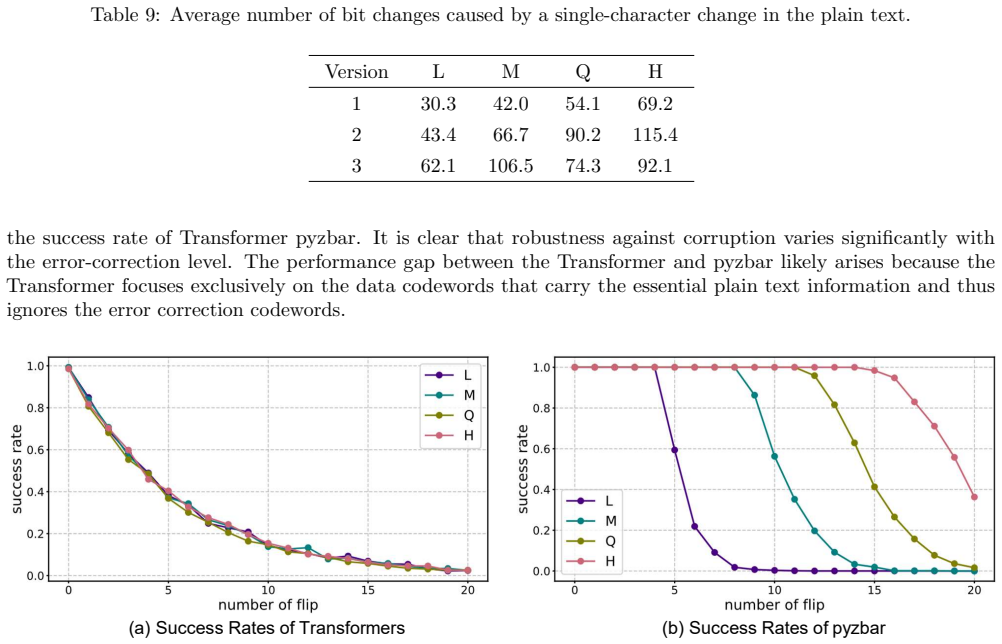
On its own terms, the paper's central discovery is that a Transformer trained on 500,000 examples of QR codes with a fixed version, mask pattern, and error-correction level can learn the decoding map: average clean success is above 93% for v1-v3 L-level codes across all eight mask patterns, and under many random flip errors or burst errors it beats both the theoretical success probability the paper derives and a conventional QR decoder. The same model generalizes to German, Swahili, shuffled English, and random alphabetic strings at roughly 94-99% clean accuracy, with the lowest success on strings that resemble misspellings or leetspeak; a no-TLD variant collapses to 3.0%, showing the model expects the domain-name format. Controlled error-location experiments show flips in data codewords degrade success while flips in error-correction codewords do not, so the paper concludes the Transformer does not perform Reed-Solomon-style correction and instead reconstructs plausible text from a learned language prior. The paper also reports that if mask patterns are chosen by the standard scoring rule instead of fixed, average success falls to 68.3% because the training data becomes dominated by a couple of mask patterns.
Load-bearing premise
The results assume the QR code is already detected and handed to the model as a cleanly linearized bit string with a fixed mask pattern and a fixed code version, trained separately per mask; once masks are chosen automatically by the realistic scoring rule, average success drops to 68.3%, so the beyond-limit performance does not yet transfer to unmodified real-world QR capture.
Editorial extensions
If this is right
- Under random flip errors, Transformer success stays above the newly derived Reed-Solomon success curve once errors exceed about nine bits, and data augmentation widens the gap; thus the theoretical error-correction limit is not a ceiling for a learned decoder that has access to plaintext statistics.
- The model is sensitive to flips in data codewords but nearly insensitive to flips in error-correction codewords, so it achieves robustness through output reconstruction rather than by exploiting the QR code's redundancy.
- The learned decoder generalizes to German, Swahili, shuffled English, and random alphabetic strings with high clean accuracy, but drops to 3.0% when the period and top-level domain are removed, showing the model has internalized the domain-name format itself.
- On inputs containing misspellings or leetspeak, the model often overwrites the actual text with a familiar word, so a learned decoder can silently correct and distort data rather than report failure.
Reading between the lines
- If the mechanism is a generic statistical prior over payloads, the same beyond-limit effect should appear for other structured payloads such as URLs, fixed-format records, or natural-language messages, and the size of the gap should track how predictable the payload distribution is.
- The always-output-something behavior implies learned decoders need a confidence or abstention layer before deployment in settings where silent corruption is costly; the paper's examples show near-miss outputs under heavy corruption.
- Because mask-pattern imbalance alone drops success from roughly 93% to 68.3%, a practical end-to-end reader would likely need a mask-classification front-end followed by per-mask decoding, a combination the paper motivates but does not evaluate as a full pipeline.
- The bit-string protocol skips image noise, perspective, blur, and detection; whether the claimed robustness survives upstream visual distortions is an open question, and testing it would require pairing this decoder with a detector.
Editorial analysis
A structured set of objections, weighed in public.
Referee Report
Summary. The paper proposes a new task, learning-based QR code decoding, as a case study of learning functions with medium input sensitivity. The authors train standard Transformer sequence-to-sequence models on QR codes linearized into bit strings, with fixed version, error-correction level, and mask pattern, and evaluate decoding success on clean and corrupted inputs. They compare against pyzbar and against a theoretical success-rate formula for the standard Reed-Solomon decoder (Theorems 4.1-4.3). The experiments show that the Transformer decodes clean codes with over 93% success across versions, outperforms the theoretical curve and pyzbar under severe flip and burst corruption for (v3,L) mask pattern 0, generalizes from English-rich training data to German, Swahili, shuffled, and random alphabetic strings, and is insensitive to errors in the error-correction codewords. The paper also reports that training on automatically selected mask patterns yields only 68.3% average success, motivating the fixed-mask protocol.
Significance. If the results hold, this is a useful contribution to the study of input sensitivity in deep learning: it identifies a class of moderately sensitive functions and demonstrates that a generic Transformer can learn QR decoding by exploiting corpus-level language structure, exceeding the success rate of a standard decoder. The theoretical derivation of the standard decoder's success rate under random bit flips is a valuable reference, and the sensitivity analysis (ECC bits ignored by the model) is an interesting falsifiable observation. The paper is generally thorough, with extensive appendices and concrete examples. The strengths are the novel task formulation, the internal consistency of the combinatorial derivation (apart from the issue raised below), and the breadth of generalization experiments.
major comments (3)
- [Appendix H, Theorem 4.3, Eq. (4)] Theorem 4.3 is not the probability of successful format-information decoding under the uniform bit-flip model stated in Section 4. With q bit errors distributed over the two 15-bit copies, the success probability is sum_{i=0..q, min(i,q-i)<=3} C(15,i)C(15,q-i)/C(30,q), not the fraction |{(i,j): i+j=q, min(i,j)<=3}|/(q+1). The proof treats all q+1 allocations as equally likely, which is only true if errors are placed uniformly over the two copies rather than uniformly over the 30 bits. The numerical impact on Figure 6 is likely small because q is almost always small for n<=20 in v3-L, but the theorem as stated is false and must be corrected.
- [Abstract, Section 8, Section 5.1] The headline claim that Transformers 'can successfully decode QR codes, even beyond the theoretical error-correction limit' is stronger than what the experiments establish. The main results fix the mask pattern, fix the version, train a separate model per mask, and feed cleanly linearized bit strings (Section 5.1). Under the realistic mask-selection protocol, Table 1 reports an average success rate of 68.3%, with most mask patterns below 70%. The abstract and conclusion should explicitly state these boundary conditions. In addition, the 'theoretical error-correction limit' is the expected success rate of the standard Reed-Solomon decoder, not a hard information-theoretic bound; the wording should be changed to something like 'the success rate of standard error correction.'
- [Section 4, Figure 6] The theoretical curve in Figure 6 is not reproducible from the manuscript. Theorem 4.1 depends on N, Nd, Nf, and Nr, but the paper never gives these values for the (v3,L) QR code used in Figure 6, nor for the versions and levels used in Section 7. The authors should provide a table of these parameters or state them in the figure caption. Without them, the central 'beyond the theoretical limit' comparison cannot be independently verified.
minor comments (6)
- [Appendix H, proof of Theorem 4.2, Eq. (6)] The denominator in Eq. (6) is written C(Nd, n) but should be C(Nd, p); the theorem statement has the correct denominator, so this is a proof typo.
- [Tables 3, 5 and Figure 6] No standard deviations, confidence intervals, or number of random seeds are reported. Since evaluation sets contain 1,000-5,000 samples, reporting results over at least three seeds would strengthen the empirical claims.
- [Appendix B, final paragraph] The sentence 'the remaining patterns fall below the 3 % threshold' appears to be a typo; the reported success rates (49.1-68.8%) are below 70%, not below 3%.
- [Figure 6(b)] The 'Theoretical' line is described by Theorem 4.1, which is derived for uniformly random flip errors; for burst errors, the same curve is not theoretically justified, so the caption should clarify whether it is shown only as a reference.
- [Section 5.1] The text says 'We fixed each dataset's QR code version, error correction level, and mask pattern' but the experiments in Figure 6 use separate models per mask; please clarify that a separate model is trained for each mask pattern.
- [Appendix F] The claim that 'in Version 3 and later versions, the data codewords are divided into two or more blocks' is not true for (v3,L) and (v3,M), which have a single block; this should be corrected and the explanation of Table 9 revisited.
Circularity Check
No significant circularity: the theoretical limit is independent combinatorics and the empirical claims are evaluated on held-out data.
full rationale
The paper's central derivation, Theorems 4.1–4.3, computes the success rate of standard Reed–Solomon/BCH error correction from the QR specification parameters (Nd, Nf, Nr, Mecc, t) using inclusion–exclusion. No constant in this formula is fitted to Transformer behavior; it is a closed-form probability over uniformly random bit flips and is therefore an external benchmark rather than an input to the model. The Transformer results are evaluated on held-out domain names (train/test split) and on corrupted inputs generated after training; the 'beyond the theoretical limit' comparison in Figure 6 is an empirical comparison against this independent curve, not a prediction derived from the same fitted values. The generalization study (Section 6) introduces eight evaluation sets with lexical properties different from the training distribution, so those success rates are not forced by construction. The fixed-mask and linearization-order choices are motivated by preliminary experiments, but these choices are reported as limitations (Table 1 shows the realistic auto-mask average of 68.3%) and do not constitute fitting a parameter to the headline claim. Self-citations (Kera et al. 2024, 2025) appear only in related-work context and are not load-bearing for any theorem or experimental conclusion. No step in the paper reduces by definition to its own inputs.
Assumptions & free parameters
assumptions (4)
- domain assumption Bit flips occur uniformly at random across the encoding region.
- domain assumption QR code detection is already completed and the input is a cleanly linearized bit string with known mask pattern and version.
- standard math Reed-Solomon decoding succeeds iff at most t codewords contain errors, with t=floor(Mecc/2).
- domain assumption Tranco domain names are representative of natural-language text structure.
Cite this review
Pith. "Pith review of Learning Moderately Input-Sensitive Functions: A Case Study in QR Code Decoding." pith.science (2026). https://pith.science/paper/AD6GHWCO
@misc{pith2026250620305,
  author       = {Pith},
  title        = {Pith review of: Learning Moderately Input-Sensitive Functions: A Case Study in QR Code Decoding},
  year         = {2026},
  howpublished = {\url{https://pith.science/paper/AD6GHWCO}},
  note         = {Machine review of arXiv:2506.20305}
}
read the original abstract
The hardness of learning a function that attains a target task relates to its input-sensitivity. For example, image classification tasks are input-insensitive as minor corruptions should not affect the classification results, whereas arithmetic and symbolic computation, which have been recently attracting interest, are highly input-sensitive as each input variable connects to the computation results. This study presents the first learning-based Quick Response (QR) code decoding and investigates learning functions of medium sensitivity. Our experiments reveal that Transformers can successfully decode QR codes, even beyond the theoretical error-correction limit, by learning the structure of embedded texts. They generalize from English-rich training data to other languages and even random strings. Moreover, we observe that the Transformer-based QR decoder focuses on data bits while ignoring error-correction bits, suggesting a decoding mechanism distinct from standard QR code readers.
Figures


Figures from the paper (7 more)


Reference graph
Works this paper leans on
-
[1]
Global lyapunov functions: a long-standing open problem in mathematics, with symbolic transformers
Alberto Alfarano, Fran c ois Charton, and Amaury Hayat. Global lyapunov functions: a long-standing open problem in mathematics, with symbolic transformers. In Advances in Neural Information Processing Systems, 2024
work page 2024
-
[2]
Linear algebra with transformers
Fran c ois Charton. Linear algebra with transformers. Transactions on Machine Learning Research, 2022
work page 2022
-
[3]
Learning the greatest common divisor: explaining transformer predictions
Fran c ois Charton. Learning the greatest common divisor: explaining transformer predictions. In International Conference on Learning Representations, 2024
work page 2024
-
[4]
A lightweight barcode detection algorithm based on deep learning
Jingchao Chen, Ning Dai, Xudong Hu, and Yanhong Yuan. A lightweight barcode detection algorithm based on deep learning. Applied Sciences, 2024
work page 2024
-
[5]
Overcoming a theoretical limitation of self-attention
David Chiang and Peter Cholak. Overcoming a theoretical limitation of self-attention. In Proceedings of the 60th Annual Meeting of the Association for Computational Linguistics, pages 7654--7664, 2022
work page 2022
-
[6]
Qr code detection using convolutional neural networks
Tzu-Han Chou, Chuan-Sheng Ho, and Yan-Fu Kuo. Qr code detection using convolutional neural networks. International Conference on Advanced Robotics and Intelligent Systems, pages 1--5, 2015
work page 2015
-
[7]
An image is worth 16x16 words: Transformers for image recognition at scale
Alexey Dosovitskiy, Lucas Beyer, Alexander Kolesnikov, Dirk Weissenborn, Xiaohua Zhai, Thomas Unterthiner, Mostafa Dehghani, Matthias Minderer, Georg Heigold, Sylvain Gelly, Jakob Uszkoreit, and Neil Houlsby. An image is worth 16x16 words: Transformers for image recognition at scale. In International Conference on Learning Representations, 2021
2021
-
[8]
Vinay Edula, Kalyan Ammisetty, Aakash Kotha, Deepthi Ravipati, Aakashnag Davuluri, and Arulmozhivarman P. A novel framework for qr code detection and decoding from obscure images using yolo object detection and real-esrgan image enhancement technique. In International Conference on Computing Communication and Networking Technologies, pages 1--6, 2023
work page 2023
Show all 33 references
-
[9]
Why are sensitive functions hard for transformers? In Proceedings of the Annual Meeting of the Association for Computational Linguistics, pages 14973--15008, 2024
Michael Hahn and Mark Rofin. Why are sensitive functions hard for transformers? In Proceedings of the Annual Meeting of the Association for Computational Linguistics, pages 14973--15008, 2024
2024
-
[10]
Information technology — automatic identification and data capture techniques — qr code bar code symbology specification, 2024
International Organization for Standardization . Information technology — automatic identification and data capture techniques — qr code bar code symbology specification, 2024
2024
-
[11]
Learning to compute gr \" o bner bases
Hiroshi Kera, Yuki Ishihara, Yuta Kambe, Tristan Vaccon, and Kazuhiro Yokoyama. Learning to compute gr \" o bner bases. In Advances in Neural Information Processing Systems, 2024
2024
-
[12]
Computational algebra with attention: Transformer oracles for border basis algorithms
Hiroshi Kera, Nico Pelleriti, Yuki Ishihara, Max Zimmer, and Sebastian Pokutta. Computational algebra with attention: Transformer oracles for border basis algorithms. arXiv:2505.23696, 2025
2025 arXiv
-
[13]
Transformers provably solve parity efficiently with chain of thought
Juno Kim and Taiji Suzuki. Transformers provably solve parity efficiently with chain of thought. In International Conference on Learning Representations, 2025
2025
-
[14]
An improvement on qr code limit angle detection using convolution neural network
Wendy Cahya Kurniawan, Hiroshi Okumura, Muladi, and Anik Nur Handayani. An improvement on qr code limit angle detection using convolution neural network. In International Conference on Electrical, Electronics and Information Engineering, pages 234--238, 2019
2019
-
[15]
Deep learning for symbolic mathematics
Guillaume Lample and Fran c ois Charton. Deep learning for symbolic mathematics. In International Conference on Learning Representations, 2020
2020
-
[16]
Binary codes capable of correcting deletions, insertions and reversals
Vladimir Iosifovich Levenshtein. Binary codes capable of correcting deletions, insertions and reversals. Soviet Physics Doklady, pages 707--710, 1966
1966
-
[17]
BART: denoising sequence-to-sequence pre-training for natural language generation, translation, and comprehension
Mike Lewis, Yinhan Liu, Naman Goyal, Marjan Ghazvininejad, Abdelrahman Mohamed, Omer Levy, Veselin Stoyanov, and Luke Zettlemoyer. BART: denoising sequence-to-sequence pre-training for natural language generation, translation, and comprehension. In Proceedings of the Annual Me...
2020
-
[18]
Salsa verde: a machine learning attack on learning with errors with sparse small secrets
Cathy Li, Emily Wenger, Zeyuan Allen-Zhu, Francois Charton, and Kristin Lauter. Salsa verde: a machine learning attack on learning with errors with sparse small secrets. In Advances in Neural Information Processing Systems, 2023 a
2023
-
[19]
Salsapicante: A machine learning attack on lwe with binary secrets
Cathy Yuanchen Li, Jana Sot\' a kov\' a , Emily Wenger, Mohamed Malhou, Evrard Garcelon, Fran c ois Charton, and Kristin Lauter. Salsapicante: A machine learning attack on lwe with binary secrets. In Proceedings of the ACM SIGSAC Conference on Computer and Communications Secur...
2023
-
[20]
Decoupled weight decay regularization
Ilya Loshchilov and Frank Hutter. Decoupled weight decay regularization. In International Conference on Learning Representations, 2019
2019
-
[21]
Qr code detection with faster-rcnn based on fpn
Jinbo Peng, Song Yuan, and Xin Yuan. Qr code detection with faster-rcnn based on fpn. In Artificial Intelligence and Security, pages 434--443, 2020
2020
-
[22]
Tranco: A research-oriented top sites ranking hardened against manipulation
Victor Le Pochat, Tom Van Goethem, Samaneh Tajalizadehkhoob, Maciej Korczyński, and Wouter Joosen. Tranco: A research-oriented top sites ranking hardened against manipulation. arXiv preprint arXiv:1806.01156, 2018
2018 arXiv
-
[23]
Grokking: Generalization beyond overfitting on small algorithmic datasets
Alethea Power, Yuri Burda, Harri Edwards, Igor Babuschkin, and Vedant Misra. Grokking: Generalization beyond overfitting on small algorithmic datasets. arXiv preprint arXiv:2201.02177, 2022
2022 arXiv
-
[24]
Quick response barcode deblurring via doubly convolutional neural network
Haitao Pu, Mingqu Fan, Jinliang Yang, and Jian Lian. Quick response barcode deblurring via doubly convolutional neural network. Multimedia Tools and Applications, page 897–912, 2019
2019
-
[25]
Robust speech recognition via large-scale weak supervision
Alec Radford, Jong Wook Kim, Tao Xu, Greg Brockman, Christine McLeavey, and Ilya Sutskever. Robust speech recognition via large-scale weak supervision. In International Conference on Machine Learning, pages 28492--28518, 2023
2023
-
[26]
Failures of gradient-based deep learning
Shai Shalev - Shwartz, Ohad Shamir, and Shaked Shammah. Failures of gradient-based deep learning. In International Conference on Machine Learning, pages 3067--3075, 2017
2017
-
[27]
Positional description matters for transformers arithmetic
Ruoqi Shen, S \' e bastien Bubeck, Ronen Eldan, Yin Tat Lee, Yuanzhi Li, and Yi Zhang. Positional description matters for transformers arithmetic. arXiv:2311.14737, 2023
2023 arXiv
-
[28]
Super resolution for qr code images
Takahiro Shindo, Taiju Watanabe, Remina Yano, Marika Arimoto, Miho Takahashi, and Hiroshi Watanabe. Super resolution for qr code images. In Global Conference on Consumer Electronics, pages 274--277, 2022
2022
-
[29]
Gomez, Lukasz Kaiser, and Illia Polosukhin
Ashish Vaswani, Noam Shazeer, Niki Parmar, Jakob Uszkoreit, Llion Jones, Aidan N. Gomez, Lukasz Kaiser, and Illia Polosukhin. Attention is all you need. In Advances in Neural Information Processing Systems, pages 5998--6008, 2017
2017
-
[30]
Emily Wenger, Mingjie Chen, Fran c ois Charton, and Kristin E. Lauter. SALSA: attacking lattice cryptography with transformers. In Advances in Neural Information Processing Systems, 2022
2022
-
[31]
Ehfp-gan: Edge-enhanced hierarchical feature pyramid network for damaged qr code reconstruction
Jianhua Zheng, Ruolin Zhao, Zhongju Lin, Shuangyin Liu, Rong Zhu, Zihao Zhang, Yusha Fu, and Junde Lu. Ehfp-gan: Edge-enhanced hierarchical feature pyramid network for damaged qr code reconstruction. Mathematics, 2023
2023
-
[32]
Susskind, Samy Bengio, and Preetum Nakkiran
Hattie Zhou, Arwen Bradley, Etai Littwin, Noam Razin, Omid Saremi, Joshua M. Susskind, Samy Bengio, and Preetum Nakkiran. What algorithms can transformers learn? A study in length generalization. In International Conference on Learning Representations, 2024
2024
-
[33]
Detrs with collaborative hybrid assignments training
Zhuofan Zong, Guanglu Song, and Yu Liu. Detrs with collaborative hybrid assignments training. In International Conference on Computer Vision, pages 6725--6735, 2023
2023
Reviewed August 6, 2026 · model on record in the stance chip above.
Discussion (0). Sign in to comment.