REVIEW 4 major objections 5 minor 1 cited by
Large Language Model-Driven Code Compliance Checking in Building Information Modeling
T0 review · 4 major / 5 minor · reviewed 2026-08-06 · deepseek-v4-flash
Pith's one-line read This paper argues that a four-part engineered prompt plus an error-feedback loop lets LLMs turn building-code text into executable Python scripts that run in Revit and flag non-compliant elements.
desk verdict A scrappy engineering demo of LLM-generated Revit checks with a real evaluation gap: success is defined as script execution, not correct checking, so the accuracy claim is unmeasured. read the letter →
The pith
A machine-rendered reading of the paper's core claim, the machinery that carries it, and where it could break.
The reading
What carries the argument
The mechanism that carries the argument is the optimized prompt combined with the error-feedback loop. The prompt is a fixed multi-part template that gives the LLM the rule text, the exact Revit and IronPython environment versions, compatibility constraints such as avoiding f-strings and using `revit.activeuidocument.document`, and rule-specific instructions about which Revit element categories and parameters to query. When a generated script fails in Revit's PythonShell, the framework returns the error message to the LLM and asks for a corrected script; the paper reports that this iterative correction turns a first-attempt script into one that executes. The connected measure is the Success Rate defined in Equation (1), the number of correctly executed scripts divided by the number of attempts, which the paper uses to compare LLM performance.
What would settle it
Take the residential model from Case Study 1, deliberately change a door so its width is stored in a custom shared parameter rather than the built-in width parameter, run the Rule 1 script, and see whether it still flags the undersized door. If the script reports compliant while a human reviewer flags it, the execution-based Success Rate metric would still score the run as correct, showing that execution success and checking correctness have come apart.
Extended reading notes
Core claim
The central claim is that regulation text can be converted into executable Python scripts for real-time compliance checking inside the BIM environment, with the LLM as the rule interpreter and Revit's PythonShell as the execution engine. The authors propose a semi-automated framework with four phases: input data (BIM model plus regulatory documents), AI-based interpretation where an LLM reads the regulation and writes an IronPython script, rule checking that runs the script in Revit and sends error messages back to the LLM for refinement, and output that reports compliant and non-compliant elements with recommendations. They identify a four-component optimized prompt, covering persona, basic prompt, rule description, general instructions, and rule-specific instructions, that reliably produces scripts compatible with Revit 2024 and IronPython 3.4.1. Case-study results show the generated scripts classifying doors, stairs, guardrails, ceiling heights, window-to-wall ratios, room areas, fixtures, footings, and ventilation rates as compliant or non-compliant; among eight LLMs tested, Grok, ChatGPT 4.0, and Claude Sonnet 3.5 produced working scripts while Meta Llama 3.1-405B and Microsoft Copilot did not.
Load-bearing premise
A generated script that executes without error is counted as a successful check, even if it reads the wrong parameter or applies the wrong threshold, and the paper never validates its verdicts against a human expert or an independent checker.
Editorial extensions
If this is right
- If the claim holds, rule interpretation no longer requires a programmer to hand-code each building-code clause; a new rule can be added by supplying its text and a rule-specific instruction in the prompt.
- The same four-part prompt structure should transfer to other Revit versions and to rules beyond the twelve tested, as long as the target BIM elements have stable category names and parameters.
- Compliance outputs become immediately actionable because flagged elements carry Revit Element IDs, letting users locate and fix violations during design rather than after permit review.
- Because the scripts run inside Revit rather than in a separate checker, the feedback loop shortens the checking cycle and keeps compliance review inside the designer's normal environment.
- The cost comparison in the paper indicates that lower-priced models can approach the script-generation performance of more expensive ones, which would change the cost calculus for automated compliance checking deployments.
Reading between the lines
- The paper does not test this, but a natural next step is to compare the generated scripts' verdicts against an independent human plan reviewer on the same models, which would separate 'runs without error' from 'checks the rule correctly.'
- Extending beyond the paper, the pipeline's modularity suggests it could be pointed at other regulatory documents, such as zoning ordinances, accessibility codes, or energy codes, by changing only the rule text and rule-specific instructions.
- Because the paper's Success Rate metric counts a script as correct as long as it executes, a robust deployment would want a second validation layer that samples flagged and unflagged elements against known ground-truth violations.
- An LLM agent that can read Revit error messages and edit scripts autonomously would remove the manual script-transfer step the authors list as limitation (4), moving the framework from semi-automated to fully automated.
Editorial analysis
A structured set of objections, weighed in public.
Referee Report
Summary. The paper proposes an LLM-driven framework for semi-automated building-code compliance checking inside Autodesk Revit. Regulatory clauses are fed to LLMs through an engineered prompt structure; the LLMs generate IronPython scripts that run in Revit's PythonShell, and an error-feedback loop iteratively refines scripts until they execute. The method is demonstrated on two case studies (a single-family house and an office building) with 12 rules drawn mainly from the IRC and IMC, and the authors compare eight LLMs on processing time, correction attempts, and a 'Success Rate' defined in Eq. (1). The central claim is that this approach reduces time and effort while improving accuracy relative to manual compliance checking.
Significance. If the central claims were properly validated, this would be a useful contribution: it addresses a recognized bottleneck in automated compliance checking (rule interpretation and adaptation), and the prompt-engineering structure plus the error-feedback loop are concrete and potentially reusable engineering contributions. The paper also provides a useful catalog of existing ACC tools and LLM applications in AEC. However, the evidence presented does not currently establish the claimed improvements: there is no ground-truth check of generated verdicts, no manual or independent baseline for time or accuracy, and the success metric defined in Eq. (1) conflates 'script executes' with 'script performs the correct compliance check.' The framework may well work, but the validation is presently incomplete.
major comments (4)
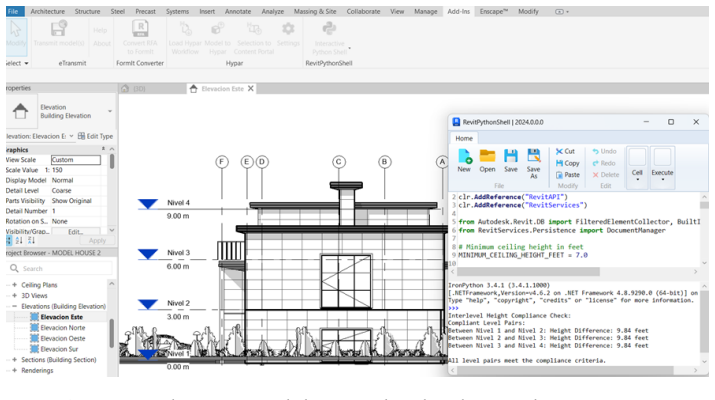
- [§4.6, Eq. (1); Figures 4–11] The central claim of improved accuracy is not supported because Eq. (1) defines success as the fraction of scripts that execute without error, and the case-study figures show only post-execution outputs. A script that encodes the wrong threshold, reads the wrong Revit parameter, or checks the wrong element category would still count as 'correctly executed.' There is no comparison against a human expert, an independent rule checker, or a manually verified ground truth for any of the 12 rules, so neither the abstract's 'improving accuracy' claim nor the Section 5 conclusion that violations were 'successfully identified' is established. The authors should add a semantic ground-truth evaluation: for each rule, determine the actual compliant/non-compliant status of elements in the test models by manual expert review, and report precision, recall, and F1 for the generated scripts' verdicts, not just execution status.
- [§4.6, Table 4; §5] The evaluation narrative is internally inconsistent. Table 4 shows Grok with the highest average Success Rate (76.7%) and the fewest correction attempts (0.6), while ChatGPT 4.0 averages 13.2% and Claude Sonnet 3.5 averages 23.7%. Yet the conclusions state that 'ChatGPT 4.0 and Claude Sonnet 3.5 emerged as the most effective.' If 'most effective' is meant in terms of cost, reliability, or another criterion, that criterion should be stated and applied consistently; otherwise the conclusion contradicts the reported data. Additionally, Table 4 evaluates only Rules 1–5, not the 12 rules used in the case studies, so claims about overall model ranking rest on a small subset.
- [§4.3–§4.4; Abstract] The claimed reduction in time and effort is not quantified anywhere. The two case studies report screenshots of script outputs but no measurements of manual checking time for comparison, no user study, and no controlled experiment. To support the abstract's assertion that the system 'eliminated repetitive tasks' and 'reduced the time and effort required for compliance checks,' the authors need at least a basic time comparison (e.g., expert manual review time versus framework-assisted review time on the same models) and a description of how effort was measured.
- [§5, Limitation (5)] The acknowledged reliance on well-structured BIM metadata is a serious scope restriction that interacts with the accuracy claim. In the case studies, the scripts depend on accurate room tags, correct element categories, and complete parameter data; the authors state that incomplete or inconsistent metadata 'can lead to inaccurate interpretations of the model.' Because most real-world BIM models contain at least some missing or inconsistent data, the framework's practical accuracy in realistic settings remains unmeasured. This is not a reason to reject the framework, but it should be treated as a boundary condition in the claims and ideally tested by deliberately introducing metadata errors in a controlled experiment.
minor comments (5)
- [Title page / author affiliations] The affiliations contain typographical errors: 'Center for T ransportation Research' and 'The University of T exas at Austin' have stray spaces after 'T'.
- [Figure 1 caption] The caption reads 'Figure 1:LLM-Based Framework for Rule-Checking in BIM' with a missing space after the colon; the same formatting issue appears in other figure captions.
- [Figure 11 caption / §4.3] The sentence 'In compliance verification, it is critical to check for the presence of required elements in designated spaces' is duplicated verbatim in the text preceding Figure 11.
- [§4.6, Eq. (1) and Table 4] The denominator in Eq. (1) is ambiguous. In Table 4, Grok's Rule 1 shows 0 correction attempts and a 100% success rate, while ChatGPT's Rule 1 shows 6 correction attempts and 14.3%, which suggests the denominator is correction attempts plus the initial attempt. This convention should be stated explicitly in the text accompanying Eq. (1).
- [§4.2, Table 3] The entry for Rule 10 in Table 3, 'param.Definition.Name for param in element.Parameters', is a code fragment rather than a rule-specific instruction; it should be rewritten as an instruction or removed, since the reader cannot tell what behavior it is meant to induce.
Circularity Check
Accuracy claim reduces by construction to error-free execution; the rest of the pipeline is empirical and not circular.
-
self definitional
[Abstract; Section 4.6, Eq. (1)]
"Moreover, we introduced a quantitative metric, Success Rate, calculated using the following formula: Success Rate (%)= Number of Correctly Executed Scripts / Number of Attempts ×100 (1). This formula measures the LLM's efficiency in producing functional, error-free Python scripts relative to the number of correction attempts made."
The abstract claims the case studies 'demonstrated the system's ability to reduce the time and effort required for compliance checks while improving accuracy,' and Section 4.6 states model performance was evaluated 'in terms of efficiency, speed, and accuracy.' The only accuracy-related metric is Eq. (1), which defines a script as 'Correctly Executed' if it runs without error. No expert or independent ground-truth check is used for any of the 12 rules, so a script with the wrong threshold, wrong parameter, or wrong element category still counts as successful. Thus the accuracy claim is defined by construction as execution success rather than semantic correctness of the compliance verdict.
full rationale
The paper is an empirical engineering pipeline rather than a formal derivation chain, and there are no load-bearing self-citations: the references are external and the prompt construction is described directly. The automation, time-saving, and report-generation claims are supported by concrete demonstrations inside Revit and are not circular. The one genuinely self-definitional element is the success/accuracy metric: Eq. (1) equates 'correct' scripts with scripts that execute without errors, and this metric is the sole quantitative support for the 'improving accuracy' claim. Section 4.2 also shows the optimized prompt was iterated until it worked on Rule 1 and then demonstrated on the same rule, a minor train-on-test leakage that reinforces the need for an external semantic ground truth. Limitations (5) and (6) admit dependence on well-structured BIM metadata and Revit-specific API data, which correctly locate the main external validity risk but do not themselves create circularity. The framework's central technical contribution, converting regulations into Revit-executable IronPython checks with an error-feedback loop, stands independent of the self-defined metric; the circularity is concentrated in the accuracy evaluation, so a moderate score is appropriate.
Assumptions & free parameters
assumptions (4)
- domain assumption The building-code rules selected in Table 1 are faithfully represented by the Python checks, and their cited code sources are correct.
- domain assumption The BIM model metadata (room tags, boundaries, element categories, parameters) is accurate and complete enough for the checks.
- ad hoc to paper Script execution without error is a valid proxy for correct compliance checking.
- domain assumption The LLM outputs evaluated in Table 4 are generated under the same optimized prompt and are representative of each model's capability.
Cite this review
Pith. "Pith review of Large Language Model-Driven Code Compliance Checking in Building Information Modeling." pith.science (2026). https://pith.science/paper/UJS5KRU7
@misc{pith2026250620551,
  author       = {Pith},
  title        = {Pith review of: Large Language Model-Driven Code Compliance Checking in Building Information Modeling},
  year         = {2026},
  howpublished = {\url{https://pith.science/paper/UJS5KRU7}},
  note         = {Machine review of arXiv:2506.20551}
}
read the original abstract
This research addresses the time-consuming and error-prone nature of manual code compliance checking in Building Information Modeling (BIM) by introducing a Large Language Model (LLM)-driven approach to semi-automate this critical process. The developed system integrates LLMs such as GPT, Claude, Gemini, and Llama, with Revit software to interpret building codes, generate Python scripts, and perform semi-automated compliance checks within the BIM environment. Case studies on a single-family residential project and an office building project demonstrated the system's ability to reduce the time and effort required for compliance checks while improving accuracy. It streamlined the identification of violations, such as non-compliant room dimensions, material usage, and object placements, by automatically assessing relationships and generating actionable reports. Compared to manual methods, the system eliminated repetitive tasks, simplified complex regulations, and ensured reliable adherence to standards. By offering a comprehensive, adaptable, and cost-effective solution, this proposed approach offers a promising advancement in BIM-based compliance checking, with potential applications across diverse regulatory documents in construction projects.
Figures


Figures from the paper (10 more)




Forward citations
Cited by 1 Pith paper
-
Neuro-Symbolic AI for LEED compliance: Document-Centric Benchmarking, Deterministic Numeric Checking, and When Multimodal Hurts
A 4B local LLM hits 67.3% on LEED v4.1 credit screening; a deterministic numeric checker lifts EA-p2 from 50% to 100%, but the full neuro-symbolic pipeline trails at 61.6%.
Reference graph
Works this paper leans on
-
[1]
Jinyue Zhang, Bing Cui, Ying Gao, and Daxin Zhang. Factors influencing the acceptance of bim-based automated code compliance checking in the aec industry in china.Journal of Management in Engineering, 39(6):04023036, 2023. 21 of 24
work page 2023
-
[2]
Building information modeling based automated building regulation compliance check- ing asp
Murat Aydın. Building information modeling based automated building regulation compliance check- ing asp. net web software.Intelligent Automation & Soft Computing, 28(1), 2021
work page 2021
-
[3]
A review on bim-based automated code compliance checking system
Aimi Sara Ismail, Kherun Nita Ali, and Noorminshah A Iahad. A review on bim-based automated code compliance checking system. In2017 international conference on research and innovation in information systems (icriis), pages 1–6. IEEE, 2017
work page 2017
-
[4]
Automated code compliance checking based on a visual language and building information modeling
Cornelius Preidel and Andr ´e Borrmann. Automated code compliance checking based on a visual language and building information modeling. InProc. of the 32nd ISARC 2015, 2015
work page 2015
-
[5]
Nanjiang Chen, Xuhui Lin, Hai Jiang, and Yi An. Automated building information modeling compliance check through a large language model combined with deep learning and ontology.Buildings, 14(7):1983, 2024
work page 1983
-
[6]
Yukang Wang, Yue Liu, Haozhe Cai, Jia Wang, and Xiaoping Zhou. An automated fire code compliance checking jointly using building information models and natural language processing.Fire, 6(9):358, 2023
work page 2023
-
[7]
Endiq Yogana and Yusuf Latief. Development of system information of building code checking in planning and permitting phase to improve building code compliance based on work breakdown structure (wbs) using building information modeling (bim). InJournal of Physics: Conference Series, volume 1858, page 012091. IOP Publishing, 2021
work page 2021
-
[8]
Towards French Smart Building Code: Compliance Checking Based on Semantic Rules
Nicolas Bus, Ana Roxin, Guillaume Picinbono, and Muhammad Fahad. Towards french smart building code: Compliance checking based on semantic rules.arXiv preprint arXiv:1910.00334, 2019
work page Pith review arXiv 1910
Show all 45 references
-
[9]
Sihao Li, Jiali Wang, and Zhao Xu. Automated compliance checking for bim models based on chinese-nlp and knowledge graph: an integrative conceptual framework.Engineering, Construction and Architectural Management, 2024
2024
-
[10]
Strategically using applied machine learning for accessibility documentation in the built environment
Marvin Lange, Reuben Kirkham, and Benjamin Tannert. Strategically using applied machine learning for accessibility documentation in the built environment. InHuman-Computer Interaction–INTERACT 2021: 18th IFIP TC 13 International Conference, Bari, Italy, August 30–September 3, ...
2021
-
[11]
Blockchain and building information modeling (bim): Review and applications in post-disaster recovery.Buildings, 9(6):149, 2019
Nawari O Nawari and Shriraam Ravindran. Blockchain and building information modeling (bim): Review and applications in post-disaster recovery.Buildings, 9(6):149, 2019
2019
-
[12]
Refinement of the visual code checking language for an automated checking of building information models regarding applicable regulations
Cornelius Preidel and Andr ´e Borrmann. Refinement of the visual code checking language for an automated checking of building information models regarding applicable regulations. InComputing in Civil Engineering 2017, pages 157–165. 2017
2017
-
[13]
Compliance checking on topological spatial relationships of building elements based on building information models and ontology.Sustainability, 15(14):10901, 2023
Xuefeng Zhao, Lingli Huang, Zhe Sun, Xiongtao Fan, and Meng Zhang. Compliance checking on topological spatial relationships of building elements based on building information models and ontology.Sustainability, 15(14):10901, 2023
2023
-
[14]
Tanya Bloch and Rafael Sacks. Clustering information types for semantic enrichment of building information models to support automated code compliance checking.Journal of Computing in Civil Engineering, 34(6):04020040, 2020
2020
-
[15]
Enriching building information modeling models through information delivery specification.Buildings, 14(7):2206, 2024
Giancarlo de Marco, Cinzia Slongo, and Dietmar Siegele. Enriching building information modeling models through information delivery specification.Buildings, 14(7):2206, 2024
2024
-
[16]
High-level implementable methods for automated building code compliance checking.Developments in the Built Environment, 15:100174, 2023
Jin-Kook Lee, Kyunghyun Cho, Hyeokjin Choi, Soohyung Choi, Sumin Kim, and Seung Hyun Cha. High-level implementable methods for automated building code compliance checking.Developments in the Built Environment, 15:100174, 2023. 22 of 24
2023
-
[17]
How can chatgpt help in automated building code compliance checking?Proc
Jiansong Zhang. How can chatgpt help in automated building code compliance checking?Proc. ISARC, Chennai, India, pages 63–70, 2023
2023
-
[18]
Using large language models for the interpretation of building regulations.arXiv preprint arXiv:2407.21060, 2024
Stefan Fuchs, Michael Witbrock, Johannes Dimyadi, and Robert Amor. Using large language models for the interpretation of building regulations.arXiv preprint arXiv:2407.21060, 2024
2024 arXiv
-
[19]
Andr´e Borrmann, Markus K¨onig, Christian Koch, and Jakob Beetz.Building information modeling: Why? what? how?Springer, 2018
2018
-
[20]
Building code compliance checking using bim technology
Tang-Hung Nguyen and Jin-Lee Kim. Building code compliance checking using bim technology. In Proceedings of the 2011 winter simulation conference (WSC), pages 3395–3400. IEEE, 2011
2011
-
[21]
Automated rule-based checking for the validation of accessibility and visibility of a building information model
YC Lee, CM Eastman, and JK Lee. Automated rule-based checking for the validation of accessibility and visibility of a building information model. InComputing in Civil Engineering 2015, pages 572–579. 2015
2015
-
[22]
Using building information modeling to transform the building codes compliance process
Anne Anderson. Using building information modeling to transform the building codes compliance process. InConstruction Research Congress 2020, pages 1048–1056. American Society of Civil Engineers Reston, VA, 2020
2020
-
[23]
Applications of bim: a brief review and future outline
Zahra Pezeshki and Syed Ali Soleimani Ivari. Applications of bim: a brief review and future outline. Archives of Computational Methods in Engineering, 25:273–312, 2018
2018
-
[24]
Building information modeling (bim): Trends, benefits, risks, and challenges for the aec industry.Leadership and management in engineering, 11(3):241–252, 2011
Salman Azhar. Building information modeling (bim): Trends, benefits, risks, and challenges for the aec industry.Leadership and management in engineering, 11(3):241–252, 2011
2011
-
[25]
Building information modelling maturity matrix
Bilal Succar. Building information modelling maturity matrix. InHandbook of research on building information modeling and construction informatics: Concepts and technologies, pages 65–103. IGI Global, 2010
2010
-
[26]
Research on a bim model quality compliance checking method based on a knowledge graph.Journal of Computing in Civil Engineering, 39(1):04024049, 2025
Simiao Zhu, Jianliang Zhou, Lei Cheng, Xuehai Fu, Yan Wang, and Kexin Dai. Research on a bim model quality compliance checking method based on a knowledge graph.Journal of Computing in Civil Engineering, 39(1):04024049, 2025
2025
-
[27]
Semantic modeling for automated compliance checking
DM Salama and NM El-Gohary. Semantic modeling for automated compliance checking. InComputing in Civil Engineering (2011), pages 641–648. 2011
2011
-
[28]
Automated information transformation for automated regu- latory compliance checking in construction.Journal of Computing in Civil Engineering, 29(4):B4015001, 2015
Jiansong Zhang and Nora M El-Gohary. Automated information transformation for automated regu- latory compliance checking in construction.Journal of Computing in Civil Engineering, 29(4):B4015001, 2015
2015
-
[29]
Ontology-based framework for building environmental monitoring and compliance checking under bim environment.Building and Environment, 141:127–142, 2018
Botao Zhong, Chen Gan, Hanbin Luo, and Xuejiao Xing. Ontology-based framework for building environmental monitoring and compliance checking under bim environment.Building and Environment, 141:127–142, 2018
2018
-
[30]
William Andrich, Bruno Daniotti, Alberto Pavan, and Claudio Mirarchi. Check and validation of building information models in detailed design phase: A check flow to pave the way for bim based renovation and construction processes.Buildings, 12(2):154, 2022
2022
-
[31]
Integrating building and context information for automated zoning code checking: a review.Journal of Information T echnology in Construction, 27, 2022
Yelin Demir Altıntas ¸and M Emre ˙Ilal. Integrating building and context information for automated zoning code checking: a review.Journal of Information T echnology in Construction, 27, 2022
2022
-
[32]
Rule checking interface development between building information model and end user.Automation in Construction, 105:102842, 2019
Su-Ling Fan, Hung-Lin Chi, and Po-Quan Pan. Rule checking interface development between building information model and end user.Automation in Construction, 105:102842, 2019. 23 of 24
2019
-
[33]
UpCodes Official Website, 2025
UpCodes. UpCodes Official Website, 2025. URL https://up.codes. Available at: https://up.codes. Accessed: 2025-05-06
2025
-
[34]
Smartreview apr – automated plan review for revit, 2025
SMARTreview. Smartreview apr – automated plan review for revit, 2025. Available at: https:// smartreview.biz/apr_learn_more. Accessed: 2025-05-13
2025
-
[35]
Solibri – intelligent model checking for bim, 2025
Solibri. Solibri – intelligent model checking for bim, 2025. Available at: https://www.solibri.com/ intelligent-model-checking. Accessed: 2025-05-13
2025
-
[36]
Autodesk model checker for revit, 2025
Autodesk. Autodesk model checker for revit, 2025. Available at: https://interoperability. autodesk.com/modelchecker.php. Accessed: 2025-05-13
2025
-
[37]
icheck for building – accessibility [cbc], 2025
Bureau Veritas. icheck for building – accessibility [cbc], 2025. Available at: https://apps.autodesk. com/RVT/en/Detail/Index?appLang=en&id=1041774428548349665&os=Win64. Accessed: 2025-05-13
2025
-
[38]
Revit code tools, 2025
EvolveLAB. Revit code tools, 2025. Available at: https://www.evolvelab.io/product-page/ revit-code-tools. Accessed: 2025-05-13
2025
-
[39]
Validations for ensuring the interoperability of data exchange of a building information model.Automation in Construction, 58:176–195, 2015
Yong-Cheol Lee, Charles M Eastman, and Jin-Kook Lee. Validations for ensuring the interoperability of data exchange of a building information model.Automation in Construction, 58:176–195, 2015
2015
-
[40]
Large language models: A survey.arXiv preprint arXiv:2402.06196, 2024
Shervin Minaee, Tomas Mikolov, Narjes Nikzad, Meysam Chenaghlu, Richard Socher, Xavier Amatriain, and Jianfeng Gao. Large language models: A survey.arXiv preprint arXiv:2402.06196, 2024
2024 arXiv
-
[41]
Interactive design by integrating a large pre-trained language model and building information modeling
Suhyung Jang and Ghang Lee. Interactive design by integrating a large pre-trained language model and building information modeling. InComputing in Civil Engineering 2023, pages 291–299. 2022
2023
-
[42]
Generative aibim: An automatic and intelligent structural design pipeline integrating bim and generative ai.Information Fusion, 114:102654, 2025
Zhili He, Yu-Hsing Wang, and Jian Zhang. Generative aibim: An automatic and intelligent structural design pipeline integrating bim and generative ai.Information Fusion, 114:102654, 2025
2025
-
[43]
Inter- national Code Council, Washington, D.C., 2021
International Code Council (ICC).International Residential Code (IRC) 2021. Inter- national Code Council, Washington, D.C., 2021. URL https://shop.iccsafe.org/ 2021-international-residential-code-irc.html
2021
-
[44]
Inter- national Code Council, Washington, D.C., 2021
International Code Council (ICC).International Mechanical Code (IMC) 2021. Inter- national Code Council, Washington, D.C., 2021. URL https://shop.iccsafe.org/ 2021-international-mechanical-code-imc.html
2021
-
[45]
McGraw-hill New York, 1996
Joseph E Bowles and Yingzhong Guo.Foundation analysis and design, volume 5. McGraw-hill New York, 1996. 24 of 24
1996
Reviewed August 6, 2026 · model on record in the stance chip above.
Discussion (0). Sign in to comment.