REVIEW 5 major objections 6 minor 2 cited by
HRIBench: Benchmarking Vision-Language Models for Real-Time Human Perception in Human-Robot Interaction
T0 review · 5 major / 6 minor · reviewed 2026-08-06 · deepseek-v4-flash
Pith's one-line read HRIBench: 1,000 VQA questions show today's vision-language models cannot yet serve as real-time human-perception engines for robots.
desk verdict A useful first HRI-specific VLM perception benchmark with a plausible negative result, but the unvalidated single-expert labels and unexplained random baselines mean the headline gap should be read with caution. read the letter →
The pith
A machine-rendered reading of the paper's core claim, the machinery that carries it, and where it could break.
The reading
What carries the argument
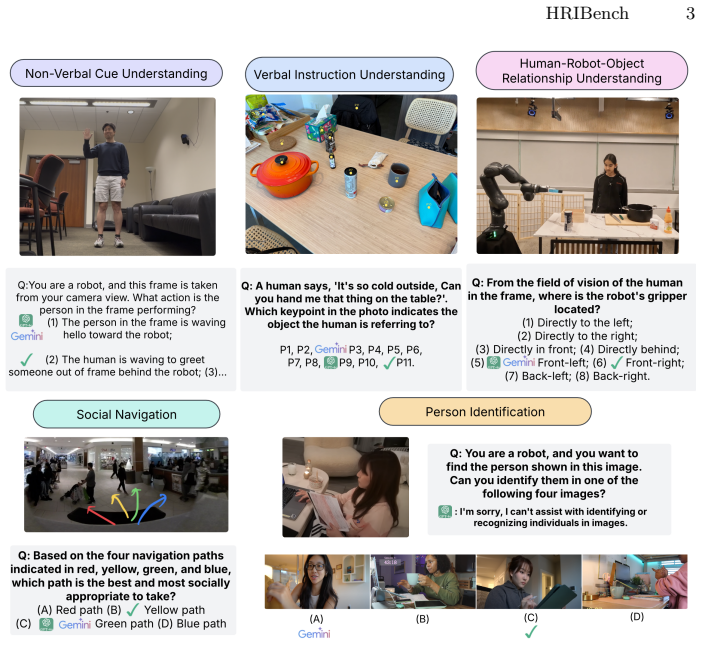
The load-bearing object is HRIBench itself: a multiple-choice VQA benchmark with 200 questions per domain, for 1,000 total, built by collecting in-the-wild non-verbal-cue recordings and reusing HandMeThat, CoMaD, MuSoHu, and YouTube study/work videos for the other domains. Each question is scored against a single human-expert ground-truth answer, and every model is measured on both accuracy and seconds-per-question latency so that the performance-latency trade-off can be read directly. The benchmark's design choices—fixed prompt format, four answer options in the person-identification domain, colored path overlays for navigation—are what make the comparison across 11 models and the human baseline possible.
What would settle it
Have independent annotators re-answer a random sample of, say, 200 HRIBench questions without seeing the provided ground truth; if agreement with the published answers falls well below the human baseline (0.93), or if many questions are flagged as ambiguous, then the central negative conclusion is not stable. Alternatively, rerun the best open-source model with in-context examples from the same domain; if this pushes it above roughly 0.85 with latency under 0.7 seconds, the claim that no current model is suitable for real-time HRI would be refuted.
Extended reading notes
Core claim
HRIBench's central claim is empirical: on a curated set of 1,000 VQA questions drawn from real HRI scenarios and public datasets, the best closed-source models reach roughly 0.50 average accuracy (and the best open-source model 0.31), far below a 0.93 human baseline and close to a 0.23 random baseline in some domains. The models need multiple seconds per question—Gemini-1.5-pro at 2.66 seconds per question is the fastest adequate closed-source option, while test-time-reasoning models take 19–42 seconds—far above the roughly 0.7-second threshold for natural interaction cited from prior work. The paper therefore concludes that generalizable VLMs lack fine-grained multimodal perception (eye gaze, gesture-gaze coordination), struggle with ambiguous language-visual instructions and physical/spatial reasoning, and are not yet deployable as real-time HRI perception systems.
Load-bearing premise
The benchmark treats the authors' curated answers and the single domain expert's answer as the uniquely correct ground truth for all 1,000 questions; if any questions are ambiguous, wrongly answered, or guessable from distractor patterns, the reported VLM shortfalls would be overstated.
Editorial extensions
If this is right
- No current VLM should be trusted as the sole perception module in a real-time HRI system; roboticists should expect failures in eye gaze, ambiguous instruction disambiguation, and spatial reasoning.
- The benchmark provides a reusable 1,000-question instrument for tracking whether future small, low-latency VLMs close the gap to the 0.93 human baseline.
- The large accuracy gap between test-time-reasoning models (0.49–0.50) and faster models (0.30–0.44) suggests that accuracy gains currently come only by sacrificing real-time feasibility.
- Open-source models, especially InternVL2.5-8B, outperform larger models like Llama3.2, pointing research toward compact architectures rather than raw parameter count.
- The 0.7-second latency budget from human interaction timing gives a concrete numeric target for VLM-based HRI perception systems.
Reading between the lines
- If HRIBench's ground truth is trustworthy, one testable prediction is that adding visual grounding supervision—particularly for gaze direction and perspective-taking—will improve VLM accuracy more than simply increasing model size.
- A fair extension would be to report per-domain accuracy with confidence intervals across multiple runs, since the paper ran every experiment once; variability could change which model looks best on the latency frontier.
- The benchmark's multiple-choice format may understate real failures in open-ended reasoning; an open-answer variant could reveal even larger gaps in instruction-following and explanation.
- Because the human experts were allowed context across questions while VLMs saw one question at a time, part of the measured gap may be due to evaluation asymmetry rather than perception alone.
Editorial analysis
A structured set of objections, weighed in public.
Referee Report
Summary. The paper introduces HRIBench, a visual question-answering (VQA) benchmark of 1,000 questions across five domains relevant to human perception in human-robot interaction: non-verbal cue understanding, verbal instruction understanding, human-robot-object relationship understanding, social navigation, and person identification. The benchmark is assembled partly from new recordings by the authors and partly from public datasets. The authors evaluate 11 vision-language models (six closed-source, five open-source) along with human and random baselines, reporting per-domain accuracy and mean latency. Their main findings are that the best models reach roughly half the human baseline accuracy, that several models perform at or below the random baseline in particular domains, and that all models fail to meet the 0.7-second latency threshold they adopt for real-time interaction, leading to the conclusion that current VLMs are not yet suitable for real-time HRI perception. The paper also discusses failure modes and releases the benchmark and results in a public GitHub repository.
Significance. If the benchmark is valid and the measurements reliable, this is a timely and useful contribution: it fills a gap in VLM benchmarking for HRI perception, provides a reusable set of 1,000 questions, and offers a broad performance-latency comparison across six closed-source and five open-source models. The negative result about current VLMs is informative, and the failure-mode discussion (gaze direction, ambiguous instructions, spatial reasoning) gives concrete directions for future research. The public GitHub release supports reproducibility. The main caveat is that the headline conclusion subtracts VLM accuracy from a human-answer gold standard whose validity is not yet established, and the measurements are single-run with no variance information; the value of the contribution therefore depends on the validation and statistical robustness that the current manuscript lacks.
major comments (5)
- [§2, Table 1, Limitations] The central claim that VLMs 'still struggle' is a comparison against the human baseline, but the human ground truth is generated by one expert per domain, with no inter-annotator agreement, no per-question ambiguity analysis, and no release of the exact question and option prompts in the paper. The random baseline column shows large domain differences (Relationship 0.43, Non-Verbal 0.01), which makes it essential to demonstrate that correct answers are uniquely identifiable and not discoverable from distractor patterns; without this, the reported capability gaps may overstate VLM failure. The Limitations section acknowledges single-run evaluation and possible human contextual advantage, but does not address this label-validity issue. Please add an annotation protocol, agreement metrics, per-question ambiguity checks, and make the exact questions, options, and prompts available.
- [§3, Table 1, Limitations] Every experiment was run only once, with no error bars, confidence intervals, or statistical tests reported. This is especially consequential for the latency comparisons—e.g., the statement that Gemini-1.5-pro achieves the best performance-latency tradeoff and that InternVL2.5-8B substantially outperforms Llama3.2—because closed-source API latency can vary with network and server load, and small accuracy differences (e.g., 0.30 vs. 0.31 in Relationship) may be noise. Please report multiple runs, standard deviations, and bootstrap intervals or significance tests for both accuracy and latency.
- [§3, Fig. 2, real-time threshold] The second central claim—that no model offers a 'satisfactory performance-latency trade-off suitable for real-time deployment'—rests on the 0.7-second threshold taken from prior work [14] without a sensitivity analysis. The threshold was not derived for VLM perception loops, and no experiment in the paper measures end-to-end interaction delay; moreover, open-source latency is hardware-dependent and closed-source latency is network-dependent, as the Limitations section acknowledges. Please justify the threshold's applicability, report how the conclusion changes over a plausible range (e.g., 0.3–1.5 s), and provide latency distributions or percentiles rather than averages only.
- [Table 1, §2 (Person identification)] The person-identification domain is evaluated under a task formulation that concatenates the query image and the four answer options into a single image, and the table shows N/A for three closed-source models due to refusal and for Llama3.2 due to lack of multi-image support; the average accuracy and latency exclude the domain entirely. This makes the headline 'none of the models' statement ambiguous: the evidence is based on four domains for some models and five for others, and person-identification results are not directly comparable across models. Please clarify whether refusals are scored as errors, analyze the concatenation formulation as a potential confound, and state explicitly the domain coverage for each model in the abstract and results.
- [Table 1, random baseline] The random baseline is not defined anywhere in the paper. The reported values imply strong domain-specific differences—0.43 for Relationship and 0.01 for Non-Verbal—that cannot follow from a common four-choice format, so it is unclear whether VLM scores near the random baseline indicate chance-level performance or a mismatch in how the baseline was computed. Please specify the baseline definition (e.g., uniform random over answer options, or over dataset labels) and report the number of answer options for each question in each domain.
minor comments (6)
- [Throughout] There are several formatting artifacts, including 'T able 1' in the caption and 'V erbal' as a section heading; these should be cleaned up.
- [Table 1] The caption states that average accuracy and latency are computed excluding person identification, but the table still includes a Person Identification column with N/A entries; please clarify how the averages were calculated and what N/A means.
- [Table 1] The human baseline is reported without latency; please add a note that human evaluation was offline and not timed, so the latency comparison is only among the VLMs.
- [References] Reference [14], used as the source of the 0.7-second threshold, is a discourse-analytic study of conversation timing; please add a robotics-specific citation or explicitly justify the transfer of this threshold to HRI perception.
- [§2 (Person identification)] The paper reports that YouTubers publicly disclosed their ages, but it does not address consent, dataset terms, or ethical review for re-using video frames; please add a data-rights and ethics statement.
- [§2] The paper calls all 1,000 questions 'novel,' but the relationship, navigation, and verbal-instruction domains are derived from existing datasets; please specify which parts are newly curated and which are reformatted or transformed.
Circularity Check
No significant circularity; the benchmark evaluation is empirically measured against external human baselines and prior datasets.
full rationale
HRIBench is an empirical benchmark, not a derivation: there are no equations, no fitted parameters, and no model outputs that are fed back into the construction of the benchmark's ground truth. The central claim, that current VLMs struggle with HRI-relevant perception and latency, is a measurement of accuracy and latency against human-expert and random baselines. The ground-truth labels are produced by scripted non-verbal acting, by reuse of existing public datasets for verbal instructions, relationships, and social navigation, and by source identities in YouTube frames; these are evaluation inputs, not outputs of the VLMs being tested. No step in the paper reduces to its own inputs: for example, excluding person identification from averaged metrics and adopting the 0.7-second latency threshold from prior external literature are choices that affect interpretation but are not circular derivations. The self-citations in the references (Quori, PhysBench, ManipBench) are contextual and are not load-bearing for the measured results. The main reviewer concern, that single-expert ground truth is unvalidated and could overstate VLM failures, is a validity and correctness risk, not a circularity; it does not make the measurement equivalent to its inputs by construction. Therefore, the appropriate circularity score is 0.
Assumptions & free parameters
free parameters (1)
- real-time latency threshold =
0.7 s
assumptions (5)
- domain assumption The five domains (non-verbal cues, verbal instruction, human-robot-object relationship, social navigation, person identification) are the core perceptual tasks for HRI.
- domain assumption Human expert answers are the correct ground truth for every HRIBench question.
- domain assumption VLMs have not seen the HRIBench questions or source frames during training.
- domain assumption The 0.7-second latency threshold is the correct cutoff for real-time HRI perception.
- ad hoc to paper Concatenating the query image and four answer options into a single image is a fair presentation for person identification.
Cite this review
Pith. "Pith review of HRIBench: Benchmarking Vision-Language Models for Real-Time Human Perception in Human-Robot Interaction." pith.science (2026). https://pith.science/paper/YW6ELPN4
@misc{pith2026250620566,
  author       = {Pith},
  title        = {Pith review of: HRIBench: Benchmarking Vision-Language Models for Real-Time Human Perception in Human-Robot Interaction},
  year         = {2026},
  howpublished = {\url{https://pith.science/paper/YW6ELPN4}},
  note         = {Machine review of arXiv:2506.20566}
}
read the original abstract
Real-time human perception is crucial for effective human-robot interaction (HRI). Large vision-language models (VLMs) offer promising generalizable perceptual capabilities but often suffer from high latency, which negatively impacts user experience and limits VLM applicability in real-world scenarios. To systematically study VLM capabilities in human perception for HRI and performance-latency trade-offs, we introduce HRIBench, a visual question-answering (VQA) benchmark designed to evaluate VLMs across a diverse set of human perceptual tasks critical for HRI. HRIBench covers five key domains: (1) non-verbal cue understanding, (2) verbal instruction understanding, (3) human-robot object relationship understanding, (4) social navigation, and (5) person identification. To construct HRIBench, we collected data from real-world HRI environments to curate questions for non-verbal cue understanding, and leveraged publicly available datasets for the remaining four domains. We curated 200 VQA questions for each domain, resulting in a total of 1000 questions for HRIBench. We then conducted a comprehensive evaluation of both state-of-the-art closed-source and open-source VLMs (N=11) on HRIBench. Our results show that, despite their generalizability, current VLMs still struggle with core perceptual capabilities essential for HRI. Moreover, none of the models within our experiments demonstrated a satisfactory performance-latency trade-off suitable for real-time deployment, underscoring the need for future research on developing smaller, low-latency VLMs with improved human perception capabilities. HRIBench and our results can be found in this Github repository: https://github.com/interaction-lab/HRIBench.
Figures


Forward citations
Cited by 2 Pith papers
-
HRIBench: Benchmarking Interaction-Centric Human-Robot Collaboration
A new benchmark for intent-aware human-robot collaboration shows current VLA robot policies fail at coordination and safety, while simulated practice improves real-world task success from 0.10 to 0.43.
-
ERR@HRI 3.0 Challenge: Multimodal Detection of Errors and Anticipation in Human-Robot Interactions
ERR@HRI 3.0 supplies raw webcam datasets and tracks for reactive bystander failure detection and anticipatory outcome prediction in HRI, with three teams beating weak CNN baselines.
Reference graph
Works this paper leans on
-
[14]
Discourse Processes52(4), 255–289 (2015)
Kendrick, K.H., Torreira, F.: The timing and construction of preference: A quan- titative study. Discourse Processes52(4), 255–289 (2015)
work page 2015
-
[1]
Evaluating Vision-Language Models as Evaluators in Path Planning
Aghzal, M., Yue, X., Plaku, E., Yao, Z.: Evaluating Vision-Language Models as Evaluators in Path Planning. arXiv preprint arXiv:2411.18711 (2024)
work page Pith review arXiv 2024
-
[2]
In: Proceedings of the 19th ACM International Conference on Mul- timodal Interaction, pp
Ben-Youssef, A., Clavel, C., Essid, S., Bilac, M., Chamoux, M., Lim, A.: Ue-Hri: A New Dataset for the Study of User Engagement in Spontaneous Human-Robot Interactions. In: Proceedings of the 19th ACM International Conference on Mul- timodal Interaction, pp. 464–472 (2017)
work page 2017
-
[3]
arXiv preprint arXiv:2505.15517 (2025)
Chen, K., Xie, S., Ma, Z., Goldberg, K.: Robo2VLM: Visual Question Answer- ing from Large-Scale In-the-Wild Robot Manipulation Datasets. arXiv preprint arXiv:2505.15517 (2025)
arXiv 2025
-
[4]
In: Proceedings of the IEEE/CVF Conference on Computer Vision and Pattern Recognition, pp
Chen, Z., Wu, J., Wang, W., Su, W., Chen, G., Xing, S., Zhong, M., Zhang, Q., Zhu, X., Lu, L., et al.: Internvl: Scaling up Vision Foundation Models and Aligning for Generic Visual-Linguistic Tasks. In: Proceedings of the IEEE/CVF Conference on Computer Vision and Pattern Recognition, pp. 24,185–24,198 (2024)
work page 2024
-
[5]
In: International Conference on Learning Representations (ICLR) (2025)
Chow, W., Mao, J., Li, B., Seita, D., Guizilini, V., Wang, Y.: Physbench: Bench- marking and Enhancing Vision-Language Models for Physical World Understand- ing. In: International Conference on Learning Representations (ICLR) (2025)
work page 2025
-
[6]
In: 2008 8th Ieee International Conference on Automatic Face & Gesture Recognition, pp
Cruz, C., Sucar, L.E., Morales, E.F.: Real-Time Face Recognition for Human- Robot Interaction. In: 2008 8th Ieee International Conference on Automatic Face & Gesture Recognition, pp. 1–6. IEEE (2008)
work page 2008
-
[7]
arXiv preprint arXiv:2312.11805 (2023)
Google, G.T.: Gemini: A Family of Highly Capable Multimodal Models. arXiv preprint arXiv:2312.11805 (2023)
arXiv 2023
Show all 27 references
-
[8]
arXiv preprint arXiv:2407.21783 (2024) HRIBench 9
Grattafiori, A., Dubey, A., Jauhri, A., Pandey, A., Kadian, A., Al-Dahle, A., Let- man, A., Mathur, A., Schelten, A., Vaughan, A., et al.: The Llama 3 Herd of Models. arXiv preprint arXiv:2407.21783 (2024) HRIBench 9
2024 arXiv
-
[9]
In: Neural Information Processing Systems (NeurIPS) (2018)
Gupta, A., Murali, A., Gandhi, D., Pinto, L.: Robot Learning in Homes: Improving Generalization and Reducing Dataset Bias. In: Neural Information Processing Systems (NeurIPS) (2018)
2018
-
[10]
arXiv preprint arXiv:2411.05821 (2024)
Guruprasad, P., Sikka, H., Song, J., Wang, Y., Liang, P.P.: Benchmarking Vi- sion, Language, and Action Models on Robotic Learning Tasks. arXiv preprint arXiv:2411.05821 (2024)
2024 arXiv
-
[11]
Human factors53(5), 517–527 (2011)
Hancock, P.A., Billings, D.R., Schaefer, K.E., Chen, J.Y., De Visser, E.J., Parasur- aman, R.: A Meta-Analysis of Factors Affecting Trust in Human-Robot Interaction. Human factors53(5), 517–527 (2011)
2011
-
[12]
arXiv preprint arXiv:2504.16054 (2025)
Intelligence, P., Black, K., Brown, N., Darpinian, J., Dhabalia, K., Driess, D., Esmail, A., Equi, M., Finn, C., Fusai, N., Galliker, M.Y., Ghosh, D., Groom, L., Hausman, K., Ichter, B., Jakubczak, S., Jones, T., Ke, L., LeBlanc, D., Levine, S., Li-Bell, A., Mothukuri, M., Nai...
2025 arXiv
-
[13]
In: Conference on Robot Learning (2023)
Kedia, K., Dan, P., Bhardwaj, A., Choudhury, S.: ManiCast: Collaborative Manip- ulation with Cost-Aware Human Forecasting. In: Conference on Robot Learning (2023)
2023
-
[15]
arXiv preprint arXiv:2501.02189 (2025)
Li, Z., Wu, X., Du, H., Nghiem, H., Shi, G.: Benchmark Evaluations, Applica- tions, and Challenges of Large Vision Language Models: A Survey. arXiv preprint arXiv:2501.02189 (2025)
2025 arXiv
-
[16]
In: Robotics: Science and Systems (RSS) (2024)
Liu, P., Orru, Y., Paxton, C., Shafiullah, N.M.M., Pinto, L.: OK-Robot: What Really Matters in Integrating Open-Knowledge Models for Robotics. In: Robotics: Science and Systems (RSS) (2024)
2024
-
[17]
ACM Transactions on Human-Robot Interaction12(3), 1–39 (2023)
Mavrogiannis, C., Baldini, F., Wang, A., Zhao, D., Trautman, P., Steinfeld, A., Oh, J.: Core Challenges of Social Robot Navigation: A Survey. ACM Transactions on Human-Robot Interaction12(3), 1–39 (2023)
2023
-
[18]
https://robotsguide.com/robots/kuri (n.d.)
Mayfield Robotics: Kuri. https://robotsguide.com/robots/kuri (n.d.). Accessed: 2025-06-10
2025
-
[19]
In: 2023 IEEE/RSJ International Conference on Intelligent Robots and Systems (IROS), pp
Nguyen, D.M., Nazeri, M., Payandeh, A., Datar, A., Xiao, X.: Toward Human-Like Social Robot Navigation: A Large-Scale, Multi-Modal, Social Human Navigation Dataset. In: 2023 IEEE/RSJ International Conference on Intelligent Robots and Systems (IROS), pp. 7442–7447. IEEE (2023)
2023
-
[20]
Image and Vision Computing25(12), 1875–1884 (2007)
Nickel, K., Stiefelhagen, R.: Visual Recognition of Pointing Gestures for Human– Robot Interaction. Image and Vision Computing25(12), 1875–1884 (2007)
2007
-
[21]
arXiv preprint arXiv:2410.21276 (2024)
OpenAI: GPT-4o System Card. arXiv preprint arXiv:2410.21276 (2024)
2024 arXiv
-
[22]
ACM Transactions on Human-Robot Interaction12(1), 1–66 (2023)
Robinson, N., Tidd, B., Campbell, D., Kuli´ c, D., Corke, P.: Robotic Vision for Human-Robot Interaction and Collaboration: A Survey and Systematic Review. ACM Transactions on Human-Robot Interaction12(1), 1–66 (2023)
2023
-
[23]
IEEE Transactions on Robotics38(3), 1755–1772 (2021)
Specian, A., Mead, R., Kim, S., Matari´ c, M., Yim, M.: Quori: A Community- Informed Design of a Socially Interactive Humanoid Robot. IEEE Transactions on Robotics38(3), 1755–1772 (2021)
2021
-
[24]
ACM Transactions on Human-Robot Interaction 12(2), 1–21 (2023)
Urakami, J., Seaborn, K.: Nonverbal Cues in Human–Robot Interaction: A Com- munication Studies Perspective. ACM Transactions on Human-Robot Interaction 12(2), 1–21 (2023)
2023
-
[25]
Advances in Neural Information Processing Systems35, 12,014–12,026 (2022) 10 Zhonghao Shi et al
Wan, Y., Mao, J., Tenenbaum, J.: Handmethat: Human-Robot Communication in Physical and Social Environments. Advances in Neural Information Processing Systems35, 12,014–12,026 (2022) 10 Zhonghao Shi et al
2022
-
[26]
arXiv preprint arXiv:2505.09698 (2025)
Zhao, E., Raval, V., Zhang, H., Mao, J., Shangguan, Z., Nikolaidis, S., Wang, Y., Seita, D.: Manipbench: Benchmarking Vision-Language Models for Low-Level Robot Manipulation. arXiv preprint arXiv:2505.09698 (2025)
2025 arXiv
-
[27]
In: Artificial In- telligence and Machine Learning in Defense Applications II (2020)
Zhdanova, M., Voronin, V., Semenishchev, E., Ilyukhin, Y., Zelensky, A.: Human Activity Recognition for Efficient Human-Robot Collaboration. In: Artificial In- telligence and Machine Learning in Defense Applications II (2020)
2020
Reviewed August 6, 2026 · model on record in the stance chip above.
Discussion (0). Continue with ORCID to comment.