REVIEW 4 major objections 5 minor 19 references
Define-ML: An Approach to Ideate Machine Learning-Enabled Systems
T0 review · 4 major / 5 minor · reviewed 2026-08-06 · deepseek-v4-flash
Pith's one-line read The paper claims that Define-ML, a Lean Inception extension, overcomes traditional ideation methods' blind spots for ML systems by making data sources and ML feasibility explicit, and reports unanimous intention to adopt it among…
desk verdict A clearly written method paper with a genuinely new integration of existing ideation tools, but the evidence is perceptual and the 'validated' wording oversells it; still worth a serious peer review. read the letter →
The pith
A machine-rendered reading of the paper's core claim, the machinery that carries it, and where it could break.
The reading
What carries the argument
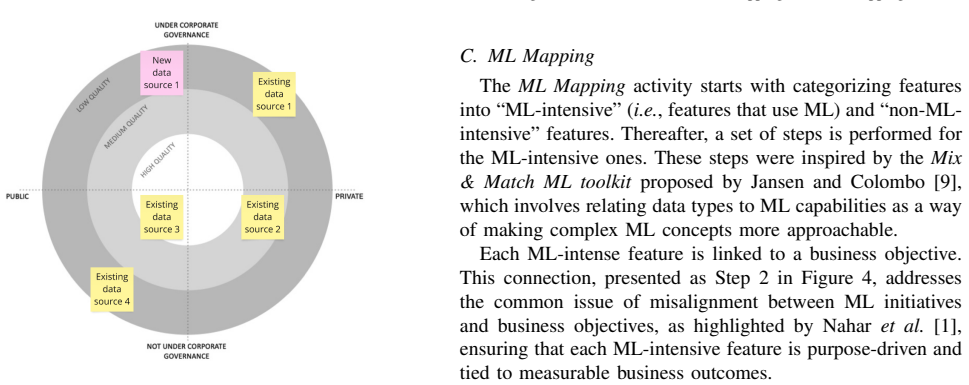
The central mechanism is the three-activity sequence, each supported by a visual board. Data Source Mapping positions data sources on axes of public versus private and corporate governance, with quality circles for high, medium, and low quality. Feature-to-Data Source Mapping links each prioritized feature to the data sources needed to build it, exposing the MVP's data dependencies. ML Mapping separates ML-intensive from non-ML features, attaches each ML-intensive feature to a business objective, then uses tokens for data types and ML capabilities to match data sources to plausible model types. These activities are carried out during a collaborative workshop that includes ML experts, who provide real-time feasibility judgments that keep ideas grounded in what is technically achievable.
What would settle it
A concrete test would be a controlled longitudinal comparison where teams ideate ML-enabled products using either Define-ML or the unmodified Lean Inception, with facilitation kept neutral, and success measured by objective outcomes such as the share of ideated features that reach a deployed product using available data, the rate of feature pivots due to data unavailability, or stakeholder alignment scores over time. If Define-ML teams show no fewer data-related dead ends and no better alignment than the Lean Inception baseline, the central claim would be refuted.
Extended reading notes
Core claim
On the paper's own terms, the discovery is that a structured extension of Lean Inception—adding Data Source Mapping, Feature-to-Data Source Mapping, and ML Mapping—can address the distinct challenges of ideating ML-enabled systems, namely aligning business objectives with probabilistic behavior and making data dependencies explicit early. The three activities ask teams to map data sources by access and governance, connect each proposed feature to the data it needs, and match ML-intensive features to feasible model types while tying each to a business objective. Static validation with a simulated loan-approval problem and dynamic validation in a retail demand-forecasting case both yielded high perceived usefulness on the new activities and unanimous expressed intention to adopt the framework. The authors conclude that Define-ML provides a structured framework for addressing the unique challenges of ideating ML-enabled systems.
Load-bearing premise
The load-bearing premise is that participants' questionnaire answers about perceived usefulness, ease of use, and intention to adopt—collected right after researcher-facilitated workshops—are a reliable stand-in for the framework's true effectiveness in real product ideation.
Editorial extensions
If this is right
- If Define-ML works as reported, teams can surface data gaps and feasibility constraints before committing to an ML product vision, reducing later rework.
- The feature-to-data matrix gives the MVP definition an explicit data-dependency input, making scope decisions more realistic.
- The structured activities give business and technical stakeholders a shared vocabulary, fostering cross-functional alignment on data-driven products.
- The open template release means practitioners can adopt the framework without proprietary tools, and the documented facilitation role suggests organizations should budget for ML-expert support.
- Acceptance across two industry contexts (energy sector and retail/beverage) offers initial evidence of applicability beyond a single domain.
Reading between the lines
- Editorial inference: the same data-to-feature mapping logic could extend beyond ML to any data-intensive product ideation, since data dependency is not unique to predictive features.
- Editorial inference: because all workshops were researcher-facilitated and evaluation was self-reported, the unanimous adoption intent may overstate what would happen when teams run Define-ML on their own; a replication with neutral facilitation would test the persistence of the effect.
- Editorial inference: the ML Mapping step, built on data-type and capability tokens, could be extended to generative AI and agent-based features (as the authors suggest as future work) by adding tokens for those capability classes.
- Editorial inference: the artifacts Define-ML produces, such as the feature-to-data-source matrix, could feed directly into requirements engineering for ML, potentially reducing the specification gap documented in prior work.
Signed reviews
Editorial analysis
A structured set of objections, weighed in public.
Referee Report
Summary. The paper proposes Define-ML, an extension of the Lean Inception ideation workshop with three new activities (Data Source Mapping, Feature-to-Data Source Mapping, and ML Mapping) intended to address ML-specific concerns in early product ideation. The authors followed the Technology Transfer Model, first presenting the approach in a lab session, then running a static validation with 11 practitioners on a toy problem, and a dynamic validation in a three-day workshop with a multinational energy drink company, where 9 of 11 business participants completed a TAM-based questionnaire. The reported results show high perceived usefulness for the new activities and unanimous (static) or near-unanimous (dynamic) intention to adopt the framework. The paper concludes that Define-ML is a 'validated approach' for ML product ideation. The manuscript includes an open science repository and a Miro template for the boards.
Significance. If the results are taken at face value, Define-ML addresses a real and current gap: most ideation methods for software products do not explicitly handle data dependencies, technical feasibility, and the alignment of ML capabilities with business goals. The paper's strengths are its concrete, reproducible artifacts (open Miro template, Zenodo repository), its adherence to a systematic technology-transfer methodology with defined research questions, and its candid threats-to-validity section, which explicitly acknowledges that TAM captures perceptions and that facilitator bias is possible. The evaluation, however, rests entirely on self-reported perceptions and behavioral intentions, with no baseline comparison, no objective outcome measures, small samples, and researcher-facilitated sessions. The paper would be a useful contribution as a design study reporting practitioner perceptions of a new ideation framework; the current wording overstates the strength of the evidence.
major comments (4)
- [Abstract; Section VIII] The conclusion that Define-ML is a 'validated approach' for ML product ideation is not supported by the evidence presented. The evaluation in Sections V and VI uses TAM-based questionnaires that measure perceived usefulness, ease of use, and intention to use (Section VI.C), and the authors themselves concede in Section VII.B that 'TAM and qualitative feedback basically capture perceptions.' There is no objective measure of ideation outcome quality, such as feasibility of the produced product definition, alignment with available data, or downstream project success. I recommend either tempering the claim to 'an approach that practitioners perceived as useful' or adding evidence that links the workshop outputs to actual ideation effectiveness.
- [Sections V and VI] Neither validation includes a comparison baseline. All participants used only Define-ML, so the high agreement ratings could reflect the general value of any structured, facilitated workshop rather than the specific contribution of the three ML-focused activities. To support the central claim that these activities add value over and above Lean Inception, a comparison with an unmodified Lean Inception session, or at least an explicit within-workshop evaluation of what each activity contributed beyond the baseline method, would be needed. Without such a comparison, the paper's motivation that traditional ideation methods 'lack explicit support for ML-specific considerations' (Section II.A) is plausible but not empirically backed by the reported data.
- [Section VI.D, RQ3; Section V.D, RQ3] The characterization 'strong perceived usefulness' in the conclusion is too strong for the ML Mapping activity in the dynamic validation, where only 6 of 9 practitioners agreed, 2 partially agreed, and 1 was neutral, and where one participant reported that the artifact 'confused me most.' The static validation also had 2 of 11 participants only partially agreeing. The paper should either report this activity as only moderately supported or explain why these results still justify the overall claim of strong usefulness.
- [Section VI.D, RQ4; Section VII.B] The 'intention to adopt' measure was collected immediately after the workshop and is a behavioral intention, not actual adoption. The authors correctly note in Section VII.B that longitudinal tracking is future work, but the conclusion in Section VIII states a 'clear practitioners' intent to adopt' as if it were evidence of adoption readiness. I recommend distinguishing clearly between reported intention and evidenced adoption in the abstract and conclusion, and noting the self-selection issue: only 9 of the 11 business participants answered the questionnaire, and the non-respondents may differ systematically from respondents.
minor comments (5)
- [Abstract] The phrase 'intent of adoption' should be 'intention to adopt' to match the terminology used in Section VI.C and the TAM literature.
- [Section VII.A] Typo: 'aproach' should be 'approach'.
- [Sections V and VI] The manuscript frequently has stray spaces before periods in headings and section references (e.g., 'V . Yildirim' in Section II.B, 'F . Step 6' in Section III.F). Please fix these formatting issues in the final version.
- [Section IV.A] The term 'corporate governance' in the Data Source Mapping board may be unclear to readers outside the specific organizational context; consider defining it explicitly or using a more self-explanatory label such as 'IT-managed data' vs. 'locally managed data'.
- [Figures 5 and 7] Please ensure that the frequency bars are accompanied by the exact counts or percentages, since the numbers are central to the reader's ability to assess the strength of the agreement findings.
Circularity Check
No significant circularity: the validation evidence is empirical and self-reported, but the conclusions are not equivalent to the inputs by construction.
full rationale
This paper does not contain a mathematical derivation chain or fitted parameters, so the classic circularity failure modes do not apply. Define-ML is presented as an extension of Lean Inception with three new activities, and its evaluation is based on two empirical studies using TAM-based questionnaires and qualitative feedback. The conclusion that Define-ML is a 'validated approach' rests on participants' perceived usefulness, ease of use, and intention to adopt; this is an inferential limitation, not a circularity. The authors explicitly acknowledge in Section VII.B that 'TAM and qualitative feedback basically capture perceptions' and that 'all workshops were facilitated by the researchers, which could introduce facilitator bias.' These are honest threats to validity, and the paper does not disguise them. There is no step in which a quantity is defined in terms of the result it is supposed to predict, and no load-bearing self-citation chain: the cited prior work by the authors is used as background or motivation, not as an unverified uniqueness theorem that forces the conclusion. The central claim is therefore independent of its evidence in the sense required for circularity; the weakness is a standard external-validity and measurement concern, not a circular derivation.
Assumptions & free parameters
assumptions (2)
- domain assumption Perceived usefulness measured by TAM questionnaires is a valid indicator of an ideation framework's practical value.
- domain assumption The Lean Inception method lacks sufficient support for ML-specific concerns such as data dependencies and feasibility.
Cite this review
Pith. "Pith review of Define-ML: An Approach to Ideate Machine Learning-Enabled Systems." pith.science (2026). https://pith.science/paper/MVPAZPTJ
@misc{pith2026250620621,
  author       = {Pith},
  title        = {Pith review of: Define-ML: An Approach to Ideate Machine Learning-Enabled Systems},
  year         = {2026},
  howpublished = {\url{https://pith.science/paper/MVPAZPTJ}},
  note         = {Machine review of arXiv:2506.20621}
}
read the original abstract
[Context] The increasing adoption of machine learning (ML) in software systems demands specialized ideation approaches that address ML-specific challenges, including data dependencies, technical feasibility, and alignment between business objectives and probabilistic system behavior. Traditional ideation methods like Lean Inception lack structured support for these ML considerations, which can result in misaligned product visions and unrealistic expectations. [Goal] This paper presents Define-ML, a framework that extends Lean Inception with tailored activities - Data Source Mapping, Feature-to-Data Source Mapping, and ML Mapping - to systematically integrate data and technical constraints into early-stage ML product ideation. [Method] We developed and validated Define-ML following the Technology Transfer Model, conducting both static validation (with a toy problem) and dynamic validation (in a real-world industrial case study). The analysis combined quantitative surveys with qualitative feedback, assessing utility, ease of use, and intent of adoption. [Results] Participants found Define-ML effective for clarifying data concerns, aligning ML capabilities with business goals, and fostering cross-functional collaboration. The approach's structured activities reduced ideation ambiguity, though some noted a learning curve for ML-specific components, which can be mitigated by expert facilitation. All participants expressed the intention to adopt Define-ML. [Conclusion] Define-ML provides an openly available, validated approach for ML product ideation, building on Lean Inception's agility while aligning features with available data and increasing awareness of technical feasibility.
Figures


Figures from the paper (3 more)


Reference graph
Works this paper leans on
-
[1]
N. Nahar, H. Zhang, G. Lewis, S. Zhou, and C. K ¨astner, “A meta- summary of challenges in building products with ml components– collecting experiences from 4758+ practitioners,” in2023 IEEE/ACM 2nd International Conference on AI Engineering–Software Engineering for AI (CAIN). IEEE, 2023, pp. 171–183
work page 2023
-
[2]
Lean inception: how to align people and build the right product,
P. Caroli, “Lean inception: how to align people and build the right product,”Editora Caroli, 2018
work page 2018
-
[3]
A. P. S. Alves, M. Kalinowski, G. Giray, D. Mendez, N. Lavesson, K. Azevedo, H. Villamizar, T. Escovedo, H. Lopes, S. Bifflet al., “Status quo and problems of requirements engineering for machine learning: Results from an international survey,” inInternational Conference on Product-Focused Software Process Improvement, 2023, pp. 159–174
work page 2023
-
[4]
Naming the Pain in Machine Learning-Enabled Systems Engineering
M. Kalinowski, D. Mendez, G. Giray, A. P. S. Alves, K. Azevedo, T. Escovedo, H. Villamizar, H. Lopes, T. Baldassarre, S. Wagneret al., “Naming the pain in machine learning-enabled systems engineering,” arXiv preprint arXiv:2406.04359, 2024
work page Pith review arXiv 2024
-
[5]
A model for technology transfer in practice,
T. Gorschek, P. Garre, S. Larsson, and C. Wohlin, “A model for technology transfer in practice,”IEEE software, vol. 23, no. 6, pp. 88– 95, 2006
work page 2006
-
[6]
T. Brownet al., “Design thinking,”Harvard business review, vol. 86, no. 6, p. 84, 2008
work page 2008
-
[7]
R. Banfield, C. T. Lombardo, and T. Wax,Design sprint: A practical guidebook for building great digital products. ” O’Reilly”, 2015
work page 2015
-
[8]
E. Ries,The lean startup: How today’s entrepreneurs use continuous innovation to create radically successful businesses. Crown Currency, 2011
work page 2011
Show all 19 references
-
[9]
Mix & match machine learning: An ideation toolkit to design machine learning-enabled solutions,
A. Jansen and S. Colombo, “Mix & match machine learning: An ideation toolkit to design machine learning-enabled solutions,” inProceedings of the Seventeenth International Conference on Tangible, Embedded, and Embodied Interaction, 2023, pp. 1–18
2023
-
[10]
Creating design resources to scaffold the ideation of ai concepts,
N. Yildirim, C. Oh, D. Sayar, K. Brand, S. Challa, V . Turri, N. Crosby Walton, A. E. Wong, J. Forlizzi, J. McCannet al., “Creating design resources to scaffold the ideation of ai concepts,” inProceedings of the 2023 ACM Designing Interactive Systems Conference, 2023, pp. 2326–2346
2023
-
[11]
Investigating how practitioners use human-ai guidelines: A case study on the people+ ai guidebook,
N. Yildirim, M. Pushkarna, N. Goyal, M. Wattenberg, and F. Vi ´egas, “Investigating how practitioners use human-ai guidelines: A case study on the people+ ai guidebook,” inProceedings of the 2023 CHI Confer- ence on Human Factors in Computing Systems, 2023, pp. 1–13
2023
-
[12]
Identify- ing concerns when specifying machine learning-enabled systems: A perspective-based approach,
H. Villamizar, M. Kalinowski, H. Lopes, and D. Mendez, “Identify- ing concerns when specifying machine learning-enabled systems: A perspective-based approach,”Journal of Systems and Software, vol. 213, 2024
2024
-
[13]
A systematic mapping study and practitioner insights on the use of software engineering practices to develop mvps,
S. Alonso, M. Kalinowski, B. Ferreira, S. D. Barbosa, and H. Lopes, “A systematic mapping study and practitioner insights on the use of software engineering practices to develop mvps,”Information and Software Technology, vol. 156, p. 107144, 2023
2023
-
[14]
Lessons learned to improve the ux practices in agile projects involving data science and process automation,
B. Ferreira, S. Marques, M. Kalinowski, H. Lopes, and S. D. Barbosa, “Lessons learned to improve the ux practices in agile projects involving data science and process automation,”Information and Software Tech- nology, vol. 155, p. 107106, 2023
2023
-
[15]
Lean r&d: An agile research and development approach for digi- tal transformation,
M. Kalinowski, H. Lopes, A. F. Teixeira, G. da Silva Cardoso, A. Ku- ramoto, B. Itagyba, S. T. Batista, J. A. Pereira, T. Silva, J. A. Warrak et al., “Lean r&d: An agile research and development approach for digi- tal transformation,” inProduct-Focused Software Process Improve...
2020
-
[16]
Experiences applying lean r&d in industry-academia collaboration projects,
M. Kalinowski, L. Romao, A. Rodrigues, C. Barbosa, H. Villamizar, S. D. Barbosa, and H. Lopes, “Experiences applying lean r&d in industry-academia collaboration projects,” in17th International Confer- ence on Software Quality, Software Quality Days SWQD 2025, Munich, Germany, ...
2025
-
[17]
Runeson, M
P. Runeson, M. Host, A. Rainer, and B. Regnell,Case study research in software engineering: Guidelines and examples. John Wiley & Sons, 2012
2012
-
[18]
The tame project: Towards improvement-oriented software environments,
V . R. Basili and H. D. Rombach, “The tame project: Towards improvement-oriented software environments,”IEEE Transactions on software engineering, vol. 14, no. 6, pp. 758–773, 1988
1988
-
[19]
Perceived usefulness, perceived ease of use, and user acceptance of information technology,
F. D. Davis, “Perceived usefulness, perceived ease of use, and user acceptance of information technology,”MIS quarterly, pp. 319–340, 1989
1989
Reviewed August 6, 2026 · model on record in the stance chip above.
Discussion (0). Continue with ORCID to comment.