REVIEW 4 major objections 5 minor 2 cited by
Stochastic Parameter Decomposition
T0 review · 4 major / 5 minor · reviewed 2026-08-06 · deepseek-v4-flash
Pith's one-line read Stochastic Parameter Decomposition learns, per rank-one piece of a network's weights, how much that piece can be randomly ablated without changing outputs, and this suffices to recover known mechanisms in every toy model tested.
desk verdict A genuine, clearly-written method advance over APD, but the robustness claim is only as strong as the beta3 selection rule, which still leans on known ground truth. read the letter →
The pith
A machine-rendered reading of the paper's core claim, the machinery that carries it, and where it could break.
The reading
What carries the argument
The load-bearing object is the learned causal importance function: for each rank-one subcomponent $U^l_{:,c}V^l_{c,:}$ of weight matrix $W^l$, a small MLP maps the subcomponent's inner activation $h^l_c(x)=\sum_j V^l_{c,j}a^l_j(x)$ to an importance value $g^l_c(x)\in[0,1]$ through a leaky hard sigmoid. The importance value sets the lower end of a uniform mask $m^l_c(x,r)=g^l_c(x)+(1-g^l_c(x))r$ with $r\sim U(0,1)$, so a subcomponent predicted unimportant is aggressively and randomly ablated, while a predicted-important one stays near full strength. Three objectives compete: faithfulness (the subcomponents sum to the original weights), stochastic reconstruction (the randomly masked network reproduces the target's outputs, both globally and layerwise), and minimality (the $\ell^p$ magnitude of the importance values is penalized). The mechanism works because the stochastic masks probe every joint ablation pattern with some probability, so a subcomponent that is genuinely load-bearing on an input cannot afford a high ablation probability and keeps its importance high, whereas superfluous subcomponents are driven to importance zero.
What would settle it
Construct a small network with a known mechanism whose causal importance genuinely depends on activity elsewhere in the network, for example a gated circuit where a downstream layer decides whether an upstream rank-one component matters on a given input. Apply SPD with its per-subcomponent, own-activation-only importance MLPs: if the learned importance values systematically disagree with brute-force measurement of how much each subcomponent can actually be ablated on inputs where the cross-layer dependence binds, the expressivity assumption behind the method gives way.
Extended reading notes
Core claim
The paper claims that a neural network can be decomposed into its causal mechanisms without computing any attributions. For each weight matrix $W^l$ the method learns a set of rank-one subcomponents $\sum_c U^l_{:,c}V^l_{c,:}$ together with a small learned predictor that outputs an importance value $g^l_c(x)\in[0,1]$ for each subcomponent on each input; importance is defined operationally as the complement of ablatability, the amount by which the subcomponent can be randomly masked while leaving the output unchanged. On every input the subcomponents are masked by random amounts between their predicted importance and full strength, and the masked network is trained to reproduce the target output while a minimality penalty drives all importance values toward zero. The demonstrated result is that this stochastic ablation objective aligns subcomponents with ground-truth mechanisms: in toy models of superposition, compressed computation, and cross-layer distributed representations the learned decompositions match the known mechanisms up to small error, with mean max cosine similarity of 1.000 and mean L2 ratio close to 1, and without the shrinkage the attribution-based predecessor exhibited. In the compressed-computation model the method also reverses a mechanistic conclusion of the earlier method, finding that the MLP output matrix is one high-rank component rather than one per input feature.
Load-bearing premise
The method assumes that a subcomponent's ablatability on a given input is predictable from a single scalar, that subcomponent's own inner activation, and the authors concede that arbitrary models will likely require more expressive importance functions that take in more of the network.
Editorial extensions
If this is right
- SPD decomposes a three-layer residual MLP that the attribution-based method could not handle, with masks showing one subcomponent per input feature and a single output component spread across all three layers.
- In every toy model tested the learned subcomponents recover the ground-truth mechanisms with mean max cosine similarity 1.000 and mean L2 ratio near 1, indicating correct orientation and no shrinkage of magnitudes.
- On the Toy Model of Compressed Computation SPD finds that the MLP output matrix is a single rank-50 component, contradicting the earlier attribution-based decomposition's claim of one component per input feature.
- SPD decomposes an identity matrix inserted into a superposition model into exactly $m_1$ rank-one subcomponents that sum to it, demonstrating the method does not suffer the feature-splitting failure of activation-space dictionary learning.
- Because it needs no estimate of how many components are active per datapoint and lets gradients reach every subcomponent on every step, the authors expect SPD to scale to larger, non-toy models such as language models.
Reading between the lines
- If the local-importance assumption survives scaling, the practical bottleneck of the approach shifts to clustering: SPD produces per-layer rank-one pieces, and a general algorithmic grouping step, which the toy-model study avoids because ground truth names the clusters, will decide whether the method works on real networks.
- The learned importance values double as a basis-free causal map: the masks specify which parameter vectors matter for which inputs, so SPD outputs could serve as circuit hypotheses that activation-patching or causal-scrubbing tests would then verify, without choosing units in advance.
- A stress test the paper does not run: applying SPD to the embedding and unembedding matrices of a small transformer, where the one-component-per-token expectation can be checked directly and would give the first evidence the method transfers beyond toy MLPs.
- The reported mean L2 ratios slightly exceed 1 (up to 1.031), a mild magnitude overshoot opposite in sign to the predecessor's shrinkage; whether this bias grows with depth and couples to the importance penalty $\beta_3$ is left open.
Editorial analysis
A structured set of objections, weighed in public.
Referee Report
Summary. The paper introduces Stochastic Parameter Decomposition (SPD), a method for decomposing a neural network's weight matrices into rank-one subcomponents that sum to the original weights (faithfulness), are active as sparsely as possible per input (minimality), and are simple by construction. SPD trains a per-subcomponent causal importance function that predicts how ablatable each subcomponent is on a given input, and uses stochastically sampled masks to encourage the masked model to match the target model. The full loss is Eq. (8), combining a faithfulness term, two stochastic reconstruction losses, and an importance-minimality penalty with coefficient beta3. The paper evaluates SPD on several toy models with known ground-truth mechanisms (Toy Model of Superposition, TMS with a hidden identity, Toy Model of Compressed Computation, and two- and three-layer Cross-Layer Distributed Representations), reporting MMCS and ML2R near 1 for the superposition models and qualitative agreement for the others. The authors claim SPD is more scalable and robust to hyperparameters than Attribution-based Parameter Decomposition (APD), and release code and training details.
Significance. If the empirical claims hold, SPD is a meaningful step for linear parameter decomposition and mechanistic interpretability: it replaces gradient-based attributions with a directly trained causal importance model, avoids the top-k hyperparameter of APD, and is demonstrated on slightly larger and deeper toy models than APD could handle. The paper is commendably concrete: it releases code, provides pseudocode (Algorithm 1), reports hyperparameters in Appendix A.4, and includes the authors' own admission of unresolved issues, notably an unexplained skew in the two-layer model (Section 3.4, Figure 10) and the lack of a general clustering procedure. The central advertised property, however, is robustness to hyperparameters, and the evidence for that property is currently entangled with knowledge of the ground truth, as detailed in the major comments. The significance is therefore conditional: the method has clear promise, but the paper does not yet establish the robustness claim it advertises.
major comments (4)
- [§2.3.3, Eq. (7); §3.3, Fig. 8; Appendix A.3] The central empirical claim that SPD identifies ground-truth mechanisms is not yet separated from knowledge of the ground truth. Section 3.3, Figure 8 shows that when beta3 is too small, the learned masks become non-monosemantic, but the decomposition remains faithful in the sense that the masked model reconstructs the target output; the Appendix A.3 heuristics 'Negligible performance loss' and 'Other sanity checks' do not rule out this regime, because the bad regime has importance values equal to 1 everywhere and no reconstruction failure. Appendix A.4.1 then reports beta3=3e-3 with p=1 for TMS5-2/TMS5-2+ID and beta3=1e-4 with p=2 for TMS40-10/TMS40-10+ID, a 30-fold variation, and the 'Recovering known mechanisms' heuristic explicitly uses the known decomposition to select beta3. Consequently, the MMCS=1.000 results in Table 1 may reflect selecting hyperparameters from the answer rather than a robust property of SPD. Please quantify the beta3 working range for at least one model and provide a ground-truth-free selection rule, for example a validation criterion that penalizes non-minimality without access to known mechanisms.
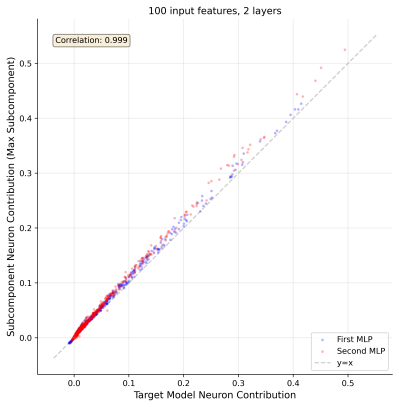
- [§3.4, Fig. 10] The two-layer Cross-Layer Distributed Representations result is presented as a success, yet Figure 10 shows a systematic skew toward higher values on the Y-axis, and the text states 'We currently do not understand the source of this discrepancy' and notes sensitivity to random seeds. Because the paper's central claim includes that SPD succeeds on this model, the unexplained systematic error and seed sensitivity should be resolved or quantified. Please report the number of seeds, the spread of the neuron-contribution agreement and MMCS across seeds, and whether the skew persists after hyperparameter search; without this, the reported result may reflect a favorable run rather than a stable property of SPD.
- [§3, Eq. (9)] The MMCS metric in Eq. (9) takes a maximum over all C subcomponents. When C is large, as in the 2-layer and 3-layer models where C=400 and C=500 (Appendix A.4.2), random or spurious subcomponents can inflate the max, and the metric does not penalize the presence of extra subcomponents. Table 1 reports MMCS=1.000 to three decimal places for four models, which is strong; please report the full distribution of cosine similarities, the number of non-negligible subcomponents learned per model, and a precision/recall-style statistic that penalizes spurious subcomponents, so the quantitative claim is not driven by the max over many candidates.
- [§5, footnote 6] The identification argument in Section 5, footnote 6 asserts that in an idealized setting, any beta3 infinitesimally larger than zero makes the desired decomposition the global optimum, but this claim is not proved and is stated conditionally on several idealizations. The toy experiments do not establish robustness to beta3; they establish that a few hand-picked beta3 values recover known mechanisms. Please either prove the global-optimum claim for the specific linear and ReLU toy models, or replace it with a clearly delimited empirical claim about the beta3 working range, and report how the quantitative metrics vary across beta3 values for each model.
minor comments (5)
- [§2.3.1 and Appendix A.2] The causal importance function is defined as outputting values in [0,1], but the leaky hard sigmoids in Appendix A.2 deliberately produce outputs outside this range; the text should clarify how the mask sampling in Eq. (3) and the importance penalty in Eq. (7) treat out-of-range values.
- [§3.2] The sentence 'APD fails to learn ground truth mechanisms in this model' is stated without a quantitative comparison or a reference to a figure/table; please add a quantitative comparison or move the claim to a discussion section.
- [§2.3.2, Eq. (5)] The statement that Eq. (5) is equivalent to Eq. (4) 'if the subcomponents sum to the original weights' should be expanded: the equivalence also requires that the layerwise losses are combined with weights that match the sampling distribution, and the current wording is too terse.
- [§3.3] The reference to 'unpublished work, forthcoming' should be replaced by a citation or removed, and the 'WandB report here' links should include stable URLs or DOIs.
- [Figure 8] The caption and text mix 'left'/'right' with 'left two columns' and 'right two columns'; please standardize the direction labels so the too-low, just-right, and too-high regimes are unambiguous.
Circularity Check
SPD's headline recovery results are partly fitted inputs: Appendix A.3 recommends choosing the sparsity coefficient β3 using the same known ground-truth mechanisms whose recovery is then reported as the headline result.
-
fitted input called prediction
[Appendix A.3, Heuristics for Hyperparameter Selection]
"Recovering known mechanisms: If some of the ground truth mechanisms in the target model are already known, we can restrict hyperparameters such that they recover those mechanisms. For example, in a language model, the embedding matrix mechanisms are usually known: Each vocabulary element should be assigned one mechanism. If none of a model's mechanisms are known to start with, we could insert known mechanisms into it."
The paper's headline quantitative result—MMCS = 1.000 and ML2R ≈ 1 in Table 1, read as evidence that SPD 'seems to identify known ground-truth mechanisms up to a small error'—is obtained after selecting β3, the only coefficient in Equation 8 that drives sparsity, using exactly those known ground-truth mechanisms. The Appendix A.3 heuristic explicitly tells the user to narrow hyperparameters until known mechanisms are recovered. Since a too-small β3 produces faithful but non-minimal decompositions (g≈1 everywhere) that still pass the other A.3 sanity checks, the selection against ground truth is load-bearing: the reported recovery is not an independent prediction but a hyperparameter chosen to produce it.
full rationale
SPD is not circular in the strong sense: it optimizes the loss in Equation 8 and compares learned subcomponents to external ground-truth weight columns, and the loss does not directly encode the target mechanisms. The central derivation (Section 2) is self-contained: faithfulness, stochastic reconstruction, and importance-minimality are defined independently of the benchmark metrics. However, the paper's robustness and identification claims are weakened by a fitted-input step. Appendix A.3's 'Recovering known mechanisms' heuristic selects the sparsity coefficient β3 by checking whether the decomposition recovers known mechanisms; the same known mechanisms are then used to compute the MMCS/ML2R results in Table 1. Because β3 is the sole term in Equation 8 pushing toward minimality, a too-small value collapses the learned causal importance to g≈1, making the stochastic reconstruction losses trivially satisfied while the decomposition remains faithful but non-minimal. The paper acknowledges this failure mode in Section 3.3 ('When the importance loss coefficient β3 is too small...', calling it 'a poor decomposition') and shows only three β3 values in Figure 8 without quantifying a working range; the per-model β3 values in Appendix A.4.1 differ by more than an order of magnitude (3e-3 vs 1e-4). Consequently, the claim in Section 5 that SPD is 'considerably more scalable and robust to hyperparameters than APD' is not supported by a ground-truth-free selection rule, and the recovery demonstration is partly a re-statement of the tuning criterion. Self-citations to Braun et al. [2025] provide context and a baseline but are not load-bearing for SPD's own derivation. Overall, the circularity is limited to hyperparameter selection rather than the method's mathematical core, so a moderate score of 4 is appropriate.
Assumptions & free parameters
free parameters (5)
- beta3 (importance minimality coefficient) =
3e-3 (TMS5-2, TMS5-2+ID); 1e-4 (TMS40-10, TMS40-10+ID); 1e-5 (1- and 2-layer residual MLPs); 0.5e-5 (3-layer)
- C (subcomponents per layer) =
20 (TMS); 100 (1-layer); 400 (2-layer); 500 (3-layer)
- p in L_importance-minimality =
1 (TMS5-2, TMS5-2+ID); 2 (others)
- S (mask samples per step) =
1
- learning rate =
1e-3 (TMS); 2e-3 (1-layer); 1e-3 (2- and 3-layer)
assumptions (4)
- domain assumption Rank-one subcomponents within a single layer can represent the network's mechanisms
- domain assumption A subcomponent's causal importance can be predicted from its own inner activation alone
- ad hoc to paper The stochastic objective (Eq. 8) has a global optimum at the ground-truth decomposition
- domain assumption The hard-sigmoid gate with leaky slopes and S=1 suffices for stable training
Cite this review
Pith. "Pith review of Stochastic Parameter Decomposition." pith.science (2026). https://pith.science/paper/IEORHBU5
@misc{pith2026250620790,
  author       = {Pith},
  title        = {Pith review of: Stochastic Parameter Decomposition},
  year         = {2026},
  howpublished = {\url{https://pith.science/paper/IEORHBU5}},
  note         = {Machine review of arXiv:2506.20790}
}
read the original abstract
A key step in reverse engineering neural networks is to decompose them into simpler parts that can be studied in relative isolation. Linear parameter decomposition -- a framework that has been proposed to resolve several issues with current decomposition methods -- decomposes neural network parameters into a sum of sparsely used vectors in parameter space. However, the current main method in this framework, Attribution-based Parameter Decomposition (APD), is impractical on account of its computational cost and sensitivity to hyperparameters. In this work, we introduce \textit{Stochastic Parameter Decomposition} (SPD), a method that is more scalable and robust to hyperparameters than APD, which we demonstrate by decomposing models that are slightly larger and more complex than was possible to decompose with APD. We also show that SPD avoids other issues, such as shrinkage of the learned parameters, and better identifies ground truth mechanisms in toy models. By bridging causal mediation analysis and network decomposition methods, this demonstration opens up new research possibilities in mechanistic interpretability by removing barriers to scaling linear parameter decomposition methods to larger models. We release a library for running SPD and reproducing our experiments at https://github.com/goodfire-ai/spd/tree/spd-paper.
Figures


Figures from the paper (12 more)




Forward citations
Cited by 2 Pith papers
-
Individual Parameters in Weight-Sparse Transformers Appear Interpretable
An automated LLM pipeline finds that 12–31% of nonzero weights in weight-sparse transformers admit short, held-out-validated descriptions of when they matter, far above dense controls.
-
Targeted Recovery of Weight-Space Mechanisms From Neural Networks
A targeted decomposition method recovers the weight-space mechanisms behind specific inputs at low FLOPs, enabling focused ablation and rewiring of a 12-block transformer.
Reference graph
Works this paper leans on
-
[1]
Sanity checks for saliency maps
Julius Adebayo, Justin Gilmer, Michael Muelly, Ian Goodfellow, Moritz Hardt, and Been Kim. Sanity checks for saliency maps. In S. Bengio, H. Wallach, H. Larochelle, K. Grauman, N. Cesa-Bianchi, and R. Garnett, editors, Advances in Neural Information Processing Systems, volume 31. Curran Associates, Inc., 2018. URL https://proceedings.neurips.cc/paper_file...
work page 2018
-
[2]
Compressed computation is (probably) not computation in superposition
Jai Bhagat, Sara Molas Medina, Giorgi Giglemiani, and Stefan Heimersheim. Compressed computation is (probably) not computation in superposition. https://www.lesswrong.com/posts/ZxFchCFJFcgysYsT9/compressed-computation-is-probably-not-computation-in, 2025
work page 2025
-
[3]
Dan Braun, Lucius Bushnaq, Stefan Heimersheim, Jake Mendel, and Lee Sharkey. Interpretability in parameter space: Minimizing mechanistic description length with attribution-based parameter decomposition, 2025. URL https://arxiv.org/abs/2501.14926
arXiv 2025
-
[4]
Towards monosemanticity: Decomposing language models with dictionary learning
Trenton Bricken, Adly Templeton, Joshua Batson, Brian Chen, Adam Jermyn, Tom Conerly, Nick Turner, Cem Anil, Carson Denison, Amanda Askell, Robert Lasenby, Yifan Wu, Shauna Kravec, Nicholas Schiefer, Tim Maxwell, Nicholas Joseph, Zac Hatfield-Dodds, Alex Tamkin, Karina Nguyen, Brayden McLean, Josiah E Burke, Tristan Hume, Shan Carter, Tom Henighan, and Ch...
work page 2023
-
[5]
Steven Cao, Victor Sanh, and Alexander M. Rush. Low-complexity probing via finding subnetworks, 2021. URL https://arxiv.org/abs/2104.03514
arXiv 2021
-
[6]
Lawrence Chan, Adrià Garriga-Alonso, Nicholas Goldowsky-Dill, Ryan Greenblatt, Jenny Nitishinskaya, Ansh Radhakrishnan, Buck Shlegeris, and Nate Thomas. Causal scrubbing: a method for rigorously testing interpretability hypotheses [redwood research], December 2022. URL https://www.alignmentforum.org/posts/JvZhhzycHu2Yd57RN/causal-scrubbing-a-method-for-ri...
work page 2022
-
[7]
A is for absorption: Studying feature splitting and absorption in sparse autoencoders, 2024
David Chanin, James Wilken-Smith, Tomáš Dulka, Hardik Bhatnagar, and Joseph Bloom. A is for absorption: Studying feature splitting and absorption in sparse autoencoders, 2024. URL https://arxiv.org/abs/2409.14507
arXiv 2024
-
[8]
Identifying Sparsely Active Circuits Through Local Loss Landscape Decomposition
Brianna Chrisman, Lucius Bushnaq, and Lee Sharkey. Identifying sparsely active circuits through local loss landscape decomposition, 2025. URL https://arxiv.org/abs/2504.00194
work page Pith review arXiv 2025
Show all 45 references
-
[9]
Towards automated circuit discovery for mechanistic interpretability
Arthur Conmy, Augustine Mavor-Parker, Aengus Lynch, Stefan Heimersheim, and Adri\` a Garriga-Alonso. Towards automated circuit discovery for mechanistic interpretability. In A. Oh, T. Naumann, A. Globerson, K. Saenko, M. Hardt, and S. Levine, editors, Advances in Neural Inform...
2023
-
[10]
Are neural nets modular? inspecting functional modularity through differentiable weight masks
R \'o bert Csord \'a s, Sjoerd van Steenkiste, and J \"u rgen Schmidhuber. Are neural nets modular? inspecting functional modularity through differentiable weight masks. In International Conference on Learning Representations, 2021. URL https://openreview.net/forum?id=7uVcpu-gMD
2021
-
[11]
Sparse autoencoders find highly interpretable features in language models
Hoagy Cunningham, Logan Riggs Smith, Aidan Ewart, Robert Huben, and Lee Sharkey. Sparse autoencoders find highly interpretable features in language models. In The Twelfth International Conference on Learning Representations, 2024. URL https://openreview.net/forum?id=F76bwRSLeK
2024
-
[12]
Toy models of superposition, 2022
Nelson Elhage, Tristan Hume, Catherine Olsson, Nicholas Schiefer, Tom Henighan, Shauna Kravec, Zac Hatfield-Dodds, Robert Lasenby, Dawn Drain, Carol Chen, Roger Grosse, Sam McCandlish, Jared Kaplan, Dario Amodei, Martin Wattenberg, and Christopher Olah. Toy models of superposi...
2022
-
[13]
Fong and Andrea Vedaldi
Ruth C. Fong and Andrea Vedaldi. Interpretable explanations of black boxes by meaningful perturbation. In 2017 IEEE International Conference on Computer Vision (ICCV). IEEE, October 2017. doi:10.1109/iccv.2017.371. URL http://dx.doi.org/10.1109/ICCV.2017.371
2017 doi
-
[14]
Scaling and evaluating sparse autoencoders, 2024
Leo Gao, Tom Dupré la Tour, Henk Tillman, Gabriel Goh, Rajan Troll, Alec Radford, Ilya Sutskever, Jan Leike, and Jeffrey Wu. Scaling and evaluating sparse autoencoders, 2024. URL https://arxiv.org/abs/2406.04093
2024 arXiv
-
[15]
Causal abstractions of neural networks
Atticus Geiger, Hanson Lu, Thomas Icard, and Christopher Potts. Causal abstractions of neural networks. In Proceedings of the 35th International Conference on Neural Information Processing Systems, NIPS '21, Red Hook, NY, USA, 2024 a . Curran Associates Inc. ISBN 9781713845393
2024
-
[16]
Finding alignments between interpretable causal variables and distributed neural representations
Atticus Geiger, Zhengxuan Wu, Christopher Potts, Thomas Icard, and Noah Goodman. Finding alignments between interpretable causal variables and distributed neural representations. In Francesco Locatello and Vanessa Didelez, editors, Proceedings of the Third Conference on Causal...
2024
-
[17]
Mathematical models of computation in superposition, 2024
Kaarel Hänni, Jake Mendel, Dmitry Vaintrob, and Lawrence Chan. Mathematical models of computation in superposition, 2024. URL https://arxiv.org/abs/2408.05451
2024 arXiv
-
[18]
Tanh penalty in dictionary learning
Adam Jermyn, Adly Templeton, Joshua Batson, and Trenton Bricken. Tanh penalty in dictionary learning. https://transformer-circuits.pub/2024/feb-update/index.html#: :text=handle
2024
-
[19]
Auto-encoding variational bayes, 2013
Diederik P Kingma and Max Welling. Auto-encoding variational bayes, 2013. URL https://arxiv.org/abs/1312.6114
2013 arXiv
-
[20]
Atp*: An efficient and scalable method for localizing llm behaviour to components, 2024
János Kramár, Tom Lieberum, Rohin Shah, and Neel Nanda. Atp*: An efficient and scalable method for localizing llm behaviour to components, 2024. URL https://arxiv.org/abs/2403.00745
2024 arXiv
-
[21]
Sparse autoencoders do not find canonical units of analysis, 2025
Patrick Leask, Bart Bussmann, Michael Pearce, Joseph Bloom, Curt Tigges, Noura Al Moubayed, Lee Sharkey, and Neel Nanda. Sparse autoencoders do not find canonical units of analysis, 2025. URL https://arxiv.org/abs/2502.04878
2025 arXiv
-
[22]
David K. Lewis. Counterfactuals. Blackwell, Malden, Mass., 1973
1973
-
[23]
Sparse crosscoders for cross-layer features and model diffing, October 2024
Jack Lindsay, Adly Templeton, Jonathan Marcus, Thomas Conerly, Joshua Batson, and Christopher Olah. Sparse crosscoders for cross-layer features and model diffing, October 2024. URL https://transformer-circuits.pub/2024/crosscoders/index.html
2024
-
[24]
Decoupled weight decay regularization, 2019
Ilya Loshchilov and Frank Hutter. Decoupled weight decay regularization, 2019. URL https://arxiv.org/abs/1711.05101
2019 arXiv
-
[25]
Michaud, Yonatan Belinkov, David Bau, and Aaron Mueller
Samuel Marks, Can Rager, Eric J. Michaud, Yonatan Belinkov, David Bau, and Aaron Mueller. Sparse feature circuits: Discovering and editing interpretable causal graphs in language models, 2024. URL https://arxiv.org/abs/2403.19647
2024 arXiv
-
[26]
Uncovering model processing strategies with non-negative per-example fisher factorization, 2025
Michael Matena and Colin Raffel. Uncovering model processing strategies with non-negative per-example fisher factorization, 2025. URL https://arxiv.org/abs/2310.04649
2025 arXiv
-
[27]
The hydra effect: Emergent self-repair in language model computations, 2023
Thomas McGrath, Matthew Rahtz, Janos Kramar, Vladimir Mikulik, and Shane Legg. The hydra effect: Emergent self-repair in language model computations, 2023. URL https://arxiv.org/abs/2307.15771
2023 arXiv
-
[28]
SAE feature geometry is outside the superposition hypothesis
Jake Mendel. SAE feature geometry is outside the superposition hypothesis. Alignment Forum, 2024. URL https://www.alignmentforum.org/posts/MFBTjb2qf3ziWmzz6/sae-feature-geometry-is-outside-the-superposition-hypothesis
2024
-
[29]
Skeletonization: A technique for trimming the fat from a network via relevance assessment
Michael C Mozer and Paul Smolensky. Skeletonization: A technique for trimming the fat from a network via relevance assessment. In D. Touretzky, editor, Advances in Neural Information Processing Systems, volume 1. Morgan-Kaufmann, 1988. URL https://proceedings.neurips.cc/paper_...
1988
-
[30]
Missed causes and ambiguous effects: Counterfactuals pose challenges for interpreting neural networks, 2024
Aaron Mueller. Missed causes and ambiguous effects: Counterfactuals pose challenges for interpreting neural networks, 2024. URL https://arxiv.org/abs/2407.04690
2024 arXiv
-
[31]
The quest for the right mediator: A history, survey, and theoretical grounding of causal interpretability, 2024
Aaron Mueller, Jannik Brinkmann, Millicent Li, Samuel Marks, Koyena Pal, Nikhil Prakash, Can Rager, Aruna Sankaranarayanan, Arnab Sen Sharma, Jiuding Sun, Eric Todd, David Bau, and Yonatan Belinkov. The quest for the right mediator: A history, survey, and theoretical grounding...
2024
-
[32]
Taking features out of superposition with sparse autoencoders, Dec 2022
Lee Sharkey, Dan Braun, and Beren Millidge. Taking features out of superposition with sparse autoencoders, Dec 2022. URL https://www.alignmentforum.org/posts/z6QQJbtpkEAX3Aojj/interim-research-report-taking-features-out-of-superposition
2022
-
[33]
Michaud, Stephen Casper, Max Tegmark, William Saunders, David Bau, Eric Todd, Atticus Geiger, Mor Geva, Jesse Hoogland, Daniel Murfet, and Tom McGrath
Lee Sharkey, Bilal Chughtai, Joshua Batson, Jack Lindsey, Jeff Wu, Lucius Bushnaq, Nicholas Goldowsky-Dill, Stefan Heimersheim, Alejandro Ortega, Joseph Bloom, Stella Biderman, Adria Garriga-Alonso, Arthur Conmy, Neel Nanda, Jessica Rumbelow, Martin Wattenberg, Nandi Schoots, ...
2025 arXiv
-
[34]
Deep inside convolutional networks: Visualising image classification models and saliency maps, 2014
Karen Simonyan, Andrea Vedaldi, and Andrew Zisserman. Deep inside convolutional networks: Visualising image classification models and saliency maps, 2014. URL https://arxiv.org/abs/1312.6034
2014 arXiv
-
[35]
Axiomatic attribution for deep networks, 2017
Mukund Sundararajan, Ankur Taly, and Qiqi Yan. Axiomatic attribution for deep networks, 2017
2017
-
[36]
Attribution patching outperforms automated circuit discovery
Aaquib Syed, Can Rager, and Arthur Conmy. Attribution patching outperforms automated circuit discovery. In Yonatan Belinkov, Najoung Kim, Jaap Jumelet, Hosein Mohebbi, Aaron Mueller, and Hanjie Chen, editors, Proceedings of the 7th BlackboxNLP Workshop: Analyzing and Interpret...
2024 doi
-
[37]
true features
Demian Till. Do sparse autoencoders find "true features"?, February 2024. URL https://www.lesswrong.com/posts/QoR8noAB3Mp2KBA4B/do-sparse-autoencoders-find-true-features
2024
-
[38]
Investigating gender bias in language models using causal mediation analysis
Jesse Vig, Sebastian Gehrmann, Yonatan Belinkov, Sharon Qian, Daniel Nevo, Yaron Singer, and Stuart Shieber. Investigating gender bias in language models using causal mediation analysis. In H. Larochelle, M. Ranzato, R. Hadsell, M.F. Balcan, and H. Lin, editors, Advances in Ne...
2020
-
[39]
Differentiation and specialization of attention heads via the refined local learning coefficient, 2024
George Wang, Jesse Hoogland, Stan van Wingerden, Zach Furman, and Daniel Murfet. Differentiation and specialization of attention heads via the refined local learning coefficient, 2024. URL https://arxiv.org/abs/2410.02984
2024 arXiv
-
[40]
Interpretability in the wild: a circuit for indirect object identification in gpt-2 small
Kevin Wang, Alexandre Variengien, Arthur Conmy, Buck Shlegeris, and Jacob Steinhardt. Interpretability in the wild: a circuit for indirect object identification in gpt-2 small. arXiv preprint arXiv:2211.00593, 2022
2022 arXiv
-
[41]
Algebraic geometry and statistical learning theory, volume 25
Sumio Watanabe. Algebraic geometry and statistical learning theory, volume 25. Cambridge university press, 2009
2009
-
[42]
David S. Watson. Conceptual challenges for interpretable machine learning. Synthese, 200: 0 65, 2022. doi:10.1007/s11229-022-03485-5. URL https://doi.org/10.1007/s11229-022-03485-5
2022 doi
-
[43]
Addressing feature suppression in saes, Feb 2024
Benjamin Wright and Lee Sharkey. Addressing feature suppression in saes, Feb 2024. URL https://www.alignmentforum.org/posts/3JuSjTZyMzaSeTxKk/addressing-feature-suppression-in-saes
2024
-
[44]
Transformer visualization via dictionary learning: contextualized embedding as a linear superposition of transformer factors
Zeyu Yun, Yubei Chen, Bruno Olshausen, and Yann LeCun. Transformer visualization via dictionary learning: contextualized embedding as a linear superposition of transformer factors. In Eneko Agirre, Marianna Apidianaki, and Ivan Vuli \'c , editors, Proceedings of Deep Learning ...
2021 doi
-
[45]
Can subnetwork structure be the key to out-of-distribution generalization?, 2021
Dinghuai Zhang, Kartik Ahuja, Yilun Xu, Yisen Wang, and Aaron Courville. Can subnetwork structure be the key to out-of-distribution generalization?, 2021. URL https://arxiv.org/abs/2106.02890
2021 arXiv
Reviewed August 6, 2026 · model on record in the stance chip above.
Discussion (0). Sign in to comment.